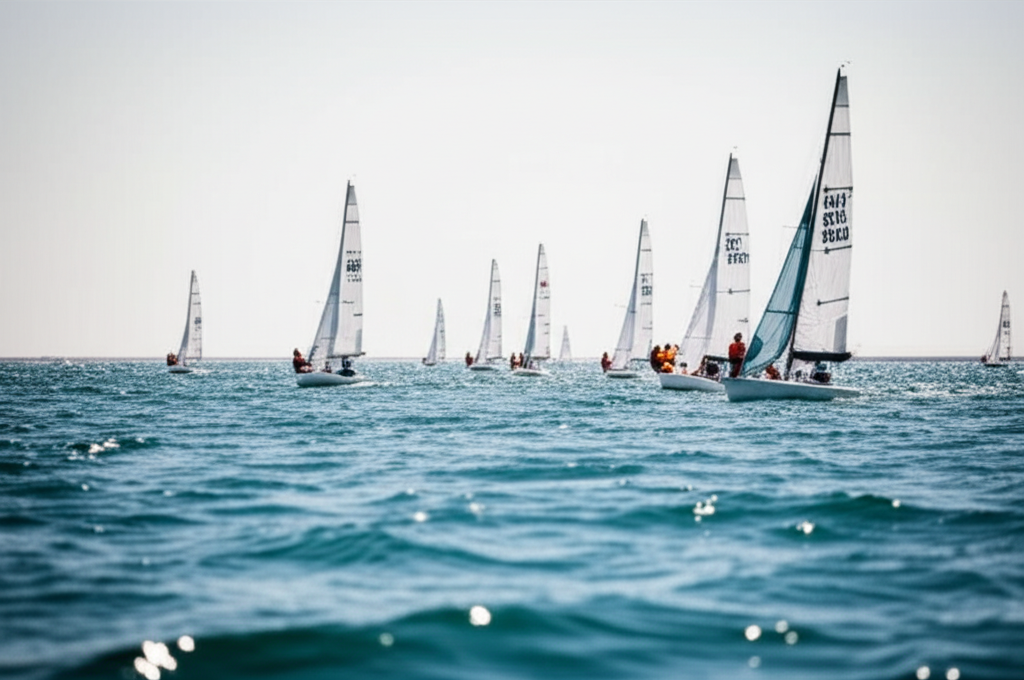
Sailing Skills Course
Why this course?
The Regatta Skills
course
Is designed to take your sailing skills to the next level, whether you’re an enthusiastic beginner or a seasoned racer. Learn the key tactics and strategies to optimize your performance in competition. Master boat setup, reading wind and tides, and decision-making under pressure. This program will provide you with the tools you need to improve your speed, accuracy, and consistency in every race.
Differentiating Advantages
- Interactive Race Simulations: Practice real-world scenarios and hone your sailing skills.
- Individual Performance Analysis: Receive personalized feedback to identify your areas for improvement.
- Optimized Starting and Tacking Strategies: Gain an advantage from the start and master crucial maneuvers.
- In-depth Knowledge of the Racing Rules: Sail with confidence and avoid penalties.
- Access to a Community of Sailors: Connect with other enthusiasts, share experiences, and learn from the best.
- Modality: Online
- Level: Cursos
- Hours: 150 H
- Start date: 26-07-2026
Availability: 1 in stock
Who is it aimed at?
- Sailors and skippers looking to optimize performance, tactics, and strategies in regattas of any level.
- Crew members wanting to perfect specific roles, onboard communication, and teamwork under pressure.
- Shipbuilding coaches and trainers interested in incorporating advanced methodologies for data analysis, meteorology, and risk management.
- Organizers of nautical events/sailing clubs looking to improve the safety, efficiency, and competitiveness of their regattas.
- Sailing enthusiasts wanting to transform their passion into competitive skills and gain a thorough understanding of the dynamics of the regattas.
Learning Flexibility
Adapted to your pace: 24/7 accessible online content, interactive discussion forums, and practical exercises to apply what you’ve learned on the water.
Objectives and competencies

Optimize speed under different wind and sea conditions:
“Anticipate the effects of wind and waves on course and speed, adjusting sails/engine and optimizing trim to maintain control and efficiency.”

Apply tactical strategies to outperform opponents in regattas:
“Optimize your starting position, take advantage of wind shifts, and manage the current with precise sail and rudder adjustments.”

Understanding and applying the racing rules to real-life situations:
“Identify infringements, determine the boat with right of way, and make tactical decisions based on the rules in complex regatta scenarios.”

Refine the vessel's maneuvers for precise and efficient execution:
Anticipate drift and leeway, considering currents, wind, and dynamic draft.

Mastering boat setup to maximize competitive performance:
Adjust sail tension, angle of attack, and carriage position to optimize power and reduce wind resistance according to weather conditions and heading.

Develop the ability to make quick and effective decisions under pressure in the regatta environment:
Prioritize the safety of the crew and the vessel, assessing risks and adapting the tactical strategy according to weather conditions and competition.
Curriculum - Modules
- Comprehensive Maritime Incident Management: protocols, roles, and chain of command for coordinated response
- Operational Planning and Execution: briefing, routes, weather windows, and go/no-go criteria
- Rapid Risk Assessment: criticality matrix, scene control, and decision-making under pressure
- Operational Communication: VHF/GMDSS, standardized reports, and inter-agency liaison
- Tactical Mobility and Safe Boarding: RHIB maneuvers, approach, mooring, and recovery
- Equipment and Technologies: PPE, signaling, satellite tracking, and field data logging
- Immediate Care of the Affected: primary assessment, hypothermia, trauma, and stabilization for evacuation
- Adverse Environmental Conditions: swell, Visibility, flows, and operational mitigation
Simulation and training: critical scenarios, use of VR/AR, and exercises with performance metrics
Documentation and continuous improvement: lessons learned, indicators (MTTA/MTTR), and SOP updates
- Introduction to Tactics and Strategy in Racing: Definitions and Scope
- Meteorology for Sailors: Interpreting Forecasts, True Wind vs. Apparent
Boat Setup: Sail Adjustment, Trim, and Weight Distribution
Regatta Course Analysis: Currents, Depth, Obstacles, and Local Winds
Pre-Start Strategy: Risk Assessment and Optimal Route Planning
Start Tactics: Positioning, Speed, and Space Control
Maneuvers: Tacks, Gybes, and Optimization Techniques
Windward Tactics: Cover, Priority, and Position Defense
Leeward Strategy: Course Selection, Distance Minimization, and Wave Utilization
- Post-Regatta Analysis: Performance Evaluation and Lessons Learned
‘
- Introduction to Racing: Formats, Rules, and Safety
- The Wind: Theory, Measurement, Local Effects, and Forecasting
- Onboard Instrumentation: Anemometer, Wind Vane, Compass, GPS, and Software
- Sail Trim: Genoa, Mainsail, Spinnaker/Gennaker, and Jibs
- Basic and Advanced Maneuvers: Tacking, Gybing, Hoisting, and Lowering
- Upwind Strategies: Laylines, Wind Shifts, Steps, and Current
- Leeward Tactics: Angles, Pressure, Position, and Cover
- Tides and Currents in Strategy: Calculations, Effects, and Exploitation
- Start and Finish: Positioning, Time, Penalties, and laylines
- Post-race analysis: data, performance, and continuous improvement
‘
- Introduction to regattas: types, formats, and basic rules.
- Basic meteorology for sailors: wind, pressure, temperature, humidity.
- Nautical instruments: anemometers, wind vanes, GPS, compasses, depth sounders.
- Analysis of the racecourse: currents, depths, obstacles.
- Starting strategies: timing, position, line control.
- Upwind tactics: laylines, tacks, protecting the favorable side.
- Downwind tactics: courses, jibes, spinnaker control.
- Crew management: roles, communication, coordination.
- Weather forecasting for regattas: interpretation of bulletins and models.
- Post-regatta analysis: performance evaluation, identification of areas for improvement.
‘
- Introduction to Meteorology: Basic Concepts and Their Impact on Regattas
- Wind: Formation, Types, Gradient, Local Effects (Coastal Breezes, Thermals)
- Clouds: Identification, Formation, and Relationship with Meteorological Systems
- Pressure Systems: Anticyclones, Lows, Fronts, Troughs, and Ridges
- Weather Forecasts: Sources, Interpretation (GRIB Files, Numerical Models)
- Regatta Strategy: Analysis of the Racecourse, Preferred Courses
- Real-Time Tactics: Decisions Based on Wind, Current, and Competitors’ Positions
- Instrumentation: Anemometers, Wind Vanes, GPS, Navigation Software
- Post-Regatta Analysis: Evaluation of the strategy and tactics employed
Regatta safety: preparation for adverse weather conditions
‘
- System Architecture and Components: Structural design, materials, and subsystems (mechanical, electrical, electronic, and fluid) with selection and assembly criteria for marine environments
- Fundamentals and Principles of Operation: Physical and engineering foundations (thermodynamics, fluid mechanics, electricity, control, and materials) that explain performance and operating limits
- Safety and Environmental (SHE): Risk analysis, PPE, LOTO, hazardous atmospheres, spill and waste management, and emergency response plans
- Applicable Regulations and Standards: IMO/ISO/IEC requirements and local regulations;
- Conformance criteria, certification, and best practices for operation and maintenance
- Inspection, testing, and diagnostics: Visual/dimensional inspection, functional testing, data analysis, and predictive techniques (vibration, thermography, fluid analysis) to identify root causes
- Preventive and predictive maintenance: Hourly/cycle/seasonal plans, lubrication, adjustments, calibrations, consumable replacement, post-service verification, and operational reliability
- Instrumentation, tools, and metrology: Measuring and testing equipment, diagnostic software, calibration and traceability; selection criteria, safe use, and storage
- Onboard integration and interfaces: Mechanical, electrical, fluid, and data compatibility; Sealing and watertightness, EMC/EMI, corrosion protection, and interoperability testing.
Quality, acceptance testing, and commissioning: process and materials control, FAT/SAT, bench and sea trials, go/no-go criteria, and evidence documentation.
Technical documentation and integrated practice: logs, checklists, reports, and a complete case study (safety → diagnosis → intervention → verification → report) applicable to any system.
Plan de estudio - Módulos
- Comprehensive Maritime Incident Management: protocols, roles, and chain of command for coordinated response
- Operational Planning and Execution: briefing, routes, weather windows, and go/no-go criteria
- Rapid Risk Assessment: criticality matrix, scene control, and decision-making under pressure
- Operational Communication: VHF/GMDSS, standardized reports, and inter-agency liaison
- Tactical Mobility and Safe Boarding: RHIB maneuvers, approach, mooring, and recovery
- Equipment and Technologies: PPE, signaling, satellite tracking, and field data logging
- Immediate Care of the Affected: primary assessment, hypothermia, trauma, and stabilization for evacuation
- Adverse Environmental Conditions: swell, Visibility, flows, and operational mitigation
Simulation and training: critical scenarios, use of VR/AR, and exercises with performance metrics
Documentation and continuous improvement: lessons learned, indicators (MTTA/MTTR), and SOP updates
- Introduction to Tactics and Strategy in Racing: Definitions and Scope
- Meteorology for Sailors: Interpreting Forecasts, True Wind vs. Apparent
Boat Setup: Sail Adjustment, Trim, and Weight Distribution
Regatta Course Analysis: Currents, Depth, Obstacles, and Local Winds
Pre-Start Strategy: Risk Assessment and Optimal Route Planning
Start Tactics: Positioning, Speed, and Space Control
Maneuvers: Tacks, Gybes, and Optimization Techniques
Windward Tactics: Cover, Priority, and Position Defense
Leeward Strategy: Course Selection, Distance Minimization, and Wave Utilization
- Post-Regatta Analysis: Performance Evaluation and Lessons Learned
‘
- Introduction to Racing: Formats, Rules, and Safety
- The Wind: Theory, Measurement, Local Effects, and Forecasting
- Onboard Instrumentation: Anemometer, Wind Vane, Compass, GPS, and Software
- Sail Trim: Genoa, Mainsail, Spinnaker/Gennaker, and Jibs
- Basic and Advanced Maneuvers: Tacking, Gybing, Hoisting, and Lowering
- Upwind Strategies: Laylines, Wind Shifts, Steps, and Current
- Leeward Tactics: Angles, Pressure, Position, and Cover
- Tides and Currents in Strategy: Calculations, Effects, and Exploitation
- Start and Finish: Positioning, Time, Penalties, and laylines
- Post-race analysis: data, performance, and continuous improvement
‘
- Introduction to regattas: types, formats, and basic rules.
- Basic meteorology for sailors: wind, pressure, temperature, humidity.
- Nautical instruments: anemometers, wind vanes, GPS, compasses, depth sounders.
- Analysis of the racecourse: currents, depths, obstacles.
- Starting strategies: timing, position, line control.
- Upwind tactics: laylines, tacks, protecting the favorable side.
- Downwind tactics: courses, jibes, spinnaker control.
- Crew management: roles, communication, coordination.
- Weather forecasting for regattas: interpretation of bulletins and models.
- Post-regatta analysis: performance evaluation, identification of areas for improvement.
‘
- Introduction to Meteorology: Basic Concepts and Their Impact on Regattas
- Wind: Formation, Types, Gradient, Local Effects (Coastal Breezes, Thermals)
- Clouds: Identification, Formation, and Relationship with Meteorological Systems
- Pressure Systems: Anticyclones, Lows, Fronts, Troughs, and Ridges
- Weather Forecasts: Sources, Interpretation (GRIB Files, Numerical Models)
- Regatta Strategy: Analysis of the Racecourse, Preferred Courses
- Real-Time Tactics: Decisions Based on Wind, Current, and Competitors’ Positions
- Instrumentation: Anemometers, Wind Vanes, GPS, Navigation Software
- Post-Regatta Analysis: Evaluation of the strategy and tactics employed
Regatta safety: preparation for adverse weather conditions
‘
- System Architecture and Components: Structural design, materials, and subsystems (mechanical, electrical, electronic, and fluid) with selection and assembly criteria for marine environments
- Fundamentals and Principles of Operation: Physical and engineering foundations (thermodynamics, fluid mechanics, electricity, control, and materials) that explain performance and operating limits
- Safety and Environmental (SHE): Risk analysis, PPE, LOTO, hazardous atmospheres, spill and waste management, and emergency response plans
- Applicable Regulations and Standards: IMO/ISO/IEC requirements and local regulations;
- Conformance criteria, certification, and best practices for operation and maintenance
- Inspection, testing, and diagnostics: Visual/dimensional inspection, functional testing, data analysis, and predictive techniques (vibration, thermography, fluid analysis) to identify root causes
- Preventive and predictive maintenance: Hourly/cycle/seasonal plans, lubrication, adjustments, calibrations, consumable replacement, post-service verification, and operational reliability
- Instrumentation, tools, and metrology: Measuring and testing equipment, diagnostic software, calibration and traceability; selection criteria, safe use, and storage
- Onboard integration and interfaces: Mechanical, electrical, fluid, and data compatibility; Sealing and watertightness, EMC/EMI, corrosion protection, and interoperability testing.
Quality, acceptance testing, and commissioning: process and materials control, FAT/SAT, bench and sea trials, go/no-go criteria, and evidence documentation.
Technical documentation and integrated practice: logs, checklists, reports, and a complete case study (safety → diagnosis → intervention → verification → report) applicable to any system.
- Introduction to Tactics and Strategy: Definitions and Key Concepts
- Environmental Analysis: Identifying Opportunities and Threats
- Goal Setting: SMART and Strategic Alignment
- Strategy Development: Models and Frameworks (e.g., SWOT, PESTEL)
- Tactical Planning Techniques: Scheduling, Budgeting, and Resource Allocation
- Strategic Implementation: Change Management and Communication
- Strategic Leadership: Inspiration, Motivation, and Decision Making
- Performance Measurement: KPIs, Balanced Scorecard Scorecard and Results Analysis
Adaptation and Continuous Improvement: PDCA Cycle and Risk Management
Case Studies: Analysis of Strategic Successes and Failures
‘
- Introduction to Regatta: formats, roles on board, safety.
- Nautical terminology specific to racing sails.
- Basic maneuvers: tacking, gybing, raising and lowering sails.
- Sail trim: adjusting the mainsail and jib according to the wind (angle and strength).
- Adjusting halyards, sheets, backstays, and tailstays: their function and importance.
- Upwind tactics: laylines, wind shift, cover, and positioning.
- Downwind tactics: optimal angle, gybing, monitoring the competition.
- Starts: strategy, timing route, line control.
- Use of the spinnaker/gennaker: hoisting, trimming, jibing and lowering.
- Racing rules: basic concepts and penalties.
‘
- Fundamentals of Regatta Tactics: Key Concepts and Priorities
- Short-Term Strategy: Racecourse Analysis and Tactical Options
- Basic Meteorology for Sailors: True Wind vs. Apparent wind, gradient, stability
- Interpretation of weather reports: sources of information and reliability
- Local effects of wind: land, sea, obstacles and their influence on tactics
- Starting strategy: position, timing, risk and reward
- Upwind tactics: laylines, roles, protection and attack
- Downwind tactics: wind angles, planing, strategic options
- Fleet management: competitive analysis and decision-making
- Adapting tactics and strategy to changing weather conditions
‘
- Introduction to nautical meteorology: scales, variables, and sources of information.
- Wind: formation, gradient, geostrophic, thermal, local effects (breezes, land breezes).
- Clouds: classification, formation, weather indicators, and atmospheric stability.
- Pressure systems: high and low pressure systems, fronts, cyclones, anticyclones.
- Weather forecasting: numerical models, interpretation of maps and bulletins.
- Onboard meteorological instrumentation: anemometer, barometer, wind vane, thermometer.
- Meteorological tactics in regattas: analysis of the racecourse, areas of favorable wind.
- Short- and long-term strategy: course optimization, Fleet positioning.
- Weather risks: storms, fog, strong winds, large waves.
- Adaptation to changing conditions: decision-making and strategic flexibility.
‘
Career opportunities
- Professional Racing Crew Member: Optimizing boat performance, sail handling, tactics, and strategy.
- Racing Skipper: Team leadership, strategic decision-making, and boat and crew management.
- Racing Team Coach: Designing training programs, performance analysis, and developing individual and team skills.
- Racing Officer: Organizing and managing regatta events, enforcing the rules of the race, and officiating.
- Sail/Boat Designer: Applying technical knowledge to improve racing performance.
- Regatta Technical Consultant: Advising on the optimization of boats, sails, and racing tactics.
- Specialized Journalist
- Regatta Project Manager: Planning and execution of projects related to regatta participation.
“`
Admission requirements

Academic/professional profile:
Degree/Bachelor's degree in Nautical Science/Maritime Transport, Naval/Marine Engineering, or a related field; or proven professional experience in bridge/operations.

Language proficiency:
Recommended functional maritime English (SMCP) for simulations and technical materials.

5. Induction
Updated resume, copy of degree or seaman's book, ID card/passport, letter of motivation.

Technical requirements (for online):
Equipment with camera/microphone, stable connection, ≥ 24” monitor recommended for ECDIS/Radar-ARPA.
Admission process and dates

1. Online
application
(form + documents).

2. Academic review and interview
(profile/objectives/schedule compatibility).

3. Admission decision
(+ scholarship proposal if applicable).

4. Reservation of place
(deposit) and registration.

5. Induction
(access to campus, calendars, simulator guides).
Scholarships and grants
- Sailing Fundamentals: Learn the key principles to optimize your racing performance.
- Tactics and Strategy: Master the techniques to make smart decisions on the water and outperform your opponents.
- Meteorology for Sailors: Interpret weather conditions and adjust your strategy to make the most of the wind.
- Advanced Maneuvers: Hone your sailing skills to execute quick and efficient maneuvers.
- Physical and Mental Preparation: Discover how to optimize your physical and mental condition to meet the challenges of competition.
Testimonials
“After intense training focused on strategy and technique, I achieved first place in the regional regatta, surpassing very experienced competitors. My precision in the maneuvers and efficient communication with my team were key to achieving victory.”
Mastering advanced kitesurfing techniques in the Advanced Water Sports course exceeded my expectations. I was able to perform maneuvers like the kiteloop and backroll with control and safety, allowing me to fully enjoy the power of the wind and waves. The expert instruction and practical approach of the course were key to my progress.
I achieved first place in the regional regatta, surpassing my personal speed record and executing an impeccable sailing strategy that allowed me to outpace my competitors even in changing wind conditions.
“I achieved first place in the regional regatta, beating competitors with much more experience. My starting strategy and wind management during the race were key to the victory.”

Frequently asked questions
To be the first to cross the finish line.
Yes. The itinerary includes ECDIS/Radar-ARPA/BRM with harbor, ocean, fog, storm, and SAR scenarios.
Online with live sessions; hybrid option for simulator/practical placements through agreements.
The performance of the vessels and the skills of the crews in navigating a predefined course as quickly as possible.
Recommended functional SMCP. We offer support materials for standard phraseology.
Yes, with a relevant degree or experience in maritime/port operations. The admissions interview will confirm suitability.
Optional (3–6 months) through Companies & Collaborations and the Alumni Network.
Simulator practice (rubrics), defeat plans, SOPs, checklists, micro-tests and applied TFM.
A degree from Navalis Magna University + operational portfolio (tracks, SOPs, reports and KPIs) useful for audits and employment.
- Introduction to nautical meteorology: scales, variables, and sources of information.
- Wind: formation, gradient, geostrophic, thermal, local effects (breezes, land breezes).
- Clouds: classification, formation, weather indicators, and atmospheric stability.
- Pressure systems: high and low pressure systems, fronts, cyclones, anticyclones.
- Weather forecasting: numerical models, interpretation of maps and bulletins.
- Onboard meteorological instrumentation: anemometer, barometer, wind vane, thermometer.
- Meteorological tactics in regattas: analysis of the racecourse, areas of favorable wind.
- Short- and long-term strategy: course optimization, Fleet positioning.
- Weather risks: storms, fog, strong winds, large waves.
- Adaptation to changing conditions: decision-making and strategic flexibility.
‘
Request information
- Complete the Application Form
- Attach your CV/Qualifications (if you have them to hand).
- Indicate your preferred cohort (January/May/September) and whether you want the hybrid option with simulator sessions.
Teachers
Eng. Tomás Riera
Full Professor
Eng. Tomás Riera
Full Professor
Eng. Sofía Marquina
Full Professor
Eng. Sofía Marquina
Full Professor
Eng. Javier Bañuls
Full Professor
Eng. Javier Bañuls
Full Professor
Dr. Nuria Llobregat
Full Professor
Dr. Nuria Llobregat
Full Professor
Dr. Pau Ferrer
Full Professor
Dr. Pau Ferrer
Full Professor
Cap. Javier Abaroa (MCA)
Full Professor
Cap. Javier Abaroa (MCA)
Full Professor

