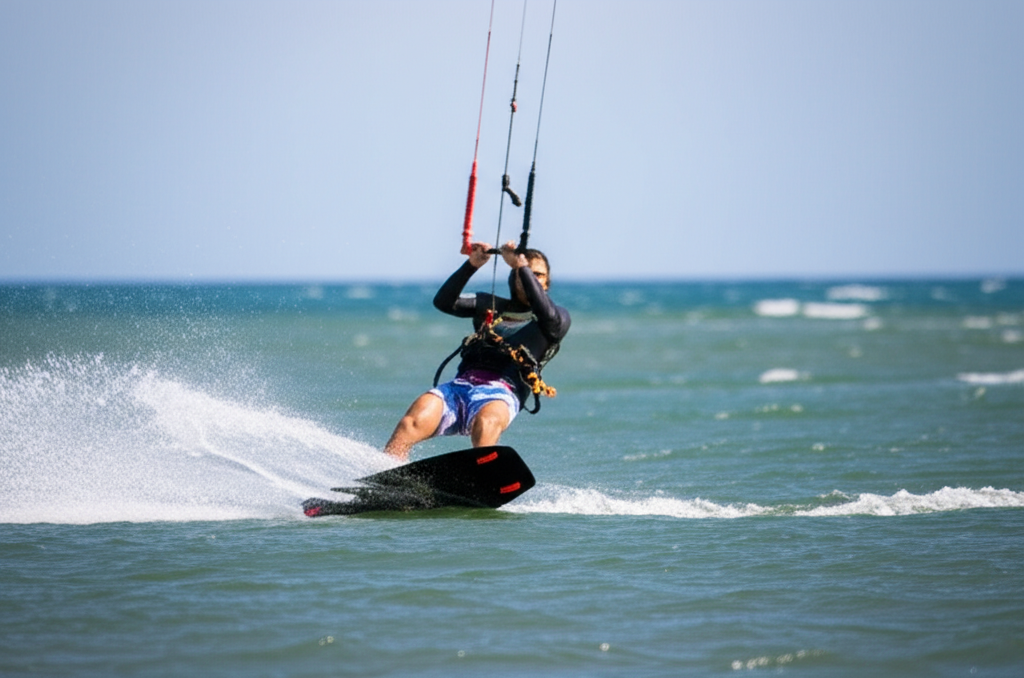
Kitesurfing course and safe maneuvers

Why this course?

Learn Kitesurfing and Safe Maneuvers

Enjoy the sea with confidence and control. This intensive course will guide you from the fundamentals to advanced techniques, prioritizing safety at every stage. Master kite control, body dragging, water starts, and basic maneuvers with a solid foundation in regulations, meteorology, and risk assessment. Become an independent and responsible kitesurfer!

Enjoy the sea with confidence and control.

Differentiating Advantages

  • Certified Instructors: extensive experience and passion for teaching kitesurfing.
  • Modern and Safe Equipment: state-of-the-art kites, boards, and harnesses.
  • Personalized Approach: small groups for individualized attention.
  • Practice in Safe Environments: beaches with ideal learning conditions.
  • Certification Upon Completion: validates your knowledge and skills as a kitesurfer.
Curso

Kitesurfing course and safe maneuvers

Availability: 1 in stock

Who is it aimed at?

  • Beginners who want to learn the basics of kitesurfing in a safe and controlled way, understanding the wind, equipment, and initial techniques.
  • Intermediate kitesurfers who are looking to refine their technique, learn new maneuvers, and increase their confidence on the water.
  • Kitesurfing instructors in training who need a in-depth understanding of safety principles and best teaching practices.
  • Experienced watersports enthusiasts who want to discover kitesurfing and enjoy the adrenaline rush of gliding across the water.
  • Adventurous travelers who want to incorporate kitesurfing into their holidays and explore new destinations from a unique perspective Unique.

Adaptability and Progress
Flexible course: personalized pace, supervised practice, and expert guidance to maximize your learning and enjoyment.

Curso

Objectives and competencies

Mastering kite control in various conditions:

“Adapt the flight technique to the intensity and direction of the wind, waves and currents, maximizing efficiency and safety.”

Perform controlled transitions and turns:

“Anticipate inertia, wind, and currents, using propellers and rudder with precision.”

Perform effective self-rescues in emergency situations:

Assess the situation, communicate the emergency, activate safety teams and apply personal survival techniques adapted to the maritime environment.

Understand and apply water safety and priority rules:

Interpreting visual and acoustic signals, acting proactively in risky situations and effectively communicating intentions to other vessels.

Perfecting assisted and unassisted takeoff and landing:

Anticipate adverse weather conditions and adapt the maneuver to ensure the safety of the vessel and crew.

Increase the height and duration of basic jumps:

“Develop explosive power, jumping technique and proprioception through plyometric exercises, specific strength training and balance/stability practices.”

Curriculum - Modules

  1. Comprehensive Maritime Incident Management: protocols, roles, and chain of command for coordinated response
  2. Operational Planning and Execution: briefing, routes, weather windows, and go/no-go criteria
  3. Rapid Risk Assessment: criticality matrix, scene control, and decision-making under pressure
  4. Operational Communication: VHF/GMDSS, standardized reports, and inter-agency liaison
  5. Tactical Mobility and Safe Boarding: RHIB maneuvers, approach, mooring, and recovery
  6. Equipment and Technologies: PPE, signaling, satellite tracking, and field data logging
  7. Immediate Care of the Affected: primary assessment, hypothermia, trauma, and stabilization for evacuation
  8. Adverse Environmental Conditions: swell, Visibility, flows, and operational mitigation

    Simulation and training: critical scenarios, use of VR/AR, and exercises with performance metrics

    Documentation and continuous improvement: lessons learned, indicators (MTTA/MTTR), and SOP updates

  1. Introduction to Kitesurfing: History, evolution, and disciplines.
  2. Basic Terminology: Equipment components (kite, board, lines, bar, harness).
  3. Wind Theory: Wind window, direction and intensity, local effects.
  4. Safety in Kitesurfing: Kite safety systems (chicken loop, leash, fifth line).
  5. Spot Assessment: Weather conditions, tides, currents, obstacles, and hazards.
  6. Equipment Setup and Check: Kite inflation, line connections, harness adjustment.
  7. Land Practices: Kite control in the wind window, assisted launch and landing.
  8. First Steps in the Water: Body Dragging, board retrieval, kite relaunch.
  9. Rules of precedence and courtesy: Safe riding and respect for other users.
  10. Environmental considerations: Impact of kitesurfing on the marine ecosystem and best practices.

  1. Introduction to Kitesurfing: History, Evolution, and Disciplines
  2. Basic Meteorology for Kitesurfing: Wind, Pressure, Temperature, and Frontal Systems
  3. Kitesurfing Equipment: Types of Kites, Boards, Harnesses, and Lines
  4. Active Safety: Safety Systems, Pre-Flight Check, and Communication
  5. Take-off and Landing Techniques: Assisted and Self-Rescue
  6. Kite Control: Wind Window, Power, and Upwind/Broadway … Avoid collisions and respect other users.
  7. Kitesurfer Ethics: Respect for the environment and the local community

  1. Introduction to Kitesurfing: History, evolution, and different disciplines.
  2. Kitesurfing Equipment: Types of kites, bars, lines, boards, harnesses, and accessories.
  3. Safety in Kitesurfing: Safety systems, operation, and correct use.
  4. Weather Conditions: Wind (direction, intensity, gusts), tides, waves, and their influence.
  5. Spot Assessment: Identifying hazards, safe launch and landing zones, and obstacles.
  6. Equipment Setup and Preparation: Inflation, connecting lines, pre-flight check, and safety check.
  7. First Steps on Land: Kite control in the wind window, pulling exercises.
  8. Body Drag: Dragging the kite through the water, upwind riding, and board recovery.
  9. Water Start: Techniques for standing up and starting to ride the board.
  10. Rules of Priority and Etiquette: Priority on the water, respect for other users and the environment.

  1. Meteorology for Kitesurfing: interpreting forecasts, local winds, and frontal systems.
  2. Basic kite aerodynamics: coefficients, lift, and drag.
  3. Wind Window: understanding, power zones, and safety.
  4. Self-rescue techniques: quick release, line winding, and swimming with equipment.
  5. Right-of-way on the water: navigation rules for kitesurfers.
  6. Basic maritime signaling and buoy recognition.
  7. Environmental hazards: currents, tides, and dangerous marine life.
  8. Choosing the right equipment based on conditions and skill level: kites, boards, harnesses, and lines.
  9. Communication on the water: signals Manuals, use of radios (optional).
  10. Basic first aid for common kitesurfing injuries.

  1. System Architecture and Components: Structural design, materials, and subsystems (mechanical, electrical, electronic, and fluid) with selection and assembly criteria for marine environments
  2. Fundamentals and Principles of Operation: Physical and engineering foundations (thermodynamics, fluid mechanics, electricity, control, and materials) that explain performance and operating limits
  3. Safety and Environmental (SHE): Risk analysis, PPE, LOTO, hazardous atmospheres, spill and waste management, and emergency response plans
  4. Applicable Regulations and Standards: IMO/ISO/IEC requirements and local regulations;
  5. Conformance criteria, certification, and best practices for operation and maintenance
  6. Inspection, testing, and diagnostics: Visual/dimensional inspection, functional testing, data analysis, and predictive techniques (vibration, thermography, fluid analysis) to identify root causes
  7. Preventive and predictive maintenance: Hourly/cycle/seasonal plans, lubrication, adjustments, calibrations, consumable replacement, post-service verification, and operational reliability
  8. Instrumentation, tools, and metrology: Measuring and testing equipment, diagnostic software, calibration and traceability; selection criteria, safe use, and storage
  9. Onboard integration and interfaces: Mechanical, electrical, fluid, and data compatibility; Sealing and watertightness, EMC/EMI, corrosion protection, and interoperability testing.

    Quality, acceptance testing, and commissioning: process and materials control, FAT/SAT, bench and sea trials, go/no-go criteria, and evidence documentation.

    Technical documentation and integrated practice: logs, checklists, reports, and a complete case study (safety → diagnosis → intervention → verification → report) applicable to any system.

Plan de estudio - Módulos

  1. Comprehensive Maritime Incident Management: protocols, roles, and chain of command for coordinated response
  2. Operational Planning and Execution: briefing, routes, weather windows, and go/no-go criteria
  3. Rapid Risk Assessment: criticality matrix, scene control, and decision-making under pressure
  4. Operational Communication: VHF/GMDSS, standardized reports, and inter-agency liaison
  5. Tactical Mobility and Safe Boarding: RHIB maneuvers, approach, mooring, and recovery
  6. Equipment and Technologies: PPE, signaling, satellite tracking, and field data logging
  7. Immediate Care of the Affected: primary assessment, hypothermia, trauma, and stabilization for evacuation
  8. Adverse Environmental Conditions: swell, Visibility, flows, and operational mitigation

    Simulation and training: critical scenarios, use of VR/AR, and exercises with performance metrics

    Documentation and continuous improvement: lessons learned, indicators (MTTA/MTTR), and SOP updates

  1. Introduction to Kitesurfing: History, evolution, and disciplines.
  2. Basic Terminology: Equipment components (kite, board, lines, bar, harness).
  3. Wind Theory: Wind window, direction and intensity, local effects.
  4. Safety in Kitesurfing: Kite safety systems (chicken loop, leash, fifth line).
  5. Spot Assessment: Weather conditions, tides, currents, obstacles, and hazards.
  6. Equipment Setup and Check: Kite inflation, line connections, harness adjustment.
  7. Land Practices: Kite control in the wind window, assisted launch and landing.
  8. First Steps in the Water: Body Dragging, board retrieval, kite relaunch.
  9. Rules of precedence and courtesy: Safe riding and respect for other users.
  10. Environmental considerations: Impact of kitesurfing on the marine ecosystem and best practices.

  1. Introduction to Kitesurfing: History, Evolution, and Disciplines
  2. Basic Meteorology for Kitesurfing: Wind, Pressure, Temperature, and Frontal Systems
  3. Kitesurfing Equipment: Types of Kites, Boards, Harnesses, and Lines
  4. Active Safety: Safety Systems, Pre-Flight Check, and Communication
  5. Take-off and Landing Techniques: Assisted and Self-Rescue
  6. Kite Control: Wind Window, Power, and Upwind/Broadway … Avoid collisions and respect other users.
  7. Kitesurfer Ethics: Respect for the environment and the local community

  1. Introduction to Kitesurfing: History, evolution, and different disciplines.
  2. Kitesurfing Equipment: Types of kites, bars, lines, boards, harnesses, and accessories.
  3. Safety in Kitesurfing: Safety systems, operation, and correct use.
  4. Weather Conditions: Wind (direction, intensity, gusts), tides, waves, and their influence.
  5. Spot Assessment: Identifying hazards, safe launch and landing zones, and obstacles.
  6. Equipment Setup and Preparation: Inflation, connecting lines, pre-flight check, and safety check.
  7. First Steps on Land: Kite control in the wind window, pulling exercises.
  8. Body Drag: Dragging the kite through the water, upwind riding, and board recovery.
  9. Water Start: Techniques for standing up and starting to ride the board.
  10. Rules of Priority and Etiquette: Priority on the water, respect for other users and the environment.

  1. Meteorology for Kitesurfing: interpreting forecasts, local winds, and frontal systems.
  2. Basic kite aerodynamics: coefficients, lift, and drag.
  3. Wind Window: understanding, power zones, and safety.
  4. Self-rescue techniques: quick release, line winding, and swimming with equipment.
  5. Right-of-way on the water: navigation rules for kitesurfers.
  6. Basic maritime signaling and buoy recognition.
  7. Environmental hazards: currents, tides, and dangerous marine life.
  8. Choosing the right equipment based on conditions and skill level: kites, boards, harnesses, and lines.
  9. Communication on the water: signals Manuals, use of radios (optional).
  10. Basic first aid for common kitesurfing injuries.

  1. System Architecture and Components: Structural design, materials, and subsystems (mechanical, electrical, electronic, and fluid) with selection and assembly criteria for marine environments
  2. Fundamentals and Principles of Operation: Physical and engineering foundations (thermodynamics, fluid mechanics, electricity, control, and materials) that explain performance and operating limits
  3. Safety and Environmental (SHE): Risk analysis, PPE, LOTO, hazardous atmospheres, spill and waste management, and emergency response plans
  4. Applicable Regulations and Standards: IMO/ISO/IEC requirements and local regulations;
  5. Conformance criteria, certification, and best practices for operation and maintenance
  6. Inspection, testing, and diagnostics: Visual/dimensional inspection, functional testing, data analysis, and predictive techniques (vibration, thermography, fluid analysis) to identify root causes
  7. Preventive and predictive maintenance: Hourly/cycle/seasonal plans, lubrication, adjustments, calibrations, consumable replacement, post-service verification, and operational reliability
  8. Instrumentation, tools, and metrology: Measuring and testing equipment, diagnostic software, calibration and traceability; selection criteria, safe use, and storage
  9. Onboard integration and interfaces: Mechanical, electrical, fluid, and data compatibility; Sealing and watertightness, EMC/EMI, corrosion protection, and interoperability testing.

    Quality, acceptance testing, and commissioning: process and materials control, FAT/SAT, bench and sea trials, go/no-go criteria, and evidence documentation.

    Technical documentation and integrated practice: logs, checklists, reports, and a complete case study (safety → diagnosis → intervention → verification → report) applicable to any system.

  1. Introduction to Kitesurfing: History, evolution, and styles.
  2. Basic Terminology: Equipment components (kite, board, lines, bar), winds, and riding areas.
  3. Fundamental Meteorology: Wind (direction, intensity, gusts), pressure systems, forecast interpretation.
  4. Safety in Kitesurfing: Safety systems (leash, quick release), risk assessment, and safe zones.
  5. Equipment Setup and Preparation: Kite inflation, line connection, bar adjustment.
  6. Launch and Landing Techniques: Assisted and self-launches, controlled landings.
  7. Kite Control on Land: Handling exercises, wind windows, ground safety.
  8. First steps in the water: Body Drag (surfing while being towed by the kite), board recovery.
  9. Relaunching the kite in the water: Techniques and solutions to common problems.
  10. Priorities and rules of navigation: Right of way, respect for other users, safe riding.

  1. Introduction to Kitesurfing: History, styles, and equipment components.
  2. Safety in Kitesurfing: Risk assessment, weather, and safe spots.
  3. Equipment Knowledge: Types of kites, bars, lines, and boards. Basic Maintenance.
  4. Equipment Setup and Takedown: Safe procedures and pre-flight check.
  5. Wind Theory: Wind windows, directions, and effects of wind on the kite.
  6. First Flights: Practice on land, kite control, and safety drills.
  7. Body Dragging: Dragging in the water, board recovery, and basic navigation.
  8. Kite Relaunching: Relaunching techniques from the water in different conditions.
  9. First Glides: Introduction to navigation, correct posture, and speed control.
  10. Water Safety and Right-of-Way Rules: Communication with other kitesurfers and beachgoers.

  1. Introduction to Kitesurfing: History, evolution, and different disciplines.
  2. Kitesurfing Equipment: Types of kites, boards, harnesses, lines, and safety systems.
  3. Meteorology for Kitesurfing: Wind, clouds, atmospheric pressure, and weather forecasting.
  4. Safety in Kitesurfing: Safe zones, risks, signage, and communication.
  5. Launch and Landing Techniques: Assisted and self-rescue.
  6. Kite Control: Wind window, key positions, and power management.
  7. Basic Navigation: Heading, upwind, across the wind, and downwind.
  8. First Steps on the Board: Water start, stance, balance, and Direction control.
  9. Technical progression: Basic jumps, transitions, and elementary maneuvers.
  10. Responsibility and ethics in kitesurfing: Respect for the environment and other users.

  1. Introduction to Kitesurfing: History, Evolution, and Styles
  2. Basic Meteorology: Wind, Pressure, Gradients, Frontal Systems, and Their Influence on Kitesurfing
  3. Kitesurfing Equipment: Types of Kites, Bars, Lines, Boards, Harnesses, Vests, and Helmets. Maintenance and Care
  4. Kitesurfing Safety: safety systems (quick release), lifelines, self-rescue, and assisted rescue
  5. Rules of Navigation and Priority: understanding the rules to avoid collisions on the water
  6. Equipment Setup and Preparation: inflating the kite, connecting lines, adjusting the harness
  7. Kite Control Techniques on Land: warm-up exercises and familiarizing yourself with the kite
  8. Assisted Launch and Landing: safe procedure and communication with the assistant
  9. First Flights on the Water: upwind and downwind body dragging
  10. Kite Relaunching Theory from the Water: techniques and troubleshooting

Career opportunities

  • Kitesurfing Instructor: In kitesurfing schools, sports clubs, or independently.
  • Kitesurfing Monitor: Assisting instructors and guiding beginners in practice.
  • Kitesurfing Guide: Taking groups to kitesurfing spots, ensuring their safety and enjoyment.
  • Kitesurfing Equipment Repair Technician: Repairing and maintaining kites, boards, and other equipment.
  • Kitesurfing Event Organizer: Coordinating competitions, festivals, and other kitesurfing-related events.
  • Kitesurfing Digital Content Creator: Producing videos, photos, and articles for online platforms.
  • Kitesurfing Shop Assistant: Advising customers on equipment, offering rental and sales services.
  • Aquatic Rescuer (Kitesurfing): As part of rescue teams on beaches and kitesurfing areas.

“`

Admission requirements

Academic/professional profile:

Degree/Bachelor's degree in Nautical Science/Maritime Transport, Naval/Marine Engineering, or a related field; or proven professional experience in bridge/operations.

Language proficiency:

Recommended functional maritime English (SMCP) for simulations and technical materials.

5. Induction

Updated resume, copy of degree or seaman's book, ID card/passport, letter of motivation.

Technical requirements (for online):

Equipment with camera/microphone, stable connection, ≥ 24” monitor recommended for ECDIS/Radar-ARPA.

Admission process and dates

1. Online
application

(form + documents).

2. Academic review and interview

(profile/objectives/schedule compatibility).

3. Admission decision

(+ scholarship proposal if applicable).

4. Reservation of place

(deposit) and registration.

5. Induction

(access to campus, calendars, simulator guides).

Scholarships and grants

  • Master Kitesurfing: Learn the basics and advanced techniques for total control on the water.
  • Safe Maneuvers: Execute tricks and jumps with confidence, minimizing risks and maximizing fun.
  • Equipment and Safety: Get to know your equipment thoroughly and the best practices for riding safely in any condition.
  • Personalized Progression: We adapt the training to your level, from beginner to expert, so you can reach your goals.
  • Certified Instructors: Learn from experienced professionals who will guide you every step of the way.
Take your kitesurfing to the next level and enjoy the adrenaline rush with complete safety!

Testimonials

Frequently asked questions

Yes. The itinerary includes ECDIS/Radar-ARPA/BRM with harbor, ocean, fog, storm, and SAR scenarios.

Online with live sessions; hybrid option for simulator/practical placements through agreements.

Recommended functional SMCP. We offer support materials for standard phraseology.

Yes, with a relevant degree or experience in maritime/port operations. The admissions interview will confirm suitability.

Optional (3–6 months) through Companies & Collaborations and the Alumni Network.

Simulator practice (rubrics), defeat plans, SOPs, checklists, micro-tests and applied TFM.

A degree from Navalis Magna University + operational portfolio (tracks, SOPs, reports and KPIs) useful for audits and employment.

  1. Introduction to Kitesurfing: History, Evolution, and Styles
  2. Basic Meteorology: Wind, Pressure, Gradients, Frontal Systems, and Their Influence on Kitesurfing
  3. Kitesurfing Equipment: Types of Kites, Bars, Lines, Boards, Harnesses, Vests, and Helmets. Maintenance and Care
  4. Kitesurfing Safety: safety systems (quick release), lifelines, self-rescue, and assisted rescue
  5. Rules of Navigation and Priority: understanding the rules to avoid collisions on the water
  6. Equipment Setup and Preparation: inflating the kite, connecting lines, adjusting the harness
  7. Kite Control Techniques on Land: warm-up exercises and familiarizing yourself with the kite
  8. Assisted Launch and Landing: safe procedure and communication with the assistant
  9. First Flights on the Water: upwind and downwind body dragging
  10. Kite Relaunching Theory from the Water: techniques and troubleshooting

Request information

  1. Complete the Application Form
  2. Attach your CV/Qualifications (if you have them to hand).
  3. Indicate your preferred cohort (January/May/September) and whether you want the hybrid option with simulator sessions.
An academic advisor will contact you within 24–48 hours to guide you through the admission process, scholarships, and compatibility with your professional schedule. Translated with DeepL.com (free version)
Please enable JavaScript in your browser to complete this form.
Click or drag a file to this area to upload.

Teachers

0
    0
    Tu carrito
    Tu carrito esta vacíoRegresar a la tienda
    Scroll to Top


