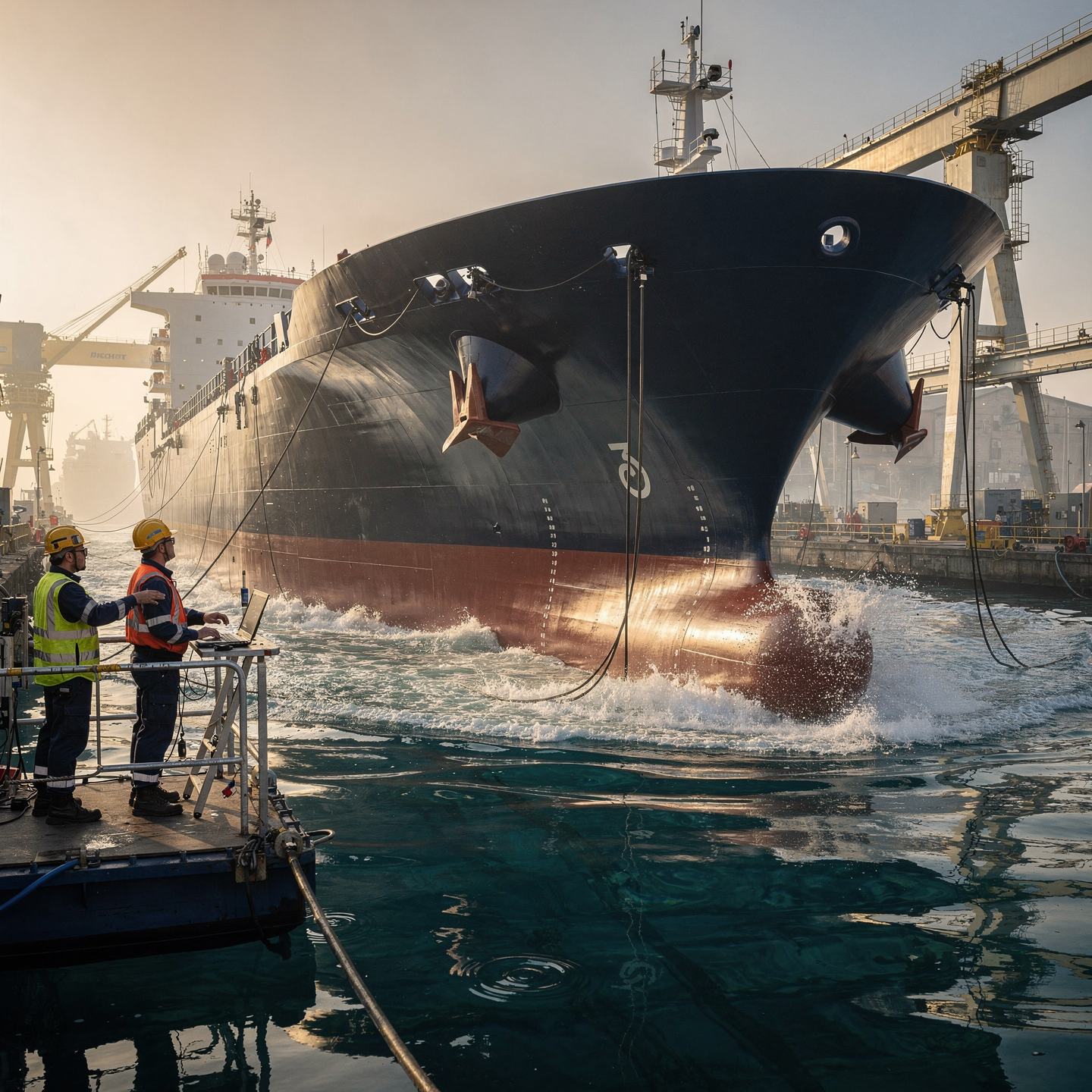
Diploma in Fluid Dynamics Applied to Ships
Why this certificate program?
The Diploma in Fluid Dynamics Applied to Ships
This program will provide you with the essential tools to understand and optimize the hydrodynamic behavior of vessels. You will learn everything from theoretical foundations to practical applications in design, performance, and efficiency. This intensive program is designed for naval engineers, naval architects, and maritime professionals seeking to specialize in fluid analysis and modeling.
Differential Advantages
- CFD Modeling: Master the use of simulation software to predict fluid behavior around the hull.
- Design Optimization: Learn to reduce drag and improve propulsive efficiency through advanced analysis.
- Stability and Maneuverability: Delve into fluid dynamics related to stability under different navigation conditions.
- Practical Applications: Real-world case studies and applied projects to consolidate learning and develop practical skills.
- Expert Instructors: Professionals with extensive experience in the naval industry and fluid dynamics research.
- Modality: Online
- Level: Diplomado
- Hours: 800 H
- Start date: 13-06-2026
Availability: 1 in stock
Who is it aimed at?
- Naval engineers and naval architects seeking to deepen their knowledge of the hydrodynamic design and optimization of vessels.
- Maritime industry professionals interested in energy efficiency and reducing ship emissions.
- Researchers and academics wishing to strengthen their knowledge of modeling and simulation of flows around ships.
- Engineering and related science students seeking specialization in fluid dynamics applied to naval design.
- Consultants and technical advisors needing advanced tools for analysis and problem-solving in the maritime sector.
Flexibility and applicability Adapted to your pace: online content available 24/7, practical cases for immediate application and personalized tutoring to answer your questions.
Objectives and competencies

Optimize hydrodynamic design to reduce drag and improve energy efficiency:
“Evaluate and adjust the shape of the hull, appendages, and propulsion systems using CFD simulations and tank testing to minimize friction and form resistance.”

Analyze and model fluid behavior around the hull to predict performance and stability.
Implement CFD (Computational Fluid Dynamics) and towing tank tests to optimize hull hydrodynamics and minimize drag.

Solving cavitation and ventilation problems to optimize the performance of propellers and appendages:
“Modify the design of propellers and appendages, use advanced materials and coatings, adjust operating parameters, and improve ventilation systems.”

Applying CFD simulation tools to analyze and optimize fluid-structure interaction in ships:
“Evaluate and modify the design of the hull and internal structures to minimize resistance, vibrations and flow-induced deformations, optimizing hydrodynamic efficiency and structural integrity.”

Evaluate and improve the maneuverability and control of the ship under various sailing conditions:
Interpreting environmental information (traffic, weather, sea conditions) and anticipating actions to optimize the route and avoid risks.

Design efficient naval propulsion systems considering the interaction between the engine, propeller, and hull:
“Optimize the selection and configuration of components to minimize fuel consumption and emissions, considering the system’s life cycle.”
Curriculum - Modules
- Comprehensive Maritime Incident Management: protocols, roles, and chain of command for coordinated response
- Operational Planning and Execution: briefing, routes, weather windows, and go/no-go criteria
- Rapid Risk Assessment: criticality matrix, scene control, and decision-making under pressure
- Operational Communication: VHF/GMDSS, standardized reports, and inter-agency liaison
- Tactical Mobility and Safe Boarding: RHIB maneuvers, approach, mooring, and recovery
- Equipment and Technologies: PPE, signaling, satellite tracking, and field data logging
- Immediate Care of the Affected: primary assessment, hypothermia, trauma, and stabilization for evacuation
- Adverse Environmental Conditions: swell, Visibility, flows, and operational mitigation
Simulation and training: critical scenarios, use of VR/AR, and exercises with performance metrics
Documentation and continuous improvement: lessons learned, indicators (MTTA/MTTR), and SOP updates
- Introduction to Naval Computational Modeling: Fundamentals and Applications
- Geometry and Meshing: Creation of CAD models, generation of structured and unstructured meshes.
- Introduction to CFD Analysis: Navier-Stokes equations, numerical methods (finite volumes, finite differences, finite elements).
- Fluid Modeling: Properties, viscosity models, Newtonian and non-Newtonian fluids.
- Boundary Conditions: Definition and application in naval problems (inlet, outlet, wall, symmetry).
- Turbulence Modeling: RANS (k-epsilon, k-omega), LES, and DES models.
- Drag to Forward Motion: Simulation of drag Friction, shape, and wave patterns.
- Modeling the Flow Around the Hull: Wake analysis, flow separation, cavitation.
- Validation and Verification: Comparison with experimental data, convergence analysis.
- Post-Processing and Results Analysis: Data visualization, obtaining performance coefficients.
‘
- Introduction to Numerical Analysis: Need, types, and applications in naval engineering.
- **Fundamentals of CFD Simulation**: Navier-Stokes equations, turbulence models.
- **Preprocessing**: Geometry, meshing, and boundary conditions for naval problems.
- Discretization: Finite difference, finite volume, and finite element methods.
- **Solvtors**: Iterative algorithms, convergence, and stability in naval simulations.
- Postprocessing: Visualization of results, data analysis, and validation.
- Flow Modeling Around the Hull: Resistance, waves, and behavior in rough seas.
- **Propeller Analysis**: Propeller design and optimization using CFD.
- Flow Simulation in Internal Systems: Piping, pumps, and onboard cooling systems.
- Case Studies: Real-world applications of numerical analysis and CFD in naval design.
‘
- Introduction to Numerical Analysis in Naval Design: Need, Scope, and Limitations
- Finite Element Method (FEM): Theoretical Foundations and Applications in Naval Structures
- Finite Element Software: Selection, Management, and Validation (ANSYS, ABAQUS, etc.)
- Modeling Complex Naval Structures: Simplifications, Meshing, and Optimization
- Static and Dynamic Analysis: Loads, Boundary Conditions, and Interpretation of Results
- Vibration Analysis: Natural Frequencies, Vibration Modes, and Response to Excitations
- Fatigue Analysis: Service Life Prediction and Design for Fatigue Resistance
- Analysis of Impact and Collision: Simulation of High-Energy Events and Damage Assessment
Computational Fluid Flow Analysis (CFD): Simulation of Fluid Flows Around Ships and Marine Artifacts
Naval Design Optimization Through Numerical Analysis: Performance- and Safety-Based Design
‘
- Introduction to Computational Simulation in Naval Engineering
- Fundamentals of Hydrodynamics: Navier-Stokes Equations, Laminar and Turbulent Flow
- Geometric Modeling: Creating CAD Models for Hydrodynamic Simulation
- Computational Meshes: Types, Generation, and Quality Criteria
- Numerical Methods: Finite Elements, Finite Volumes, Finite Differences
- Simulation of Flow Around the Hull: Resistance, Waves, and Wake
- Stability Analysis: Statics and Dynamics, Stability Criteria
- Maneuverability Simulation: Steering, Turning, and Stopping
- Design Optimization: Using Genetic Algorithms and Other Techniques
- Validation and Verification of Results: Comparison with Experimental data and standards
‘
- System Architecture and Components: Structural design, materials, and subsystems (mechanical, electrical, electronic, and fluid) with selection and assembly criteria for marine environments
- Fundamentals and Principles of Operation: Physical and engineering foundations (thermodynamics, fluid mechanics, electricity, control, and materials) that explain performance and operating limits
- Safety and Environmental (SHE): Risk analysis, PPE, LOTO, hazardous atmospheres, spill and waste management, and emergency response plans
- Applicable Regulations and Standards: IMO/ISO/IEC requirements and local regulations;
- Conformance criteria, certification, and best practices for operation and maintenance
- Inspection, testing, and diagnostics: Visual/dimensional inspection, functional testing, data analysis, and predictive techniques (vibration, thermography, fluid analysis) to identify root causes
- Preventive and predictive maintenance: Hourly/cycle/seasonal plans, lubrication, adjustments, calibrations, consumable replacement, post-service verification, and operational reliability
- Instrumentation, tools, and metrology: Measuring and testing equipment, diagnostic software, calibration and traceability; selection criteria, safe use, and storage
- Onboard integration and interfaces: Mechanical, electrical, fluid, and data compatibility; Sealing and watertightness, EMC/EMI, corrosion protection, and interoperability testing.
Quality, acceptance testing, and commissioning: process and materials control, FAT/SAT, bench and sea trials, go/no-go criteria, and evidence documentation.
Technical documentation and integrated practice: logs, checklists, reports, and a complete case study (safety → diagnosis → intervention → verification → report) applicable to any system.
- Introduction to Computational Simulation in Naval Engineering.
- **Fundamentals of Naval Hydrodynamics**: Navier-Stokes Equations, Laminar and Turbulent Flow.
- **CAD Modeling**: Creation of Complex Naval Geometries.
- Mesh Generation**: Mesh Types (structured, unstructured, hybrid), Mesh Quality.
- **CFD**: Numerical Methods (Finite Elements, Finite Volumes), Solvers, Boundary Conditions.
- Simulation of **Drag**: Calculation Methods, Influence of Hull Shape.
- Simulation of **Wave Behavior**: Vessel Motion, Frequency Response, Regular and Irregular Waves.
- **Hydrodynamic Optimization**: Optimization Algorithms, Objective Function, Design Variables.
- Results Validation: Verification, validation, and calibration of models.
- Applications: Design of propellers, rudders, stabilizers, and hull-propeller interaction analysis.
‘
Career opportunities
- Naval Design Engineer: Hydrodynamic optimization of hulls, appendages, and propulsion systems.
- Marine Engineering Consultant: Fluid analysis and simulation for improving ship efficiency and safety.
- Researcher at Naval Technology Centers: Development of computational and experimental models for studying hydrodynamic behavior.
- Sea Trial Specialist: Planning, execution, and analysis of tests to validate ship performance.
- Shipyard Technician: Implementation of design improvements based on fluid dynamics.
- Renewable Marine Energy Expert: Design and optimization of devices for capturing energy from waves and ocean currents.
- Analyst at Naval Software Companies: Development and support of fluid simulation tools for the naval industry.
- Lecturer/Trainer: In naval and maritime engineering programs, imparting knowledge about fluid dynamics.
“`
Admission requirements

Academic/professional profile:
Degree/Bachelor's degree in Nautical Science/Maritime Transport, Naval/Marine Engineering, or a related field; or proven professional experience in bridge/operations.

Language proficiency:
Recommended functional maritime English (SMCP) for simulations and technical materials.

Documentation:
Updated resume, copy of degree or seaman's book, ID card/passport, letter of motivation.

Technical requirements (for online):
Equipment with camera/microphone, stable connection, ≥ 24” monitor recommended for ECDIS/Radar-ARPA.
Admission process and dates

1. Online
application
(form + documents).

2. Academic review and interview
(profile/objectives/schedule compatibility).

3. Admission decision
(+ scholarship proposal if applicable).

4. Reservation of place
(deposit) and registration.

5. Induction
(access to campus, calendars, simulator guides).
Scholarships and grants
- Solid Foundations: Master the theory and modeling of fluid dynamics applied to naval engineering.
- Advanced Simulations: Learn to use CFD software to analyze and optimize the hydrodynamic behavior of ships.
- Design and Optimization: Apply your knowledge to improve the efficiency, stability, and strength of vessels.
- Case Studies: Work with real-world projects and relevant scenarios in the maritime industry.
- Industry Experts: Learn from Experienced professionals in naval design and fluid simulation. Boost your career and become a leading specialist in naval engineering.
Testimonials
This diploma program provided me with the necessary tools to optimize the design of boat hulls. I applied the knowledge I gained in computational fluid dynamics to reduce the drag of a prototype by 15%, which resulted in significant fuel savings and an increase in the vessel’s speed.
The Advanced Naval Engineering Diploma provided me with design and computational analysis tools that I applied directly to my work, optimizing the hydrodynamic performance of a new hull design. This resulted in a 12% reduction in fuel consumption, validated through towing tank tests. This generated significant cost savings for the company and a substantial improvement in the vessel’s efficiency.
This diploma program provided me with the necessary tools to optimize the design of boat hulls. By applying the knowledge I gained about resistance and hydrodynamic stability, I managed to reduce the fuel consumption of a ferry model by 12%, exceeding the expectations of the project I was collaborating on.
This diploma program provided me with the necessary tools to optimize the design of boat hulls. I applied the knowledge I gained in computational fluid dynamics to reduce the drag of a prototype by 12%, which resulted in significant fuel savings and an improvement in overall efficiency.

Frequently asked questions
It studies the movement of fluids (mainly water) around the hull of a ship, and how those interactions affect the design, performance, stability, and maneuverability of the vessel.
Yes. The itinerary includes ECDIS/Radar-ARPA/BRM with harbor, ocean, fog, storm, and SAR scenarios.
Online with live sessions; hybrid option for simulator/practical placements through agreements.
All types of vessels, from small recreational boats to large cargo ships and oil platforms.
Recommended functional SMCP. We offer support materials for standard phraseology.
Yes, with a relevant degree or experience in maritime/port operations. The admissions interview will confirm suitability.
Optional (3–6 months) through Companies & Collaborations and the Alumni Network.
Simulator practice (rubrics), defeat plans, SOPs, checklists, micro-tests and applied TFM.
A degree from Navalis Magna University + operational portfolio (tracks, SOPs, reports and KPIs) useful for audits and employment.
- Introduction to CFD: basic concepts, conservation laws, applications in naval engineering.
- Preprocessing: generation of complex geometries, meshing (structured, unstructured, hybrid), mesh quality.
- Turbulence models: RANS (k-epsilon, k-omega SST), LES, DES. Selection and validation.
- Boundary conditions: inlet, outlet, wall, symmetry, specific conditions for naval problems (wave, wind).
- Discretization schemes: finite differences, finite volumes, finite elements. Order and stability.
- Solvtors: iterative methods, convergence, stopping criteria, convergence acceleration.
- Post-processing: visualization of results (contours, vectors, graphs), data analysis, coefficient calculation.
- Flow simulation around the hull: drag, generated waves, hull-propeller interaction.
- Propulsion system simulation: propellers, azimuthal thrusters, cavitation.
- Validation and verification: comparison with experimental data, sensitivity analysis, uncertainty.
‘
Request information
Complete the Application Form.
Attach your CV/degree certificate (if you have it to hand).
Indicate your preferred cohort (January/May/September) and whether you would like the hybrid option with simulator sessions.
An academic advisor will contact you within 24–48 hours to guide you through the admission process, scholarships, and compatibility with your professional schedule.
Faculty
Eng. Tomás Riera
Full Professor
Eng. Tomás Riera
Full Professor
Eng. Sofía Marquina
Full Professor
Eng. Sofía Marquina
Full Professor
Eng. Javier Bañuls
Full Professor
Eng. Javier Bañuls
Full Professor
Dr. Nuria Llobregat
Full Professor
Dr. Nuria Llobregat
Full Professor
Dr. Pau Ferrer
Full Professor
Dr. Pau Ferrer
Full Professor
Cap. Javier Abaroa (MCA)
Full Professor
Cap. Javier Abaroa (MCA)
Full Professor

