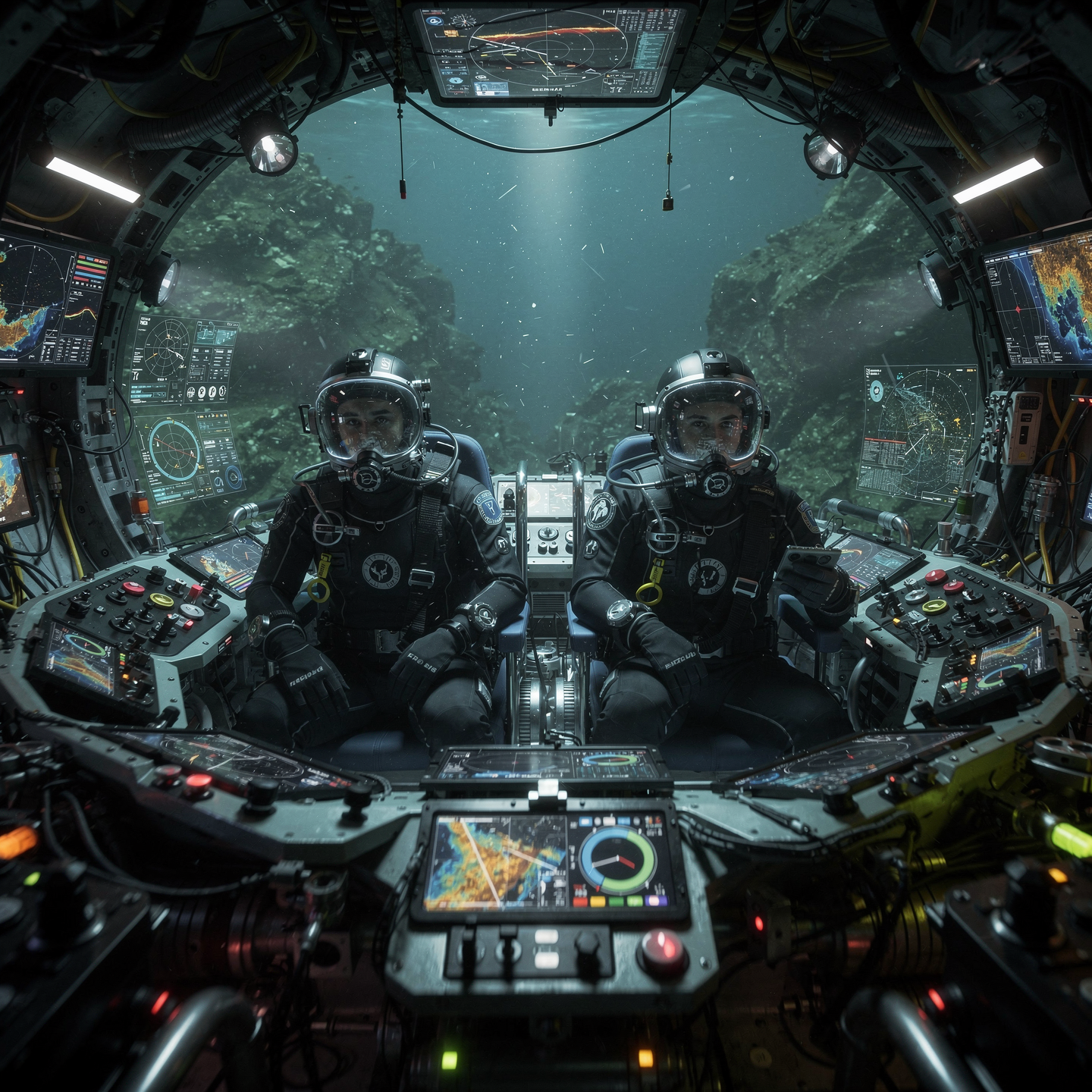
Master’s Degree in Submarines and Deep Diving Technologies

Why this master’s programme?

The Master in Submarines and Deep-Dive Technologies

Offers comprehensive training in the design, operation, and maintenance of submarines, as well as in cutting-edge technologies for exploring the ocean depths. Immerse yourself in the study of hydrodynamics, underwater propulsion, life support systems, and autonomous navigation. Master the techniques of underwater inspection, repair, and rescue, and explore the applications of these technologies in scientific research, the offshore industry, and naval defense.

Differential Advantages

  • Advanced Simulations: Hands-on experience operating submarines in diverse operational scenarios.
  • Industry Experts: Learn from leading professionals in submarine design, construction, and operation.
  • Deep Diving Technologies: Familiarize yourself with ROVs, AUVs, sensors, and tools for underwater exploration.
  • Hands-on Projects: Participate in the design and development of innovative solutions for real-world underwater challenges.
  • Professional Networking: Connect with leading companies and organizations in the maritime and submarine sector.
Submarinos

Master’s Degree in Submarines and Deep Diving Technologies

Availability: 1 in stock

Who is it aimed at?

  • Naval and ocean engineers seeking specialization in the design, construction, and maintenance of submarines and submersible vehicles.
  • Naval officers and defense professionals wishing to acquire in-depth knowledge of submarine operations, weapons systems, and countermeasures.
  • Marine researchers and scientists needing to master deep-diving technologies for the exploration, research, and exploitation of marine resources.
  • Offshore oil and gas industry professionals interested in the use of submarines for the inspection, repair, and maintenance of underwater infrastructure.
  • Graduates in engineering, physics, or marine sciences aspiring to an innovative career in the field of underwater robotics, oceanography, and The exploration of the seabed.

    Academic flexibility

    Adapted to the needs of professionals: online format with recorded classes, asynchronous discussion forums, and personalized tutoring.

Submarinos

Objectives and skills

Manage and optimize underwater life support systems:

Ensuring the purity of the breathing gas, constantly monitoring the composition and acting proactively against any deviation from safe parameters, guaranteeing the health and safety of the divers.

Develop and implement predictive maintenance strategies for underwater equipment:

Implement vibration analysis, infrared thermography, and oil analysis to detect incipient failures and optimize preventive maintenance programs.

Lead and coordinate underwater rescue and salvage operations:

“Planning complex dives, managing risks, resources and communications, to optimize team efficiency and safety.”

Design and implement high-precision navigation and positioning systems in underwater environments:

Integrate inertial, acoustic, and pressure sensors with Kalman filtering algorithms for robust position estimation, compensating for drift and minimizing errors in real time.

Assess and mitigate risks in operations with autonomous underwater vehicles (AUVs).

“Identify critical points of the AUV (navigation, power, communications) and establish clear and proven contingency plans.”

To devise and implement innovative solutions for the exploration and sustainable exploitation of deep-sea resources:

Develop and integrate advanced robotic technologies and data analysis systems for detailed mapping of the seabed, accurate identification of mineral deposits, and minimization of environmental impact during extraction.

Study plan – Modules

  1. Fundamentals of hydraulic systems: principles of hydraulics, types of fluids, properties of oils, and their behavior at high pressure in underwater environments
  2. Design and selection of hydraulic components: pumps, valves, actuators, and accumulators specifically for autonomous underwater vehicles (AUVs) and their resistance to corrosion and fatigue in deep immersion
  3. Advanced modeling of hydraulic circuits: numerical simulation, computational fluid dynamics (CFD) applied to precision hydraulic systems and redundant systems
  4. Integration of automatic control systems: distributed control architecture, implementation of PID, LQR, and adaptive controllers for precise diving and navigation maneuvers
  5. Electronics and sensors in hydraulic systems: pressure, flow, and position sensors, integration with data acquisition (DAQ) systems and industrial communication networks (CAN, Modbus)
  6. Diagnostic and predictive maintenance protocols: use of continuous monitoring techniques through analysis Vibration analysis, thermography, and fluid analysis to anticipate failures and optimize system lifespan.

    Fail-resistant design: fail-safe strategies, active and passive redundancy, and Failure Mode and Effects Analysis (FMEA) in hydraulic and control systems to ensure safety and operability during extended dives.

    Intelligent control and advanced automation: incorporation of artificial intelligence algorithms for automatic optimization of hydraulic parameters based on real-time data and underwater environmental conditions.

    Integrated case study: complete design of a hydraulic handling and propulsion system for an AUV, from sizing to the integration of the automatic control system and peripheral testing.

    Applicable regulations and standards: review of international standards (ISO, IEEE, IMCA) and specific criteria for homologation and certification of hydraulic systems in autonomous underwater vehicles.

  1. Fundamentals of electric propulsion for deep-diving vehicles: basic concepts, types of electric motors, and onboard power generation systems.
  2. Design and selection of propulsion systems: energy efficiency analysis, integration with advanced battery systems, and thermal management in high-pressure environments.
  3. Emerging technologies in advanced fuels: hydrogen, methanol, and synthetic fuels for submarines and autonomous underwater vehicles (AUVs).
  4. Hybrid and dual-propulsion systems: combining electric motors and internal combustion engines to optimize range and power during extended dives.
  5. Critical materials and components for propulsion systems in extreme conditions: corrosion resistance, electrical insulation, and mechanical durability.
  6. Integration of electronic control systems for dynamic propulsion management: vector control, rapid response, and redundancies Safety.
  7. Performance evaluation and digital simulation: CFD (Computational Fluid Dynamics) modeling applied to underwater propellers and propulsion systems.

    Energy storage innovations for submersible vehicles: advanced solid-state battery technologies, supercapacitors, and underwater recharging systems.

    International regulations and environmental requirements for propulsion systems in deep-sea submersibles: certifications, emissions, and operational safety.

    Case studies and project analysis: detailed study of current and future submarines with integrated electric propulsion systems and advanced fuels, bibliography, and industry trends.

  1. Fundamentals of hydraulic systems on subsea platforms: fluid properties, types of pumps, accumulators, actuators, and control valves
  2. Design and architecture of integrated hydraulic systems: open and closed circuits, redundancy, and fault mitigation in high-pressure environments
  3. Electronics applied to deep diving: pressure, temperature, flow, and position sensors; industrial communication protocols (CAN, Modbus, Profibus)
  4. Integration of hydraulic and electronic systems: programmable logic controllers (PLCs), SCADA systems, and real-time communication networks
  5. Advanced control dynamics: PID algorithms, adaptive and predictive control for the stability and maneuverability of subsea vehicles
  6. Diagnostics and predictive maintenance: leak detection techniques, vibration analysis, thermography, and remote monitoring
  7. Specific regulations and international standards for hydraulic systems and Electronics in deep immersion: DNV-GL, ABS, ISO 13628

    Energy management and efficiency: recovery techniques, consumption minimization, and uninterruptible power supply systems in underwater environments

    Human-machine interfaces (HMIs) on subsea platforms: design, ergonomics, and adaptation to extreme pressure and temperature conditions

    Case studies and advanced simulations: implementation of integrated systems in submersibles, failure analysis, and emergency procedures

  1. Fundamentals of structural design in deep-sea submersible hulls: principles of strength and stability under extreme hydrostatic pressures
  2. Modeling and simulation using finite element methods (FEM): how to define loads, meshes, and boundary conditions in subsea structures
  3. Stress and strain analysis in materials subjected to high-pressure environments: evaluation of critical points and stress concentration zones
  4. Advanced materials for submersible hulls: high-strength alloys, composites, and special coatings
  5. Microstructural properties of special steels and their fatigue and fracture behavior under deep-sea immersion cycles
  6. Corrosion in deep-sea environments: electrochemical mechanisms, stress corrosion cracking, and advanced monitoring techniques
  7. Corrosion preservation and protection techniques: nanomaterial coatings, impedance systems, and maintenance strategies Predictive testing.

    Structural fatigue and service life of submersible hulls: design criteria, cyclic load analysis, and accelerated testing methods.

    International regulations and standards applied to the design and certification of submarine and submersible vehicle hulls.

    Case studies of structural failure in deep-sea submersible vehicles: diagnosis, forensic analysis, and lessons learned for design improvement.

    Integration of auxiliary systems and structural sensors for real-time hull integrity monitoring.

    Optimization of weight and strength through advanced manufacturing and assembly techniques in submersible structures.

    Application of emerging technologies, such as 3D printing and smart materials, for innovation in submarine hulls.

    Environmental impact assessment of materials and coatings: sustainability and compliance with environmental regulations.

    Multidisciplinary analysis methodologies combining FEM, CFD (Computational Fluid Dynamics), and other technologies. computational) and machine learning techniques for predicting and preventing structural failures

  1. Fundamentals of Inertial Navigation Systems (INS): Physical Principles, Basic Sensors, and Integration Algorithms
  2. Design and Advanced Architecture of Inertial Measurement Units (IMUs) for Deep Dive Use
  3. Calibration and Error Compensation: Drift, Bias, Noise, and Alignment in Extreme Conditions
  4. Sensor Fusion: Integrating INS with GNSS Systems, Doppler Sonar, and Altimeters for Accurate Underwater Navigation
  5. Dynamic Control of Submersible Vehicles: Modeling Hydrodynamic and Kinematic Dynamics in High-Pressure Environments
  6. Adaptive and Predictive Control Algorithms for Maintaining Position and Trajectory During Autonomous Missions
  7. Autonomous Navigation Systems: Strategies for Navigation Without GPS in Deep Dive Environments and Limited Communication
  8. Implementation of Attitude and Orientation Control Using Gyroscopes, Accelerometers, and Magnetometers in Underwater Vehicles
  9. Redundant Sensors and Actuators: Designing Fault-Tolerant Systems to Ensure Operability Under Critical Conditions
  10. Real-Time Control Software and Architecture: Protocols, Algorithms, and Hardware Used in Autonomous Submarine Control
  11. Planning and Execution Strategies for Autonomous Missions in Extreme Immersion Environments: Routes, Obstacle Avoidance, and Energy Management
  12. Simulation and Modeling of Navigation and Control Systems: Tools for Prediction and Optimization of Operations
  13. System Performance Evaluation: Metrics, Laboratory Validation, and Testing in Real Environments
  14. International Standards and Regulations Applicable to Navigation and Control Systems in Submarine Operations
  15. Case Studies and Analysis of Real Missions: Lessons Learned, Technological Innovation, and Future Trends in Autonomous Submarine Navigation and Control
  1. Fundamentals of Propulsion Systems in Deep-Sea Autonomous Vehicles: Types, Thermodynamic and Electrochemical Principles
  2. Advanced Electric Propulsion: Brushless DC Motors, Induction Motors, Vector Control, and Energy Optimization
  3. Hybrid and Fuel Cell Propulsion Technologies for Extended Missions and High Endurance
  4. Battery and Energy Storage Systems: Lithium-Ion Batteries, Redox Flow Batteries, and Supercapacitors for High-Pressure Environments
  5. Design and Material Selection for Hulls and Critical Components: Corrosion- and Fatigue-Resistant Alloys Under Extreme Pressure
  6. Nanomaterials and Smart Coatings: Increasing Mechanical Strength and Reducing Biofouling in Submarine Conditions
  7. Advanced Control and Autonomous Navigation Systems: Integrating AI, Inertial Sensors, and Navigation by Multibeam sonar

    Redundancy and safety in control systems: fail-safe protocols, self-diagnostics, and real-time automatic recovery
    Hydrodynamic optimization of propellers and control surfaces to minimize fuel consumption and maximize maneuverability
    Vehicle-environment interaction: environmental sensors, flow modeling, and dynamic adaptation to minimize impact and improve efficiency
    Testing and validation in simulated and field environments: protocols, performance metrics, and international certification
    Emerging trends: magnetic propulsion, metamaterials, and bio-inspired systems applied to extreme immersion autonomous vehicles
    Environmental impact and sustainability: life cycle assessment and strategies to minimize ecological footprint in underwater operations

  1. Fundamentals of propulsion for underwater vehicles: thermodynamic principles, applied hydraulics, and energy efficiency in aquatic environments
  2. Comprehensive design of electric and mechanical propulsion systems: selection of motors, propeller types, transmission systems, and advanced couplings
  3. Dynamic modeling and simulation of underwater platforms under extreme conditions: analysis of structural strength and hydrodynamic behavior
  4. Advanced control of autonomous underwater vehicles: navigation algorithms, position estimation using inertial and acoustic sensors, and adaptive control systems
  5. Integration of attitude, depth, and speed control systems with artificial intelligence and machine learning technologies for operational optimization
  6. Diagnostic and predictive maintenance methodologies in integrated systems, including vibration analysis and real-time monitoring
  7. Structural design and analysis using finite elements for high-pressure casings: selection of composite materials and metals resistant to corrosion and fatigue from cycles of immersion
  8. Fluid-structure interaction in deep environments: techniques for mitigating hydrodynamic loads and thermal impacts
  9. Redundant systems and fail-safe protocols in electronic and mechanical architectures for autonomous underwater vehicles
  10. International regulations and applicable standards in the design and operation of extreme immersion autonomous vehicles: certification, safety, and regulatory aspects
  1. Fundamentals of Underwater Sensors: Physical Principles of Sound and Light in Liquid Media and Their Impact on Signal Transmission
  2. Advanced Types of Underwater Sensors: Hydrophones, Multibeam Sonar, Underwater LiDAR, and High-Resolution Optical Sensors
  3. Development and Application of Chemical and Biological Sensors for Environmental Monitoring and Pollutant Detection in Deep Dives
  4. Integration of Multi-modal Sensory Systems to Improve Situational Awareness in Autonomous Underwater Vehicles (AUVs) and Remotely Operated Vehicles (ROVs)
  5. Underwater Optical Communication: Theoretical Foundations, Modulation, and Advanced Techniques for High-Speed, Low-Latency Data Transmission
  6. Optimizations in Optical Communication: Mitigation of Scattering, Turbulence, and Attenuation Caused by Suspended Particles and Water Variability
  7. Robust Communication Protocols for Environments
  8. Extreme Pressure: Redundancy, Error Correction, and Dynamic Adaptation in Underwater Links
  9. Design and Testing of Autonomous Systems in High-Pressure Environments: Materials, Encapsulated Electronics, and Thermal Dissipation Techniques
  10. Distributed Sensor Networks and Communication Architectures for Cooperative and Synchronized Operations in Deep Dive
  11. Case Studies: Implementation of Advanced Sensors and Optical Communications in Scientific, Military, and Commercial Missions in Abyssal Zones
  12. Interoperability Challenges Between Platforms: Integration of Heterogeneous Sensor Data for Automated Decision-Making and Efficient Remote Control
  13. Impact of Extreme Pressure and Temperature on the Accuracy and Operating Life of Sensors and Communication Systems
  14. State of the Art and Future Trends: Artificial Intelligence Applied to Underwater Sensor Data Analysis and Optimization of Optical Communication Networks
  15. Computational Simulation and Propagation Modeling of Acoustic and Optical Signals in Complex Seafloors
  16. and deep-diving scenarios

  17. International safety and operational standards and regulations for the deployment of sensors and communications in autonomous underwater vehicles
  1. Fundamentals of Technological Innovation Applied to Autonomous Underwater Vehicles: Trends, Paradigms, and Emerging Developments in Deep Diving
  2. Advanced Composite Materials: Mechanical Properties, Corrosion Resistance, Behavior Under Extreme Pressure, and Selection for Submersible Structures
  3. Nanomaterials and Functional Coatings for Protection Against Biofouling and Wear in Deep Marine Environments
  4. Automatic Control Systems: Architecture, Adaptive Algorithms, Predictive and Robust Control in Nonlinear and Dynamic Underwater Environments
  5. Integration of Sensors and Actuators in Autonomous Vehicles: LIDAR Technologies, Multibeam Sonar, Stereoscopic Cameras, and Inertial Systems for Navigation in Limited Visibility Conditions
  6. Development of Onboard Software for Real-Time Control: Real-Time Operating Systems, Redundant Communication Protocols, and Fault-Safety
  7. Modeling and Simulation
  8. Autonomous Underwater Vehicle Dynamics: CFD applied to hydrodynamics, simulators for the design and validation of control systems
  9. Implementation of artificial intelligence and machine learning for autonomous navigation, obstacle detection, and decision-making in complex environments
  10. Redundancy and fault-tolerance strategies in control and energy management systems for long-duration, deep-sea missions
  11. International regulations and technical standards in the certification of materials and control systems for deep-sea autonomous vehicles
  1. Advanced methodology for the design of autonomous deep-sea vehicles: analysis of functional and environmental requirements
  2. Comprehensive study of materials and structures for extreme pressures: selection, strength and durability testing in ocean conditions
  3. Design and optimization of underwater propulsion systems: electric motors, hydraulic systems, and vector control
  4. Implementation of innovative sensor and navigation technologies: integration of multi-frequency sonar, LBL, USBL, and inertial navigation systems
  5. Development and simulation of autonomous control and piloting systems: artificial intelligence algorithms, machine learning, and redundancy systems
  6. Energy optimization: next-generation batteries, energy management systems, and wireless charging technologies in underwater environments
  7. Design of human-machine interfaces (HMIs) for remote control and monitoring: augmented reality, teleoperation, and real-time response systems
  8. Safety and emergency management protocols for autonomous deep-sea missions: early detection, failure analysis, and operational recovery
  9. International regulations and certifications applicable to autonomous underwater vehicles: compliance with SOLAS, IMO, and specific technical standards
  10. Planning, execution, and presentation of the final project: integration of knowledge, technical defense, and justification of applied technological innovations

Career prospects

“`html

  • Design and Development Engineer: Design, analysis, and optimization of underwater components and systems.
  • Operations and Maintenance Engineer: Management and maintenance of equipment and systems on submarines and deep-sea platforms.
  • Research Scientist: Development of new technologies and applications for the exploration and exploitation of resources in deep waters.
  • Technical Consultant: Expert advice on projects related to submarines and deep-sea technologies.
  • Naval Officer/Naval Forces: Operation and maintenance of military submarines.
  • Project Manager: Planning and execution of underwater projects, from the design phase to implementation.
  • Underwater Robotics Specialist: Development and operation of ROVs and AUVs for inspection and manipulation Underwater.
  • Underwater Safety Expert: Risk assessment and development of safety protocols for deep-water operations.
  • Teacher/Trainer: Sharing knowledge in the field of underwater technology and deep diving.

“`

Entry requirements

Academic/professional profile:

Bachelor’s degree in Nautical Science/Maritime Transport, Naval/Marine Engineering or a related qualification; or proven professional experience on the bridge/in operations.

Language proficiency:

Functional Maritime English (SMCP) recommended for simulations and technical materials.

Documentation:

Updated CV, copy of qualification or seaman’s book, national ID/passport, motivation letter.

Technical requirements (for online):

Device with camera/microphone, stable internet connection, monitor ≥ 24” recommended for ECDIS/Radar-ARPA.

Admissions process and dates

Online
application

(form + documents).

Academic review and interview

Admissions decision

Admissions decision

(+ scholarship offer if applicable).

Place reservation

(deposit) and enrolment.

Induction

(access to the virtual campus, calendars, simulator guides).

Scholarships and financial support

  • Submarine Design and Construction: Master the latest techniques in naval engineering, advanced materials, and underwater propulsion systems.
  • Deep Diving Technologies: Explore the essential tools and equipment for exploration, research, and operation in high-pressure environments.
  • Simulation and Modeling: Learn to use state-of-the-art software for behavior prediction and design optimization of submarines.
  • Operational and Safety Aspects: Gain in-depth knowledge of safety, navigation, and communication protocols in underwater operations.
  • Applications Civilians and Military: Discover the career opportunities in the defense industry, oceanographic research, and underwater resource exploration. Boost your career with specialized training in the fascinating world of submarines and the ocean depths.

Testimonials

Frequently asked questions

Submarines and deep-sea diving technologies.

Yes. The itinerary includes ECDIS/Radar-ARPA/BRM with harbor, ocean, fog, storm, and SAR scenarios.

Online with live sessions; hybrid option for simulator/practical placements through agreements.

It focuses on the development of technologies related to deep diving, although it may include aspects of piloting.

Recommended functional SMCP. We offer support materials for standard phraseology.

Yes, with a relevant degree or experience in maritime/port operations. The admissions interview will confirm suitability.

Optional (3–6 months) through Companies & Collaborations and the Alumni Network.

Simulator practice (rubrics), defeat plans, SOPs, checklists, micro-tests and applied TFM.

A degree from Navalis Magna University + operational portfolio (tracks, SOPs, reports and KPIs) useful for audits and employment.

  1. Advanced methodology for the design of autonomous deep-sea vehicles: analysis of functional and environmental requirements
  2. Comprehensive study of materials and structures for extreme pressures: selection, strength and durability testing in ocean conditions
  3. Design and optimization of underwater propulsion systems: electric motors, hydraulic systems, and vector control
  4. Implementation of innovative sensor and navigation technologies: integration of multi-frequency sonar, LBL, USBL, and inertial navigation systems
  5. Development and simulation of autonomous control and piloting systems: artificial intelligence algorithms, machine learning, and redundancy systems
  6. Energy optimization: next-generation batteries, energy management systems, and wireless charging technologies in underwater environments
  7. Design of human-machine interfaces (HMIs) for remote control and monitoring: augmented reality, teleoperation, and real-time response systems
  8. Safety and emergency management protocols for autonomous deep-sea missions: early detection, failure analysis, and operational recovery
  9. International regulations and certifications applicable to autonomous underwater vehicles: compliance with SOLAS, IMO, and specific technical standards
  10. Planning, execution, and presentation of the final project: integration of knowledge, technical defense, and justification of applied technological innovations

Request information

  1. Complete the Application Form.

  2. Attach your CV/degree certificate (if you have it to hand).

  3. Indicate your preferred cohort (January/May/September) and whether you would like the hybrid option with simulator sessions.

    An academic advisor will contact you within 24–48 hours to guide you through the admission process, scholarships, and compatibility with your professional schedule.

Please enable JavaScript in your browser to complete this form.
Click or drag a file to this area to upload.

Faculty

0
    0
    Tu carrito
    Tu carrito esta vacíoRegresar a la tienda
    Scroll to Top


