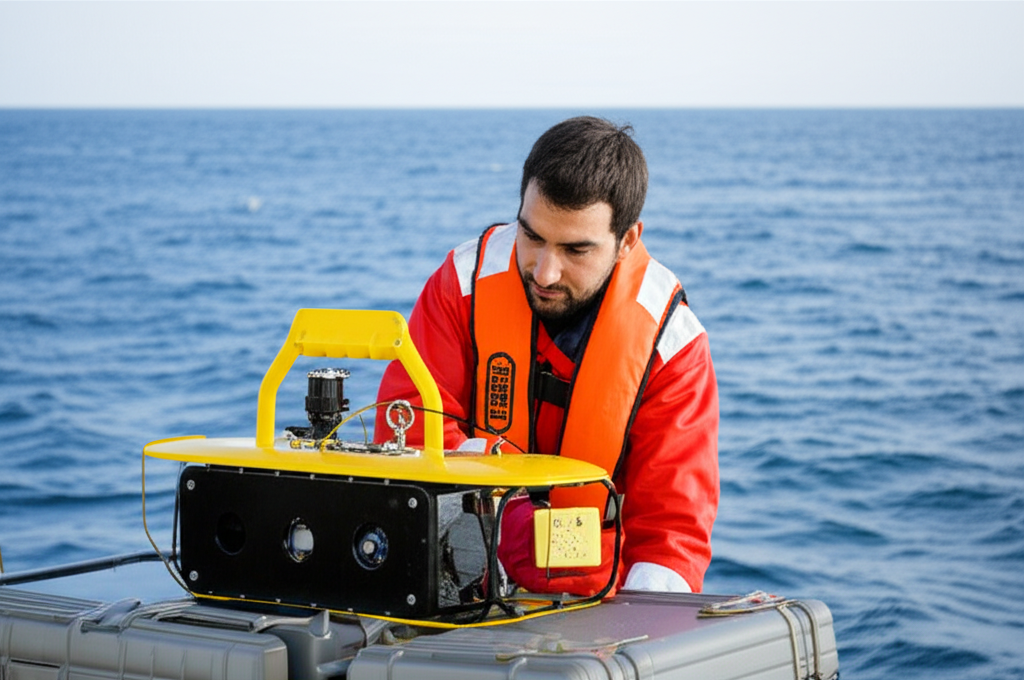
Master’s Degree in Autonomous Marine Robotics

Why this master’s programme?

The Master in Autonomous Marine Robotics

Prepares you to lead the new era of ocean exploration and management. Learn to design, build, and program autonomous underwater vehicles (AUVs) capable of performing complex tasks in challenging marine environments. Master autonomous navigation, underwater vision, oceanographic data processing, and acoustic communication, using advanced simulation tools and real prototypes. This program provides you with the skills necessary to develop innovative solutions in fields such as underwater infrastructure inspection, environmental monitoring, marine resource exploration, and ocean scientific research.

[strong>]

Differential Advantages

  • Hands-on Experience: Design, construction, and deployment of AUVs in real-world environments.
  • Advanced Simulation: Use of industry-leading software for robot modeling and control.
  • Expert Faculty: Professionals with extensive experience in marine robotics and oceanography.
  • Professional Networking: Contact with leading companies and institutions in the sector.
  • Innovative Projects: Development of solutions for real-world challenges in the marine industry.
Robótica

Master’s Degree in Autonomous Marine Robotics

Availability: 1 in stock

Who is it aimed at?

  • Engineers and scientists seeking to specialize in the design and development of autonomous underwater vehicles (AUVs) for research, exploration, or inspection.
  • Offshore industry professionals wishing to acquire advanced skills in the operation and maintenance of underwater robotic systems for inspection, repair, and maintenance tasks.
  • Academic researchers interested in delving deeper into the field of marine robotics, including autonomous navigation, underwater perception, and robotic manipulation.
  • Graduate students in engineering, robotics, oceanography, or related fields seeking specialized training in autonomous marine robotics to advance their careers.
  • Entrepreneurs and startups wishing to develop innovative solutions based on marine robotics for applications in various sectors.
  • such as energy, environment, or defense.

Learning Flexibility
 Adapted to working professionals: live and recorded online classes, access to simulators and specialized software, and personalized tutoring.

Robótica

Objectives and skills

Develop and implement advanced control systems for autonomous underwater vehicles (AUVs):

Integrate robust and adaptive path planning algorithms that enable autonomous navigation in complex and dynamic environments, minimizing energy consumption and optimizing area coverage.

Design and build innovative robotic prototypes for underwater exploration and maintenance:

“Implement robust autonomous navigation systems adapted to underwater conditions, integrating SLAM, acoustic sensors and predictive control algorithms.”

Manage marine robotics projects, from conception to commissioning, complying with quality and safety standards:

Define the scope of the project, allocate resources and establish a realistic timeline, while mitigating potential risks and ensuring effective communication among all stakeholders.

Analyzing oceanographic and environmental data to optimize the performance and autonomy of marine robots:

Develop predictive models of currents, temperature, and salinity for robot route planning and energy management, minimizing consumption and maximizing data coverage.

Diagnosing and troubleshooting complex technical problems in marine robots in challenging operating environments:

“Using advanced diagnostic tools, interpreting anomalous data and performing underwater repairs on-site, minimizing downtime.”

Leading multidisciplinary teams in research and development projects for autonomous marine robotics:

Promote effective communication and conflict resolution to align visions and optimize each member’s contribution to the project’s success.

Study plan – Modules

  1. Design and architecture of autonomous underwater systems: hardware and software components, interoperability, and modularity
  2. Advanced inertial navigation and acoustic positioning algorithms: integration of INS/DVL, LBL, USBL, and sensor fusion methods
  3. Three-dimensional mapping and 3D reconstruction of underwater environments using multibeam sensors and side-scan sonar
  4. Adaptive and robust control in autonomous underwater vehicles: predictive control techniques and nonlinear modeling
  5. Implementation of artificial intelligence for real-time detection, classification, and tracking of underwater objects
  6. Advanced underwater communication: acoustic networks, low-latency protocols, and power management in transmissions
  7. Dynamic route planning and obstacle avoidance based on machine learning and probabilistic maps
  8. Efficient power and propulsion systems for extended operations: fuel cells, advanced batteries, and management Thermal
  9. Integration of oceanographic and environmental data acquisition systems for intelligent navigation and adaptive missions

    International regulations and safety standards in autonomous underwater operations: impact on design and deployment

  1. Underwater Sensor Fundamentals: Physical Characteristics, Limitations, and Advantages in Autonomous Marine Environments
  2. Acoustic Sensors: Design and Operation of Multibeam Sonars, Echosounders, and Acoustic Imaging Systems for Mapping and Detection
  3. Optical and Visual Sensors: Multispectral Cameras, Underwater LiDAR, and Emerging Technologies for Perception in Murky Waters
  4. Integration of Inertial Sensors: IMUs, Gyroscopes, and Accelerometers on Underwater Mobile Platforms
  5. Multimodal Data Fusion: Algorithms and Architectures for Combining Heterogeneous Sensor Information in Real Time
  6. Advanced Underwater Signal Processing: Adaptive Filtering, Noise Cancellation, and Acoustic Propagation Modeling
  7. Environmental Perception and Object Recognition: Machine Learning and Deep Learning Techniques Applied to
  8. Classification and tracking in adverse conditions
  9. Autonomous navigation algorithms: Underwater SLAM (Simultaneous Localization and Mapping) and route optimization in complex 3D spaces
  10. Convolutional neural networks for image processing and real-time marine obstacle detection
  11. Communication and data transfer protocols between sensors and control systems in autonomous underwater vehicles (AUVs)
  12. Simulation and modeling: tools for the virtual validation of sensors and algorithms before field implementation
  13. Considerations of ambient noise and oceanographic factors affecting the accuracy of sensing systems
  14. Advanced sensor design and calibration to ensure robustness and reliability in extended missions
  15. Adaptive control systems based on sensor feedback for precise and safe autonomous navigation
  16. Case studies and real-world applications: studies field experience in infrastructure inspection, environmental monitoring, and autonomous underwater exploration.
  1. Autonomous Systems Architecture for Underwater Vehicles: Modular Design, Inter-Subsystem Communication, and Integration Protocols
  2. Advanced Sensory Perception: Multi-source data fusion including multibeam sonar, underwater LIDAR, stereoscopic cameras, and inertial sensors for mapping and detection
  3. Intelligent Navigation Algorithms: Simultaneous Localization and Mapping (SLAM), acoustic pattern-based navigation, and drift correction using complementary GNSS
  4. Adaptive and Robust Control: Handling dynamic uncertainties, predictive control, and compensation for hydrodynamic disturbances in real time
  5. Integration of Artificial Intelligence for Autonomous Decision-Making: Deep Neural Networks, Reinforcement Learning, and Expert Systems applied to underwater missions
  6. Mission Planning and Optimal Routes: Marine environment modeling, dynamic obstacle avoidance, and power management to extend endurance
  7. Advanced Underwater Communication: Acoustic protocols, modulation, and coding for efficient data transmission and synchronization of autonomous vehicle fleets
  8. Inertial Navigation and Hydroacoustic Reference Systems: Design and calibration of INS/DVL and their integration with external systems for precise positioning
  9. Simulation and Performance Evaluation: Realistic virtual environments for algorithm testing, control system validation, and failure analysis
  10. International regulations and standards applicable to autonomous underwater operation, operational safety, and risk mitigation in sensitive maritime environments
  1. Fundamentals and design of distributed control architectures for autonomous underwater vehicles (AUVs): hierarchies, layers, and modularity
  2. Advanced mission planning algorithms: heuristic search techniques, model-based planning, and adaptive strategies in dynamic environments
  3. Underwater communication protocols and technologies: acoustic modulation, multiplexing techniques, signal propagation, and interference mitigation
  4. Energy optimization in autonomous fleets: intelligent battery management, energy-saving strategies, and balancing performance and operational autonomy
  5. Integrated sensors and data fusion for navigation and robust control: use of DVL, INS, multibeam sonar, and environmental sensors
  6. Modeling and simulation of marine environments for validating mission plans and control systems under real-world conditions and extreme environments
  7. Predictive maintenance based on vibration analysis, thermography, and telemetry to anticipate critical failures in underwater robotic systems
  8. Management and coordination of multi-vehicle fleets: deployment strategies, task assignment, and real-time collaborative distribution
  9. Implementation of safety systems and automated contingency protocols for the safe operation of AUVs in hostile environments
  10. Integration of artificial intelligence and machine learning for continuous improvement in the control, planning, and communication of autonomous underwater fleets
  1. Fundamentals of underwater acoustic communications: physical principles of sound propagation in the marine environment, attenuation, scattering, and multipath
  2. Acoustic channel models: propagation characterization in coastal and deep-water environments, statistical and deterministic parameters for simulation
  3. Design and configuration of communication networks: hybrid, distributed, and mesh topologies for autonomous underwater vehicles (AUVs)
  4. Modulation and coding: advanced techniques for data rate optimization and robustness against interference and ambient noise
  5. Real-time communication protocols: design of multiple access schemes, error control, and synchronization
  6. Network optimization algorithms: heuristics, genetic algorithms, and machine learning applied to dynamic resource management and data paths
  7. Implementation of control systems Distributed: Integration of acoustic communications with inertial navigation systems and sensors for adaptive control of underwater fleets

    Solving latency and data rate problems in underwater networks: Delay compensation, buffering, and prioritization of critical traffic for real-time control

    Advanced temporal and spatial synchronization techniques between nodes for effective coordination of autonomous maneuvers

    Field testing and simulation: Modeling tools, testing platforms, and protocols for experimental validation in real and simulated environments

    Environmental impact and regulatory considerations: Assessment of bioacoustic effects and international regulations in underwater communications operations

    Future perspectives and technological trends: Integration with underwater IoT, distributed artificial intelligence, and hybrid acoustic-optical communications

  1. Fundamental principles of control architectures: hierarchical, distributed, and heterarchical models applied to autonomous underwater vehicles
  2. Underwater communication topologies: acoustic, optical, and electromagnetic, with analysis of range, data rate, and latency for autonomous fleets
  3. Integration of multimodal sensors: multibeam sonar, underwater LIDAR, hyperspectral cameras, and advanced inertial sensors
  4. Sensor fusion algorithms for underwater environments: data compression, noise filtering, and cross-calibration
  5. Design and optimization of low-power, high-reliability communication protocols for underwater ad-hoc networks
  6. Intelligent navigation strategies: adaptive navigation based on SLAM (Simultaneous Localization and Mapping) and reinforcement learning for dynamic environments
  7. Collaborative control between vehicles: training, dynamic task assignment, and load distribution Computational aspects
  8. Energy management and autonomy: mission planning considering consumption, wireless recharging, and prediction of ocean conditions
  9. Interference mitigation systems and integrity assurance in underwater communication links
  10. Implementation of real-time command and control systems: development of embedded software, middleware, and architectures based on ROS (Robot Operating System)
  11. Advanced simulation and virtual validation of control architectures and communication protocols
  12. International regulations and standards applicable to autonomous marine robotic systems and their interoperability
  1. Fundamentals of distributed systems in autonomous underwater vehicles: network architectures, underwater communication protocols, and unidirectional wireless sensor networks (UWSN)
  2. Advanced design of adaptive and intelligent control systems for autonomous marine vehicles: robust, predictive, and machine learning-based control
  3. Integration of multimodal sensors: multibeam sonar, underwater LIDAR, optical and magnetometric sensors for data fusion in dynamic and noisy environments
  4. AI-based sensor fusion algorithms: deep neural networks, extended Kalman filters, and Bayesian estimation techniques for improved perception and navigation
  5. Hybrid communication protocols for autonomous underwater vehicle networks: acoustic, optical, and inductive, with bandwidth and latency management strategies
  6. Real-time simulation and testing platforms for validating integration and control strategies: use of virtual environments High-fidelity and hardware-in-the-loop (HIL) systems.

    Implementation of cooperative and distributed AI control for coordinating groups of autonomous vehicles: dynamic formation, collision avoidance, and energy optimization.

    Self-diagnostic and fault recovery systems in underwater networks: redundancy techniques, fault tolerance, and predictive maintenance based on data analysis.

    Modeling and estimation of states under adverse environmental conditions: compensation for hydrodynamic disturbances, ocean currents, and acoustic noise.

    International regulations and interoperability standards for networks and control in autonomous marine robotics: IEEE, NMEA, and emerging protocols for underwater interoperability.

  1. Advanced Fundamentals of Artificial Intelligence (AI) and its application in autonomous marine robotic systems: algorithms, models, and architectures specific to underwater environments
  2. Deep Neural Networks: design, training, and optimization for perception and decision-making in underwater robotic vehicles
  3. Acoustic and optical signal processing using deep learning for object detection and classification in complex marine environments
  4. Reinforcement Learning applied to autonomous navigation and maneuvering in dynamic and unstructured environments
  5. AI-based multisensor fusion: integration of data from sonar, multispectral cameras, LIDAR, and inertial sensors to improve vehicle perception
  6. Route optimization and trajectory planning using evolutionary and deep learning algorithms adapted to underwater conditions
  7. variables

  8. Predictive modeling and real-time analysis for proactive maintenance and operational management of autonomous vehicles on extended missions
  9. Implementation of AI-based adaptive control systems for stability and maneuverability in high-turbulence environments and marine currents
  10. Development and integration of advanced simulators for training and validating intelligent algorithms in virtual underwater scenarios
  11. Ethical, regulatory, and safety considerations in the application of artificial intelligence for autonomous operations in the marine environment
  1. Advanced architecture of autonomous underwater systems: modular design, hardware and software integration for extreme marine environments
  2. Real-time control: adaptive algorithms, regulation of hydraulic and electric actuators, and predictive control techniques under dynamic and nonlinear conditions
  3. Underwater communication networks: acoustic, optical, and electromagnetic technologies; Transmission and interference mitigation protocols

    Artificial intelligence applied to perception and decision-making: supervised and unsupervised learning, convolutional neural networks for pattern recognition in sonar and underwater video

    Multispectral sensor fusion: integration of data from LIDAR sensors, multibeam sonar, hyperspectral cameras, and inertial sensors for precise autonomous navigation

    Distributed autonomy systems: communication and coordination among multiple underwater vehicles (AUV swarms), consensus algorithms, and collaborative mission strategies

    Advanced signal processing: adaptive filtering techniques, noise removal in complex underwater environments, and extraction of relevant features for autonomous decision-making

    Modeling and predictive simulation: digital twins for virtual testing of autonomous systems and validation of control strategies in diverse marine scenarios

    Robustness and fault recovery protocols Redundant architectures, online diagnostics, and strategies for maintaining operability in the face of system degradation.

    Applicable international standards and regulations: certification of marine autonomous systems, operational safety, and privacy in underwater communication networks.

  1. Advanced Fundamentals of Underwater Robotics: Kinematics, Dynamics, and Manipulator Control in Complex Marine Environments
  2. Design and Architecture of Integrated Systems for Autonomous Underwater Vehicles (AUVs): Hardware, Software, and Communication Protocols
  3. Development of Real-Time Monitoring Algorithms: Early Fault Detection and Continuous Monitoring of Critical Parameters
  4. Predictive Modeling Based on Machine Learning Applied to the Diagnosis and Predictive Maintenance of Underwater Robotic Vehicle Fleets
  5. Implementation of Predictive Maintenance Systems: Advanced Sensors, Vibration Analysis, Thermography, and Non-Destructive Techniques Adapted to Underwater Environments
  6. Integration of Underwater Communication Protocols: Hybrid Acoustic, Optical, and Radio-Frequency Protocols for Secure Data Transmission
  7. Development of Advanced Human-Machine Interfaces (HMIs) for the Remote Monitoring and Control of Robotic Fleets
  8. Autonomous Systems

    Software architecture for distributed and redundant systems: robustness, fault tolerance, and self-reconfiguration in underwater operations

    Implementation of artificial intelligence systems for autonomous decision-making in the maintenance and continuous operation of AUVs

    Study and application of international safety, operation, and maintenance standards and regulations for autonomous marine robotic systems

    Design and execution of experimental tests to validate integrated monitoring and maintenance systems in simulated and real environments

    Project management methodologies in advanced marine engineering: planning, monitoring, and control of the development of the final master’s project

    Economic and strategic analysis of the large-scale deployment of autonomous fleets with predictive maintenance: return on investment and operational sustainability

    Preparation and presentation of technical and scientific reports for the dissemination and defense of the project before academic and sectoral organizations

Career prospects

“`html

  • Autonomous Marine Robot Design and Development Engineer: Design, development, and testing of robots for diverse applications.
  • Autonomous Navigation and Control Engineer: Development of algorithms and systems for autonomous navigation of marine robots.
  • Underwater Sensor and Perception Specialist: Integration and processing of sensor data for underwater environmental perception.
  • Marine Robotics Data Scientist: Analysis of data collected by marine robots to extract relevant information.
  • Autonomous Marine Robotics Consultant: Advising companies and organizations on the implementation of marine robotic solutions.
  • Marine Robotics Researcher: Development of new technologies and algorithms for marine robotics.
  • Marine Robotics Project Manager: Planning, Coordination and execution of marine robotics projects.

    Marine Robotics Entrepreneur: Creation of new companies and startups in the field of marine robotics.

    “`

Entry requirements

Academic/professional profile:

Bachelor’s degree in Nautical Science/Maritime Transport, Naval/Marine Engineering or a related qualification; or proven professional experience on the bridge/in operations.

Language proficiency:

Functional Maritime English (SMCP) recommended for simulations and technical materials.

Documentation:

Updated CV, copy of qualification or seaman’s book, national ID/passport, motivation letter.

Technical requirements (for online):

Device with camera/microphone, stable internet connection, monitor ≥ 24” recommended for ECDIS/Radar-ARPA.

Admissions process and dates

Online
application

(form + documents).

Academic review and interview

Admissions decision

Admissions decision

(+ scholarship offer if applicable).

Place reservation

(deposit) and enrolment.

Induction

(access to the virtual campus, calendars, simulator guides).

Scholarships and financial support

  • Develop intelligent and autonomous underwater robotic systems.
  • Master navigation, control, and perception in complex marine environments.
  • Apply artificial intelligence and computer vision techniques to marine robotics.
  • Design and simulate marine robots for diverse applications.
  • Lead research and development projects in the field of underwater robotics.
Boost your career and become an expert at the forefront of marine technology.

Testimonials

Frequently asked questions

Yes. The itinerary includes ECDIS/Radar-ARPA/BRM with harbor, ocean, fog, storm, and SAR scenarios.

Online with live sessions; hybrid option for simulator/practical placements through agreements.

Maritime/offshore sector (including oil and gas, marine renewable energy, aquaculture, and oceanographic research).

Recommended functional SMCP. We offer support materials for standard phraseology.

Yes, with a relevant degree or experience in maritime/port operations. The admissions interview will confirm suitability.

Optional (3–6 months) through Companies & Collaborations and the Alumni Network.

Simulator practice (rubrics), defeat plans, SOPs, checklists, micro-tests and applied TFM.

A degree from Navalis Magna University + operational portfolio (tracks, SOPs, reports and KPIs) useful for audits and employment.

  1. Advanced Fundamentals of Underwater Robotics: Kinematics, Dynamics, and Manipulator Control in Complex Marine Environments
  2. Design and Architecture of Integrated Systems for Autonomous Underwater Vehicles (AUVs): Hardware, Software, and Communication Protocols
  3. Development of Real-Time Monitoring Algorithms: Early Fault Detection and Continuous Monitoring of Critical Parameters
  4. Predictive Modeling Based on Machine Learning Applied to the Diagnosis and Predictive Maintenance of Underwater Robotic Vehicle Fleets
  5. Implementation of Predictive Maintenance Systems: Advanced Sensors, Vibration Analysis, Thermography, and Non-Destructive Techniques Adapted to Underwater Environments
  6. Integration of Underwater Communication Protocols: Hybrid Acoustic, Optical, and Radio-Frequency Protocols for Secure Data Transmission
  7. Development of Advanced Human-Machine Interfaces (HMIs) for the Remote Monitoring and Control of Robotic Fleets
  8. Autonomous Systems

    Software architecture for distributed and redundant systems: robustness, fault tolerance, and self-reconfiguration in underwater operations

    Implementation of artificial intelligence systems for autonomous decision-making in the maintenance and continuous operation of AUVs

    Study and application of international safety, operation, and maintenance standards and regulations for autonomous marine robotic systems

    Design and execution of experimental tests to validate integrated monitoring and maintenance systems in simulated and real environments

    Project management methodologies in advanced marine engineering: planning, monitoring, and control of the development of the final master’s project

    Economic and strategic analysis of the large-scale deployment of autonomous fleets with predictive maintenance: return on investment and operational sustainability

    Preparation and presentation of technical and scientific reports for the dissemination and defense of the project before academic and sectoral organizations

Request information

  1. Complete the Application Form.

  2. Attach your CV/degree certificate (if you have it to hand).

  3. Indicate your preferred cohort (January/May/September) and whether you would like the hybrid option with simulator sessions.

    An academic advisor will contact you within 24–48 hours to guide you through the admission process, scholarships, and compatibility with your professional schedule.

Please enable JavaScript in your browser to complete this form.
Click or drag a file to this area to upload.

Faculty

0
    0
    Tu carrito
    Tu carrito esta vacíoRegresar a la tienda
    Scroll to Top


