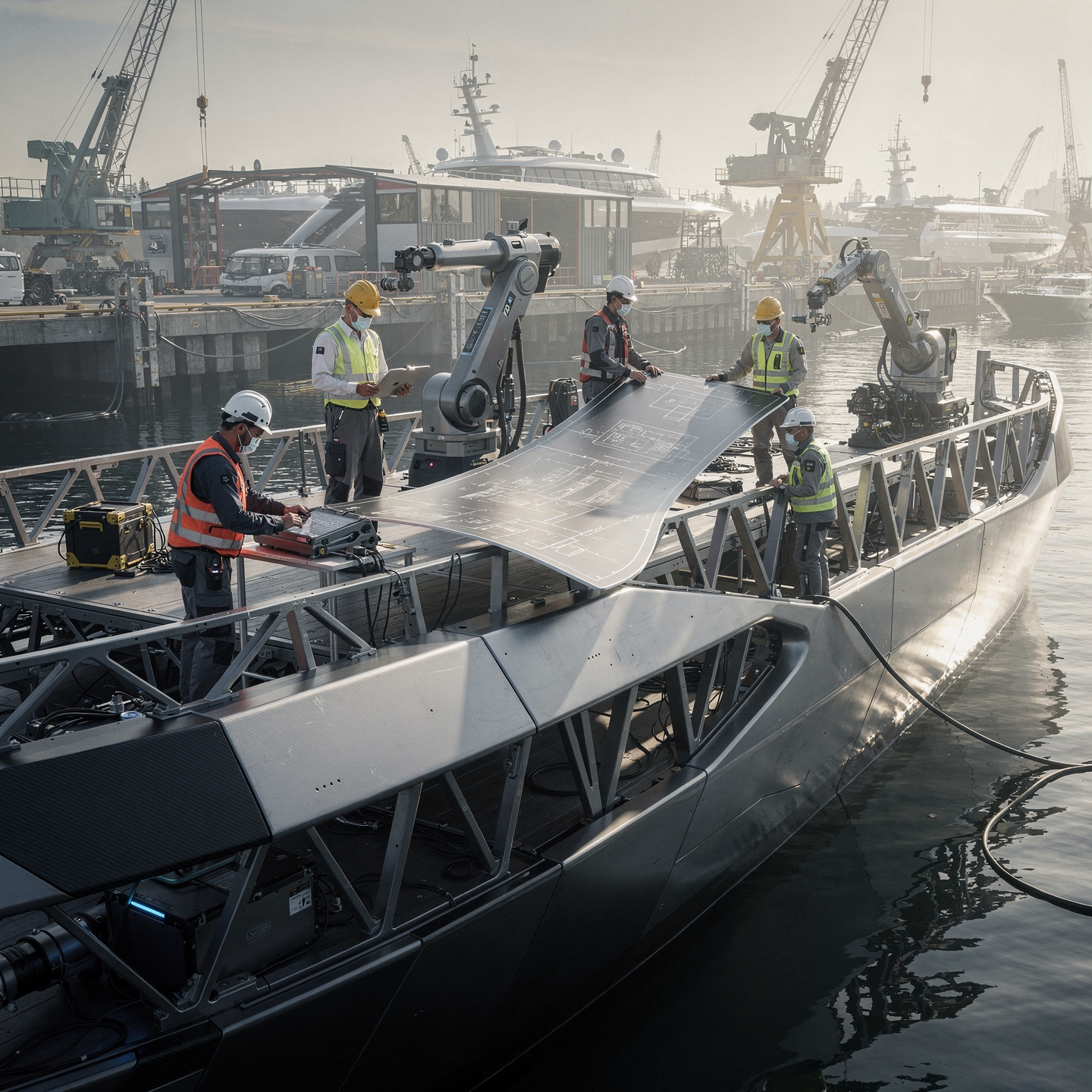
Master’s Degree in Advanced Materials for Ships of the Future
Why this master’s programme?
The Master in Advanced Materials for Ships of the Future
This program prepares you to lead innovation in the naval industry. Delve into the development and application of cutting-edge materials that will revolutionize shipbuilding, from high-strength alloys to lightweight composites and nanomaterials. Learn to select, characterize, and optimize materials to improve the efficiency, safety, and sustainability of tomorrow’s ships. This program provides you with the skills necessary to design innovative naval structures and meet the challenges of the maritime future.
This program prepares you to lead innovation in the naval industry.
Differential Advantages
- Design and Simulation: FEA modeling and analysis tools to optimize material performance in marine environments.
- Advanced Joining Technologies: Master welding, adhesion, and hybrid joining techniques for 21st-century shipbuilding.
- Sustainability and Life Cycle: Evaluate the environmental impact of materials and design strategies for a circular economy in the shipbuilding industry.
- Corrosion and Protection: Understand marine corrosion mechanisms and apply advanced protection techniques to extend the service life of vessels.
- Industry Collaboration: Participate in real-world projects with leading companies in the shipbuilding sector and access networking opportunities.
- Modality: Online
- Level: Masters
- Hours: 1600 H
- Start date: 26-04-2026
Availability: 1 in stock
Who is it aimed at?
- Naval engineers and naval architects interested in the application of new materials for ship optimization.
- Materials scientists seeking to specialize in the specific demands and challenges of the marine environment.
- R&D managers in shipyards and shipping companies who need to stay up-to-date on the latest trends in materials for shipbuilding.
- Consultants and certifiers in the maritime industry requiring a in-depth knowledge of regulations and standards related to advanced materials.
- Engineering and science graduates seeking a differentiating profile in the naval sector by specializing in innovative materials.
Flexibility and Practical Approach
Designed for working professionals: online format with downloadable resources, applied projects, and connections with experts in the naval sector.
Objectives and skills

Design and optimize the selection of materials for naval components:
“Considering resistance to marine corrosion, weight, cost, availability, and specific environmental regulations.”

Develop and implement corrosion mitigation strategies in marine environments:
“Select corrosion-resistant materials, apply protective coatings, and establish an inspection and preventive maintenance program.”

Evaluate and predict the long-term performance of naval materials under extreme conditions:
By integrating accelerated testing, predictive modeling, and historical data analysis to estimate the degradation and remaining lifespan of structural components and coatings under simulated environmental stress.

Leading research and development projects in advanced materials for the naval industry:
Manage multidisciplinary teams, optimizing resources and deadlines, to generate innovative solutions that boost the competitiveness of the sector.

Integrate sustainability and energy efficiency criteria into the selection of materials for ships:
Prioritize recycled, renewable and low environmental impact materials, evaluating their full life cycle and promoting innovation in eco-efficient materials for shipbuilding.

Apply advanced characterization and modeling techniques to understand the behavior of naval materials:
“Using specialized software (e.g., finite elements), interpreting results and validating models with experimental data.”
Study plan – Modules
- Advanced Fundamentals of Composite Materials: Types, Mechanical, Thermal, and Chemical Properties Specific to Naval Applications
- Innovations in Polymer Matrices and Fibrous Reinforcements: Carbon, Glass, Aramid Fibers, and Hybrid Materials for Structural Optimization
- Manufacturing and Assembly Processes for Composite Components in Shipbuilding: Infusion, Lamination, Pultrusion, and Closed Mold Technology
- Multidisciplinary Simulation-Aided Design: Mechanical Modeling, Fatigue Analysis, Impact Resistance, and Corrosion Behavior in Marine Environments
- Integration of Composite Materials with Metallic Structures: Joining Techniques, Thermal Compatibility, and Solutions for Galvanizing Mitigation
- Application of Composite Materials for Weight Reduction and Improved Energy Efficiency in Hulls, Superstructures, and Moving Elements
- Life Cycle Assessment (LCA) and Environmental Assessment of Composite Materials Applied in Sustainable Shipbuilding
- Regulatory implications and certification of composite materials in the shipbuilding industry: compliance with international standards and safety criteria
- Case studies and pioneering projects: advanced vessels and offshore platforms incorporating composite materials to improve sustainability and performance
- Future trends in the development of smart composite materials for ships: integrated sensors, self-repair, and adaptation to dynamic operating conditions
- Fundamentals of nanostructure in metallic and polymeric materials for naval engineering: improved mechanical, thermal, and chemical properties
- Advanced methods for synthesizing nanostructured materials: chemical vapor deposition (CVD), molecular self-assembly, and electrochemical techniques
- Nanostructural characterization using transmission electron microscopy (TEM), X-ray diffraction (XRD), and Raman spectroscopy applied to naval materials
- Computational design and molecular modeling for predicting the behavior of nanostructures under dynamic loads and aggressive marine environments
- Optimization of nanoengineered alloys for high resistance to corrosion and fatigue in extreme marine environments
- Computational materials reinforced with nanofibers and nanoparticles for weight reduction and improved structural strength in hulls and superstructures
- Application of coatings
Intelligent nanostructured materials: self-cleaning, antimicrobial, and self-healing properties for long-term protection and maintenance.
Accelerated testing and long-term durability assessment of nanostructured materials under mechanical, thermal, and chemical stress conditions typical of the naval environment.
Integration of nanostructured materials into additive manufacturing processes and advanced joining techniques for high-precision naval components.
International regulations and technical standards for the safe and sustainable implementation of advanced materials in the construction and repair of future ships.
- Fundamentals of Advanced Composite Materials: Polymer Matrix, Carbon Fibers, Aramids and Glass, Essential Mechanical and Thermal Properties for Naval Applications
- Manufacturing Processes of Composites: Lamination, Infusion, Pultrusion, and Compression Molding Techniques Adapted to Shipbuilding
- Microstructural and Mechanical Characterization: Non-Destructive Methods, Electron Microscopy Analysis, and Fatigue Testing Specific to Marine Environments
- Nanostructured Materials: Carbon Nanotubes, Graphene, and Metallic Nanoparticles for Strength, Conductivity, and Durability Enhancements in Marine Components
- Integration of Nanofillers into Composite Matrices: Principles, Homogeneous Dispersions, Compatibilization, and Functional Enhancements at the Nanoscale
- Optimizing the Design of Composite Structures Through Advanced Simulation: Multiscale FEM Modeling and Materials Truth Analysis for Ships Next Generation
- Sustainability and Life Cycle of Materials: Environmental Impact Assessment, Recyclability, Biodegradability, and Strategies to Minimize the Carbon Footprint in the Shipbuilding Industry
- Development of Advanced Nanostructured Coatings with Antifouling, Corrosion Resistance, and Self-Healing Properties for Extended Protection in Saline Environments
- Practical Implementation in Naval Engineering: Case Studies of Real-World Applications, Structural Optimizations, and Performance in Hybrid and Autonomous Vessels
- Future Perspectives and Emerging Trends: Smart Materials, Self-Sensor Composites, and Disruptive Technologies for Energy Efficiency and Navigational Safety
- Fundamentals of composite and nanostructured materials: classification, mechanical, thermal, and chemical properties applied in the advanced shipbuilding industry
- Structural design of composite materials: analysis of interfaces, anisotropy, behavior under dynamic loads, and topological optimization for high-performance vessels
- Advanced manufacturing processes: impregnation, curing, automated lamination (ATL/AFP), additive manufacturing of nanostructured materials, and quality control through non-destructive testing (NDT)
- Applied nanotechnology: functionalization of polymer matrices and nanostructured reinforcements to improve corrosion resistance, self-healing, and antifouling properties in aggressive marine environments
- Multifunctional integration: combining composite materials with embedded sensors for real-time monitoring of structural health and response to residual loads and fatigue
- Modeling Computational methods: simulation and prediction of mechanical and thermal behavior using FEM methods, multiscale analysis, and AI-based optimization.
Durability management and predictive maintenance: strategies to extend the service life of composite components using advanced degradation analysis and rehabilitation techniques for nanostructured materials.
International standards and certifications applicable to composite materials in shipbuilding: SOLAS, ISO, and DNV GL compliance and their implications for design and inspection.
Case studies and projects: real-world industrial applications in the design and integration of advanced materials in next-generation vessels and the development of innovative solutions for the maritime industry.
Future trends and technological challenges: smart materials, recyclability, sustainability, and their impact on the construction of eco-efficient and high-tech vessels.
- Fundamentals of marine corrosion: types, electrochemical mechanisms, and specific environmental factors in the shipbuilding industry
- Advanced materials for coatings: next-generation polymers, nanocomposites, and bio-inspired materials
- Emerging technologies in smart coatings: self-healing systems, self-repairing coatings, and controlled-release inhibitors
- Integrated smart cathodic protection: design, implementation, and real-time monitoring for next-generation vessels
- Nanotechnology applied to anticorrosive coatings: surface functionalization and optimization of mechanical and chemical properties
- Multifunctional coatings: combining anticorrosive, antifouling, hydrophobic, and self-cleaning properties on marine surfaces
- Advanced methodologies for corrosion assessment and monitoring: electrochemical techniques, embedded sensors, and predictive analysis using artificial intelligence
- Sustainable design and development of Coatings: Eco-efficiency criteria, international regulations, and environmental impact reduction in the shipbuilding industry
Case studies and practical applications: Implementation on advanced commercial, military, and transport vessels
Future perspectives and technological challenges in corrosion protection for the global fleet: Innovation, predictive maintenance, and the circular economy
- Fundamentals of nanostructured composite materials: structures, mechanical and physical properties, and their impact on naval engineering
- Advanced manufacturing processes and applied nanotechnology: synthesis, deposition, and integration techniques in naval components
- Microstructural characterization and analysis: advanced methods of electron microscopy, spectroscopy, and diffraction for the evaluation of nanostructured materials
- Smart coatings for protection and efficiency: autonomous properties, self-healing systems, and damage detection in marine environments
- Innovation in nanostructured-based antimicrobial and anticorrosive coatings to improve durability and performance in extreme marine conditions
- Computational modeling and multiscale simulation of mechanical and thermal behavior in composite materials for high-performance vessels
- Sustainability and ecocompatibility: advanced materials for reducing weight, energy consumption, and emissions in construction naval
- Systemic integration of nanostructured materials in the design of hulls and superstructures for optimization of strength, flexibility, and reduced maintenance
- Life cycle assessment and recyclability criteria for composite materials and smart coatings applied to the naval industry
- Case studies and industrial application studies: incorporation of nanostructured technologies in cutting-edge naval projects and ships of the future
- Advanced Fundamentals of Composite Materials: Types, Matrix, Reinforcements, and Molecular Bonding Mechanisms
- Manufacturing Processes and Emerging Technologies: Vacuum Infusion, Pultrusion, Automated Lamination, and Compression Molding
- Characterization and Structural Analysis of Nanostructured Materials: Electron Microscopy, Spectroscopy, and X-ray Diffraction Techniques
- Enhanced Mechanical Properties: Fatigue Resistance, Impact Toughness, and Viscoelastic Behavior in Marine Environments
- Innovation in Nanofillers and Functional Coatings for Corrosion and Biofouling Protection in Naval Hulls
- Smart and Adaptive Materials: Integration of Piezoelectric Sensors and Self-Healing Layers for Real-Time Structural Monitoring
- Optimizing Energy Performance and Reducing Structural Weight through Multiscale Design and Advanced Computational Simulation
- Sustainability Strategies: Recyclability, biodegradable materials, and life cycle assessment in shipbuilding
Practical applications in naval design: case studies of high-speed vessels, offshore platforms, and autonomous maritime vehicles
International standards and certifications applicable to composite and nanostructured materials in the shipbuilding industry
- Fundamentals of Multifunctional Materials: Definition, Classification, and Applications in Advanced Naval Engineering
- Mechanical and Physicochemical Properties: Analysis of Strength, Toughness, Thermal and Electrical Conductivity for Materials Used in Marine Environments
- Advanced Structural Characterization Techniques: Electron Microscopy, X-ray Diffraction, and Photoelectron Spectroscopy
- Computational Modeling and Simulation of Multifunctional Behavior: FEM, CFD, and Multiscale Analysis Methods for Design Optimization
- Smart Composite Materials: Applied Nanotechnology, Self-Healing Materials, and Conductive Polyesters for High-Tech Shipbuilding
- Optimization of Properties Through Specific Thermal and Thermochemical Treatments for Extreme Marine Environments
- Development and Application of Advanced Coatings: Anti-corrosive, Antimicrobial, and Self-Cleaning Protection for Naval Structures
- Evaluation and Control of the Sustainability: Selection of eco-efficient and recyclable materials in the maritime industry
Integration of sensors and functional materials for real-time monitoring of structural integrity and operating conditions
International regulations and standards applicable to innovative materials in shipbuilding: certifications, testing, and technological validation
Case studies and failure analyses of multifunctional materials applied to futuristic vessels
Research and development projects in advanced materials: current trends and future perspectives for maritime sustainability
- Advanced Fundamentals of Composite Materials: Structure, Mechanical Behavior, and Physicochemical Properties Applied to Shipbuilding
- Design and Manufacturing of Nanostructures: Carbon Nanotubes, Metallic Nanoparticles, and Their Effects on the Strength and Durability of Marine Materials
- Smart Coatings: Self-Healing, Anti-Corrosive, and Self-Cleaning Materials for Aggressive Marine Environments
- Integration of Composite Materials with Sensor Technologies for Real-Time Monitoring of the Structural State and Operational Condition of Ships
- Multiscale Computational Modeling: Simulation of the Mechanical and Thermal Behavior of Nanostructured Materials Under Extreme Marine Conditions
- Advanced Characterization Techniques: Raman Spectroscopy, Transmission Electron Microscopy (TEM), and X-ray Diffraction Analysis for Quality Control and Material Development
- Innovations in Fiber-Reinforced Polymers (FRP) and Hybrids for weight reduction, increased rigidity, and improved naval energy efficiency
Sustainable development: selection of eco-friendly and recyclable materials to minimize the environmental footprint in the shipbuilding industry
Application of nanotechnology coatings for protection against biofouling, galvanic corrosion, and abrasive wear on hulls and submerged structures
Case studies and failure analysis in advanced materials: lessons learned for continuous improvement and optimization of the ship’s life cycle
- Advanced Materials Fundamentals: Structure, Mechanical Properties, and Behavior in Aggressive Marine Environments
- Nanostructured Technologies Applied to Materials for the Naval Industry: Synthesis, Characterization, and Functionalization
- Integrated Design of Composite and Metallurgical Materials for Weight Reduction and Strength Increase in Hulls and Superstructures
- Smart Coatings: Operating Principles, Self-Healing, Embedded Sensors, and Adaptive Responses to Corrosion and Biofouling
- Computational Simulation for Optimization of Nanostructured Materials and Coatings: Multiscale Modeling and Predictive Analysis
- Advanced Experimental Evaluation: Microstructural Characterization Techniques, Mechanical Testing, and Durability Analysis under Real Marine Conditions
- Integration of Advanced Materials with Propulsion and Energy Systems for Improved Performance and Energy Efficiency
- International Regulations and Standards Applicable to Advanced Materials
- In shipbuilding: certification, maintenance, and sustainability
- Innovation and future trends in shipbuilding materials: multifunctional nanomaterials, smart coatings, and adaptive structures
- Development and presentation of the final project: integrated design, material selection, and optimization strategy based on technical, economic, and environmental criteria
Career prospects
“`html
- Materials Engineer in Shipyards: Selection and application of advanced materials for shipbuilding.
- Researcher and Developer of New Materials: Innovation in materials to improve the performance, durability, and sustainability of ships.
- Naval Engineering Consultant: Technical advice on materials and their application in ship design and construction.
- Quality Control Specialist: Ensuring the quality of materials used in shipbuilding.
- Non-Destructive Testing Technician: Inspection and evaluation of materials without damaging them.
- Ship Maintenance and Repair Manager: Selection of appropriate materials for repairs and maintenance.
- Materials Innovation Project Manager: Leading development and application projects of Advanced materials in the naval sector.
Technical advisor on regulations and certifications: Knowledge and application of regulations on materials in shipbuilding.
“`
Entry requirements

Academic/professional profile:
Bachelor’s degree in Nautical Science/Maritime Transport, Naval/Marine Engineering or a related qualification; or proven professional experience on the bridge/in operations.

Language proficiency:
Functional Maritime English (SMCP) recommended for simulations and technical materials.

Documentation:
Updated CV, copy of qualification or seaman’s book, national ID/passport, motivation letter.

Technical requirements (for online):
Device with camera/microphone, stable internet connection, monitor ≥ 24” recommended for ECDIS/Radar-ARPA.
Admissions process and dates

Online
application
(form + documents).

Academic review and interview
Admissions decision

Admissions decision
(+ scholarship offer if applicable).

Place reservation
(deposit) and enrolment.

Induction
(access to the virtual campus, calendars, simulator guides).
Scholarships and financial support
- Design and Material Selection: Master the latest trends in innovative materials to optimize vessel performance and sustainability.
- Joining and Manufacturing Technologies: Learn advanced shipbuilding techniques using composite materials, high-strength alloys, and nanomaterials.
- Life Cycle Assessment and Sustainability: Incorporate ecodesign criteria and environmental impact assessment into material selection and application.
- Simulation and Modeling: Use cutting-edge software tools to predict material behavior under extreme operating conditions.
- Certification and Regulations: Understand the international standards and regulations governing the use of advanced materials in the shipbuilding industry.
Testimonials
This master’s degree provided me with the necessary tools to lead the development of a new antifouling coating for ship hulls. Thanks to the knowledge I gained about nanomaterials and advanced characterization techniques, we achieved a formulation that was 30% more effective and had a significantly lower environmental impact, resulting in a major contract with an international shipping company and publication in a high-impact scientific journal.
During my Master’s degree in Advanced Engineering & Underwater Robotics, I developed a novel control algorithm for ROVs that improved stability in strong currents by 30%, validated in simulations and tank tests. This work received an award at the international marine robotics conference and led to a collaboration with a leading company in the sector for its implementation in commercial vehicles.
This master’s degree provided me with the tools and knowledge necessary to lead the development of a new carbon fiber composite for boat hulls. Its practical application in a real-world project during the program allowed me to demonstrate a 20% reduction in hull weight, while increasing fuel efficiency and speed. This resulted in the patenting of the material and my current position as head of R&D at a major shipping company.
“This master’s degree provided me with the tools and knowledge necessary to lead the development of new composite materials in the naval industry. Thanks to the specialization in emerging technologies and the practical approach of the program, I obtained a position as chief materials engineer at a major shipping company, where I currently lead innovation projects in sustainability and efficiency.”

Frequently asked questions
Naval industry or maritime industry.
Yes. The itinerary includes ECDIS/Radar-ARPA/BRM with harbor, ocean, fog, storm, and SAR scenarios.
Online with live sessions; hybrid option for simulator/practical placements through agreements.
The shipbuilding and naval industry.
Recommended functional SMCP. We offer support materials for standard phraseology.
Yes, with a relevant degree or experience in maritime/port operations. The admissions interview will confirm suitability.
Optional (3–6 months) through Companies & Collaborations and the Alumni Network.
Simulator practice (rubrics), defeat plans, SOPs, checklists, micro-tests and applied TFM.
A degree from Navalis Magna University + operational portfolio (tracks, SOPs, reports and KPIs) useful for audits and employment.
- Advanced Materials Fundamentals: Structure, Mechanical Properties, and Behavior in Aggressive Marine Environments
- Nanostructured Technologies Applied to Materials for the Naval Industry: Synthesis, Characterization, and Functionalization
- Integrated Design of Composite and Metallurgical Materials for Weight Reduction and Strength Increase in Hulls and Superstructures
- Smart Coatings: Operating Principles, Self-Healing, Embedded Sensors, and Adaptive Responses to Corrosion and Biofouling
- Computational Simulation for Optimization of Nanostructured Materials and Coatings: Multiscale Modeling and Predictive Analysis
- Advanced Experimental Evaluation: Microstructural Characterization Techniques, Mechanical Testing, and Durability Analysis under Real Marine Conditions
- Integration of Advanced Materials with Propulsion and Energy Systems for Improved Performance and Energy Efficiency
- International Regulations and Standards Applicable to Advanced Materials
- In shipbuilding: certification, maintenance, and sustainability
- Innovation and future trends in shipbuilding materials: multifunctional nanomaterials, smart coatings, and adaptive structures
- Development and presentation of the final project: integrated design, material selection, and optimization strategy based on technical, economic, and environmental criteria
Request information
Complete the Application Form.
Attach your CV/degree certificate (if you have it to hand).
Indicate your preferred cohort (January/May/September) and whether you would like the hybrid option with simulator sessions.
An academic advisor will contact you within 24–48 hours to guide you through the admission process, scholarships, and compatibility with your professional schedule.
Faculty
Eng. Tomás Riera
Full Professor
Eng. Tomás Riera
Full Professor
Eng. Sofía Marquina
Full Professor
Eng. Sofía Marquina
Full Professor
Eng. Javier Bañuls
Full Professor
Eng. Javier Bañuls
Full Professor
Dr. Nuria Llobregat
Full Professor
Dr. Nuria Llobregat
Full Professor
Dr. Pau Ferrer
Full Professor
Dr. Pau Ferrer
Full Professor
Cap. Javier Abaroa (MCA)
Full Professor
Cap. Javier Abaroa (MCA)
Full Professor

