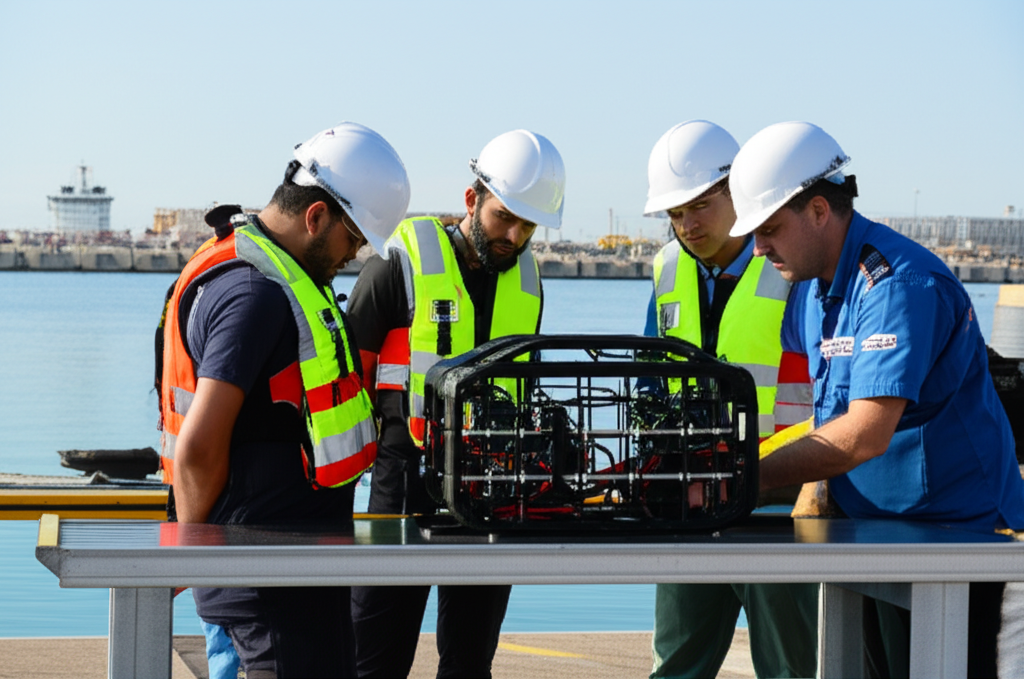
Master in Underwater Drones and Offshore Inspection

Why this master’s programme?

The Master’s in Underwater Drones and Offshore Inspection

This program offers comprehensive training in the operation and application of ROVs (Remotely Operated Vehicles) for the offshore industry. You will learn to perform visual and non-destructive inspections, underwater maintenance and repairs, and accurate data collection in challenging environments. Master the navigation, control, and manipulation technology of underwater drones, as well as data interpretation and the preparation of technical reports.

Differentiating Advantages

  • Hands-on Training: Learn with advanced simulators and real equipment, developing essential operational skills.
  • Professional Certification: Obtain industry-recognized certifications that validate your skills and increase your employability.
  • Expert Instructors: Access classes taught by professionals with extensive experience in the offshore sector and the use of underwater drones.
  • Comprehensive Knowledge: Understand regulations, risks, and best practices in offshore inspection and maintenance.
  • Career Opportunities: Connect with leading companies in the sector and access job offers in a constantly growing market.
Drones

Master in Underwater Drones and Offshore Inspection

Availability: 1 in stock

Who is it aimed at?

  • Professional engineers, technicians, and divers seeking to specialize in the inspection and maintenance of underwater structures using drones.
  • Offshore companies (oil, gas, renewable energy) wishing to optimize their inspection processes, reduce costs, and improve safety.
  • Marine researchers and scientists requiring advanced tools for the exploration and study of the underwater environment.
  • Engineering, oceanography, and robotics students seeking cutting-edge training in the field of underwater drones.
  • Marine safety and rescue professionals interested in the inspection of ship hulls and structures submerged.

Flexibility and specialization
 Master’s program designed for active professionals: online format with optional in-person internships, updated content, and faculty experts in the offshore sector.

Drones

Objectives and skills

Master the operation and maintenance of ROVs for the inspection of underwater infrastructure.

“Perform visual and non-destructive inspections, interpret data, and prepare accurate technical reports.”

Interpreting and analyzing inspection data for informed decision-making:

“Identify trends and anomalous patterns in inspection data, assessing their potential impact on safety and operational efficiency to prioritize corrective actions.”

Manage offshore inspection projects using underwater drones, optimizing resources and complying with regulations:

“Implement predictive and corrective maintenance plans for drones, minimizing downtime and maximizing operational efficiency.”

Develop innovative solutions for specific challenges in offshore underwater inspection:

Implementing machine vision and deep learning techniques for the automatic detection of anomalies in underwater structures, reducing inspection times and improving accuracy.

Applying advanced navigation and ROV control techniques in complex offshore environments:

“Operate ROVs with precision in high current and limited visibility conditions, using acoustic positioning systems and advanced robotic manipulation tools.”

Evaluate the structural integrity of underwater assets using advanced non-destructive inspection technologies:

“Identify and apply NDT (Non-Destructive Inspection) methodologies such as UT, ACFM, ECT, and Digital Radiography, interpreting data to determine the condition of the asset and report critical findings.”

Study plan – Modules

  1. Fundamentals of Underwater Robotics: Design, Types, and Specific Applications in Offshore Environments
  2. Propulsion and Maneuvering Systems: Thrusters, Dynamic Stabilization, Attitude Control, and Position Hold
  3. Advanced Sensor Architectures: Multibeam Sonar, Underwater LiDAR, Hyperspectral Cameras, and Inertial Motion Units (IMUs)
  4. Communication and Data Transmission in Marine Environments: Acoustic, Optical, and RF Technologies, Protocols, and Limitations
  5. Integrating Artificial Intelligence for Autonomous Navigation and Real-Time Detection of Structural Anomalies
  6. Offshore Non-Destructive Testing (NDT) Methods: Ultrasound Techniques, Eddy Currents, Magnetic Induced Currents, and Infrared Thermography Applied to Underwater Structures
  7. Modeling and Simulation of Inspection Scenarios: Prediction Failure analysis using fatigue and corrosion analysis in metals and composites

    International standards and regulations applicable to offshore inspection and underwater drone operations

    Safety and risk management protocols: procedures to minimize operational and environmental impacts in sensitive marine environments

    Case studies and real-world experiences: detailed analysis of inspections carried out on offshore platforms, pipelines, and submarine cables using advanced underwater drones

  1. Fundamentals of Underwater Autonomous Systems: Architecture, Advanced Sensors, and Actuators
  2. Mechanical and Electronic Design of Underwater Drones: Material Selection, Waterproofing, and Communication Links
  3. Hydrodynamic Modeling and Stability Control in Offshore Environments: CFD Simulation Techniques and Experimental Validation
  4. Autonomous Navigation Algorithms: Localization Using SLAM, Sensor Fusion, and Real-Time Processing of Acoustic and Optical Data
  5. Mission Planning Strategies: Optimal Route Generation, Dynamic Obstacle Avoidance, and Energy Management
  6. Integration of Inspection Technologies: Multispectral Cameras, Side-Scan Sonar, Underwater LiDAR, and Corrosion Sensors
  7. Operational Protocols in Offshore Scenarios: Deployment, Recovery, Adverse Environmental Conditions, and Risk Mitigation
  8. Optimizing Operational Efficiency: Data Analysis, Predictive Maintenance, and Machine Learning Algorithms for Continuous Improvement
  9. Regulations and Standards Applicable to Autonomous Underwater Systems in Offshore Inspection: Certifications, Safety, and Compliance
  10. Advanced Case Studies: Practical Application on Oil Platforms, Subsea Cables, and Offshore Wind Structures
  1. Fundamentals of Underwater Robotics: Design, Structure, and Materials Resistant to Corrosion and Hydrostatic Pressure
  2. Propulsion and Maneuverability Systems in Underwater Drones: Thruster Analysis, Vector Control, and Stability in Dynamic Offshore Environments
  3. Advanced Sensor Technologies: Multibeam Sonar, Hyperspectral Cameras, Underwater LiDAR, and Magnetometry for Mapping and Detection
  4. Integration of Underwater Navigation Systems: INS, DVL, USBL, and Their Fusion for Precise Positioning in Deep Water
  5. Underwater Communication: Acoustic, Optical, and Electromagnetic Methods, Challenges, and Solutions for Real-Time Transmission
  6. Applications of Artificial Intelligence and Machine Learning for Recognition, Anomaly Classification, and Autonomous Decision-Making in Offshore Inspection
  7. Innovative Non-Digital Inspection Techniques
  8. Destructive Testing (NDT): Phased array ultrasound, eddy current testing, digital radiography, and infrared thermography applied to underwater structures

    Safety and operational protocols in offshore environments: risk mitigation, international regulations, and emergency management

    Case studies and analysis of current projects: predictive maintenance, early detection of corrosion and structural failures on oil platforms and offshore wind farms

    Future and trends in underwater robotics: collaborative drones, remote manipulation, and mass deployment in comprehensive inspection

  1. Applicable International Regulations and Certifications: Detailed analysis of IMO, IHO, API regulations, and DNV GL standards for the safe operation of underwater drones in offshore environments.
  2. Risk Assessment and Comprehensive Safety Management: HAZID and HAZOP methodologies adapted to operations with autonomous submersible vehicles, including threat identification and mitigation on offshore platforms.
  3. Advanced Underwater Mission Planning: Definition of objectives, route design, environmental analysis, and deployment logistics in dynamic offshore conditions.
  4. Underwater Acoustic Communications: Physical principles, modulation technologies, and specific protocols for reliable links between drones and base stations, including interference and latency mitigation.
  5. Multisensor Integration in Underwater Drones: Configuration and fusion of data from multibeam sonar, underwater LIDAR, and sensors High-precision inertial sensors, spread spectrum cameras, and magnetometers.

    Preventive maintenance and calibration protocols to ensure operational accuracy and durability of sensors and systems during critical inspections on offshore platforms.

    Advanced data analysis: real-time and post-mission processing with artificial intelligence algorithms, machine learning, and predictive models for detecting structural anomalies and corrosion.

    Implementation of operational data management systems (DMS) and quality control to meet international standards and the requirements of the oil and energy industry.

    Emergency and contingency procedures: recovery protocols, communication failure procedures, safe autonomous navigation, and redundancy strategies to minimize operational risks.

    Training in multidisciplinary team management and technical leadership to oversee complex operations in offshore environments, ensuring regulatory compliance and industrial safety standards.

  1. Fundamentals of Advanced Underwater Navigation: Hydrodynamic Principles and Kinematics in Complex Marine Environments
  2. Modeling and Simulation of Dynamic Motions of Underwater Vehicles: Analysis of Forces, Moments, and Stability in Variable Ocean Currents
  3. Design and Optimization of PID and Adaptive Control Systems for Position and Trajectory Maintenance in Autonomous Underwater Vehicles (AUVs)
  4. Multisensor Integration for Navigation: Fusion of Data from Inertial Measurement Units (IMUs), Acoustic Positioning Systems (USBLs, LBLs), and Doppler Navigational Lighting (DVLs) for Accuracy in Offshore Environments
  5. 3D Mapping and Reconnaissance of Offshore Structures Using Multibeam Sonar and Underwater LiDAR Technology: Reconstruction Algorithms and Real-Time Data Processing
  6. Autonomous Route Planning and Dynamic Obstacle Avoidance in Underwater Environments with Variable Topography and Turbulence
  7. Advanced adaptive control techniques to compensate for the effects of waves, turbulence, and wind on the surface during inspection missions
  8. Communication and data link protocols in underwater vehicles: acoustic waves, modulation, range, and interference mitigation in extreme offshore conditions
  9. Implementation of artificial intelligence and machine learning algorithms for predicting and correcting deviations in navigability and positioning
  10. Operational procedures for offshore infrastructure inspection: integration of navigation systems with command platforms and real-time risk analysis
  11. Evaluation and management of operational safety in underwater operations: regulations, mitigation of system failures, and recovery strategies in the event of critical failures
  12. Energy optimization in propulsion and control systems to extend autonomy in extended offshore inspection missions
  13. Study of hydrodynamic profiles to improve maneuverability and minimize environmental and structural impacts during operations delicate
  14. Advanced simulation and training in virtual environments for the operation and control of underwater drones in complex offshore scenarios

    Post-mission analysis and technical report: interpretation of navigation data, performance evaluation, and continuous optimization of dynamic control

  1. Fundamentals and evolution of disruptive technologies in underwater robotics: from remotely operated vehicles (ROVs) to autonomous underwater vehicles (AUVs)
  2. Advanced propulsion systems: design and dynamics of hydraulic, electric, and acoustic thrusters for efficient maneuverability in offshore environments
  3. Integrated architecture of multispectral and multifrequency sensors for underwater inspection: multibeam sonar, hyperspectral cameras, underwater LIDAR, and flow sensors
  4. Artificial Intelligence and Machine Learning applied to perception, decision-making, and autonomous navigation in complex and dynamic environments
  5. Underwater communication networks: acoustic, optical, and electromagnetic technologies for real-time data exchange and their impact on offshore operations
  6. Innovative predictive maintenance and diagnostic strategies based on digital twins and big data analytics for infrastructure Critical Offshore Systems
  7. Adaptive and Robust Control: Algorithms for the Stabilization and Control of Underwater Drones in Extreme Conditions of Pressure, Currents, and Limited Visibility

    Integration of Robotic Systems on Offshore Platforms: Protocols, Interfaces, and Standards to Ensure Interoperability and Operational Safety

    Practical Applications of Autonomous Robotics in the Inspection, Repair, and Environmental Monitoring of Oil, Gas, and Renewable Energy Platforms and Subsea Structures

    International Standards and Certifications Applicable to the Operation of Autonomous Offshore Robotic Systems: ISO, IMCA, DNV GL, and Industry Guidelines

  1. Fundamentals of hydraulics and pneumatics applied to underwater systems: principles, actuator control, and technical specifications
  2. Architecture of autonomous and non-autonomous systems: sensors, processors, actuators, communication, and distributed control architecture
  3. Design and selection of materials for extreme marine environments: corrosion, fatigue, biofouling, and resistance to hydrostatic pressure
  4. Propulsion systems: electric, hydraulic, and hybrid; Energy efficiency and consumption optimization in offshore operations

    Integration of Inertial Navigation Systems (INS) and Global Positioning System (GNSS) for precise control in complex underwater environments

    Advanced development and programming of control algorithms for autonomous piloting: SLAM, waypoint navigation, obstacle avoidance, and optimal routes

    International protocols and standards for underwater communication: acoustic, optical, and electromagnetic, with latency and signal quality analysis

    Regulations and certifications applicable to underwater vehicles and offshore systems: classification, inspection, and compliance with ISO and API standards

    Operational planning in complex inspections: risk analysis, environmental studies, assembly, and deployment of real-time monitoring systems

    Safety systems in remote operations: redundancy, fail-safe, emergency management, and recovery from critical failures

    Advanced methodologies for non-destructive inspection (IND) Underwater drones: ultrasound, eddy currents, and intelligent visual recognition

    Integration of artificial intelligence and machine learning for automatic anomaly detection and optimization of inspection routes

    Human factors and ergonomics in the operation of autonomous and semi-autonomous systems: human-machine interfaces, training, and operating protocols

    Analysis of real-world cases and advanced simulation in virtual environments for design validation and safe operation of underwater drones on offshore platforms

    Predictive and preventive maintenance practices: sensor calibration, firmware updates, and vehicle lifecycle management

  1. Fundamental principles of multimodal sensors in underwater environments: types, characteristics, and specific applications for underwater drones
  2. Integration of LIDAR and SONAR technologies: data fusion methods for three-dimensional mapping and precise detection of offshore structures
  3. Development and optimization of distributed sensor networks: architecture, protocols, and redundancy to ensure reliability in extreme environments
  4. Underwater acoustic communication: physical principles, modulation, coding, and advanced techniques for real-time data transmission
  5. Optical and electromagnetic communication systems in the ocean: limitations, innovations, and case studies in offshore inspection
  6. Advanced signal processing and adaptive filtering for improved data quality in noisy and turbulent environments
  7. Multimodal synchronization and calibration algorithms to ensure temporal and spatial coherence in Measurements
  8. Implementation of artificial intelligence and machine learning for predictive analysis and early detection of failures in underwater infrastructure
  9. Predictive maintenance based on sensor data: key metrics, degradation models, and proactive intervention strategies
  10. Safety protocols and international regulations applicable to the operation of drones and communication systems in sensitive offshore environments
  1. Introduction to Underwater Robotics: Historical Evolution, Key Milestones, and Technical Challenges in Deep-Sea Environments
  2. Underwater Drone Design and Architecture: Detailed Analysis of Structures, Advanced High-Resistance Corrosion-Resistant Materials, and Electric and Hydraulic Propulsion Systems
  3. Autonomous Navigation and Control Systems: Integration of Inertial Positioning Algorithms (INS), Ultrasonic Navigation, Underwater SLAM, and Multisensor Fusion for Operations in GPS-Denied Environments
  4. Advanced Sensing for Offshore Inspection: Multibeam Sonar Technologies, Adaptive Underwater LiDAR, Hyperspectral Cameras, and Current and Temperature Sensors for Detailed Structural Monitoring
  5. Underwater Communication Protocols: Acoustic Transmission Techniques, Digital Modulation, and Mesh Networks for Real-Time Remote Control and Efficient Data Transfer
  6. Artificial Intelligence and Machine Learning Applied to Anomaly Detection: Development of Predictive Models and Recognition of Deterioration Patterns
  7. and automated damage classification of marine infrastructure.

    Advanced inspection and preventive maintenance strategies: autonomous mission planning, route optimization, and use of digital twins to simulate operating conditions and predict structural failures.

    Robotic handling systems for offshore interventions: development of robotic arms, modular tools, and force control for repair and maintenance in complex environments.

    International standards and regulations applicable to offshore operations with underwater drones: legal compliance, equipment certification, and industrial safety protocols.

    Analysis of success stories and future trends: integration of underwater 5G, collaborative robotics between ROVs and AUVs, and applications in marine renewable energy and scientific exploration.

  1. Objectives and Scope of the Final Project: definition and delimitation of the inspection and predictive maintenance project for offshore infrastructure using autonomous underwater drones.
  2. Comprehensive Design of the Autonomous System: technical specifications, hardware and software integration, control and communication architectures for underwater operation in offshore environments.
  3. Modeling and Simulation of Autonomous Navigation: development of dynamic and kinematic models, adaptive control algorithms, and optimization for precise maneuvers in adverse maritime conditions.
  4. Advanced Sensors for Inspection: selection and integration of multispectral sensors, high-resolution sonar, hyperspectral cameras, and underwater LIDAR technologies for detection and detailed analysis of structures.
  5. Real-Time Processing and Data Analysis: implementation of computer vision algorithms, machine learning, and sensor fusion techniques for automatic classification of damage and structural anomalies.
  6. Predictive Maintenance Protocols: Development of predictive models based on artificial intelligence to anticipate failures, intervention planning, and optimization of the infrastructure’s lifecycle.
  7. Offshore Condition Assessment: Detailed study of currents, waves, temperature, and salinity, and their impact on the operation of the autonomous system and structural integrity.
  8. Submarine Telecommunications Integration: Design of robust communication systems, real-time data transmission protocols, redundancy, and failover for safe remote operation.
  9. Safety Regulations and Standards: Comprehensive analysis of international and local regulations applicable to underwater drone operations in offshore environments, including certifications and best practices.
  10. Project Planning and Execution: Detailed schedule, resource management, risk analysis and mitigation, using agile methodologies and advanced technology project management techniques.
  11. Validation and Verification of the System: laboratory testing and trials in controlled and real-world environments, performance metrics, sensor calibration, and evaluation of system autonomy and reliability.

    Technical Report Development and Results Presentation: preparation of rigorous technical documentation, advanced data visualization, and preparation for oral presentation before an expert committee.

    […]

Career prospects

“`html

  • Offshore Inspection Technician with Underwater Drones: Inspection of underwater structures, oil platforms, offshore wind farms, etc.
  • ROV (Remotely Operated Vehicle) Operator: Operation and maintenance of ROVs for inspection, repair, and maintenance tasks in underwater environments.
  • Underwater Surveying and Mapping Specialist: Creation of maps and 3D models of the seabed using underwater drones equipped with advanced sensors.
  • Underwater Technology Consultant: Advising companies and institutions on the application of underwater drones in various sectors.
  • Underwater Robotics Researcher: Development of new technologies and applications for underwater drones in the scientific and technological fields.
  • Offshore Project Manager with Underwater drones: Planning, coordination, and supervision of projects involving the use of underwater drones in the offshore sector.

    Expert in predictive maintenance of underwater infrastructure: Using data collected by underwater drones to predict failures and optimize the maintenance of underwater structures.

    Trainer in the operation of underwater drones: Delivering courses and workshops to train professionals in the safe and efficient use of underwater drones.

    “`

Entry requirements

Academic/professional profile:

Bachelor’s degree in Nautical Science/Maritime Transport, Naval/Marine Engineering or a related qualification; or proven professional experience on the bridge/in operations.

Language proficiency:

Functional Maritime English (SMCP) recommended for simulations and technical materials.

Documentation:

Updated CV, copy of qualification or seaman’s book, national ID/passport, motivation letter.

Technical requirements (for online):

Device with camera/microphone, stable internet connection, monitor ≥ 24” recommended for ECDIS/Radar-ARPA.

Admissions process and dates

Online
application

(form + documents).

Academic review and interview

Admissions decision

Admissions decision

(+ scholarship offer if applicable).

Place reservation

(deposit) and enrolment.

Induction

(access to the virtual campus, calendars, simulator guides).

Scholarships and financial support

  • Comprehensive Mastery: Learn to operate underwater drones (ROVs) in offshore environments, from planning to executing inspections.
  • Advanced Technology: Delve into the handling of sensors, navigation, and control systems specific to underwater inspection with ROVs.
  • Professional Certification: Obtain a recognized qualification that will open doors to a booming career in the offshore and underwater industry.
  • Real-World Practice: Participate in simulations and practical projects that will allow you to apply your knowledge in real-world inspection scenarios.
  • Industry Experts: Learn from Experienced professionals in the operation and inspection of ROVs in the offshore industry, guaranteeing practical and up-to-date learning. Boost your career and become a highly sought-after specialist in the underwater inspection sector.

Testimonials

Frequently asked questions

Yes. The itinerary includes ECDIS/Radar-ARPA/BRM with harbor, ocean, fog, storm, and SAR scenarios.

Online with live sessions; hybrid option for simulator/practical placements through agreements.

Recommended functional SMCP. We offer support materials for standard phraseology.

Yes, with a relevant degree or experience in maritime/port operations. The admissions interview will confirm suitability.

Optional (3–6 months) through Companies & Collaborations and the Alumni Network.

Simulator practice (rubrics), defeat plans, SOPs, checklists, micro-tests and applied TFM.

A degree from Navalis Magna University + operational portfolio (tracks, SOPs, reports and KPIs) useful for audits and employment.

  1. Objectives and Scope of the Final Project: definition and delimitation of the inspection and predictive maintenance project for offshore infrastructure using autonomous underwater drones.
  2. Comprehensive Design of the Autonomous System: technical specifications, hardware and software integration, control and communication architectures for underwater operation in offshore environments.
  3. Modeling and Simulation of Autonomous Navigation: development of dynamic and kinematic models, adaptive control algorithms, and optimization for precise maneuvers in adverse maritime conditions.
  4. Advanced Sensors for Inspection: selection and integration of multispectral sensors, high-resolution sonar, hyperspectral cameras, and underwater LIDAR technologies for detection and detailed analysis of structures.
  5. Real-Time Processing and Data Analysis: implementation of computer vision algorithms, machine learning, and sensor fusion techniques for automatic classification of damage and structural anomalies.
  6. Predictive Maintenance Protocols: Development of predictive models based on artificial intelligence to anticipate failures, intervention planning, and optimization of the infrastructure’s lifecycle.
  7. Offshore Condition Assessment: Detailed study of currents, waves, temperature, and salinity, and their impact on the operation of the autonomous system and structural integrity.
  8. Submarine Telecommunications Integration: Design of robust communication systems, real-time data transmission protocols, redundancy, and failover for safe remote operation.
  9. Safety Regulations and Standards: Comprehensive analysis of international and local regulations applicable to underwater drone operations in offshore environments, including certifications and best practices.
  10. Project Planning and Execution: Detailed schedule, resource management, risk analysis and mitigation, using agile methodologies and advanced technology project management techniques.
  11. Validation and Verification of the System: laboratory testing and trials in controlled and real-world environments, performance metrics, sensor calibration, and evaluation of system autonomy and reliability.

    Technical Report Development and Results Presentation: preparation of rigorous technical documentation, advanced data visualization, and preparation for oral presentation before an expert committee.

    […]

Request information

  1. Complete the Application Form.

  2. Attach your CV/degree certificate (if you have it to hand).

  3. Indicate your preferred cohort (January/May/September) and whether you would like the hybrid option with simulator sessions.

    An academic advisor will contact you within 24–48 hours to guide you through the admission process, scholarships, and compatibility with your professional schedule.

Please enable JavaScript in your browser to complete this form.
Click or drag a file to this area to upload.

Faculty

0
    0
    Tu carrito
    Tu carrito esta vacíoRegresar a la tienda
    Scroll to Top


