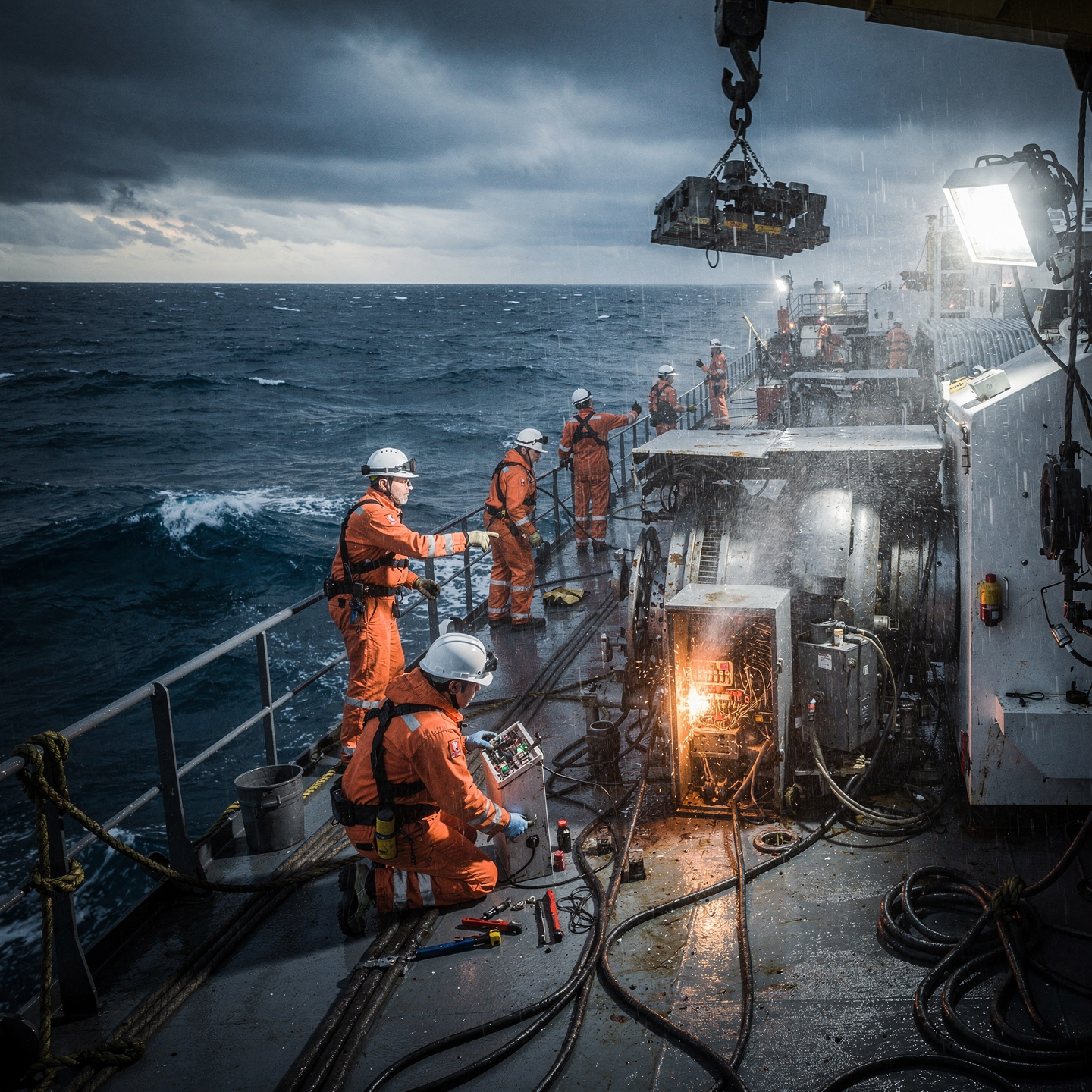
Master’s Degree in Emergency Offshore Repairs

Why this master’s programme?

The Master’s Degree in Emergency Repairs at Sea

This program trains you to lead and execute critical interventions in challenging maritime environments. You will learn to diagnose and troubleshoot failures in main and auxiliary machinery, electrical and electronic systems, and naval structures, minimizing downtime and ensuring vessel safety. This program combines advanced theoretical knowledge with intensive practical simulations, preparing professionals to face emergency situations efficiently and decisively.

Differential Advantages

  • Innovative Repair Techniques: underwater welding, composite repair, onboard 3D printing.
  • Crisis Management and Logistics: team coordination, resource optimization, and effective communication in stressful situations.
  • Safety and Regulatory Compliance: safety protocols, international regulations, and risk management at sea.
  • Real-Life Scenario Simulation: dealing with complex breakdowns, adverse weather conditions, and resource limitations.
  • Networking Professional: Contact with experts in the naval industry and career development opportunities.

Master’s Degree in Emergency Offshore Repairs

Availability: 1 in stock

Who is it aimed at?

  • Naval and marine engineers seeking to specialize in fast and effective solutions for critical breakdowns at sea.
  • Technical superintendents and maintenance managers interested in minimizing downtime and optimizing fleet availability.
  • Chief engineers and deck officers wishing to expand their knowledge of innovative repair techniques and emergency management at sea.
  • Salvage and ship repair companies seeking to train their personnel in fast and safe intervention methodologies under extreme conditions.
  • Maritime consultants and surveyors needing in-depth knowledge of the latest technologies and procedures in emergency repairs for their evaluations.

Flexibility and applicability
 Adapted for high-demand professionals: online format with practical case studies, access to industry experts, and focus on solving real-world problems.

Objectives and skills

Diagnose and resolve critical faults quickly:

“Analyze the available information (instruments, alarms, reports) to identify the root cause and apply emergency/contingency procedures prioritizing navigational safety and environmental protection.”

Coordinate multidisciplinary teams in adverse maritime environments:

“Establish clear roles and responsibilities, facilitating effective communication and decision-making under pressure, prioritizing safety and regulatory compliance.”

Master underwater welding and repair techniques:

“Perform welding and cutting with coated electrodes (SMAW), GTAW (TIG) and FCAW, following AWS D3.6 procedures and applying non-destructive inspection (NDT) techniques to guarantee structural integrity.”

Implement rigorous safety protocols in maritime emergency operations:

Establish security perimeters, control access and encrypted communications, prioritizing the integrity of information and the chain of custody of evidence.

Restoring the operability of vital systems on damaged ships:

“Assess damage, prioritize critical repairs, and restore power, propulsion, governance, and communications.”

Efficiently managing limited resources in emergency situations:

Prioritize vital needs (water, food, shelter, communication), optimize the use of emergency equipment, and establish clear rationing and distribution protocols.

Study plan – Modules

  1. Fundamentals of Critical Systems in Marine Machinery: Classification, Structure, and Basic Operation
  2. Advanced Diagnostics: Non-destructive techniques, vibration analysis, infrared thermography, and ultrasound applied to vital components
  3. Interpretation of Real-Time Operating Parameters: Pressure, Temperature, Flow Rate, and Revolutions in Main and Auxiliary Equipment
  4. Early Failure Detection: Common Patterns in Propulsion Systems, Pumps, Compressors, and Electric Generators
  5. Rapid Assessment Protocols: Prioritization of Interventions Based on Criticality and Operational Risk
  6. Emergency Repairs: Temporary Patching Techniques, Hot Welding, Hot Replacement, and Quick Couplings
  7. Safe Isolation and Lockout Procedures for Immediate Repairs in Confined Spaces and High-Pressure Areas
  8. Advanced Tools and Materials for
  9. Repair: Selection, Handling, and Storage for Offshore Interventions
  10. Integration of Remote Monitoring and Predictive Diagnostic Systems for Real-Time Support During Repairs
  11. Detailed Case Studies: Resolving Critical Failures Under Adverse Conditions and Technical Limitations
  12. Risk and Safety Management During Emergency Repairs: Planning, Communication, and Multidisciplinary Coordination
  13. Technical Documentation and Post-Repair Reports: Formats, Records, and Communication with Onshore and Offshore Teams
  14. Optimizing Repair Time Through Lean Methodologies Applied to Emergency Management in Naval Machinery
  15. Virtual Hands-on Workshop and Advanced Simulations to Reinforce Learning of Diagnostic Techniques and Immediate Repairs
  1. Advanced fault diagnosis in propulsion systems: identification of critical mechanical and electrical faults using vibration analysis, thermography, and ultrasound techniques applied to diesel engines and marine turbines.
  2. Emergency intervention protocols: a systematic framework for safe and effective intervention, from initial detection to operational recovery, integrating international regulations and naval industry standards.
  3. Specialized tools for onboard repairs: selection, handling, and calibration of portable hydraulic, electrical, and electronic equipment designed for rapid interventions in adverse conditions at sea.
  4. Operational safety in confined spaces and hazardous areas: establishment of procedures for the prevention of electrical accidents, inhalation of toxic gases, and handling of hazardous materials during critical repairs.
  5. Integration and commissioning of emergency power generation systems: techniques for restoring circuits and synchronizing auxiliary generators under safety-limiting conditions.
  6. and time.

  7. Temporary Repairs and Interim Solutions: Application of marine technical DIY techniques to ensure the continued functionality of vital systems, including onboard welding and quick-coupling systems.
  8. Post-Repair Assessment and Predictive Maintenance: Implementation of remote monitoring systems and data analysis to anticipate future failures and optimize the lifespan of repaired equipment.
  9. Team and Role Management During Emergencies: Coordination of the multidisciplinary technical team, effective communication under pressure, and leadership in critical situations according to STCW and SOLAS regulations.
  10. Post-Intervention Documentation and Reporting Protocols: Preparation of detailed technical reports, compliance with audit requirements, and record-keeping for maintaining official certifications.
  11. Case Studies and Advanced Simulations: Study of real-world incidents, resolution of complex problems, and adoption of best practices to reduce downtime and associated risks in operations maritime.
  1. Advanced Introduction to Technological Innovation Applied to Critical Marine Systems: Trends, Smart Materials, and Automation
  2. In-Depth Analysis of Predictive and Prescriptive Diagnostics: Integrated Sensors, Marine IoT, Artificial Intelligence, and Predictive Maintenance
  3. Protocols and Techniques for Structural Assessment in High-Pressure and Saltwater Corrosion Environments: Ultrasound, Thermography, and Non-Destructive Testing
  4. Design and Execution of Immediate Repairs: Containment Strategies, Temporary Reinforcements, and Sealing in Adverse Conditions
  5. Advanced Management of Rescue and Recovery of Critical Systems During Maritime Emergencies: Multidisciplinary Coordination, Satellite Communication, and Real-Time Simulations
  6. Operational Safety and International Regulations Applicable to Emergency Interventions at Sea: SOLAS, IMO, Environmental Protocols, and Certifications
  7. Innovative methodologies for damage control and catastrophic failure prevention: dynamic risk analysis and application of redundant systems

    Telemetry and remote monitoring capabilities for continuous supervision of repairs and structural stability on platforms and vessels

    Application of underwater robots and drones in inspection and repair: advanced techniques, limitations, and case studies

    Digital simulation and augmented reality for training and planning urgent repairs in complex maritime scenarios

    Personal and collective safety protocols in highly complex environments: use of specialized PPE, risk assessment, and evacuation procedures

    Technical documentation and repair reports with a focus on quality standards and traceability for international audits

    Study of real-world cases and lessons learned in maritime emergencies: critical analysis of successful interventions and continuous process improvements

  1. Emergency Command and Control at Sea: Command structure, decision-making under pressure, interdepartmental coordination, and effective leadership during critical situations
  2. Emergency Communication Protocols: Advanced use of VHF/HF radio communications, satellite (Inmarsat, Iridium), distress and position signals (EPIRB, SART), and management of internal and external networks
  3. Emergency Logistics and Resource Management: Planning and mobilization of material and human resources, management of critical inventories, rapid provisioning, and optimization of auxiliary resources
  4. Advanced Structural Damage Assessment: Identification, categorization, and prioritization of damage to the hull, superstructure, and critical systems using immersive techniques and remote sensing
  5. Marine Intervention Welding: Specialized welding techniques in aggressive atmospheres, portable equipment, welding in confined spaces, and under ambient conditions adverse conditions
  6. Certifications and regulations applicable to urgent repairs: compliance with SOLAS, CLASS, ISO, and specific maritime standards for rapid interventions

    Introduction to NDT (Non-Destructive Testing) inspection methods: principles, applications, and protocols for evaluating the integrity of welds and materials at sea (ultrasound, magnetic particle, penetrant testing, and radiography)

    Development and execution of salvage plans: risk assessment, action phases, coordination with external teams, and international legal frameworks

    Operational continuity during emergencies: techniques for maintaining essential systems, energy management, auxiliary equipment, and procedures to ensure the operational stability of the vessel

    Simulations of real-world damage control scenarios: design, response evaluation, and results analysis to improve response capabilities to complex incidents at sea

  1. Fundamentals of Integrated Maritime Emergency Management: Risk Assessment, Critical Point Identification, and Specific Vulnerability Analysis
  2. Development of Strategic Rapid Response Plans: Structure, Protocols, Resource Allocation, and Interdisciplinary Coordination
  3. Technical Leadership in High-Pressure Situations: Advanced Cognitive Skills, Evidence-Based Decision Making, and Management of Multidisciplinary Teams
  4. International Regulations and Applicable Standards for Emergency Repairs at Sea: SOLAS, IMO, ISM, and Naval Classification Guidelines
  5. Effective Communication in Emergencies: Integrated Maritime Communication Systems, Critical Data Transmission, and Information Crisis Management
  6. Advanced Technologies for Monitoring and Controlling Repairs in Harsh Environments: Remote Sensors, Drones, Automated Systems, and Telemetry
  7. Team Dynamics in Critical Situations: Roles, Situational Leadership, Stress Management, and Optimization of Operational Performance
  8. Analysis of real-life cases and emergency simulations: diagnoses, immediate response, and post-action evaluation for continuous improvement
  9. Contingency planning and enhanced safety protocols: design of operational alternatives, resource management, and minimization of environmental impact
  10. Integration of quality and safety management systems in emergency repairs: technical audits, incident reports, and ensuring regulatory compliance
  1. Comprehensive analysis of critical offshore systems: identification of essential components and structural vulnerabilities
  2. Advanced predictive and corrective diagnostic techniques: use of ultrasound, infrared thermography, and vibration analysis for early fault detection
  3. Non-destructive testing (NDT) protocols applied to marine machinery under extreme conditions
  4. Implementation of IoT technologies and smart sensors for real-time monitoring of onboard electrical and mechanical systems
  5. Immediate repair methodologies for hydraulic, pneumatic, and electronic systems with limited resources and optimized storage
  6. Management of redundancy and backup systems in main and auxiliary engines to ensure continuous operation
  7. Advanced isolation and safe lockout procedures in risk areas to prevent damage propagation
  8. Emergency techniques for the recovery and repair of critical communication and navigation systems during failures Simultaneous
  9. Underwater robotics and drone applications for remote inspection and repair of submerged infrastructure
  10. Design and execution of technical rescue plans: safe evacuation protocols, extraction, and specialized first aid at sea
  11. Simulations and management of critical situations using virtual reality software for training and rapid decision-making
  12. International regulations and safety standards applied to emergency repairs on vessels and oil platforms
  13. Logistics optimization and human resource management in urgent operations: coordination and communication in a multi-sectoral environment
  14. Analysis of real-world cases of complex breakdowns and practical solutions: applied learning and prevention of future incidents
  15. Post-repair technical report: documentation, traceability, and functional integrity validation for official certification
  1. Advanced diagnostics through condition analysis: real-time monitoring techniques using integrated sensors, vibration, thermography, and ultrasound for the early detection of faults in propulsion and power generation systems.
  2. Methodologies for the rapid identification of faults in critical hydraulic and pneumatic systems, including analysis of pressure, flow, and fluid contamination.
  3. Interpretation and use of telemetry and SCADA systems for remote assessment of operational status on offshore platforms and vessels.
  4. Emergency protocols for failures in navigation and communication systems: implementation of immediate procedures to restore the functionality of radars, ECDIS, AIS, and VHF/UHF radios.
  5. Specialized techniques for the on-site repair and replacement of electrical and electronic components subjected to harsh marine environments, ensuring watertightness and corrosion resistance.
  6. Application of non-invasive technologies
  7. For the detection of microcracks and internal corrosion in metal structures, pipes, and storage tanks.
  8. Express repair of propulsion systems: protocols for partial disassembly, mechanical adjustments, and defect removal in shafts, lubrication, and gears under critical conditions.
  9. Management and optimization of limited onboard resources during complex breakdowns: key indicators for rapid and effective decision-making.
  10. Integration of safety and risk prevention procedures during interventions on high-voltage electrical systems in marine environments, including shielding and energy lockout/tagout.
  11. Real-world case studies and advanced simulations of concurrent multiple failures, with the application of differential diagnostic protocols for efficient restoration of operational capability.
  1. Advanced fault diagnosis in critical naval systems: on-site identification of electrical, mechanical, and hydraulic failures under open sea conditions
  2. Comprehensive crisis management protocols: activation, coordination, and control of multidisciplinary teams in maritime emergency environments
  3. Implementation of immediate technical response procedures: optimization of reaction times and reduction of operational impact
  4. Strategic risk analysis and vulnerability assessment of vital systems: main engines, generators, propulsion and control systems
  5. Application of advanced temporary repair techniques under extreme conditions: use of composite materials, emergency welding, and watertight sealing
  6. Management and maintenance of the structural integrity of the hull and auxiliary systems during emergency operations
  7. Effective crisis communication: information exchange protocols between the bridge, engine room, and specialized technical teams
  8. Decision-making under pressure: evaluation methodologies Rapid response, prioritization of critical failures, and efficient resource allocation.

    Handling of specialized tools and equipment for emergency interventions: digital diagnostic systems, remote sensors, and real-time monitoring devices.

    International regulations and standards applicable to emergency repairs at sea: SOLAS, IMCA, ISM, and OCIMF recommendations.

    Case studies and advanced simulations of incidents at sea: analysis of real-life situations and development of comprehensive technical solutions.

    Planning and execution of contingency plans for the maintenance of critical naval systems: prevention and response to multiple failures.

    Post-incident evaluation: preparation of detailed technical reports, root cause analysis, and proposals for continuous improvement in emergency protocols.

    Integration of IoT technology and SCADA systems for real-time monitoring and preventive failure management.

    Training in leadership and management of technical teams during critical operations at sea, including aspects Psychological factors and stress management

  1. Advanced Fundamentals in Fault Diagnosis: Symptom Identification, Root Cause Analysis, and Prioritization in Maritime Emergency Contexts
  2. Instrumentation and Sensors in Critical Systems: Operation and Calibration Under Dynamic and Adverse Conditions (Pressure, Vibration, Salt Spray)
  3. Non-Destructive Testing (NDT) Techniques Applied to Marine Structures and Components: Ultrasound, Thermography, Eddy Currents, and Augmented Visual Analysis
  4. Remote Diagnostic Procedures: Use of Telemetry, Underwater Drones, and Artificial Intelligence to Assess Damage Without Endangering the Crew
  5. Methodologies for Rapid Structural Integrity Assessment of Hull, Piping, and Auxiliary Systems
  6. Immediate Repair Protocols: Material Selection, Application and Temporary Patching Techniques, Cold Welding, and Use of Specialized Marine Adhesives
  7. Management and Optimization Time management during emergency interventions: simultaneous planning and coordination with safety and firefighting systems

    Integration of life support systems and environmental control in repair areas: atmosphere balance, ventilation, and hazardous gas monitoring

    International regulations and applicable technical standards for emergency repairs: SOLAS, IMO, ISO 19901, and predictive maintenance codes

    Advanced simulation of emergency scenarios using virtual reality to train and test diagnostic and repair protocols at sea

  1. Introduction to Emergency Offshore Repairs: Operational Context and Challenges Inherent in Harsh Marine Environments
  2. Advanced Methodologies for Structural Damage Assessment: Identification, Diagnosis, and Prioritization Using Non-Destructive Techniques and Materials Analysis
  3. Design and Planning of Critical Interventions in Adverse Conditions: Resource Management, Response Times, and Risk Assessment
  4. Application of Emerging Technologies for Rapid Repairs: 3D Printing of Onboard Parts, Use of Composite Materials, and High-Strength Structural Adhesives
  5. Integration of Automated Systems and Sensors for Real-Time Monitoring During Repairs: SCADA Systems, Maritime IoT, and Structural Condition Telemetry
  6. Safety and Incident Mitigation Protocols During Critical Repairs: Work Area Analysis, Confined Space Management, and Environmental Pollution Prevention
  7. Advanced Welding and Joining Techniques in Extreme Marine Conditions: Controlled Processes, Inspection, and Certification in Accordance with Standards International (AWS, DNV-GL)

    Logistics and supply chain management at sea: team coordination, material distribution, and effective communication with shore-based command centers
    Simulation and predictive modeling of post-repair structural failure scenarios: software tools and fatigue and corrosion analysis
    Final integration: development of a comprehensive critical repair project, applying technical, regulatory, and sustainability criteria to guarantee the vessel’s operability and safety

Career prospects

“`html

  • Offshore Platform Repair Technician: Maintenance and repair of critical equipment in demanding marine environments.
  • Maintenance Supervisor on Specialized Vessels: Coordination and supervision of repair teams at sea.
  • Project Engineer in Marine Engineering Companies: Design and management of repair and maintenance projects on offshore infrastructure.
  • Technical Consultant in Maritime Salvage Companies: Damage assessment and planning of salvage operations at sea.
  • Repair Inspector for Marine Insurance Companies: Damage assessment and supervision of repairs to ensure compliance with regulations.
  • Underwater Welding and Structural Repair Specialist: Performing complex welding and repairs on submerged structures.
  • Logistics and Procurement Manager for Offshore repairs: Coordination of the supply of equipment and materials for urgent repairs.

    Researcher and developer of new marine repair techniques: Innovation in methods and technologies for efficient and safe offshore repairs.

    “`

Entry requirements

Academic/professional profile:

Bachelor’s degree in Nautical Science/Maritime Transport, Naval/Marine Engineering or a related qualification; or proven professional experience on the bridge/in operations.

Language proficiency:

Functional Maritime English (SMCP) recommended for simulations and technical materials.

Documentation:

Updated CV, copy of qualification or seaman’s book, national ID/passport, motivation letter.

Technical requirements (for online):

Device with camera/microphone, stable internet connection, monitor ≥ 24” recommended for ECDIS/Radar-ARPA.

Admissions process and dates

Online
application

(form + documents).

Academic review and interview

Admissions decision

Admissions decision

(+ scholarship offer if applicable).

Place reservation

(deposit) and enrolment.

Induction

(access to the virtual campus, calendars, simulator guides).

Scholarships and financial support

  • Advanced Diagnostics: Master the techniques for inspection and assessment of damage to naval structures and critical systems.
  • Repair Strategies: Learn to implement quick and effective solutions to minimize downtime and economic losses.
  • Risk Management: Develop skills for the prevention and mitigation of risks associated with repair operations in extreme conditions.
  • Innovative Technologies: Familiarize yourself with the latest tools and materials for underwater and high-seas repairs.
  • Professional Certification: Obtain an internationally recognized credential that will boost your career in the industry maritime.
Prepare to lead crucial interventions and ensure operational continuity on the high seas.

Testimonials

Frequently asked questions

Oil and gas platforms, offshore wind farms, ships and other offshore installations.

Yes. The itinerary includes ECDIS/Radar-ARPA/BRM with harbor, ocean, fog, storm, and SAR scenarios.

Online with live sessions; hybrid option for simulator/practical placements through agreements.

Structural, mechanical, electrical and piping system repairs on oil platforms, ships and other offshore installations, often under time pressure and with limited resources, to ensure safety and operational continuity.

Recommended functional SMCP. We offer support materials for standard phraseology.

Yes, with a relevant degree or experience in maritime/port operations. The admissions interview will confirm suitability.

Optional (3–6 months) through Companies & Collaborations and the Alumni Network.

Simulator practice (rubrics), defeat plans, SOPs, checklists, micro-tests and applied TFM.

A degree from Navalis Magna University + operational portfolio (tracks, SOPs, reports and KPIs) useful for audits and employment.

  1. Introduction to Emergency Offshore Repairs: Operational Context and Challenges Inherent in Harsh Marine Environments
  2. Advanced Methodologies for Structural Damage Assessment: Identification, Diagnosis, and Prioritization Using Non-Destructive Techniques and Materials Analysis
  3. Design and Planning of Critical Interventions in Adverse Conditions: Resource Management, Response Times, and Risk Assessment
  4. Application of Emerging Technologies for Rapid Repairs: 3D Printing of Onboard Parts, Use of Composite Materials, and High-Strength Structural Adhesives
  5. Integration of Automated Systems and Sensors for Real-Time Monitoring During Repairs: SCADA Systems, Maritime IoT, and Structural Condition Telemetry
  6. Safety and Incident Mitigation Protocols During Critical Repairs: Work Area Analysis, Confined Space Management, and Environmental Pollution Prevention
  7. Advanced Welding and Joining Techniques in Extreme Marine Conditions: Controlled Processes, Inspection, and Certification in Accordance with Standards International (AWS, DNV-GL)

    Logistics and supply chain management at sea: team coordination, material distribution, and effective communication with shore-based command centers
    Simulation and predictive modeling of post-repair structural failure scenarios: software tools and fatigue and corrosion analysis
    Final integration: development of a comprehensive critical repair project, applying technical, regulatory, and sustainability criteria to guarantee the vessel’s operability and safety

Request information

  1. Complete the Application Form.

  2. Attach your CV/degree certificate (if you have it to hand).

  3. Indicate your preferred cohort (January/May/September) and whether you would like the hybrid option with simulator sessions.

    An academic advisor will contact you within 24–48 hours to guide you through the admission process, scholarships, and compatibility with your professional schedule.

Please enable JavaScript in your browser to complete this form.
Click or drag a file to this area to upload.

Faculty

0
    0
    Tu carrito
    Tu carrito esta vacíoRegresar a la tienda
    Scroll to Top


