
Master’s Degree in Underwater Technology and Autonomous Underwater Vehicles (AUV/ROV)
Why this master’s programme?
The Master’s Degree in Underwater Technology and Autonomous Underwater Vehicles (AUV/ROV)
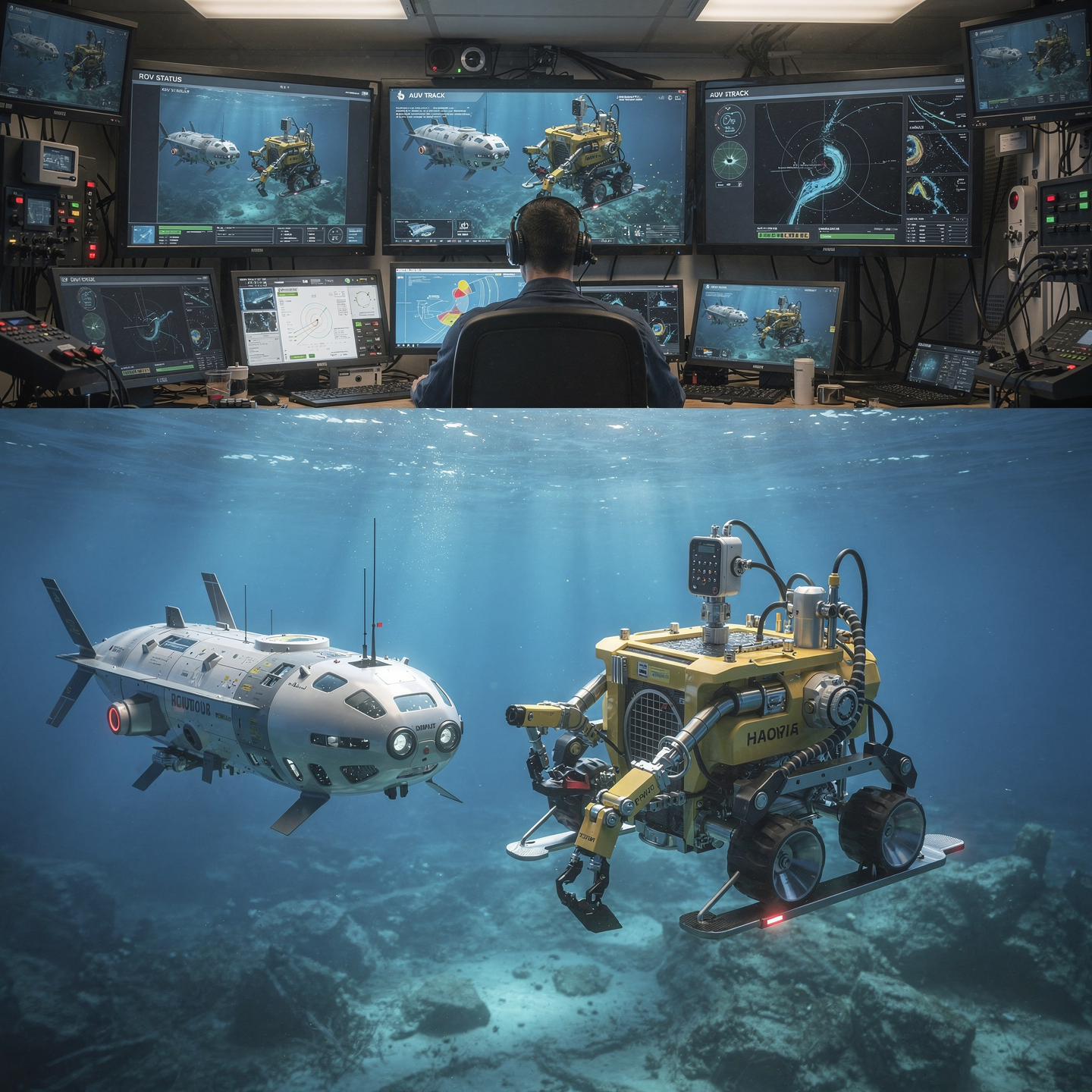
This program prepares you to lead the next generation of underwater exploration and work. Gain a comprehensive understanding of AUV/ROV systems, from their design and operation to their maintenance and application in various sectors. Delve into key areas such as underwater robotics, autonomous navigation, acoustic communication, and non-destructive inspection, acquiring the skills necessary to innovate in this constantly evolving field. This program will provide you with a solid foundation in engineering, electronics, and programming, combined with a hands-on approach through simulations, case studies, and real-world projects.
Differentiating Advantages
- Specialized Laboratories: access to state-of-the-art equipment for experimentation and development.
- Industry Collaboration: practical projects and networking opportunities with leading companies in the sector.
- Expert Faculty: active professionals with extensive experience in subsea and AUV/ROV technology.
- Multidisciplinary Approach: integrates knowledge from engineering, robotics, oceanography, and marine sciences.
- Guaranteed Career Opportunities: high demand for qualified professionals in offshore exploration and energy marine renewables and scientific research.
- Modality: Online
- Level: Masters
- Hours: 1600 H
- Start date:
Availability: 1 in stock
Who is it aimed at?
- Engineers from various disciplines (mechanical, electronic, control, software) interested in underwater robotics and ocean exploration.
- Scientists and oceanographers seeking to master technological tools for marine research and environmental monitoring.
- Offshore industry professionals (oil, gas, renewable energy) requiring specialized knowledge in underwater inspection, maintenance, and repair with AUVs/ROVs.
- Academic researchers wishing to develop innovative projects in the field of underwater automation and artificial intelligence applied to the marine environment.
- Technicians and operators of ROV/AUV professionals seeking advanced certification and skills updates in the latest technologies and methodologies.
Flexibility and specialization
Ideal for working professionals: online and blended learning options, practical industry-oriented projects, and networking with industry experts.
Objectives and skills

Design, build and operate innovative AUV/ROV systems:
“Implement modular and scalable architectures for AUV/ROV, facilitating adaptation to diverse missions and the integration of new technologies.”

Managing complex underwater projects:
“Plan in detail the phases, resources and risks, ensuring the technical and economic viability of the project.”

Develop and implement predictive maintenance strategies for underwater equipment:
“Integrating data analytics, remote monitoring, and non-destructive testing to optimize the availability and reliability of underwater assets.”

Interpreting and analyzing oceanographic and geophysical data for decision-making:
“Evaluate the quality and reliability of the data, identifying anomalies and applying appropriate corrections to model scenarios and anticipate risks.”
Leading multidisciplinary teams in complex underwater operations:
“Manage effective communication and coordination between specialists (ROVs, divers, engineers) to optimize execution and minimize risks at each stage of the operation.”

Assessing risks and ensuring safety in underwater interventions:
Implement a comprehensive risk management system, including HAZID/HAZOP analysis and robust contingency plans, adapted to the specific conditions of the underwater environment and the type of intervention, with emphasis on effective communication and change control.
Study plan – Modules
- Comprehensive Maritime Incident Management: protocols, roles, and chain of command for coordinated response
- Operational Planning and Execution: briefing, routes, weather windows, and go/no-go criteria
- Rapid Risk Assessment: criticality matrix, scene control, and decision-making under pressure
- Operational Communication: VHF/GMDSS, standardized reports, and inter-agency liaison
- Tactical Mobility and Safe Boarding: RHIB maneuvers, approach, mooring, and recovery
- Equipment and Technologies: PPE, signaling, satellite tracking, and field data logging
- Immediate Care of the Affected: primary assessment, hypothermia, trauma, and stabilization for evacuation
- Adverse Environmental Conditions: swell, Visibility, flows, and operational mitigation
Simulation and training: critical scenarios, use of VR/AR, and exercises with performance metrics
Documentation and continuous improvement: lessons learned, indicators (MTTA/MTTR), and SOP updates
- Fundamentals of Inertial and Doppler Navigation: Modern INS architecture, MEMS sensors vs. laser/FOG gyroscopes, error estimation (bias, scale, noise), error models and calibration, INS/DVL integration for drift correction, initial alignment techniques, and on-mission realignment.
- Acoustic Velocimetry (DVL) and Altimetry: DVL operating principles, bottom and water-track locking modes, resolution and accuracy, soft/rocky bottom effects, sound-speed compensation, lock validation, and lock loss strategies.
- Advanced Underwater SLAM: EKF-SLAM, Graph-SLAM, and Particle-SLAM approaches adapted to aquatic environments, uncertainty representation, loop closure with acoustic and optical data, asynchronous data management, and scalability in high-density maps.
- Acoustic perception and array processing: multibeam sonar (MBES), imaging sonar (SSS/FLS) and echo sounders; Beamforming, adaptive beamforming, object detection and classification, matched field processing (MFP), and advanced localization techniques (DOA, TDOA) in multipath and noisy environments.
- Optical sensors and underwater photogrammetry: stereo cameras, structured lighting, underwater photogrammetry, geometric and radiometric calibration, absorption and scattering correction, high-resolution 3D reconstruction, and fusion with acoustic data for semantic mapping.
- Sensor fusion and estimation filters: extended/unscented Kalman filters, information filters, particle filters, handling of rate and latency asymmetry, outlier rejection techniques, fault management, and real-time estimation reconfiguration.
- Hydrodynamic modeling and vehicle control: 6-DOF dynamic models, identification of hydrodynamic parameters, classic PID control vs. modern control (LQR, H∞, sliding) mode), adaptive and robust control for maneuvers in the presence of nonlinear currents and disturbances.
- Planning and Autonomous Guidance: local and global planning algorithms (A*, RRT*, graph search), behavior-based navigation, potential fields, dynamically constrained planning, trajectory optimization, and tracking with energy and operational safety considerations.
- Predictive Control and Mission Autonomy: Model Predictive Control (MPC) for trajectory tracking and collision avoidance, energy planning, supervisory control for mode management (deployment, bottom crossing, hover), contingency management, and real-time decision-making.
- Submarine Communications and Heterogeneous Networks: physical acoustic channel (propagation, attenuation, SSP), modulation and coding (FSK, PSK, OFDM), link protocols and MAC for low rate and high latency, acoustic/optical/RF integration, use of USV/ASV buoys/relays and delay-tolerant networks for cooperative operations.
Collaborative localization and multi-vector fleets: cooperative navigation techniques, LBL/USBL/SSBL, observation and map sharing, information consistency in distributed networks, task division, and multi-agent training and replanning under communication failures.
Mapping, representation, and data management: probabilistic occupancy maps, TSDF/voxel grids for 3D reconstruction, high-resolution bathymetric mosaics, semantic seabed labeling, and efficient map compression and transmission strategies for telemetry and post-processing.
Advanced perception and machine learning: target detection and classification using CNNs and 3D models, transfer of learning to underwater domains, online and few-shot learning, sensor-semantic fusion, explainability, and validation of ML models under operational conditions. real-world applications.
- Time synchronization and frame referencing: precise time-stamping, PTP/NTP synchronization adapted to acoustic latencies, frame transformations (body, vehicle, nav, map), extrinsic/intrinsic calibration, and management of time deviations in distributed systems.
- Mission security and cybersecurity: threat analysis and risk models specific to AUVs/ROVs, node authentication and authorization, software and firmware integrity (secure boot, digital signatures), secure communications (envelope encryption, key management), intrusion detection, and mitigation strategies to maintain mission security and availability.
- Middleware, software architecture, and closed-loop testing: comparison and application of ROS/ROS2, MOOS-IvP, and DDS; timing and QoS management in embedded software; HIL/SIL testing, simulators (UUV Simulator, Gazebo), and test benches for verification, validation, and certification of algorithms under reproducible conditions.
Operations, procedures, and standards: design of operational procedures for deployment and recovery, checklists for sensor verification, mission management and safety matrices, compliance with international standards, and best practices for safe operation in coastal and oceanic environments.
Hands-on laboratories and field exercises: calibration and testing of INS/DVL/sonar/cameras, implementation of real-time SLAM pipelines, acoustic communication exercises with commercial modems, bathymetric mapping campaign, and cybersecurity assessment in real-world scenarios. Deliverables include technical reports, reproducible code, and labeled datasets.
Case studies and industrial applications include: underwater infrastructure inspection (pipelines, cables, platforms), precision surveying and bathymetry, scientific prospecting, recovery operations and emergency response, cost-benefit analysis for AUV/ROV architecture selection, and integrated solutions at industrial scale.
This is the title of your module:
Underwater Mission Operations and Management with AUVs/ROVs: Tactical Planning, Fleet Coordination, Operational Safety, Maritime Logistics, Predictive Maintenance, and Real-Time Simulation
Integration and selection of sensors for AUV/ROV: MBES, SSS, altimeters, DVL, ADCP, CTD, magnetometers, optical and hyperspectral cameras, imaging sonars, and lasers; Selection criteria based on scientific/industrial objective and trade-off between energy consumption, bandwidth, and post-processing complexity.
Navigation and positioning systems: INS/DVL, Kalman filters, surface GNSS integration, USBL/LBL/SSBL, acoustic SLAM, and sensor fusion techniques to minimize drift and maintain positional accuracy in extended missions and GNSS-denied environments.
Control architectures and autonomy modes: trajectory planning, attitude and elevation control, energy management, and adaptive behavior modes (patrol, sweep, hover, point investigation), and failsafe and safe state design for contingencies.
Tactical and sensor tactical planning: design of coverage patterns (lawnmower, radial, racetrack), operating parameters (overlap, altitude, speed), and time/energy optimization to maximize data quality per mission.
Carrier platform integration: coordination procedures with DP vessels, mooring station management, synchronization of operational windows with maritime traffic, and coordination with coastal traffic/VTS.
Operational safety and risk management: HAZID/HAZOP methodologies applied to UUV/ROV operations, risk matrices, FMEA analysis, abort and recovery procedures, exclusion zones, and mitigation of collisions with wildlife and surface traffic.
Regulation, permits, and compliance: international and local legal framework applicable to unmanned operations (UNCLOS, port regulations, environmental permits), notification requirements to maritime authorities, and best practices for obtaining expedited permits for commercial missions.
Standard Operating Procedures (SOPs) and checklists: development of SOPs for pre-deployment, embarkation, launch, operation, and recovery. Emergency and post-mission support; document control and records required by clients and audits.
Maritime logistics and supply chain management: platform mobilization planning, critical spare parts management, batteries and warehousing, multimodal transport, crew coordination, and logistics cost optimization.
Predictive maintenance and PHM (Prognostics and Health Management): condition sensors (vibration, temperature, current), health telemetry, anomaly detection algorithms, remaining useful life (RUL) models, and condition-based maintenance strategies to maximize fleet availability.
Digital twins and lifecycle modeling: building virtual replicas of the vehicle and critical components, simulating workloads, degradation, and failure scenarios to validate maintenance schedules and costs throughout the lifecycle.
Real-time simulation, HIL/SIL, and mission rehearsal: physical and acoustic simulation architectures, integration Hardware-in-the-Loop and Software-in-the-Loop for mission validation, firmware testing, operator training, and first-leap risk reduction.
Operational training and human factors: design of training programs for pilots and mission operators, CRM/BRM applied to multi-platform teams, fatigue management, decision-making under stress, and effective communication between bridge, technical team, and MCC.
Operations cybersecurity: firmware hardening, key management/firmware signing, OT/IT network segmentation, acoustic link protection, incident response, and compliance with security best practices for critical infrastructure.
Data processing and information value chain: data flow from acquisition to final product (preprocessing, georeferencing, sound correction, mosaicking, DTM/DTM generation), quality control, analytics software, and delivery of certifiable geospatial deliverables.
Post-processing automation and machine learning: ML/AI applications for bottom classification, object detection, temporal change detection, noise reduction, and automatic anomaly prioritization for inspection and emergency response.
Acoustic simulation and environmental mitigation: acoustic propagation modeling, planning to minimize impact on marine fauna, mitigation strategies, and compliance with mammal observation protocols during survey operations.
Operational and financial performance metrics: definition and monitoring of KPIs (MTBF, MTTR, mission success rate, cost per operating hour, coverage per deployment), development of business cases and cost-to-complete models for clients and stakeholders.
Acceptance testing and certification: FAT/SAT design for UUV/ROV systems, mission acceptance criteria, verification protocols, and traceability for compliance with industrial, oil and gas, hydrographic, and defense clients.
Case studies and real-world exercises: guided planning and execution of typical missions (underwater infrastructure inspection, surveying High-resolution bathymetric surveying, search and location, environmental monitoring), with risk analysis, logistics, execution, and post-mission reporting.
Contractual, insurance, and commercial operational aspects: contractual structures for AUV/ROV services (time-and-materials vs. deliverables), time extension clauses due to environmental conditions, operational insurance, and civil liability in offshore operations.
Technological trends and roadmap: evaluation of emerging technologies (high-density batteries, hybrid propulsion, underwater optical communications, distributed autonomy), criteria for fleet scalability, and technological evolution plans in organizations.
- Market Overview and Segmentation by Application: Quantitative and qualitative analysis of key markets (offshore renewables, oil & gas, deep-sea mining, marine science, defense, aquaculture, submarine cabling), market size (TAM/SAM/SOM), compound annual growth rates (CAGR), technological and regulatory drivers, and geographic opportunity maps with barriers to entry and estimated time to market.
- Business Models Applicable to AUV/ROV: Capital expenditure (CAPEX), chartering, pay-per-survey, SaaS/analytics (data as a service), managed services, performance-based contracts with KPIs (availability, accuracy, response time), and hybrid models to maximize recurring revenue.
- Value Proposition Design and Technical-Commercial Proposal: Definition of use cases by sector, value-delivered matrices (risk reduction) Human resources, cost per hour of work, improvement in data resolution), technical value proposition (autonomy, payload, modularity), and development of technical pitch decks for industrial and financial clients.
Pricing strategies and contractual structures: pricing per mission, per mapped area, per operating hour, pricing per data processed, volume discount schemes, contractual SLAs, non-compliance penalty clauses, performance guarantees, and price scaling models based on service levels.
Financial modeling and key metrics for decision-making: templates for direct and indirect costs (materials, labor, R&D, testing, certification), cash flow models, EBITDA per unit, TCO calculation per platform, LTV/CAC for services, payback, NPV, IRR, and sensitivity to key variables (battery cost, utilization rate, price per mission).
Funding sources and capital structures for each phase of the life cycle: pre-seed funding and seed funding (business angels, accelerators), VC Series A/B (growth capital), bank debt and asset leasing, project finance for long-term contracts, government grants and H2020/Horizon Europe programs, corporate finance, and strategic joint ventures.
Innovative financial instruments and economic risk mitigation: revenue-based financing, performance bonds, public guarantees, parametric weather insurance, fleet securitization, and co-financing schemes with clients (CAPEX sharing) to accelerate adoption.
Commercial and financial risk assessment: PESTEL and SWOT analysis applied to AUVs/ROVs, identification of operational risks (LRU failures, battery degradation), market risks (saturation, competition), regulatory risks (export controls, classification requirements), and mitigation plans with financial contingencies.
Supply chains and strategic sourcing for critical components: identification and qualification of suppliers for propulsion, high-performance batteries Density, sensors (multibeam, sound, underwater lidar), sealed electronics, composite materials, and dual-sourcing, nearshoring, and long-lead management strategies to reduce lead times.
Industrial design for manufacturability and scalability: DFM/DFMA applied to AUV/ROV modules, module standardization (comms, power, sensors), leveraging additive manufacturing for critical parts, assembly line automation, and tolerances for mass testing and calibration.
Operational logistics and reverse logistics management: multimodal transport planning for international deployments, customs and permit management, logistics for remote areas, asset tracking systems, critical spare parts management, field repair vs. on-site repair, and return and recycling policies.
Inventory planning and replenishment models: EOQ calculation, safety stock determination based on MTTR/MTBF, implementation of MRP/ERP integrated with suppliers, and obsolescence management. Technological and modular maintenance kit strategies to reduce downtime.
Certification, compliance, and applicable standards: classification requirements by societies (DNV, ABS, Lloyd’s), relevant ISO frameworks (9001, 14001, 27001 for data cybersecurity), export control regulations (ITAR/EAR, national controls), and certification procedures for sensors and software for commercial and military use.
Strategic alliance strategies, ecosystems, and industrial partnerships: design of joint ventures with shipyards, systems integrators, satellite communications providers, university R&D centers, and public-private partnerships;
- Revenue share models, consortium governance, and consortium formation for large tenders.
- Technical-operational go-to-market and validation pilots: design of pilot programs (PoCs) with measurable KPIs, framework agreements for scaling after successful PoCs, playbooks for commercial deployments, acceptance engineering (FAT/SAT), and training and customer support packages.
- Data and intellectual property monetization: models for monetizing geophysical and operational data (licenses, marketplaces, APIs), data governance and co-ownership models with clients, IP protection (patents, trade secrets), and secondary monetization strategies (analytics, digital twins, ML/AI for value extraction).
- Availability- and utilization-oriented operations and maintenance: design of predictive maintenance strategies based on telemetry and digital twins, Health & Usage Monitoring Systems (HUMS) programs, definition of Operational KPIs (MTBF, MTTR, operational availability, mission cycles), and scalable O&M contracts.
Industrial scaling and replicability models: production capacity roadmap by stages (10, 50, 200 units/year), investments in tooling and automation, benchmarking of unit costs to volume, selective outsourcing strategies, and quality control at critical suppliers.
Legal, contractual, and insurance aspects: contractual structures for international tenders, indemnity and limitation of liability models, operational insurance and third-party liability coverage, confidentiality and cybersecurity clauses, and dispute resolution processes in complex contracts.
Technology transition and organizational change management roadmap: integration of R&D into the commercial value chain, technical and commercial training packages for sales, field teams, and support, technology adoption KPIs, and plans to minimize customer resistance to change.
Case studies and lessons learned Lessons learned from real-world projects: technical and financial analysis of successful and failed deployments, return metrics by sector, critical success factors for replication, and a due diligence template for evaluating M&A or strategic investment opportunities.
KPIs, dashboards, and reporting for investors and clients: definition of operational and financial metrics for periodic reporting (fleet utilization, recurring revenue, churn, margin per contract), reporting templates for due diligence and compliance, and best practices for communicating technical milestones to non-technical stakeholders.
Sustainability, ESG, and social acceptance: incorporation of life cycle criteria, carbon footprint of maritime operations, environmental compliance in offshore contracts, and communication strategies to secure social licenses to operate and competitive advantages with clients who have demanding ESG policies.
- Final Project Objective: Definition of the commercial and operational scope for the design and deployment of AUV/ROV fleets, KPI success criteria, industrialization roadmap, and return on investment (ROI) plan.
- Conceptual Design and System Architectures: Platform selection (AUV vs. ROV), mechatronic architecture, onboard network topologies, mission-specific modularity, and redundancy strategies.
- Prototype Technical Specifications: Requirements for range, endurance, payload, coupled communications (acoustic, optical, satellite), and vibration/temperature profile for environmental testing.
- Propulsion and Control Engineering: Motors, converters, propellers/vectoring propulsion, energy efficiency, advanced controllers, and CFD modeling for fuel consumption and maneuverability optimization.
- Navigation and Positioning Systems: Integration INS/DVL/USBL/LBL/GNSS, sensor fusion (Kalman, particle filters), drift estimation, and navigation strategies in deep water and coastal structures.
Sensors and payloads: selection and integration of multifrequency echosounders, HD/low-light cameras, underwater LiDAR, magnetometers, chemical/pH/CTD sensors, and design of mechanical and electrical interfaces.
Software architecture and autonomy: ROS/ROS2 stack design, mission middleware, route planning, distributed decision-making, adaptive mission, and HIL/SIL simulation for verification.
Systems modeling and advanced simulation: digital twins, multiphysics simulation, virtual mission testing with meto-oceanographic variability for robustness and control validation.
Rapid prototyping and manufacturing techniques: material selection (composites, alloys), additive manufacturing processes, molds, watertight assemblies, and
- Protocols for IP68/ISO watertightness testing.
- Power electronics and energy management: battery design (Li-ion, LiFePO4), BMS, DC architecture, energy conversion, and charge/discharge strategies to maximize lifespan and safety.
- Operational communication and telemetry: acoustic link design, modulation, protocols, latency, and bandwidth for real-time control and transfer of large volumes of scientific data.
- Planning, execution, and control of sea trials: test phases (basin, nearshore, offshore), checklists, roles and responsibilities, operational safety, and acceptance metrics.
- Meteorology and oceanography applied to trials: interpretation of tides, currents, stratification, sounds, background noise, and their impact on navigation, communications, and sensors.
- Launch and recovery procedures: design of interfaces with vessels and surface vehicles Autonomous vehicles, cranes, ramps, guidance systems, and risk mitigation in adverse conditions.
Integration and Verification Testing (IVV): test bench development, FAT/SAT procedures, requirements traceability, verification matrices, and acceptance criteria for industrial scaling.
Quality, Reliability, and Predictive Maintenance: failure mode analysis (FMEA), MTBF/MTTR, health telemetry, predictive maintenance algorithms, and spare parts planning for fleets.
Safety protocols and operational risk management: HAZID/HAZOP analysis, contingency plans, vehicle loss response, emergency recovery, and operational insurance.
Applicable regulations, certifications, and standards: classification by shipbuilding societies, relevant IMO/IEC/ISO compliance, environmental permits, and testing protocols for commercial type approval.
Government strategy and business models: SaaS vs. hardware sales, OPEX vs. CAPEX contracts, Leasing models, managed services, and data monetization.
Economic and financial analysis of the project: estimation of unit costs, cost structure per hour of operation, LCO (Levelized Cost of Operation), sensitivity analysis, and price scaling by volume.
Industrial and supply chain plan for scaling: selection of critical suppliers, supply chain management, MRP planning, localization strategies, and quality control in mass production.
Intellectual property protection and market strategies: patents, trade secrets, confidentiality agreements, technology licenses, and product roadmap to maintain a competitive advantage.
Legal, contractual, and compliance aspects: service contracts, civil liability, usage limitations, SLA clauses, GDPR, and management of sensitive data obtained in marine operations.
Fleet operation and orchestration models: scheduling, asset management, hybrid AUV/ROV fleet, operational load balancing, and remote operation platforms. (MMS/Control Center).
- Data analytics and derived services: ingestion pipeline, distributed storage, labeling, machine learning for automatic classification/inspection, and value-added products for industrial clients.
- Industrial validation and client pilots: design of commercial trials, contractual KPIs, technical-commercial cooperation agreements, and feedback incorporation strategies for product iteration.
- Project management and governance: team structure, milestones, critical timeline, agile methodology vs. V-cycle depending on the phase, and reporting for stakeholders and investors.
- Operational training and knowledge transfer: training plans for crews and remote operators, mission simulators, technical documentation, and standard operating procedures (SOPs).
- Environmental impact and sustainability: impact assessment, mitigation of risks to marine fauna, decarbonization strategies, and green certifications for commercial advantage.
- Real-world case studies and benchmarking: detailed analysis of Existing industrial deployments, lessons learned, comparative performance metrics, and practical recommendations for competitive differentiation.
[This section appears to be incomplete and lacks context.]
- System Architecture and Components: Structural design, materials, and subsystems (mechanical, electrical, electronic, and fluid) with selection and assembly criteria for marine environments
- Fundamentals and Principles of Operation: Physical and engineering foundations (thermodynamics, fluid mechanics, electricity, control, and materials) that explain performance and operating limits
- Safety and Environmental (SHE): Risk analysis, PPE, LOTO, hazardous atmospheres, spill and waste management, and emergency response plans
- Applicable Regulations and Standards: IMO/ISO/IEC requirements and local regulations;
- Conformance criteria, certification, and best practices for operation and maintenance
- Inspection, testing, and diagnostics: Visual/dimensional inspection, functional testing, data analysis, and predictive techniques (vibration, thermography, fluid analysis) to identify root causes
- Preventive and predictive maintenance: Hourly/cycle/seasonal plans, lubrication, adjustments, calibrations, consumable replacement, post-service verification, and operational reliability
- Instrumentation, tools, and metrology: Measuring and testing equipment, diagnostic software, calibration and traceability; selection criteria, safe use, and storage
- Onboard integration and interfaces: Mechanical, electrical, fluid, and data compatibility; Sealing and watertightness, EMC/EMI, corrosion protection, and interoperability testing.
Quality, acceptance testing, and commissioning: process and materials control, FAT/SAT, bench and sea trials, go/no-go criteria, and evidence documentation.
Technical documentation and integrated practice: logs, checklists, reports, and a complete case study (safety → diagnosis → intervention → verification → report) applicable to any system.
This is the title of your module:
Development Platforms and Digital Twins for AUVs/ROVs: Middleware, CI/CD, Emulation, and Software Verification for Safe Marine Deployments
Advanced introduction to software architecture for AUVs/ROVs: control, perception, planning, and mission domains; layer separation, service-oriented design, and microservices patterns for marine onboard systems.
Comparative robotic middleware: a technical and practical study of ROS2 (DDS/RTPS), LCM, ZeroMQ, and MAVLink. Selection criteria based on latency, determinism, QoS, security, and energy cost for AUVs/ROVs.
In-depth analysis of DDS/RTPS: QoS (reliability, durability, deadline), partitioning, discovery, configuration of marine networks with variable latency and loss; Benchmarking of throughput and jitter in acoustic and tether links.
Design and development of digital twins: multi-resolution physical and logical modeling (hydrodynamics, propulsion, battery, sensors), real-time state synchronization, and fidelity strategies for testing and decision-making.
Simulation and emulation of marine environments: advanced integration of Gazebo/UUV Simulator, Unity/Unreal, MATLAB/Simulink, and simplified CFD to represent currents, waves, turbidity, and bottom effects in acoustic and optical sensors.
SIL/HIL/MIL strategies: deployment of Model-in-the-Loop, Software-in-the-Loop, and Hardware-in-the-Loop tests for incremental validation. Test bench setup with actuators, ESCs, and sensor replicas.
Continuous Integration and Continuous Deployment (CI/CD) in marine projects: reproducible pipelines with GitLab CI, Jenkins, and GitHub Actions; artifact management, cross-compilation, onboard toolchains (Yocto, Buildroot), and secure image creation.
Containerization and orchestration for AUVs/ROVs: use of Docker, Alpine, musl, and lightweight orchestrators (K3s, balena) for onboard deployments;
Batch processing, onboard storage, and synchronization with cloud data lakes.
Submarine networks and communication: topologies for tethered and non-tethered operations, acoustic modulation, error correction protocols, bandwidth planning for mission and telemetry, and middleware adapter design for unreliable links.
Marine deployment security: communication encryption (TLS/DTLS), identity and certificate management, IEC 62443 policies applied to AUVs/ROVs, secure boot, runtime integrity verification, and secure OTA update strategies.
Certification and compliance practices: mapping regulatory and security requirements for commercial deployments—applicable maritime regulations, critical software standards (adapted IEC 61508/ISO 26262 concepts), and generating evidence for audits.
Mission test automation: design of automated suites of operational scenarios and parameterization of variables. Environmental considerations, acceptance criteria, and automatic generation of verification reports for manufacturers and operators.
Monitoring, diagnostics, and teleoperation: HMI for operators, asset health dashboards, predictive maintenance techniques, remote diagnostics, and secure manual control via middleware with guaranteed QoS.
Digital twin lifecycle management: model versioning, traceability between software, hardware configurations, and validation scenarios; Workflows to maintain synchronization between the robot twin and the real vehicle during the operational cycle.
Performance and energy consumption optimization: CPU/I/O profile analysis, scheduling strategies in RTOS (FreeRTOS, VxWorks), reduction of critical latencies, and design for energy efficiency in extended missions.
Fleet operations and multi-robot coordination: orchestration of distributed missions, map/target sharing, consensus in latency-sensitive networks, collaborative localization, and tolerance to network partitioning.
Instrumentation for open-sea testing: design of onboard test benches, synchronized data acquisition, fault telemetry, and recovery and safety procedures during campaigns in adverse conditions.
Case studies and field studies: detailed analysis of industrial and scientific deployments, troubleshooting of real-world faults, lessons learned, and adaptation of CI/CD pipelines to marine logistics environments.
Final integrative project: development of a pipeline Complete from digital twin definition to HIL/SIL deployment, including secure CI/CD, automated testing, verification report, and certification plan for a real-world use case (inspection/subsurface/survey).
- AUV/ROV Platform Design and Architecture: mission requirements, hydrodynamic and structural trade-off analysis, material and anti-corrosion coating selection, FEM modeling for hull and pressurized compartments, watertightness criteria and penetrators, passive/active thermal management, safety factors for deep-sea operations, modularity and standardization criteria (payload panels, racks, mechanical and electrical interfaces).
- Propulsion and Power Systems: electric, hybrid, and fuel cell propulsion topologies; propeller, thruster vectoring, and waterjet design; propulsion efficiency mapping and performance curve; Advanced battery management (BMS, SOC/SOH, high-energy chemistries), recharging and swapping systems, power control (inverters, vector control), EMI/EMC mitigation, and energy-saving strategies for endurance missions.
Sensor and payload integration: Sensor integration architecture (multibeam, side-scan, and FLS sonars, RGB/stereo cameras, adapted underwater lidar, magnetometers, CTD), time synchronization (PPS, PTP), wet/dry bay design, wet-mate connectivity, sensor API standardization, real-time data management, and onboard storage with compression and pre-processing policies.
Rugged autonomous navigation: GNSS-INS sensor fusion (when surfaced), INS/DVL/USBL/LBL, advanced state filters (extended/unscented Kalman, filter bank, particle filters), and strategies for Self-calibration and reconditioning on mission, drift and covariance estimation, optimal trajectory planning under uncertainty, and robust control against partial sensor failures.
Perception and cognitive autonomy: perception algorithms based on deep learning and probabilistic models for detection and classification in sonar/optical imaging, underwater semantic segmentation, acoustic/visuo-acoustic SLAM, domain adaptation and data augmentation techniques for marine environments, uncertainty mechanisms (Bayesian NN, ensembles), and safe decision-making policies in the face of adverse conditions (turbidity, acoustic noise, sensor biofouling).
Underwater communications and heterogeneous networks: modulation and multiplexing in acoustics (FSK, PSK, OFDM), link and transport protocols for channels with latency and loss (DTN, forward error correction), synchronization and ranging techniques (USBL/SSBL), hybrid integration with surface RF/satellite links, protocols Cooperative mesh and opportunistic communication strategies for fleets.
Underwater cybersecurity and operational resilience: AUV/ROV-specific threat modeling, firmware hardening (secure boot, chain of trust), key management in onboard environments, telemetry and storage encryption, intrusion and vehicle behavior anomaly detection, secure OTA update policies, operational continuity in the face of attacks, and supply-chain security considerations for hardware/software.
Digital twins and CI/CD pipelines for embedded systems: Multi-physics twin construction (CFD for hydrodynamics, structural FEA, acoustics), synthetic sensor and dataset generation, simulator containerization (Docker/Kubernetes), continuous integration for firmware and algorithms (unit/integration/e2e tests), hardware-in-the-loop (HIL) and software-in-the-loop (SIL) for continuous validation and risk reduction in offshore deployments. Open.
- Sea Trials and Verification/Validation: Design of test campaigns (FAT/SAT/Sea Trials), reference instrumentation, test protocols for energy performance, positional accuracy and mission capability, acceptance metrics, recovery and safety procedures during testing, post-mission analysis, generation of evidence for certification, and contingency plans in case of failure.
- Fleet Operations and Mission Orchestration: C2 (command & control) architectures for multiple vehicles, dynamic task planning and assignment, cooperative coordination and swarm tactics, real-time monitoring, telemetry and operational dashboards, logistics management and port support, emergency protocols, and collaborative recovery.
- Predictive Maintenance and Lifecycle Management: PHM (prognostics & health management) strategies, telemetry for degradation modeling (batteries, motors, seals), and predictive algorithms (Time-series, survival analysis, ML), condition-based maintenance policies, critical spare parts, refurbishment and periodic recertification procedures, MTBF/MTTR, and inventory optimization.
Regulatory models, standards, and operational certification: requirements of classification societies and maritime authorities (DNV, IMCA, applicable ISO standards), certification processes for autonomous operation, environmental and safety compliance, creation of technical documentation, audit protocols, and testing for obtaining operating permits in jurisdictional waters and the high seas.
Business strategies, commercial and operational scaling: market analysis by sector (offshore energy, cable/pipeline inspection, oceanography, defense), revenue models (platform sales vs. platform-as-a-Service/DaaS), TCO/CAPEX-OPEX analysis, mission-based pricing, leasing and industrial partnership strategies, roadmaps for industrial scaling, and requirements for supply chain industrialization.
- Applied laboratories and integrative case studies: practical HW/SW integration exercises, HIL campaigns and supervised sea trials, fault injection for resilience, final projects with a complete mission (design, simulation, deployment, analysis), benchmarking against international standards, and preparation of a technical-commercial dossier ready for presentation to clients and certification bodies.
This is the title of your module: Advanced Enablement in Autonomous Underwater Systems (AUV/ROV): Prototyping, Marine Validation, Mission Resilience, and Industrial Scaling
Control and Guidance: Multivariable PID controllers, predictive control (MPC), adaptive control, robust H-infinity control, and autopilot techniques for complex trajectory tracking.
Autonomy and Decision-Making Architecture: Tactical and strategic planning layers, decision trees, reactive and deliberative mission planning, and multi-AUV/ROV distributed missions.
Embarked Software and Middleware: ROS/ROS2 architecture, RTOS, latencies, execution security, onboard containers, and secure development practices for critical systems.
Continuous Integration and Software Testing: CI/CD for maritime software, unit and integration testing, benchmarking, and quality assurance in non-interactive environments. Deterministic.
Hardware-in-the-Loop (HIL), Software-in-the-Loop (SIL), and Model-in-the-Loop (MIL): test bench design, sensor emulation, algorithm validation, and risk reduction prior to marine trials.
Advanced simulation and digital twin: dynamic vehicle modeling, digital twin for mission testing, communications simulation, and performance evaluation in extreme scenarios.
Underwater communications: acoustic modulation, short-range optical link, RS485/PWR for surface, robust protocols, latency/bandwidth trade-offs, and retransmission techniques.
Safety, redundancy, and fault tolerance: design for operational degradation, physical and logical redundancy strategies, in-flight reconfiguration, and automated contingency plans.
Industrial production and scaling: Design for manufacturability (DFM), supply chain, assembly, quality control, FAT/SAT acceptance testing, and unit cost reduction.
Project management and time to market: Agile planning for R&D projects, management of technical milestones, roadmap from prototype to product, and B2B commercialization.
Life cycle economics and business models: Total cost of ownership (TCO) analysis, predictive maintenance, service contracts (SaaS/Robotics-as-a-Service), pricing, and return on investment assessment.
Cybersecurity specific to maritime systems: Communications threats, platform hardening, secure over-the-air (OTA) updates, key management, and secure software certification.
Environmental impact and environmental regulations: Mitigation Acoustic impact assessment, responsible operating procedures, life cycle assessment, and environmental regulatory compliance.
Acceptance testing and operational demonstrations: preparation of test protocols, acceptance metrics, technical reports, and drafting of deliverables for clients and certification bodies.
Technical documentation and quality: generation of manuals, procedures, bills of materials (BOMs), assembly drawings, configuration records, and traceability for audits.
Intellectual property, contracts, and legal aspects: innovation protection strategies, confidentiality agreements, licensing, and regulatory considerations in international markets.
Real-world case studies and applied engineering studies: detailed analysis of industrial projects, lessons learned, controlled failure, and iterative design improvements.
Laboratory and guided practical campaign: bench prototyping, subsystem integration, pool testing, and a final marine campaign with mission evaluation. real.
- Contextualization of the final project: objectives, scope, technical hypotheses, and acceptance criteria for operational certification of AUV/ROV fleets
- Systems engineering methodology applied to subsea platforms: V-model, MBSE, DOORS, and requirements traceability
- Specification of operational and safety requirements (ORS/SRS): missions, availability, SIL, and safety case
- Fleet architecture and definition of the value chain: roles of AUV/ROVs, surface and control stations, links, and gateways
- Modeling and design of digital twins: topology, fidelity levels (multidomain: hydrodynamic, structural, electrical, and logical)
- Simulation and co-simulation tools for twins: Gazebo/UUV Simulator, Unity3D, Modelica, CFD (OpenFOAM), real-time co-simulation real
- Experimental identification of hydrodynamic parameters and twin validation: tank tests, towing, system identification, and model tuning
- Sensor-actuator integration: DVL, surface INS/GNSS, multibeam, sidescan, imaging sonar, cameras, magnetometer, pressure sensors, and their calibration
- Sensor fusion and robust navigation: EKF/UKF/Factor Graphs, underwater SLAM, GNSS loss handling, INS/DVL alignment
- Advanced control system design: MPC, adaptive control, H-infinity robust control, and secure learning-based control
- Distributed software architecture for fleets: ROS2/DDS, deterministic middleware, QoS, synchronization, and time-stamping
- Underwater communication patterns: acoustics (protocols, latency, loss), optics, Tethered and hybrid links; intermittent connectivity management
Mission management and fleet orchestration: centralized planning vs. Decentralized task allocation, consensus, and formation control
Development and automation with CI/CD for AUV/ROV: cross-compile pipelines, Docker containers, automated simulation testing, and HIL
Automated testing strategies: unit, integration, system, regression, simulation-in-the-loop (SIL), software-in-the-loop (SITL), and hardware-in-the-loop (HIL)
Practices for secure deployments: versioning, canary releases, blue-green deployments, and SBOM and dependency management
Cybersecurity applied to underwater systems: threat modeling (STRIDE/ATT&CK), hardening, secure boot, TPM, code signing, and key management
Protection of communications and data: VPNs, low-bandwidth TLS, and telemetry encryption Acoustics and anonymization techniques
Anomaly detection and resilience: real-time monitoring, onboard IDS/IPS, run-time integrity checks, and automatic recovery
Secure physical and electronic architecture: consideration of EMC/EMI, filters, galvanic isolation, and design for harsh marine environments
Design for certification: classification requirements, interaction with classification societies (DNV, ABS), applicable IEC 61508/IEC 61162/ISO standards, and creation of technical evidence
Test plans and verification matrices: definition of test cases, success criteria, instrumentation, and traceability procedures
Environmental and robustness testing: pressure testing at nominal depth, thermal cycling, corrosion (salt spray), vibration, shock, and wet connectorization testing
Offshore campaign phases: logistical planning, safety, test areas, Permits, LARS, and launch and recovery procedures
Sea testing methodology for industrial scale-up: from prototype trials to acceptance trials, complexity increments, and KPI metrics (MTBF, availability, positional accuracy)
Recovery and contingency: mission failure procedures, points of no return, surface-up strategies, and vessel-assisted recovery
Operational fleet validation processes: acceptance testing, FAT/SAT adapted to AUV/ROV, and generation of operational certification packages
Predictive maintenance and PHM: telemetry for health, predictive models, maintenance twin, spare parts logistics, and optimized MTTR/MTTF
Industrial scale-up and manufacturability: DFx (design for manufacturability, testability, serviceability), module standardization, supply chain, and procurement
Regulatory and operational compliance aspects: marine domain access permits, protection of Data, Export Control, and Civil Liability
- Final presentation and technical defense: report structure, demonstration in a real/simulated environment, evaluation questions, and checklist for approval of the Master’s Thesis
Human Integration and Surface Operations: HMI/UX interfaces for operators, real-time twin visualization, and assisted decision-making procedures
Operational Safety Plan and Risk Analysis: HAZID/HAZOP for missions, technical and operational mitigations, exercises, and drills
Final Project Delivery Requirements: technical deliverables (functional twin, implemented CI/CD pipeline, test report, certification dossier) and offshore demonstration
Project Evaluation and Success Metrics: quantitative KPIs, requirements coverage matrix, twin performance evaluation, and production scale-up criteria
Exploitation and Technology Transfer Plan: industrialization roadmap, business models, intellectual property, and commercial exploitation plan
Documentation and Evidence for Certification: technical manuals, operating procedures, test reports, configuration records, and reproducible test plan
Career prospects
“`html
- AUV/ROV Design and Development Engineer: Design, modeling, and simulation of underwater vehicles.
- AUV/ROV Operator and Pilot: Operation, maintenance, and repair of underwater vehicles in various applications.
- AUV/ROV Navigation and Control Specialist: Development of autonomous navigation, control, and underwater positioning systems.
- Underwater Systems Engineer: Integration of sensors, actuators, and communication systems in underwater environments.
- Underwater Robotics Researcher: Research and development of new technologies and applications for underwater vehicles.
- Underwater Technology Consultant: Technical advice on underwater exploration, inspection, and maintenance projects.
- Underwater Project Manager: Planning, execution, and control of projects involving the use of underwater technology.
- Specialist in marine renewable energy: Development and maintenance of underwater infrastructure for wind, wave, and other energy generation.
- Expert in inspection and maintenance of underwater infrastructure: Inspection and repair of pipelines, cables, oil platforms, and other submerged structures.
- Project Officer in offshore exploration companies: Use of AUVs/ROVs for seabed mapping and resource reconnaissance.
“`


Entry requirements

Academic/professional profile:
Bachelor’s degree in Nautical Science/Maritime Transport, Naval/Marine Engineering or a related qualification; or proven professional experience on the bridge/in operations.

Language proficiency:
Functional Maritime English (SMCP) recommended for simulations and technical materials.

Documentation:
Updated CV, copy of qualification or seaman’s book, national ID/passport, motivation letter.

Technical requirements (for online):
Device with camera/microphone, stable internet connection, monitor ≥ 24” recommended for ECDIS/Radar-ARPA.
Admissions process and dates

Online
application
(form + documents).
Academic review and interview
Admissions decision

Admissions decision
(+ scholarship offer if applicable).

Place reservation
(deposit) and enrolment.

Induction
(access to the virtual campus, calendars, simulator guides).
Scholarships and financial support
- Cutting-Edge Technology: Master the latest innovations in AUV/ROV and their application in the underwater industry.
- Design and Operation: Learn to design, build, and operate autonomous and remotely controlled underwater vehicles.
- Practical Applications: Explore applications in exploration, inspection, maintenance, and underwater rescue.
- Advanced Simulations: Use specialized software for AUV/ROV simulation and control in realistic virtual environments.
- Industry Experts: Learn from leading professionals in the underwater and robotics industries. Marina.

Testimonials
This master’s program provided me with the tools and knowledge necessary to design an innovative navigation control system for AUVs, which I later successfully implemented in my final project. This project not only earned me the highest grade but also attracted the interest of a leading company in the sector, where I currently work developing next-generation AUVs.

During my Master’s degree in Naval Engineering and Mechanics, I led the development of a hybrid propulsion system for recreational boats, reducing fuel consumption by 30% according to simulations. This project, presented at the international naval engineering conference, received the award for best sustainable innovation and allowed me to sign a preliminary contract with a major shipping company.
This master’s degree provided me with the tools and knowledge necessary to lead the development of a new navigation algorithm for AUVs in highly turbid environments. Thanks to my specialization in sensors and autonomous control, I successfully implemented the algorithm on an ROV used for inspecting oil platforms, increasing inspection efficiency by 30% and significantly reducing risks to divers.
This master’s degree provided me with the necessary tools and knowledge to design and develop an autonomous navigation system for ROVs, which I later successfully implemented in a leading company in the sector, improving the efficiency of its underwater inspection operations by 30%.
Frequently asked questions
Underwater technology and autonomous/remotely operated vehicles (AUV/ROV).
Yes. The itinerary includes ECDIS/Radar-ARPA/BRM with harbor, ocean, fog, storm, and SAR scenarios.
Online with live sessions; hybrid option for simulator/practical placements through agreements.
Unmanned (AUV/ROV).
Recommended functional SMCP. We offer support materials for standard phraseology.
Yes, with a relevant degree or experience in maritime/port operations. The admissions interview will confirm suitability.
Optional (3–6 months) through Companies & Collaborations and the Alumni Network.
Simulator practice (rubrics), defeat plans, SOPs, checklists, micro-tests and applied TFM.
A degree from Navalis Magna University + operational portfolio (tracks, SOPs, reports and KPIs) useful for audits and employment.
- Contextualization of the final project: objectives, scope, technical hypotheses, and acceptance criteria for operational certification of AUV/ROV fleets
- Systems engineering methodology applied to subsea platforms: V-model, MBSE, DOORS, and requirements traceability
- Specification of operational and safety requirements (ORS/SRS): missions, availability, SIL, and safety case
- Fleet architecture and definition of the value chain: roles of AUV/ROVs, surface and control stations, links, and gateways
- Modeling and design of digital twins: topology, fidelity levels (multidomain: hydrodynamic, structural, electrical, and logical)
- Simulation and co-simulation tools for twins: Gazebo/UUV Simulator, Unity3D, Modelica, CFD (OpenFOAM), real-time co-simulation real
- Experimental identification of hydrodynamic parameters and twin validation: tank tests, towing, system identification, and model tuning
- Sensor-actuator integration: DVL, surface INS/GNSS, multibeam, sidescan, imaging sonar, cameras, magnetometer, pressure sensors, and their calibration
- Sensor fusion and robust navigation: EKF/UKF/Factor Graphs, underwater SLAM, GNSS loss handling, INS/DVL alignment
- Advanced control system design: MPC, adaptive control, H-infinity robust control, and secure learning-based control
- Distributed software architecture for fleets: ROS2/DDS, deterministic middleware, QoS, synchronization, and time-stamping
- Underwater communication patterns: acoustics (protocols, latency, loss), optics, Tethered and hybrid links; intermittent connectivity management
Mission management and fleet orchestration: centralized planning vs. Decentralized task allocation, consensus, and formation control
Development and automation with CI/CD for AUV/ROV: cross-compile pipelines, Docker containers, automated simulation testing, and HIL
Automated testing strategies: unit, integration, system, regression, simulation-in-the-loop (SIL), software-in-the-loop (SITL), and hardware-in-the-loop (HIL)
Practices for secure deployments: versioning, canary releases, blue-green deployments, and SBOM and dependency management
Cybersecurity applied to underwater systems: threat modeling (STRIDE/ATT&CK), hardening, secure boot, TPM, code signing, and key management
Protection of communications and data: VPNs, low-bandwidth TLS, and telemetry encryption Acoustics and anonymization techniques
Anomaly detection and resilience: real-time monitoring, onboard IDS/IPS, run-time integrity checks, and automatic recovery
Secure physical and electronic architecture: consideration of EMC/EMI, filters, galvanic isolation, and design for harsh marine environments
Design for certification: classification requirements, interaction with classification societies (DNV, ABS), applicable IEC 61508/IEC 61162/ISO standards, and creation of technical evidence
Test plans and verification matrices: definition of test cases, success criteria, instrumentation, and traceability procedures
Environmental and robustness testing: pressure testing at nominal depth, thermal cycling, corrosion (salt spray), vibration, shock, and wet connectorization testing
Offshore campaign phases: logistical planning, safety, test areas, Permits, LARS, and launch and recovery procedures
Sea testing methodology for industrial scale-up: from prototype trials to acceptance trials, complexity increments, and KPI metrics (MTBF, availability, positional accuracy)
Recovery and contingency: mission failure procedures, points of no return, surface-up strategies, and vessel-assisted recovery
Operational fleet validation processes: acceptance testing, FAT/SAT adapted to AUV/ROV, and generation of operational certification packages
Predictive maintenance and PHM: telemetry for health, predictive models, maintenance twin, spare parts logistics, and optimized MTTR/MTTF
Industrial scale-up and manufacturability: DFx (design for manufacturability, testability, serviceability), module standardization, supply chain, and procurement
Regulatory and operational compliance aspects: marine domain access permits, protection of Data, Export Control, and Civil Liability
- Final presentation and technical defense: report structure, demonstration in a real/simulated environment, evaluation questions, and checklist for approval of the Master’s Thesis
Human Integration and Surface Operations: HMI/UX interfaces for operators, real-time twin visualization, and assisted decision-making procedures
Operational Safety Plan and Risk Analysis: HAZID/HAZOP for missions, technical and operational mitigations, exercises, and drills
Final Project Delivery Requirements: technical deliverables (functional twin, implemented CI/CD pipeline, test report, certification dossier) and offshore demonstration
Project Evaluation and Success Metrics: quantitative KPIs, requirements coverage matrix, twin performance evaluation, and production scale-up criteria
Exploitation and Technology Transfer Plan: industrialization roadmap, business models, intellectual property, and commercial exploitation plan
Documentation and Evidence for Certification: technical manuals, operating procedures, test reports, configuration records, and reproducible test plan
Request information
Complete the Application Form.
Attach your CV/degree certificate (if you have it to hand).
Indicate your preferred cohort (January/May/September) and whether you would like the hybrid option with simulator sessions.
An academic advisor will contact you within 24–48 hours to guide you through the admission process, scholarships, and compatibility with your professional schedule.
Faculty

Eng. Tomás Riera
Full Professor
Eng. Tomás Riera
Full Professor
Naval engineer specializing in the selection, integration, and optimization of propulsion systems for yachts, high-speed craft, and service vessels.

Eng. Sofía Marquina
Full Professor
Eng. Sofía Marquina
Full Professor
Materials engineer specializing in marine composites and corrosion protection systems for ships, yachts, and port structures.
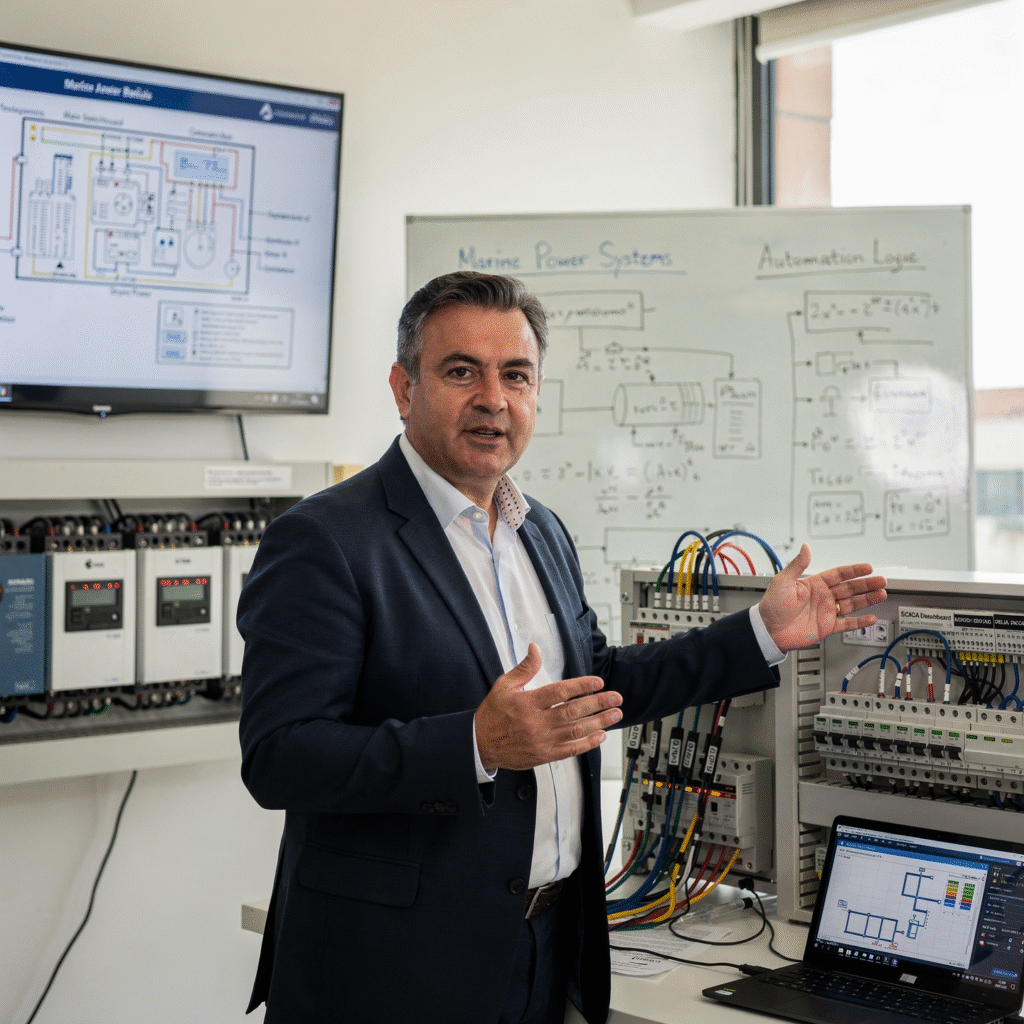
Eng. Javier Bañuls
Full Professor
Eng. Javier Bañuls
Full Professor
Naval electrical engineer with over fifteen years of experience in the design, integration, and operation of power and automation systems.

Dr. Nuria Llobregat
Full Professor
Dr. Nuria Llobregat
Full Professor
Specialist in meteorological and operational decision-making for coastal and offshore navigation, integrating wind, wave, and current models.

Dr. Pau Ferrer
Full Professor
Dr. Pau Ferrer
Full Professor
Naval engineer with a PhD in applied hydrodynamics and over a decade of experience designing high-performance hulls and marine structures.

Cap. Javier Abaroa (MCA)
Full Professor
Cap. Javier Abaroa (MCA)
Full Professor
MCA-certified captain with command of ocean-going vessels, specializing in advanced maneuvering, navigation management, and bridge safety.