
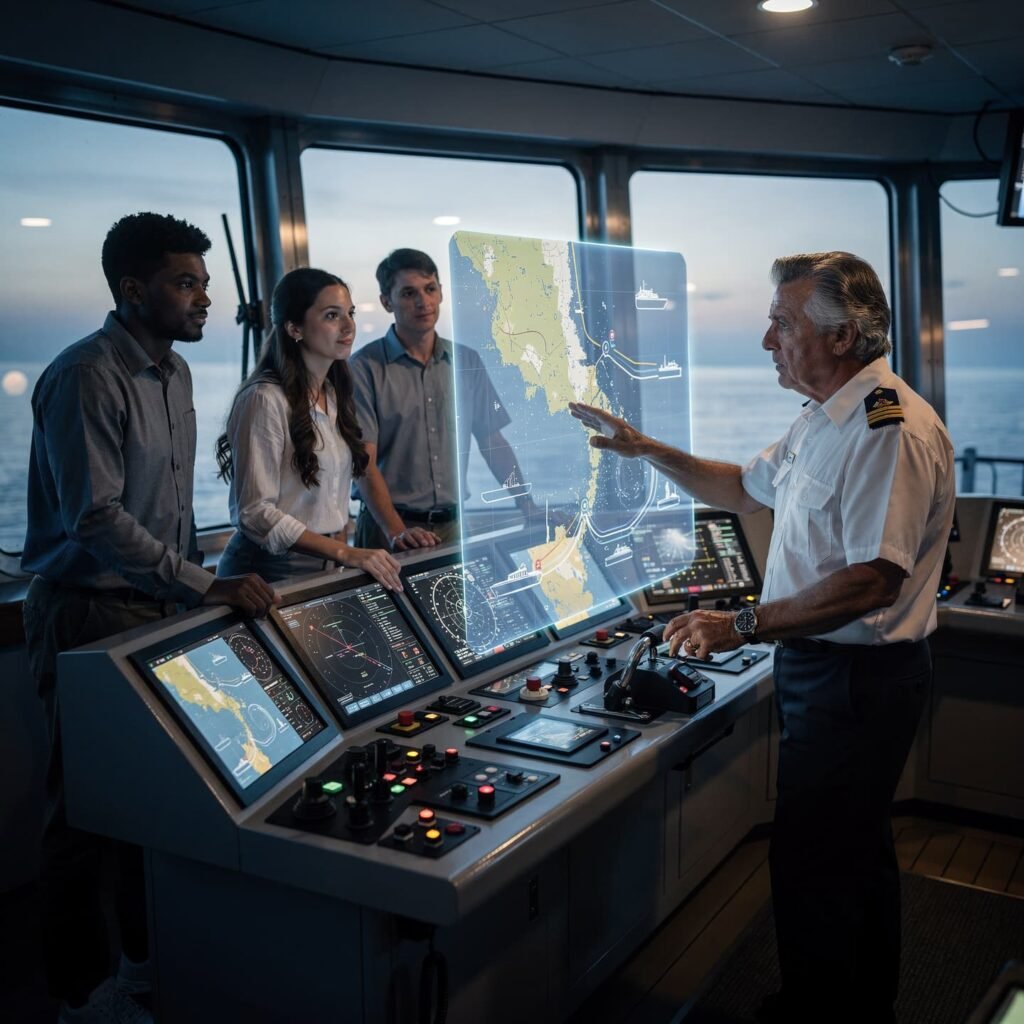
Why Digital Maritime Competence Is Now a Core Employability Signal
Maritime operations have always been technology-forward, but in the last decade the shift has accelerated: navigation ecosystems, integrated bridge systems, automation, remote support, data-driven maintenance, and rapidly evolving cyber risk. As a result, employers increasingly screen for digital readiness—not as an “extra”, but as a baseline expectation.
For training providers focused on Excellence in International Naval & Maritime Education, this is an opportunity: modern programmes can combine deep operational realism with digital methods that accelerate competence and improve assessment quality.
This article explains the components of modern digital maritime training and how learners can choose programmes that translate directly into workplace capability.
1) Simulation-Based Learning: Where Competence Becomes Measurable
Simulation is not “nice to have” when it is integrated correctly. It is one of the few ways to practise high-stakes decision-making without real-world risk.
High-value simulation training includes:
-
Scenario complexity that reflects real operations (traffic density, restricted waters, failure modes)
-
Structured roles (watchkeeper, master, pilot interface, operations support)
-
Evidence capture (decision logs, communication patterns, procedural compliance)
-
Debrief discipline (root cause analysis, alternative strategies, risk trade-offs)
Why it matters for careers:
Employers want people who can demonstrate judgement and procedural discipline. Simulation makes it observable.
Why it matters for SEO:
Search terms around “bridge simulator training”, “maritime simulator courses”, and “operational readiness” are high-intent queries. When your site offers detailed pages that explain the value, structure, and outcomes, you attract learners who are ready to enrol.
2) ECDIS Practice: From Button Knowledge to Navigation Thinking
Many learners can describe what ECDIS is, but employers care about whether you can:
-
Configure systems appropriately for voyage context
-
Detect and prevent common human-factor errors
-
Apply cross-check logic and maintain situational awareness
-
Integrate ECDIS into the bridge team’s decision process
Good ECDIS-focused training emphasises:
-
Settings discipline (alarms, safety contours, updates)
-
Risk management in restricted waters and high-traffic situations
-
“Misleading confidence” prevention (automation bias)
-
Practical voyage planning and monitoring evidence
If your training provider sells courses, consider creating:
-
A detailed ECDIS course landing page (outcomes + who it’s for + assessment)
-
Supporting articles on typical ECDIS error patterns and prevention practices
3) Data Literacy for Maritime Professionals: The Quiet Differentiator
Shore-based maritime roles increasingly require the ability to interpret:
-
Fleet performance metrics
-
Port turnaround KPIs
-
Maintenance trends and reliability indicators
-
Safety leading indicators and near-miss patterns
-
Fuel efficiency and emissions-related reporting needs
Data literacy does not mean becoming a data scientist. It means being able to:
-
Ask the right operational questions
-
Understand what a metric actually measures
-
Detect distorted reporting incentives
-
Make decisions that improve performance safely
Well-designed programmes incorporate applied tasks such as:
-
Building an operational performance dashboard (even at a basic level)
-
Writing an evidence-based improvement proposal
-
Translating data signals into procedural changes
4) AI in Maritime: Practical Use, Real Limits, Responsible Integration
AI is already present indirectly in many systems: predictive analytics, anomaly detection, decision support tools, and workflow automation. But maritime operations are unforgiving environments for careless adoption.
Training should teach:
-
Where AI is useful (pattern detection, document automation, risk support)
-
Where AI is risky (overconfidence, blind reliance, missing context)
-
How to validate outputs and maintain human accountability
-
How to document AI-assisted decisions responsibly
Programmes positioned as “Excellence” should explicitly include:
-
Case studies of decision support success and failure
-
Human factors, bias, and auditability
-
Governance approaches (who approves, who reviews, what evidence is kept)
5) Cyber Awareness: From “IT Problem” to Operational Survival Skill
Cyber risk in maritime is not a distant concern. It can affect:
-
Navigation systems and integrated bridges
-
Port and terminal operational technology
-
Fleet management systems
-
Safety reporting and compliance documentation
-
Communications and scheduling
Cyber-aware training for maritime professionals includes:
-
Typical attack surfaces (phishing, credential reuse, unpatched systems)
-
Operational impacts (loss of visibility, manipulation risk, service disruption)
-
Basic response logic (containment, reporting, continuity planning)
-
Cultural factors (training crews and staff, building good habits)
This is especially relevant for shore-based roles (ports, shipping companies, service providers) where digital workflows are mission-critical.
What to Look for in a Digital Maritime Programme
If you are choosing a course, diploma, or master’s pathway, look for these signals:
-
Hands-on tasks: not just reading—building, simulating, documenting
-
Assessment evidence: deliverables you can show (reports, plans, dashboards)
-
Operational context: technology taught in realistic scenarios
-
Human factors: how systems fail in practice, not only in theory
-
Update discipline: the programme is refreshed as technology evolves
FAQs
Do I need technical background to take digital maritime training?
No. The best programmes teach operational digital competence without assuming you are an engineer—while still offering advanced routes for technical learners.
Will simulation training help me get hired?
It can, because simulation produces evidence of decision-making and procedural discipline—two traits employers value highly.
Is AI replacing maritime professionals?
AI is more likely to augment workflows than replace accountable operational roles. Training should focus on responsible integration, validation, and governance.