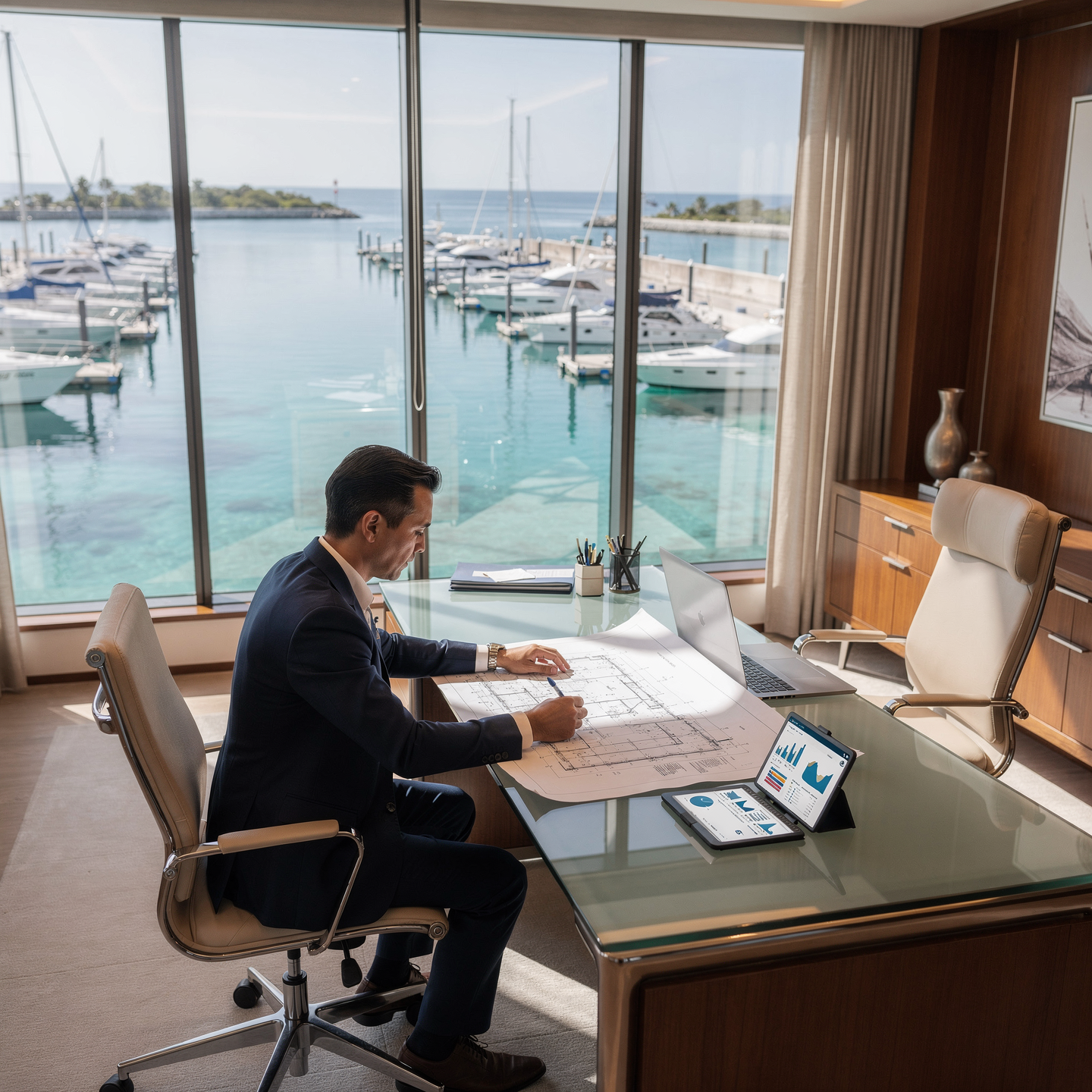
Marina Management Course
Why this course?
The Marina Management Course
This course provides you with the essential tools for efficient and profitable management. Learn about maritime legislation, port operations, tourism marketing, and human resource management, optimizing the customer experience and maximizing your marina’s potential. This program prepares you to lead successfully in the nautical sector, driving the growth and sustainability of your marina.
This course provides you with the essential tools for efficient and profitable management. Learn about maritime legislation, port operations, tourism marketing, and human resource management, optimizing the customer experience and maximizing your marina’s potential.
Differential Advantages
- Case Studies: Analysis of real-world situations and simulation of marina management.
- Networking: Connection with industry professionals and access to job opportunities.
- Management Tools: Specialized software for marina and port administration.
- Technical Visits: Tours of leading marinas to observe best practices.
- Flexibility: Online format with access to learning materials and personalized tutoring.
- Modality: Online
- Level: Cursos
- Hours: 150 H
- Start date: 25-04-2026
Availability: 1 in stock
Who is it aimed at?
- Marina directors and managers seeking to optimize management, improve profitability, and increase customer satisfaction.
- Mooring managers and operations staff who need to delve deeper into efficient procedures, port security, and high-quality customer service.
- Administrators and accountants who need a solid understanding of maritime legislation, financial management, and regulatory compliance.
- Investors and real estate developers interested in developing successful port projects, from planning to marketing.
- Students and professionals in the nautical sector seeking specialization in marina administration and management.
Flexibility and applicability
Designed for professionals with demanding schedules: 24/7 online access to content, applicable case studies, and personalized tutoring.
Objectives and competencies

Optimize the management of port resources and infrastructure:
Implement data-driven predictive and corrective maintenance systems to minimize downtime and optimize asset lifespan.

Monitor and ensure regulatory compliance in matters of safety and the environment:
“Implement and maintain a safety and environmental management system (SMS/SGA) in accordance with national and international regulations, ensuring risk identification, control definition, staff training, and effective emergency response.”

Promote excellence in customer service and the quality of port services:
“Implement standardized and effective communication protocols, ensuring accurate and timely information for users and stakeholders.”

Develop marketing and promotional strategies to enhance the attractiveness and profitability of the marina:
“Analyze the target market, segment customers, and adapt the service and communication offering to maximize occupancy and spending at the port.”

Implement efficient systems for managing reservations and allocating moorings:
“Automating processes, integrating reservation management software with port information systems and optimizing allocation according to criteria of size, services and availability.”

Establish emergency response protocols and ensure the safety of vessels and users:
Implement safety drills, inspect emergency equipment, and train the crew in evacuation and rescue.
Curriculum - Modules
- Comprehensive Maritime Incident Management: protocols, roles, and chain of command for coordinated response
- Operational Planning and Execution: briefing, routes, weather windows, and go/no-go criteria
- Rapid Risk Assessment: criticality matrix, scene control, and decision-making under pressure
- Operational Communication: VHF/GMDSS, standardized reports, and inter-agency liaison
- Tactical Mobility and Safe Boarding: RHIB maneuvers, approach, mooring, and recovery
- Equipment and Technologies: PPE, signaling, satellite tracking, and field data logging
- Immediate Care of the Affected: primary assessment, hypothermia, trauma, and stabilization for evacuation
- Adverse Environmental Conditions: swell, Visibility, flows, and operational mitigation
Simulation and training: critical scenarios, use of VR/AR, and exercises with performance metrics
Documentation and continuous improvement: lessons learned, indicators (MTTA/MTTR), and SOP updates
- Introduction to Integrated Nautical Management: Scope and Responsibilities
- Legal Framework: International Conventions (SOLAS, MARPOL, STCW), National Legislation
- Maritime Safety: Safety Culture, Risk Management, and Accident Prevention
- Port Operations: Coordination, Communications, and Safety Procedures
- Crew Management: Roles, Responsibilities, Training, and Welfare
- Maintenance and Repairs: Planning, Execution, and Cost Control
- Quality Management Systems: ISO 9001, ISO 14001, ISO 45001
- Onboard Emergencies: Contingency Plans, Drills, and Response
- Protection of the Marine Environment: Pollution Prevention, Management of Waste
- Audits and inspections: preparation, implementation, and follow-up of corrective actions
- Introduction to Marina Management: Evolution and Trends
- Legal and Regulatory Framework: Maritime, Port, and Environmental Legislation
- Strategic Planning of Marinas: SWOT Analysis, Vision, and Objectives
- Design and Construction of Marinas: Infrastructure, Facilities, and Sustainability
- Port Operations: Reception, Berthing, Mooring, and Vessel Services
- Waste Management: Collection, Treatment, and Disposal (MARPOL)
- Maritime Safety in Marinas: Emergency Plans and Risk Prevention
- Security Systems: CCTV, Access Control, Alarms, and Response
- Environmental Sustainability in Marine: Water, Energy, and Biodiversity Management
Environmental Quality Certifications and Standards (ISO 14001, EMAS)
‘
- Introduction to Marina Management: Evolution, Typology, and Trends.
- Legal and Regulatory Framework: Port Legislation, Concessions, and Licenses.
- Strategic Planning of the Marina: Objectives, Mission, and Vision.
- Analysis of the Nautical Market: Segments, Demand, and Competition.
- Port Infrastructure: Design, Construction, and Maintenance.
- Equipment: Types, Characteristics, and Operational Needs.
- Port Services: Mooring, Slipway, Fuel, Security, etc.
- Economic and Financial Management: Budgets, Costs, and Profitability.
- Marketing and Sales: Acquisition and retention strategies.
Managing quality and excellence in service.
‘
- Introduction to Port Management: History, Evolution, and Trends
- International and National Legal Framework: Agreements, Laws, and Regulations
- Port Strategic Planning: SWOT Analysis, Objectives, and KPIs
- Port Infrastructure: Types of Docks, Basins, Warehouses, and Equipment
- Loading and Unloading Operations: Types of Goods, Equipment, and Procedures
- Port Logistics Chain Management: Intermodality, Transport, and Distribution
- Port Security: ISPS Code, Protection Measures, and Access Control
- Port Environmental Management: Regulations, Pollution Prevention, and Sustainability
- Information Technologies in Port Management: Management Systems, Digitalization, and Automation
- Risk and emergency management: contingency plans, drills, and incident response
‘
- System Architecture and Components: Structural design, materials, and subsystems (mechanical, electrical, electronic, and fluid) with selection and assembly criteria for marine environments
- Fundamentals and Principles of Operation: Physical and engineering foundations (thermodynamics, fluid mechanics, electricity, control, and materials) that explain performance and operating limits
- Safety and Environmental (SHE): Risk analysis, PPE, LOTO, hazardous atmospheres, spill and waste management, and emergency response plans
- Applicable Regulations and Standards: IMO/ISO/IEC requirements and local regulations;
- Conformance criteria, certification, and best practices for operation and maintenance
- Inspection, testing, and diagnostics: Visual/dimensional inspection, functional testing, data analysis, and predictive techniques (vibration, thermography, fluid analysis) to identify root causes
- Preventive and predictive maintenance: Hourly/cycle/seasonal plans, lubrication, adjustments, calibrations, consumable replacement, post-service verification, and operational reliability
- Instrumentation, tools, and metrology: Measuring and testing equipment, diagnostic software, calibration and traceability; selection criteria, safe use, and storage
- Onboard integration and interfaces: Mechanical, electrical, fluid, and data compatibility; Sealing and watertightness, EMC/EMI, corrosion protection, and interoperability testing.
Quality, acceptance testing, and commissioning: process and materials control, FAT/SAT, bench and sea trials, go/no-go criteria, and evidence documentation.
Technical documentation and integrated practice: logs, checklists, reports, and a complete case study (safety → diagnosis → intervention → verification → report) applicable to any system.
Plan de estudio - Módulos
- Comprehensive Maritime Incident Management: protocols, roles, and chain of command for coordinated response
- Operational Planning and Execution: briefing, routes, weather windows, and go/no-go criteria
- Rapid Risk Assessment: criticality matrix, scene control, and decision-making under pressure
- Operational Communication: VHF/GMDSS, standardized reports, and inter-agency liaison
- Tactical Mobility and Safe Boarding: RHIB maneuvers, approach, mooring, and recovery
- Equipment and Technologies: PPE, signaling, satellite tracking, and field data logging
- Immediate Care of the Affected: primary assessment, hypothermia, trauma, and stabilization for evacuation
- Adverse Environmental Conditions: swell, Visibility, flows, and operational mitigation
Simulation and training: critical scenarios, use of VR/AR, and exercises with performance metrics
Documentation and continuous improvement: lessons learned, indicators (MTTA/MTTR), and SOP updates
- Introduction to Integrated Nautical Management: Scope and Responsibilities
- Legal Framework: International Conventions (SOLAS, MARPOL, STCW), National Legislation
- Maritime Safety: Safety Culture, Risk Management, and Accident Prevention
- Port Operations: Coordination, Communications, and Safety Procedures
- Crew Management: Roles, Responsibilities, Training, and Welfare
- Maintenance and Repairs: Planning, Execution, and Cost Control
- Quality Management Systems: ISO 9001, ISO 14001, ISO 45001
- Onboard Emergencies: Contingency Plans, Drills, and Response
- Protection of the Marine Environment: Pollution Prevention, Management of Waste
- Audits and inspections: preparation, implementation, and follow-up of corrective actions
- Introduction to Marina Management: Evolution and Trends
- Legal and Regulatory Framework: Maritime, Port, and Environmental Legislation
- Strategic Planning of Marinas: SWOT Analysis, Vision, and Objectives
- Design and Construction of Marinas: Infrastructure, Facilities, and Sustainability
- Port Operations: Reception, Berthing, Mooring, and Vessel Services
- Waste Management: Collection, Treatment, and Disposal (MARPOL)
- Maritime Safety in Marinas: Emergency Plans and Risk Prevention
- Security Systems: CCTV, Access Control, Alarms, and Response
- Environmental Sustainability in Marine: Water, Energy, and Biodiversity Management
Environmental Quality Certifications and Standards (ISO 14001, EMAS)
‘
- Introduction to Marina Management: Evolution, Typology, and Trends.
- Legal and Regulatory Framework: Port Legislation, Concessions, and Licenses.
- Strategic Planning of the Marina: Objectives, Mission, and Vision.
- Analysis of the Nautical Market: Segments, Demand, and Competition.
- Port Infrastructure: Design, Construction, and Maintenance.
- Equipment: Types, Characteristics, and Operational Needs.
- Port Services: Mooring, Slipway, Fuel, Security, etc.
- Economic and Financial Management: Budgets, Costs, and Profitability.
- Marketing and Sales: Acquisition and retention strategies.
Managing quality and excellence in service.
‘
- Introduction to Port Management: History, Evolution, and Trends
- International and National Legal Framework: Agreements, Laws, and Regulations
- Port Strategic Planning: SWOT Analysis, Objectives, and KPIs
- Port Infrastructure: Types of Docks, Basins, Warehouses, and Equipment
- Loading and Unloading Operations: Types of Goods, Equipment, and Procedures
- Port Logistics Chain Management: Intermodality, Transport, and Distribution
- Port Security: ISPS Code, Protection Measures, and Access Control
- Port Environmental Management: Regulations, Pollution Prevention, and Sustainability
- Information Technologies in Port Management: Management Systems, Digitalization, and Automation
- Risk and emergency management: contingency plans, drills, and incident response
‘
- System Architecture and Components: Structural design, materials, and subsystems (mechanical, electrical, electronic, and fluid) with selection and assembly criteria for marine environments
- Fundamentals and Principles of Operation: Physical and engineering foundations (thermodynamics, fluid mechanics, electricity, control, and materials) that explain performance and operating limits
- Safety and Environmental (SHE): Risk analysis, PPE, LOTO, hazardous atmospheres, spill and waste management, and emergency response plans
- Applicable Regulations and Standards: IMO/ISO/IEC requirements and local regulations;
- Conformance criteria, certification, and best practices for operation and maintenance
- Inspection, testing, and diagnostics: Visual/dimensional inspection, functional testing, data analysis, and predictive techniques (vibration, thermography, fluid analysis) to identify root causes
- Preventive and predictive maintenance: Hourly/cycle/seasonal plans, lubrication, adjustments, calibrations, consumable replacement, post-service verification, and operational reliability
- Instrumentation, tools, and metrology: Measuring and testing equipment, diagnostic software, calibration and traceability; selection criteria, safe use, and storage
- Onboard integration and interfaces: Mechanical, electrical, fluid, and data compatibility; Sealing and watertightness, EMC/EMI, corrosion protection, and interoperability testing.
Quality, acceptance testing, and commissioning: process and materials control, FAT/SAT, bench and sea trials, go/no-go criteria, and evidence documentation.
Technical documentation and integrated practice: logs, checklists, reports, and a complete case study (safety → diagnosis → intervention → verification → report) applicable to any system.
- Port Legal Framework: National and International Regulations.
- Security Management: Risk Analysis, Contingency Plans.
- Loading and Unloading Operations: Types of Cargo, Equipment, Stowage.
- Terminal Management: Resource Optimization, Planning.
- Port Area Security: Access Control, Surveillance, Prevention.
- Maritime Security: ISPS Code, Threats, Security Plans.
- Dangerous Goods: IMDG Regulations, Handling, Storage.
- Port Environmental Management: Pollution Prevention, Waste.
- Applied Technologies: Digitalization, Automation, Traceability.
- Port Emergencies: Protocols, Drills, coordination.
‘
- Introduction to Port Management: History, Evolution, and Current Trends
- Legal and Regulatory Framework: International Agreements, National and Local Legislation
- Port Infrastructure: Types of Ports, Terminals, Quays, and Basins
- Port Equipment: Cranes, Cargo Handling Machinery, Transport Systems
- Port Operations: Loading and Unloading, Stowage, Unstowage, Storage
- Port Security: ISPS Code, Security Plans, Access Control
- Port Environmental Management: Pollution Prevention, Waste Treatment
- Port Logistics: Supply Chain, Intermodal Transport, Distribution
- Information Technologies: Management Systems Port activities, cargo traceability
Risk management in the port sector: identification, assessment, and mitigation
‘
- International Maritime Legislation: SOLAS, MARPOL, STCW Conventions, and others.
- Maritime Law: Charter parties, marine insurance, salvage.
- Administrative Regime: Ship registration, licenses, inspections.
- Civil and Criminal Liability of the Shipowner and the Master.
- Quality Management in the Maritime Sector: ISO standards, audits.
- Protection of the Marine Environment: Prevention of pollution from hydrocarbons, sewage, and waste.
- Risk Management in Maritime Activities: Identification, assessment, and control.
- Maritime Security: Protection against unlawful acts, navigational safety, workplace safety.
- Legal Aspects of Maritime Transport of Goods: Knowledge of Shipping, claims.
- Dispute resolution in the maritime sector: arbitration, mediation, litigation.
‘
- Introduction to Marinas: Types, Services, and Economic Importance
- Legal and Regulatory Framework: Port Legislation, Concessions, and Authorizations
- Planning and Design: Layout, Infrastructure, Access, and Services
- Mooring Management: Allocation, Rates, Contracts, and Rotation
- Port Operations: Vessel Reception and Dispatch, Waste Management
- Vessel Services: Water, Electricity, Fuel, Dry Dock, and Maintenance
- Environmental Management: Contingency Plans, Spill and Noise Control
- Port Security: Protection Plans, Access Control, and Video Surveillance
- Emergencies and Rescue: Protocols, Equipment, and Coordination with Authorities
- Customer service and service quality: surveys, complaints, and continuous improvement
‘
Career opportunities
- Mooring Manager: berth allocation and control, space optimization.
- Port Administrator: customer service, invoicing, document management.
- Facilities Manager: preventive and corrective maintenance, service supervision.
- Sales/Marketing: service promotion, customer acquisition, event organization.
- Security Officer: access control, emergency plans, risk prevention.
- Nautical Activities Coordinator: course organization, boat rentals, sporting events.
- Environmental Technician: waste management, spill control, regulatory compliance.
- Marina Director: Comprehensive port management, strategic planning, institutional relations.
“`
Admission requirements

Academic/professional profile:
Degree/Bachelor's degree in Nautical Science/Maritime Transport, Naval/Marine Engineering, or a related field; or proven professional experience in bridge/operations.

Language proficiency:
Recommended functional maritime English (SMCP) for simulations and technical materials.

5. Induction
Updated resume, copy of degree or seaman's book, ID card/passport, letter of motivation.

Technical requirements (for online):
Equipment with camera/microphone, stable connection, ≥ 24” monitor recommended for ECDIS/Radar-ARPA.
Admission process and dates

1. Online
application
(form + documents).

2. Academic review and interview
(profile/objectives/schedule compatibility).

3. Admission decision
(+ scholarship proposal if applicable).

4. Reservation of place
(deposit) and registration.

5. Induction
(access to campus, calendars, simulator guides).
Scholarships and grants
- Port Management: Learn to efficiently manage all operational and administrative aspects of a marina.
- Legal Framework: Understand current regulations and how to apply them to ensure compliance and the port’s viability.
- Resource Management: Optimize profitability through the effective management of moorings, services, and facilities.
- Customer Service: Build customer loyalty with excellent service and specialized marketing strategies.
- Safety and Sustainability: Implement safety protocols and environmentally friendly practices.
Testimonials
I implemented an online booking management system that increased marina occupancy by 15% and reduced administrative costs by 8% in the first year.
My training in Port and Marina Management provided me with the necessary tools to optimize operations at my marina. I implemented a new mooring management system based on the knowledge I gained, resulting in a 15% increase in occupancy and a significant improvement in customer satisfaction.
I implemented a digital management system that optimized berth allocation by 30%, reducing waiting times and increasing customer satisfaction, which resulted in a 15% increase in the marina’s annual revenue.
I implemented a digital management system that optimized mooring allocation, increasing occupancy by 15% and customer satisfaction by 20% in the first quarter.

Frequently asked questions
Provide a safe and secure place to moor boats.
Yes. The itinerary includes ECDIS/Radar-ARPA/BRM with harbor, ocean, fog, storm, and SAR scenarios.
Online with live sessions; hybrid option for simulator/practical placements through agreements.
To ensure a safe, efficient and profitable operation of the marina, meeting the needs of the clients.
Recommended functional SMCP. We offer support materials for standard phraseology.
Yes, with a relevant degree or experience in maritime/port operations. The admissions interview will confirm suitability.
Optional (3–6 months) through Companies & Collaborations and the Alumni Network.
Simulator practice (rubrics), defeat plans, SOPs, checklists, micro-tests and applied TFM.
A degree from Navalis Magna University + operational portfolio (tracks, SOPs, reports and KPIs) useful for audits and employment.
- Introduction to Marinas: Types, Services, and Economic Importance
- Legal and Regulatory Framework: Port Legislation, Concessions, and Authorizations
- Planning and Design: Layout, Infrastructure, Access, and Services
- Mooring Management: Allocation, Rates, Contracts, and Rotation
- Port Operations: Vessel Reception and Dispatch, Waste Management
- Vessel Services: Water, Electricity, Fuel, Dry Dock, and Maintenance
- Environmental Management: Contingency Plans, Spill and Noise Control
- Port Security: Protection Plans, Access Control, and Video Surveillance
- Emergencies and Rescue: Protocols, Equipment, and Coordination with Authorities
- Customer service and service quality: surveys, complaints, and continuous improvement
‘
Request information
- Complete the Application Form
- Attach your CV/Qualifications (if you have them to hand).
- Indicate your preferred cohort (January/May/September) and whether you want the hybrid option with simulator sessions.
Teachers
Eng. Tomás Riera
Full Professor
Eng. Tomás Riera
Full Professor
Eng. Sofía Marquina
Full Professor
Eng. Sofía Marquina
Full Professor
Eng. Javier Bañuls
Full Professor
Eng. Javier Bañuls
Full Professor
Dr. Nuria Llobregat
Full Professor
Dr. Nuria Llobregat
Full Professor
Dr. Pau Ferrer
Full Professor
Dr. Pau Ferrer
Full Professor
Cap. Javier Abaroa (MCA)
Full Professor
Cap. Javier Abaroa (MCA)
Full Professor

