Underwater Drone Course
Why this course?
The Comprehensive Underwater Drone (ROV) Course
Immerse yourself in the fascinating world of underwater exploration and work. Learn everything from the fundamentals of ROV technology to its practical application in inspection, maintenance, research, and rescue. Master piloting, sensor and tool operation, and data analysis techniques to become a highly sought-after professional.
Differential Advantages
- Intensive Hands-on Training: piloting in a simulator and in a pool with real ROVs.
- Expert Knowledge: taught by professionals with extensive experience in the underwater industry.
- Maintenance and Repair: learn to diagnose and troubleshoot common ROV problems.
- Real-World Applications: case studies and practical projects in various sectors.
- Professional Certification: obtain a recognized certificate to boost your career.
- Modality: Online
- Level: Cursos
- Hours: 150 H
- Start date: 25-04-2026
Availability: 1 in stock
Who is it aimed at?
- Marine engineers, technicians, and scientists looking to expand their capabilities in underwater inspection, research, and maintenance.
- Aquaculture and fisheries professionals interested in monitoring ecosystem health, assessing populations, and optimizing production.
- Marine rescue and safety teams needing tools for search and recovery in low-visibility or hazardous environments.
- Robotics and underwater exploration enthusiasts who want to build, operate, and customize their own autonomous vehicles.
- Educators and researchers looking to implement innovative technologies in curricula and scientific projects.
Learning Flexibility
Adaptable At your own pace: asynchronous modules available 24/7, discussion forums for collaboration and personalized follow-up by experts.
Objectives and competencies

Conduct detailed inspections and collect accurate data in hazardous underwater environments:
“Using ROVs and advanced sensors to assess the integrity of structures, identify risks, and document findings with millimeter precision.”

Mapping and modeling complex underwater environments in 3D:
Integrate data from multiple sensors (sonar, LIDAR, cameras) and SLAM algorithms for accurate and robust reconstructions, even in low visibility conditions and dynamic terrain.

Perform maintenance and repair tasks on remote underwater infrastructure:
“Diagnosing faults using ROVs and remote control tools, repairing pipes, cables and structures with specialized techniques and following strict safety protocols.”

Detect and neutralize underwater threats autonomously:
“Use advanced ASW systems (sonobuoys, variable towed sonar) for location, identification and tracking, adapting tactics to the detected acoustic signature and oceanographic conditions.”
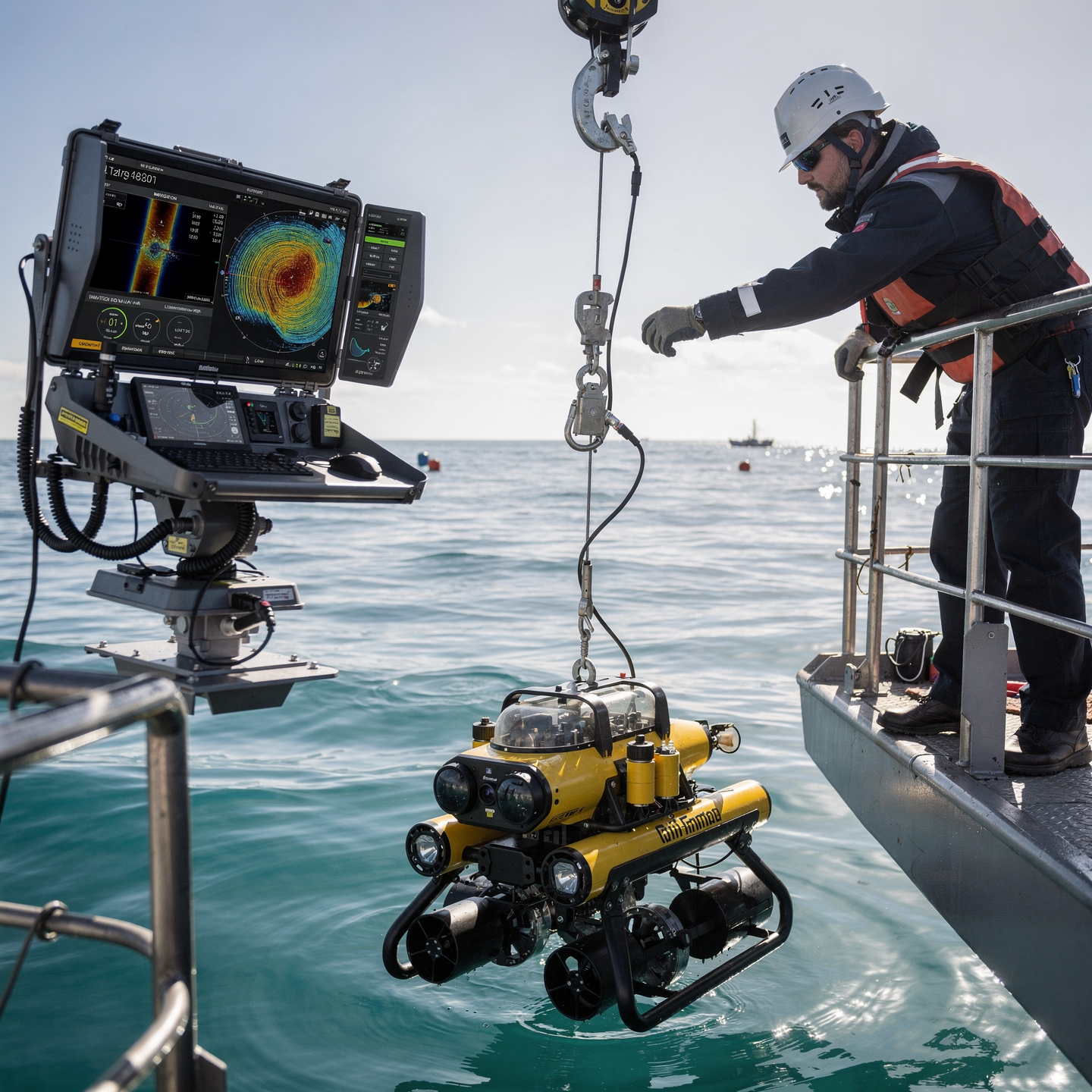
Respond quickly to underwater emergencies, such as leaks or accidents:
“Act promptly according to emergency procedures, prioritizing the safety of human life and the environment, coordinating with rescue teams and port authorities.”
Optimize the exploration and extraction of underwater natural resources:
Implement cutting-edge technologies for the accurate detection of deposits, minimizing the environmental impact during extraction and maximizing the efficiency of the process.
Curriculum - Modules
- What is an ROV and how does it differ from AUVs/surface drones
- Types of ROVs (inspection, intervention, observation, industrial)
- Main components: chassis, propulsion, tether, control, camera
- Principles of safe operation in underwater environments
- Basic mission planning: objectives, environment, risks
- Operational roles: pilot, technician, supervisor, and data logging
- Buoyancy, buoyancy, and Archimedes’ principle
- Stability: center of gravity and center of buoyancy
- ROV trim and balance for different missions
- Practical hydrodynamics: resistance, turbulence, and drag
- Propulsion systems: types, configuration, and 3D motion control
- Depth control and positioning in currents
- ROV Electrical Architecture: Distribution and Protection
- Power Sources: Batteries, Cable Power, and Autonomy
- Tether/Umbilical Cable: Types, Handling, and Tangle Prevention
- Communications: Signal, Latency, Interference, and Loss
- Consoles, Controllers, and Base Stations
- Managing Common Electrical Faults and Safety Procedures
- Basic Controls: Axes, Combined Movements, and Coordination
- Standard Maneuvers: Approach, Inspection, Tracking, and Return
- Low Visibility Control: Safe Navigation Techniques
- Stable Positioning for Recording and Data Capture
- Emergency Management: Signal Loss, Entangled Tether, Propeller Failure
- Professional Piloting Best Practices and Operational Checklist
- Cameras, Lighting, and Professional Image Capture
- Sonar (Turbidity Vision): Types and Basic Readings
- Environmental Sensors: Depth, Temperature, Turbidity, Salinity
- Instrument Integration: Configuration and Reading Validation
- Data Recording, Labeling, and Organization for Technical Reports
- Principles of Photogrammetry and Underwater Visual Surveying
- Inspection of hulls, propellers, rudders, and sea intakes
- Port inspection: pilings, docks, chains, fenders, and structures
- Offshore and energy: pipelines, submarine cables, and critical structures
- Aquaculture: nets, cages, biofouling, mortality, and escape points
- Marine research: visual sampling, transects, and habitat monitoring
- Search and rescue: search patterns, documentation, and recovery
Plan de estudio - Módulos
- What is an ROV and how does it differ from AUVs/surface drones
- Types of ROVs (inspection, intervention, observation, industrial)
- Main components: chassis, propulsion, tether, control, camera
- Principles of safe operation in underwater environments
- Basic mission planning: objectives, environment, risks
- Operational roles: pilot, technician, supervisor, and data logging
- Buoyancy, buoyancy, and Archimedes’ principle
- Stability: center of gravity and center of buoyancy
- ROV trim and balance for different missions
- Practical hydrodynamics: resistance, turbulence, and drag
- Propulsion systems: types, configuration, and 3D motion control
- Depth control and positioning in currents
- ROV Electrical Architecture: Distribution and Protection
- Power Sources: Batteries, Cable Power, and Autonomy
- Tether/Umbilical Cable: Types, Handling, and Tangle Prevention
- Communications: Signal, Latency, Interference, and Loss
- Consoles, Controllers, and Base Stations
- Managing Common Electrical Faults and Safety Procedures
- Basic Controls: Axes, Combined Movements, and Coordination
- Standard Maneuvers: Approach, Inspection, Tracking, and Return
- Low Visibility Control: Safe Navigation Techniques
- Stable Positioning for Recording and Data Capture
- Emergency Management: Signal Loss, Entangled Tether, Propeller Failure
- Professional Piloting Best Practices and Operational Checklist
- Cameras, Lighting, and Professional Image Capture
- Sonar (Turbidity Vision): Types and Basic Readings
- Environmental Sensors: Depth, Temperature, Turbidity, Salinity
- Instrument Integration: Configuration and Reading Validation
- Data Recording, Labeling, and Organization for Technical Reports
- Principles of Photogrammetry and Underwater Visual Surveying
- Inspection of hulls, propellers, rudders, and sea intakes
- Port inspection: pilings, docks, chains, fenders, and structures
- Offshore and energy: pipelines, submarine cables, and critical structures
- Aquaculture: nets, cages, biofouling, mortality, and escape points
- Marine research: visual sampling, transects, and habitat monitoring
- Search and rescue: search patterns, documentation, and recovery
- Preventive maintenance: cleaning, sealing, and corrosion control
- Inspection of connectors, gaskets, housings, and pressure/lead tightness
- Troubleshooting: thrusters, cameras, lights, and controls
- Component replacement: safe procedures and testing
- Post-mission protocols: checklist, log, and preparation for the next departure
- Maintenance plan based on operating hours + management of critical spare parts
#VALUE!
#VALUE!
Career opportunities
- Underwater ROV Operator: Inspection, maintenance, and repair of underwater infrastructure (oil platforms, offshore wind farms, pipelines).
- Oceanographic Data Acquisition Technician: Collection of data with sensors on board the drone (temperature, salinity, currents), analysis, and interpretation of the information.
- Ship Hull Inspector: Evaluation of the condition of ship hulls without the need for dry docking, identification of damage and corrosion.
- Marine Researcher: Use of drones for seabed exploration, filming of fauna and flora, and environmental impact studies.
- Search and Rescue: Location of missing objects or people in the water, support for rescue operations.
- Marine Agriculture: Monitoring of marine crops (algae, oysters, mussels), control of environmental parameters.
Underwater archaeology: Documentation of submerged archaeological remains, creation of 3D models of sites.
Port security: Inspection of port infrastructure, detection of intruders or underwater threats.
“`
Admission requirements

Academic/professional profile:
Degree/Bachelor's degree in Nautical Science/Maritime Transport, Naval/Marine Engineering, or a related field; or proven professional experience in bridge/operations.

Language proficiency:
Recommended functional maritime English (SMCP) for simulations and technical materials.

5. Induction
Updated resume, copy of degree or seaman's book, ID card/passport, letter of motivation.

Technical requirements (for online):
Equipment with camera/microphone, stable connection, ≥ 24” monitor recommended for ECDIS/Radar-ARPA.
Admission process and dates

1. Online
application
(form + documents).

2. Academic review and interview
(profile/objectives/schedule compatibility).

3. Admission decision
(+ scholarship proposal if applicable).

4. Reservation of place
(deposit) and registration.

5. Induction
(access to campus, calendars, simulator guides).
Scholarships and grants
- Explore the Depths: Master underwater drone (ROV) technology and unlock a world of possibilities in inspection, research, and maintenance.
- Learn from Experts: Gain practical and theoretical knowledge from instructors with industry experience.
- Professional Certification: Receive a recognized certificate that validates your ROV operation and maintenance skills.
- Real-World Applications: Discover how underwater drones are used in sectors such as energy, aquaculture, marine exploration, and security.
- Intensive Hands-on Training: Participate in simulations and practical exercises to develop your skills in a safe and controlled environment.
Testimonials
During my training in underwater drones, I successfully completed the development and implementation of an autonomous navigation system for the inspection of oil platforms, achieving 98% accuracy in detecting structural anomalies and reducing inspection time by 40% compared to traditional methods.
During the Robotics and Underwater Technology course, I exceeded my expectations by designing and programming an ROV capable of navigating an underwater obstacle course, demonstrating fluency in the control software and a deep understanding of buoyancy and propulsion principles. This project allowed me to effectively apply knowledge of electronics, mechanics, and hydrodynamics, solidifying my interest in ocean engineering.
During my underwater drone training, I exceeded expectations by designing an autonomous navigation system that allowed the drone to map a coral reef with 98% accuracy, collecting high-quality visual and sensory data crucial for a biodiversity study.
I managed to develop an autonomous control system for an underwater drone that successfully mapped a coral reef at a depth of 30 meters, collecting high-quality visual and environmental data during a 2-hour mission without human intervention.

Frequently asked questions
Yes. The itinerary includes ECDIS/Radar-ARPA/BRM with harbor, ocean, fog, storm, and SAR scenarios.
Online with live sessions; hybrid option for simulator/practical placements through agreements.
Longer dive times and access to environments that are dangerous or inaccessible to divers.
Recommended functional SMCP. We offer support materials for standard phraseology.
Yes, with a relevant degree or experience in maritime/port operations. The admissions interview will confirm suitability.
Optional (3–6 months) through Companies & Collaborations and the Alumni Network.
Simulator practice (rubrics), defeat plans, SOPs, checklists, micro-tests and applied TFM.
A degree from Navalis Magna University + operational portfolio (tracks, SOPs, reports and KPIs) useful for audits and employment.
Request information
- Complete the Application Form
- Attach your CV/Qualifications (if you have them to hand).
- Indicate your preferred cohort (January/May/September) and whether you want the hybrid option with simulator sessions.
Teachers
Eng. Tomás Riera
Full Professor
Eng. Tomás Riera
Full Professor
Eng. Sofía Marquina
Full Professor
Eng. Sofía Marquina
Full Professor
Eng. Javier Bañuls
Full Professor
Eng. Javier Bañuls
Full Professor
Dr. Nuria Llobregat
Full Professor
Dr. Nuria Llobregat
Full Professor
Dr. Pau Ferrer
Full Professor
Dr. Pau Ferrer
Full Professor
Cap. Javier Abaroa (MCA)
Full Professor
Cap. Javier Abaroa (MCA)
Full Professor