Introduction to Marine Robots Course
Why this course?
The Introduction to Marine Robots
course
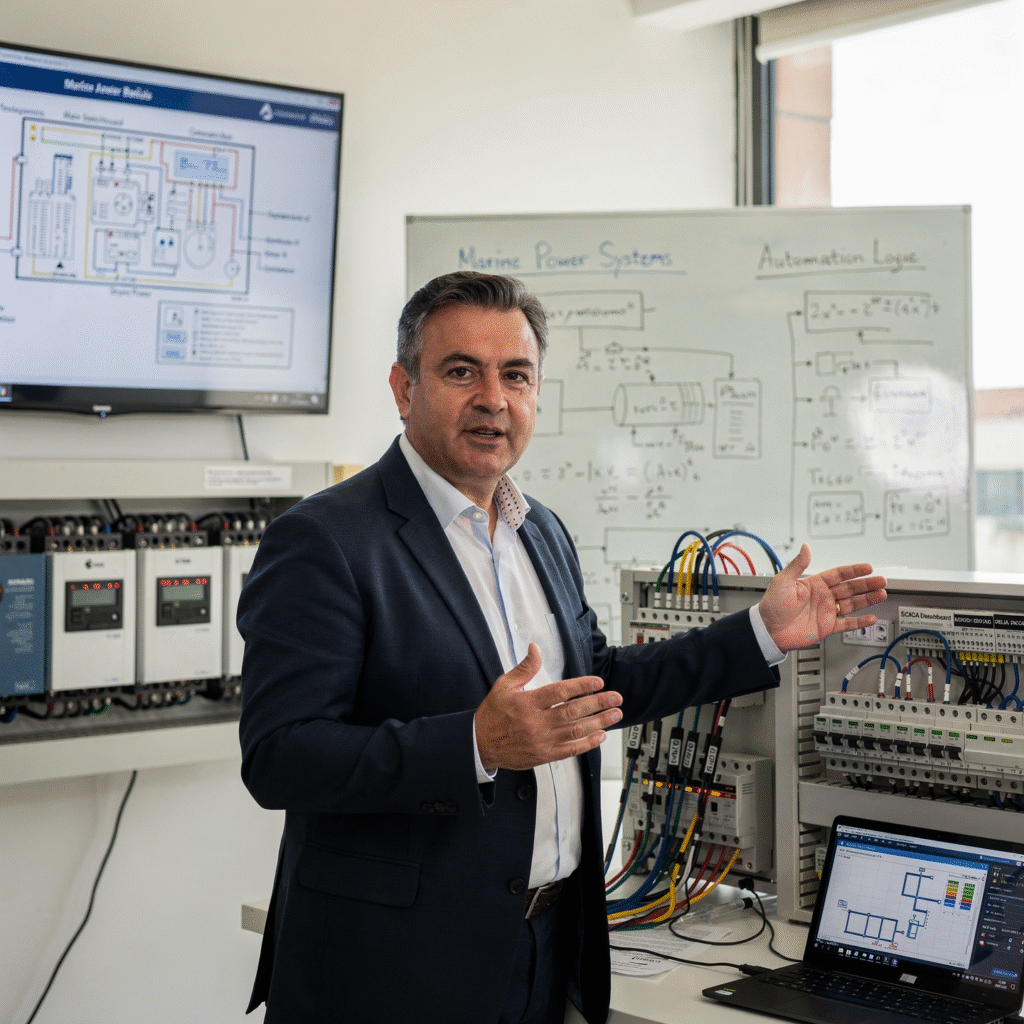
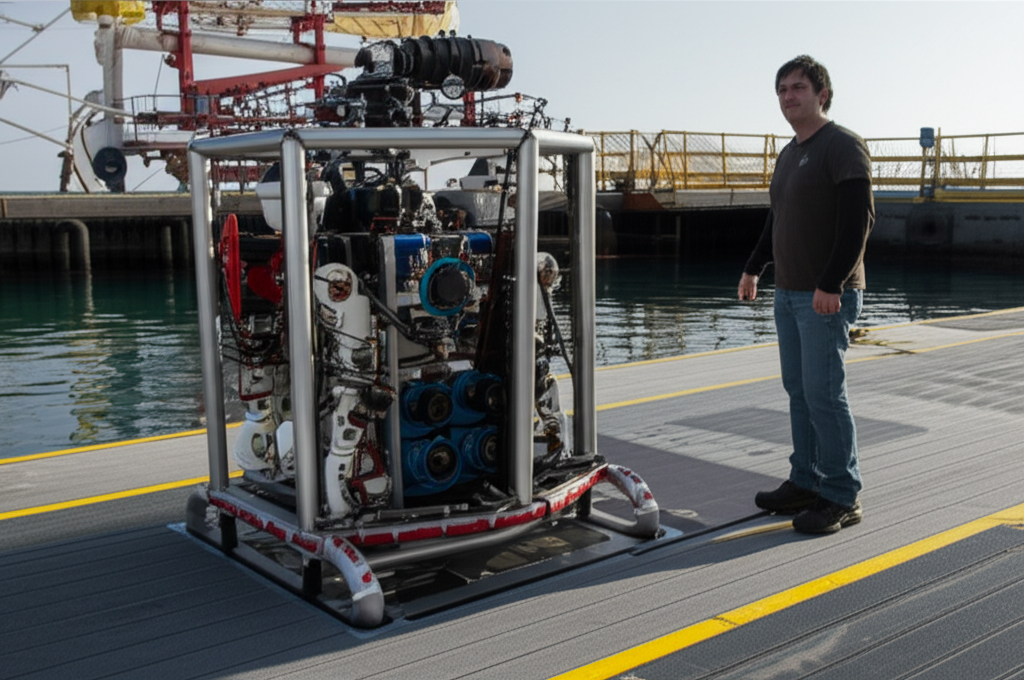
Immerses you in the fascinating world of underwater robotics, covering everything from theoretical foundations to practical applications in various industries. You will learn about design, control, and programming of ROVs (Remotely Operated Vehicles) and AUVs (Autonomous Underwater Vehicles), with an emphasis on their use for inspection, exploration, and maintenance in marine environments.
Key Benefits
- Essential Knowledge: Architecture, sensors, actuators, and communication systems of marine robots.
- Practical Skills: Simulation, control, and basic programming of ROVs and AUVs.
- Real-World Applications: Inspection of underwater infrastructure, ocean exploration, and rescue operations.
- Future Trends: Collaborative robotics, artificial intelligence, and autonomous vehicles in the marine environment.
- Career Opportunities: Career development in energy, oceanographic research, and defense companies.
- Modality: Online
- Level: Cursos
- Hours: 150 H
- Start date: 25-04-2026
Availability: 1 in stock
Who is it aimed at?
- Engineers and technicians looking to specialize in the design, operation, and maintenance of underwater robots (ROVs and AUVs).
- Engineering, robotics, or marine science students interested in exploring robotics applications in the ocean environment.
- Offshore industry professionals (oil, gas, renewable energy) who want to understand the use of marine robots for inspection, repair, and maintenance.
- Marine researchers and scientists seeking advanced tools for deep-ocean exploration and study.
- Companies and organizations looking to implement robotic solutions in their maritime and underwater operations.
Flexibility and Access
Learn at your own pace with on-demand content, hands-on exercises, and live sessions to answer questions and connect with experts.
Objectives and competencies

Understanding the architecture and key components of ROVs:
“Identify the propulsion, control, power, and communication systems, as well as their interrelation in the overall operation of the ROV.”

Operating ROVs in a basic and safe manner:
“Conduct simple underwater visual inspections, following predefined procedures and reporting relevant findings.”

Perform underwater visual inspections using ROVs:
“Identify structural anomalies, corrosion, and damage, documenting findings with photographic and video accuracy for detailed technical reports.”

Troubleshooting simple problems and performing basic preventative maintenance on ROVs:
“Identify common faults, replace basic components, and verify correct operation after maintenance by following manuals.”
Interpreting basic data collected by ROV sensors:
“Understanding depth, temperature, pressure, and orientation readings to assess the environment and ROV integrity.”

Apply standard safety protocols during ROV operation:
“Following emergency procedures, mitigating electrical, mechanical and hydraulic risks, and ensuring the isolation and protection of equipment and personnel.”
Curriculum - Modules
- Comprehensive Maritime Incident Management: protocols, roles, and chain of command for coordinated response
- Operational Planning and Execution: briefing, routes, weather windows, and go/no-go criteria
- Rapid Risk Assessment: criticality matrix, scene control, and decision-making under pressure
- Operational Communication: VHF/GMDSS, standardized reports, and inter-agency liaison
- Tactical Mobility and Safe Boarding: RHIB maneuvers, approach, mooring, and recovery
- Equipment and Technologies: PPE, signaling, satellite tracking, and field data logging
- Immediate Care of the Affected: primary assessment, hypothermia, trauma, and stabilization for evacuation
- Adverse Environmental Conditions: swell, Visibility, flows, and operational mitigation
Simulation and training: critical scenarios, use of VR/AR, and exercises with performance metrics
Documentation and continuous improvement: lessons learned, indicators (MTTA/MTTR), and SOP updates
- Introduction to ROVs: History, Types, and Applications
- Basic Physics for ROVs: Buoyancy, Drag, Stability
- Main Components of an ROV: Structure, Propellers, Umbilical
- Power Systems: Power Supplies, Electrical Distribution
- Communication Systems: Signal Types, Data Transmission
- Sensors and Navigation Systems: Cameras, Sonar, IMU, DVL
- Actuators and Manipulators: Types, Operation, Maintenance
- Pre-Dive Procedures: Inspection, Testing, Calibration
- ROV Operation: Control, Navigation, Underwater Tasks
- Preventive and Corrective Maintenance: Programs, Diagnostics, repair
‘
- Introduction to ROVs: Types, applications, and main components.
- Basic Electricity and Electronics: Fundamentals, circuits, sensors, and actuators.
- Hydraulics: Principles, hydraulic systems in ROVs, maintenance of hydraulic components.
- Communications and Control: Telemetry systems, control interfaces, communication protocols.
- Navigation and Positioning: Underwater navigation systems, position sensors, data interpretation.
- Basic ROV Operation: Pre-operation, deployment, piloting, recovery.
- Preventive Maintenance: Inspection, lubrication, component replacement, spare parts management.
- Troubleshooting Common Problems: Fault diagnosis Electrical, hydraulic, and communication systems.
- Safety in operation and maintenance: Safety procedures, associated risks, use of personal protective equipment.
- Technical documentation: Manufacturer’s manuals, electrical and hydraulic diagrams, maintenance records.
‘
- Introduction to Underwater Robotics: History, Evolution, and Current Applications.
- Fundamentals of Hydrodynamics: Buoyancy, Drag, Lift, and Stability in Aquatic Environments.
- ROV Components: Structure, Propulsion, Power Systems, Communication, and Control.
- Underwater Sensors: Cameras, Sonar, Pressure, Temperature, Conductivity, and Chemical Sensors.
- Underwater Actuators: Manipulators, Cutting Tools, Grip and Sampling Systems.
- Navigation and Positioning Systems: Inertial Navigation, Acoustic Navigation, GPS, and Vision Systems.
- ROV Control: Control Modes (Manual, Semi-Autonomous, Autonomous), Stability, and Real-Time Control.
- Communications
- Underwater Systems: Cables, acoustics, optics, and communication protocols.
- Design and Construction Considerations: Materials, sealing, pressure resistance, and corrosion.
- ROV Maintenance and Repair: Procedures, tools, and troubleshooting common problems.
‘
- Introduction to ROVs: Types, Applications, and Main Components
- Basic Electricity: Voltage, Current, Resistance, and Ohm’s Law Applied to ROVs
- Basic Hydraulics: Principles, Components, and Hydraulic Systems in ROVs
- Communications: Types of Umbilical Cables, Signals, and Communication Protocols
- Sensors: Types of Sensors Used in ROVs (Cameras, Sonar, etc.) and Their Operation
- Navigation and Positioning: Underwater Navigation Systems and Positioning Techniques
- Basic ROV Operation: Controls, Maneuvers, and Standard Operating Procedures
- Preventive Maintenance: Inspections, Lubrication, Component Replacement, and Calibration
Troubleshooting Common Problems: Diagnosing and Repairing Electrical, Hydraulic, and Mechanical Faults
Safe Operation and Maintenance: Safety Procedures, Risks, and Preventive Measures
‘
- System Architecture and Components: Structural design, materials, and subsystems (mechanical, electrical, electronic, and fluid) with selection and assembly criteria for marine environments
- Fundamentals and Principles of Operation: Physical and engineering foundations (thermodynamics, fluid mechanics, electricity, control, and materials) that explain performance and operating limits
- Safety and Environmental (SHE): Risk analysis, PPE, LOTO, hazardous atmospheres, spill and waste management, and emergency response plans
- Applicable Regulations and Standards: IMO/ISO/IEC requirements and local regulations;
- Conformance criteria, certification, and best practices for operation and maintenance
- Inspection, testing, and diagnostics: Visual/dimensional inspection, functional testing, data analysis, and predictive techniques (vibration, thermography, fluid analysis) to identify root causes
- Preventive and predictive maintenance: Hourly/cycle/seasonal plans, lubrication, adjustments, calibrations, consumable replacement, post-service verification, and operational reliability
- Instrumentation, tools, and metrology: Measuring and testing equipment, diagnostic software, calibration and traceability; selection criteria, safe use, and storage
- Onboard integration and interfaces: Mechanical, electrical, fluid, and data compatibility; Sealing and watertightness, EMC/EMI, corrosion protection, and interoperability testing.
Quality, acceptance testing, and commissioning: process and materials control, FAT/SAT, bench and sea trials, go/no-go criteria, and evidence documentation.
Technical documentation and integrated practice: logs, checklists, reports, and a complete case study (safety → diagnosis → intervention → verification → report) applicable to any system.
Plan de estudio - Módulos
- Comprehensive Maritime Incident Management: protocols, roles, and chain of command for coordinated response
- Operational Planning and Execution: briefing, routes, weather windows, and go/no-go criteria
- Rapid Risk Assessment: criticality matrix, scene control, and decision-making under pressure
- Operational Communication: VHF/GMDSS, standardized reports, and inter-agency liaison
- Tactical Mobility and Safe Boarding: RHIB maneuvers, approach, mooring, and recovery
- Equipment and Technologies: PPE, signaling, satellite tracking, and field data logging
- Immediate Care of the Affected: primary assessment, hypothermia, trauma, and stabilization for evacuation
- Adverse Environmental Conditions: swell, Visibility, flows, and operational mitigation
Simulation and training: critical scenarios, use of VR/AR, and exercises with performance metrics
Documentation and continuous improvement: lessons learned, indicators (MTTA/MTTR), and SOP updates
- Introduction to ROVs: History, Types, and Applications
- Basic Physics for ROVs: Buoyancy, Drag, Stability
- Main Components of an ROV: Structure, Propellers, Umbilical
- Power Systems: Power Supplies, Electrical Distribution
- Communication Systems: Signal Types, Data Transmission
- Sensors and Navigation Systems: Cameras, Sonar, IMU, DVL
- Actuators and Manipulators: Types, Operation, Maintenance
- Pre-Dive Procedures: Inspection, Testing, Calibration
- ROV Operation: Control, Navigation, Underwater Tasks
- Preventive and Corrective Maintenance: Programs, Diagnostics, repair
‘
- Introduction to ROVs: Types, applications, and main components.
- Basic Electricity and Electronics: Fundamentals, circuits, sensors, and actuators.
- Hydraulics: Principles, hydraulic systems in ROVs, maintenance of hydraulic components.
- Communications and Control: Telemetry systems, control interfaces, communication protocols.
- Navigation and Positioning: Underwater navigation systems, position sensors, data interpretation.
- Basic ROV Operation: Pre-operation, deployment, piloting, recovery.
- Preventive Maintenance: Inspection, lubrication, component replacement, spare parts management.
- Troubleshooting Common Problems: Fault diagnosis Electrical, hydraulic, and communication systems.
- Safety in operation and maintenance: Safety procedures, associated risks, use of personal protective equipment.
- Technical documentation: Manufacturer’s manuals, electrical and hydraulic diagrams, maintenance records.
‘
- Introduction to Underwater Robotics: History, Evolution, and Current Applications.
- Fundamentals of Hydrodynamics: Buoyancy, Drag, Lift, and Stability in Aquatic Environments.
- ROV Components: Structure, Propulsion, Power Systems, Communication, and Control.
- Underwater Sensors: Cameras, Sonar, Pressure, Temperature, Conductivity, and Chemical Sensors.
- Underwater Actuators: Manipulators, Cutting Tools, Grip and Sampling Systems.
- Navigation and Positioning Systems: Inertial Navigation, Acoustic Navigation, GPS, and Vision Systems.
- ROV Control: Control Modes (Manual, Semi-Autonomous, Autonomous), Stability, and Real-Time Control.
- Communications
- Underwater Systems: Cables, acoustics, optics, and communication protocols.
- Design and Construction Considerations: Materials, sealing, pressure resistance, and corrosion.
- ROV Maintenance and Repair: Procedures, tools, and troubleshooting common problems.
‘
- Introduction to ROVs: Types, Applications, and Main Components
- Basic Electricity: Voltage, Current, Resistance, and Ohm’s Law Applied to ROVs
- Basic Hydraulics: Principles, Components, and Hydraulic Systems in ROVs
- Communications: Types of Umbilical Cables, Signals, and Communication Protocols
- Sensors: Types of Sensors Used in ROVs (Cameras, Sonar, etc.) and Their Operation
- Navigation and Positioning: Underwater Navigation Systems and Positioning Techniques
- Basic ROV Operation: Controls, Maneuvers, and Standard Operating Procedures
- Preventive Maintenance: Inspections, Lubrication, Component Replacement, and Calibration
Troubleshooting Common Problems: Diagnosing and Repairing Electrical, Hydraulic, and Mechanical Faults
Safe Operation and Maintenance: Safety Procedures, Risks, and Preventive Measures
‘
- System Architecture and Components: Structural design, materials, and subsystems (mechanical, electrical, electronic, and fluid) with selection and assembly criteria for marine environments
- Fundamentals and Principles of Operation: Physical and engineering foundations (thermodynamics, fluid mechanics, electricity, control, and materials) that explain performance and operating limits
- Safety and Environmental (SHE): Risk analysis, PPE, LOTO, hazardous atmospheres, spill and waste management, and emergency response plans
- Applicable Regulations and Standards: IMO/ISO/IEC requirements and local regulations;
- Conformance criteria, certification, and best practices for operation and maintenance
- Inspection, testing, and diagnostics: Visual/dimensional inspection, functional testing, data analysis, and predictive techniques (vibration, thermography, fluid analysis) to identify root causes
- Preventive and predictive maintenance: Hourly/cycle/seasonal plans, lubrication, adjustments, calibrations, consumable replacement, post-service verification, and operational reliability
- Instrumentation, tools, and metrology: Measuring and testing equipment, diagnostic software, calibration and traceability; selection criteria, safe use, and storage
- Onboard integration and interfaces: Mechanical, electrical, fluid, and data compatibility; Sealing and watertightness, EMC/EMI, corrosion protection, and interoperability testing.
Quality, acceptance testing, and commissioning: process and materials control, FAT/SAT, bench and sea trials, go/no-go criteria, and evidence documentation.
Technical documentation and integrated practice: logs, checklists, reports, and a complete case study (safety → diagnosis → intervention → verification → report) applicable to any system.
- Introduction to ROVs: Types, Applications, and Main Components
- Basic Hydraulics: Hydraulic Systems in ROVs, Pumps, Valves, and Actuators
- Electricity and Electronics: Umbilical Cables, Power Supplies, Power Distribution
- Underwater Communications: Signal Types, Bandwidth, Fiber Optics
- Sensors: Cameras, Sonar, Depth Sensors, Temperature Sensors, and Other Environmental Sensors
- Control and Navigation: Control Systems, Autopilots, Acoustic Positioning
- Preventive Maintenance: Visual Inspections, Functional Tests, Lubrication
- Corrective Maintenance: Fault Diagnosis, Component Repair, Replacement of parts
- Safety in Underwater Operations: Risks, safety procedures, protective equipment
- Regulations and Standards: Industry Standards, certifications, applicable legislation
‘
- Introduction to ROVs: Types, Applications, and Main Components
- Basic Hydraulics: Principles, Hydraulic Systems in ROVs, Maintenance
- Electricity and Electronics: Fundamentals, Subsea Cabling, Sensors, and Actuators
- Submarine Communications: Cable Types, Signals, Troubleshooting
- Navigation and Positioning: Acoustic, Inertial, and Visual Systems
- ROV Operation: Pre-Inspection, Deployment, Piloting, Recovery
- Preventive Maintenance: Inspection, Lubrication, Component Replacement
- Troubleshooting: Fault Diagnosis, Field Repairs
- Safety in Operations with ROV: Procedures, Risks, Mitigation
Industry Regulations and Standards: IMCA, ADCI, Legal Requirements
‘
- Introduction to ROVs: Types, Applications, and Main Components
- Basic Hydraulics: Principles, Components, and Systems of ROVs
- Electricity and Electronics: Fundamentals, Underwater Cabling, and Connectors
- Underwater Communications: Types of Cables, Fiber Optics, and Protocols
- Sensors and Payloads: Cameras, Sonar, Manipulators, and Tools
- Underwater Navigation and Positioning: USBL, LBL, DVL, and Inertial Systems
- Basic ROV Operation: Launch, Recovery, and Piloting Procedures
- Preventive Maintenance: Inspections, Lubrication, and Component Replacement
- Safety in ROV Operations: Risks and Procedures Emergency and regulatory procedures
- Documentation and records: manuals, maintenance plans, and operating logs
‘
- Introduction to ROVs: Types, components, and underwater applications.
- Basic hydraulics: Components, systems, and preventive maintenance.
- Electricity and electronics: Wiring, connectors, testing, and troubleshooting.
- Underwater communications: Cable types, signals, and protocols.
- Sensors and navigation: Sonar, cameras, IMU, and positioning systems.
- ROV operation: Pre-inspection, deployment, piloting, and recovery.
- Preventive and corrective maintenance: Procedures, tools, and spare parts.
- Standards and regulations: Safety, environmental, and applicable regulations.
- Management of Risks: Identification, assessment, and mitigation of underwater hazards.
Documentation and Records: Inspection, maintenance, and operation reports.
‘
Career opportunities
- ROV/AUV Operation and Maintenance Technician: Inspection, repair, and maintenance of underwater robots.
- ROV/AUV Pilot: Remote operation of robots for various underwater tasks (inspection, rescue, etc.).
- Underwater Data Analyst: Processing and interpretation of data collected by marine robots (images, sensors, etc.).
- Marine Robot Software Developer: Programming and development of algorithms for robot control and autonomy.
- Marine Robotics Researcher: Development of new technologies and applications for underwater robots.
- Underwater Robotics Consultant: Technical advice for companies and organizations that use marine robots.
- Robotics Instructor
Marine: Training of personnel in the operation and maintenance of underwater robots.
Sales and marketing of marine robotic equipment: Promotion and sale of ROVs/AUVs and their components.
“`
Admission requirements

Academic/professional profile:
Degree/Bachelor's degree in Nautical Science/Maritime Transport, Naval/Marine Engineering, or a related field; or proven professional experience in bridge/operations.

Language proficiency:
Recommended functional maritime English (SMCP) for simulations and technical materials.

5. Induction
Updated resume, copy of degree or seaman's book, ID card/passport, letter of motivation.

Technical requirements (for online):
Equipment with camera/microphone, stable connection, ≥ 24” monitor recommended for ECDIS/Radar-ARPA.
Admission process and dates

1. Online
application
(form + documents).

2. Academic review and interview
(profile/objectives/schedule compatibility).

3. Admission decision
(+ scholarship proposal if applicable).

4. Reservation of place
(deposit) and registration.

5. Induction
(access to campus, calendars, simulator guides).
Scholarships and grants
- Marine Robotics Fundamentals: Master the basic principles of ROV and AUV design, propulsion, and control.
- Sensors and Navigation: Learn to integrate and calibrate essential sensors for underwater navigation, such as IMUs, sonar, and cameras.
- Underwater Communications: Explore acoustic and optical communication techniques used for data transmission in marine environments.
- Practical Applications: Discover real-world applications of marine robots in infrastructure inspection, oceanographic research, and resource exploration.
- Simulations and Modeling: Use simulation tools to design, test, and optimize the performance of marine robots under various conditions.
Testimonials
During the Introduction to Marine Robotics training, I exceeded my expectations by successfully designing and programming a virtual ROV to perform a simulated inspection mission in an underwater environment. I mastered the principles of buoyancy, propulsion, and control, enabling me to navigate the ROV through an obstacle course and collect accurate sensor data. This achievement confirms my understanding of the fundamentals of marine robotics and my ability to apply them in practical scenarios.
I applied the knowledge from the Robotics and Underwater Technology course to develop an autonomous navigation system for an oil platform inspection ROV, which resulted in a 30% reduction in inspection time and a significant increase in the safety of operations.
I applied the design and control principles learned in the course to improve the stability of an ROV during tank testing. I managed to reduce vehicle drift by 60% by optimizing the thruster configuration and implementing a PID control algorithm. This result allowed for more accurate measurements of the underwater environment, validating the effectiveness of the techniques learned.
I applied the design and control principles learned in the “Introduction to Marine Robots” course to develop an autonomous navigation system for an ROV used to inspect underwater pipelines. This system, successfully tested in simulations and in a controlled environment, reduced inspection time by 30% and improved anomaly detection accuracy by 15% compared to previously used manual methods.

Frequently asked questions
Yes. The itinerary includes ECDIS/Radar-ARPA/BRM with harbor, ocean, fog, storm, and SAR scenarios.
Online with live sessions; hybrid option for simulator/practical placements through agreements.
Recommended functional SMCP. We offer support materials for standard phraseology.
Yes, with a relevant degree or experience in maritime/port operations. The admissions interview will confirm suitability.
Optional (3–6 months) through Companies & Collaborations and the Alumni Network.
Simulator practice (rubrics), defeat plans, SOPs, checklists, micro-tests and applied TFM.
A degree from Navalis Magna University + operational portfolio (tracks, SOPs, reports and KPIs) useful for audits and employment.
- Introduction to ROVs: Types, components, and underwater applications.
- Basic hydraulics: Components, systems, and preventive maintenance.
- Electricity and electronics: Wiring, connectors, testing, and troubleshooting.
- Underwater communications: Cable types, signals, and protocols.
- Sensors and navigation: Sonar, cameras, IMU, and positioning systems.
- ROV operation: Pre-inspection, deployment, piloting, and recovery.
- Preventive and corrective maintenance: Procedures, tools, and spare parts.
- Standards and regulations: Safety, environmental, and applicable regulations.
- Management of Risks: Identification, assessment, and mitigation of underwater hazards.
Documentation and Records: Inspection, maintenance, and operation reports.
‘
Request information
- Complete the Application Form
- Attach your CV/Qualifications (if you have them to hand).
- Indicate your preferred cohort (January/May/September) and whether you want the hybrid option with simulator sessions.
Teachers
Eng. Tomás Riera
Full Professor
Eng. Tomás Riera
Full Professor
Eng. Sofía Marquina
Full Professor
Eng. Sofía Marquina
Full Professor
Eng. Javier Bañuls
Full Professor
Eng. Javier Bañuls
Full Professor
Dr. Nuria Llobregat
Full Professor
Dr. Nuria Llobregat
Full Professor
Dr. Pau Ferrer
Full Professor
Dr. Pau Ferrer
Full Professor
Cap. Javier Abaroa (MCA)
Full Professor
Cap. Javier Abaroa (MCA)
Full Professor