Marine Sampling Techniques Course

Why this course?

The Marine Sampling Techniques course

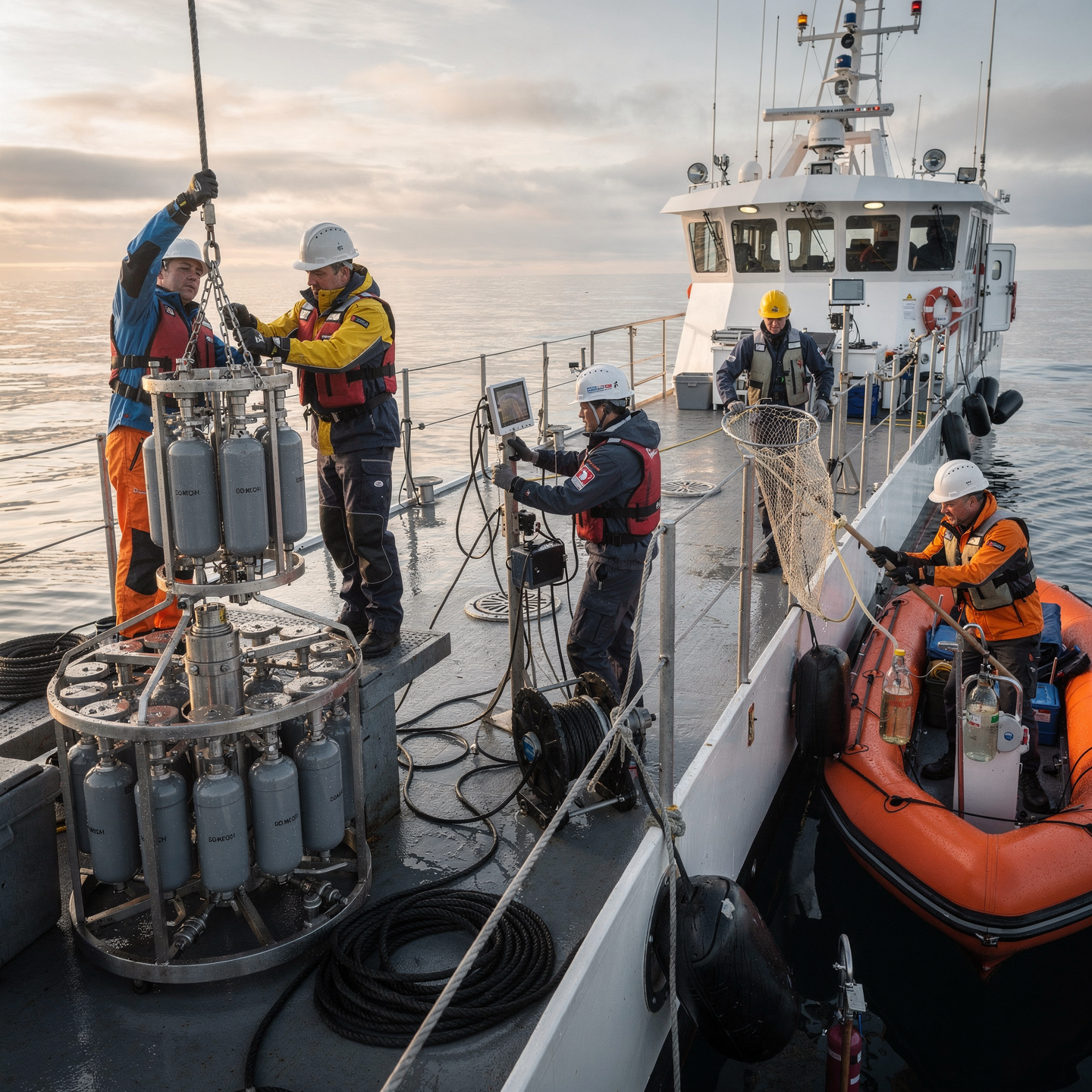
This course will provide you with the essential skills for collecting accurate and representative data in the ocean environment. Learn to plan and execute effective sampling campaigns, mastering the use of specialized equipment and applying standardized protocols to ensure the quality of your results. This program will equip you to contribute to scientific knowledge and the sustainable management of marine resources, covering everything from water and sediment sampling to biodiversity analysis and marine pollution assessment.

Differential Advantages

  • Updated Methodologies: Learn the latest sampling techniques for diverse scientific and environmental applications.
  • Intensive Practice: Participate in simulations and case studies that will allow you to apply the knowledge acquired in real-world situations.
  • Industry Experts: Learn from professionals with extensive experience in marine research and natural resource management.
  • Professional Certification: Obtain a certificate that validates your skills in marine sampling techniques and enhances your professional profile.
  • Practical Application: Acquire the necessary skills to work on research projects, environmental consulting, and coastal management.
Técnicas

Marine Sampling Techniques Course

Availability: 1 in stock

Who is it aimed at?

  • Marine biologists and oceanographers seeking to optimize data collection for studies of biodiversity, pollution, and climate change.
  • Laboratory technicians and environmental analysts who need to standardize their sampling protocols to ensure the accuracy and traceability of results.
  • Marine science students who wish to acquire practical skills in sampling and the use of specialized equipment.
  • Environmental consultants and marine project managers interested in implementing effective methodologies for assessing the ecological status of coastal and oceanic ecosystems.
  • Staff from government agencies and NGOs who need training in sampling techniques for monitoring water quality and species conservation marine.

Learning Flexibility
 Adapted to different learning paces: asynchronous modules available 24/7, discussion forums for resolving doubts, and practical exercises with personalized feedback.

Técnicas

Objectives and competencies

Apply appropriate sampling methods:

“Select the method (random, stratified, systematic) according to the objective of the study and the characteristics of the population, minimizing bias and maximizing representativeness.”

Evaluate the quality of the collected samples:

Verify the integrity of the container, storage conditions and cold chain, confirming traceability and associated documentation.

Managing and preserving marine samples:

Ensure complete traceability, from collection to analysis and archiving, meeting quality and safety standards.

Interpreting marine sampling data:

“Identify patterns, anomalies, and trends in oceanographic variables, considering data quality and applying basic statistical methods.”

Select the appropriate sampling equipment:

Consider the sample type, matrix, target contaminants, and environmental conditions to ensure representativeness and minimize the risk of cross-contamination.

Meticulously document the sampling process:

“Record each stage (planning, execution, analysis), ensuring traceability, reproducibility, and scientific validity.”

Curriculum - Modules

  1. Comprehensive Maritime Incident Management: protocols, roles, and chain of command for coordinated response
  2. Operational Planning and Execution: briefing, routes, weather windows, and go/no-go criteria
  3. Rapid Risk Assessment: criticality matrix, scene control, and decision-making under pressure
  4. Operational Communication: VHF/GMDSS, standardized reports, and inter-agency liaison
  5. Tactical Mobility and Safe Boarding: RHIB maneuvers, approach, mooring, and recovery
  6. Equipment and Technologies: PPE, signaling, satellite tracking, and field data logging
  7. Immediate Care of the Affected: primary assessment, hypothermia, trauma, and stabilization for evacuation
  8. Adverse Environmental Conditions: swell, Visibility, flows, and operational mitigation

    Simulation and training: critical scenarios, use of VR/AR, and exercises with performance metrics

    Documentation and continuous improvement: lessons learned, indicators (MTTA/MTTR), and SOP updates

  1. Introduction to Marine Sampling: Importance, Objectives, and Applications
  2. Sampling Planning: Sampling design, station selection, and variables to be measured
  3. Sampling Equipment: Types, operation, calibration, and maintenance (Niskin bottles, dredges, plankton nets)
  4. Sampling of Seawater: Collection, preservation, and transport techniques (surface sampling, deep sampling, vertical profiles)
  5. Sampling of Marine Sediments: Collection, handling, and storage methods (cores, box corers)
  6. Sampling of Marine Organisms: Capture, identification, and preservation techniques (plankton, benthos, fish)
  7. Quality Control in Sampling: Assurance Quality control, contamination control, and sample traceability.

    Data Management: Data recording, storage, analysis, and presentation of results.

    Marine Sampling Safety: Risks, precautions, and personal protective equipment.

    Legislation and Regulations Applicable to Marine Sampling: Directives, standards, and best practices.

  1. Introduction to Marine Sampling: Objectives, Sampling Types, and Applications
  2. Basic Sampling Equipment: Niskin Bottles, Plankton Nets, Dredges, Corers
  3. Water Sampling: Vertical Profiles, Discrete Sampling, Pumping Systems
  4. Sediment Sampling: Surface and Deep Techniques, Sample Preservation
  5. Biota Sampling: Plankton, Benthos, Fish, Marine Mammals (Ethical and Legal Considerations)
  6. Sampling Strategies: Random, Systematic, Stratified, Clusters
  7. Designing Sampling Plans: Defining Objectives, Selecting Stations, Sampling Frequency
  8. Non-Sampling Techniques Destructive methods: Remote sensing, underwater acoustics, ROVs

    Sample preservation and transport: Physical and chemical methods, chain of custody

    Quality control in sampling: Blanks, duplicates, equipment calibration, traceability

  1. Introduction to marine sampling: objectives, types, and applications
  2. Sampling planning: design, station locations, frequency
  3. Sampling equipment: Niskin bottles, plankton nets, dredges, corers
  4. Water sampling techniques: surface, depth, profiles
  5. Sediment sampling: surface, depth, preservation
  6. Organism sampling: plankton, benthos, fish, seabirds
  7. Sample preservation: chemical methods, freezing, filtration
  8. Sample transport and storage: chain of custody, traceability
  9. Quality control: blanks, duplicates, standards, calibration
  10. Documentation and Traceability: field records, chain of custody forms

  1. Introduction to Marine Sampling: Objectives, types of sampling, representativeness
  2. Basic Sampling Equipment: Niskin bottles, dredges, plankton nets, corers
  3. Water Sampling: Collection, preservation, and transport techniques
  4. Sediment Sampling: Collection, stratification, and storage methods
  5. Biological Sampling: Plankton, benthos, fish, and other marine organisms
  6. Quality Control in Sampling: Blanks, duplicates, standards, traceability
  7. Marine Environmental Regulations and Legislation: Framework directives, international conventions
  8. Data Analysis and Statistics Applied to Sampling: Data processing, interpretation
  9. Safety
  10. in marine sampling: Occupational risks, personal protective equipment

    Ethics in marine research: Responsibility and best practices

  1. System Architecture and Components: Structural design, materials, and subsystems (mechanical, electrical, electronic, and fluid) with selection and assembly criteria for marine environments
  2. Fundamentals and Principles of Operation: Physical and engineering foundations (thermodynamics, fluid mechanics, electricity, control, and materials) that explain performance and operating limits
  3. Safety and Environmental (SHE): Risk analysis, PPE, LOTO, hazardous atmospheres, spill and waste management, and emergency response plans
  4. Applicable Regulations and Standards: IMO/ISO/IEC requirements and local regulations;
  5. Conformance criteria, certification, and best practices for operation and maintenance
  6. Inspection, testing, and diagnostics: Visual/dimensional inspection, functional testing, data analysis, and predictive techniques (vibration, thermography, fluid analysis) to identify root causes
  7. Preventive and predictive maintenance: Hourly/cycle/seasonal plans, lubrication, adjustments, calibrations, consumable replacement, post-service verification, and operational reliability
  8. Instrumentation, tools, and metrology: Measuring and testing equipment, diagnostic software, calibration and traceability; selection criteria, safe use, and storage
  9. Onboard integration and interfaces: Mechanical, electrical, fluid, and data compatibility; Sealing and watertightness, EMC/EMI, corrosion protection, and interoperability testing.

    Quality, acceptance testing, and commissioning: process and materials control, FAT/SAT, bench and sea trials, go/no-go criteria, and evidence documentation.

    Technical documentation and integrated practice: logs, checklists, reports, and a complete case study (safety → diagnosis → intervention → verification → report) applicable to any system.

Plan de estudio - Módulos

  1. Comprehensive Maritime Incident Management: protocols, roles, and chain of command for coordinated response
  2. Operational Planning and Execution: briefing, routes, weather windows, and go/no-go criteria
  3. Rapid Risk Assessment: criticality matrix, scene control, and decision-making under pressure
  4. Operational Communication: VHF/GMDSS, standardized reports, and inter-agency liaison
  5. Tactical Mobility and Safe Boarding: RHIB maneuvers, approach, mooring, and recovery
  6. Equipment and Technologies: PPE, signaling, satellite tracking, and field data logging
  7. Immediate Care of the Affected: primary assessment, hypothermia, trauma, and stabilization for evacuation
  8. Adverse Environmental Conditions: swell, Visibility, flows, and operational mitigation

    Simulation and training: critical scenarios, use of VR/AR, and exercises with performance metrics

    Documentation and continuous improvement: lessons learned, indicators (MTTA/MTTR), and SOP updates

  1. Introduction to Marine Sampling: Importance, Objectives, and Applications
  2. Sampling Planning: Sampling design, station selection, and variables to be measured
  3. Sampling Equipment: Types, operation, calibration, and maintenance (Niskin bottles, dredges, plankton nets)
  4. Sampling of Seawater: Collection, preservation, and transport techniques (surface sampling, deep sampling, vertical profiles)
  5. Sampling of Marine Sediments: Collection, handling, and storage methods (cores, box corers)
  6. Sampling of Marine Organisms: Capture, identification, and preservation techniques (plankton, benthos, fish)
  7. Quality Control in Sampling: Assurance Quality control, contamination control, and sample traceability.

    Data Management: Data recording, storage, analysis, and presentation of results.

    Marine Sampling Safety: Risks, precautions, and personal protective equipment.

    Legislation and Regulations Applicable to Marine Sampling: Directives, standards, and best practices.

  1. Introduction to Marine Sampling: Objectives, Sampling Types, and Applications
  2. Basic Sampling Equipment: Niskin Bottles, Plankton Nets, Dredges, Corers
  3. Water Sampling: Vertical Profiles, Discrete Sampling, Pumping Systems
  4. Sediment Sampling: Surface and Deep Techniques, Sample Preservation
  5. Biota Sampling: Plankton, Benthos, Fish, Marine Mammals (Ethical and Legal Considerations)
  6. Sampling Strategies: Random, Systematic, Stratified, Clusters
  7. Designing Sampling Plans: Defining Objectives, Selecting Stations, Sampling Frequency
  8. Non-Sampling Techniques Destructive methods: Remote sensing, underwater acoustics, ROVs

    Sample preservation and transport: Physical and chemical methods, chain of custody

    Quality control in sampling: Blanks, duplicates, equipment calibration, traceability

  1. Introduction to marine sampling: objectives, types, and applications
  2. Sampling planning: design, station locations, frequency
  3. Sampling equipment: Niskin bottles, plankton nets, dredges, corers
  4. Water sampling techniques: surface, depth, profiles
  5. Sediment sampling: surface, depth, preservation
  6. Organism sampling: plankton, benthos, fish, seabirds
  7. Sample preservation: chemical methods, freezing, filtration
  8. Sample transport and storage: chain of custody, traceability
  9. Quality control: blanks, duplicates, standards, calibration
  10. Documentation and Traceability: field records, chain of custody forms

  1. Introduction to Marine Sampling: Objectives, types of sampling, representativeness
  2. Basic Sampling Equipment: Niskin bottles, dredges, plankton nets, corers
  3. Water Sampling: Collection, preservation, and transport techniques
  4. Sediment Sampling: Collection, stratification, and storage methods
  5. Biological Sampling: Plankton, benthos, fish, and other marine organisms
  6. Quality Control in Sampling: Blanks, duplicates, standards, traceability
  7. Marine Environmental Regulations and Legislation: Framework directives, international conventions
  8. Data Analysis and Statistics Applied to Sampling: Data processing, interpretation
  9. Safety
  10. in marine sampling: Occupational risks, personal protective equipment

    Ethics in marine research: Responsibility and best practices

  1. System Architecture and Components: Structural design, materials, and subsystems (mechanical, electrical, electronic, and fluid) with selection and assembly criteria for marine environments
  2. Fundamentals and Principles of Operation: Physical and engineering foundations (thermodynamics, fluid mechanics, electricity, control, and materials) that explain performance and operating limits
  3. Safety and Environmental (SHE): Risk analysis, PPE, LOTO, hazardous atmospheres, spill and waste management, and emergency response plans
  4. Applicable Regulations and Standards: IMO/ISO/IEC requirements and local regulations;
  5. Conformance criteria, certification, and best practices for operation and maintenance
  6. Inspection, testing, and diagnostics: Visual/dimensional inspection, functional testing, data analysis, and predictive techniques (vibration, thermography, fluid analysis) to identify root causes
  7. Preventive and predictive maintenance: Hourly/cycle/seasonal plans, lubrication, adjustments, calibrations, consumable replacement, post-service verification, and operational reliability
  8. Instrumentation, tools, and metrology: Measuring and testing equipment, diagnostic software, calibration and traceability; selection criteria, safe use, and storage
  9. Onboard integration and interfaces: Mechanical, electrical, fluid, and data compatibility; Sealing and watertightness, EMC/EMI, corrosion protection, and interoperability testing.

    Quality, acceptance testing, and commissioning: process and materials control, FAT/SAT, bench and sea trials, go/no-go criteria, and evidence documentation.

    Technical documentation and integrated practice: logs, checklists, reports, and a complete case study (safety → diagnosis → intervention → verification → report) applicable to any system.

  1. Introduction to Sampling and QA/QC: Definitions and Objectives.
  2. Types of Sampling: Random, Stratified, Systematic, Judgmental.
  3. Sampling Planning: Design, Sample Size, Representativeness.
  4. Sampling Equipment and Materials: Selection, Calibration, and Maintenance.
  5. Field Sampling Techniques: Soil, Water, Air, Solids.
  6. Sample Preservation and Transport: Containers, Labeling, Chain of Custody.
  7. Quality Control in Sampling: Blanks, Duplicates, Fortification.
  8. Quality Assurance in Sampling: Documentation, Traceability, Audits.
  9. Analysis of Quality Control Data Quality: Calculation of precision, accuracy, and bias.

    Sampling and QA/QC regulations and standards: ISO, EPA, etc.

  1. Introduction to marine sampling: objectives, applications, and sample types.
  2. Sampling equipment: Niskin bottles, dredges, plankton nets, corers.
  3. Sampling planning: experimental design, station selection, frequency.
  4. Water sampling techniques: procedures, precautions, and volumes.
  5. Sediment sampling techniques: methods, preservation, and storage.
  6. Biota sampling techniques: capture, identification, and preservation of organisms.
  7. Quality control in sampling: blanks, duplicates, reference materials.
  8. Safety in marine sampling: risks, protective equipment, and protocols.
  9. Regulations and legislation applicable to marine sampling.
  10. Sampling data management: recording, analysis, and storage.

  1. Introduction to marine sampling: objectives, types, and applications.
  2. Basic sampling equipment: Niskin bottles, plankton nets, dredges, corers.
  3. Water sampling: techniques for collecting, preserving, and transporting samples.
  4. Sediment sampling: methods of extraction, handling, and storage.
  5. Biological sampling: plankton, benthos, fish, and other marine organisms.
  6. Quality control in sampling: quality assurance (QA) and quality control (QC).
  7. Safety in marine sampling: risks and preventive measures.
  8. Sampling protocols for different types of analysis: physicochemical, biological, and microbiological.
  9. Ethical and legal considerations in marine sampling.
  10. Documentation and traceability: data recording, chain of custody.

  1. Introduction to marine sampling: Objectives, applications, and types of sampling.
  2. Sampling planning: Strategy design, station selection, and schedule.
  3. Sampling equipment and materials: Niskin bottles, plankton nets, dredges, corers, and multiparameter sounders.
  4. Sample sampling techniques for seawater: Surface, deep, vertical profiles, and integrated sampling.
  5. Sample sampling techniques for marine sediments: Surface, subsurface, and core sampling.
  6. Sample sampling techniques for marine organisms: Plankton, benthos, nekton, and non-destructive sampling.
  7. Sample preservation and transport: Fixation, refrigeration, and Freezing and documentation of the chain of custody.
  8. Quality control in sampling: Quality assurance, contamination control, and equipment calibration.

    Analysis of sampling data: Descriptive statistics, analysis of variance, and graphical representation techniques.

    Safety in marine sampling: Associated risks, personal protective equipment, and emergency protocols.

Career opportunities

  • Marine Laboratory Technician: Sample analysis, quality control, report preparation.
  • Research Scientist: Participation in oceanographic research projects, sampling design, data analysis.
  • Environmental Consultant: Environmental impact assessment of marine activities, design of monitoring plans, technical advice.
  • Marine Resource Manager: Planning and management of marine protected areas, control of fishing activities, ecosystem conservation.
  • Aquaculture Technician: Water quality control, sampling of farmed organisms, monitoring of environmental parameters.
  • Marine Data Analyst: Processing and analysis of oceanographic data, modeling of marine processes, preparation of technical reports.
  • Water Quality Inspector: Sampling and analysis of coastal and oceanic waters, spill control, and environmental quality monitoring.

    Marine Environmental Educator: Scientific outreach, design of educational programs, and raising awareness about marine conservation.

    “`

Admission requirements

Academic/professional profile:

Degree/Bachelor's degree in Nautical Science/Maritime Transport, Naval/Marine Engineering, or a related field; or proven professional experience in bridge/operations.

Language proficiency:

Recommended functional maritime English (SMCP) for simulations and technical materials.

5. Induction

Updated resume, copy of degree or seaman's book, ID card/passport, letter of motivation.

Technical requirements (for online):

Equipment with camera/microphone, stable connection, ≥ 24” monitor recommended for ECDIS/Radar-ARPA.

Admission process and dates

1. Online
application

(form + documents).

2. Academic review and interview

(profile/objectives/schedule compatibility).

3. Admission decision

(+ scholarship proposal if applicable).

4. Reservation of place

(deposit) and registration.

5. Induction

(access to campus, calendars, simulator guides).

Scholarships and grants

  • Sampling Mastery: Learn the essential techniques for collecting high-quality marine samples.
  • Effective Planning: Design optimized sampling strategies based on objectives and available resources.
  • Comprehensive Analysis: Process and analyze sampling data to gain valuable insights into the marine ecosystem.
  • Tools and Equipment: Become familiar with the proper use and maintenance of specialized sampling equipment.
  • Safety and Regulations: Apply safety protocols and comply with current regulations for marine sampling.
Boost your career as a research professional marine with practical and applicable knowledge.

Testimonials

Frequently asked questions

Random sampling selects sampling points randomly within the study area, while stratified sampling first divides the area into subgroups (strata) with similar characteristics (e.g., depth, habitat type) and then samples randomly within each stratum.

Yes. The itinerary includes ECDIS/Radar-ARPA/BRM with harbor, ocean, fog, storm, and SAR scenarios.

Online with live sessions; hybrid option for simulator/practical placements through agreements.

In simple random sampling, all points in the marine environment have the same probability of being sampled, whereas in stratified sampling, the environment is divided into strata (e.g., depth zones, habitat types) and simple random sampling is carried out within each stratum, ensuring representation of all areas of interest.

Recommended functional SMCP. We offer support materials for standard phraseology.

Yes, with a relevant degree or experience in maritime/port operations. The admissions interview will confirm suitability.

Optional (3–6 months) through Companies & Collaborations and the Alumni Network.

Simulator practice (rubrics), defeat plans, SOPs, checklists, micro-tests and applied TFM.

A degree from Navalis Magna University + operational portfolio (tracks, SOPs, reports and KPIs) useful for audits and employment.

  1. Introduction to marine sampling: Objectives, applications, and types of sampling.
  2. Sampling planning: Strategy design, station selection, and schedule.
  3. Sampling equipment and materials: Niskin bottles, plankton nets, dredges, corers, and multiparameter sounders.
  4. Sample sampling techniques for seawater: Surface, deep, vertical profiles, and integrated sampling.
  5. Sample sampling techniques for marine sediments: Surface, subsurface, and core sampling.
  6. Sample sampling techniques for marine organisms: Plankton, benthos, nekton, and non-destructive sampling.
  7. Sample preservation and transport: Fixation, refrigeration, and Freezing and documentation of the chain of custody.
  8. Quality control in sampling: Quality assurance, contamination control, and equipment calibration.

    Analysis of sampling data: Descriptive statistics, analysis of variance, and graphical representation techniques.

    Safety in marine sampling: Associated risks, personal protective equipment, and emergency protocols.

Request information

  1. Complete the Application Form
  2. Attach your CV/Qualifications (if you have them to hand).
  3. Indicate your preferred cohort (January/May/September) and whether you want the hybrid option with simulator sessions.
An academic advisor will contact you within 24–48 hours to guide you through the admission process, scholarships, and compatibility with your professional schedule. Translated with DeepL.com (free version)
Please enable JavaScript in your browser to complete this form.
Click or drag a file to this area to upload.

Teachers

0
    0
    Tu carrito
    Tu carrito esta vacíoRegresar a la tienda
    Scroll to Top


