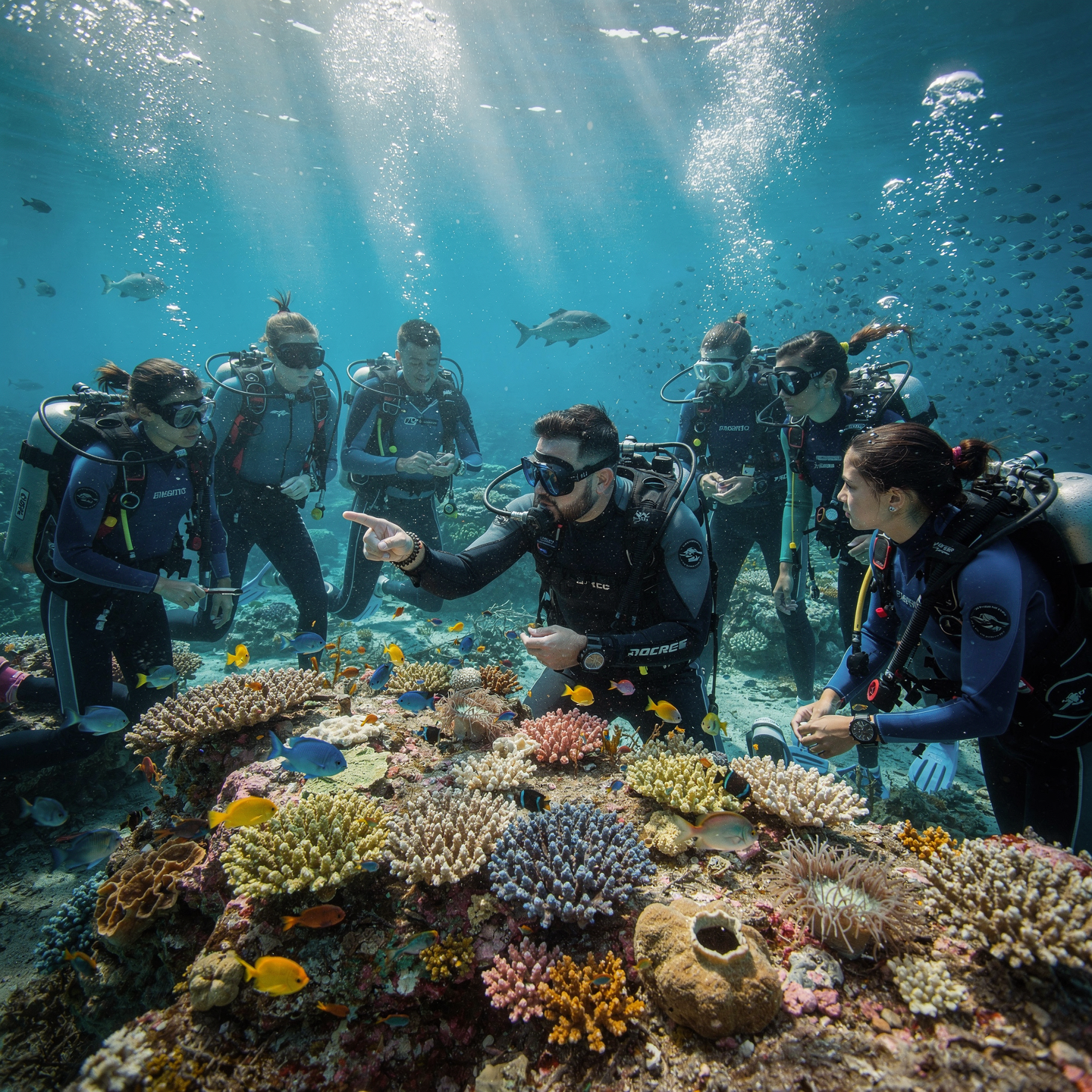
Reef and Marine Conservation Course

Why this course?

The Reef and Marine Conservation

course

This course provides you with the essential tools to understand and protect these vital ecosystems. You will learn about marine biodiversity, the threats facing reefs (climate change, pollution, overfishing), and the most effective conservation strategies. You will develop skills in ecological monitoring, habitat restoration, and sustainable marine resource management. This program will empower you to actively contribute to the health of our oceans and their future.

This course provides you with the essential tools to understand and protect these vital ecosystems. You will learn about marine biodiversity, the threats facing reefs (climate change, pollution, overfishing), and the most effective conservation strategies. You will develop skills in ecological monitoring, habitat restoration, and sustainable marine resource management. This program will empower you to actively contribute to the health of our oceans and their future.

Differential Advantages

  • Practical Approach: You will learn sampling techniques, data analysis, and conservation project design.
  • Subject Matter Experts: You will receive instruction from leading marine scientists and conservation professionals.
  • Real-World Case Studies: You will analyze successful examples of reef conservation in different parts of the world.
  • Networking Opportunities: You will connect with other students and professionals interested in marine conservation.
  • Certification: Upon completion of the course, you will receive a certificate validating your knowledge and skills.
Conservación

Reef and Marine Conservation Course

Availability: 1 in stock

Who is it aimed at?

  • Marine biologists and students seeking to deepen their knowledge of conservation techniques, species identification, and reef ecosystem assessment.
  • Divers and tour guides interested in sustainable diving practices, group management, and effective environmental outreach.
  • Managers of marine protected areas requiring tools for planning, monitoring, and management of coastal resources.
  • Environmental educators and communicators interested in developing innovative teaching materials and awareness campaigns.
  • Sea lovers and engaged citizens seeking to actively contribute to the protection of reefs and marine life.

Flexibility of Learning

Adapted to your pace: Asynchronous modules accessible 24/7, discussion forums, and personalized tutoring to answer your questions.

Conservación

Objectives and competencies

Implement mitigation strategies:

“Assess risks, prioritize actions, and communicate effectively with the crew.”

Promote community participation:

“Organize events and workshops to involve residents in local development decision-making and promote open dialogue between residents and authorities.”

Restoring degraded marine ecosystems:

“Implement coral reef restoration techniques, such as the cultivation and transplantation of coral fragments, and monitor their long-term progress.”

Monitoring the health of the reefs:

“Identify and document key indicators of reef health (coral cover, species present, bleaching) using standardized methodologies and appropriate technologies (underwater photography, sensors).”

Promote sustainable fishing practices:

Implement selective fishing gear and report incidental catches.

Reduce marine pollution:

Minimize accidental spills by rigorously adhering to loading/unloading procedures and contingency plans, demonstrating proactivity in detecting and correcting potential technical or human failures.

Curriculum - Modules

  1. Comprehensive Maritime Incident Management: protocols, roles, and chain of command for coordinated response
  2. Operational Planning and Execution: briefing, routes, weather windows, and go/no-go criteria
  3. Rapid Risk Assessment: criticality matrix, scene control, and decision-making under pressure
  4. Operational Communication: VHF/GMDSS, standardized reports, and inter-agency liaison
  5. Tactical Mobility and Safe Boarding: RHIB maneuvers, approach, mooring, and recovery
  6. Equipment and Technologies: PPE, signaling, satellite tracking, and field data logging
  7. Immediate Care of the Affected: primary assessment, hypothermia, trauma, and stabilization for evacuation
  8. Adverse Environmental Conditions: swell, Visibility, flows, and operational mitigation

    Simulation and training: critical scenarios, use of VR/AR, and exercises with performance metrics

    Documentation and continuous improvement: lessons learned, indicators (MTTA/MTTR), and SOP updates

  1. Introduction to Reef Ecology: Biodiversity, Importance, and Threats
  2. Identification of Key Species: Corals, Fish, Invertebrates, and Algae
  3. Environmental Parameters: Temperature, Salinity, Light, and Water Quality
  4. Visual Monitoring Techniques: Transects, Quadrats, and Coverage Estimates
  5. Underwater Photography and Videography: Documentation and Data Analysis
  6. Monitoring Coral Health: Bleaching, Diseases, and Predation
  7. Active Restoration Strategies: Coral Propagation and Transplanting
  8. Artificial Structures: Design, Implementation, and Monitoring of Artificial Reefs
  9. Invasive Species Management: Identification, Control, and Eradication

    Community Participation and Environmental Education: Involvement and Sustainability

  1. Introduction to Reef Health: Importance, Threats, and Resilience
  2. Water Quality Monitoring: Physical, Chemical, and Biological Parameters
  3. Coral Identification: Morphology, Key Species, and Health Status
  4. Underwater Visual Census Techniques: Transects, Quadrats, and Photography
  5. Disease and Bleaching Assessment: Causes, Symptoms, and Protocols
  6. Active Restoration Strategies: Propagation, Transplanting, and Artificial Structures
  7. Invasive Species Control and Macroalgae Management
  8. Community Engagement: Environmental Education, Volunteering, and Citizen Science
  9. Data Analysis and Preparation of technical reports.
  10. Environmental legislation and regulations for reef protection.

  1. Introduction to Reef Ecology: Structure, Function, and Importance.
  2. Reef Biodiversity: Identification of Key Species (Corals, Fish, Invertebrates).
  3. Environmental Factors that Influence Reefs: Temperature, Salinity, Light, Nutrients.
  4. Threats to Reefs: Climate Change, Pollution, Overfishing, Diseases.
  5. Monitoring Reef Health: Visual and Quantitative Assessment Methodologies.
  6. Reef Health Indicators: Coral Cover, Fish Abundance, Presence of Diseases.
  7. Reef Restoration Techniques: Coral Propagation, Substrate Stabilization.
  8. Coral Nursery Management: Design, maintenance, and transplantation of colonies.
  9. Marine Conservation Legislation and Policies: Protected areas and regulations.
  10. Community Participation in Reef Conservation: Environmental education and ecotourism.

  1. Introduction to Reef Ecology: Biodiversity, Importance, and Threats
  2. Identification of Key Species: Corals, Fish, Invertebrates, and Algae
  3. Visual Monitoring Techniques: Transects, Quadrats, and Photoquadrats
  4. Physicochemical Water Parameters: Temperature, Salinity, pH, and Dissolved Oxygen
  5. Coral Health: Identification of Diseases, Bleaching, and Predation
  6. Anthropogenic Impacts: Pollution, Overfishing, and Climate Change
  7. Active Restoration Strategies: Coral Nurseries, Transplanting, and Artificial Structures
  8. Coral Nursery Management: Propagation, Maintenance, and Acclimation
  9. Coral transplantation techniques: site selection, anchoring, and monitoring
  10. Evaluating restoration success: ecological and socioeconomic indicators

  1. System Architecture and Components: Structural design, materials, and subsystems (mechanical, electrical, electronic, and fluid) with selection and assembly criteria for marine environments
  2. Fundamentals and Principles of Operation: Physical and engineering foundations (thermodynamics, fluid mechanics, electricity, control, and materials) that explain performance and operating limits
  3. Safety and Environmental (SHE): Risk analysis, PPE, LOTO, hazardous atmospheres, spill and waste management, and emergency response plans
  4. Applicable Regulations and Standards: IMO/ISO/IEC requirements and local regulations;
  5. Conformance criteria, certification, and best practices for operation and maintenance
  6. Inspection, testing, and diagnostics: Visual/dimensional inspection, functional testing, data analysis, and predictive techniques (vibration, thermography, fluid analysis) to identify root causes
  7. Preventive and predictive maintenance: Hourly/cycle/seasonal plans, lubrication, adjustments, calibrations, consumable replacement, post-service verification, and operational reliability
  8. Instrumentation, tools, and metrology: Measuring and testing equipment, diagnostic software, calibration and traceability; selection criteria, safe use, and storage
  9. Onboard integration and interfaces: Mechanical, electrical, fluid, and data compatibility; Sealing and watertightness, EMC/EMI, corrosion protection, and interoperability testing.

    Quality, acceptance testing, and commissioning: process and materials control, FAT/SAT, bench and sea trials, go/no-go criteria, and evidence documentation.

    Technical documentation and integrated practice: logs, checklists, reports, and a complete case study (safety → diagnosis → intervention → verification → report) applicable to any system.

Plan de estudio - Módulos

  1. Comprehensive Maritime Incident Management: protocols, roles, and chain of command for coordinated response
  2. Operational Planning and Execution: briefing, routes, weather windows, and go/no-go criteria
  3. Rapid Risk Assessment: criticality matrix, scene control, and decision-making under pressure
  4. Operational Communication: VHF/GMDSS, standardized reports, and inter-agency liaison
  5. Tactical Mobility and Safe Boarding: RHIB maneuvers, approach, mooring, and recovery
  6. Equipment and Technologies: PPE, signaling, satellite tracking, and field data logging
  7. Immediate Care of the Affected: primary assessment, hypothermia, trauma, and stabilization for evacuation
  8. Adverse Environmental Conditions: swell, Visibility, flows, and operational mitigation

    Simulation and training: critical scenarios, use of VR/AR, and exercises with performance metrics

    Documentation and continuous improvement: lessons learned, indicators (MTTA/MTTR), and SOP updates

  1. Introduction to Reef Ecology: Biodiversity, Importance, and Threats
  2. Identification of Key Species: Corals, Fish, Invertebrates, and Algae
  3. Environmental Parameters: Temperature, Salinity, Light, and Water Quality
  4. Visual Monitoring Techniques: Transects, Quadrats, and Coverage Estimates
  5. Underwater Photography and Videography: Documentation and Data Analysis
  6. Monitoring Coral Health: Bleaching, Diseases, and Predation
  7. Active Restoration Strategies: Coral Propagation and Transplanting
  8. Artificial Structures: Design, Implementation, and Monitoring of Artificial Reefs
  9. Invasive Species Management: Identification, Control, and Eradication

    Community Participation and Environmental Education: Involvement and Sustainability

  1. Introduction to Reef Health: Importance, Threats, and Resilience
  2. Water Quality Monitoring: Physical, Chemical, and Biological Parameters
  3. Coral Identification: Morphology, Key Species, and Health Status
  4. Underwater Visual Census Techniques: Transects, Quadrats, and Photography
  5. Disease and Bleaching Assessment: Causes, Symptoms, and Protocols
  6. Active Restoration Strategies: Propagation, Transplanting, and Artificial Structures
  7. Invasive Species Control and Macroalgae Management
  8. Community Engagement: Environmental Education, Volunteering, and Citizen Science
  9. Data Analysis and Preparation of technical reports.
  10. Environmental legislation and regulations for reef protection.

  1. Introduction to Reef Ecology: Structure, Function, and Importance.
  2. Reef Biodiversity: Identification of Key Species (Corals, Fish, Invertebrates).
  3. Environmental Factors that Influence Reefs: Temperature, Salinity, Light, Nutrients.
  4. Threats to Reefs: Climate Change, Pollution, Overfishing, Diseases.
  5. Monitoring Reef Health: Visual and Quantitative Assessment Methodologies.
  6. Reef Health Indicators: Coral Cover, Fish Abundance, Presence of Diseases.
  7. Reef Restoration Techniques: Coral Propagation, Substrate Stabilization.
  8. Coral Nursery Management: Design, maintenance, and transplantation of colonies.
  9. Marine Conservation Legislation and Policies: Protected areas and regulations.
  10. Community Participation in Reef Conservation: Environmental education and ecotourism.

  1. Introduction to Reef Ecology: Biodiversity, Importance, and Threats
  2. Identification of Key Species: Corals, Fish, Invertebrates, and Algae
  3. Visual Monitoring Techniques: Transects, Quadrats, and Photoquadrats
  4. Physicochemical Water Parameters: Temperature, Salinity, pH, and Dissolved Oxygen
  5. Coral Health: Identification of Diseases, Bleaching, and Predation
  6. Anthropogenic Impacts: Pollution, Overfishing, and Climate Change
  7. Active Restoration Strategies: Coral Nurseries, Transplanting, and Artificial Structures
  8. Coral Nursery Management: Propagation, Maintenance, and Acclimation
  9. Coral transplantation techniques: site selection, anchoring, and monitoring
  10. Evaluating restoration success: ecological and socioeconomic indicators

  1. System Architecture and Components: Structural design, materials, and subsystems (mechanical, electrical, electronic, and fluid) with selection and assembly criteria for marine environments
  2. Fundamentals and Principles of Operation: Physical and engineering foundations (thermodynamics, fluid mechanics, electricity, control, and materials) that explain performance and operating limits
  3. Safety and Environmental (SHE): Risk analysis, PPE, LOTO, hazardous atmospheres, spill and waste management, and emergency response plans
  4. Applicable Regulations and Standards: IMO/ISO/IEC requirements and local regulations;
  5. Conformance criteria, certification, and best practices for operation and maintenance
  6. Inspection, testing, and diagnostics: Visual/dimensional inspection, functional testing, data analysis, and predictive techniques (vibration, thermography, fluid analysis) to identify root causes
  7. Preventive and predictive maintenance: Hourly/cycle/seasonal plans, lubrication, adjustments, calibrations, consumable replacement, post-service verification, and operational reliability
  8. Instrumentation, tools, and metrology: Measuring and testing equipment, diagnostic software, calibration and traceability; selection criteria, safe use, and storage
  9. Onboard integration and interfaces: Mechanical, electrical, fluid, and data compatibility; Sealing and watertightness, EMC/EMI, corrosion protection, and interoperability testing.

    Quality, acceptance testing, and commissioning: process and materials control, FAT/SAT, bench and sea trials, go/no-go criteria, and evidence documentation.

    Technical documentation and integrated practice: logs, checklists, reports, and a complete case study (safety → diagnosis → intervention → verification → report) applicable to any system.

  1. Introduction to ecological restoration and its application to reefs
  2. Reef ecology: structure, function, biodiversity, and ecosystem services
  3. Threats to reefs: climate change, pollution, overfishing, diseases
  4. Active restoration techniques: propagation, transplanting, substrate stabilization
  5. Reef monitoring: biological, physical, and chemical indicators
  6. Data analysis: statistical tools and visualization
  7. Reef resilience: factors that promote it and strategies to strengthen it
  8. Adaptive management: planning, implementation, evaluation, and adjustment
  9. Community participation: involvement of local stakeholders and Environmental education
  10. Legislation and public policies: legal framework for the protection and restoration of reefs

  1. Reef Ecology: Structure, Function, and Biodiversity
  2. Threats to Reefs: Climate Change, Pollution, and Overfishing
  3. Ecological Monitoring: Visual Methods, Transects, and Quadrats
  4. Environmental Parameters: Temperature, Salinity, pH, and Nutrients
  5. Coral Health: Bleaching, Disease, and Mortality
  6. Reef Resilience: Factors Promoting Recovery
  7. Management Strategies: Marine Protected Areas, Zoning, and Regulation
  8. Reef Restoration: Coral Propagation, Artificial Structures
  9. Community Participation: Education, Awareness, and Empowerment

    Data Analysis: Interpretation, Visualization, and Decision Making

  1. Introduction to coral reefs: biodiversity, ecological functions, and socioeconomic value.
  2. Threats to reefs: climate change, ocean acidification, pollution, and overfishing.
  3. Monitoring reef health: biological indicators, sampling methods, and data analysis.
  4. Reef restoration: propagation techniques, coral transplantation, and artificial structures.
  5. Integrated coastal management: marine spatial planning, zoning, and participatory governance.
  6. Marine protected areas: design, effective management, and conservation assessment.
  7. Sustainable ecotourism: best practices, community benefits, and minimizing impacts.
  8. Legislation and policies: instruments legal frameworks, international agreements, and national strategies.
  9. Coastal communities: participation, empowerment, and alternative livelihoods.
  10. Environmental communication and education: awareness-raising, behavior change, and scientific outreach.

  1. Introduction to marine ecology: basic concepts and coastal ecosystems.
  2. Biology and ecology of coral reefs: structure, function, and biodiversity.
  3. Identification of reef species: corals, fish, invertebrates, and algae.
  4. Scientific diving techniques: safety, equipment, and underwater protocols.
  5. Underwater photography and videography: documentation and visual communication.
  6. Water quality monitoring: physical, chemical, and biological parameters.
  7. Anthropogenic impacts on reefs: pollution, overfishing, and climate change.
  8. Methodologies for assessing the conservation status of reefs.
  9. Design and implementation of coastal monitoring programs.
  10. Data analysis and preparation of technical reports.

Career opportunities

  • Marine Conservation Technician: Implementation of reef restoration programs, monitoring of marine ecosystem health.
  • Marine Biologist/Researcher: Study of reef biodiversity, analysis of environmental impacts, development of conservation strategies.
  • Marine Protected Area Manager: Planning and management of marine reserves, regulatory compliance, environmental education.
  • Environmental Consultant: Environmental impact assessment of coastal projects, design of mitigation measures, advising companies and institutions.
  • Environmental Educator: Development of educational programs on marine conservation, scientific outreach, community awareness.
  • Ecotourism Guide: Leading sustainable tourism activities, interpretation of natural heritage, promotion of conservation.
  • Aquarist/Aquarium Manager: Care of captive marine species, facility maintenance, scientific outreach.
  • Laboratory Technician: Analysis of water samples and marine organisms, support for scientific research, quality control.

“`

Admission requirements

Academic/professional profile:

Degree/Bachelor's degree in Nautical Science/Maritime Transport, Naval/Marine Engineering, or a related field; or proven professional experience in bridge/operations.

Language proficiency:

Recommended functional maritime English (SMCP) for simulations and technical materials.

5. Induction

Updated resume, copy of degree or seaman's book, ID card/passport, letter of motivation.

Technical requirements (for online):

Equipment with camera/microphone, stable connection, ≥ 24” monitor recommended for ECDIS/Radar-ARPA.

Admission process and dates

1. Online
application

(form + documents).

2. Academic review and interview

(profile/objectives/schedule compatibility).

3. Admission decision

(+ scholarship proposal if applicable).

4. Reservation of place

(deposit) and registration.

5. Induction

(access to campus, calendars, simulator guides).

Scholarships and grants

  • Discover the Hidden Beauty: Immerse yourself in the fascinating world of reefs and seas, understanding their ecological importance and vulnerability.
  • Tools for Action: Learn monitoring, restoration, and sustainable management techniques to protect these vital ecosystems.
  • Real and Tangible Impact: Participate in conservation projects and actively contribute to the preservation of marine biodiversity.
  • Experts by Your Side: Receive training from renowned marine biologists, conservationists, and scientists who are leaders in ocean research and protection.
  • A Sustainable Future: Acquire the knowledge and skills necessary to promote marine conservation and ensure a healthy future for our oceans.
Join the wave of change and become an advocate for the reefs and seas!

Testimonials

Frequently asked questions

Yes. The itinerary includes ECDIS/Radar-ARPA/BRM with harbor, ocean, fog, storm, and SAR scenarios.

Online with live sessions; hybrid option for simulator/practical placements through agreements.

Recommended functional SMCP. We offer support materials for standard phraseology.

Yes, with a relevant degree or experience in maritime/port operations. The admissions interview will confirm suitability.

Optional (3–6 months) through Companies & Collaborations and the Alumni Network.

Simulator practice (rubrics), defeat plans, SOPs, checklists, micro-tests and applied TFM.

A degree from Navalis Magna University + operational portfolio (tracks, SOPs, reports and KPIs) useful for audits and employment.

  1. Introduction to marine ecology: basic concepts and coastal ecosystems.
  2. Biology and ecology of coral reefs: structure, function, and biodiversity.
  3. Identification of reef species: corals, fish, invertebrates, and algae.
  4. Scientific diving techniques: safety, equipment, and underwater protocols.
  5. Underwater photography and videography: documentation and visual communication.
  6. Water quality monitoring: physical, chemical, and biological parameters.
  7. Anthropogenic impacts on reefs: pollution, overfishing, and climate change.
  8. Methodologies for assessing the conservation status of reefs.
  9. Design and implementation of coastal monitoring programs.
  10. Data analysis and preparation of technical reports.

Request information

  1. Complete the Application Form
  2. Attach your CV/Qualifications (if you have them to hand).
  3. Indicate your preferred cohort (January/May/September) and whether you want the hybrid option with simulator sessions.
An academic advisor will contact you within 24–48 hours to guide you through the admission process, scholarships, and compatibility with your professional schedule. Translated with DeepL.com (free version)
Please enable JavaScript in your browser to complete this form.
Click or drag a file to this area to upload.

Teachers

0
    0
    Tu carrito
    Tu carrito esta vacíoRegresar a la tienda
    Scroll to Top


