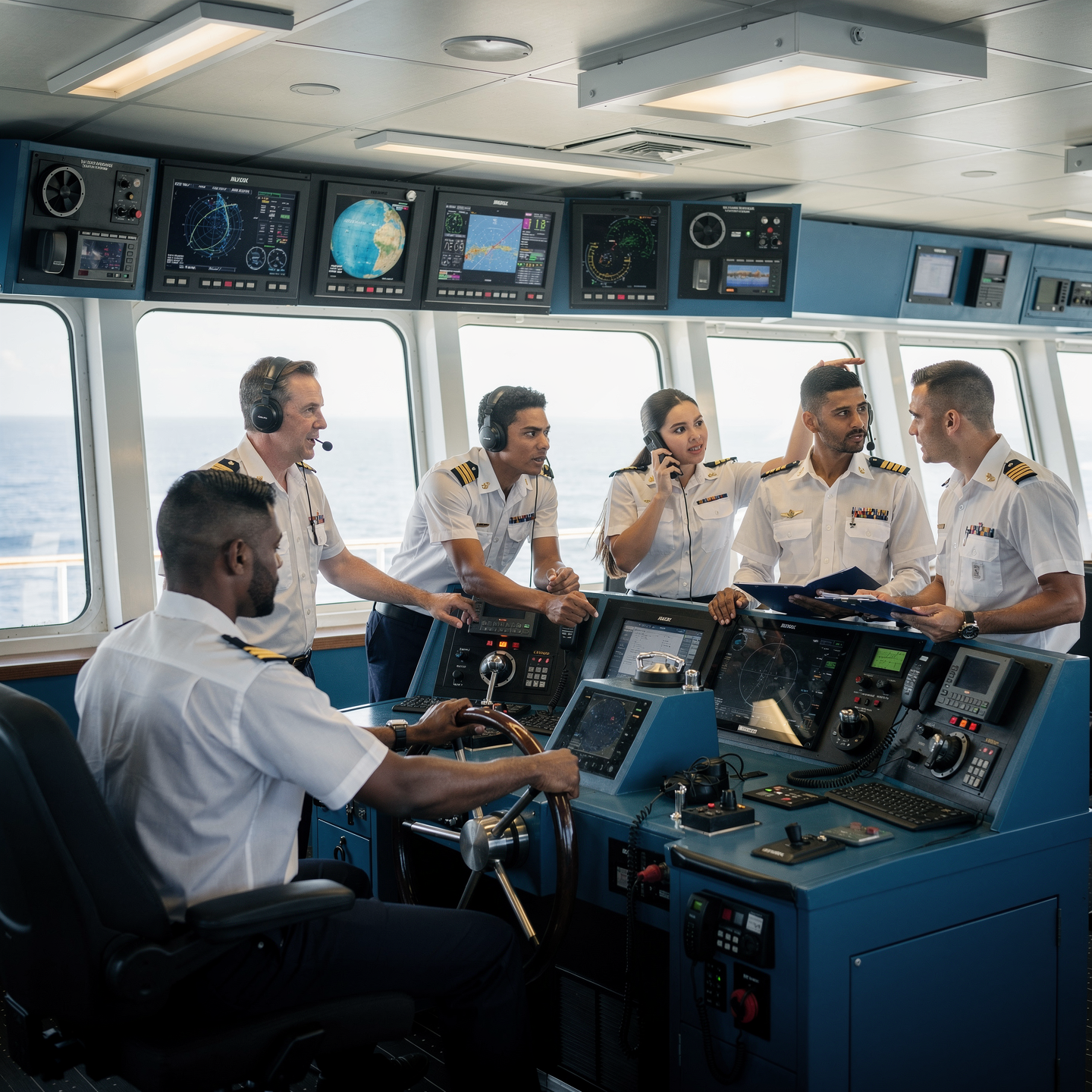
Effective Communication on Ships Course

Why this course?

The Effective Communication on Ships

This course is designed to improve safety and operational efficiency on board through clear and precise communication. You will learn to avoid critical misunderstandings, optimize teamwork, and manage emergency situations effectively. This program addresses the specific characteristics of the maritime environment, with practical exercises and simulations that will allow you to apply communication techniques in real-life situations, from coordinating maneuvers to crisis management, in order to minimize risks and optimize collaboration among the crew.

Differential Advantages

  • Practical Simulations: Realistic scenarios to improve communication in critical situations.
  • Active Listening Techniques: Developing skills to understand and respond effectively.
  • Intercultural Communication: Strategies to overcome language and cultural barriers.
  • Conflict Management: Tools to resolve disagreements constructively.
  • Nonverbal Communication: Interpreting and using body language to improve understanding.

Comunicación

Effective Communication on Ships Course

Availability: 1 in stock

Who is it aimed at?

  • Officers and seamen of all ranks looking to improve clarity and accuracy in their onboard communications.
  • Supervisors and department heads wanting to optimize coordination and information flow between teams.
  • Deck and engine room personnel needing to reduce misunderstandings and avoid errors resulting from poor communication.
  • New recruits and cadets aiming to master standard communication protocols and quickly adapt to the maritime work environment.
  • Maritime safety and HSEQ professionals interested in fostering a culture of proactive communication to prevent incidents and improve overall safety.

Flexibility for your routine
Ā Accessible content online 24/7, practical exercises focused on real-world scenarios, and a discussion forum to share experiences with industry colleagues.

Comunicación

Objectives and competencies

Establish and maintain active listening on board:

Implement standardized communication procedures (IMO phrases), prioritizing clarity and avoiding ambiguities, documenting all relevant communication in the bridge log.

To give clear and concise instructions in emergency situations:

“Prioritize the safety of the crew, passengers, and vessel, using standardized language (IMO) and relying on available resources (manuals, checklists).”

Use nonverbal communication to complement and reinforce key messages:

“Modulate tone, posture, and gestures to emphasize important points and build trust.”

Adapt communication to the cultural and linguistic context of the crew:

“Use clear and concise language, taking into account possible language barriers and adapting technical vocabulary.”

Resolving conflicts on board through assertive communication:

“Implement active listening and negotiation techniques, identifying the needs and interests of all parties involved to reach mutually beneficial solutions and maintain a collaborative work environment.”

To effectively coordinate ship maneuvers using standardized communication protocols:

Interpret orders and transmit them clearly, using the SMCP and adapting to different scenarios and roles on board.

Curriculum - Modules

  1. Comprehensive Maritime Incident Management: protocols, roles, and chain of command for coordinated response
  2. Operational Planning and Execution: briefing, routes, weather windows, and go/no-go criteria
  3. Rapid Risk Assessment: criticality matrix, scene control, and decision-making under pressure
  4. Operational Communication: VHF/GMDSS, standardized reports, and inter-agency liaison
  5. Tactical Mobility and Safe Boarding: RHIB maneuvers, approach, mooring, and recovery
  6. Equipment and Technologies: PPE, signaling, satellite tracking, and field data logging
  7. Immediate Care of the Affected: primary assessment, hypothermia, trauma, and stabilization for evacuation
  8. Adverse Environmental Conditions: swell, Visibility, flows, and operational mitigation

    Simulation and training: critical scenarios, use of VR/AR, and exercises with performance metrics

    Documentation and continuous improvement: lessons learned, indicators (MTTA/MTTR), and SOP updates

  1. Legal and Regulatory Framework for Maritime Safety: SOLAS, MARPOL, and STCW Conventions and their updates.
  2. International Maritime Organizations: IMO, Coast Guard, and their roles in safety.
  3. Maritime Communication: Radio communication procedures, GMDSS, VHF, MF/HF, and EPIRBs.
  4. SAR (Search and Rescue): Organization, procedures, equipment, and communications in SAR operations.
  5. Crisis Management on Board: Threat identification, risk assessment, and contingency plans.
  6. Fires on Board: Prevention, detection, extinguishing, equipment, and emergency procedures.
  7. Damage and Water Ingress: Control procedures for Damage, watertightness, and pumping.
  8. Abandon Ship: Evacuation procedures, lifeboats, life rafts, and survival equipment.
  9. Cargo Security: Stowage, securing, handling of dangerous goods, and spill prevention.
  10. Maritime Cybersecurity: Cyber ​​threats, vulnerabilities, and protective measures in communication and navigation systems.

  1. Introduction to Maritime Radiocommunications: Purpose and Scope.
  2. Radio Equipment: VHF, MF/HF, DSC, NAVTEX, EPIRB, SART.
  3. Call Procedures: Urgency, Safety, Routine.
  4. International Phonetic Alphabet and Numbers: Correct Use and Practice.
  5. IMO Standard Phraseology (SMCP): Application in Communications.
  6. Maritime English: Technical Vocabulary, Essential Grammar, and Pronunciation.
  7. GMDSS Communications: Global Maritime Distress and Safety System.
  8. Emergency Management: Incident Assessment, Response, and Communication.
  9. Emergency Drills: Planning, execution, and evaluation.
  10. Legislation and Regulations: Compliance with international and national regulations.

  1. Introduction to Maritime Communication: Importance, Evolution, and Challenges
  2. Standard Maritime Terminology: Glossary, Abbreviations, and Key Phrases
  3. Radiocommunications: Equipment, Frequencies, and Calling Procedures (VHF, MF/HF)
  4. Radio Regulations: ITU, IMO, National Authorities
  5. GMDSS (Global Maritime Distress and Safety System): Components and Operation
  6. Distress Procedures: MAYDAY, PAN PAN, SECURITE Priorities.
  7. Communication in emergency situations: fire, collision, man overboard, shipwreck.
  8. Maritime safety: position reports, notices to mariners, weather information.
  9. Communication protocols with port authorities, pilots, and tugboats.
  10. Effective use of Standard Maritime English: IMO Model Course 3.17.

  1. Regulatory framework for maritime communications: IMO, ITU, SOLAS
  2. Radiocommunication equipment: VHF, MF/HF, Inmarsat, GMDSS
  3. Calling and listening procedures: channels, frequencies, MMSI
  4. Radiotelephony: standard phraseology, phonetic alphabet, numbers
  5. Distress messages: MAYDAY, PAN PAN, SECURITE; Structure and priorities

    Safety communications: Notices to mariners, meteorology

    GMDSS: Systems, alert procedures, search and rescue

    EPIRB, SART, NAVTEX, DSC: Operation and basic maintenance

    Internal communications: Public address systems, internal telephony, walkie-talkies

    Cybersecurity in maritime communications: Threats and best practices

  1. System Architecture and Components: Structural design, materials, and subsystems (mechanical, electrical, electronic, and fluid) with selection and assembly criteria for marine environments
  2. Fundamentals and Principles of Operation: Physical and engineering foundations (thermodynamics, fluid mechanics, electricity, control, and materials) that explain performance and operating limits
  3. Safety and Environmental (SHE): Risk analysis, PPE, LOTO, hazardous atmospheres, spill and waste management, and emergency response plans
  4. Applicable Regulations and Standards: IMO/ISO/IEC requirements and local regulations;
  5. Conformance criteria, certification, and best practices for operation and maintenance
  6. Inspection, testing, and diagnostics: Visual/dimensional inspection, functional testing, data analysis, and predictive techniques (vibration, thermography, fluid analysis) to identify root causes
  7. Preventive and predictive maintenance: Hourly/cycle/seasonal plans, lubrication, adjustments, calibrations, consumable replacement, post-service verification, and operational reliability
  8. Instrumentation, tools, and metrology: Measuring and testing equipment, diagnostic software, calibration and traceability; selection criteria, safe use, and storage
  9. Onboard integration and interfaces: Mechanical, electrical, fluid, and data compatibility; Sealing and watertightness, EMC/EMI, corrosion protection, and interoperability testing.

    Quality, acceptance testing, and commissioning: process and materials control, FAT/SAT, bench and sea trials, go/no-go criteria, and evidence documentation.

    Technical documentation and integrated practice: logs, checklists, reports, and a complete case study (safety → diagnosis → intervention → verification → report) applicable to any system.

Plan de estudio - Módulos

  1. Comprehensive Maritime Incident Management: protocols, roles, and chain of command for coordinated response
  2. Operational Planning and Execution: briefing, routes, weather windows, and go/no-go criteria
  3. Rapid Risk Assessment: criticality matrix, scene control, and decision-making under pressure
  4. Operational Communication: VHF/GMDSS, standardized reports, and inter-agency liaison
  5. Tactical Mobility and Safe Boarding: RHIB maneuvers, approach, mooring, and recovery
  6. Equipment and Technologies: PPE, signaling, satellite tracking, and field data logging
  7. Immediate Care of the Affected: primary assessment, hypothermia, trauma, and stabilization for evacuation
  8. Adverse Environmental Conditions: swell, Visibility, flows, and operational mitigation

    Simulation and training: critical scenarios, use of VR/AR, and exercises with performance metrics

    Documentation and continuous improvement: lessons learned, indicators (MTTA/MTTR), and SOP updates

  1. Legal and Regulatory Framework for Maritime Safety: SOLAS, MARPOL, and STCW Conventions and their updates.
  2. International Maritime Organizations: IMO, Coast Guard, and their roles in safety.
  3. Maritime Communication: Radio communication procedures, GMDSS, VHF, MF/HF, and EPIRBs.
  4. SAR (Search and Rescue): Organization, procedures, equipment, and communications in SAR operations.
  5. Crisis Management on Board: Threat identification, risk assessment, and contingency plans.
  6. Fires on Board: Prevention, detection, extinguishing, equipment, and emergency procedures.
  7. Damage and Water Ingress: Control procedures for Damage, watertightness, and pumping.
  8. Abandon Ship: Evacuation procedures, lifeboats, life rafts, and survival equipment.
  9. Cargo Security: Stowage, securing, handling of dangerous goods, and spill prevention.
  10. Maritime Cybersecurity: Cyber ​​threats, vulnerabilities, and protective measures in communication and navigation systems.

  1. Introduction to Maritime Radiocommunications: Purpose and Scope.
  2. Radio Equipment: VHF, MF/HF, DSC, NAVTEX, EPIRB, SART.
  3. Call Procedures: Urgency, Safety, Routine.
  4. International Phonetic Alphabet and Numbers: Correct Use and Practice.
  5. IMO Standard Phraseology (SMCP): Application in Communications.
  6. Maritime English: Technical Vocabulary, Essential Grammar, and Pronunciation.
  7. GMDSS Communications: Global Maritime Distress and Safety System.
  8. Emergency Management: Incident Assessment, Response, and Communication.
  9. Emergency Drills: Planning, execution, and evaluation.
  10. Legislation and Regulations: Compliance with international and national regulations.

  1. Introduction to Maritime Communication: Importance, Evolution, and Challenges
  2. Standard Maritime Terminology: Glossary, Abbreviations, and Key Phrases
  3. Radiocommunications: Equipment, Frequencies, and Calling Procedures (VHF, MF/HF)
  4. Radio Regulations: ITU, IMO, National Authorities
  5. GMDSS (Global Maritime Distress and Safety System): Components and Operation
  6. Distress Procedures: MAYDAY, PAN PAN, SECURITE Priorities.
  7. Communication in emergency situations: fire, collision, man overboard, shipwreck.
  8. Maritime safety: position reports, notices to mariners, weather information.
  9. Communication protocols with port authorities, pilots, and tugboats.
  10. Effective use of Standard Maritime English: IMO Model Course 3.17.

  1. Regulatory framework for maritime communications: IMO, ITU, SOLAS
  2. Radiocommunication equipment: VHF, MF/HF, Inmarsat, GMDSS
  3. Calling and listening procedures: channels, frequencies, MMSI
  4. Radiotelephony: standard phraseology, phonetic alphabet, numbers
  5. Distress messages: MAYDAY, PAN PAN, SECURITE; Structure and priorities

    Safety communications: Notices to mariners, meteorology

    GMDSS: Systems, alert procedures, search and rescue

    EPIRB, SART, NAVTEX, DSC: Operation and basic maintenance

    Internal communications: Public address systems, internal telephony, walkie-talkies

    Cybersecurity in maritime communications: Threats and best practices

  1. System Architecture and Components: Structural design, materials, and subsystems (mechanical, electrical, electronic, and fluid) with selection and assembly criteria for marine environments
  2. Fundamentals and Principles of Operation: Physical and engineering foundations (thermodynamics, fluid mechanics, electricity, control, and materials) that explain performance and operating limits
  3. Safety and Environmental (SHE): Risk analysis, PPE, LOTO, hazardous atmospheres, spill and waste management, and emergency response plans
  4. Applicable Regulations and Standards: IMO/ISO/IEC requirements and local regulations;
  5. Conformance criteria, certification, and best practices for operation and maintenance
  6. Inspection, testing, and diagnostics: Visual/dimensional inspection, functional testing, data analysis, and predictive techniques (vibration, thermography, fluid analysis) to identify root causes
  7. Preventive and predictive maintenance: Hourly/cycle/seasonal plans, lubrication, adjustments, calibrations, consumable replacement, post-service verification, and operational reliability
  8. Instrumentation, tools, and metrology: Measuring and testing equipment, diagnostic software, calibration and traceability; selection criteria, safe use, and storage
  9. Onboard integration and interfaces: Mechanical, electrical, fluid, and data compatibility; Sealing and watertightness, EMC/EMI, corrosion protection, and interoperability testing.

    Quality, acceptance testing, and commissioning: process and materials control, FAT/SAT, bench and sea trials, go/no-go criteria, and evidence documentation.

    Technical documentation and integrated practice: logs, checklists, reports, and a complete case study (safety → diagnosis → intervention → verification → report) applicable to any system.

    Effective Communication: Barriers, Models, and Communication Styles

    Active Listening: Techniques, Empathy, and Message Comprehension

    Nonverbal Communication: Body Language, Expressions, and Signals

    Standard Communication Protocols: IMO, VHF, and GMDSS Phraseology

    Information Management: Synthesis, Clarity, and Precision

    Human Factors: Fatigue, Stress, Workload, and Performance

    Situational Awareness: Perception, Understanding, and Projection

    Decision-Making: Models, Cognitive Biases, and Risk Assessment

    Teamwork: Coordination, Cooperation, and Situational Leadership

    Intercultural Communication: Differences, adaptability and respect

  1. Definition and scope of maritime communication protocols.
  2. International regulations: IMO, SOLAS, MARPOL, STCW.
  3. Communication systems: VHF, MF/HF, Inmarsat, GMDSS.
  4. Call and response procedures in emergency communications (MAYDAY, PAN PAN, SECURITE).
  5. Information management: incident reporting, vessel tracking.
  6. Maritime security: threats, piracy, maritime terrorism.
  7. ISPS Code: ship and port security measures.
  8. Crisis management on board: emergency planning and response.
  9. SAR: Organization, procedures, and search and rescue equipment.

    Communication with authorities: coordination in crisis situations.

  1. Legal and Regulatory Framework: SOLAS, ISM, ISPS, STCW
  2. Internal Communication: Hierarchy, Channels, Active Listening Protocols
  3. External Communication: VHF, MF/HF, GMDSS, NAVTEX, Inmarsat
  4. Distress Call Procedures: MAYDAY, PAN PAN, SECURITE
  5. Information Management: Confidentiality, Data Security, GDPR
  6. Security Threats: Hacking, Stowaways, Illicit Acts
  7. Access Control: Identification, Records, Restricted Areas
  8. Emergency Response Plan: Fires, Floods, Abandonment, Man Overboard
  9. First Aid: Basic Protocols, First Aid Kit, Communication with telemedicine
  10. Emergency drills and exercises: planning, execution, and evaluation

  1. Introduction to Communication: Models, Elements, and Barriers
  2. Assertive Communication: Principles, Techniques, and Benefits
  3. Active Listening: Levels, Skills, and Effective Feedback
  4. Empathy and Rapport: Creating Connection and Mutual Understanding
  5. Nonverbal Communication: Body Language, Expressions, and Tone of Voice
  6. Conflict Management: Types, Causes, and Stages
  7. Conflict Resolution Strategies: Negotiation, Mediation, and Arbitration
  8. Managing Emotions in Conflict Situations: Control and Appropriate Expression
  9. Intercultural Communication: Cultural Differences and Adaptation
  10. Onboard Application: Case Studies and Simulations

Career opportunities

  • Onboard Communications Officer: Responsible for internal and external communications, ensuring efficiency and clarity in information transmission.
  • Maritime Public Relations Specialist: Manages the shipping company’s image and communicates with media and stakeholders.
  • Maritime Emergency Coordinator: Responsible for communication in crisis situations, coordinating teams and transmitting vital information.
  • Maritime Communication Trainer: Instructor in effective communication courses for onboard and shore-based personnel.
  • Maritime Intercultural Communication Consultant: Expert in facilitating communication between crews of different nationalities.
  • Maritime Technical Writer: Creates clear and concise manuals, procedures, and technical documentation.
  • Maritime Interpreter: Facilitates communication in port and on board among people who speak different languages.

    Port Authority Liaison Officer: responsible for communication and coordination with port authorities.

    “`

Admission requirements

Academic/professional profile:

Degree/Bachelor's degree in Nautical Science/Maritime Transport, Naval/Marine Engineering, or a related field; or proven professional experience in bridge/operations.

Language proficiency:

Recommended functional maritime English (SMCP) for simulations and technical materials.

5. Induction

Updated resume, copy of degree or seaman's book, ID card/passport, letter of motivation.

Technical requirements (for online):

Equipment with camera/microphone, stable connection, ≄ 24ā€ monitor recommended for ECDIS/Radar-ARPA.

Admission process and dates

1. Online
application

(form + documents).

2. Academic review and interview

(profile/objectives/schedule compatibility).

3. Admission decision

(+ scholarship proposal if applicable).

4. Reservation of place

(deposit) and registration.

5. Induction

(access to campus, calendars, simulator guides).

Scholarships and grants

  • Master Maritime Communication: Learn the key techniques for clear and effective communication in nautical environments.
  • Protocols and Terminology: Familiarize yourself with standard protocols and specific vocabulary used on board and in communications with shore.
  • Conflict Management: Acquire skills to resolve conflicts and improve collaboration among the crew.
  • Emergency Communication: Prepare to communicate effectively in crisis situations, ensuring the safety of the vessel and crew.
  • Intercultural Communication: Develop sensitivity and strategies to communicate with diverse crews and overcome cultural barriers.
Increase the safety and efficiency of your vessel through effective and professional communication.

Testimonials

Frequently asked questions

To ensure the safety of life, the protection of the marine environment and the efficient operation of the vessel.

Yes. The itinerary includes ECDIS/Radar-ARPA/BRM with harbor, ocean, fog, storm, and SAR scenarios.

Online with live sessions; hybrid option for simulator/practical placements through agreements.

Ensure the safety of the crew, the vessel, and the environment.

Recommended functional SMCP. We offer support materials for standard phraseology.

Yes, with a relevant degree or experience in maritime/port operations. The admissions interview will confirm suitability.

Optional (3–6 months) through Companies & Collaborations and the Alumni Network.

Simulator practice (rubrics), defeat plans, SOPs, checklists, micro-tests and applied TFM.

A degree from Navalis Magna University + operational portfolio (tracks, SOPs, reports and KPIs) useful for audits and employment.

  1. Introduction to Communication: Models, Elements, and Barriers
  2. Assertive Communication: Principles, Techniques, and Benefits
  3. Active Listening: Levels, Skills, and Effective Feedback
  4. Empathy and Rapport: Creating Connection and Mutual Understanding
  5. Nonverbal Communication: Body Language, Expressions, and Tone of Voice
  6. Conflict Management: Types, Causes, and Stages
  7. Conflict Resolution Strategies: Negotiation, Mediation, and Arbitration
  8. Managing Emotions in Conflict Situations: Control and Appropriate Expression
  9. Intercultural Communication: Cultural Differences and Adaptation
  10. Onboard Application: Case Studies and Simulations

Request information

  1. Complete the Application Form
  2. Attach your CV/Qualifications (if you have them to hand).
  3. Indicate your preferred cohort (January/May/September) and whether you want the hybrid option with simulator sessions.
An academic advisor will contact you within 24–48 hours to guide you through the admission process, scholarships, and compatibility with your professional schedule. Translated with DeepL.com (free version)
Please enable JavaScript in your browser to complete this form.
Click or drag a file to this area to upload.

Teachers

0
    0
    Tu carrito
    Tu carrito esta vacĆ­oRegresar a la tienda
    Scroll to Top


