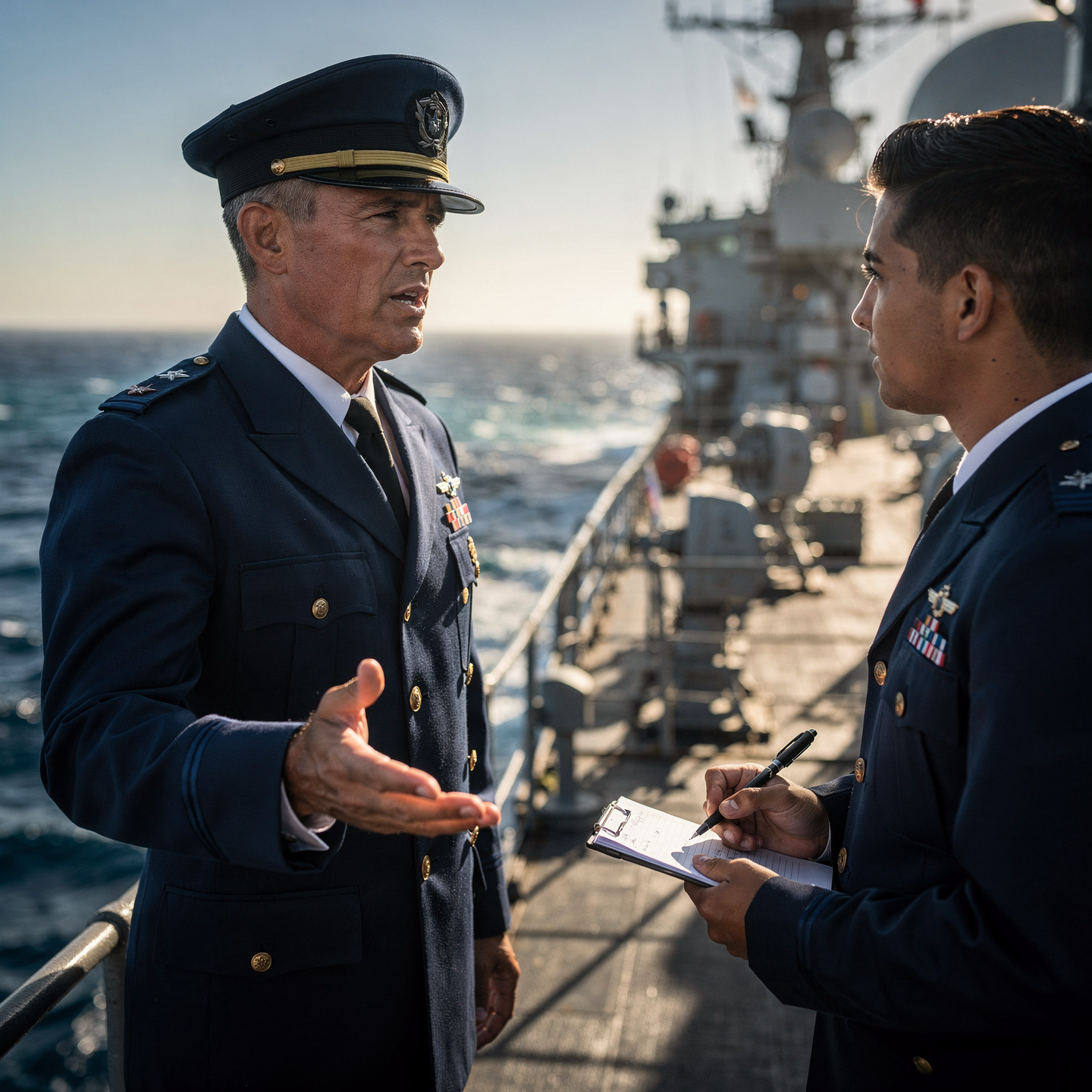
Coaching course for naval commanders
Why this course?
The Coaching Course for Naval Officers
This course is designed to enhance effective leadership and team management in the maritime environment. This program offers proven coaching tools and techniques to optimize communication, foster motivation, and develop the full potential of each crew member. Through a practical and personalized approach, participants will learn to resolve conflicts, set clear objectives, and create a high-performing, collaborative work environment.
Differential Advantages
- Communication Skills Development: active listening, constructive feedback, and assertive communication.
- Motivation and Empowerment Techniques: to inspire and engage the crew.
- Conflict Management and Problem Solving: tools to address challenges and foster collaboration.
- Situational Leadership: adapting leadership style to the needs of the team and the situation.
- Practical Application: exercises, simulations, and case studies based on real-life naval scenarios.
- Modality: Online
- Level: Cursos
- Hours: 150 H
- Start date: 25-04-2026
Availability: 1 in stock
Who is it aimed at?
- Naval Officers, Merchant Marine Captains, and Mid-Level Managers seeking to enhance their leadership, effective communication, and team management skills in demanding environments.
- Department Heads and Area Managers wishing to develop skills for strategic decision-making, conflict resolution, and staff motivation.
- Future Naval Commanders aspiring to acquire the necessary tools to lead successfully in complex and changing situations.
- Maritime professionals interested in understanding the dynamics of naval leadership and applying it in their own organizational contexts.
- Consultants and trainers seeking to expand their expertise in leadership and team management in demanding environments Pressure.
Flexibility and Adaptability:
Designed for professionals with demanding schedules: personalized sessions, practical exercises adapted to real-world contexts, and individualized follow-up.
Objectives and competencies

Promoting effective situational leadership:
“Adapt the leadership style to the competence and motivation of the crew, promoting autonomy and individual and collective responsibility.”

Developing resilience and adaptability in the face of uncertainty:
“Analyze risk scenarios, prioritize responses, and remain calm under pressure, effectively communicating decisions.”

Optimizing communication and teamwork in high-pressure situations:
“Prioritize active listening and clarity in messages, using standardized protocols (e.g., SBAR) and remaining calm in the face of adversity to facilitate joint decision-making.”

Cultivating self-awareness and emotional intelligence for more effective decision-making:
“Recognizing and managing one’s own and the team’s emotions to communicate clearly and resolve conflicts constructively, minimizing stress and maximizing performance.”

Inspiring and motivating crews to reach their full potential:
Promote assertive communication, teamwork, and effective stress management to build a positive and resilient work environment on board.

To promote the continuous personal and professional growth of staff members:
Develop leadership and effective communication skills for team management and conflict resolution.
Curriculum - Modules
- Comprehensive Maritime Incident Management: protocols, roles, and chain of command for coordinated response
- Operational Planning and Execution: briefing, routes, weather windows, and go/no-go criteria
- Rapid Risk Assessment: criticality matrix, scene control, and decision-making under pressure
- Operational Communication: VHF/GMDSS, standardized reports, and inter-agency liaison
- Tactical Mobility and Safe Boarding: RHIB maneuvers, approach, mooring, and recovery
- Equipment and Technologies: PPE, signaling, satellite tracking, and field data logging
- Immediate Care of the Affected: primary assessment, hypothermia, trauma, and stabilization for evacuation
- Adverse Environmental Conditions: swell, Visibility, flows, and operational mitigation
Simulation and training: critical scenarios, use of VR/AR, and exercises with performance metrics
Documentation and continuous improvement: lessons learned, indicators (MTTA/MTTR), and SOP updates
- Introduction to Situational Leadership: Foundations and Models
- Assessing Development Level: Identifying Follower Maturity
- Situational Leadership Styles: Directing, Coaching, Supporting, and Delegating
- Adapting Leadership to Context: Flexibility and Agility in Decision-Making
- Assertive Communication: Principles, Techniques, and Barriers
- Active Listening and Empathy: Key Tools for Effective Communication
- Conflict Management: Assertive Resolution and Negotiation Strategies
- Effective Feedback: Giving and Receiving Constructive Feedback
- Leadership Situational and Assertive Communication in the Navy: Practical Application in Naval Scenarios.
- Development of Leadership and Communication Skills: Simulations and Practical Exercises.
‘
- Introduction to Situational Leadership: Origins and Theoretical Foundations.
- Analysis of the Naval Context: Peculiarities and Challenges of the Maritime Environment.
- The Four Styles of Situational Leadership: Directing, Supervising, Supporting, and Delegating.
- Team Maturity Diagnosis: Evaluation of Skills and Motivation.
- Leadership Adaptation: Adjusting the Style to the Team’s Development Level.
- Effective Communication in the Naval Environment: Clarity, Precision, and Active Listening.
- Motivation and Recognition: Strategies to Boost Team Performance.
- Conflict Management: Constructive Approach to Differences and Tensions.
- Decision-Making Team Decision-Making: Involvement, accountability, and consensus.
Naval Leadership Development: Mentoring, coaching, and empowerment.
‘
- Introduction to Situational Leadership: Models and Foundations
- Team Development Level Diagnosis: Competence and Commitment
- The Four Leadership Styles: Directing, Coaching, Supporting, Delegating
- Adapting Leadership to the Context and Specific Tasks on Board
- Effective Communication: Active Listening, Feedback, and Conflict Resolution
- Team Empowerment and Motivation: Recognition and Development
- Performance Management: Goal Setting, Monitoring, and Evaluation
- Building Trust and Cohesion in the Team on Board
- Crisis Management: Decision Making Under Pressure
Situational Leadership in Maritime Culture: Challenges and Opportunities
‘
- Introduction to Situational Leadership: Key Concepts and Theoretical Models
- Team Development Level Diagnosis: Skills and Motivation Assessment
- Situational Leadership Styles: Directing, Coaching, Supporting, and Delegating
- Adapting Leadership to Context: Flexibility and Decision-Making
- Effective Communication in Situational Leadership: Feedback, Active Listening, and Clarity
- Team Motivation and Commitment: Strategies to Enhance Performance
- Conflict Management and Problem Solving: Techniques for Addressing Challenges
- Empowerment and Skills Development: Fostering Individual and Collective Growth
- Situational Leadership in the Navy: Practical Application in Naval Scenarios.
- Team Performance Evaluation and Continuous Improvement: Measuring Results and Adjustments.
‘
- System Architecture and Components: Structural design, materials, and subsystems (mechanical, electrical, electronic, and fluid) with selection and assembly criteria for marine environments
- Fundamentals and Principles of Operation: Physical and engineering foundations (thermodynamics, fluid mechanics, electricity, control, and materials) that explain performance and operating limits
- Safety and Environmental (SHE): Risk analysis, PPE, LOTO, hazardous atmospheres, spill and waste management, and emergency response plans
- Applicable Regulations and Standards: IMO/ISO/IEC requirements and local regulations;
- Conformance criteria, certification, and best practices for operation and maintenance
- Inspection, testing, and diagnostics: Visual/dimensional inspection, functional testing, data analysis, and predictive techniques (vibration, thermography, fluid analysis) to identify root causes
- Preventive and predictive maintenance: Hourly/cycle/seasonal plans, lubrication, adjustments, calibrations, consumable replacement, post-service verification, and operational reliability
- Instrumentation, tools, and metrology: Measuring and testing equipment, diagnostic software, calibration and traceability; selection criteria, safe use, and storage
- Onboard integration and interfaces: Mechanical, electrical, fluid, and data compatibility; Sealing and watertightness, EMC/EMI, corrosion protection, and interoperability testing.
Quality, acceptance testing, and commissioning: process and materials control, FAT/SAT, bench and sea trials, go/no-go criteria, and evidence documentation.
Technical documentation and integrated practice: logs, checklists, reports, and a complete case study (safety → diagnosis → intervention → verification → report) applicable to any system.
Plan de estudio - Módulos
- Comprehensive Maritime Incident Management: protocols, roles, and chain of command for coordinated response
- Operational Planning and Execution: briefing, routes, weather windows, and go/no-go criteria
- Rapid Risk Assessment: criticality matrix, scene control, and decision-making under pressure
- Operational Communication: VHF/GMDSS, standardized reports, and inter-agency liaison
- Tactical Mobility and Safe Boarding: RHIB maneuvers, approach, mooring, and recovery
- Equipment and Technologies: PPE, signaling, satellite tracking, and field data logging
- Immediate Care of the Affected: primary assessment, hypothermia, trauma, and stabilization for evacuation
- Adverse Environmental Conditions: swell, Visibility, flows, and operational mitigation
Simulation and training: critical scenarios, use of VR/AR, and exercises with performance metrics
Documentation and continuous improvement: lessons learned, indicators (MTTA/MTTR), and SOP updates
- Introduction to Situational Leadership: Foundations and Models
- Assessing Development Level: Identifying Follower Maturity
- Situational Leadership Styles: Directing, Coaching, Supporting, and Delegating
- Adapting Leadership to Context: Flexibility and Agility in Decision-Making
- Assertive Communication: Principles, Techniques, and Barriers
- Active Listening and Empathy: Key Tools for Effective Communication
- Conflict Management: Assertive Resolution and Negotiation Strategies
- Effective Feedback: Giving and Receiving Constructive Feedback
- Leadership Situational and Assertive Communication in the Navy: Practical Application in Naval Scenarios.
- Development of Leadership and Communication Skills: Simulations and Practical Exercises.
‘
- Introduction to Situational Leadership: Origins and Theoretical Foundations.
- Analysis of the Naval Context: Peculiarities and Challenges of the Maritime Environment.
- The Four Styles of Situational Leadership: Directing, Supervising, Supporting, and Delegating.
- Team Maturity Diagnosis: Evaluation of Skills and Motivation.
- Leadership Adaptation: Adjusting the Style to the Team’s Development Level.
- Effective Communication in the Naval Environment: Clarity, Precision, and Active Listening.
- Motivation and Recognition: Strategies to Boost Team Performance.
- Conflict Management: Constructive Approach to Differences and Tensions.
- Decision-Making Team Decision-Making: Involvement, accountability, and consensus.
Naval Leadership Development: Mentoring, coaching, and empowerment.
‘
- Introduction to Situational Leadership: Models and Foundations
- Team Development Level Diagnosis: Competence and Commitment
- The Four Leadership Styles: Directing, Coaching, Supporting, Delegating
- Adapting Leadership to the Context and Specific Tasks on Board
- Effective Communication: Active Listening, Feedback, and Conflict Resolution
- Team Empowerment and Motivation: Recognition and Development
- Performance Management: Goal Setting, Monitoring, and Evaluation
- Building Trust and Cohesion in the Team on Board
- Crisis Management: Decision Making Under Pressure
Situational Leadership in Maritime Culture: Challenges and Opportunities
‘
- Introduction to Situational Leadership: Key Concepts and Theoretical Models
- Team Development Level Diagnosis: Skills and Motivation Assessment
- Situational Leadership Styles: Directing, Coaching, Supporting, and Delegating
- Adapting Leadership to Context: Flexibility and Decision-Making
- Effective Communication in Situational Leadership: Feedback, Active Listening, and Clarity
- Team Motivation and Commitment: Strategies to Enhance Performance
- Conflict Management and Problem Solving: Techniques for Addressing Challenges
- Empowerment and Skills Development: Fostering Individual and Collective Growth
- Situational Leadership in the Navy: Practical Application in Naval Scenarios.
- Team Performance Evaluation and Continuous Improvement: Measuring Results and Adjustments.
‘
- System Architecture and Components: Structural design, materials, and subsystems (mechanical, electrical, electronic, and fluid) with selection and assembly criteria for marine environments
- Fundamentals and Principles of Operation: Physical and engineering foundations (thermodynamics, fluid mechanics, electricity, control, and materials) that explain performance and operating limits
- Safety and Environmental (SHE): Risk analysis, PPE, LOTO, hazardous atmospheres, spill and waste management, and emergency response plans
- Applicable Regulations and Standards: IMO/ISO/IEC requirements and local regulations;
- Conformance criteria, certification, and best practices for operation and maintenance
- Inspection, testing, and diagnostics: Visual/dimensional inspection, functional testing, data analysis, and predictive techniques (vibration, thermography, fluid analysis) to identify root causes
- Preventive and predictive maintenance: Hourly/cycle/seasonal plans, lubrication, adjustments, calibrations, consumable replacement, post-service verification, and operational reliability
- Instrumentation, tools, and metrology: Measuring and testing equipment, diagnostic software, calibration and traceability; selection criteria, safe use, and storage
- Onboard integration and interfaces: Mechanical, electrical, fluid, and data compatibility; Sealing and watertightness, EMC/EMI, corrosion protection, and interoperability testing.
Quality, acceptance testing, and commissioning: process and materials control, FAT/SAT, bench and sea trials, go/no-go criteria, and evidence documentation.
Technical documentation and integrated practice: logs, checklists, reports, and a complete case study (safety → diagnosis → intervention → verification → report) applicable to any system.
- Introduction to Situational Leadership: Origins, Models, and Applications in the Navy
- Assessing Development Level: Competency and Commitment Evaluation
- Situational Leadership Styles: Directive, Coaching, Supportive, and Delegating
- Adapting Leadership to the Naval Context: Missions, Hierarchy, and Culture
- Effective Communication: Principles, Barriers, and Strategies in the Navy
- Active Listening: Techniques, Empathy, and Constructive Feedback
- Nonverbal Communication: Body Language, Tone of Voice, and Facial Expressions
- Conflict Management: Identification, Resolution, and Mediation in Naval Environments
- Motivation and Recognition: Strategies to Boost Performance and Morale
- Leadership in crisis situations: decision-making, communication, and control
‘
- Introduction to Situational Leadership: Origins and Evolution
- Leadership Models: Transactional, Transformational, and Situational Leadership
- Team Development Level Assessment: Competence and Commitment
- The Four Styles of Situational Leadership: Directing, Coaching, Supporting, and Delegating
- Adapting Leadership to the Naval Context: Missions, Hierarchy, and Discipline
- Effective Communication in Situational Leadership: Feedback, Active Listening, and Empathy
- Performance Management: Goal Setting, Monitoring, and Evaluation
- Motivation and Recognition in Naval Teams: Incentives, Rewards, and Professional Development
- Conflict Resolution: Mediation and Negotiation Strategies in the Naval Environment naval.
- Leadership skills development: self-awareness, emotional intelligence, and resilience.
‘
- Introduction to Situational Leadership: Foundations and Models
- Analysis of the Naval Context: Challenges and Particularities of the Maritime Environment
- Assessment of the Development Level: Identifying Team Skills and Motivation
- Adapting Leadership Styles: Directive, Coaching, Supportive, Delegating
- Effective Communication in the Naval Environment: Clarity, Precision, and Active Listening
- Conflict Management and Problem Resolution in Crisis Situations
- Motivation and Development of Naval Personnel: Fostering Commitment and Excellence
- Building High-Performance Teams: Cohesion, Trust, and Accountability
- Decision-Making Under Pressure: Risk Analysis and Objective Prioritization
- Evaluation and Continuous Improvement of Leadership situational and naval equipment management.
‘
- Introduction to Situational Leadership: Key Concepts and Theoretical Models
- Assessing the Level of Development: Diagnosing the Team’s Readiness and Capacity
- Situational Leadership Styles: Directing, Coaching, Supporting, and Delegating
- Applying Situational Leadership: Adapting the Style to the Context and Individuals
- Assertive Communication: Techniques and Tools for Clear and Effective Communication
- Active Listening and Empathy: Understanding the Needs and Perspectives of Subordinates
- Communicating in Crisis and Stressful Situations: Remaining Calm and Conveying Accurate Information
- Constructive Feedback: Giving and Receiving Feedback for Personal and Professional Development professional.
- Conflict Resolution: Strategies for addressing and resolving disagreements within the team.
- Leadership and Communication in the Navy: Adapting principles to the military environment.
‘
Career opportunities
- Leadership and Management of Naval Teams: Improving communication, motivation, and performance of onboard personnel.
- Conflict Management and Decision-Making: Effective problem-solving and crisis management in naval environments.
- Development of Individual and Collective Potential: Fostering the professional and personal growth of crew members.
- Optimizing Performance in Naval Operations: Improving efficiency, safety, and coordination in missions and tasks.
- Adaptation to Change and Innovation: Preparing for the challenges and opportunities of the modern naval environment.
- Effective Communication and Interpersonal Relations: Improving collaboration and understanding among crew members and other teams.
- Mentoring and Development of Future Naval Leaders: Transferring knowledge, skills, and values to the new generations of officers.
- Well-being and resilience in high-demand environments: managing stress, fatigue, and other factors that affect the mental and physical health of naval personnel.
‘
Admission requirements

Academic/professional profile:
Degree/Bachelor's degree in Nautical Science/Maritime Transport, Naval/Marine Engineering, or a related field; or proven professional experience in bridge/operations.

Language proficiency:
Recommended functional maritime English (SMCP) for simulations and technical materials.

5. Induction
Updated resume, copy of degree or seaman's book, ID card/passport, letter of motivation.

Technical requirements (for online):
Equipment with camera/microphone, stable connection, ≥ 24” monitor recommended for ECDIS/Radar-ARPA.
Admission process and dates

1. Online
application
(form + documents).

2. Academic review and interview
(profile/objectives/schedule compatibility).

3. Admission decision
(+ scholarship proposal if applicable).

4. Reservation of place
(deposit) and registration.

5. Induction
(access to campus, calendars, simulator guides).
Scholarships and grants
- Transformational Leadership: Master coaching techniques to inspire and empower your naval team to peak performance.
- Strategic Communication: Learn to communicate with clarity, precision, and empathy in high-pressure, hierarchical environments.
- Talent Management: Discover how to identify, develop, and retain key talent within the naval structure.
- Conflict Resolution: Acquire the necessary tools to address and resolve conflicts effectively, fostering a harmonious work environment.
- Decision Making: Improve your ability to make informed and strategic decisions under pressure, considering all relevant variables.
Testimonials
“The naval command coaching provided me with practical and effective tools to lead my team with greater confidence and achieve exceptional results. I learned to communicate assertively, delegate responsibilities efficiently, and foster a collaborative and motivating work environment. Thanks to this training, we improved team cohesion, optimized our operational performance, and exceeded our established goals. I highly recommend this program to any naval commanding officer seeking to strengthen their leadership skills.”
I applied the assertive communication and conflict management skills I learned in the Maritime Psychology and Leadership course to resolve a dispute between two officers that was affecting team morale. The mediation, based on the course principles, resulted in a satisfactory agreement for both parties and a significant improvement in the work environment on board. This translated into a 15% increase in efficiency during critical maneuvers on the last voyage.
“Coaching provided me with crucial tools for leading high-performing teams in complex naval environments. I significantly improved my communication, conflict management, and ability to motivate my staff to achieve challenging goals. As a result, my department’s efficiency increased by 15%, and my team’s job satisfaction rose markedly.”
“Coaching provided me with crucial tools to lead more effectively. I learned to delegate strategically, communicate clearly and assertively, and foster a collaborative and motivating work environment. The direct result has been a significant improvement in my team’s performance, achieving goals more quickly and efficiently, and a notable decrease in interpersonal conflicts.”

Frequently asked questions
Develop the leadership, management, and decision-making skills of naval officers for optimal performance in complex and high-pressure environments.
Yes. The itinerary includes ECDIS/Radar-ARPA/BRM with harbor, ocean, fog, storm, and SAR scenarios.
Online with live sessions; hybrid option for simulator/practical placements through agreements.
Effective communication, decision making, stress management, emotional intelligence, delegation, mentoring, strategic thinking, and adaptability.
Recommended functional SMCP. We offer support materials for standard phraseology.
Yes, with a relevant degree or experience in maritime/port operations. The admissions interview will confirm suitability.
Optional (3–6 months) through Companies & Collaborations and the Alumni Network.
Simulator practice (rubrics), defeat plans, SOPs, checklists, micro-tests and applied TFM.
A degree from Navalis Magna University + operational portfolio (tracks, SOPs, reports and KPIs) useful for audits and employment.
- Introduction to Situational Leadership: Key Concepts and Theoretical Models
- Assessing the Level of Development: Diagnosing the Team’s Readiness and Capacity
- Situational Leadership Styles: Directing, Coaching, Supporting, and Delegating
- Applying Situational Leadership: Adapting the Style to the Context and Individuals
- Assertive Communication: Techniques and Tools for Clear and Effective Communication
- Active Listening and Empathy: Understanding the Needs and Perspectives of Subordinates
- Communicating in Crisis and Stressful Situations: Remaining Calm and Conveying Accurate Information
- Constructive Feedback: Giving and Receiving Feedback for Personal and Professional Development professional.
- Conflict Resolution: Strategies for addressing and resolving disagreements within the team.
- Leadership and Communication in the Navy: Adapting principles to the military environment.
‘
Request information
- Complete the Application Form
- Attach your CV/Qualifications (if you have them to hand).
- Indicate your preferred cohort (January/May/September) and whether you want the hybrid option with simulator sessions.
Teachers
Eng. Tomás Riera
Full Professor
Eng. Tomás Riera
Full Professor
Eng. Sofía Marquina
Full Professor
Eng. Sofía Marquina
Full Professor
Eng. Javier Bañuls
Full Professor
Eng. Javier Bañuls
Full Professor
Dr. Nuria Llobregat
Full Professor
Dr. Nuria Llobregat
Full Professor
Dr. Pau Ferrer
Full Professor
Dr. Pau Ferrer
Full Professor
Cap. Javier Abaroa (MCA)
Full Professor
Cap. Javier Abaroa (MCA)
Full Professor

