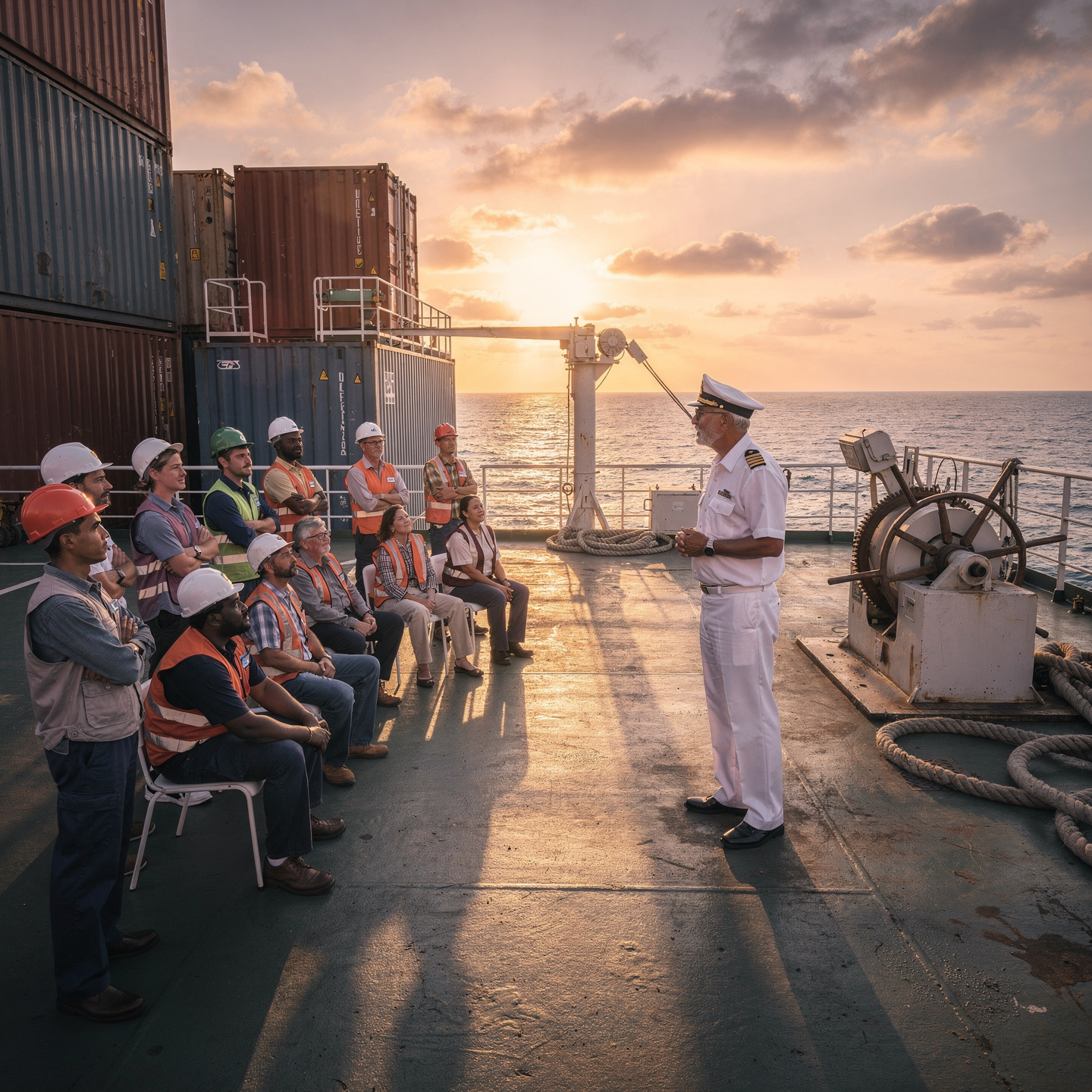
Leadership Course in Maritime Operations

Why this course?

The Leadership in Maritime Operations Course

This course provides you with the tools and strategies necessary to lead high-performing teams in the demanding maritime environment. Learn to communicate effectively, make strategic decisions, and manage resources efficiently. This program is designed to enhance your leadership skills, fostering a culture of safety, collaboration, and operational excellence. Develop your ability to inspire and motivate your team, maximizing performance and minimizing risks in every operation.

Differential Advantages

  • Soft Skills Development: assertive communication, emotional intelligence, and conflict management.
  • Decision-Making Under Pressure: risk analysis, contingency planning, and emergency response.
  • Managing Multicultural Teams: inclusive leadership, diversity, and intercultural problem-solving.
  • Resource Optimization: strategic planning, time management, and efficient task allocation.
  • Case Studies and Simulations: real-world application of acquired knowledge in challenging maritime scenarios.

Liderazgo

Leadership Course in Maritime Operations

Availability: 1 in stock

Who is it aimed at?

  • Superintendents, Operations Managers, and Fleet Chiefs seeking to enhance their leadership skills and strategic decision-making abilities in complex maritime environments.
  • Captains and First Officers aspiring to greater responsibility roles and wishing to develop inspirational and effective leadership in team management.
  • Navy and Coast Guard Officers needing to strengthen their command and coordination capabilities in high-risk maritime operations.
  • Maritime industry professionals interested in understanding leadership dynamics, change management, and effective communication in the sector.
  • Consultants and trainers seeking to update their knowledge of maritime leadership and offer innovative solutions to their clients clients.

Flexibility and applicability
 Designed for professionals with demanding schedules: asynchronous online format, downloadable study materials, and practical case studies applicable to current maritime realities.

Liderazgo

Objectives and competencies

Efficiently manage human and material resources:

Implement optimized protocols for resource allocation, monitoring, and control, minimizing waste and maximizing operational efficiency, with a focus on continuous improvement and adaptability to the changing needs of the environment.

Optimizing strategic decision-making in critical situations:

“Analyze complex risk scenarios, prioritize objectives and deploy flexible contingency plans, effectively communicating the strategy to the crew.”

Supervise and effectively coordinate loading and unloading operations:

“To ensure regulatory compliance, optimize time and resources, and guarantee the safety of cargo, personnel, and the vessel.”

Ensuring compliance with regulations and maritime safety standards:

Inspect and maintain safety equipment (life jackets, life rafts, EPIRBs) according to SOLAS, coordinating with port and classification authorities.

Promote effective communication and collaboration between the crew and ground staff:

“Implement clear and concise communication protocols, using standard terminology and designated channels for each type of information, ensuring mutual understanding and rapid problem resolution both on board and with personnel on land.”

Implement and maintain quality management systems in maritime operations:

“Documenting and auditing key processes, ensuring compliance with IMO, SOLAS regulations and ISO 9001 standards, with a focus on continuous improvement and the prevention of non-conformities.”

Curriculum - Modules

  1. Comprehensive Maritime Incident Management: protocols, roles, and chain of command for coordinated response
  2. Operational Planning and Execution: briefing, routes, weather windows, and go/no-go criteria
  3. Rapid Risk Assessment: criticality matrix, scene control, and decision-making under pressure
  4. Operational Communication: VHF/GMDSS, standardized reports, and inter-agency liaison
  5. Tactical Mobility and Safe Boarding: RHIB maneuvers, approach, mooring, and recovery
  6. Equipment and Technologies: PPE, signaling, satellite tracking, and field data logging
  7. Immediate Care of the Affected: primary assessment, hypothermia, trauma, and stabilization for evacuation
  8. Adverse Environmental Conditions: swell, Visibility, flows, and operational mitigation

    Simulation and training: critical scenarios, use of VR/AR, and exercises with performance metrics

    Documentation and continuous improvement: lessons learned, indicators (MTTA/MTTR), and SOP updates

  1. Introduction to Human Resource Management in the Maritime Sector
  2. Recruitment and Selection of Maritime Personnel: Profiles and Competencies
  3. Contracting: Types of Maritime Contracts, Collective Bargaining Agreements
  4. National and International Maritime Labor Legislation: ILO, IMO
  5. Payroll and Compensation Management: Salaries, Allowances, Holidays
  6. Training and Development of Maritime Personnel: STCW, Specific Courses
  7. Performance Evaluation: Feedback, Improvement Plans
  8. Occupational Risk Prevention in the Maritime Environment: Safety and Health
  9. Management of Labor Relations: Collective Bargaining, Disputes
  10. Rights and Crew obligations: welfare and working conditions

  1. Introduction to Human Resource Management in the Maritime Sector: specific characteristics and challenges.
  2. National and International Maritime Labor Law Framework: ILO, STCW, and MLC conventions.
  3. Recruitment and Selection of Maritime Personnel: profiles, certifications, and requirements.
  4. Crew Hiring and Management: contracts, salaries, benefits, and taxes.
  5. Rights and Obligations of Maritime Workers: working hours, rest periods, and vacations.
  6. Occupational Risk Prevention and Occupational Health on Board: safety, hygiene, and well-being.
  7. Performance Management and Evaluation of Maritime Personnel: KPIs, feedback, and professional development.
  8. Resolution of Labor Disputes on Board: mediation and arbitration and legal procedures.
  9. Termination of Maritime Employment Contracts: causes, compensation, and notice periods.

    Labor Audits and Regulatory Compliance in the Maritime Sector.

  1. Introduction to Human Resource Management on Board: Challenges and Opportunities
  2. Legal and Regulatory Framework: International Conventions and Maritime Labor Legislation
  3. Selection and Recruitment: Profiles, Competencies, and Adaptation to the Maritime Environment
  4. Training and Development: Training Programs, Certification, and Continuous Improvement
  5. Performance Evaluation: Metrics, Feedback, and Individual and Collective Improvement Plans
  6. Effective Communication: Channels, Tools, and Protocols for Information Transmission
  7. Leadership and Motivation: Leadership Styles, Incentives, and Recognition of Good Performance
  8. Conflict Management: Identification, Mediation, and Resolution of Interpersonal Problems
  9. Teamwork: Roles, Responsibilities, and Group dynamics on board
  10. Workplace well-being and health: Ergonomics, prevention of occupational risks and promotion of healthy habits

  1. Legal and regulatory framework for maritime crisis management
  2. Organization of the emergency response: levels, roles, and responsibilities
  3. Risk assessment: identification, analysis, and prioritization of maritime threats
  4. Contingency plans: development, implementation, and drills
  5. Emergency communications: protocols, equipment, and networks
  6. Maritime salvage: search and rescue (SAR) operations, towing, and pollution control
  7. First aid and life support in maritime environments
  8. Damage control: containment, repair, and stabilization techniques
  9. Crisis management on board: procedures, leadership, and communication with shore
  10. Incident investigation and lessons learned

  1. System Architecture and Components: Structural design, materials, and subsystems (mechanical, electrical, electronic, and fluid) with selection and assembly criteria for marine environments
  2. Fundamentals and Principles of Operation: Physical and engineering foundations (thermodynamics, fluid mechanics, electricity, control, and materials) that explain performance and operating limits
  3. Safety and Environmental (SHE): Risk analysis, PPE, LOTO, hazardous atmospheres, spill and waste management, and emergency response plans
  4. Applicable Regulations and Standards: IMO/ISO/IEC requirements and local regulations;
  5. Conformance criteria, certification, and best practices for operation and maintenance
  6. Inspection, testing, and diagnostics: Visual/dimensional inspection, functional testing, data analysis, and predictive techniques (vibration, thermography, fluid analysis) to identify root causes
  7. Preventive and predictive maintenance: Hourly/cycle/seasonal plans, lubrication, adjustments, calibrations, consumable replacement, post-service verification, and operational reliability
  8. Instrumentation, tools, and metrology: Measuring and testing equipment, diagnostic software, calibration and traceability; selection criteria, safe use, and storage
  9. Onboard integration and interfaces: Mechanical, electrical, fluid, and data compatibility; Sealing and watertightness, EMC/EMI, corrosion protection, and interoperability testing.

    Quality, acceptance testing, and commissioning: process and materials control, FAT/SAT, bench and sea trials, go/no-go criteria, and evidence documentation.

    Technical documentation and integrated practice: logs, checklists, reports, and a complete case study (safety → diagnosis → intervention → verification → report) applicable to any system.

Plan de estudio - Módulos

  1. Comprehensive Maritime Incident Management: protocols, roles, and chain of command for coordinated response
  2. Operational Planning and Execution: briefing, routes, weather windows, and go/no-go criteria
  3. Rapid Risk Assessment: criticality matrix, scene control, and decision-making under pressure
  4. Operational Communication: VHF/GMDSS, standardized reports, and inter-agency liaison
  5. Tactical Mobility and Safe Boarding: RHIB maneuvers, approach, mooring, and recovery
  6. Equipment and Technologies: PPE, signaling, satellite tracking, and field data logging
  7. Immediate Care of the Affected: primary assessment, hypothermia, trauma, and stabilization for evacuation
  8. Adverse Environmental Conditions: swell, Visibility, flows, and operational mitigation

    Simulation and training: critical scenarios, use of VR/AR, and exercises with performance metrics

    Documentation and continuous improvement: lessons learned, indicators (MTTA/MTTR), and SOP updates

  1. Introduction to Human Resource Management in the Maritime Sector
  2. Recruitment and Selection of Maritime Personnel: Profiles and Competencies
  3. Contracting: Types of Maritime Contracts, Collective Bargaining Agreements
  4. National and International Maritime Labor Legislation: ILO, IMO
  5. Payroll and Compensation Management: Salaries, Allowances, Holidays
  6. Training and Development of Maritime Personnel: STCW, Specific Courses
  7. Performance Evaluation: Feedback, Improvement Plans
  8. Occupational Risk Prevention in the Maritime Environment: Safety and Health
  9. Management of Labor Relations: Collective Bargaining, Disputes
  10. Rights and Crew obligations: welfare and working conditions

  1. Introduction to Human Resource Management in the Maritime Sector: specific characteristics and challenges.
  2. National and International Maritime Labor Law Framework: ILO, STCW, and MLC conventions.
  3. Recruitment and Selection of Maritime Personnel: profiles, certifications, and requirements.
  4. Crew Hiring and Management: contracts, salaries, benefits, and taxes.
  5. Rights and Obligations of Maritime Workers: working hours, rest periods, and vacations.
  6. Occupational Risk Prevention and Occupational Health on Board: safety, hygiene, and well-being.
  7. Performance Management and Evaluation of Maritime Personnel: KPIs, feedback, and professional development.
  8. Resolution of Labor Disputes on Board: mediation and arbitration and legal procedures.
  9. Termination of Maritime Employment Contracts: causes, compensation, and notice periods.

    Labor Audits and Regulatory Compliance in the Maritime Sector.

  1. Introduction to Human Resource Management on Board: Challenges and Opportunities
  2. Legal and Regulatory Framework: International Conventions and Maritime Labor Legislation
  3. Selection and Recruitment: Profiles, Competencies, and Adaptation to the Maritime Environment
  4. Training and Development: Training Programs, Certification, and Continuous Improvement
  5. Performance Evaluation: Metrics, Feedback, and Individual and Collective Improvement Plans
  6. Effective Communication: Channels, Tools, and Protocols for Information Transmission
  7. Leadership and Motivation: Leadership Styles, Incentives, and Recognition of Good Performance
  8. Conflict Management: Identification, Mediation, and Resolution of Interpersonal Problems
  9. Teamwork: Roles, Responsibilities, and Group dynamics on board
  10. Workplace well-being and health: Ergonomics, prevention of occupational risks and promotion of healthy habits

  1. Legal and regulatory framework for maritime crisis management
  2. Organization of the emergency response: levels, roles, and responsibilities
  3. Risk assessment: identification, analysis, and prioritization of maritime threats
  4. Contingency plans: development, implementation, and drills
  5. Emergency communications: protocols, equipment, and networks
  6. Maritime salvage: search and rescue (SAR) operations, towing, and pollution control
  7. First aid and life support in maritime environments
  8. Damage control: containment, repair, and stabilization techniques
  9. Crisis management on board: procedures, leadership, and communication with shore
  10. Incident investigation and lessons learned

  1. System Architecture and Components: Structural design, materials, and subsystems (mechanical, electrical, electronic, and fluid) with selection and assembly criteria for marine environments
  2. Fundamentals and Principles of Operation: Physical and engineering foundations (thermodynamics, fluid mechanics, electricity, control, and materials) that explain performance and operating limits
  3. Safety and Environmental (SHE): Risk analysis, PPE, LOTO, hazardous atmospheres, spill and waste management, and emergency response plans
  4. Applicable Regulations and Standards: IMO/ISO/IEC requirements and local regulations;
  5. Conformance criteria, certification, and best practices for operation and maintenance
  6. Inspection, testing, and diagnostics: Visual/dimensional inspection, functional testing, data analysis, and predictive techniques (vibration, thermography, fluid analysis) to identify root causes
  7. Preventive and predictive maintenance: Hourly/cycle/seasonal plans, lubrication, adjustments, calibrations, consumable replacement, post-service verification, and operational reliability
  8. Instrumentation, tools, and metrology: Measuring and testing equipment, diagnostic software, calibration and traceability; selection criteria, safe use, and storage
  9. Onboard integration and interfaces: Mechanical, electrical, fluid, and data compatibility; Sealing and watertightness, EMC/EMI, corrosion protection, and interoperability testing.

    Quality, acceptance testing, and commissioning: process and materials control, FAT/SAT, bench and sea trials, go/no-go criteria, and evidence documentation.

    Technical documentation and integrated practice: logs, checklists, reports, and a complete case study (safety → diagnosis → intervention → verification → report) applicable to any system.

  1. Introduction to Human Resource Management in the Maritime Environment: Challenges and Specificities.
  2. Recruitment and Selection of Maritime Personnel: Profiles, Competencies, and Specific Regulations.
  3. Continuing Education and Professional Development: STCW, Specialization and Refresher Courses.
  4. Performance Evaluation and Talent Management: KPIs, Feedback, and Career Plans on Board.
  5. Maritime Labor Legislation: Contracts, Working Hours, Rest Periods, Insurance, and Collective Bargaining Agreements.
  6. Effective Internal Communication: Channels, Protocols, and Crisis Management on Board.
  7. Leadership Skills and Management of Multicultural Teams at Sea: Motivation, Delegation, and Conflict Resolution.
  8. External Communication and Public Relations: Interaction with Authorities port authorities, clients, and the media.
  9. Managing diversity and inclusion on board: respect, equal opportunities, and prevention of harassment.
  10. Health, safety, and well-being at work: ergonomics, prevention of psychosocial risks, and promotion of healthy habits.

  1. Introduction to Human Resource Management in the Maritime Sector: Particularities and Challenges.
  2. Maritime Legal Framework: International Conventions (ILO, IMO), National Legislation, and Impact on HR.
  3. Recruitment and Selection of Maritime Personnel: Profiles, Competencies, and Specific Processes.
  4. Recruitment and Remuneration: Types of Contracts, Salary Scales, Benefits, and Compensation in the Maritime Industry.
  5. Training and Professional Development: STCW, Specialization Courses, and Career Plans onboard and ashore.
  6. Performance Evaluation: Key Performance Indicators (KPIs), Feedback, Improvement Plans, and Promotion.
  7. Occupational Health and Safety Management onboard: Risk Prevention, Emergency Protocols, and Crew Welfare.
  8. Relationships Labor Relations: collective bargaining, unions, conflict resolution, and grievance handling.

    Crew Rights and Obligations: rest periods, leave, repatriation, and social protection.

    Ethics and Corporate Social Responsibility in Maritime Human Resource Management.

  1. Introduction to HR Management: Evolution, trends, and challenges in the maritime sector.
  2. Recruitment and selection of maritime personnel: Profiles, sources, interviews, and assessments.
  3. Maritime employment contracts: Types of contracts, specific clauses, and documentation.
  4. International maritime labor legislation: ILO Conventions, MLC, and other applicable regulations.
  5. Payroll and compensation management: Calculation, taxes, and benefits in the maritime sector.
  6. Training and development: Training plans, certifications, and continuous improvement of the crew.
  7. Performance evaluation: Methods, feedback, and personalized improvement plans.
  8. Conflict management and labor relations: Negotiation, mediation, and Dispute resolution.
  9. Maritime occupational health and safety: Risk prevention, protocols, and emergency measures.
  10. Onboard personnel management: Leave, rotations, repatriations, and crew welfare.

  1. Introduction to Human Resource Management in the Maritime Sector: Particularities and Challenges
  2. Maritime Labor Legislation: International Conventions (MLC), National Regulations, and Implications
  3. Recruitment and Selection of Maritime Personnel: Profiles, Competencies, and Specific Processes
  4. Training and Development: Program Design, Simulations, Certification, and Skills Updating
  5. Performance Evaluation: Methodologies, KPIs, and Feedback in the Maritime Context
  6. Compensation and Benefits: Salary Structures, Incentives, Insurance, and Onboard Welfare
  7. Diversity and Inclusion Management: Equity, Respect, and Adaptation to Different Cultures
  8. Occupational Health and Safety in Maritime Work: Risk Identification, Prevention, and Emergency Response
  9. Relationships Labor and Collective Bargaining: unions, agreements, and conflict resolution

    Psychosocial Well-being of the Crew: managing stress, fatigue, isolation, and emotional support

Career opportunities

  • Maritime Operations Supervisor: Team coordination, process optimization, resource management.
  • Maritime Route Planner: Risk analysis, efficient route selection, vessel tracking.
  • Maritime Emergency Coordinator: Incident response, crisis management, communication with authorities.
  • Port Terminal Manager: Berth planning, service coordination, resource optimization.
  • Maritime Logistics Consultant: Supply chain analysis, process improvement, cost reduction.
  • Maritime Safety Auditor: Risk assessment, implementation of preventive measures, regulatory compliance.
  • Maritime Operations Director: Strategic planning, budget management, team leadership.
  • Specialist in Fleet management: Maintenance optimization, cost control, efficiency improvement.

    “`

Admission requirements

Academic/professional profile:

Degree/Bachelor's degree in Nautical Science/Maritime Transport, Naval/Marine Engineering, or a related field; or proven professional experience in bridge/operations.

Language proficiency:

Recommended functional maritime English (SMCP) for simulations and technical materials.

5. Induction

Updated resume, copy of degree or seaman's book, ID card/passport, letter of motivation.

Technical requirements (for online):

Equipment with camera/microphone, stable connection, ≥ 24” monitor recommended for ECDIS/Radar-ARPA.

Admission process and dates

1. Online
application

(form + documents).

2. Academic review and interview

(profile/objectives/schedule compatibility).

3. Admission decision

(+ scholarship proposal if applicable).

4. Reservation of place

(deposit) and registration.

5. Induction

(access to campus, calendars, simulator guides).

Scholarships and grants

  • Leadership Strategies: Master the key techniques for effective decision-making and managing high-performing teams in maritime environments.
  • Crisis Management: Learn to anticipate, respond to, and mitigate critical situations, ensuring the safety and continuity of operations.
  • Effective Communication: Develop clear and persuasive communication skills to lead with confidence and foster collaboration onboard and ashore.
  • Regulatory Framework: Gain in-depth knowledge of international maritime regulations and their impact on leadership and operations management.
  • Studies in Case study: Analyze real-world situations and learn from best practices in maritime operations leadership. Boost your career and become an exemplary leader in the maritime sector.

Testimonials

Frequently asked questions

To ensure the safe, efficient and effective execution of maritime operations.

Yes. The itinerary includes ECDIS/Radar-ARPA/BRM with harbor, ocean, fog, storm, and SAR scenarios.

Online with live sessions; hybrid option for simulator/practical placements through agreements.

Clear communication, effective decision-making under pressure, risk management, maritime technical knowledge, leadership of diverse teams, adaptability to changing situations, strategic planning, and results orientation.

Recommended functional SMCP. We offer support materials for standard phraseology.

Yes, with a relevant degree or experience in maritime/port operations. The admissions interview will confirm suitability.

Optional (3–6 months) through Companies & Collaborations and the Alumni Network.

Simulator practice (rubrics), defeat plans, SOPs, checklists, micro-tests and applied TFM.

A degree from Navalis Magna University + operational portfolio (tracks, SOPs, reports and KPIs) useful for audits and employment.

  1. Introduction to Human Resource Management in the Maritime Sector: Particularities and Challenges
  2. Maritime Labor Legislation: International Conventions (MLC), National Regulations, and Implications
  3. Recruitment and Selection of Maritime Personnel: Profiles, Competencies, and Specific Processes
  4. Training and Development: Program Design, Simulations, Certification, and Skills Updating
  5. Performance Evaluation: Methodologies, KPIs, and Feedback in the Maritime Context
  6. Compensation and Benefits: Salary Structures, Incentives, Insurance, and Onboard Welfare
  7. Diversity and Inclusion Management: Equity, Respect, and Adaptation to Different Cultures
  8. Occupational Health and Safety in Maritime Work: Risk Identification, Prevention, and Emergency Response
  9. Relationships Labor and Collective Bargaining: unions, agreements, and conflict resolution

    Psychosocial Well-being of the Crew: managing stress, fatigue, isolation, and emotional support

Request information

  1. Complete the Application Form
  2. Attach your CV/Qualifications (if you have them to hand).
  3. Indicate your preferred cohort (January/May/September) and whether you want the hybrid option with simulator sessions.
An academic advisor will contact you within 24–48 hours to guide you through the admission process, scholarships, and compatibility with your professional schedule. Translated with DeepL.com (free version)
Please enable JavaScript in your browser to complete this form.
Click or drag a file to this area to upload.

Teachers

0
    0
    Tu carrito
    Tu carrito esta vacíoRegresar a la tienda
    Scroll to Top


