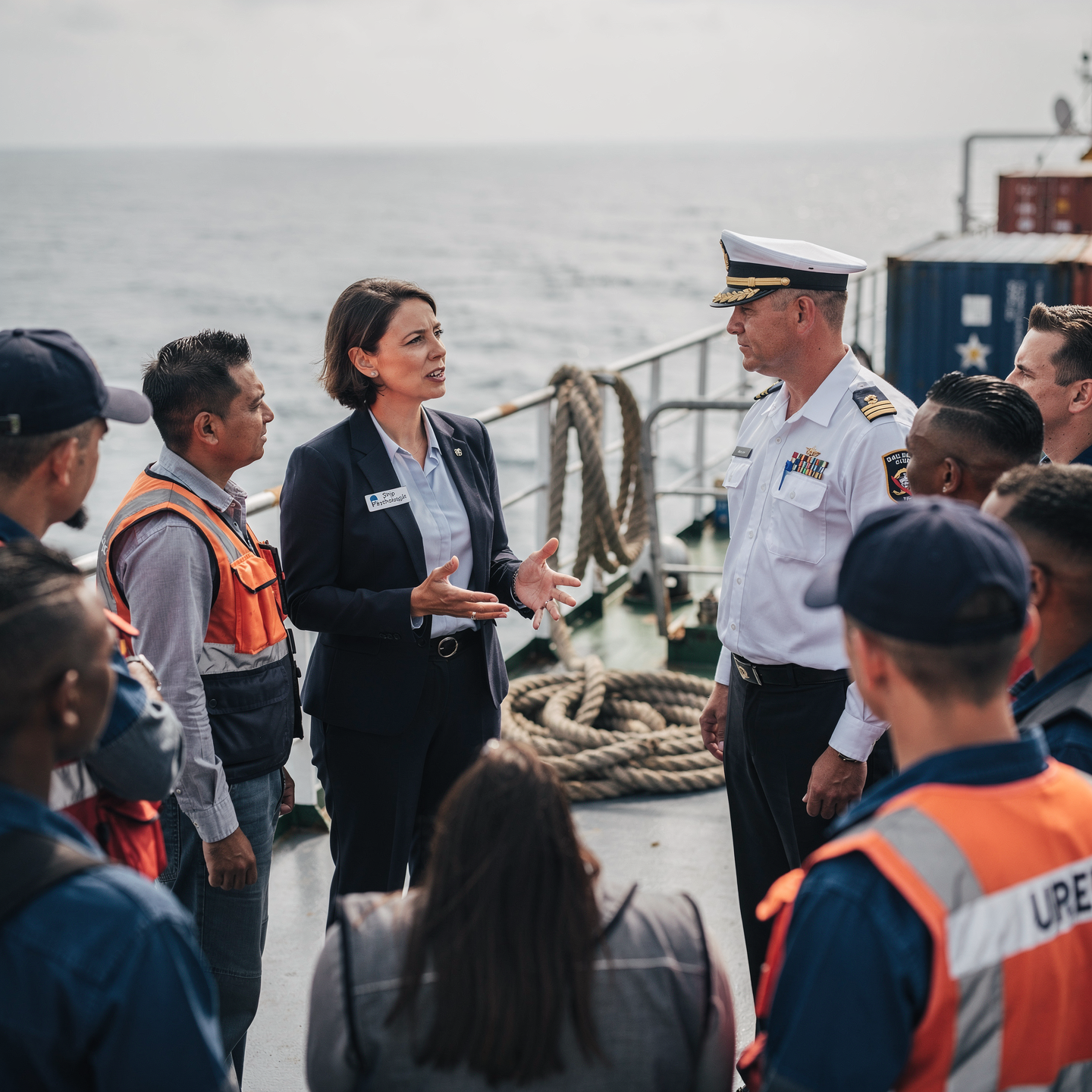
Course on the Psychology of Crew and Captains

Why this course?

The Crew and Captains Psychology

This course provides you with the essential tools to understand and manage human dynamics on board. You will learn to optimize communication, resolve conflicts effectively, and foster a positive and safe work environment. This program focuses on empathic leadership, stress management, and improving the well-being of the entire crew, including your own. Master the skills needed to build a cohesive and resilient team.

Key Benefits

  • Understand Human Psychology: Identify behavioral patterns and improve interpersonal interaction.
  • Effective Leadership: Develop leadership skills that inspire trust and collaboration.
  • Conflict Management: Learn conflict resolution techniques to maintain harmony on board.
  • Onboard Well-being: Promote a healthy work environment and reduce stress and fatigue.
  • Assertive Communication: Improve communication to avoid misunderstandings and strengthen teamwork.
PsicologĂ­a

Course on the Psychology of Crew and Captains

Availability: 1 in stock

Who is it aimed at?

  • Captains and First Officers seeking to lead more effectively, manage conflicts, and foster a positive work environment.
  • Officers on Watch (OOW) and crew members interested in improving communication, teamwork, and emotional intelligence on board.
  • Fleet Managers and HR personnel wishing to implement wellbeing strategies to reduce stress and fatigue among the crew.
  • Maritime instructors and trainers who want to incorporate psychological tools into their training and professional development programs.
  • Nautical and Maritime Transport students aspiring to understand human dynamics in maritime environments and strengthen their skills Interpersonal skills.

Flexibility and applicability
Adapted to maritime life: practical and relevant content, real case studies, and strategies for immediate application in daily work.

PsicologĂ­a

Objectives and competencies

Optimize communication and cohesion among crew members:

Implement standardized communication methodologies (e.g., SBAR), promote active listening and constructive conflict resolution through simulations and debriefing sessions.

Develop strategies for the effective management of stress and fatigue in maritime environments:

“Implementing mindfulness and time management techniques adapted to the onboard routine, fostering effective communication and mutual support among the crew to reduce mental load and prevent burnout.”

Promoting resilient and empathetic leadership in captains:

“Managing stress and pressure, promoting assertive communication and collaborative decision-making in crisis situations.”

Implement psychological assessment techniques for the selection and development of maritime personnel:

“Design and implement cognitive, emotional, and personality aptitude tests adapted to the maritime environment, interpreting results to identify suitable candidates and areas for improvement in development plans.”

Establish protocols for psychological intervention in crisis and emergency situations at sea:

“Implement Psychological First Aid (PFA) techniques adapted to the maritime environment, prioritizing the safety and emotional stability of the crew and passengers.”

Promote the psychological well-being and mental health of the crew:

Implement stress management strategies and promote effective communication on board, facilitating access to psychological support resources and fostering a positive and collaborative work environment.

Curriculum - Modules

  1. Comprehensive Maritime Incident Management: protocols, roles, and chain of command for coordinated response
  2. Operational Planning and Execution: briefing, routes, weather windows, and go/no-go criteria
  3. Rapid Risk Assessment: criticality matrix, scene control, and decision-making under pressure
  4. Operational Communication: VHF/GMDSS, standardized reports, and inter-agency liaison
  5. Tactical Mobility and Safe Boarding: RHIB maneuvers, approach, mooring, and recovery
  6. Equipment and Technologies: PPE, signaling, satellite tracking, and field data logging
  7. Immediate Care of the Affected: primary assessment, hypothermia, trauma, and stabilization for evacuation
  8. Adverse Environmental Conditions: swell, Visibility, flows, and operational mitigation

    Simulation and training: critical scenarios, use of VR/AR, and exercises with performance metrics

    Documentation and continuous improvement: lessons learned, indicators (MTTA/MTTR), and SOP updates

  1. Introduction to Human Factors: Definition, scope, and importance in aviation.
  2. Effective Communication: Assertive communication and active listening techniques in the cockpit and with air traffic control.
  3. Situational Awareness: Elements, threats, and strategies for maintaining and improving situational awareness.
  4. Decision-Making: Decision-making models, cognitive biases, and risk management in complex environments.
  5. Leadership in Aviation: Leadership styles, qualities of an effective leader, and distributed leadership in the cockpit.
  6. Teamwork: Group dynamics, roles and responsibilities, coordination, and mutual support.
  7. Stress and Fatigue Management: Identifying symptoms, coping strategies, and resource management.
  8. Safety Culture: Key elements, promoting a safety culture, and incident reporting.
  9. Human Error: Types of errors, underlying causes, and mitigation strategies.
  10. CRM/BRM (Crew/Bridge Resource Management): Principles, practical application, and continuous improvement.

  1. Introduction to Human Factors in Aviation: Definitions and scope.
  2. SHELL Model: Software, Hardware, Environment, Liveware (individual), Liveware (group).
  3. Cockpit Communication: Effective communication, active listening, assertiveness.
  4. Decision Making: Decision-making models, cognitive biases, risk management.
  5. Situational Awareness: Factors that affect it, techniques to improve it, loss of situational awareness.
  6. Fatigue Management: Circadian rhythms, sleep, strategies to mitigate fatigue.
  7. Safety Culture: Elements of a positive safety culture, incident and error reporting.
  8. Situational Leadership: Leadership styles, adapting to the Context, team empowerment.
  9. Teamwork: Roles and responsibilities, coordination, conflict resolution.
  10. Stress Management: Stress identification, coping techniques, resilience.

  1. Introduction to Human Factors in Navigation: Definitions and Scope
  2. Perception and Attention: Cognitive Limitations, Sensory Filters, and Vigilance
  3. Memory and Mental Load: Types of Memory, Overload, and Management Strategies
  4. Decision-Making: Decision Models, Heuristics, Cognitive Biases, and Critical Thinking
  5. Communication: Effective Communication on the Bridge, Active Listening, and Feedback
  6. Teamwork (BRM/CRM): Roles, Responsibilities, Coordination, and Leadership
  7. Stress and Fatigue: Causes, Effects, and Mitigation Strategies in Navigation
  8. Safety Culture: Importance, Promotion, and Continuous Improvement in the Maritime Environment
  9. Design of Human-Machine Interfaces (HMIs): Ergonomics, Usability, and Effective Alarms

    Incident Analysis and Lessons Learned: Investigation, Root Cause Analysis, and Prevention

  1. Introduction to Human Factors: Definition, importance, and historical evolution.
  2. Human performance models: SHEL, Reason’s Swiss Cheese Model.
  3. Effective communication: Active listening, assertive communication, constructive feedback.
  4. Situational awareness: Perception, understanding, projection.
  5. Decision-making: Heuristics, cognitive biases, decision models.
  6. Leadership: Leadership styles, situational leadership, transformational leadership.
  7. Teamwork: Team roles, group dynamics, conflict resolution.
  8. CRM (Cabin Resource Management): CRM principles, application in aviation.
  9. Fatigue and Stress: Effects on performance, management strategies.

    Safety culture: Promoting a positive safety culture, incident reporting.

  1. System Architecture and Components: Structural design, materials, and subsystems (mechanical, electrical, electronic, and fluid) with selection and assembly criteria for marine environments
  2. Fundamentals and Principles of Operation: Physical and engineering foundations (thermodynamics, fluid mechanics, electricity, control, and materials) that explain performance and operating limits
  3. Safety and Environmental (SHE): Risk analysis, PPE, LOTO, hazardous atmospheres, spill and waste management, and emergency response plans
  4. Applicable Regulations and Standards: IMO/ISO/IEC requirements and local regulations;
  5. Conformance criteria, certification, and best practices for operation and maintenance
  6. Inspection, testing, and diagnostics: Visual/dimensional inspection, functional testing, data analysis, and predictive techniques (vibration, thermography, fluid analysis) to identify root causes
  7. Preventive and predictive maintenance: Hourly/cycle/seasonal plans, lubrication, adjustments, calibrations, consumable replacement, post-service verification, and operational reliability
  8. Instrumentation, tools, and metrology: Measuring and testing equipment, diagnostic software, calibration and traceability; selection criteria, safe use, and storage
  9. Onboard integration and interfaces: Mechanical, electrical, fluid, and data compatibility; Sealing and watertightness, EMC/EMI, corrosion protection, and interoperability testing.

    Quality, acceptance testing, and commissioning: process and materials control, FAT/SAT, bench and sea trials, go/no-go criteria, and evidence documentation.

    Technical documentation and integrated practice: logs, checklists, reports, and a complete case study (safety → diagnosis → intervention → verification → report) applicable to any system.

Plan de estudio - MĂłdulos

  1. Comprehensive Maritime Incident Management: protocols, roles, and chain of command for coordinated response
  2. Operational Planning and Execution: briefing, routes, weather windows, and go/no-go criteria
  3. Rapid Risk Assessment: criticality matrix, scene control, and decision-making under pressure
  4. Operational Communication: VHF/GMDSS, standardized reports, and inter-agency liaison
  5. Tactical Mobility and Safe Boarding: RHIB maneuvers, approach, mooring, and recovery
  6. Equipment and Technologies: PPE, signaling, satellite tracking, and field data logging
  7. Immediate Care of the Affected: primary assessment, hypothermia, trauma, and stabilization for evacuation
  8. Adverse Environmental Conditions: swell, Visibility, flows, and operational mitigation

    Simulation and training: critical scenarios, use of VR/AR, and exercises with performance metrics

    Documentation and continuous improvement: lessons learned, indicators (MTTA/MTTR), and SOP updates

  1. Introduction to Human Factors: Definition, scope, and importance in aviation.
  2. Effective Communication: Assertive communication and active listening techniques in the cockpit and with air traffic control.
  3. Situational Awareness: Elements, threats, and strategies for maintaining and improving situational awareness.
  4. Decision-Making: Decision-making models, cognitive biases, and risk management in complex environments.
  5. Leadership in Aviation: Leadership styles, qualities of an effective leader, and distributed leadership in the cockpit.
  6. Teamwork: Group dynamics, roles and responsibilities, coordination, and mutual support.
  7. Stress and Fatigue Management: Identifying symptoms, coping strategies, and resource management.
  8. Safety Culture: Key elements, promoting a safety culture, and incident reporting.
  9. Human Error: Types of errors, underlying causes, and mitigation strategies.
  10. CRM/BRM (Crew/Bridge Resource Management): Principles, practical application, and continuous improvement.

  1. Introduction to Human Factors in Aviation: Definitions and scope.
  2. SHELL Model: Software, Hardware, Environment, Liveware (individual), Liveware (group).
  3. Cockpit Communication: Effective communication, active listening, assertiveness.
  4. Decision Making: Decision-making models, cognitive biases, risk management.
  5. Situational Awareness: Factors that affect it, techniques to improve it, loss of situational awareness.
  6. Fatigue Management: Circadian rhythms, sleep, strategies to mitigate fatigue.
  7. Safety Culture: Elements of a positive safety culture, incident and error reporting.
  8. Situational Leadership: Leadership styles, adapting to the Context, team empowerment.
  9. Teamwork: Roles and responsibilities, coordination, conflict resolution.
  10. Stress Management: Stress identification, coping techniques, resilience.

  1. Introduction to Human Factors in Navigation: Definitions and Scope
  2. Perception and Attention: Cognitive Limitations, Sensory Filters, and Vigilance
  3. Memory and Mental Load: Types of Memory, Overload, and Management Strategies
  4. Decision-Making: Decision Models, Heuristics, Cognitive Biases, and Critical Thinking
  5. Communication: Effective Communication on the Bridge, Active Listening, and Feedback
  6. Teamwork (BRM/CRM): Roles, Responsibilities, Coordination, and Leadership
  7. Stress and Fatigue: Causes, Effects, and Mitigation Strategies in Navigation
  8. Safety Culture: Importance, Promotion, and Continuous Improvement in the Maritime Environment
  9. Design of Human-Machine Interfaces (HMIs): Ergonomics, Usability, and Effective Alarms

    Incident Analysis and Lessons Learned: Investigation, Root Cause Analysis, and Prevention

  1. Introduction to Human Factors: Definition, importance, and historical evolution.
  2. Human performance models: SHEL, Reason’s Swiss Cheese Model.
  3. Effective communication: Active listening, assertive communication, constructive feedback.
  4. Situational awareness: Perception, understanding, projection.
  5. Decision-making: Heuristics, cognitive biases, decision models.
  6. Leadership: Leadership styles, situational leadership, transformational leadership.
  7. Teamwork: Team roles, group dynamics, conflict resolution.
  8. CRM (Cabin Resource Management): CRM principles, application in aviation.
  9. Fatigue and Stress: Effects on performance, management strategies.

    Safety culture: Promoting a positive safety culture, incident reporting.

  1. System Architecture and Components: Structural design, materials, and subsystems (mechanical, electrical, electronic, and fluid) with selection and assembly criteria for marine environments
  2. Fundamentals and Principles of Operation: Physical and engineering foundations (thermodynamics, fluid mechanics, electricity, control, and materials) that explain performance and operating limits
  3. Safety and Environmental (SHE): Risk analysis, PPE, LOTO, hazardous atmospheres, spill and waste management, and emergency response plans
  4. Applicable Regulations and Standards: IMO/ISO/IEC requirements and local regulations;
  5. Conformance criteria, certification, and best practices for operation and maintenance
  6. Inspection, testing, and diagnostics: Visual/dimensional inspection, functional testing, data analysis, and predictive techniques (vibration, thermography, fluid analysis) to identify root causes
  7. Preventive and predictive maintenance: Hourly/cycle/seasonal plans, lubrication, adjustments, calibrations, consumable replacement, post-service verification, and operational reliability
  8. Instrumentation, tools, and metrology: Measuring and testing equipment, diagnostic software, calibration and traceability; selection criteria, safe use, and storage
  9. Onboard integration and interfaces: Mechanical, electrical, fluid, and data compatibility; Sealing and watertightness, EMC/EMI, corrosion protection, and interoperability testing.

    Quality, acceptance testing, and commissioning: process and materials control, FAT/SAT, bench and sea trials, go/no-go criteria, and evidence documentation.

    Technical documentation and integrated practice: logs, checklists, reports, and a complete case study (safety → diagnosis → intervention → verification → report) applicable to any system.

  1. Introduction to Human Factors: Definition, scope, and importance in aviation.
  2. The SHELL Model: Software, Hardware, Environment, Liveware (individual), Liveware (group).
  3. Human Cognition: Attention, perception, memory, decision-making.
  4. Stress and Fatigue: Causes, effects on performance, and mitigation strategies.
  5. Cockpit Communication: Effective communication, active listening, assertiveness.
  6. Safety Culture: Principles, promotion, and maintenance.
  7. Cockpit Resource Management (CRM): Leadership, teamwork, workload management.
  8. Error Analysis: Types of errors, underlying causes, error models.
  9. Error Management Tools: Checklists, briefings, debriefings, standardized procedures.
  10. Incident and Accident Learning: Investigation, analysis, and application of lessons learned.

  1. Introduction to Human Factors in Aviation: Definitions and Relevance.
  2. SHEL Model: Software, Hardware, Environment, Liveware (Individual) and their Interactions.
  3. Effective Communication in the Cockpit and with Air Traffic Control: Standard Phraseology, Active Listening.
  4. Situational Awareness: Obtaining, Processing, and Projecting Information.
  5. Loss of situational awareness.

    Decision-making: Decision-making models, cognitive biases, risk management.

    Workload management: Strategies for optimizing mental and physical workload.

    Situational leadership in the cockpit: Leadership styles, authority, and responsibility.

    Safety culture: Elements of a positive safety culture, incident and error reporting.

    Fatigue: Causes, effects, and mitigation strategies. Sleep management and circadian rhythms.

    Stress: Identifying, managing, and preventing stress in flight situations.

  1. Introduction to Human Factors: Definition, importance, and theoretical models.
  2. Human Cognition: Perception, attention, memory, and mental workload in the cockpit.
  3. Effective Communication: Standard phraseology, active listening, and misunderstanding management.
  4. Stress and Fatigue: Impact on cognitive performance and decision-making.
  5. Decision-making: Decision models, heuristics, biases, and cognitive traps.
  6. Situational Awareness: Levels, factors that affect it, and strategies for maintaining it.
  7. Cockpit Resource Management (CRM): Principles, roles, and responsibilities.
  8. Safety Culture: Promotion, error reporting, and organizational learning.
  9. Automation: Levels, dependency, compliance, and alarm management.
  10. Case studies: Analysis of incidents and accidents related to human factors.

“`

  1. Introduction to Human Factors in Aviation: Definition, scope, and importance.
  2. SHEL Model: Software, Hardware, Environment, Liveware – Interactions and management.
  3. Effective Communication in the cockpit: Standard phraseology, active listening, assertiveness.
  4. Decision-making under pressure: Heuristics, cognitive biases, and risk management.
  5. Situational awareness: Perception, understanding, and projection of the environment.
  6. Fatigue management: Circadian rhythms, sleep, mitigation strategies.
  7. Organizational culture and safety: Safety climate, incident reporting, learning.
  8. Leadership in the cockpit: Leadership styles, resource management, delegation.
  9. CRM (Crew Resource Management): Principles and practical application in aviation.
  10. Incident and accident analysis: Methodologies, identification of human factors, prevention.

Career opportunities

  • Crew Selection Psychologist: Candidate assessment, psychometric testing, interviews.
  • Crew Support Psychologist: Stress and fatigue management, conflict resolution, onboard well-being.
  • Human Factors Consultant in Ship Design: Ergonomics, safety, interface optimization.
  • Leadership and Communication Skills Trainer for Captains: Soft skills development, team management, emotional intelligence.
  • Human Behavior Researcher in Maritime Environments: Accident analysis, human error prevention, safety improvement.
  • Onboard Conflict Mediator: Communication facilitation, dispute resolution, improving the work environment.
  • Change Management Consultant in the Maritime Industry: Adaptation to New technologies, implementation of new policies, management of resistance to change.

    Forensic psychologist in maritime investigations: Analysis of the behavior of those involved in accidents, preparation of expert reports.

    “`

Admission requirements

Academic/professional profile:

Degree/Bachelor's degree in Nautical Science/Maritime Transport, Naval/Marine Engineering, or a related field; or proven professional experience in bridge/operations.

Language proficiency:

Recommended functional maritime English (SMCP) for simulations and technical materials.

5. Induction

Updated resume, copy of degree or seaman's book, ID card/passport, letter of motivation.

Technical requirements (for online):

Equipment with camera/microphone, stable connection, ≥ 24” monitor recommended for ECDIS/Radar-ARPA.

Admission process and dates

1. Online
application

(form + documents).

2. Academic review and interview

(profile/objectives/schedule compatibility).

3. Admission decision

(+ scholarship proposal if applicable).

4. Reservation of place

(deposit) and registration.

5. Induction

(access to campus, calendars, simulator guides).

Scholarships and grants

  • Understanding Group Dynamics: Learn to identify and manage group dynamics that influence crew performance and well-being.
  • Effective Communication: Develop assertive communication and active listening skills to improve collaboration and prevent conflict.
  • Stress and Pressure Management: Acquire tools to manage individual and collective stress, crucial in demanding maritime environments.
  • Situational Leadership: Adapt your leadership style to the specific needs of each situation and crew member.
  • Conflict Resolution: Master techniques to address and resolve conflicts constructively, fostering a harmonious work environment.
Apply psychology to optimize performance and safety in the environment maritime.

Testimonials

Frequently asked questions

Lead and coordinate the team to achieve mission objectives, maintaining a positive and safe work environment.

Yes. The itinerary includes ECDIS/Radar-ARPA/BRM with harbor, ocean, fog, storm, and SAR scenarios.

Online with live sessions; hybrid option for simulator/practical placements through agreements.

Poor group dynamics, characterized by poor communication, interpersonal conflicts, or ineffective leadership, can decrease crew performance, increase the likelihood of errors, and jeopardize operational safety. Conversely, positive dynamics, based on trust, mutual respect, and collaboration, improve decision-making, task coordination, and responsiveness to critical situations, promoting efficiency and safety.

Recommended functional SMCP. We offer support materials for standard phraseology.

Yes, with a relevant degree or experience in maritime/port operations. The admissions interview will confirm suitability.

Optional (3–6 months) through Companies & Collaborations and the Alumni Network.

Simulator practice (rubrics), defeat plans, SOPs, checklists, micro-tests and applied TFM.

A degree from Navalis Magna University + operational portfolio (tracks, SOPs, reports and KPIs) useful for audits and employment.

  1. Introduction to Human Factors in Aviation: Definition, scope, and importance.
  2. SHEL Model: Software, Hardware, Environment, Liveware – Interactions and management.
  3. Effective Communication in the cockpit: Standard phraseology, active listening, assertiveness.
  4. Decision-making under pressure: Heuristics, cognitive biases, and risk management.
  5. Situational awareness: Perception, understanding, and projection of the environment.
  6. Fatigue management: Circadian rhythms, sleep, mitigation strategies.
  7. Organizational culture and safety: Safety climate, incident reporting, learning.
  8. Leadership in the cockpit: Leadership styles, resource management, delegation.
  9. CRM (Crew Resource Management): Principles and practical application in aviation.
  10. Incident and accident analysis: Methodologies, identification of human factors, prevention.

Request information

  1. Complete the Application Form
  2. Attach your CV/Qualifications (if you have them to hand).
  3. Indicate your preferred cohort (January/May/September) and whether you want the hybrid option with simulator sessions.
An academic advisor will contact you within 24–48 hours to guide you through the admission process, scholarships, and compatibility with your professional schedule. Translated with DeepL.com (free version)
Please enable JavaScript in your browser to complete this form.
Click or drag a file to this area to upload.

Teachers

0
    0
    Tu carrito
    Tu carrito esta vacĂ­oRegresar a la tienda
    Scroll to Top


