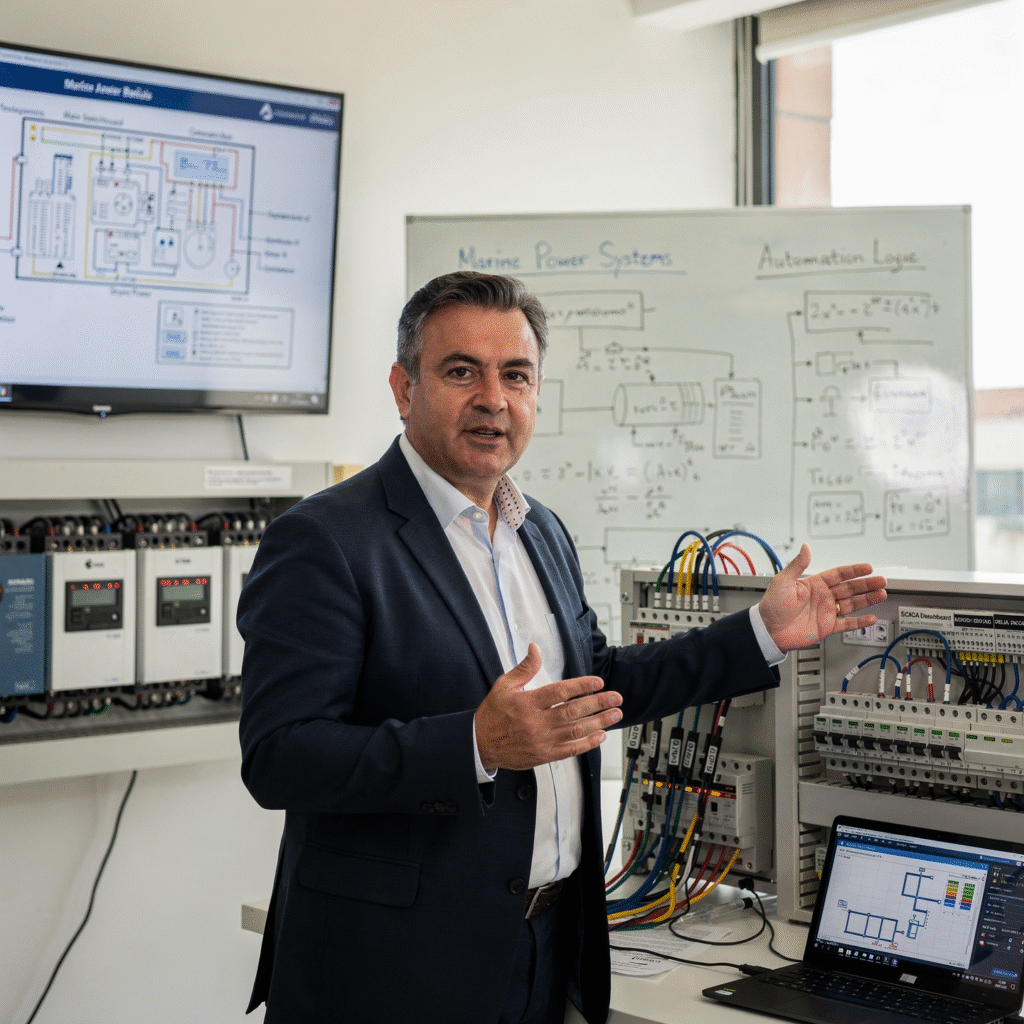
Fuel and Supply Management Course

Why this course?

The Fuel and Supply Management

course

Provides you with the essential tools and knowledge to optimize consumption, reduce costs, and ensure resource availability. Learn to master the planning, procurement, storage, and control of fuel, lubricants, and other critical supplies. Minimize risks, maximize efficiency, and contribute to the sustainability of your operation.

Fuel and Supply Management

This course provides you with the essential tools and knowledge to optimize consumption, reduce costs, and ensure resource availability. Learn to master the planning, procurement, storage, and control of fuel, lubricants, and other critical supplies. Minimize risks, maximize efficiency, and contribute to the sustainability of your operation.

Differential Advantages

  • Cost Analysis: Implement strategies to reduce fuel and supply expenses.
  • Inventory Management: Optimize stock levels to avoid shortages and obsolescence.
  • Regulations and Compliance: Ensure compliance with environmental and safety regulations.
  • Procurement Strategies: Learn to negotiate contracts and select efficient suppliers.
  • Case Studies: Apply the acquired knowledge to real-world management situations.
Gestión

Fuel and Supply Management Course

Availability: 1 in stock

Who is it aimed at?

  • Purchasing and logistics managers looking to optimize the supply chain, reduce costs, and ensure strategic sourcing.
  • Maintenance and operations managers who need to minimize consumption, extend equipment lifespan, and optimize energy performance.
  • Fleet and administrative managers requiring budget control, risk analysis, and regulatory compliance in fuel management.
  • Technicians and operational staff interested in applying best practices in fuel receiving, storage, handling, and control.
  • Sustainability professionals and energy consultants looking to implement efficiency strategies, reduce their carbon footprint, and meet targets environmental.

Learning Flexibility
Ā Adapted to your pace: asynchronous modules, collaborative discussion forums, and downloadable material for offline reference.

Gestión

Objectives and competencies

Optimize the use and control of resources:

“Manage ballast and trim efficiently, minimizing fuel consumption and optimizing stability.”

Minimize the environmental impact of operations:

Implement onboard waste management practices, including segregation, proper storage and delivery to authorized port facilities, in compliance with MARPOL and local regulations.

Ensure the timely availability of fuel and supplies:

“Efficiently manage fuel, lubricant, and spare parts resources, optimizing inventories and anticipating operational needs.”

Implement efficient storage and distribution strategies:

Optimize inventory management, route selection and transportation methods to minimize costs and delivery times, considering safety and sustainability.
Negotiate favorable contracts with fuel and supply providers:

“Thoroughly analyze market fluctuations and establish fixed or variable price agreements according to trends, seeking protection clauses against sudden increases.”
Monitor and maintain the quality of fuel and supplies:

“Verify the purity, density and other specifications of the fuel, as well as the integrity of the tanks and supply systems, documenting findings and applying corrective actions according to established procedures.”

Curriculum - Modules

  1. Comprehensive Maritime Incident Management: protocols, roles, and chain of command for coordinated response
  2. Operational Planning and Execution: briefing, routes, weather windows, and go/no-go criteria
  3. Rapid Risk Assessment: criticality matrix, scene control, and decision-making under pressure
  4. Operational Communication: VHF/GMDSS, standardized reports, and inter-agency liaison
  5. Tactical Mobility and Safe Boarding: RHIB maneuvers, approach, mooring, and recovery
  6. Equipment and Technologies: PPE, signaling, satellite tracking, and field data logging
  7. Immediate Care of the Affected: primary assessment, hypothermia, trauma, and stabilization for evacuation
  8. Adverse Environmental Conditions: swell, Visibility, flows, and operational mitigation

    Simulation and training: critical scenarios, use of VR/AR, and exercises with performance metrics

    Documentation and continuous improvement: lessons learned, indicators (MTTA/MTTR), and SOP updates

  1. Introduction to Integrated Logistics: Definition, scope, and objectives.
  2. Fuels: Types, characteristics, regulations, and storage.
  3. Fuel Suppliers: Selection, evaluation, and contract management.
  4. Demand Planning: Estimating consumption, safety stocks, and replenishment.
  5. Logistics Infrastructure: Terminals, tanks, pipelines, and service stations.
  6. Fuel Transportation: Types of transport (land, sea, air), safety, and regulations.
  7. Inventory Management: Stock control, level optimization, and prevention of losses and spills.
  8. Supply Management: Storage, preservation, rotation, and quality control.
  9. Safety and Environment: Risk prevention, Emergency plans and regulatory compliance.
  10. Key Performance Indicators (KPIs): Measurement and analysis of logistics performance.

  1. Introduction to Fuel Optimization: Importance, Benefits, and Challenges
  2. Combustion Fundamentals: Fuel Types, Calorific Value, Efficiency
  3. Storage and Distribution Systems: Tanks, Pumps, Pipelines, and Regulations
  4. Fuel Quality Control: Sampling, Analysis, Contamination, and Treatment
  5. Consumption Optimization: Equipment Operation, Maintenance, and Adjustment Techniques
  6. Supply Management: Needs Planning, Procurement, and Storage
  7. Fuel Logistics: Transportation, Transfer, and Inventory Control
  8. Energy Efficiency: Use of Alternative Energies and Innovative Technologies
  9. Performance Monitoring and Control: Key Performance Indicators (KPIs) and Data Analysis
  10. Environmental Regulations and Sustainability: Emissions Reduction and Best Practices

  1. Fuel Management Fundamentals: Importance, Costs, and Environmental Impact
  2. Types of Fuel: Characteristics, Specifications, and Storage
  3. Fuel Systems: Components, Operation, and Maintenance
  4. Measuring and Controlling Consumption: Techniques, Instruments, and Data Analysis
  5. Energy Efficiency: Optimizing Operations and Technologies
  6. Fuel Handling Safety: Preventing Spills, Fires, and Explosions
  7. Standards and Regulations: Environmental Compliance and Maritime Safety
  8. Fuel Waste Management: Treatment, Disposal, and Recycling
  9. Cost-Benefit Analysis: Investments in Efficiency and Safety
  10. Fuel Saving Strategies: Best Practices and Innovative Technologies

  1. Introduction to Logistics and the Supply Chain in the Context of Fuel
  2. Inventory Fundamentals: Types, Valuation Methods (FIFO, LIFO, Average)
  3. Fuel Storage: Tank Types, Safety Regulations, Maintenance
  4. Fuel Receiving and Unloading: Procedures, Quality Control, Sampling
  5. Fuel Measurement Systems: Calibration, Errors, Technologies (Sensors, Flow Meters)
  6. Fuel Demand Management: Forecasting, Planning, Allocation
  7. Loss and Spill Control: Prevention, Detection, Emergency Response
  8. Software and Tools for Fuel Management Fuel Inventory and Control
  9. Fuel Inventory Audit: Procedures, Key Performance Indicators (KPIs)
  10. Regulatory Aspects and Environmental Regulations Applicable to Fuel Handling

  1. System Architecture and Components: Structural design, materials, and subsystems (mechanical, electrical, electronic, and fluid) with selection and assembly criteria for marine environments
  2. Fundamentals and Principles of Operation: Physical and engineering foundations (thermodynamics, fluid mechanics, electricity, control, and materials) that explain performance and operating limits
  3. Safety and Environmental (SHE): Risk analysis, PPE, LOTO, hazardous atmospheres, spill and waste management, and emergency response plans
  4. Applicable Regulations and Standards: IMO/ISO/IEC requirements and local regulations;
  5. Conformance criteria, certification, and best practices for operation and maintenance
  6. Inspection, testing, and diagnostics: Visual/dimensional inspection, functional testing, data analysis, and predictive techniques (vibration, thermography, fluid analysis) to identify root causes
  7. Preventive and predictive maintenance: Hourly/cycle/seasonal plans, lubrication, adjustments, calibrations, consumable replacement, post-service verification, and operational reliability
  8. Instrumentation, tools, and metrology: Measuring and testing equipment, diagnostic software, calibration and traceability; selection criteria, safe use, and storage
  9. Onboard integration and interfaces: Mechanical, electrical, fluid, and data compatibility; Sealing and watertightness, EMC/EMI, corrosion protection, and interoperability testing.

    Quality, acceptance testing, and commissioning: process and materials control, FAT/SAT, bench and sea trials, go/no-go criteria, and evidence documentation.

    Technical documentation and integrated practice: logs, checklists, reports, and a complete case study (safety → diagnosis → intervention → verification → report) applicable to any system.

Plan de estudio - Módulos

  1. Comprehensive Maritime Incident Management: protocols, roles, and chain of command for coordinated response
  2. Operational Planning and Execution: briefing, routes, weather windows, and go/no-go criteria
  3. Rapid Risk Assessment: criticality matrix, scene control, and decision-making under pressure
  4. Operational Communication: VHF/GMDSS, standardized reports, and inter-agency liaison
  5. Tactical Mobility and Safe Boarding: RHIB maneuvers, approach, mooring, and recovery
  6. Equipment and Technologies: PPE, signaling, satellite tracking, and field data logging
  7. Immediate Care of the Affected: primary assessment, hypothermia, trauma, and stabilization for evacuation
  8. Adverse Environmental Conditions: swell, Visibility, flows, and operational mitigation

    Simulation and training: critical scenarios, use of VR/AR, and exercises with performance metrics

    Documentation and continuous improvement: lessons learned, indicators (MTTA/MTTR), and SOP updates

  1. Introduction to Integrated Logistics: Definition, scope, and objectives.
  2. Fuels: Types, characteristics, regulations, and storage.
  3. Fuel Suppliers: Selection, evaluation, and contract management.
  4. Demand Planning: Estimating consumption, safety stocks, and replenishment.
  5. Logistics Infrastructure: Terminals, tanks, pipelines, and service stations.
  6. Fuel Transportation: Types of transport (land, sea, air), safety, and regulations.
  7. Inventory Management: Stock control, level optimization, and prevention of losses and spills.
  8. Supply Management: Storage, preservation, rotation, and quality control.
  9. Safety and Environment: Risk prevention, Emergency plans and regulatory compliance.
  10. Key Performance Indicators (KPIs): Measurement and analysis of logistics performance.

  1. Introduction to Fuel Optimization: Importance, Benefits, and Challenges
  2. Combustion Fundamentals: Fuel Types, Calorific Value, Efficiency
  3. Storage and Distribution Systems: Tanks, Pumps, Pipelines, and Regulations
  4. Fuel Quality Control: Sampling, Analysis, Contamination, and Treatment
  5. Consumption Optimization: Equipment Operation, Maintenance, and Adjustment Techniques
  6. Supply Management: Needs Planning, Procurement, and Storage
  7. Fuel Logistics: Transportation, Transfer, and Inventory Control
  8. Energy Efficiency: Use of Alternative Energies and Innovative Technologies
  9. Performance Monitoring and Control: Key Performance Indicators (KPIs) and Data Analysis
  10. Environmental Regulations and Sustainability: Emissions Reduction and Best Practices

  1. Fuel Management Fundamentals: Importance, Costs, and Environmental Impact
  2. Types of Fuel: Characteristics, Specifications, and Storage
  3. Fuel Systems: Components, Operation, and Maintenance
  4. Measuring and Controlling Consumption: Techniques, Instruments, and Data Analysis
  5. Energy Efficiency: Optimizing Operations and Technologies
  6. Fuel Handling Safety: Preventing Spills, Fires, and Explosions
  7. Standards and Regulations: Environmental Compliance and Maritime Safety
  8. Fuel Waste Management: Treatment, Disposal, and Recycling
  9. Cost-Benefit Analysis: Investments in Efficiency and Safety
  10. Fuel Saving Strategies: Best Practices and Innovative Technologies

  1. Introduction to Logistics and the Supply Chain in the Context of Fuel
  2. Inventory Fundamentals: Types, Valuation Methods (FIFO, LIFO, Average)
  3. Fuel Storage: Tank Types, Safety Regulations, Maintenance
  4. Fuel Receiving and Unloading: Procedures, Quality Control, Sampling
  5. Fuel Measurement Systems: Calibration, Errors, Technologies (Sensors, Flow Meters)
  6. Fuel Demand Management: Forecasting, Planning, Allocation
  7. Loss and Spill Control: Prevention, Detection, Emergency Response
  8. Software and Tools for Fuel Management Fuel Inventory and Control
  9. Fuel Inventory Audit: Procedures, Key Performance Indicators (KPIs)
  10. Regulatory Aspects and Environmental Regulations Applicable to Fuel Handling

  1. System Architecture and Components: Structural design, materials, and subsystems (mechanical, electrical, electronic, and fluid) with selection and assembly criteria for marine environments
  2. Fundamentals and Principles of Operation: Physical and engineering foundations (thermodynamics, fluid mechanics, electricity, control, and materials) that explain performance and operating limits
  3. Safety and Environmental (SHE): Risk analysis, PPE, LOTO, hazardous atmospheres, spill and waste management, and emergency response plans
  4. Applicable Regulations and Standards: IMO/ISO/IEC requirements and local regulations;
  5. Conformance criteria, certification, and best practices for operation and maintenance
  6. Inspection, testing, and diagnostics: Visual/dimensional inspection, functional testing, data analysis, and predictive techniques (vibration, thermography, fluid analysis) to identify root causes
  7. Preventive and predictive maintenance: Hourly/cycle/seasonal plans, lubrication, adjustments, calibrations, consumable replacement, post-service verification, and operational reliability
  8. Instrumentation, tools, and metrology: Measuring and testing equipment, diagnostic software, calibration and traceability; selection criteria, safe use, and storage
  9. Onboard integration and interfaces: Mechanical, electrical, fluid, and data compatibility; Sealing and watertightness, EMC/EMI, corrosion protection, and interoperability testing.

    Quality, acceptance testing, and commissioning: process and materials control, FAT/SAT, bench and sea trials, go/no-go criteria, and evidence documentation.

    Technical documentation and integrated practice: logs, checklists, reports, and a complete case study (safety → diagnosis → intervention → verification → report) applicable to any system.

  1. Introduction to Integrated Logistics: Concept, Scope, and Evolution
  2. Supply Chain Management: Actors, Processes, and Flows
  3. Types of Inventory: Raw Materials, Work-in-Process, Finished Goods, and MRO
  4. Inventory Valuation Methods: FIFO, LIFO, Weighted Average
  5. Inventory Management Systems: ABC, EOQ, Just-in-Time (JIT)
  6. Warehousing and Distribution: Design, Equipment, and Operations
  7. Transportation Route Optimization: Models, Software, and Case Studies
  8. Human Resource Management in Logistics: Selection, Training, and Performance
  9. Key Performance Indicators (KPIs) in Logistics and Inventory
  10. Emerging Technologies in Logistics: Automation, blockchain and IoT

  1. Introduction to Fuel Logistics: Importance, challenges, and regulations.
  2. Types of Fuels: Classification, properties, and applications in different sectors.
  3. Fuel Storage: Design, construction, and maintenance of tanks and reservoirs.
  4. Safety Measures in Storage: Prevention of fires, spills, and explosions.
  5. Quality Control: Sampling, analysis, and certification of fuels.
  6. Inventory Management: Control methods, records, and stock audits.
  7. Fuel Transportation: Modes (land, sea, air), packaging, and labeling.
  8. Environmental Regulations: Compliance with regulations for environmental protection Environment.
  9. Fuel Distribution: Service stations, industrial clients, and end consumers.
  10. Risk Management: Identification, assessment, and mitigation of risks in the fuel logistics chain.

  1. Introduction to Fuel Logistics: Importance and Challenges
  2. Types of Fuels: Characteristics, Specifications, and Applications
  3. Storage Infrastructure: Tanks, Pipelines, Pumps, and Equipment
  4. Supply: Suppliers, Contracts, Transportation, and Receiving
  5. Quality Control: Sampling, Analysis, and Standards
  6. Inventory Management: Control Methods, Minimum and Maximum Stock Levels
  7. Loss Measurement and Control: Causes, Detection, and Prevention
  8. Safety in Fuel Handling: Standards, Risks, and Accident Prevention
  9. Environmental Management: Impact, Regulations, and Best Practices
  10. Software and Tools for Fuel Logistics Management

  1. Introduction to Integrated Logistics: Definition, Scope, and Components.
  2. Types of Storage Tanks: Characteristics, Regulations, and Applications.
  3. Fundamentals of Traceability: Importance, Principles, and Objectives.
  4. Traceability in the Supply Chain: Product Identification, Tracking, and Control.
  5. Technologies for Traceability: Barcodes, RFID, GPS, and Blockchain.
  6. Inventory Management in Tank Logistics: Methods and Optimization.
  7. Quality and Safety Control in Product Storage and Transportation.
  8. Applicable Regulations and Standards: National and International Standards.
  9. Information Systems for Logistics and Traceability: ERP, WMS, and TMS.
  10. Case Studies and Best Practices in Logistics comprehensive, tanks and traceability.

Career opportunities

  • Fuel Purchasing Manager: cost optimization, market analysis, supplier negotiation.
  • Supply Chain Logistics Manager: route planning, inventory management, transportation coordination.
  • Fuel Quality Control Specialist: sample analysis, contaminant detection, regulatory compliance.
  • Fuel Consumption Auditor: energy efficiency assessment, identification of areas for improvement, KPI monitoring.
  • Fuel Storage Technician: tank management, safety control, spill prevention.
  • Energy Efficiency Consultant: advising companies, developing savings strategies, implementing technologies.
  • Fuel Management Products and Services Salesperson: sales of additives, monitoring systems, and solutions. Software.
  • Risk management in fuel supply: vulnerability analysis, contingency plans, insurance.

“`

Admission requirements

Academic/professional profile:

Degree/Bachelor's degree in Nautical Science/Maritime Transport, Naval/Marine Engineering, or a related field; or proven professional experience in bridge/operations.

Language proficiency:

Recommended functional maritime English (SMCP) for simulations and technical materials.

5. Induction

Updated resume, copy of degree or seaman's book, ID card/passport, letter of motivation.

Technical requirements (for online):

Equipment with camera/microphone, stable connection, ≄ 24ā€ monitor recommended for ECDIS/Radar-ARPA.

Admission process and dates

1. Online
application

(form + documents).

2. Academic review and interview

(profile/objectives/schedule compatibility).

3. Admission decision

(+ scholarship proposal if applicable).

4. Reservation of place

(deposit) and registration.

5. Induction

(access to campus, calendars, simulator guides).

Scholarships and grants

  • Optimize Costs: Learn to reduce fuel and supply expenses through efficient management strategies.
  • Inventory Control: Master techniques for precise and cost-effective resource management.
  • Effective Negotiation: Acquire key skills to obtain the best prices and terms from suppliers.
  • Data Analysis: Use tools to identify trends and opportunities for improvement in your supply chain.
  • Sustainability: Implement eco-friendly practices that benefit both the environment and your company.
Increase the profitability and efficiency of your business with strategic fuel and supply management.

Testimonials

Frequently asked questions

To ensure the uninterrupted availability of fuel and supplies necessary for the operation, at the lowest possible cost and in compliance with quality and safety standards.

Yes. The itinerary includes ECDIS/Radar-ARPA/BRM with harbor, ocean, fog, storm, and SAR scenarios.

Online with live sessions; hybrid option for simulator/practical placements through agreements.

To ensure the continuous availability of fuel and supplies necessary for the operation, at the lowest cost and with maximum performance.

Recommended functional SMCP. We offer support materials for standard phraseology.

Yes, with a relevant degree or experience in maritime/port operations. The admissions interview will confirm suitability.

Optional (3–6 months) through Companies & Collaborations and the Alumni Network.

Simulator practice (rubrics), defeat plans, SOPs, checklists, micro-tests and applied TFM.

A degree from Navalis Magna University + operational portfolio (tracks, SOPs, reports and KPIs) useful for audits and employment.

  1. Introduction to Integrated Logistics: Definition, Scope, and Components.
  2. Types of Storage Tanks: Characteristics, Regulations, and Applications.
  3. Fundamentals of Traceability: Importance, Principles, and Objectives.
  4. Traceability in the Supply Chain: Product Identification, Tracking, and Control.
  5. Technologies for Traceability: Barcodes, RFID, GPS, and Blockchain.
  6. Inventory Management in Tank Logistics: Methods and Optimization.
  7. Quality and Safety Control in Product Storage and Transportation.
  8. Applicable Regulations and Standards: National and International Standards.
  9. Information Systems for Logistics and Traceability: ERP, WMS, and TMS.
  10. Case Studies and Best Practices in Logistics comprehensive, tanks and traceability.

Request information

  1. Complete the Application Form
  2. Attach your CV/Qualifications (if you have them to hand).
  3. Indicate your preferred cohort (January/May/September) and whether you want the hybrid option with simulator sessions.
An academic advisor will contact you within 24–48 hours to guide you through the admission process, scholarships, and compatibility with your professional schedule. Translated with DeepL.com (free version)
Please enable JavaScript in your browser to complete this form.
Click or drag a file to this area to upload.

Teachers

0
    0
    Tu carrito
    Tu carrito esta vacĆ­oRegresar a la tienda
    Scroll to Top