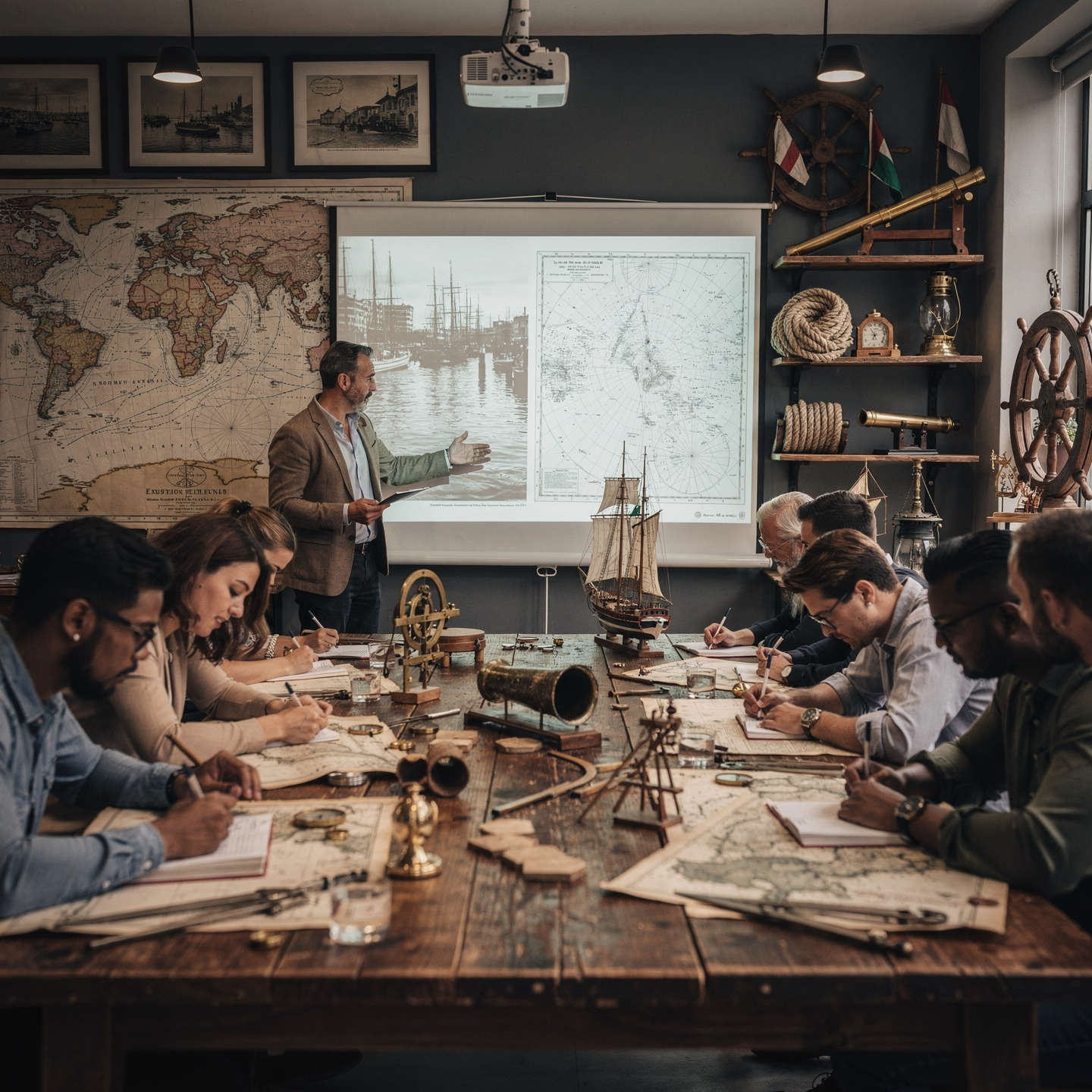
Course on Port and Seafaring Culture
Why this course?
The Port and Seafarer Culture
Immerse yourself in the fascinating maritime world, exploring its rich history, traditions, and the crucial role of ports as centers of global exchange. Discover the customs and rituals of seafarers, from work songs to deeply rooted superstitions, and understand the evolution of ports throughout the centuries, their economic and social impact. This program offers you a unique perspective on life at sea, the challenges faced by sailors, and the importance of preserving maritime heritage.
Differential Advantages
- In-depth Exploration: Analysis of maritime history, seafaring cultures, and port evolution.
- Anthropological Approach: Understanding the traditions, rituals, and values of seafarers.
- Global Vision: Analysis of the economic and social impact of ports on different cultures.
- Multimedia Materials: Access to videos, images, and historical documents that enrich learning.
- Active Participation: Discussion forums and practical activities for exchanging knowledge and experiences.
- Modality: Online
- Level: Cursos
- Hours: 150 H
- Start date: 25-07-2026
Availability: 1 in stock
Who is it aimed at?
- History, anthropology, and sociology students interested in exploring the rich maritime tradition and its impact on coastal communities.
- Tourism and cultural management professionals seeking to design authentic experiences that connect visitors with maritime heritage.
- Artists, writers, and content creators who find inspiration in the sea and wish to delve deeper into its stories and symbolism.
- Members of coastal communities and seafarers’ associations seeking to preserve and promote their cultural heritage and traditional knowledge.
- Anyone passionate about the sea who wants to better understand its influence on society and the lives of those who live on and depend on it.
he.
Learning Flexibility
Access content at your own pace, participate in interactive discussion forums and enjoy supplementary materials for an enriching learning experience.
Objectives and competencies

Interpreting marine meteorology:
Interpreting weather reports and their impact on navigation, adapting the route and speed to minimize risks and optimize fuel consumption.

Managing maritime safety on board:
Implement contingency plans (fires, breakdowns, man overboard) and coordinate the crew’s response effectively.

Apply international maritime regulations:
“Implement the SOLAS Convention and its amendments.”
“Considering the type of vessel, cargo, and navigation area, and documenting the actions taken.”
“Prioritizing the safety of human life at sea and the protection of the marine environment.”

Operate and maintain navigation equipment:
“Interpreting the information provided and acting accordingly, ensuring navigational safety and pollution prevention.”

Coordinate and supervise port operations:
“To efficiently manage loading and unloading, optimizing time and ensuring the safety of cargo and personnel.”

To operate boats efficiently and safely:
“Optimize fuel consumption considering weather conditions, sea state and route, and act diligently in emergency situations.”
Curriculum - Modules
- Comprehensive Maritime Incident Management: protocols, roles, and chain of command for coordinated response
- Operational Planning and Execution: briefing, routes, weather windows, and go/no-go criteria
- Rapid Risk Assessment: criticality matrix, scene control, and decision-making under pressure
- Operational Communication: VHF/GMDSS, standardized reports, and inter-agency liaison
- Tactical Mobility and Safe Boarding: RHIB maneuvers, approach, mooring, and recovery
- Equipment and Technologies: PPE, signaling, satellite tracking, and field data logging
- Immediate Care of the Affected: primary assessment, hypothermia, trauma, and stabilization for evacuation
- Adverse Environmental Conditions: swell, Visibility, flows, and operational mitigation
Simulation and training: critical scenarios, use of VR/AR, and exercises with performance metrics
Documentation and continuous improvement: lessons learned, indicators (MTTA/MTTR), and SOP updates
- Origins of Navigation: From Antiquity to the Age of Discovery
- The Age of Sail: Development of Ships, Trade Routes, and Naval Wars
- Great Maritime Explorers: Columbus, Magellan, Cook, and Their Legacies
- Impact of Navigation on Global Trade and Cultural Exchange
- Seafaring Traditions: Baptisms of Line, Superstitions, and Rituals on Board
- Seafaring Slang: Nautical Terms, Expressions, and Their Evolution
- Life on Board: Routines, Hierarchies, and Challenges at Sea
- Famous Shipwrecks: The Titanic, the Mary Celeste, and Their Mysteries
- Piracy: from privateers to modern pirates
- The future of navigation: new technologies and environmental challenges
‘
- Introduction to Maritime History: Periodization and Sources
- Navigation in Antiquity: Phoenicians, Greeks, and Romans
- The Middle Ages and the Age of Discovery: Vikings, Chinese, and European Expansion
- The Golden Age of Navigation: Development of Cartography and Shipbuilding
- Piracy and Privateering: Causes, Consequences, and Key Figures
- The Industrial Revolution and Maritime Transport: Steam, Steel, and Canals
- Naval Warfare: From Antiquity to the Modern Era
- Historic Ports: Functions, Evolution, and Heritage
- Seafaring Traditions: Folklore, Superstitions, and Slang
- The Future of Maritime History and Heritage Preservation
port.
‘
- Introduction to Maritime History: Definitions, Sources, and Periodization.
- Ancient History and the Domination of the Mediterranean: Phoenicians, Greeks, and Romans.
- The Age of Discovery: Nautical Innovations, Exploration, and Trade.
- Traditional Shipbuilding: Materials, Techniques, and Evolution of Ships.
- Historic Ports: Functions, Infrastructure, and Urban Development.
- Port Trades: Stevedores, Shipwrights, Pilots, and Lighthouse Keepers.
- Maritime Traditions: Music, Gastronomy, Rituals, and Superstitions.
- Shipwrecks and Rescues: Histories, Legislation, and Salvage Techniques.
- The Impact of the industrialization of navigation: Steam, steel, and engines.
- Maritime heritage: Conservation, museums, historic ships, and archives.
‘
- Introduction to Maritime History: Concepts, Periodization, and Sources.
- Navigation in Antiquity: Phoenicians, Greeks, and Romans.
- The Age of Discovery: European Exploration and Expansion.
- The Rise of Sail: Ships, Routes, and Trade.
- The Industrial Revolution and Steam Power: Transformation of Navigation.
- The Port as a Center of Activity: Functions, Infrastructure, and Evolution.
- Seafaring Traditions: Rituals, Folklore, and Slang.
- Cultural Impact of Life at Sea: Art, Literature, and Music.
- Conservation of Maritime Heritage: Historic Ships, Museums, and Archives.
- The future of port heritage: challenges and opportunities.
‘
- System Architecture and Components: Structural design, materials, and subsystems (mechanical, electrical, electronic, and fluid) with selection and assembly criteria for marine environments
- Fundamentals and Principles of Operation: Physical and engineering foundations (thermodynamics, fluid mechanics, electricity, control, and materials) that explain performance and operating limits
- Safety and Environmental (SHE): Risk analysis, PPE, LOTO, hazardous atmospheres, spill and waste management, and emergency response plans
- Applicable Regulations and Standards: IMO/ISO/IEC requirements and local regulations;
- Conformance criteria, certification, and best practices for operation and maintenance
- Inspection, testing, and diagnostics: Visual/dimensional inspection, functional testing, data analysis, and predictive techniques (vibration, thermography, fluid analysis) to identify root causes
- Preventive and predictive maintenance: Hourly/cycle/seasonal plans, lubrication, adjustments, calibrations, consumable replacement, post-service verification, and operational reliability
- Instrumentation, tools, and metrology: Measuring and testing equipment, diagnostic software, calibration and traceability; selection criteria, safe use, and storage
- Onboard integration and interfaces: Mechanical, electrical, fluid, and data compatibility; Sealing and watertightness, EMC/EMI, corrosion protection, and interoperability testing.
Quality, acceptance testing, and commissioning: process and materials control, FAT/SAT, bench and sea trials, go/no-go criteria, and evidence documentation.
Technical documentation and integrated practice: logs, checklists, reports, and a complete case study (safety → diagnosis → intervention → verification → report) applicable to any system.
Plan de estudio - Módulos
- Comprehensive Maritime Incident Management: protocols, roles, and chain of command for coordinated response
- Operational Planning and Execution: briefing, routes, weather windows, and go/no-go criteria
- Rapid Risk Assessment: criticality matrix, scene control, and decision-making under pressure
- Operational Communication: VHF/GMDSS, standardized reports, and inter-agency liaison
- Tactical Mobility and Safe Boarding: RHIB maneuvers, approach, mooring, and recovery
- Equipment and Technologies: PPE, signaling, satellite tracking, and field data logging
- Immediate Care of the Affected: primary assessment, hypothermia, trauma, and stabilization for evacuation
- Adverse Environmental Conditions: swell, Visibility, flows, and operational mitigation
Simulation and training: critical scenarios, use of VR/AR, and exercises with performance metrics
Documentation and continuous improvement: lessons learned, indicators (MTTA/MTTR), and SOP updates
- Origins of Navigation: From Antiquity to the Age of Discovery
- The Age of Sail: Development of Ships, Trade Routes, and Naval Wars
- Great Maritime Explorers: Columbus, Magellan, Cook, and Their Legacies
- Impact of Navigation on Global Trade and Cultural Exchange
- Seafaring Traditions: Baptisms of Line, Superstitions, and Rituals on Board
- Seafaring Slang: Nautical Terms, Expressions, and Their Evolution
- Life on Board: Routines, Hierarchies, and Challenges at Sea
- Famous Shipwrecks: The Titanic, the Mary Celeste, and Their Mysteries
- Piracy: from privateers to modern pirates
- The future of navigation: new technologies and environmental challenges
‘
- Introduction to Maritime History: Periodization and Sources
- Navigation in Antiquity: Phoenicians, Greeks, and Romans
- The Middle Ages and the Age of Discovery: Vikings, Chinese, and European Expansion
- The Golden Age of Navigation: Development of Cartography and Shipbuilding
- Piracy and Privateering: Causes, Consequences, and Key Figures
- The Industrial Revolution and Maritime Transport: Steam, Steel, and Canals
- Naval Warfare: From Antiquity to the Modern Era
- Historic Ports: Functions, Evolution, and Heritage
- Seafaring Traditions: Folklore, Superstitions, and Slang
- The Future of Maritime History and Heritage Preservation
port.
‘
- Introduction to Maritime History: Definitions, Sources, and Periodization.
- Ancient History and the Domination of the Mediterranean: Phoenicians, Greeks, and Romans.
- The Age of Discovery: Nautical Innovations, Exploration, and Trade.
- Traditional Shipbuilding: Materials, Techniques, and Evolution of Ships.
- Historic Ports: Functions, Infrastructure, and Urban Development.
- Port Trades: Stevedores, Shipwrights, Pilots, and Lighthouse Keepers.
- Maritime Traditions: Music, Gastronomy, Rituals, and Superstitions.
- Shipwrecks and Rescues: Histories, Legislation, and Salvage Techniques.
- The Impact of the industrialization of navigation: Steam, steel, and engines.
- Maritime heritage: Conservation, museums, historic ships, and archives.
‘
- Introduction to Maritime History: Concepts, Periodization, and Sources.
- Navigation in Antiquity: Phoenicians, Greeks, and Romans.
- The Age of Discovery: European Exploration and Expansion.
- The Rise of Sail: Ships, Routes, and Trade.
- The Industrial Revolution and Steam Power: Transformation of Navigation.
- The Port as a Center of Activity: Functions, Infrastructure, and Evolution.
- Seafaring Traditions: Rituals, Folklore, and Slang.
- Cultural Impact of Life at Sea: Art, Literature, and Music.
- Conservation of Maritime Heritage: Historic Ships, Museums, and Archives.
- The future of port heritage: challenges and opportunities.
‘
- System Architecture and Components: Structural design, materials, and subsystems (mechanical, electrical, electronic, and fluid) with selection and assembly criteria for marine environments
- Fundamentals and Principles of Operation: Physical and engineering foundations (thermodynamics, fluid mechanics, electricity, control, and materials) that explain performance and operating limits
- Safety and Environmental (SHE): Risk analysis, PPE, LOTO, hazardous atmospheres, spill and waste management, and emergency response plans
- Applicable Regulations and Standards: IMO/ISO/IEC requirements and local regulations;
- Conformance criteria, certification, and best practices for operation and maintenance
- Inspection, testing, and diagnostics: Visual/dimensional inspection, functional testing, data analysis, and predictive techniques (vibration, thermography, fluid analysis) to identify root causes
- Preventive and predictive maintenance: Hourly/cycle/seasonal plans, lubrication, adjustments, calibrations, consumable replacement, post-service verification, and operational reliability
- Instrumentation, tools, and metrology: Measuring and testing equipment, diagnostic software, calibration and traceability; selection criteria, safe use, and storage
- Onboard integration and interfaces: Mechanical, electrical, fluid, and data compatibility; Sealing and watertightness, EMC/EMI, corrosion protection, and interoperability testing.
Quality, acceptance testing, and commissioning: process and materials control, FAT/SAT, bench and sea trials, go/no-go criteria, and evidence documentation.
Technical documentation and integrated practice: logs, checklists, reports, and a complete case study (safety → diagnosis → intervention → verification → report) applicable to any system.
- Introduction to Maritime History: Ancient Civilizations and Trade Routes
- Life Aboard Ships in the Early Modern Period: Hierarchies, Roles, and Routines
- Traditional Shipbuilding: Materials, Techniques, and Evolution
- Artisanal Fishing: Techniques, Arts, and Cultural Impact
- Seafood Gastronomy: Ingredients, Recipes, and Culinary Traditions
- Maritime Festivals and Rituals: Celebrations, Beliefs, and Symbolism
- Nautical Crafts: Knots, Weaving, Models, and Marine Decorations
- Sea Music and Dances: Work Songs, Legends, and Artistic Expressions
- Sea Literature and Stories: Adventures, Shipwrecks, and Characters legendary
- Maritime heritage conservation: museums, historic vessels and archives
‘
- Introduction to Maritime History: Periodization and Sources.
- Navigation in Antiquity: Techniques, Routes, and Trade.
- The Age of Discovery: Nautical Innovations and Global Expansion.
- Historical Shipbuilding: Types of Ships and Their Evolution.
- Piracy and Privateering: Their Impact on Maritime History.
- Life on Board: Customs, Hierarchies, and Challenges.
- Port Heritage: Architecture, Infrastructure, and Significance.
- Seafaring Traditions: Rituals, Legends, and Popular Culture.
- Conservation and Dissemination of Maritime and Port Heritage.
- The Future of Maritime History: Research and New Perspectives.
‘
- Introduction to Maritime History: periodization, sources, and approaches.
- The Influence of the Sea on Culture: myths, legends, and maritime symbolism.
- Coastal Folklore: sailors’ songs, tales, and oral traditions.
- Life in Ports: trades, nautical slang, and port culture.
- Maritime Festivals and Celebrations: rituals, processions, and popular festivals.
- Crafts and Naval Traditions: shipbuilding, nautical knots, and decoration.
- Maritime Gastronomy: typical dishes, ingredients, and culinary techniques.
- Sailors’ Superstitions and Beliefs: Omens, amulets, and rituals for good luck.
- Maritime Heritage: conservation, museums, and historical sites.
- The Future of Port Traditions: challenges and opportunities for cultural preservation.
‘
- Introduction to Maritime History: Civilizations and the Sea
- Ancient Shipbuilding: Techniques and Materials Through Time
- Great Maritime Explorations: Discoveries and Trade Routes
- Seafaring Traditions: Rituals, Superstitions, and Life Aboard Ship
- Maritime Music and Literature: Sailors’ Songs, Poems, and Novels
- Nautical Art: Historical Cartography, Seafaring Votive Offerings, and Naval Painting
- The Age of Sail: Ships, Naval Battles, and Transatlantic Trade
- Impact of the Sea on Culture: Mythology, Folklore, and Gastronomy
- Preservation of Maritime Heritage: Museums, Historic Ships, and Underwater Archaeological Sites
- The Future of Maritime Traditions in a Globalized World
‘
Career opportunities
- Cultural Manager in Port Areas: Design and management of cultural activities related to the sea and ports.
- Maritime Heritage Technician: Research, conservation, and dissemination of maritime cultural heritage.
- Sociocultural Facilitator in Coastal Communities: Facilitation of activities to promote maritime culture and local development.
- Tour Guide specializing in maritime and port routes: Design and conduct of guided tours that highlight the history and culture of ports and seafarers.
- Documentarian and Researcher on Maritime Issues: Collection, analysis, and dissemination of information on the culture of ports and seafarers.
- Manager of Cultural Projects Related to the Sea: Planning, execution, and evaluation of projects that promote maritime culture.
- Consultant on Maritime Culture Issues for Institutions and companies: advising on the integration of maritime culture into development and communication strategies.
Educator in museums and maritime interpretation centers: designing and developing educational programs to promote the culture of ports and seafarers.
“`
Admission requirements

Academic/professional profile:
Degree/Bachelor's degree in Nautical Science/Maritime Transport, Naval/Marine Engineering, or a related field; or proven professional experience in bridge/operations.

Language proficiency:
Recommended functional maritime English (SMCP) for simulations and technical materials.

5. Induction
Updated resume, copy of degree or seaman's book, ID card/passport, letter of motivation.

Technical requirements (for online):
Equipment with camera/microphone, stable connection, ≥ 24” monitor recommended for ECDIS/Radar-ARPA.
Admission process and dates

1. Online
application
(form + documents).

2. Academic review and interview
(profile/objectives/schedule compatibility).

3. Admission decision
(+ scholarship proposal if applicable).

4. Reservation of place
(deposit) and registration.

5. Induction
(access to campus, calendars, simulator guides).
Scholarships and grants
- Immersion in Maritime Culture: Discover the traditions, values, and customs that define ports and sailors.
- History and Evolution of Ports: Explore the past, present, and future of ports as vital centers of global trade.
- Life on Board and Ashore: Understand the challenges and rewards of life at sea and adapting to port communities.
- Intercultural Communication: Develop skills to interact effectively with people of diverse nationalities and backgrounds in the maritime environment.
- Maritime Heritage: Appreciate the importance of preserving the cultural legacy of ports and sailors for future generations.
Testimonials
During my training in Port and Maritime Culture, I exceeded my expectations by gaining a deep understanding of the interconnectedness between port communities and the sea. I not only learned about trade routes and the evolution of navigation, but also developed an appreciation for the traditions, challenges, and unique identity of maritime life. This knowledge will enrich my future research on the social and economic impact of ports on coastal cultures.
The Naval Culture and History course exceeded my expectations. I gained a deep understanding of maritime evolution, from antiquity to the present day, including strategic, technological, and cultural aspects. The dynamic classes and the materials provided allowed me to grasp the importance of naval power throughout history and its influence on the contemporary world. I highly recommend this course to anyone interested in broadening their historical and geopolitical perspective.
My understanding of port and maritime culture deepened considerably thanks to this training. I learned to interpret the complex relationships between the sea, people, and the economy, from ancient seafaring traditions to the modern challenges of globalization and sustainability. I can now more accurately analyze the cultural and economic impact of ports, as well as appreciate the rich history and unique lifestyle of seafaring communities.
During my training in Port and Maritime Culture, I gained a deep understanding of the interconnectedness between port communities and the sea, from traditional fishing techniques to modern maritime logistics. I applied this knowledge to develop a cultural revitalization project in a declining fishing port, integrating local maritime history with sustainable practices. The project not only attracted tourism but also empowered the local community, creating new economic opportunities and strengthening its cultural identity.

Frequently asked questions
Yes. The itinerary includes ECDIS/Radar-ARPA/BRM with harbor, ocean, fog, storm, and SAR scenarios.
Online with live sessions; hybrid option for simulator/practical placements through agreements.
Recommended functional SMCP. We offer support materials for standard phraseology.
Yes, with a relevant degree or experience in maritime/port operations. The admissions interview will confirm suitability.
Optional (3–6 months) through Companies & Collaborations and the Alumni Network.
Simulator practice (rubrics), defeat plans, SOPs, checklists, micro-tests and applied TFM.
A degree from Navalis Magna University + operational portfolio (tracks, SOPs, reports and KPIs) useful for audits and employment.
- Introduction to Maritime History: Civilizations and the Sea
- Ancient Shipbuilding: Techniques and Materials Through Time
- Great Maritime Explorations: Discoveries and Trade Routes
- Seafaring Traditions: Rituals, Superstitions, and Life Aboard Ship
- Maritime Music and Literature: Sailors’ Songs, Poems, and Novels
- Nautical Art: Historical Cartography, Seafaring Votive Offerings, and Naval Painting
- The Age of Sail: Ships, Naval Battles, and Transatlantic Trade
- Impact of the Sea on Culture: Mythology, Folklore, and Gastronomy
- Preservation of Maritime Heritage: Museums, Historic Ships, and Underwater Archaeological Sites
- The Future of Maritime Traditions in a Globalized World
‘
Request information
- Complete the Application Form
- Attach your CV/Qualifications (if you have them to hand).
- Indicate your preferred cohort (January/May/September) and whether you want the hybrid option with simulator sessions.
Teachers
Eng. Tomás Riera
Full Professor
Eng. Tomás Riera
Full Professor
Eng. Sofía Marquina
Full Professor
Eng. Sofía Marquina
Full Professor
Eng. Javier Bañuls
Full Professor
Eng. Javier Bañuls
Full Professor
Dr. Nuria Llobregat
Full Professor
Dr. Nuria Llobregat
Full Professor
Dr. Pau Ferrer
Full Professor
Dr. Pau Ferrer
Full Professor
Cap. Javier Abaroa (MCA)
Full Professor
Cap. Javier Abaroa (MCA)
Full Professor

