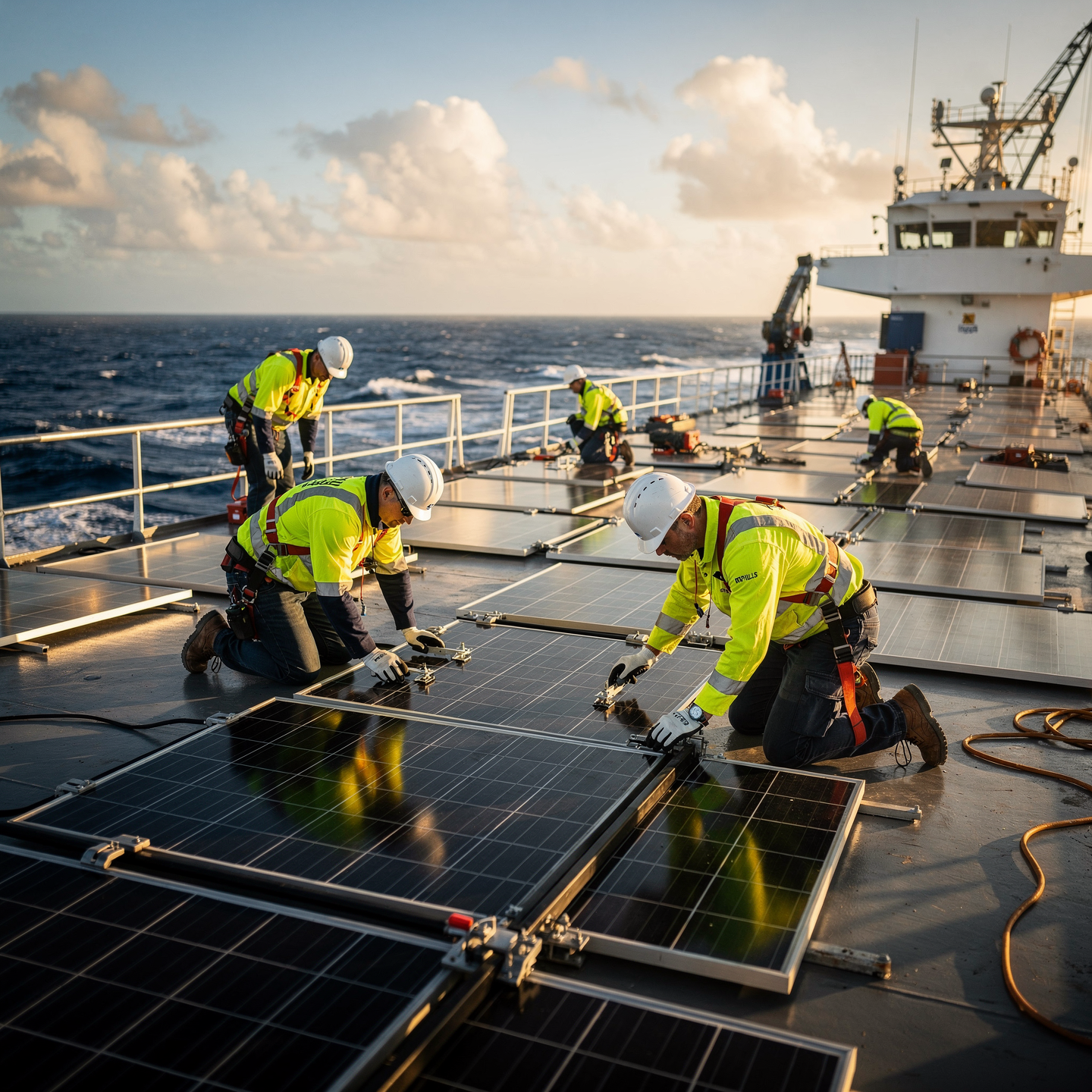
Solar Panel Course for Boats
Why this course?
The Solar Panels on Boats
course
Provides you with the necessary tools to harness solar energy on board. Learn about the selection, installation, and maintenance of photovoltaic systems, optimizing your vessel’s energy consumption and reducing your environmental footprint. Master the principles of solar energy, system components, and best practices for safe and efficient integration.
Differential Advantages
- Calculating Energy Demand: Size your solar system to meet your actual onboard needs.
- Selecting Components: Learn how to choose the right panels, regulators, batteries, and inverters.
- Step-by-Step Installation: A practical guide with diagrams and tips for a safe and long-lasting installation.
- Maintenance and Troubleshooting: Extend the life of your system and troubleshoot common problems.
- Case Studies and Real-World Examples: Apply your knowledge to different types of vessels.
- Modality: Online
- Level: Cursos
- Hours: 150 H
- Start date: 24-10-2026
Availability: 1 in stock
Who is it aimed at?
- Boat owners seeking energy independence, reduced reliance on generators, and a lower carbon footprint.
- Marine technicians and installers interested in expanding their knowledge and offering onboard solar system installation services.
- Naval engineers and designers who want to integrate solar energy solutions into boat design and construction.
- Boating and DIY enthusiasts who want to learn how to install and maintain solar systems on their own boats.
- Boat rental companies and shipyards looking to offer more sustainable options and reduce operating costs.
Flexibility and Convenience:
Online course with content at your own pace, access from any device and specialized technical support to answer your questions.
Objectives and competencies

Evaluate the technical and economic feasibility of integrating solar panels into vessels.
“Analyze the incident solar radiation, the available space, energy consumption and return on investment, considering maritime regulations and navigation conditions.”

Design and implement efficient solar energy management systems adapted to the specific needs of each vessel.
“Correctly size the components (panels, batteries, inverter) and optimize their location to maximize solar energy capture and minimize losses.”

Optimize the overall energy efficiency of the vessel by integrating solar power.
“Evaluate the feasibility and sizing of the solar system, considering energy needs, available surface area and local weather conditions.”

Train staff in the operation, maintenance, and troubleshooting of installed solar systems.
“Diagnosing faults, repairing components and optimizing performance, guaranteeing the continuity of the electricity supply.”

Reduce dependence on fossil fuels and decrease the vessel's carbon footprint:
“Optimize routes considering currents, winds, and sea conditions to minimize fuel consumption.”

Ensuring the safety and durability of solar panels in the marine environment, protecting them from corrosion and the elements.
“Select corrosion-resistant materials and apply protective coatings, carrying out inspections and preventive maintenance.”
Curriculum - Modules
- Comprehensive Maritime Incident Management: protocols, roles, and chain of command for coordinated response
- Operational Planning and Execution: briefing, routes, weather windows, and go/no-go criteria
- Rapid Risk Assessment: criticality matrix, scene control, and decision-making under pressure
- Operational Communication: VHF/GMDSS, standardized reports, and inter-agency liaison
- Tactical Mobility and Safe Boarding: RHIB maneuvers, approach, mooring, and recovery
- Equipment and Technologies: PPE, signaling, satellite tracking, and field data logging
- Immediate Care of the Affected: primary assessment, hypothermia, trauma, and stabilization for evacuation
- Adverse Environmental Conditions: swell, Visibility, flows, and operational mitigation
Simulation and training: critical scenarios, use of VR/AR, and exercises with performance metrics
Documentation and continuous improvement: lessons learned, indicators (MTTA/MTTR), and SOP updates
- Fundamentals of Photovoltaic Solar Energy: Cells, Modules, and Systems.
- Installation of Solar Panels on Vessels: Location, Orientation, and Mounting.
- Energy Storage Systems: Batteries, Inverters, and Charge Controllers.
- Design of Marine Photovoltaic Systems: Load Calculation, Sizing, and Efficiency.
- Electrical Safety in Marine Environments: Protection Against Overvoltages, Short Circuits, and Indirect Contact.
- Regulations and Legislation on Solar Energy on Vessels.
- Maritime Safety Equipment: Life Jackets, Life Rafts, and EPIRBs.
- Emergency Procedures at Sea: Man Overboard, Fire, and Abandon Ship.
- Maritime Communications: VHF, DSC, and alert systems.
First aid and survival at sea.
‘
- Introduction to Marine Solar Energy: Types and Applications
- Components of a Marine Solar System: Panels, Inverters, Batteries, Regulators
- Design Considerations for Marine Environments: Salinity, Corrosion, Vibrations, Waves
- Installing Solar Panels on Vessels: Location, Mounting, Wiring
- Connecting Electrical Systems: Regulations, Safety, Grounding
- Preventive Maintenance: Cleaning, Inspection, Performance Testing
- Troubleshooting and Repairing: Diagnostics, Tools, Spare Parts
- Performance Optimization: Monitoring, Adjustments, Improvements
- Safety in Handling Solar Energy: Electrical Hazards, Personal protection.
- Regulations and standards applicable to marine solar energy.
‘
- Introduction to Marine Solar Energy and its Advantages
- Fundamentals of Photovoltaics: Cells, Modules, and Arrays
- Components of a Marine Photovoltaic System: Inverters, Regulators, and Batteries
- Design of Photovoltaic Systems for Vessels: Load Calculation and Sizing
- Selection of Equipment and Materials: Specific Considerations for the Marine Environment
- Regulations and Standards: Safety, Fire Protection, and Grid Connection
- Installation of Solar Panels on Vessels: Mounting, Wiring, and Connection
- Connection to Batteries and Energy Management Systems: Optimization and Control
- Maintenance and Monitoring of Photovoltaic Systems Marine photovoltaics: Diagnosis and repair
Safety in the installation and operation of marine photovoltaic systems
‘
- Introduction to Marine Solar Energy: Types and Applications
- Fundamentals of Photovoltaic Solar Energy: Cells, Modules, and Systems
- Marine Technologies for Solar Energy: Floating Platforms, Submerged Structures
- Site Analysis: Solar Resource Assessment, Marine Environmental Conditions
- Design of Marine Solar Systems: Sizing, Component Selection
- Regulatory Aspects and Permits: Marine Regulations, Environmental Impact
- Installation of Marine Solar Systems: Assembly Procedures, Electrical Connection
- Preventive and Corrective Maintenance: Inspections, Cleaning, Repairs
- System Monitoring and Control: Data Acquisition, Optimization Performance
- Installation and Maintenance Safety: Electrical hazards, working at heights, maritime safety
‘
- System Architecture and Components: Structural design, materials, and subsystems (mechanical, electrical, electronic, and fluid) with selection and assembly criteria for marine environments
- Fundamentals and Principles of Operation: Physical and engineering foundations (thermodynamics, fluid mechanics, electricity, control, and materials) that explain performance and operating limits
- Safety and Environmental (SHE): Risk analysis, PPE, LOTO, hazardous atmospheres, spill and waste management, and emergency response plans
- Applicable Regulations and Standards: IMO/ISO/IEC requirements and local regulations;
- Conformance criteria, certification, and best practices for operation and maintenance
- Inspection, testing, and diagnostics: Visual/dimensional inspection, functional testing, data analysis, and predictive techniques (vibration, thermography, fluid analysis) to identify root causes
- Preventive and predictive maintenance: Hourly/cycle/seasonal plans, lubrication, adjustments, calibrations, consumable replacement, post-service verification, and operational reliability
- Instrumentation, tools, and metrology: Measuring and testing equipment, diagnostic software, calibration and traceability; selection criteria, safe use, and storage
- Onboard integration and interfaces: Mechanical, electrical, fluid, and data compatibility; Sealing and watertightness, EMC/EMI, corrosion protection, and interoperability testing.
Quality, acceptance testing, and commissioning: process and materials control, FAT/SAT, bench and sea trials, go/no-go criteria, and evidence documentation.
Technical documentation and integrated practice: logs, checklists, reports, and a complete case study (safety → diagnosis → intervention → verification → report) applicable to any system.
Plan de estudio - Módulos
- Comprehensive Maritime Incident Management: protocols, roles, and chain of command for coordinated response
- Operational Planning and Execution: briefing, routes, weather windows, and go/no-go criteria
- Rapid Risk Assessment: criticality matrix, scene control, and decision-making under pressure
- Operational Communication: VHF/GMDSS, standardized reports, and inter-agency liaison
- Tactical Mobility and Safe Boarding: RHIB maneuvers, approach, mooring, and recovery
- Equipment and Technologies: PPE, signaling, satellite tracking, and field data logging
- Immediate Care of the Affected: primary assessment, hypothermia, trauma, and stabilization for evacuation
- Adverse Environmental Conditions: swell, Visibility, flows, and operational mitigation
Simulation and training: critical scenarios, use of VR/AR, and exercises with performance metrics
Documentation and continuous improvement: lessons learned, indicators (MTTA/MTTR), and SOP updates
- Fundamentals of Photovoltaic Solar Energy: Cells, Modules, and Systems.
- Installation of Solar Panels on Vessels: Location, Orientation, and Mounting.
- Energy Storage Systems: Batteries, Inverters, and Charge Controllers.
- Design of Marine Photovoltaic Systems: Load Calculation, Sizing, and Efficiency.
- Electrical Safety in Marine Environments: Protection Against Overvoltages, Short Circuits, and Indirect Contact.
- Regulations and Legislation on Solar Energy on Vessels.
- Maritime Safety Equipment: Life Jackets, Life Rafts, and EPIRBs.
- Emergency Procedures at Sea: Man Overboard, Fire, and Abandon Ship.
- Maritime Communications: VHF, DSC, and alert systems.
First aid and survival at sea.
‘
- Introduction to Marine Solar Energy: Types and Applications
- Components of a Marine Solar System: Panels, Inverters, Batteries, Regulators
- Design Considerations for Marine Environments: Salinity, Corrosion, Vibrations, Waves
- Installing Solar Panels on Vessels: Location, Mounting, Wiring
- Connecting Electrical Systems: Regulations, Safety, Grounding
- Preventive Maintenance: Cleaning, Inspection, Performance Testing
- Troubleshooting and Repairing: Diagnostics, Tools, Spare Parts
- Performance Optimization: Monitoring, Adjustments, Improvements
- Safety in Handling Solar Energy: Electrical Hazards, Personal protection.
- Regulations and standards applicable to marine solar energy.
‘
- Introduction to Marine Solar Energy and its Advantages
- Fundamentals of Photovoltaics: Cells, Modules, and Arrays
- Components of a Marine Photovoltaic System: Inverters, Regulators, and Batteries
- Design of Photovoltaic Systems for Vessels: Load Calculation and Sizing
- Selection of Equipment and Materials: Specific Considerations for the Marine Environment
- Regulations and Standards: Safety, Fire Protection, and Grid Connection
- Installation of Solar Panels on Vessels: Mounting, Wiring, and Connection
- Connection to Batteries and Energy Management Systems: Optimization and Control
- Maintenance and Monitoring of Photovoltaic Systems Marine photovoltaics: Diagnosis and repair
Safety in the installation and operation of marine photovoltaic systems
‘
- Introduction to Marine Solar Energy: Types and Applications
- Fundamentals of Photovoltaic Solar Energy: Cells, Modules, and Systems
- Marine Technologies for Solar Energy: Floating Platforms, Submerged Structures
- Site Analysis: Solar Resource Assessment, Marine Environmental Conditions
- Design of Marine Solar Systems: Sizing, Component Selection
- Regulatory Aspects and Permits: Marine Regulations, Environmental Impact
- Installation of Marine Solar Systems: Assembly Procedures, Electrical Connection
- Preventive and Corrective Maintenance: Inspections, Cleaning, Repairs
- System Monitoring and Control: Data Acquisition, Optimization Performance
- Installation and Maintenance Safety: Electrical hazards, working at heights, maritime safety
‘
- System Architecture and Components: Structural design, materials, and subsystems (mechanical, electrical, electronic, and fluid) with selection and assembly criteria for marine environments
- Fundamentals and Principles of Operation: Physical and engineering foundations (thermodynamics, fluid mechanics, electricity, control, and materials) that explain performance and operating limits
- Safety and Environmental (SHE): Risk analysis, PPE, LOTO, hazardous atmospheres, spill and waste management, and emergency response plans
- Applicable Regulations and Standards: IMO/ISO/IEC requirements and local regulations;
- Conformance criteria, certification, and best practices for operation and maintenance
- Inspection, testing, and diagnostics: Visual/dimensional inspection, functional testing, data analysis, and predictive techniques (vibration, thermography, fluid analysis) to identify root causes
- Preventive and predictive maintenance: Hourly/cycle/seasonal plans, lubrication, adjustments, calibrations, consumable replacement, post-service verification, and operational reliability
- Instrumentation, tools, and metrology: Measuring and testing equipment, diagnostic software, calibration and traceability; selection criteria, safe use, and storage
- Onboard integration and interfaces: Mechanical, electrical, fluid, and data compatibility; Sealing and watertightness, EMC/EMI, corrosion protection, and interoperability testing.
Quality, acceptance testing, and commissioning: process and materials control, FAT/SAT, bench and sea trials, go/no-go criteria, and evidence documentation.
Technical documentation and integrated practice: logs, checklists, reports, and a complete case study (safety → diagnosis → intervention → verification → report) applicable to any system.
- Introduction to Marine Solar Energy: Potential and Challenges
- Fundamentals of Photovoltaic Solar Energy: Cells, Modules, and Arrays
- Marine Environment: Corrosion, Biofouling, and Extreme Conditions
- Types of Floating Structures: Pontoons, Semi-Submersible Platforms, and Hybrid Systems
- Electrical Design: Submarine Cables, Inverters, and Grid Connection Systems
- Economic Feasibility Analysis: Costs, Return on Investment, and Subsidies
- Material Selection: Corrosion Resistance and Durability
- Anchoring and Mooring Systems: Design and Environmental Considerations
- Installation and Commissioning: Procedures and Safety
- Maintenance and monitoring: Cleaning, inspection, and repair
‘
- Introduction to photovoltaic solar energy and its application in nautical environments.
- Fundamentals of electricity: voltage, current, power, resistance, Ohm’s law.
- Photovoltaic solar panels: types, characteristics, performance, and selection.
- Batteries: types (AGM, GEL, Lithium), capacity, charge/discharge, maintenance.
- Charge controllers: types (PWM, MPPT), function, configuration, and sizing.
- Inverters: types (pure sine wave, modified sine wave), power, efficiency, safety.
- Wiring and protections: cable selection, fuses, switches, surge protection.
- Installation of solar panels in Vessels: Location, securing, orientation, tilt.
Component Connection: Wiring, terminals, connectors, polarity and continuity testing.
Maintenance and Troubleshooting: Cleaning, visual inspection, electrical testing, fault diagnosis.
‘
- Introduction to Marine Solar Energy: Types and Applications
- Fundamentals of Photovoltaic Solar Energy: Cells, Modules, and Systems
- Analysis of Marine Solar Resources: Irradiance, Temperature, and Environmental Conditions
- Design of Marine Solar Systems: Sizing, Component Selection, and Optimization
- Integration of Systems into Marine Structures: Floating Platforms, Vessels, and Ports
- Installation of Marine Solar Panels: Procedures, Safety, and Tools
- Marine Cables and Connections: Types, Standards, and Best Practices
- Energy Storage Systems: Batteries, Inverters, and Charge Management
- Preventive and Corrective Maintenance: Inspection, cleaning, and repair of components.
Regulations and legislation applicable to marine solar installations.
‘
- Introduction to photovoltaic solar energy: basic principles and terminology.
- Components of a marine photovoltaic system: solar panels, inverters, charge controllers, batteries, wiring, and protection devices.
- Selection of solar panels for marine applications: efficiency, environmental resistance, dimensions, and weight.
- Design of marine photovoltaic systems: calculation of energy demand, system sizing, component selection, and performance optimization.
- Installation of solar panels on vessels: safety considerations, mounting, orientation, and corrosion protection.
- Connection of photovoltaic system components: wiring, grounding, and surge and short-circuit protection.
- Configuration and programming of inverters and charge controllers: voltage, current, and temperature parameters.
Operating modes and energy management.
Batteries for naval photovoltaic systems: types, characteristics, charging and discharging, maintenance, and safety.
Monitoring and control of naval photovoltaic systems: measurement of electrical parameters, data logging, alarms, and remote management.
Regulations and safety in the installation and maintenance of naval photovoltaic systems.
‘
Career opportunities
- Photovoltaic System Installer on Vessels: Installation and maintenance of solar panels on boats, yachts, and other vessels.
- Marine Renewable Energy Technician: Specialist in the integration of renewable energies in the naval sector.
- Naval Energy Consultant: Advising shipowners and shipyards on energy efficiency and the use of solar panels.
- Specialized Naval Electrician: Adapting the electrical installation of vessels for the incorporation of solar systems.
- Naval Repair and Maintenance Companies: Installation and repair of photovoltaic systems on vessels.
- Boat Builder: Integration of solar systems into the design and construction of new vessels.
- Sale and Distribution of Marine Photovoltaic Equipment: Marketing of solar panels and components for boats.
- Solar Installation Inspector for Boats: Verification and certification of the correct installation and operation of the systems.
“`
Admission requirements

Academic/professional profile:
Degree/Bachelor's degree in Nautical Science/Maritime Transport, Naval/Marine Engineering, or a related field; or proven professional experience in bridge/operations.

Language proficiency:
Recommended functional maritime English (SMCP) for simulations and technical materials.

5. Induction
Updated resume, copy of degree or seaman's book, ID card/passport, letter of motivation.

Technical requirements (for online):
Equipment with camera/microphone, stable connection, ≥ 24” monitor recommended for ECDIS/Radar-ARPA.
Admission process and dates

1. Online
application
(form + documents).

2. Academic review and interview
(profile/objectives/schedule compatibility).

3. Admission decision
(+ scholarship proposal if applicable).

4. Reservation of place
(deposit) and registration.

5. Induction
(access to campus, calendars, simulator guides).
Scholarships and grants
- Solar Energy Onboard: Learn to design and install efficient photovoltaic systems for all types of vessels.
- Energy Independence: Reduce your dependence on generators and fossil fuels, cruising more sustainably.
- Calculation and Sizing: Master load calculation, panel and battery selection, and performance optimization.
- Installation and Safety: Learn best practices for the safe and long-lasting installation of solar panels in marine environments.
- Maintenance and Troubleshooting: Acquire the skills to keep your system in optimal condition and troubleshoot common problems.
Testimonials
We achieved 90% energy independence on a 40-foot sailboat by integrating flexible solar panels into the deck and bimini. This allowed the client to sail the Caribbean for three months without needing to use the generator, reducing fuel costs and emissions, as well as enjoying a quiet and eco-friendly voyage.
During the Renewable Energy and Efficiency course, I acquired a solid understanding of various technologies, including solar photovoltaic, wind, and geothermal. I applied this knowledge in a final project where I designed a hybrid renewable energy system for a rural community, achieving an 80% reduction in its dependence on fossil fuels, optimizing energy efficiency, and minimizing environmental impact. This project allowed me to excel and receive the highest grade, demonstrating my ability to apply theoretical knowledge to practical and sustainable solutions.
We achieved 90% energy autonomy on a 40-foot sailboat by integrating flexible solar panels on the deck and bimini, drastically reducing generator use and emissions, allowing for longer and quieter voyages.
We achieved 90% energy autonomy on a 40-foot sailboat by integrating flexible solar panels on the deck and bimini, allowing the client to sail the Caribbean for 3 months using only solar power for cooling, lighting, navigation, and communications.

Frequently asked questions
They provide a quiet, renewable energy source for charging batteries and powering electrical systems, reducing dependence on fossil fuels and generator noise.
Yes. The itinerary includes ECDIS/Radar-ARPA/BRM with harbor, ocean, fog, storm, and SAR scenarios.
Online with live sessions; hybrid option for simulator/practical placements through agreements.
Reduced dependence on fossil fuels and less environmental impact.
Recommended functional SMCP. We offer support materials for standard phraseology.
Yes, with a relevant degree or experience in maritime/port operations. The admissions interview will confirm suitability.
Optional (3–6 months) through Companies & Collaborations and the Alumni Network.
Simulator practice (rubrics), defeat plans, SOPs, checklists, micro-tests and applied TFM.
A degree from Navalis Magna University + operational portfolio (tracks, SOPs, reports and KPIs) useful for audits and employment.
- Introduction to photovoltaic solar energy: basic principles and terminology.
- Components of a marine photovoltaic system: solar panels, inverters, charge controllers, batteries, wiring, and protection devices.
- Selection of solar panels for marine applications: efficiency, environmental resistance, dimensions, and weight.
- Design of marine photovoltaic systems: calculation of energy demand, system sizing, component selection, and performance optimization.
- Installation of solar panels on vessels: safety considerations, mounting, orientation, and corrosion protection.
- Connection of photovoltaic system components: wiring, grounding, and surge and short-circuit protection.
- Configuration and programming of inverters and charge controllers: voltage, current, and temperature parameters.
Operating modes and energy management.
Batteries for naval photovoltaic systems: types, characteristics, charging and discharging, maintenance, and safety.
Monitoring and control of naval photovoltaic systems: measurement of electrical parameters, data logging, alarms, and remote management.
Regulations and safety in the installation and maintenance of naval photovoltaic systems.
‘
Request information
- Complete the Application Form
- Attach your CV/Qualifications (if you have them to hand).
- Indicate your preferred cohort (January/May/September) and whether you want the hybrid option with simulator sessions.
Teachers
Eng. Tomás Riera
Full Professor
Eng. Tomás Riera
Full Professor
Eng. Sofía Marquina
Full Professor
Eng. Sofía Marquina
Full Professor
Eng. Javier Bañuls
Full Professor
Eng. Javier Bañuls
Full Professor
Dr. Nuria Llobregat
Full Professor
Dr. Nuria Llobregat
Full Professor
Dr. Pau Ferrer
Full Professor
Dr. Pau Ferrer
Full Professor
Cap. Javier Abaroa (MCA)
Full Professor
Cap. Javier Abaroa (MCA)
Full Professor

