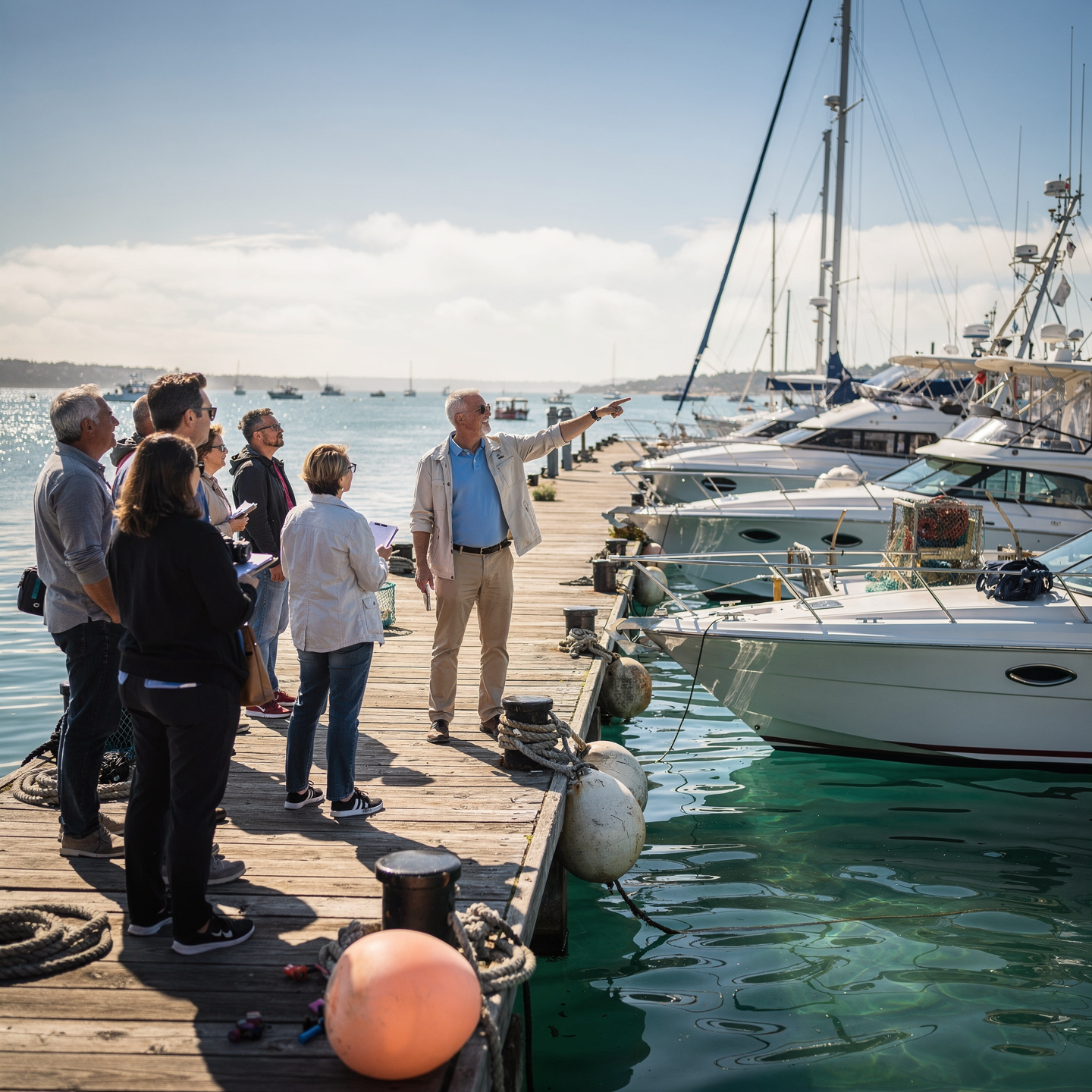
Course on Types of Vessels and Characteristics

Why this course?

The Types of Vessels and Characteristics

course

This course offers you a complete and detailed overview of the maritime world. You will learn to identify and classify different vessels, from merchant and passenger ships to recreational and specialized vessels. You will learn about their main technical characteristics, such as dimensions, cargo capacity, propulsion systems, and equipment. This program will provide you with the fundamental knowledge to work in the maritime sector, whether you are a working professional or a sea enthusiast.

Differential Advantages

  • Comprehensive Classification: detailed analysis of the different vessel categories and their specific characteristics.
  • Key Technical Characteristics: study of the essential parameters for understanding the operation of each vessel.
  • Practical Applications: real-world examples and case studies to reinforce learning.
  • Specialized Glossary: dictionary of nautical terms to facilitate understanding of the concepts.
  • Flexibility: online access to course content to study at your own pace.
Tipos

Course on Types of Vessels and Characteristics

Availability: 1 in stock

Who is it aimed at?

  • Students of naval engineering and marine architecture seeking a fundamental understanding of the diversity of vessels and their applications.
  • Maritime industry professionals (insurance, logistics, port operations) who need to expand their knowledge of different types of vessels and their capabilities.
  • Sailing and model ship enthusiasts who wish to delve deeper into the technical characteristics and history of vessels.
  • Shipyard and naval workshop personnel seeking an update on the latest trends in ship design and construction.
  • Crew members and deck officers who wish to gain in-depth knowledge of different types of vessels to improve their performance professional.

Learning flexibility: 100% online course, accessible from any device and with downloadable materials to study at your own pace.

Tipos

Objectives and competencies

Identify and classify vessels according to their design and function:

“Differentiate between dry cargo ships, liquid cargo ships, passenger ships, and special-purpose ships, recognizing their stability and maneuverability characteristics.”

Understanding nautical terminology and measurement systems used on vessels:

“Identify structural elements, equipment, and standard units of measurement, interpreting plans and technical manuals.”

Interpret and apply technical information for the safe handling of different types of vessels:

“Identify specific risks by vessel type and apply emergency procedures according to current regulations and good maritime practices.”

Evaluate the stability and performance of different vessels under various sailing conditions:

“Interpret stability, trim and load data, and adjust parameters to optimize vessel performance according to sea conditions and weather forecast.”

Select the appropriate vessel according to the specific needs and requirements of each voyage:

Evaluate navigation type, duration, expected weather and required autonomy to optimize the choice.

Recognize the propulsion and steering systems of different vessels:

Identify the characteristics and limitations of propulsion and steering systems, including their interaction and effects on vessel maneuverability.

Curriculum - Modules

  1. Comprehensive Maritime Incident Management: protocols, roles, and chain of command for coordinated response
  2. Operational Planning and Execution: briefing, routes, weather windows, and go/no-go criteria
  3. Rapid Risk Assessment: criticality matrix, scene control, and decision-making under pressure
  4. Operational Communication: VHF/GMDSS, standardized reports, and inter-agency liaison
  5. Tactical Mobility and Safe Boarding: RHIB maneuvers, approach, mooring, and recovery
  6. Equipment and Technologies: PPE, signaling, satellite tracking, and field data logging
  7. Immediate Care of the Affected: primary assessment, hypothermia, trauma, and stabilization for evacuation
  8. Adverse Environmental Conditions: swell, Visibility, flows, and operational mitigation

    Simulation and training: critical scenarios, use of VR/AR, and exercises with performance metrics

    Documentation and continuous improvement: lessons learned, indicators (MTTA/MTTR), and SOP updates

  1. Introduction to Vessel Typology: Classification according to use, size, and material.
  2. Basic Ship Structure: Hull, deck, superstructure, and reinforcing elements.
  3. Stability: Statics and dynamics, and factors that affect it.
  4. Buoyancy: Archimedes’ principle, waterline, and draft.
  5. Shipbuilding Materials: Wood, steel, alloys, and composite materials.
  6. Propulsion Systems: Types of engines, propellers, and steering systems.
  7. Auxiliary Systems: Electricity, plumbing, and ventilation.
  8. Basic Maneuvering: Use of the rudder, propeller effects, and inertia.
  9. Mooring and Anchoring: Techniques, equipment, and safety considerations.
  10. Fundamental Nautical Terminology: Essential vocabulary for navigation and maneuvering.

  1. Introduction to Naval Architecture: History, Ship Types, Nomenclature.
  2. Ship Geometry: Waterlines, Hull Shapes, Form Coefficients.
  3. Area and Volume Calculations: Simpson’s Rule, Practical Applications.
  4. Static Stability: Stability Curves, Intact Stability Criteria.
  5. Dynamic Stability: Effects of Wind, Waves, and Ship Motion.
  6. Compartmentalization and Damage Stability: Flooding Calculations, IMO Criteria.
  7. Propulsion Systems: Engine Types, Propellers, Transmission Systems.
  8. Power and Resistance Calculations: Prediction Methods, Propeller Optimization.
  9. Auxiliary Systems: Steering, Ballast, Pumping, Ventilation and refrigeration.
  10. Shipbuilding materials: steel, aluminum, composites, corrosion and protection.

  1. Introduction to Naval Architecture: History, evolution, and basic concepts.
  2. Ship Geometry: Hull shapes, waterlines, hull form, wetted surfaces, and form coefficients.
  3. Static Stability: Concepts, stability curves, and criteria for intact and damaged stability.
  4. Dynamic Stability: Effects of wind, waves, and turning on ship stability.
  5. Drag: Components of drag, calculation, and optimization of hull shape.
  6. Marine Propulsion: Propellers, engines, alternative propulsion systems, and energy efficiency.
  7. Types of Merchant Ships: Container ships, bulk carriers, tankers, gas carriers, and Ro-Ro ships.
  8. Types of Passenger Ships: Cruise ships, ferries, shuttles, and high-speed vessels.
  9. Specialty Vessels: Tugboats, dredgers, oceanographic vessels, offshore support vessels, and military vessels.
  10. Regulations and Classification: Classification societies, international conventions, and safety regulations.

  1. Introduction to Naval Architecture: History and Evolution
  2. Ship Geometry: Hull Shapes, Form Coefficients, Hull Shape
  3. Initial Stability: Metacenter, Metacentric Height, Stability Criteria
  4. Stability at Large Angles: Stability Curves, Righting Arms
  5. Drag to Forward Movement: Frictional Drag, Residual Drag, Power Required
  6. Propulsion Systems: Propellers, Engine Types, Propulsive Efficiency
  7. Maneuverability: Rudders, Turns, Directional Stability
  8. Types of Merchant Ships: Bulk Carriers, Tankers, Container Ships
  9. Types of Ships Specialized Vessels: Tugboats, Passenger Ships, Oceanographic Vessels

    Conceptual Design: Methodology, Optimization, Environmental Considerations

  1. System Architecture and Components: Structural design, materials, and subsystems (mechanical, electrical, electronic, and fluid) with selection and assembly criteria for marine environments
  2. Fundamentals and Principles of Operation: Physical and engineering foundations (thermodynamics, fluid mechanics, electricity, control, and materials) that explain performance and operating limits
  3. Safety and Environmental (SHE): Risk analysis, PPE, LOTO, hazardous atmospheres, spill and waste management, and emergency response plans
  4. Applicable Regulations and Standards: IMO/ISO/IEC requirements and local regulations;
  5. Conformance criteria, certification, and best practices for operation and maintenance
  6. Inspection, testing, and diagnostics: Visual/dimensional inspection, functional testing, data analysis, and predictive techniques (vibration, thermography, fluid analysis) to identify root causes
  7. Preventive and predictive maintenance: Hourly/cycle/seasonal plans, lubrication, adjustments, calibrations, consumable replacement, post-service verification, and operational reliability
  8. Instrumentation, tools, and metrology: Measuring and testing equipment, diagnostic software, calibration and traceability; selection criteria, safe use, and storage
  9. Onboard integration and interfaces: Mechanical, electrical, fluid, and data compatibility; Sealing and watertightness, EMC/EMI, corrosion protection, and interoperability testing.

    Quality, acceptance testing, and commissioning: process and materials control, FAT/SAT, bench and sea trials, go/no-go criteria, and evidence documentation.

    Technical documentation and integrated practice: logs, checklists, reports, and a complete case study (safety → diagnosis → intervention → verification → report) applicable to any system.

Plan de estudio - Módulos

  1. Comprehensive Maritime Incident Management: protocols, roles, and chain of command for coordinated response
  2. Operational Planning and Execution: briefing, routes, weather windows, and go/no-go criteria
  3. Rapid Risk Assessment: criticality matrix, scene control, and decision-making under pressure
  4. Operational Communication: VHF/GMDSS, standardized reports, and inter-agency liaison
  5. Tactical Mobility and Safe Boarding: RHIB maneuvers, approach, mooring, and recovery
  6. Equipment and Technologies: PPE, signaling, satellite tracking, and field data logging
  7. Immediate Care of the Affected: primary assessment, hypothermia, trauma, and stabilization for evacuation
  8. Adverse Environmental Conditions: swell, Visibility, flows, and operational mitigation

    Simulation and training: critical scenarios, use of VR/AR, and exercises with performance metrics

    Documentation and continuous improvement: lessons learned, indicators (MTTA/MTTR), and SOP updates

  1. Introduction to Vessel Typology: Classification according to use, size, and material.
  2. Basic Ship Structure: Hull, deck, superstructure, and reinforcing elements.
  3. Stability: Statics and dynamics, and factors that affect it.
  4. Buoyancy: Archimedes’ principle, waterline, and draft.
  5. Shipbuilding Materials: Wood, steel, alloys, and composite materials.
  6. Propulsion Systems: Types of engines, propellers, and steering systems.
  7. Auxiliary Systems: Electricity, plumbing, and ventilation.
  8. Basic Maneuvering: Use of the rudder, propeller effects, and inertia.
  9. Mooring and Anchoring: Techniques, equipment, and safety considerations.
  10. Fundamental Nautical Terminology: Essential vocabulary for navigation and maneuvering.

  1. Introduction to Naval Architecture: History, Ship Types, Nomenclature.
  2. Ship Geometry: Waterlines, Hull Shapes, Form Coefficients.
  3. Area and Volume Calculations: Simpson’s Rule, Practical Applications.
  4. Static Stability: Stability Curves, Intact Stability Criteria.
  5. Dynamic Stability: Effects of Wind, Waves, and Ship Motion.
  6. Compartmentalization and Damage Stability: Flooding Calculations, IMO Criteria.
  7. Propulsion Systems: Engine Types, Propellers, Transmission Systems.
  8. Power and Resistance Calculations: Prediction Methods, Propeller Optimization.
  9. Auxiliary Systems: Steering, Ballast, Pumping, Ventilation and refrigeration.
  10. Shipbuilding materials: steel, aluminum, composites, corrosion and protection.

  1. Introduction to Naval Architecture: History, evolution, and basic concepts.
  2. Ship Geometry: Hull shapes, waterlines, hull form, wetted surfaces, and form coefficients.
  3. Static Stability: Concepts, stability curves, and criteria for intact and damaged stability.
  4. Dynamic Stability: Effects of wind, waves, and turning on ship stability.
  5. Drag: Components of drag, calculation, and optimization of hull shape.
  6. Marine Propulsion: Propellers, engines, alternative propulsion systems, and energy efficiency.
  7. Types of Merchant Ships: Container ships, bulk carriers, tankers, gas carriers, and Ro-Ro ships.
  8. Types of Passenger Ships: Cruise ships, ferries, shuttles, and high-speed vessels.
  9. Specialty Vessels: Tugboats, dredgers, oceanographic vessels, offshore support vessels, and military vessels.
  10. Regulations and Classification: Classification societies, international conventions, and safety regulations.

  1. Introduction to Naval Architecture: History and Evolution
  2. Ship Geometry: Hull Shapes, Form Coefficients, Hull Shape
  3. Initial Stability: Metacenter, Metacentric Height, Stability Criteria
  4. Stability at Large Angles: Stability Curves, Righting Arms
  5. Drag to Forward Movement: Frictional Drag, Residual Drag, Power Required
  6. Propulsion Systems: Propellers, Engine Types, Propulsive Efficiency
  7. Maneuverability: Rudders, Turns, Directional Stability
  8. Types of Merchant Ships: Bulk Carriers, Tankers, Container Ships
  9. Types of Ships Specialized Vessels: Tugboats, Passenger Ships, Oceanographic Vessels

    Conceptual Design: Methodology, Optimization, Environmental Considerations

  1. System Architecture and Components: Structural design, materials, and subsystems (mechanical, electrical, electronic, and fluid) with selection and assembly criteria for marine environments
  2. Fundamentals and Principles of Operation: Physical and engineering foundations (thermodynamics, fluid mechanics, electricity, control, and materials) that explain performance and operating limits
  3. Safety and Environmental (SHE): Risk analysis, PPE, LOTO, hazardous atmospheres, spill and waste management, and emergency response plans
  4. Applicable Regulations and Standards: IMO/ISO/IEC requirements and local regulations;
  5. Conformance criteria, certification, and best practices for operation and maintenance
  6. Inspection, testing, and diagnostics: Visual/dimensional inspection, functional testing, data analysis, and predictive techniques (vibration, thermography, fluid analysis) to identify root causes
  7. Preventive and predictive maintenance: Hourly/cycle/seasonal plans, lubrication, adjustments, calibrations, consumable replacement, post-service verification, and operational reliability
  8. Instrumentation, tools, and metrology: Measuring and testing equipment, diagnostic software, calibration and traceability; selection criteria, safe use, and storage
  9. Onboard integration and interfaces: Mechanical, electrical, fluid, and data compatibility; Sealing and watertightness, EMC/EMI, corrosion protection, and interoperability testing.

    Quality, acceptance testing, and commissioning: process and materials control, FAT/SAT, bench and sea trials, go/no-go criteria, and evidence documentation.

    Technical documentation and integrated practice: logs, checklists, reports, and a complete case study (safety → diagnosis → intervention → verification → report) applicable to any system.

  1. Introduction to Naval Typology: History and Evolution of Ships.
  2. Cargo Ships: Bulk Carriers, Container Ships, Tankers, Gas Carriers, and Chemical Tankers – Design and Function.
  3. Passenger Ships: Cruise Ships, Ferries, High-Speed ​​Passenger Ships – Design, Safety, and Comfort.
  4. Fishing Vessels: Trawlers, Purse Seiners, Longliners – Design, Equipment, and Sustainability.
  5. Support and Specialty Vessels: Tugboats, Supply Ships, Dredgers, Oceanographic Vessels – Design and Applications.
  6. Recreational Craft: Motor Yachts, Sailboats, Speedboats – Design, Performance, and Market.
  7. Military Ships: Frigates, Destroyers, Aircraft Carriers, Submarines – Design, Technology, and Strategy.
  8. Basic Naval Design: Hull Shapes, Stability, Strength, and Propulsion.
  9. Shipbuilding Materials: Steel, Aluminum, Composites – Properties and Applications.
  10. Performance and Energy Efficiency: Design Optimization, Advanced Propulsion Systems, Emission Reduction.

  1. Introduction to Naval Architecture: History, evolution, and current trends.
  2. Ship Geometry: Shapes, main dimensions, and form coefficients.
  3. Static Stability: Stability criteria, stability curves, and weight effects.
  4. Dynamic Stability: Ship movements, roll, and wave response.
  5. Dress to Forward Motion: Components of drag, calculation methods, and optimization.
  6. Propulsion Systems: Types of propellers, performance, and selection.
  7. Maneuverability: Ship control, rudders, and dynamic positioning systems.
  8. Ship Typologies: Cargo ships, passenger ships, fishing vessels, military vessels, and special-purpose craft.
  9. Shipbuilding Materials: Steel, aluminum, composites, and their applications.
  10. Design Criteria: Classification standards and regulations (e.g., Lloyd’s, DNV, ABS).

  1. Introduction to Naval Architecture: History and Evolution of Ships
  2. Ship Geometry: Hull Shapes, Waterlines, Planes
  3. Static Stability: Center of Gravity, Metacenter, Initial and Large Angle Stability
  4. Buoyancy and Displacement: Archimedes’ Principle, Calculation of Displacement
  5. Drag: Components of Drag, Influence of Hull Shape
  6. Propulsion: Propellers, Alternative Propulsion Systems, Efficiency
  7. Maneuverability: Rudders, Hydrodynamic Forces, Maneuvering Tests
  8. Behavior at Sea: Ship Motions, Seasickness, Slamming
  9. Ship Typology: Ships Cargo, passenger, fishing, military, and special classifications.

    Design and regulations: Classification societies, international conventions.

  1. Introduction to ship typology: classification according to function and main characteristics
  2. General cargo ships: design, holds, loading and unloading systems
  3. Container ships: types, cells, gantry cranes, and cargo optimization
  4. Tankers: design, cargo segregation, safety systems, and pollution prevention
  5. Bulk carriers: design, holds, loading and unloading systems, and associated risks
  6. Passenger ships: ferries, cruise ships, design, safety, and onboard services
  7. Specialized ships: LNG, LPG, chemical carriers, design, safety, and specific risks
  8. Hulh structure: keel, frames, floor timbers, Deck, bulkheads, reinforcements
  9. Shipbuilding materials: steel, aluminum, composites, properties and applications

    Structural joints: welding, riveting, bolting, types, advantages and disadvantages

Career opportunities

  • Shipbuilder: Design and calculation of vessel structures, selection of materials and propulsion systems.
  • Naval Technical Inspector: Supervision of vessel construction and repair, ensuring compliance with regulations.
  • Naval Maintenance Technician: Repair and maintenance of engines, electrical and electronic systems of vessels.
  • Recreational Craft Operator: Skipper of recreational, rental, and charter vessels.
  • Marine Renewable Energy Technician: Installation and maintenance of wind and solar energy systems on vessels.
  • Naval Technical Consultant: Advising on the purchase, sale, and valuation of vessels.
  • Naval Expert: Investigation of maritime accidents and assessment of damage to vessels.
  • Maritime Training Instructor: Instructor in nautical schools and maritime training centers.

“`

Admission requirements

Academic/professional profile:

Degree/Bachelor's degree in Nautical Science/Maritime Transport, Naval/Marine Engineering, or a related field; or proven professional experience in bridge/operations.

Language proficiency:

Recommended functional maritime English (SMCP) for simulations and technical materials.

5. Induction

Updated resume, copy of degree or seaman's book, ID card/passport, letter of motivation.

Technical requirements (for online):

Equipment with camera/microphone, stable connection, ≥ 24” monitor recommended for ECDIS/Radar-ARPA.

Admission process and dates

1. Online
application

(form + documents).

2. Academic review and interview

(profile/objectives/schedule compatibility).

3. Admission decision

(+ scholarship proposal if applicable).

4. Reservation of place

(deposit) and registration.

5. Induction

(access to campus, calendars, simulator guides).

Scholarships and grants

  • Nautical Fundamentals: Master essential terminology and vessel classification.
  • Design and Structure: Understand the key elements of the hull, superstructure, and propulsion systems.
  • Detailed Typology: Explore in depth the characteristics of sailboats, yachts, cargo ships, and specialized vessels.
  • Onboard Safety: Learn about safety equipment, regulations, and emergency procedures specific to each type.
  • Navigation and Maneuvering: Acquire knowledge about the specific navigation techniques for each type of vessel.
Expand your knowledge and specialize in the maritime world with this comprehensive training.

Testimonials

Frequently asked questions

The main difference lies in their propulsion system: sailboats use the force of the wind on their sails, while motorboats use internal combustion or electric engines.

Yes. The itinerary includes ECDIS/Radar-ARPA/BRM with harbor, ocean, fog, storm, and SAR scenarios.

Online with live sessions; hybrid option for simulator/practical placements through agreements.

The way the paddler sits and the type of paddle used.

Recommended functional SMCP. We offer support materials for standard phraseology.

Yes, with a relevant degree or experience in maritime/port operations. The admissions interview will confirm suitability.

Optional (3–6 months) through Companies & Collaborations and the Alumni Network.

Simulator practice (rubrics), defeat plans, SOPs, checklists, micro-tests and applied TFM.

A degree from Navalis Magna University + operational portfolio (tracks, SOPs, reports and KPIs) useful for audits and employment.

  1. Introduction to ship typology: classification according to function and main characteristics
  2. General cargo ships: design, holds, loading and unloading systems
  3. Container ships: types, cells, gantry cranes, and cargo optimization
  4. Tankers: design, cargo segregation, safety systems, and pollution prevention
  5. Bulk carriers: design, holds, loading and unloading systems, and associated risks
  6. Passenger ships: ferries, cruise ships, design, safety, and onboard services
  7. Specialized ships: LNG, LPG, chemical carriers, design, safety, and specific risks
  8. Hulh structure: keel, frames, floor timbers, Deck, bulkheads, reinforcements
  9. Shipbuilding materials: steel, aluminum, composites, properties and applications

    Structural joints: welding, riveting, bolting, types, advantages and disadvantages

Request information

  1. Complete the Application Form
  2. Attach your CV/Qualifications (if you have them to hand).
  3. Indicate your preferred cohort (January/May/September) and whether you want the hybrid option with simulator sessions.
An academic advisor will contact you within 24–48 hours to guide you through the admission process, scholarships, and compatibility with your professional schedule. Translated with DeepL.com (free version)
Please enable JavaScript in your browser to complete this form.
Click or drag a file to this area to upload.

Teachers

0
    0
    Tu carrito
    Tu carrito esta vacíoRegresar a la tienda
    Scroll to Top


