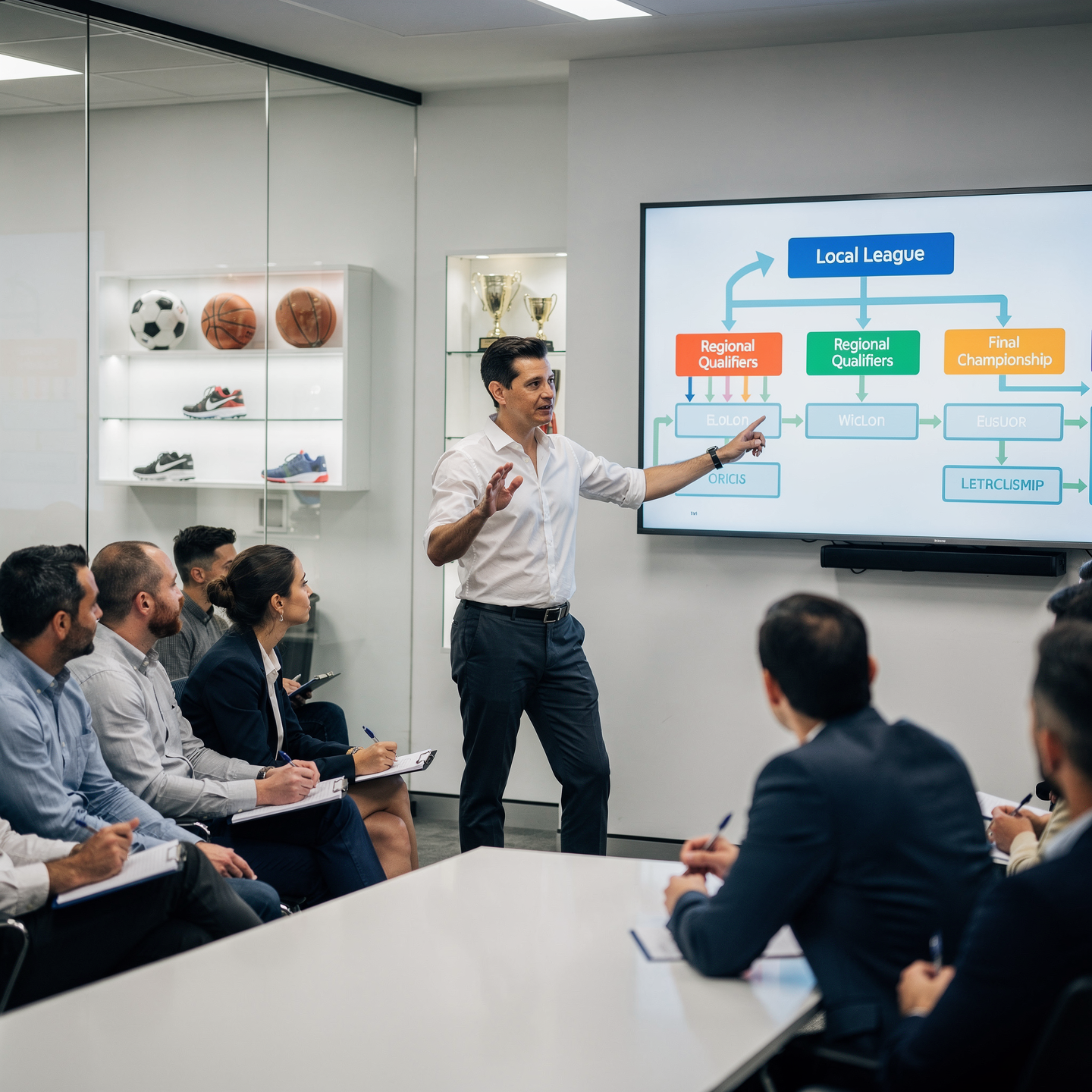
Course on the Organization of Local Championships

Why this course?

The Local Championship Organization

This course is designed to give you the tools and knowledge needed to manage successful sporting events from planning to execution. You will learn how to optimize resources, comply with regulations, and deliver memorable experiences for participants. This program covers the entire championship lifecycle, including budget creation, registration management, team coordination, and effective promotion.

Differential Advantages

  • Strategic Planning: Defining objectives, designing the event, and selecting suitable venues.
  • Resource Management: Optimizing budgets, negotiating with suppliers, and controlling expenses.
  • Marketing and Promotion: Creating effective campaigns, using social media, and public relations.
  • Impeccable Logistics: Coordinating volunteers, managing registrations, and providing participant support.
  • Regulatory Compliance: Knowledge of local regulations, event security, and risk management.
Organización

Course on the Organization of Local Championships

Availability: 1 in stock

Who is it aimed at?

  • Sports club and neighborhood association leaders who want to organize successful competitions and foster community participation.
  • Sports and recreation management students who need to acquire practical knowledge in planning, logistics, and promotion of sporting events.
  • Sports entrepreneurs interested in creating and managing local championships as a sustainable business model.
  • Physical education teachers and coaches who want to implement school and community tournaments to promote physical activity and sport.
  • Volunteers and sports event collaborators who want to deepen their skills in organizing and managing competitions.

Learning flexibility
Ā Adapted to your pace: Downloadable materials, asynchronous discussion forums, and practical examples to apply what you’ve learned in your local context.

Organización

Objectives and competencies

Maximize community participation and enjoyment:

To promote inclusive events and activities, fostering collaboration and feedback to continuously improve the community experience.

To promote the development and competitiveness of local athletes:

“Implement high-performance training programs and provide access to specialized resources (nutrition, physiotherapy, sports psychology) to optimize the potential of each athlete.”

Generate economic opportunities for the local sports sector:

Promote sports tourism and large-scale events by attracting investment and visibility for the region.

Ensure transparency and fairness in all competitions:

“Implement objective and auditable evaluation and arbitration protocols, based on clear and pre-established rules, with fair and transparent appeal mechanisms.”

Boosting the visibility and prestige of local sport:

Organize attractive sporting events and promote them effectively in local media and social networks.

Optimize resource management for long-term sustainability:

“Implement energy efficiency and responsible consumption strategies, prioritizing renewable sources and minimizing waste.”

Curriculum - Modules

  1. Comprehensive Maritime Incident Management: protocols, roles, and chain of command for coordinated response
  2. Operational Planning and Execution: briefing, routes, weather windows, and go/no-go criteria
  3. Rapid Risk Assessment: criticality matrix, scene control, and decision-making under pressure
  4. Operational Communication: VHF/GMDSS, standardized reports, and inter-agency liaison
  5. Tactical Mobility and Safe Boarding: RHIB maneuvers, approach, mooring, and recovery
  6. Equipment and Technologies: PPE, signaling, satellite tracking, and field data logging
  7. Immediate Care of the Affected: primary assessment, hypothermia, trauma, and stabilization for evacuation
  8. Adverse Environmental Conditions: swell, Visibility, flows, and operational mitigation

    Simulation and training: critical scenarios, use of VR/AR, and exercises with performance metrics

    Documentation and continuous improvement: lessons learned, indicators (MTTA/MTTR), and SOP updates

  1. Introduction to Sports Event Management: Types, Characteristics, and Trends
  2. Legal and Regulatory Framework: Permits, Licenses, Insurance, and Security
  3. Strategic Planning: Objectives, Scope, Target Audience, and Budget
  4. Event Design: Format, Program, Complementary Activities, and Participant Experience
  5. Marketing and Communication: Promotion Strategies, Social Media, Public Relations, and Advertising
  6. Human Resources Management: Volunteers, Technical Staff, Security, and Logistics
  7. Logistics and Operations: Venues, Transportation, Accommodation, Catering, and Equipment
  8. Risk Management: Identification, Assessment, and Contingency Plans
  9. Post-Event Evaluation and Analysis: Indicators of Success, participant feedback, and ROI

    Sustainability and legacy: Social, economic, and environmental impact of the event

  1. Introduction to Championship Management: Types, Scope, and Stakeholders.
  2. Phases of a Championship Lifecycle: Conception, Planning, Execution, Evaluation, and Closure.
  3. Legal and Regulatory Framework: Federations, Sports Regulations, Insurance, and Licenses.
  4. Organizational Structure: Roles, Responsibilities, and Committees (Organizing, Technical, Disciplinary).
  5. Budget and Financing: Preparation, Revenue Management (Registrations, Sponsorships), and Expense Control.
  6. Marketing and Communication: Promotion Strategies, Public Relations, and Image Management.
  7. Volunteer Management: Recruitment, Training, Task Assignment, and Recognition.
  8. Event Logistics: Venues, Equipment, Transportation, Accommodation, and Catering.
  9. Safety and Emergencies: Risk planning, action protocols, and first aid.
  10. Post-Championship Evaluation: Analysis of results, participant satisfaction, and lessons learned.

  1. Introduction to Sports Event Management: Types, Characteristics, and Trends
  2. Legal and Regulatory Framework: Permits, Licenses, Insurance, and Responsibilities
  3. Strategic Event Planning: Objectives, Scope, Budget, and Timeline
  4. Human Resources Management: Volunteering, Contracted Staff, and Key Roles
  5. Infrastructure Logistics: Venues, Equipment, Setup, and Dismantling
  6. Supplier and Sponsorship Management: Negotiation, Contracts, and Compensation
  7. Safety and Emergencies: Contingency Plans, First Aid, and Coordination
  8. Communication and Marketing: Promotion, Public Relations, and Image Management
  9. Registration and Participant Management: Online platforms, accreditations, and services.
  10. Post-Event Evaluation and Analysis: Results, impact, and future improvements.

  1. Introduction to Sports Championship Management: Overview and Trends
  2. Legal and Regulatory Framework: Federations, Regulations, and Security
  3. Event Design: Concept, Format, Calendar, and Phases
  4. Infrastructure Planning: Venues, Facilities, and Equipment
  5. Human Resource Management: Volunteers, Staff, and Technical Personnel
  6. Marketing and Communication Strategies: Promotion, Image, and Public Relations
  7. Budget and Financing: Revenue Streams, Sponsorship, and Cost Control
  8. Logistics Management: Transportation, Accommodation, Catering, and Accreditations
  9. Risk and Security Management: Emergency Plans and Protocols sanitary facilities
  10. Evaluation and closing of the championship: analysis of results and lessons learned

  1. System Architecture and Components: Structural design, materials, and subsystems (mechanical, electrical, electronic, and fluid) with selection and assembly criteria for marine environments
  2. Fundamentals and Principles of Operation: Physical and engineering foundations (thermodynamics, fluid mechanics, electricity, control, and materials) that explain performance and operating limits
  3. Safety and Environmental (SHE): Risk analysis, PPE, LOTO, hazardous atmospheres, spill and waste management, and emergency response plans
  4. Applicable Regulations and Standards: IMO/ISO/IEC requirements and local regulations;
  5. Conformance criteria, certification, and best practices for operation and maintenance
  6. Inspection, testing, and diagnostics: Visual/dimensional inspection, functional testing, data analysis, and predictive techniques (vibration, thermography, fluid analysis) to identify root causes
  7. Preventive and predictive maintenance: Hourly/cycle/seasonal plans, lubrication, adjustments, calibrations, consumable replacement, post-service verification, and operational reliability
  8. Instrumentation, tools, and metrology: Measuring and testing equipment, diagnostic software, calibration and traceability; selection criteria, safe use, and storage
  9. Onboard integration and interfaces: Mechanical, electrical, fluid, and data compatibility; Sealing and watertightness, EMC/EMI, corrosion protection, and interoperability testing.

    Quality, acceptance testing, and commissioning: process and materials control, FAT/SAT, bench and sea trials, go/no-go criteria, and evidence documentation.

    Technical documentation and integrated practice: logs, checklists, reports, and a complete case study (safety → diagnosis → intervention → verification → report) applicable to any system.

Plan de estudio - Módulos

  1. Comprehensive Maritime Incident Management: protocols, roles, and chain of command for coordinated response
  2. Operational Planning and Execution: briefing, routes, weather windows, and go/no-go criteria
  3. Rapid Risk Assessment: criticality matrix, scene control, and decision-making under pressure
  4. Operational Communication: VHF/GMDSS, standardized reports, and inter-agency liaison
  5. Tactical Mobility and Safe Boarding: RHIB maneuvers, approach, mooring, and recovery
  6. Equipment and Technologies: PPE, signaling, satellite tracking, and field data logging
  7. Immediate Care of the Affected: primary assessment, hypothermia, trauma, and stabilization for evacuation
  8. Adverse Environmental Conditions: swell, Visibility, flows, and operational mitigation

    Simulation and training: critical scenarios, use of VR/AR, and exercises with performance metrics

    Documentation and continuous improvement: lessons learned, indicators (MTTA/MTTR), and SOP updates

  1. Introduction to Sports Event Management: Types, Characteristics, and Trends
  2. Legal and Regulatory Framework: Permits, Licenses, Insurance, and Security
  3. Strategic Planning: Objectives, Scope, Target Audience, and Budget
  4. Event Design: Format, Program, Complementary Activities, and Participant Experience
  5. Marketing and Communication: Promotion Strategies, Social Media, Public Relations, and Advertising
  6. Human Resources Management: Volunteers, Technical Staff, Security, and Logistics
  7. Logistics and Operations: Venues, Transportation, Accommodation, Catering, and Equipment
  8. Risk Management: Identification, Assessment, and Contingency Plans
  9. Post-Event Evaluation and Analysis: Indicators of Success, participant feedback, and ROI

    Sustainability and legacy: Social, economic, and environmental impact of the event

  1. Introduction to Championship Management: Types, Scope, and Stakeholders.
  2. Phases of a Championship Lifecycle: Conception, Planning, Execution, Evaluation, and Closure.
  3. Legal and Regulatory Framework: Federations, Sports Regulations, Insurance, and Licenses.
  4. Organizational Structure: Roles, Responsibilities, and Committees (Organizing, Technical, Disciplinary).
  5. Budget and Financing: Preparation, Revenue Management (Registrations, Sponsorships), and Expense Control.
  6. Marketing and Communication: Promotion Strategies, Public Relations, and Image Management.
  7. Volunteer Management: Recruitment, Training, Task Assignment, and Recognition.
  8. Event Logistics: Venues, Equipment, Transportation, Accommodation, and Catering.
  9. Safety and Emergencies: Risk planning, action protocols, and first aid.
  10. Post-Championship Evaluation: Analysis of results, participant satisfaction, and lessons learned.

  1. Introduction to Sports Event Management: Types, Characteristics, and Trends
  2. Legal and Regulatory Framework: Permits, Licenses, Insurance, and Responsibilities
  3. Strategic Event Planning: Objectives, Scope, Budget, and Timeline
  4. Human Resources Management: Volunteering, Contracted Staff, and Key Roles
  5. Infrastructure Logistics: Venues, Equipment, Setup, and Dismantling
  6. Supplier and Sponsorship Management: Negotiation, Contracts, and Compensation
  7. Safety and Emergencies: Contingency Plans, First Aid, and Coordination
  8. Communication and Marketing: Promotion, Public Relations, and Image Management
  9. Registration and Participant Management: Online platforms, accreditations, and services.
  10. Post-Event Evaluation and Analysis: Results, impact, and future improvements.

  1. Introduction to Sports Championship Management: Overview and Trends
  2. Legal and Regulatory Framework: Federations, Regulations, and Security
  3. Event Design: Concept, Format, Calendar, and Phases
  4. Infrastructure Planning: Venues, Facilities, and Equipment
  5. Human Resource Management: Volunteers, Staff, and Technical Personnel
  6. Marketing and Communication Strategies: Promotion, Image, and Public Relations
  7. Budget and Financing: Revenue Streams, Sponsorship, and Cost Control
  8. Logistics Management: Transportation, Accommodation, Catering, and Accreditations
  9. Risk and Security Management: Emergency Plans and Protocols sanitary facilities
  10. Evaluation and closing of the championship: analysis of results and lessons learned

  1. System Architecture and Components: Structural design, materials, and subsystems (mechanical, electrical, electronic, and fluid) with selection and assembly criteria for marine environments
  2. Fundamentals and Principles of Operation: Physical and engineering foundations (thermodynamics, fluid mechanics, electricity, control, and materials) that explain performance and operating limits
  3. Safety and Environmental (SHE): Risk analysis, PPE, LOTO, hazardous atmospheres, spill and waste management, and emergency response plans
  4. Applicable Regulations and Standards: IMO/ISO/IEC requirements and local regulations;
  5. Conformance criteria, certification, and best practices for operation and maintenance
  6. Inspection, testing, and diagnostics: Visual/dimensional inspection, functional testing, data analysis, and predictive techniques (vibration, thermography, fluid analysis) to identify root causes
  7. Preventive and predictive maintenance: Hourly/cycle/seasonal plans, lubrication, adjustments, calibrations, consumable replacement, post-service verification, and operational reliability
  8. Instrumentation, tools, and metrology: Measuring and testing equipment, diagnostic software, calibration and traceability; selection criteria, safe use, and storage
  9. Onboard integration and interfaces: Mechanical, electrical, fluid, and data compatibility; Sealing and watertightness, EMC/EMI, corrosion protection, and interoperability testing.

    Quality, acceptance testing, and commissioning: process and materials control, FAT/SAT, bench and sea trials, go/no-go criteria, and evidence documentation.

    Technical documentation and integrated practice: logs, checklists, reports, and a complete case study (safety → diagnosis → intervention → verification → report) applicable to any system.

  1. Introduction to Competition Management: Types, Scale, and Objectives
  2. Legal and Regulatory Framework: Sports Legislation, Insurance, and Permits
  3. Budget and Financing: Preparation, Control, and Sponsorship Acquisition
  4. Human Resources: Volunteering, Contracted Staff, and Training
  5. Logistical Planning: Venues, Transportation, Accommodation, and Catering
  6. Registration and Accreditation Management: Platforms, Processes, and Security
  7. Communication and Marketing: Online and Offline Strategies, Media Relations
  8. Risk and Safety Management: Emergency Plans, First Aid, and Civil Protection
  9. Post-Competition Evaluation: Analysis Results, Surveys, and Continuous Improvement
  10. Sustainability and Legacy of Competitions: Environmental and Social Impact

  1. Introduction to Sports Logistics: Concept, Importance, and Evolution
  2. Fundamentals of Sports Promotion: Marketing, Communication, and Advertising
  3. Management of Sports Events: Planning, Organization, and Control
  4. Types of Sports Events: Amateur, Professional, Local, National, and International
  5. Human Resources in Sports Events: Volunteers, Contracted Staff, and Suppliers
  6. Budgeting and Financing of Sports Events: Sources of Income and Expenses
  7. Sports Infrastructure and Equipment: Selection, Rental, and Assembly
  8. Security in Sports Events: Emergency Plans, Access Control, and First Aid
  9. Transportation and Accommodation Logistics: Athletes, Teams, and Spectators
  10. Evaluation and Measurement of the Impact of Sports Events: Key Performance Indicators (KPIs)

  1. Introduction to sporting events: Types, characteristics, and current trends.
  2. Fundamentals of organizational structure: Roles, responsibilities, and organizational charts.
  3. Human resource management: Volunteering, contracted staff, and suppliers.
  4. Venue logistics: Space design, access, security, and services.
  5. Equipment and technology: Selection, acquisition, installation, and maintenance.
  6. Transportation and accommodation planning: Management of transfers, hotels, and meals.
  7. Sports promotion and marketing: Communication strategies, advertising, and public relations.
  8. Sponsorship management: Searching for, negotiating, and activating commercial agreements.
  9. Sales Ticketing and accreditation management: Ticketing systems, access control, and protocol.
  10. Post-event evaluation and analysis: Measuring results, reporting, and continuous improvement.

  1. Fundamentals of Sports Structure: Types of organizations, governance, and management models.
  2. Sports Marketing: Marketing strategies, branding, sponsorship, and image management.
  3. Human Resources Management in Sport: Selection, training, motivation, and team leadership.
  4. Logistics of Sporting Events: Planning, organization, coordination, and control of events.
  5. Sports Communication: Media relations, communication strategies, and crisis management.
  6. Sports Law: Legal framework, contracts, image rights, and civil liability.
  7. Sports Finance: Budgets, accounting, financing, and profitability.
  8. New Technologies in Sport: Use of digital tools for the Management, training, and dissemination.

    Sports Dissemination: Platforms, communication channels, social media, and multimedia content.

    Ethics and Values ​​in Sport: Fair play, social responsibility, and sustainability.

Career opportunities

  • Local Sports Event Manager: Planning, organizing, and executing championships.
  • Competition Coordinator: Managing registrations, schedules, and event logistics.
  • Sports Marketing Manager: Promoting and advertising championships.
  • Sports Facility Manager: Managing spaces and resources for events.
  • Sports Federation Technician: Supporting the organization of official competitions.
  • Sports Volunteer: Assisting in the organization and development of championships.
  • Competition Referee/Judge: Ensuring compliance with rules and regulations.
  • Communications and Press Officer: Disseminating results and news about the championships.

“`

Admission requirements

Academic/professional profile:

Degree/Bachelor's degree in Nautical Science/Maritime Transport, Naval/Marine Engineering, or a related field; or proven professional experience in bridge/operations.

Language proficiency:

Recommended functional maritime English (SMCP) for simulations and technical materials.

5. Induction

Updated resume, copy of degree or seaman's book, ID card/passport, letter of motivation.

Technical requirements (for online):

Equipment with camera/microphone, stable connection, ≄ 24ā€ monitor recommended for ECDIS/Radar-ARPA.

Admission process and dates

1. Online
application

(form + documents).

2. Academic review and interview

(profile/objectives/schedule compatibility).

3. Admission decision

(+ scholarship proposal if applicable).

4. Reservation of place

(deposit) and registration.

5. Induction

(access to campus, calendars, simulator guides).

Scholarships and grants

  • Comprehensive Planning: Master the creation of championships from conception to successful execution.
  • Efficient Management: Learn to optimize resources, manage budgets, and coordinate work teams.
  • Marketing and Promotion: Attract participants and audiences through effective marketing strategies and impactful advertising campaigns.
  • Regulations and Refereeing: Delve into the development of clear regulations and the impartial handling of conflict situations.
  • Digital Tools: Use platforms and software for managing registrations, results, and real-time communication.
Boost local sports and develop your skills in organizing high-level events.

Testimonials

Frequently asked questions

Promote sports competition and recreation in the community.

Yes. The itinerary includes ECDIS/Radar-ARPA/BRM with harbor, ocean, fog, storm, and SAR scenarios.

Online with live sessions; hybrid option for simulator/practical placements through agreements.

To promote healthy competition and sports development in the community.

Recommended functional SMCP. We offer support materials for standard phraseology.

Yes, with a relevant degree or experience in maritime/port operations. The admissions interview will confirm suitability.

Optional (3–6 months) through Companies & Collaborations and the Alumni Network.

Simulator practice (rubrics), defeat plans, SOPs, checklists, micro-tests and applied TFM.

A degree from Navalis Magna University + operational portfolio (tracks, SOPs, reports and KPIs) useful for audits and employment.

  1. Fundamentals of Sports Structure: Types of organizations, governance, and management models.
  2. Sports Marketing: Marketing strategies, branding, sponsorship, and image management.
  3. Human Resources Management in Sport: Selection, training, motivation, and team leadership.
  4. Logistics of Sporting Events: Planning, organization, coordination, and control of events.
  5. Sports Communication: Media relations, communication strategies, and crisis management.
  6. Sports Law: Legal framework, contracts, image rights, and civil liability.
  7. Sports Finance: Budgets, accounting, financing, and profitability.
  8. New Technologies in Sport: Use of digital tools for the Management, training, and dissemination.

    Sports Dissemination: Platforms, communication channels, social media, and multimedia content.

    Ethics and Values ​​in Sport: Fair play, social responsibility, and sustainability.

Request information

  1. Complete the Application Form
  2. Attach your CV/Qualifications (if you have them to hand).
  3. Indicate your preferred cohort (January/May/September) and whether you want the hybrid option with simulator sessions.
An academic advisor will contact you within 24–48 hours to guide you through the admission process, scholarships, and compatibility with your professional schedule. Translated with DeepL.com (free version)
Please enable JavaScript in your browser to complete this form.
Click or drag a file to this area to upload.

Teachers

0
    0
    Tu carrito
    Tu carrito esta vacĆ­oRegresar a la tienda
    Scroll to Top


