Team Rowing Techniques Course
Why this course?
The Team Rowing Techniques course
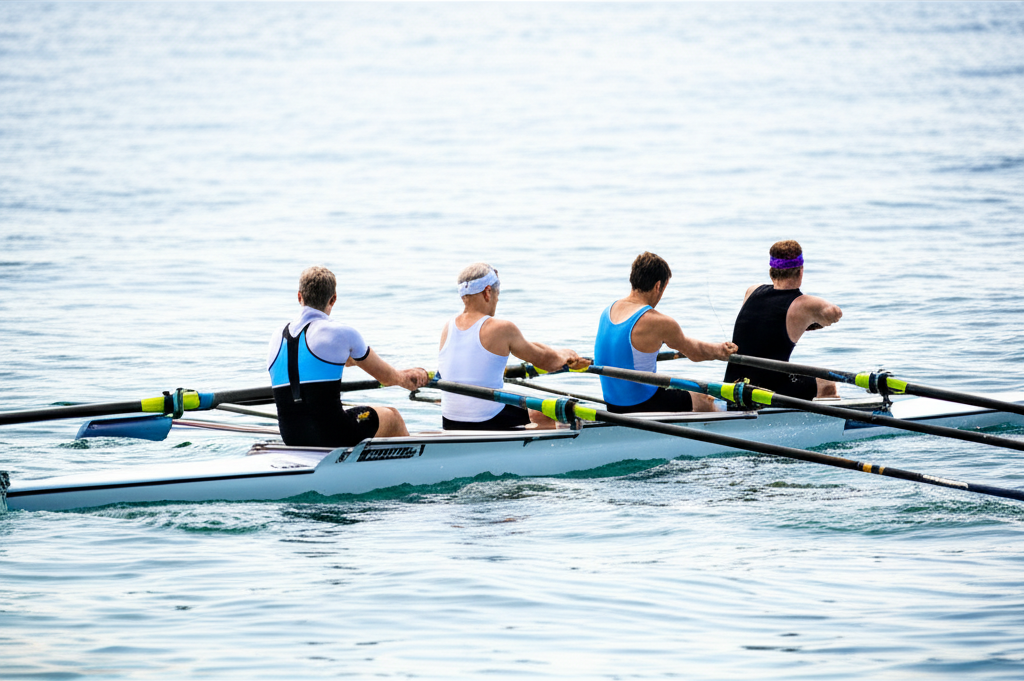
This course propels you toward synchronicity and efficiency with every stroke. Learn to optimize coordination with your team, mastering advanced propulsion techniques and rhythm and cadence strategies. Improve your communication and leadership within the boat, maximizing collective performance and achieving your goals. This course will provide you with the essential tools to become an exceptional team rower.
This course will help you achieve synchronicity and efficiency with every stroke.
Differential Advantages
- Video Analysis: Perfect your technique with personalized visual feedback.
- Competition Simulations: Experience the pressure and learn to stay calm under stress.
- Strategic Race Planning: Master the art of tactics to outmaneuver your opponents.
- Specific Physical Preparation: Strengthen your body for optimal rowing performance.
- Training in Different Water Types: Adapt your technique to any condition.
- Modality: Online
- Level: Cursos
- Hours: 150 H
- Start date: 25-04-2026
Availability: 1 in stock
Who is it aimed at?
- Intermediate and advanced rowers looking to optimize their technique, synchronization, and team power.
- Rowing coaches who want to incorporate new teaching methodologies, drills, and strategies to improve their teams’ performance.
- Team captains and leaders interested in strengthening group cohesion, communication, and effectiveness through rowing.
- Rowing enthusiasts looking to transition from individual rowing to team rowing, learning the fundamentals and dynamics of the discipline.
- Fitness instructors and personal trainers who want to expand their knowledge and integrate team rowing into their training programs.
Flexibility of Learning
Adaptable to your pace: theoretical and practical modules, progressive exercises and personalized follow-up by expert instructors.
Objectives and competencies

Synchronize movements to maximize efficiency:
Anticipate, plan and execute coordinated maneuvers, considering environmental factors, vessel dynamics and effective communications with the team.

Coordinate individual power to propel the vessel:
Optimize the use of propellers and rudders, anticipating the effects of wind and current, for efficient and safe maneuvers.

Adapt the pace to the changing water conditions:
“Anticipating risks, optimizing navigation speed and fuel consumption, prioritizing the safety and stability of the vessel.”

Maintaining team cohesion under pressure:
“Communicate clearly, listen actively, and resolve conflicts by prioritizing safety and the common goal.”
Communicate effectively to adjust the technique in real time:
“Adapt the message to the audience (crew, passengers, authorities) and the context (emergency, routine maneuver), prioritizing clarity and conciseness.”
Optimize body posture to prevent injuries:
“Implementing postural hygiene, ergonomics, and body awareness techniques to maintain optimal alignment and reduce tension in muscles and joints.”
Curriculum - Modules
- Comprehensive Maritime Incident Management: protocols, roles, and chain of command for coordinated response
- Operational Planning and Execution: briefing, routes, weather windows, and go/no-go criteria
- Rapid Risk Assessment: criticality matrix, scene control, and decision-making under pressure
- Operational Communication: VHF/GMDSS, standardized reports, and inter-agency liaison
- Tactical Mobility and Safe Boarding: RHIB maneuvers, approach, mooring, and recovery
- Equipment and Technologies: PPE, signaling, satellite tracking, and field data logging
- Immediate Care of the Affected: primary assessment, hypothermia, trauma, and stabilization for evacuation
- Adverse Environmental Conditions: swell, Visibility, flows, and operational mitigation
Simulation and training: critical scenarios, use of VR/AR, and exercises with performance metrics
Documentation and continuous improvement: lessons learned, indicators (MTTA/MTTR), and SOP updates
- Introduction to Competitive Rowing: History, Evolution, and Disciplines
- Rowing Biomechanics: Phases of the Stroke Cycle, Angles, and Levers
- Rowing Technique: Catch, Entry, Drag, Finish, and Recovery
- Synchronization: Coordination in the Boat, Rhythms, and Cadences
- Power: Developing Strength, Endurance, and Explosiveness
- Race Strategy: Pace, Changes of Pace, and Effort Management
- Physical Training: Strength, Cardio, Flexibility, and Injury Prevention
- Technical Training: Drills, Simulation, and Video Analysis
- Mental Preparation: Concentration, Visualization, and Stress Management
- Nutrition and hydration for optimal rowing performance
‘
- Introduction to Coordinated Rowing: History, Benefits, and Disciplines
- Individual Technique: Position, Grip, Efficient Rowing, and Recovery
- Basic Synchronization: Rhythm, Cadence, and Visual Synchronization
- In-Boat Communication: Commands, Signals, and Feedback
- Roles and Responsibilities: Coxswain, Bow, Midshipman, and Sternman
- Strength and Endurance Training: Specific Physical Preparation
- Race Strategies: Start, Cruising Pace, Sprint, and Finish
- Water Safety: Protocols, Emergencies, and First Aid
- Equipment Maintenance: Care of Oars, Boat, and Accessories
- Psychological Aspects: Concentration, Teamwork, and stress management
‘
- Introduction to team rowing: history, evolution, and benefits.
- Individual technical fundamentals: grip, position, stroke, recovery.
- Basic synchronization: rhythm, cadence, and timing of the rowing stroke.
- Roles and responsibilities: stroke, coxswain, different positions in the boat.
- Effective communication: verbal commands, visual and non-verbal cues.
- Strength and endurance: rowing-specific exercises and their transfer to the boat.
- Basic racing strategies: start, cruising pace, final sprint.
- Safety on the water: emergency protocols, capsizing, and rescues.
- Equipment maintenance: care of oars, boat, and other equipment.
- Team Psychology: Cohesion, Trust, and Stress Management.
‘
- Definition of Synergy: Key elements and benefits in collaboration.
- Effective Communication Models: Active listening, constructive feedback, and nonverbal communication.
- Negotiation Strategies: Preparation, identifying common interests, and conflict resolution.
- Managing High-Performance Teams: Roles, responsibilities, and group dynamics.
- Emotional Intelligence: Self-awareness, self-regulation, motivation, empathy, and social skills.
- Collaborative Leadership: Influence, delegation, empowerment, and talent development.
- Collaborative Project Management: Planning, execution, monitoring, and control of team projects.
- Group Decision-Making: Methods, techniques, and tools for decision-making joint.
- Creative Problem Solving: Brainstorming techniques, lateral thinking, and innovative solution design.
- Evaluation and Continuous Improvement: Performance indicators, results analysis, and action plans.
‘
- System Architecture and Components: Structural design, materials, and subsystems (mechanical, electrical, electronic, and fluid) with selection and assembly criteria for marine environments
- Fundamentals and Principles of Operation: Physical and engineering foundations (thermodynamics, fluid mechanics, electricity, control, and materials) that explain performance and operating limits
- Safety and Environmental (SHE): Risk analysis, PPE, LOTO, hazardous atmospheres, spill and waste management, and emergency response plans
- Applicable Regulations and Standards: IMO/ISO/IEC requirements and local regulations;
- Conformance criteria, certification, and best practices for operation and maintenance
- Inspection, testing, and diagnostics: Visual/dimensional inspection, functional testing, data analysis, and predictive techniques (vibration, thermography, fluid analysis) to identify root causes
- Preventive and predictive maintenance: Hourly/cycle/seasonal plans, lubrication, adjustments, calibrations, consumable replacement, post-service verification, and operational reliability
- Instrumentation, tools, and metrology: Measuring and testing equipment, diagnostic software, calibration and traceability; selection criteria, safe use, and storage
- Onboard integration and interfaces: Mechanical, electrical, fluid, and data compatibility; Sealing and watertightness, EMC/EMI, corrosion protection, and interoperability testing.
Quality, acceptance testing, and commissioning: process and materials control, FAT/SAT, bench and sea trials, go/no-go criteria, and evidence documentation.
Technical documentation and integrated practice: logs, checklists, reports, and a complete case study (safety → diagnosis → intervention → verification → report) applicable to any system.
Plan de estudio - Módulos
- Comprehensive Maritime Incident Management: protocols, roles, and chain of command for coordinated response
- Operational Planning and Execution: briefing, routes, weather windows, and go/no-go criteria
- Rapid Risk Assessment: criticality matrix, scene control, and decision-making under pressure
- Operational Communication: VHF/GMDSS, standardized reports, and inter-agency liaison
- Tactical Mobility and Safe Boarding: RHIB maneuvers, approach, mooring, and recovery
- Equipment and Technologies: PPE, signaling, satellite tracking, and field data logging
- Immediate Care of the Affected: primary assessment, hypothermia, trauma, and stabilization for evacuation
- Adverse Environmental Conditions: swell, Visibility, flows, and operational mitigation
Simulation and training: critical scenarios, use of VR/AR, and exercises with performance metrics
Documentation and continuous improvement: lessons learned, indicators (MTTA/MTTR), and SOP updates
- Introduction to Competitive Rowing: History, Evolution, and Disciplines
- Rowing Biomechanics: Phases of the Stroke Cycle, Angles, and Levers
- Rowing Technique: Catch, Entry, Drag, Finish, and Recovery
- Synchronization: Coordination in the Boat, Rhythms, and Cadences
- Power: Developing Strength, Endurance, and Explosiveness
- Race Strategy: Pace, Changes of Pace, and Effort Management
- Physical Training: Strength, Cardio, Flexibility, and Injury Prevention
- Technical Training: Drills, Simulation, and Video Analysis
- Mental Preparation: Concentration, Visualization, and Stress Management
- Nutrition and hydration for optimal rowing performance
‘
- Introduction to Coordinated Rowing: History, Benefits, and Disciplines
- Individual Technique: Position, Grip, Efficient Rowing, and Recovery
- Basic Synchronization: Rhythm, Cadence, and Visual Synchronization
- In-Boat Communication: Commands, Signals, and Feedback
- Roles and Responsibilities: Coxswain, Bow, Midshipman, and Sternman
- Strength and Endurance Training: Specific Physical Preparation
- Race Strategies: Start, Cruising Pace, Sprint, and Finish
- Water Safety: Protocols, Emergencies, and First Aid
- Equipment Maintenance: Care of Oars, Boat, and Accessories
- Psychological Aspects: Concentration, Teamwork, and stress management
‘
- Introduction to team rowing: history, evolution, and benefits.
- Individual technical fundamentals: grip, position, stroke, recovery.
- Basic synchronization: rhythm, cadence, and timing of the rowing stroke.
- Roles and responsibilities: stroke, coxswain, different positions in the boat.
- Effective communication: verbal commands, visual and non-verbal cues.
- Strength and endurance: rowing-specific exercises and their transfer to the boat.
- Basic racing strategies: start, cruising pace, final sprint.
- Safety on the water: emergency protocols, capsizing, and rescues.
- Equipment maintenance: care of oars, boat, and other equipment.
- Team Psychology: Cohesion, Trust, and Stress Management.
‘
- Definition of Synergy: Key elements and benefits in collaboration.
- Effective Communication Models: Active listening, constructive feedback, and nonverbal communication.
- Negotiation Strategies: Preparation, identifying common interests, and conflict resolution.
- Managing High-Performance Teams: Roles, responsibilities, and group dynamics.
- Emotional Intelligence: Self-awareness, self-regulation, motivation, empathy, and social skills.
- Collaborative Leadership: Influence, delegation, empowerment, and talent development.
- Collaborative Project Management: Planning, execution, monitoring, and control of team projects.
- Group Decision-Making: Methods, techniques, and tools for decision-making joint.
- Creative Problem Solving: Brainstorming techniques, lateral thinking, and innovative solution design.
- Evaluation and Continuous Improvement: Performance indicators, results analysis, and action plans.
‘
- System Architecture and Components: Structural design, materials, and subsystems (mechanical, electrical, electronic, and fluid) with selection and assembly criteria for marine environments
- Fundamentals and Principles of Operation: Physical and engineering foundations (thermodynamics, fluid mechanics, electricity, control, and materials) that explain performance and operating limits
- Safety and Environmental (SHE): Risk analysis, PPE, LOTO, hazardous atmospheres, spill and waste management, and emergency response plans
- Applicable Regulations and Standards: IMO/ISO/IEC requirements and local regulations;
- Conformance criteria, certification, and best practices for operation and maintenance
- Inspection, testing, and diagnostics: Visual/dimensional inspection, functional testing, data analysis, and predictive techniques (vibration, thermography, fluid analysis) to identify root causes
- Preventive and predictive maintenance: Hourly/cycle/seasonal plans, lubrication, adjustments, calibrations, consumable replacement, post-service verification, and operational reliability
- Instrumentation, tools, and metrology: Measuring and testing equipment, diagnostic software, calibration and traceability; selection criteria, safe use, and storage
- Onboard integration and interfaces: Mechanical, electrical, fluid, and data compatibility; Sealing and watertightness, EMC/EMI, corrosion protection, and interoperability testing.
Quality, acceptance testing, and commissioning: process and materials control, FAT/SAT, bench and sea trials, go/no-go criteria, and evidence documentation.
Technical documentation and integrated practice: logs, checklists, reports, and a complete case study (safety → diagnosis → intervention → verification → report) applicable to any system.
- Introduction to team rowing: history, benefits, and fundamentals.
- The boat and equipment: Types of boats, oars, seats, and adjustment.
- Individual technique: Catch, stroke, recovery, and preparation phases.
- Synchronization: Rhythm, cadence, stroke length, and coordination.
- Power: Use of legs, torso, and arms; Energy transfer.
Racing strategies: Start, cruising pace, sprint, and finish.
Team communication: Commands, signals, and feedback.
Roles and responsibilities: Bow, center, stern, and helmsman/coach.
Adjustment and adaptation: Error correction, continuous improvement, and tactical flexibility.
Water safety: Rules, accident prevention, and first aid.
‘
- Fundamentals of team rowing: History, evolution, and styles.
- Biomechanics of rowing: Movement analysis, efficiency, and ergonomics.
- Equipment selection and adjustment: Boats, oars, seats, and accessories.
- Advanced synchronization techniques: Rhythm, cadence, and coordination.
- Training strategies: Planning, periodization, and recovery.
- Development of strength and endurance: Specific and complementary exercises.
- Team communication and leadership: Roles, responsibilities, and dynamics.
- Competition tactics and strategy: Opponent analysis, race planning.
- Injury Prevention: Warm-up, stretching, and posture.
- Nutrition and Hydration for optimal rowing performance.
‘
- Fundamentals of team rowing: synchronization, power, and strategy.
- Individual technique: posture, grip, efficient paddling, and recovery.
- Synchronization: coordination, rhythm, cadence, and adjusting to the boat’s pace.
- Phases of team rowing: start, cruising pace, final sprint.
- Race strategy: course analysis, competitor analysis, and conditions analysis.
- Communication in the boat: instructions from the coxswain, feedback between rowers.
- Roles and responsibilities: coxswain, bow, middle, and stern.
- Technical and tactical adjustments during the race: reacting to unexpected events, changes of pace.
- Physical and mental training for team rowing: endurance, strength, concentration.
- Water safety: emergency, rescue, and first aid protocols.
‘
- Introduction to Team Rowing: History, Benefits, and Modalities
- Individual Technical Fundamentals: Grip, Posture, Stroke (Drive, Recovery)
- Basic Synchronization: Timing, Stroke Length, Rhythm
- Roles in the Boat: Bow, Stern, Stroke, Functions, and Responsibilities
- Effective Communication: Commands, Visual Signals, and Feedback
- Safety on the Water: Rules, Equipment, Emergency Procedures
- Boat Adjustment: Rigging, Cleats, Oleton Height
- Basic Physical Training: Strength, Endurance, Flexibility
- Nutrition and Hydration for Rowing Performance
- Sports Ethics, Team Spirit, and Respect for the Environment
environment
‘
Career opportunities
- Team Rowing Coach: Design and implementation of training plans, development of technical and tactical skills.
- Water Sports Instructor: Instructor at rowing clubs and centers, guiding beginners and promoting safe practice of the sport.
- Professional or Amateur Rowing Team Member: Participation in competitions at the local, national, and international levels.
- Rowing Event Organizer: Planning and management of regattas, tournaments, and promotional activities.
- Rowing Equipment Consultant: Advising on the selection and maintenance of boats, oars, and other equipment.
- Adaptive Rowing Instructor: Adapting techniques and programs for people with disabilities.
- Active Tourism Guide on Rowing Boats: Offering experiences Tourist activities through rowing on rivers, lakes, or the sea.
- Volunteer in community rowing programs: Promoting the sport and its benefits to society.
“`
Admission requirements

Academic/professional profile:
Degree/Bachelor's degree in Nautical Science/Maritime Transport, Naval/Marine Engineering, or a related field; or proven professional experience in bridge/operations.

Language proficiency:
Recommended functional maritime English (SMCP) for simulations and technical materials.

5. Induction
Updated resume, copy of degree or seaman's book, ID card/passport, letter of motivation.

Technical requirements (for online):
Equipment with camera/microphone, stable connection, ≥ 24” monitor recommended for ECDIS/Radar-ARPA.
Admission process and dates

1. Online
application
(form + documents).

2. Academic review and interview
(profile/objectives/schedule compatibility).

3. Admission decision
(+ scholarship proposal if applicable).

4. Reservation of place
(deposit) and registration.

5. Induction
(access to campus, calendars, simulator guides).
Scholarships and grants
- Perfect Synchronization: Master the techniques to row in unison and maximize team efficiency.
- Power and Rhythm: Learn to optimize your strength and maintain a consistent rhythm for superior performance.
- Effective Communication: Develop crucial communication skills for coordination and success on the water.
- Advanced Strategies: Discover tactics to adapt to different conditions and outperform the competition.
- Rowing Safety: Learn the essential safety measures for safe training and competition.
Testimonials
“Thanks to the Team Rowing Techniques course, our synchronization improved significantly. We managed to reduce our 2000-meter time by 12 seconds, which allowed us to win the regional regatta and qualify for the national championships. The understanding of technique and team dynamics that we gained in the course was fundamental to our success.”
Mastering advanced kitesurfing techniques during the Advanced Water Sports course allowed me to ride with greater precision and control, even in challenging conditions. Expert instruction helped me refine my jumps and maneuvers, taking me to a new level of skill in the sport.
“Thanks to this training, our team synchronized their strokes and improved efficiency with each stroke. We managed to reduce our time in the 2000-meter race by 12 seconds, which allowed us to achieve first place in the regional competition.”
“Thanks to the Team Rowing Techniques course, our synchronization improved significantly. We managed to reduce our 2000m time by 12 seconds, which allowed us to win the regional regatta and qualify for the national one.”

Frequently asked questions
Maximize the efficiency and power of the equipment.
Yes. The itinerary includes ECDIS/Radar-ARPA/BRM with harbor, ocean, fog, storm, and SAR scenarios.
Online with live sessions; hybrid option for simulator/practical placements through agreements.
Point row and couple row.
Recommended functional SMCP. We offer support materials for standard phraseology.
Yes, with a relevant degree or experience in maritime/port operations. The admissions interview will confirm suitability.
Optional (3–6 months) through Companies & Collaborations and the Alumni Network.
Simulator practice (rubrics), defeat plans, SOPs, checklists, micro-tests and applied TFM.
A degree from Navalis Magna University + operational portfolio (tracks, SOPs, reports and KPIs) useful for audits and employment.
- Introduction to Team Rowing: History, Benefits, and Modalities
- Individual Technical Fundamentals: Grip, Posture, Stroke (Drive, Recovery)
- Basic Synchronization: Timing, Stroke Length, Rhythm
- Roles in the Boat: Bow, Stern, Stroke, Functions, and Responsibilities
- Effective Communication: Commands, Visual Signals, and Feedback
- Safety on the Water: Rules, Equipment, Emergency Procedures
- Boat Adjustment: Rigging, Cleats, Oleton Height
- Basic Physical Training: Strength, Endurance, Flexibility
- Nutrition and Hydration for Rowing Performance
- Sports Ethics, Team Spirit, and Respect for the Environment
environment
‘
Request information
- Complete the Application Form
- Attach your CV/Qualifications (if you have them to hand).
- Indicate your preferred cohort (January/May/September) and whether you want the hybrid option with simulator sessions.
Teachers
Eng. Tomás Riera
Full Professor
Eng. Tomás Riera
Full Professor
Eng. Sofía Marquina
Full Professor
Eng. Sofía Marquina
Full Professor
Eng. Javier Bañuls
Full Professor
Eng. Javier Bañuls
Full Professor
Dr. Nuria Llobregat
Full Professor
Dr. Nuria Llobregat
Full Professor
Dr. Pau Ferrer
Full Professor
Dr. Pau Ferrer
Full Professor
Cap. Javier Abaroa (MCA)
Full Professor
Cap. Javier Abaroa (MCA)
Full Professor