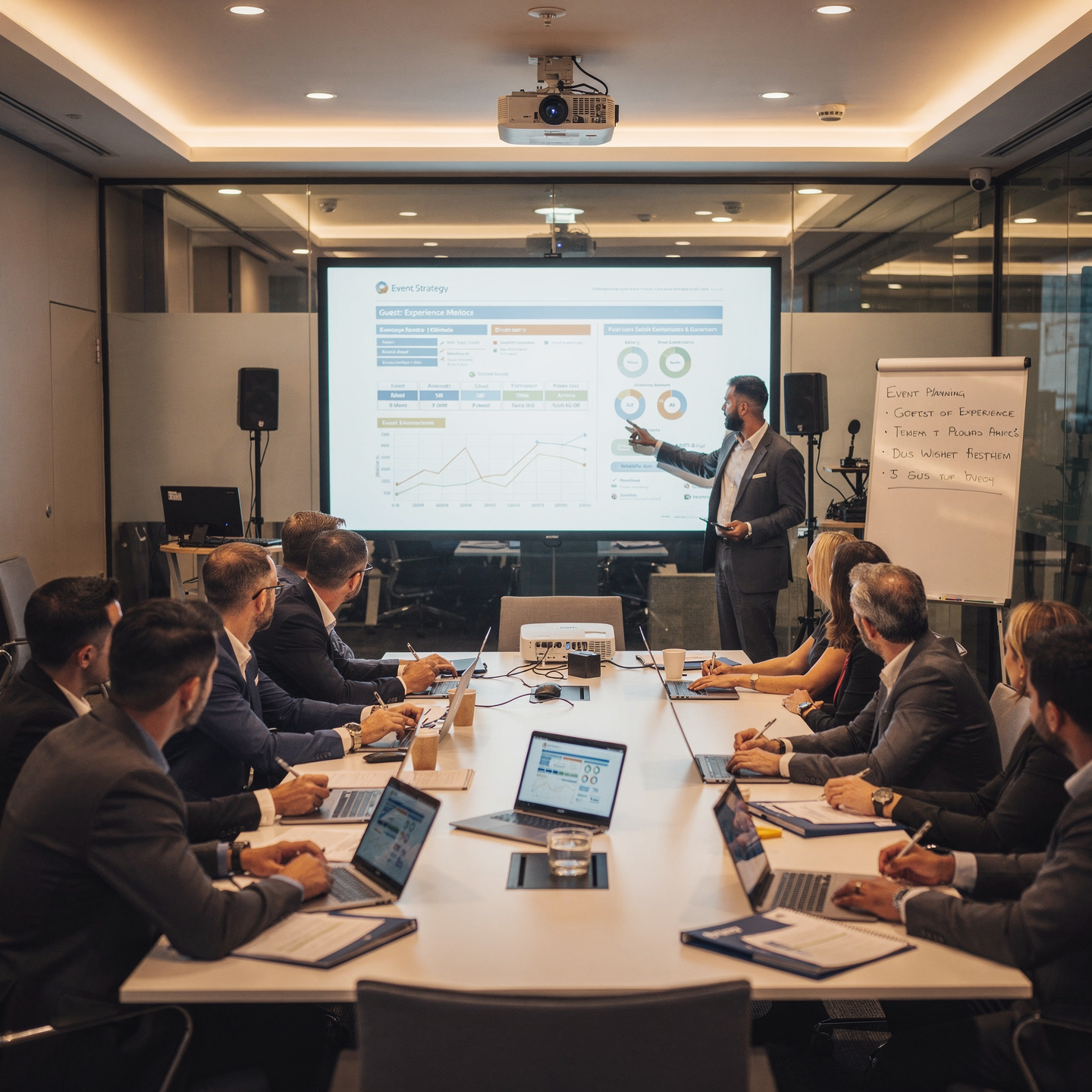
Corporate Event Organization Course
Why this course?
The Corporate Event Planning course
This course provides you with the key tools and strategies to create memorable and effective experiences. Learn everything from strategic planning to flawless execution, covering aspects such as venue selection, supplier management, program design, logistics, communication, and budget control. Master the techniques to attract, engage, and retain your audience, maximizing the impact of each event.
Corporate Event Planning
Differentiating Advantages
- Real-world case studies: analysis and resolution of common challenges in event organization.
- Professional networking: opportunities to connect with experts and colleagues in the sector.
- Downloadable tools and templates: ready-to-use resources for your own projects.
- Focus on innovation: latest trends in technology, sustainability, and event design.
- Professional certification: validates your knowledge and skills in corporate event organization.
- Modality: Online
- Level: Cursos
- Hours: 150 H
- Start date: 26-07-2026
Availability: 1 in stock
Who is it aimed at?
- Marketing and communications professionals looking to expand their skills in planning and executing impactful events.
- Freelance event organizers who want to professionalize their services, optimize budgets, and manage teams effectively.
- HR and administration managers who need to organize internal events to foster corporate culture and engagement.
- Entrepreneurs and business owners interested in generating leads and strengthening brand image through strategic events.
- Communications, marketing, or public relations students seeking practical training to enter the job market.
Flexibility and applicability
Designed for busy professionals: flexible online format, focused practical exercises and downloadable tools for immediate application.
Objectives and competencies

Becoming a master orchestrator of memorable experiences:
Design and execute immersive events, customizing every detail (environment, interaction, narrative) to evoke emotions and build lasting connections with the audience.

Mastering the art of flawless logistics and efficient supplier management:
“Optimize the supply chain with a strategic vision, from supplier selection to final delivery, ensuring profitability and customer satisfaction.”

Transform each event into a strategic opportunity to strengthen the brand and achieve business objectives:
“Maximize the ROI of each event through strategic alignment, impact measurement, and continuous optimization.”

Create events that generate impact and leave a lasting impression on attendees:
Design memorable, personalized experiences with an emotional narrative that connects with the audience’s values āāand encourages active participation.

Develop the ability to anticipate and solve problems with creativity and agility:
“Analyze complex situations, propose innovative and adaptive solutions, assess risks and optimize available resources.”

Elevating corporate event organization to a higher level of professionalism and innovation:
“Implement agile methodologies and state-of-the-art project management tools, fostering creativity and collaboration between teams to create memorable experiences and exceed attendees’ expectations.”
Curriculum - Modules
- Comprehensive Maritime Incident Management: protocols, roles, and chain of command for coordinated response
- Operational Planning and Execution: briefing, routes, weather windows, and go/no-go criteria
- Rapid Risk Assessment: criticality matrix, scene control, and decision-making under pressure
- Operational Communication: VHF/GMDSS, standardized reports, and inter-agency liaison
- Tactical Mobility and Safe Boarding: RHIB maneuvers, approach, mooring, and recovery
- Equipment and Technologies: PPE, signaling, satellite tracking, and field data logging
- Immediate Care of the Affected: primary assessment, hypothermia, trauma, and stabilization for evacuation
- Adverse Environmental Conditions: swell, Visibility, flows, and operational mitigation
Simulation and training: critical scenarios, use of VR/AR, and exercises with performance metrics
Documentation and continuous improvement: lessons learned, indicators (MTTA/MTTR), and SOP updates
- Fundamentals of Business Strategy: Vision, Mission, Values, and SWOT Analysis
- Marketing and Sales Strategies: Segmentation, Positioning, and Differentiation
- Integrated Logistics: Supply Chain, Inventory Management, and Transportation
- Value Chain Optimization: Identifying Bottlenecks and Continuous Improvement
- Basic Financial Analysis: Financial Statements, Ratios, and Cash Flow
- Introduction to ROI: Definition, Calculation, and Key Metrics
- Investment Planning: Budgets, Projections, and Scenarios
- ROI Analysis Tools: Software, Templates, and Dashboards
- Presenting Results: Reports, Charts, and Communication effective
- Success stories and lessons learned: Project analysis and best practices
‘
- Introduction to Protocol: Definition, Types, and Levels
- Event Organization: Phases, Roles, and Responsibilities
- Comprehensive Logistics: Transportation, Accommodation, Catering, and Security
- Communication Planning: Internal and External, Public Relations
- Risk Management: Identification, Assessment, and Mitigation
- Development of the Contingency Plan: Objectives, Scope, and Structure
- Response Teams: Functions, Training, and Coordination
- Drills and Tests: Design, Execution, and Evaluation
- Inter-institutional Coordination: Authorities, Emergency Services, and Volunteers
- Post-Event Analysis: Lessons Learned and Improvement continued
‘
- Introduction to Business Strategy: Key Concepts and Their Evolution
- Business Environment Analysis: PESTEL, Porter’s Five Forces, and Value Chain Analysis
- Strategy Formulation: Objectives, Mission, Vision, and Values
- Strategy Implementation: Action Plans, Resource Allocation, and KPIs
- Fundamentals of Business Logistics: Supply Chain Management and Process Optimization
- Warehousing and Distribution: Types of Warehouses, Inventory Management, and Transportation
- Purchasing and Procurement Management: Supplier Selection, Negotiation, and Contracts
- Reverse Logistics and Sustainability: Product Returns, Recycling, and Environmental Practices
- Introduction to Business Protocol: Rules of courtesy, precedence, and etiquette.
- Organization of Corporate Events: Planning, execution, and follow-up.
‘
- Introduction to Protocol: Definition, types, and its importance in business.
- Business Protocol: Protocol manuals, corporate image, and communication.
- Event Organization: Planning, types of events, and protocol for each.
- Customer Service: Effective communication techniques, handling complaints, and problem-solving.
- Customer Experience: Experience design, satisfaction measurement, and continuous improvement.
- Event Logistics: Suppliers, resource management, and team coordination.
- Travel Logistics: Reservations, transfers, and handling unforeseen circumstances.
- International Protocol: Cultural differences, greetings, and formal address.
- Netiquette and Online Protocol: Communication via email, videoconferencing, and social media.
- Customer experience management (CRM) tools and data analytics.
‘
- System Architecture and Components: Structural design, materials, and subsystems (mechanical, electrical, electronic, and fluid) with selection and assembly criteria for marine environments
- Fundamentals and Principles of Operation: Physical and engineering foundations (thermodynamics, fluid mechanics, electricity, control, and materials) that explain performance and operating limits
- Safety and Environmental (SHE): Risk analysis, PPE, LOTO, hazardous atmospheres, spill and waste management, and emergency response plans
- Applicable Regulations and Standards: IMO/ISO/IEC requirements and local regulations;
- Conformance criteria, certification, and best practices for operation and maintenance
- Inspection, testing, and diagnostics: Visual/dimensional inspection, functional testing, data analysis, and predictive techniques (vibration, thermography, fluid analysis) to identify root causes
- Preventive and predictive maintenance: Hourly/cycle/seasonal plans, lubrication, adjustments, calibrations, consumable replacement, post-service verification, and operational reliability
- Instrumentation, tools, and metrology: Measuring and testing equipment, diagnostic software, calibration and traceability; selection criteria, safe use, and storage
- Onboard integration and interfaces: Mechanical, electrical, fluid, and data compatibility; Sealing and watertightness, EMC/EMI, corrosion protection, and interoperability testing.
Quality, acceptance testing, and commissioning: process and materials control, FAT/SAT, bench and sea trials, go/no-go criteria, and evidence documentation.
Technical documentation and integrated practice: logs, checklists, reports, and a complete case study (safety ā diagnosis ā intervention ā verification ā report) applicable to any system.
Plan de estudio - Módulos
- Comprehensive Maritime Incident Management: protocols, roles, and chain of command for coordinated response
- Operational Planning and Execution: briefing, routes, weather windows, and go/no-go criteria
- Rapid Risk Assessment: criticality matrix, scene control, and decision-making under pressure
- Operational Communication: VHF/GMDSS, standardized reports, and inter-agency liaison
- Tactical Mobility and Safe Boarding: RHIB maneuvers, approach, mooring, and recovery
- Equipment and Technologies: PPE, signaling, satellite tracking, and field data logging
- Immediate Care of the Affected: primary assessment, hypothermia, trauma, and stabilization for evacuation
- Adverse Environmental Conditions: swell, Visibility, flows, and operational mitigation
Simulation and training: critical scenarios, use of VR/AR, and exercises with performance metrics
Documentation and continuous improvement: lessons learned, indicators (MTTA/MTTR), and SOP updates
- Fundamentals of Business Strategy: Vision, Mission, Values, and SWOT Analysis
- Marketing and Sales Strategies: Segmentation, Positioning, and Differentiation
- Integrated Logistics: Supply Chain, Inventory Management, and Transportation
- Value Chain Optimization: Identifying Bottlenecks and Continuous Improvement
- Basic Financial Analysis: Financial Statements, Ratios, and Cash Flow
- Introduction to ROI: Definition, Calculation, and Key Metrics
- Investment Planning: Budgets, Projections, and Scenarios
- ROI Analysis Tools: Software, Templates, and Dashboards
- Presenting Results: Reports, Charts, and Communication effective
- Success stories and lessons learned: Project analysis and best practices
‘
- Introduction to Protocol: Definition, Types, and Levels
- Event Organization: Phases, Roles, and Responsibilities
- Comprehensive Logistics: Transportation, Accommodation, Catering, and Security
- Communication Planning: Internal and External, Public Relations
- Risk Management: Identification, Assessment, and Mitigation
- Development of the Contingency Plan: Objectives, Scope, and Structure
- Response Teams: Functions, Training, and Coordination
- Drills and Tests: Design, Execution, and Evaluation
- Inter-institutional Coordination: Authorities, Emergency Services, and Volunteers
- Post-Event Analysis: Lessons Learned and Improvement continued
‘
- Introduction to Business Strategy: Key Concepts and Their Evolution
- Business Environment Analysis: PESTEL, Porter’s Five Forces, and Value Chain Analysis
- Strategy Formulation: Objectives, Mission, Vision, and Values
- Strategy Implementation: Action Plans, Resource Allocation, and KPIs
- Fundamentals of Business Logistics: Supply Chain Management and Process Optimization
- Warehousing and Distribution: Types of Warehouses, Inventory Management, and Transportation
- Purchasing and Procurement Management: Supplier Selection, Negotiation, and Contracts
- Reverse Logistics and Sustainability: Product Returns, Recycling, and Environmental Practices
- Introduction to Business Protocol: Rules of courtesy, precedence, and etiquette.
- Organization of Corporate Events: Planning, execution, and follow-up.
‘
- Introduction to Protocol: Definition, types, and its importance in business.
- Business Protocol: Protocol manuals, corporate image, and communication.
- Event Organization: Planning, types of events, and protocol for each.
- Customer Service: Effective communication techniques, handling complaints, and problem-solving.
- Customer Experience: Experience design, satisfaction measurement, and continuous improvement.
- Event Logistics: Suppliers, resource management, and team coordination.
- Travel Logistics: Reservations, transfers, and handling unforeseen circumstances.
- International Protocol: Cultural differences, greetings, and formal address.
- Netiquette and Online Protocol: Communication via email, videoconferencing, and social media.
- Customer experience management (CRM) tools and data analytics.
‘
- System Architecture and Components: Structural design, materials, and subsystems (mechanical, electrical, electronic, and fluid) with selection and assembly criteria for marine environments
- Fundamentals and Principles of Operation: Physical and engineering foundations (thermodynamics, fluid mechanics, electricity, control, and materials) that explain performance and operating limits
- Safety and Environmental (SHE): Risk analysis, PPE, LOTO, hazardous atmospheres, spill and waste management, and emergency response plans
- Applicable Regulations and Standards: IMO/ISO/IEC requirements and local regulations;
- Conformance criteria, certification, and best practices for operation and maintenance
- Inspection, testing, and diagnostics: Visual/dimensional inspection, functional testing, data analysis, and predictive techniques (vibration, thermography, fluid analysis) to identify root causes
- Preventive and predictive maintenance: Hourly/cycle/seasonal plans, lubrication, adjustments, calibrations, consumable replacement, post-service verification, and operational reliability
- Instrumentation, tools, and metrology: Measuring and testing equipment, diagnostic software, calibration and traceability; selection criteria, safe use, and storage
- Onboard integration and interfaces: Mechanical, electrical, fluid, and data compatibility; Sealing and watertightness, EMC/EMI, corrosion protection, and interoperability testing.
Quality, acceptance testing, and commissioning: process and materials control, FAT/SAT, bench and sea trials, go/no-go criteria, and evidence documentation.
Technical documentation and integrated practice: logs, checklists, reports, and a complete case study (safety ā diagnosis ā intervention ā verification ā report) applicable to any system.
- Introduction to Business Protocol: Definition, importance, and evolution.
- Effective Communication: Verbal and non-verbal skills, active listening, and feedback.
- Netiquette and Digital Communication: Protocol in emails, social media, and videoconferences.
- Time Management: Planning, prioritization, and handling unexpected events.
- Corporate Event Organization: Planning, coordination, protocol, and evaluation.
- Customer Service: Customer service techniques, complaint handling, and customer loyalty.
- Customer Experience (CX): Experience design, customer journey mapping, and satisfaction metrics.
- Meeting Protocol: Preparation, moderation, decision-making, and follow-up.
- Personal and Professional Image: Clothing, hygiene, body language, and projecting confidence.
- Cultural Adaptation: International protocol, cultural differences, and intercultural sensitivity.
‘
- Introduction to protocol: definition, types, and its importance in event organization.
- Official protocol: regulations, precedence, forms of address, and symbols.
- Corporate protocol: corporate image, communication, and public relations.
- Event organization: planning, phases, types of events, and venue selection.
- Event logistics: transportation, accommodation, catering, security, and staffing.
- Communication management: invitations, RSVPs, press releases, and social media.
- Budgeting: phases, line items, cost control, and resource optimization.
- Negotiating with suppliers: selection, contracting, contract management, and evaluation.
- Post-event evaluation: success indicators, results analysis, and continuous improvement.
- Case studies and event simulation.
‘
- Introduction to Corporate Protocol: Definition, Importance, and Evolution
- Organization of Corporate Events: Congresses, Seminars, Trade Fairs, and Conventions
- Corporate Communication: Internal and External, Strategies, and Tools
- Engagement Skills: Relationship Building, Networking, and Loyalty
- Comprehensive Logistics: Planning, Resource and Supplier Management
- Table Etiquette: Etiquette, Precedence, and Wine Pairing
- Crisis and Contingency Management: Action Plans, Communication, and Recovery
- Corporate Image: Visual Identity, Online and Offline Reputation
- Measuring and Evaluating Results: ROI, KPIs, and Impact Analysis
- Trends and Future of Protocol, the Logistics and corporate engagement
‘
- Introduction to Protocol: Definition, history, and evolution.
- Types of Events: Corporate, social, sporting, cultural, etc.
- Legal and Regulatory Framework: Current legislation regarding events.
- Personal and Professional Image: Communication Skills and etiquette.
- Strategic Event Planning: Objectives, target audience, and budget.
- Developing the event program: Schedule, activities, and speakers.
- Supplier Management: Selection, contracting, and coordination.
- Design and Setup of the event space: Layout, decoration, and ambiance.
- Protocol and Precedence: Order of seating, forms of address, and symbols.
- Post-event evaluation and analysis: Measuring results and feedback.
‘
Career opportunities
- Corporate Event Organizer: Planning, coordination, and execution of events for companies.
- Event Coordinator: Logistics, supplier, and staff management for corporate events.
- Event Marketing Specialist: Development of marketing strategies to promote corporate events.
- Sponsorship Manager: Sourcing and managing sponsorships for corporate events.
- Corporate Wedding Planner: Organization of weddings and celebrations for companies.
- Event Consultant: Advising companies on event planning and organization.
- Event Designer: Creating the aesthetics and atmosphere of corporate events.
- Event Communication Specialist: Managing communication before, during, and after the event. event.
“`
Admission requirements

Academic/professional profile:
Degree/Bachelor's degree in Nautical Science/Maritime Transport, Naval/Marine Engineering, or a related field; or proven professional experience in bridge/operations.

Language proficiency:
Recommended functional maritime English (SMCP) for simulations and technical materials.

5. Induction
Updated resume, copy of degree or seaman's book, ID card/passport, letter of motivation.

Technical requirements (for online):
Equipment with camera/microphone, stable connection, ā„ 24ā monitor recommended for ECDIS/Radar-ARPA.
Admission process and dates

1. Online
application
(form + documents).

2. Academic review and interview
(profile/objectives/schedule compatibility).

3. Admission decision
(+ scholarship proposal if applicable).

4. Reservation of place
(deposit) and registration.

5. Induction
(access to campus, calendars, simulator guides).
Scholarships and grants
- Strategic Planning: Master the key phases for successful corporate events, from conceptualization to post-event evaluation.
- Budget Management: Learn to optimize resources, negotiate with suppliers, and control costs to maximize the ROI of your events.
- Marketing and Promotion: Develop effective strategies to attract your target audience and generate impact through various communication channels.
- Flawless Logistics: Coordinate every detail, from venue selection to registration management and audiovisual production, guaranteeing a smooth and memorable experience.
- Results Measurement: Implement key metrics to evaluate the success of your events and gain valuable insights for future editions.
Testimonials
“Thanks to my training in corporate event organization, I was able to successfully plan and execute the launch of our new product. The event exceeded management’s expectations, generating a 15% increase in qualified leads and exceptional media coverage. The training provided me with the necessary tools and knowledge to manage the budget, logistics, supplier selection, and team coordination, resulting in a flawless and highly effective event for the company’s objectives.”
“Thanks to the Marketing, Tourism, and Experiences course, I was able to implement a digital marketing strategy that increased bookings for my small rural hotel by 30% in just two months. I learned how to segment my target audience, create engaging content, and use social media effectively. The knowledge I gained has been fundamental to the growth of my business.”
I planned and executed our company’s annual sales conference for 300 attendees, including logistics, speakers, entertainment, and catering, within budget and with a 15% increase in attendee satisfaction compared to the previous year, according to post-event surveys.
I planned and executed our company’s annual sales conference for 300 attendees, including logistics, venue selection, vendor management, and event program development. Post-event feedback was exceptionally positive, with a 20% increase in attendee satisfaction compared to the previous year, and leads generated exceeded the projected target by 15%.

Frequently asked questions
Strengthen brand image, boost team motivation, or generate new business opportunities.
Yes. The itinerary includes ECDIS/Radar-ARPA/BRM with harbor, ocean, fog, storm, and SAR scenarios.
Online with live sessions; hybrid option for simulator/practical placements through agreements.
Strengthen the company’s image and its business objectives.
Recommended functional SMCP. We offer support materials for standard phraseology.
Yes, with a relevant degree or experience in maritime/port operations. The admissions interview will confirm suitability.
Optional (3ā6 months) through Companies & Collaborations and the Alumni Network.
Simulator practice (rubrics), defeat plans, SOPs, checklists, micro-tests and applied TFM.
A degree from Navalis Magna University + operational portfolio (tracks, SOPs, reports and KPIs) useful for audits and employment.
- Introduction to Protocol: Definition, history, and evolution.
- Types of Events: Corporate, social, sporting, cultural, etc.
- Legal and Regulatory Framework: Current legislation regarding events.
- Personal and Professional Image: Communication Skills and etiquette.
- Strategic Event Planning: Objectives, target audience, and budget.
- Developing the event program: Schedule, activities, and speakers.
- Supplier Management: Selection, contracting, and coordination.
- Design and Setup of the event space: Layout, decoration, and ambiance.
- Protocol and Precedence: Order of seating, forms of address, and symbols.
- Post-event evaluation and analysis: Measuring results and feedback.
‘
Request information
- Complete the Application Form
- Attach your CV/Qualifications (if you have them to hand).
- Indicate your preferred cohort (January/May/September) and whether you want the hybrid option with simulator sessions.
Teachers
Eng. TomƔs Riera
Full Professor
Eng. TomƔs Riera
Full Professor
Eng. SofĆa Marquina
Full Professor
Eng. SofĆa Marquina
Full Professor
Eng. Javier BaƱuls
Full Professor
Eng. Javier BaƱuls
Full Professor
Dr. Nuria Llobregat
Full Professor
Dr. Nuria Llobregat
Full Professor
Dr. Pau Ferrer
Full Professor
Dr. Pau Ferrer
Full Professor
Cap. Javier Abaroa (MCA)
Full Professor
Cap. Javier Abaroa (MCA)
Full Professor


