Course on the Effects of Climate Change on Oceans

Why this course?

This course, “Effects of Climate Change on the Oceans,”

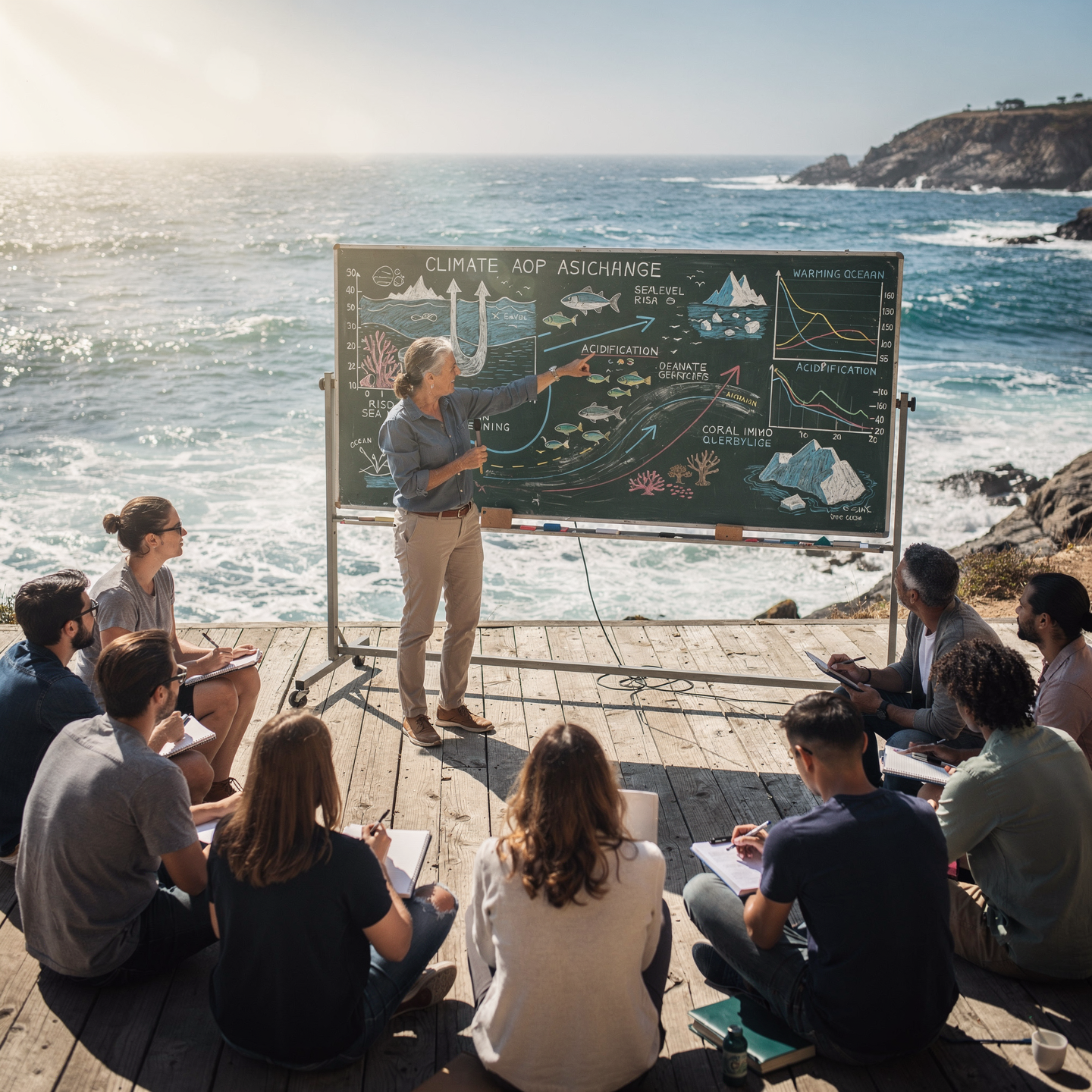
It provides you with a deep understanding of how rising temperatures, acidification, and other factors related to climate change are transforming marine ecosystems. You will learn about the impacts on biodiversity, fisheries, and coastal communities, and explore the adaptation solutions and strategies being implemented globally.

What will you learn?

  • Scientific basis: Understanding the causes and mechanisms of climate change in the oceans.
  • Ecological impact: Analyzing the effects on coral reefs, fish populations, and other marine species.
  • Socioeconomic consequences: Evaluating the implications for food security, tourism, and the coastal economy.
  • Mitigation and adaptation measures: Discovering strategies to reduce emissions and protect marine ecosystems.
  • Active participation: Inspiration and tools to contribute to ocean conservation.
Efectos

Course on the Effects of Climate Change on Oceans

Availability: 1 in stock

Who is it aimed at?

  • Oceanographers, marine biologists, and climatologists interested in understanding the direct impacts of climate change on ocean ecosystems.
  • Coastal zone managers and urban planners seeking to develop adaptation and mitigation strategies in the face of sea-level rise and extreme weather events.
  • Fisheries and aquaculture professionals who need tools to manage the risks arising from ocean acidification and species displacement.
  • Science educators and communicators who wish to update their knowledge and effectively communicate the challenges of climate change in the oceans.
  • Environmental science students and related fields seeking a in-depth understanding of the processes Oceanic factors and their relationship to the global climate.

Learning Flexibility
Access content at your own pace: videos, readings, and discussion forums available 24/7, complemented by live virtual sessions to answer questions and delve deeper into the topics.

Efectos

Objectives and competencies

Identify and mitigate coastal risks:

“To assess the vulnerability of coastal infrastructure and propose adaptation solutions based on the best available scientific evidence.”

Understanding and communicating ocean acidification:

“Explain causes, consequences, and solutions, adapting the message to different audiences (scientists, politicians, the general public).”

Assess and project sea level rise:

“Analyze historical data, climate models, and geographical factors to predict coastal impacts and develop adaptation strategies.”

Promote the sustainable management of marine resources:

Implement responsible fishing and traceability protocols, minimizing the impact on vulnerable ecosystems and complying with international regulations on catch quotas.
Analyze and model the impact on marine biodiversity:

Evaluate and mitigate noise and light pollution, considering sensitive species and breeding areas.

Develop adaptation strategies for coastal communities:

“Implement early warning systems and evacuation plans for extreme weather events, considering the socioeconomic characteristics of each community.”

Curriculum - Modules

1.1. Introduction to the global climate system and the regulatory role of the oceans
1.2. Radiative balance, greenhouse effect, and heat storage in the ocean
1.3. Fundamentals of physical oceanography: stratification, water masses, and general circulation
1.4. The carbon cycle and major marine biogeochemical cycles
1.5. Natural climate variability (ENSO, NAO, AMO) and its influence on the oceans
1.6. Climate change scenarios (IPCC) and specific projections for the marine environment

2.1. Evidence of ocean warming: observations, time series, and trends
2.2. Changes in ocean circulation: surface currents, thermohaline circulation, and gyres
2.3. Stratification, vertical mixing, and consequences for nutrients and primary productivity
2.4. Sea level rise: thermal expansion, ice melt, and continental inputs
2.5. Extreme ocean events: marine heatwaves, storms, and wave changes
2.6. Implications of ocean physical changes for regional climate and coastlines

3.1. CO₂ uptake by the ocean: physical pump, biological pump, and blue carbon
3.2. Fundamentals of ocean acidification: pH, alkalinity, and the carbonate system
3.3. Ocean deoxygenation: causes, oxygen minimum zones, and expansion of hypoxic areas
3.4. Impacts of acidification on calcifying organisms (corals, mollusks, plankton)
3.5. Combined effects of acidification, warming, and deoxygenation on food webs
3.6. Methods for monitoring and modeling ocean chemistry and its trends

4.1. Vulnerability of coral reefs, seagrass meadows, and mangroves to climate change
4.2. Response of fish and macroinvertebrate populations: displacements, collapses, and phenological changes
4.3. Effects on plankton, primary productivity, and the base of marine food webs
4.4. Interaction between climate change, overfishing, and pollution in marine ecosystems
4.5. Alteration of ecosystem services: food provision, coastal protection, and climate regulation
4.6. Regional case studies: Mediterranean, Atlantic, Pacific, and polar regions

5.1. Impacts on the fisheries and aquaculture sector: productivity, species distribution, and profitability
5.2. Climate change and coastal tourism: beach erosion, loss of attractions, and climate risks
5.3. Vulnerability of coastal communities: exposure, sensitivity, and adaptive capacity
5.4. Food security and risks to the blue economy in the context of climate change
5.5. Coastal risk analysis tools: sea-level rise scenarios and extreme events
5.6. Case studies of coastal communities in transition: examples of success and failure in adaptation

6.1. Mitigation strategies related to the oceans: emissions reduction and blue carbon
6.2. Adaptation measures in fisheries, aquaculture, and the management of marine protected areas
6.3. Integrated coastal zone planning and management in the face of climate change
6.4. International framework of climate policies and agreements related to the oceans
6.5. Economic and governance instruments for the protection of the marine environment
6.6. Citizen participation, environmental education, and communication of ocean climate risk

Plan de estudio - Módulos

1.1. Introduction to the global climate system and the regulatory role of the oceans
1.2. Radiative balance, greenhouse effect, and heat storage in the ocean
1.3. Fundamentals of physical oceanography: stratification, water masses, and general circulation
1.4. The carbon cycle and major marine biogeochemical cycles
1.5. Natural climate variability (ENSO, NAO, AMO) and its influence on the oceans
1.6. Climate change scenarios (IPCC) and specific projections for the marine environment

2.1. Evidence of ocean warming: observations, time series, and trends
2.2. Changes in ocean circulation: surface currents, thermohaline circulation, and gyres
2.3. Stratification, vertical mixing, and consequences for nutrients and primary productivity
2.4. Sea level rise: thermal expansion, ice melt, and continental inputs
2.5. Extreme ocean events: marine heatwaves, storms, and wave changes
2.6. Implications of ocean physical changes for regional climate and coastlines

3.1. CO₂ uptake by the ocean: physical pump, biological pump, and blue carbon
3.2. Fundamentals of ocean acidification: pH, alkalinity, and the carbonate system
3.3. Ocean deoxygenation: causes, oxygen minimum zones, and expansion of hypoxic areas
3.4. Impacts of acidification on calcifying organisms (corals, mollusks, plankton)
3.5. Combined effects of acidification, warming, and deoxygenation on food webs
3.6. Methods for monitoring and modeling ocean chemistry and its trends

4.1. Vulnerability of coral reefs, seagrass meadows, and mangroves to climate change
4.2. Response of fish and macroinvertebrate populations: displacements, collapses, and phenological changes
4.3. Effects on plankton, primary productivity, and the base of marine food webs
4.4. Interaction between climate change, overfishing, and pollution in marine ecosystems
4.5. Alteration of ecosystem services: food provision, coastal protection, and climate regulation
4.6. Regional case studies: Mediterranean, Atlantic, Pacific, and polar regions

5.1. Impacts on the fisheries and aquaculture sector: productivity, species distribution, and profitability
5.2. Climate change and coastal tourism: beach erosion, loss of attractions, and climate risks
5.3. Vulnerability of coastal communities: exposure, sensitivity, and adaptive capacity
5.4. Food security and risks to the blue economy in the context of climate change
5.5. Coastal risk analysis tools: sea-level rise scenarios and extreme events
5.6. Case studies of coastal communities in transition: examples of success and failure in adaptation

6.1. Mitigation strategies related to the oceans: emissions reduction and blue carbon
6.2. Adaptation measures in fisheries, aquaculture, and the management of marine protected areas
6.3. Integrated coastal zone planning and management in the face of climate change
6.4. International framework of climate policies and agreements related to the oceans
6.5. Economic and governance instruments for the protection of the marine environment
6.6. Citizen participation, environmental education, and communication of ocean climate risk

7.1. Oceanographic and climatic data sources: satellites, buoys, reanalysis, and models
7.2. Introduction to time series analysis and mapping of ocean variables
7.3. Carbon footprint assessment, impact indicators, and marine vulnerability metrics
7.4. Designing a case study: region selection, problem identification, and methodological approach
7.5. Developing an applied mitigation/adaptation project in a marine or coastal environment
7.6. Presenting, critically discussing, and communicating results to diverse audiences

#VALUE!

#VALUE!

#VALUE!

Career opportunities

#VALUE!

Admission requirements

Academic/professional profile:

Degree/Bachelor's degree in Nautical Science/Maritime Transport, Naval/Marine Engineering, or a related field; or proven professional experience in bridge/operations.

Language proficiency:

Recommended functional maritime English (SMCP) for simulations and technical materials.

5. Induction

Updated resume, copy of degree or seaman's book, ID card/passport, letter of motivation.

Technical requirements (for online):

Equipment with camera/microphone, stable connection, ≥ 24” monitor recommended for ECDIS/Radar-ARPA.

Admission process and dates

1. Online
application

(form + documents).

2. Academic review and interview

(profile/objectives/schedule compatibility).

3. Admission decision

(+ scholarship proposal if applicable).

4. Reservation of place

(deposit) and registration.

5. Induction

(access to campus, calendars, simulator guides).

Scholarships and grants

  • Understand: the causes and mechanisms of climate change that directly impact the oceans.
  • Analyze: the effects of rising temperatures, acidification, and deoxygenation on marine ecosystems.
  • Evaluate: the impact on biodiversity, fisheries, and coastal communities.
  • Develop: mitigation and adaptation strategies to protect our oceans.
  • Participate: in an informed debate on the solutions and policies needed for a sustainable future.
Deepen your scientific knowledge and the tools needed to address this global challenge.

Testimonials

Frequently asked questions

Yes. The itinerary includes ECDIS/Radar-ARPA/BRM with harbor, ocean, fog, storm, and SAR scenarios.

Online with live sessions; hybrid option for simulator/practical placements through agreements.

Recommended functional SMCP. We offer support materials for standard phraseology.

Yes, with a relevant degree or experience in maritime/port operations. The admissions interview will confirm suitability.

Optional (3–6 months) through Companies & Collaborations and the Alumni Network.

Simulator practice (rubrics), defeat plans, SOPs, checklists, micro-tests and applied TFM.

A degree from Navalis Magna University + operational portfolio (tracks, SOPs, reports and KPIs) useful for audits and employment.

#VALUE!

Request information

  1. Complete the Application Form
  2. Attach your CV/Qualifications (if you have them to hand).
  3. Indicate your preferred cohort (January/May/September) and whether you want the hybrid option with simulator sessions.
An academic advisor will contact you within 24–48 hours to guide you through the admission process, scholarships, and compatibility with your professional schedule. Translated with DeepL.com (free version)
Please enable JavaScript in your browser to complete this form.
Click or drag a file to this area to upload.

Teachers

0
    0
    Tu carrito
    Tu carrito esta vacíoRegresar a la tienda
    Scroll to Top