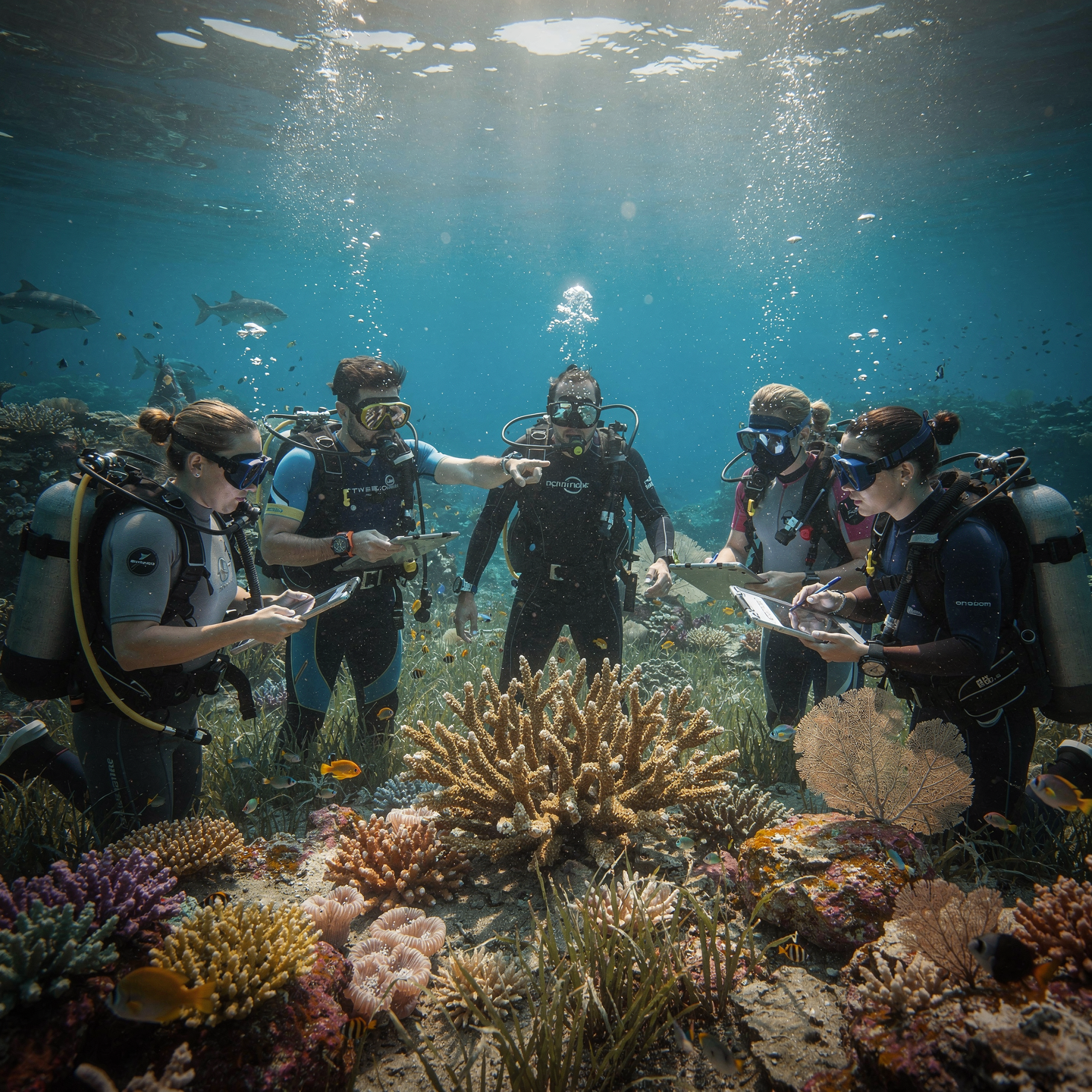
Course on local marine flora and fauna
Why this course?
Discover the Local Marine Flora and Fauna course
Immerse yourself in the fascinating world hidden beneath the waves. This program offers a comprehensive exploration of nearby marine ecosystems, from the most common species to the hidden gems of our coast. You will learn about their identification, behavior, and ecological role, with a practical and participatory approach.
Immerse yourself in the fascinating world hidden beneath the waves. This program offers a comprehensive exploration of nearby marine ecosystems, from the most common species to the hidden gems of our coastline.
Key Benefits
- Accurate Identification: Master the techniques to recognize the main species of marine flora and fauna.
- In-depth Knowledge: Understand the ecological interactions and challenges these ecosystems face.
- Hands-on Experience: Participate in field trips and workshops to apply your knowledge in the real environment.
- Marine Conservation: Acquire tools to contribute to the protection and sustainability of local marine life.
- Connection with Nature: Strengthen your connection with the sea and its biodiversity through learning and exploration.
- Modality: Online
- Level: Cursos
- Hours: 150 H
- Start date: 25-07-2026
Availability: 1 in stock
Who is it aimed at?
- Nature and diving enthusiasts who wish to deepen their knowledge of local marine species and their ecological importance.
- Marine biology and environmental science students who seek to complement their studies with a practical perspective on the identification and conservation of the region’s flora and fauna.
- Tour guides and water activity operators who need accurate and engaging information to enrich their offerings and promote responsible tourism.
- Environmental educators and science communicators interested in obtaining resources and tools to raise public awareness about local marine biodiversity.
- Volunteers from marine conservation organizations and engaged citizens who seek to actively contribute to the protection of their local marine ecosystem. Environment.
Learning Flexibility
Designed for people with diverse schedules: accessible online learning materials, open discussion forums, and practical activities adaptable to your pace.
Objectives and competencies

Identify and characterize key species:
Recognize indicator, threatened or endangered species, and their ecological role in the ecosystem.

Understanding ecological interactions:
“Identify and analyze trophic relationships, symbiosis and competition in marine ecosystems, recognizing their impact on biodiversity and resilience.”

Assess the current state of conservation:
“Inspect critical equipment, structures, and systems, identifying deterioration and scheduling preventive/corrective maintenance.”

Promote environmental awareness and respect:
“Minimize the ecological footprint through efficient waste management, responsible use of resources, and pollution prevention in all operations.”

Promoting citizen participation in science:
“Design and execute collaborative scientific projects, actively involving the community in the collection, analysis and dissemination of data.”

Documenting regional marine biodiversity:
Identify and catalog key species using non-invasive sampling techniques and environmental DNA analysis.
Curriculum - Modules
- Comprehensive Maritime Incident Management: protocols, roles, and chain of command for coordinated response
- Operational Planning and Execution: briefing, routes, weather windows, and go/no-go criteria
- Rapid Risk Assessment: criticality matrix, scene control, and decision-making under pressure
- Operational Communication: VHF/GMDSS, standardized reports, and inter-agency liaison
- Tactical Mobility and Safe Boarding: RHIB maneuvers, approach, mooring, and recovery
- Equipment and Technologies: PPE, signaling, satellite tracking, and field data logging
- Immediate Care of the Affected: primary assessment, hypothermia, trauma, and stabilization for evacuation
- Adverse Environmental Conditions: swell, Visibility, flows, and operational mitigation
Simulation and training: critical scenarios, use of VR/AR, and exercises with performance metrics
Documentation and continuous improvement: lessons learned, indicators (MTTA/MTTR), and SOP updates
- Introduction to Local Marine Biodiversity: Definition, importance, and value.
- Coastal Marine Ecosystems: Coral reefs, mangroves, seagrass meadows, estuaries, and beaches.
- Keystone Species: Identification, ecological roles, and conservation status.
- Threats to Marine Biodiversity: Pollution, overfishing, climate change, habitat destruction.
- Marine Environmental Legislation: National and international laws for the protection of biodiversity.
- Marine Protected Areas (MPAs): Design, management, and effectiveness in conservation.
- Sustainable Fisheries Management: Techniques and strategies to avoid overexploitation of resources.
- Restoration of Marine Ecosystems: Techniques for restoring reefs, mangroves, and other degraded habitats.
- Environmental Education and Community Participation: Strategies for involving the community in conservation.
- Monitoring of Marine Biodiversity: Sampling methods and data analysis for assessing the state of ecosystems.
‘
- Introduction to Marine Biology: Ecosystems and Biodiversity
- Identification of Marine Flora: Algae, Seagrasses, and Mangroves
- Identification of Marine Fauna I: Invertebrates (Sponges, Cnidarians, Mollusks, Crustaceans)
- Identification of Marine Fauna II: Fish (Bony and Cartilaginous)
- Identification of Marine Fauna III: Marine Mammals and Sea Turtles
- Non-Invasive Sampling Techniques: Observation, Photography, and Underwater Videography
- Water Quality Monitoring: Physicochemical Parameters
- Threatened Species and Legal Protection: Conventions and National Legislation
- Marine Habitat Conservation: Restoration and Sustainable Management
- Ethics in Marine Research and Scientific Dissemination
‘
- Introduction to marine biodiversity: key concepts and their importance
- Local marine ecosystems: general description (rocky, sandy, seagrass meadows, etc.)
- Main taxonomic groups: invertebrates, fish, seabirds, marine mammals
- Seaweed: basic identification, ecology, and uses
- Common invertebrates: sponges, cnidarians, mollusks, crustaceans, echinoderms
- Local fish: identification by morphological characteristics and habitat
- Seabirds: resident and migratory species, identification, and behavior
- Marine mammals: cetaceans, pinnipeds, identification, and conservation
- Invasive Species: Identification, Impact, and Control
- Local Environmental Legislation: Protected Areas, Threatened Species, and Regulations
‘
- Introduction to Local Marine Biodiversity: Key concepts and their importance.
- Coastal Ecosystems: Coral reefs, mangroves, seagrass meadows, and estuaries.
- Visual Identification Techniques: Common fish, invertebrates, algae, and marine mammals.
- Basic Taxonomy: Classification and nomenclature of marine species.
- Marine Environmental Monitoring: Methods and tools for assessing ecosystem health.
- Threats to Biodiversity: Pollution, overfishing, climate change, and invasive species.
- Marine Legislation and Conservation: Local, national, and international regulations.
- Marine Protected Areas (MPAs): Management and effectiveness in conservation.
- Citizen Participation in Conservation: Volunteer programs and citizen science.
- Practical Conservation Strategies: Habitat restoration, environmental education, and sustainable tourism.
‘
- System Architecture and Components: Structural design, materials, and subsystems (mechanical, electrical, electronic, and fluid) with selection and assembly criteria for marine environments
- Fundamentals and Principles of Operation: Physical and engineering foundations (thermodynamics, fluid mechanics, electricity, control, and materials) that explain performance and operating limits
- Safety and Environmental (SHE): Risk analysis, PPE, LOTO, hazardous atmospheres, spill and waste management, and emergency response plans
- Applicable Regulations and Standards: IMO/ISO/IEC requirements and local regulations;
- Conformance criteria, certification, and best practices for operation and maintenance
- Inspection, testing, and diagnostics: Visual/dimensional inspection, functional testing, data analysis, and predictive techniques (vibration, thermography, fluid analysis) to identify root causes
- Preventive and predictive maintenance: Hourly/cycle/seasonal plans, lubrication, adjustments, calibrations, consumable replacement, post-service verification, and operational reliability
- Instrumentation, tools, and metrology: Measuring and testing equipment, diagnostic software, calibration and traceability; selection criteria, safe use, and storage
- Onboard integration and interfaces: Mechanical, electrical, fluid, and data compatibility; Sealing and watertightness, EMC/EMI, corrosion protection, and interoperability testing.
Quality, acceptance testing, and commissioning: process and materials control, FAT/SAT, bench and sea trials, go/no-go criteria, and evidence documentation.
Technical documentation and integrated practice: logs, checklists, reports, and a complete case study (safety → diagnosis → intervention → verification → report) applicable to any system.
Plan de estudio - Módulos
- Comprehensive Maritime Incident Management: protocols, roles, and chain of command for coordinated response
- Operational Planning and Execution: briefing, routes, weather windows, and go/no-go criteria
- Rapid Risk Assessment: criticality matrix, scene control, and decision-making under pressure
- Operational Communication: VHF/GMDSS, standardized reports, and inter-agency liaison
- Tactical Mobility and Safe Boarding: RHIB maneuvers, approach, mooring, and recovery
- Equipment and Technologies: PPE, signaling, satellite tracking, and field data logging
- Immediate Care of the Affected: primary assessment, hypothermia, trauma, and stabilization for evacuation
- Adverse Environmental Conditions: swell, Visibility, flows, and operational mitigation
Simulation and training: critical scenarios, use of VR/AR, and exercises with performance metrics
Documentation and continuous improvement: lessons learned, indicators (MTTA/MTTR), and SOP updates
- Introduction to Local Marine Biodiversity: Definition, importance, and value.
- Coastal Marine Ecosystems: Coral reefs, mangroves, seagrass meadows, estuaries, and beaches.
- Keystone Species: Identification, ecological roles, and conservation status.
- Threats to Marine Biodiversity: Pollution, overfishing, climate change, habitat destruction.
- Marine Environmental Legislation: National and international laws for the protection of biodiversity.
- Marine Protected Areas (MPAs): Design, management, and effectiveness in conservation.
- Sustainable Fisheries Management: Techniques and strategies to avoid overexploitation of resources.
- Restoration of Marine Ecosystems: Techniques for restoring reefs, mangroves, and other degraded habitats.
- Environmental Education and Community Participation: Strategies for involving the community in conservation.
- Monitoring of Marine Biodiversity: Sampling methods and data analysis for assessing the state of ecosystems.
‘
- Introduction to Marine Biology: Ecosystems and Biodiversity
- Identification of Marine Flora: Algae, Seagrasses, and Mangroves
- Identification of Marine Fauna I: Invertebrates (Sponges, Cnidarians, Mollusks, Crustaceans)
- Identification of Marine Fauna II: Fish (Bony and Cartilaginous)
- Identification of Marine Fauna III: Marine Mammals and Sea Turtles
- Non-Invasive Sampling Techniques: Observation, Photography, and Underwater Videography
- Water Quality Monitoring: Physicochemical Parameters
- Threatened Species and Legal Protection: Conventions and National Legislation
- Marine Habitat Conservation: Restoration and Sustainable Management
- Ethics in Marine Research and Scientific Dissemination
‘
- Introduction to marine biodiversity: key concepts and their importance
- Local marine ecosystems: general description (rocky, sandy, seagrass meadows, etc.)
- Main taxonomic groups: invertebrates, fish, seabirds, marine mammals
- Seaweed: basic identification, ecology, and uses
- Common invertebrates: sponges, cnidarians, mollusks, crustaceans, echinoderms
- Local fish: identification by morphological characteristics and habitat
- Seabirds: resident and migratory species, identification, and behavior
- Marine mammals: cetaceans, pinnipeds, identification, and conservation
- Invasive Species: Identification, Impact, and Control
- Local Environmental Legislation: Protected Areas, Threatened Species, and Regulations
‘
- Introduction to Local Marine Biodiversity: Key concepts and their importance.
- Coastal Ecosystems: Coral reefs, mangroves, seagrass meadows, and estuaries.
- Visual Identification Techniques: Common fish, invertebrates, algae, and marine mammals.
- Basic Taxonomy: Classification and nomenclature of marine species.
- Marine Environmental Monitoring: Methods and tools for assessing ecosystem health.
- Threats to Biodiversity: Pollution, overfishing, climate change, and invasive species.
- Marine Legislation and Conservation: Local, national, and international regulations.
- Marine Protected Areas (MPAs): Management and effectiveness in conservation.
- Citizen Participation in Conservation: Volunteer programs and citizen science.
- Practical Conservation Strategies: Habitat restoration, environmental education, and sustainable tourism.
‘
- System Architecture and Components: Structural design, materials, and subsystems (mechanical, electrical, electronic, and fluid) with selection and assembly criteria for marine environments
- Fundamentals and Principles of Operation: Physical and engineering foundations (thermodynamics, fluid mechanics, electricity, control, and materials) that explain performance and operating limits
- Safety and Environmental (SHE): Risk analysis, PPE, LOTO, hazardous atmospheres, spill and waste management, and emergency response plans
- Applicable Regulations and Standards: IMO/ISO/IEC requirements and local regulations;
- Conformance criteria, certification, and best practices for operation and maintenance
- Inspection, testing, and diagnostics: Visual/dimensional inspection, functional testing, data analysis, and predictive techniques (vibration, thermography, fluid analysis) to identify root causes
- Preventive and predictive maintenance: Hourly/cycle/seasonal plans, lubrication, adjustments, calibrations, consumable replacement, post-service verification, and operational reliability
- Instrumentation, tools, and metrology: Measuring and testing equipment, diagnostic software, calibration and traceability; selection criteria, safe use, and storage
- Onboard integration and interfaces: Mechanical, electrical, fluid, and data compatibility; Sealing and watertightness, EMC/EMI, corrosion protection, and interoperability testing.
Quality, acceptance testing, and commissioning: process and materials control, FAT/SAT, bench and sea trials, go/no-go criteria, and evidence documentation.
Technical documentation and integrated practice: logs, checklists, reports, and a complete case study (safety → diagnosis → intervention → verification → report) applicable to any system.
- Introduction to local marine biodiversity: concept, importance, and threats.
- Coastal marine ecosystems: coral reefs, mangroves, seagrass meadows, estuaries, and beaches.
- Local marine flora and fauna: identification of key, endemic, and endangered species.
- Impacts of climate change: ocean acidification, sea-level rise, and coral bleaching.
- Marine pollution: sources, effects on biodiversity, and solutions.
- Sustainable fishing: selective fishing gear, catch quotas, and marine protected areas.
- Marine protected areas (MPAs): design, management, and monitoring.
- Marine conservation legislation and policies: international conventions and national laws and local communities.
- Sustainable marine ecotourism: best practices, benefits, and risks.
- Community participation and environmental education: involvement of the local community in conservation.
‘
- Introduction to local marine biodiversity: key concepts and their importance.
- Coastal ecosystems: mangroves, coral reefs, seagrass meadows, and estuaries.
- Flagship species: identification, ecology, and conservation status.
- Threats to local marine biodiversity: pollution, overfishing, climate change, and invasive species.
- Marine conservation legislation and policies: national and international agreements.
- Sustainable management tools: marine protected areas, management plans, and environmental impact assessments.
- Biodiversity monitoring: sampling techniques, data analysis, and ecosystem health indicators.
- Ecological restoration: strategies and techniques for the recovery of Degraded habitats.
Community participation and environmental education: involvement of local stakeholders in conservation.
Development of conservation and ecotourism projects: design, implementation, and evaluation.
‘
- Introduction to local marine biodiversity: Key concepts and ecological value.
- Coastal ecosystems: Estuaries, mangroves, rocky reefs, and sandy beaches.
- Key species: Identification, ecological role, and conservation status.
- Threats to marine biodiversity: Pollution, overfishing, climate change, and invasive species.
- Environmental legislation and policies: Legal framework for the protection of marine biodiversity.
- Marine protected areas (MPAs): Design, management, and effectiveness.
- Biodiversity monitoring: Sampling techniques and data analysis.
- Restoration of marine ecosystems: Techniques and projects recovery.
- Community participation: The role of local communities in conservation.
- Sustainable management of marine resources: Sustainable fishing, responsible tourism, and aquaculture.
‘
- Introduction to Marine Biodiversity: Key Concepts and Their Importance
- Local Marine Ecosystems: Types, Characteristics, and Distribution
- Identification of Marine Species: Representative Flora and Fauna of the Region
- Threats to Marine Biodiversity: Pollution, Overfishing, and Climate Change
- Marine Conservation Legislation and Policies: Local, National, and International Regulations
- Marine Protected Areas (MPAs): Design, Management, and Effectiveness
- Monitoring Marine Biodiversity: Assessment Techniques and Tools
- Restoration of Degraded Marine Ecosystems: Strategies and Case Studies
- Environmental Education and Citizen Participation: Promoting Awareness and action.
Sustainable Marine Resource Management: Approaches and practices for responsible use.
‘
Career opportunities
- Marine Tour/Ecotourism Guide: Ecosystem interpretation, route design, environmental outreach.
- Environmental Educator: Development of educational programs, workshops, and awareness activities about local marine flora and fauna.
- Laboratory/Aquarium Technician: Aquarium maintenance, care of marine species, water quality analysis.
- Volunteer/NGO Worker: Participation in marine conservation projects, beach cleanups, species monitoring.
- Researcher/Research Assistant: Data collection, sample analysis, support in scientific studies on marine flora and fauna.
- Environmental Consultant: Environmental impact assessment, report writing, advising on sustainable development projects.
- Marine Protected Area Manager: Planning and Marine reserve management, activity control, environmental monitoring.
- Sustainable Fisherman/Aquaculturist: Responsible fishing practices, environmentally friendly farming of marine species.
“`
Admission requirements

Academic/professional profile:
Degree/Bachelor's degree in Nautical Science/Maritime Transport, Naval/Marine Engineering, or a related field; or proven professional experience in bridge/operations.

Language proficiency:
Recommended functional maritime English (SMCP) for simulations and technical materials.

5. Induction
Updated resume, copy of degree or seaman's book, ID card/passport, letter of motivation.

Technical requirements (for online):
Equipment with camera/microphone, stable connection, ≥ 24” monitor recommended for ECDIS/Radar-ARPA.
Admission process and dates

1. Online
application
(form + documents).

2. Academic review and interview
(profile/objectives/schedule compatibility).

3. Admission decision
(+ scholarship proposal if applicable).

4. Reservation of place
(deposit) and registration.

5. Induction
(access to campus, calendars, simulator guides).
Scholarships and grants
- Discover marine biodiversity: Immerse yourself in the fascinating world of the species that inhabit our coasts.
- Species identification: Learn to recognize the main species of local marine flora and fauna.
- Environmental impact: Understand the threats these ecosystems face and how we can protect them.
- Field trips: Hands-on experience with guided visits to key marine environments.
- Marine conservation: Acquire knowledge and tools to contribute to the sustainability of our seas.
Testimonials
During the training on local marine flora and fauna, I was able to correctly identify over 90% of the species presented in the final assessment, including several species of algae, crustaceans, and fish endemic to the region. Furthermore, I successfully applied the knowledge I gained to design a conservation project proposal focused on protecting the habitat of a vulnerable coral species, which was praised by the instructors for its feasibility and innovative approach.
I applied the knowledge I gained about coral reef ecology to design a restoration project that obtained funding and currently shows a 30% increase in coral cover in the study area.
During the training on local marine flora and fauna, I correctly identified over 90% of the species presented in the final assessment, including subtle differences between similar species. I applied this knowledge on a subsequent field trip, where I was able to guide other participants in identifying various algae, crustaceans, and fish, contributing to greater collective learning.
During training on local marine flora and fauna, I correctly identified over 90% of the species in a practical assessment at sea, including several cryptic and juvenile species, demonstrating a deep understanding of the local ecosystem.

Frequently asked questions
Common seal
Yes. The itinerary includes ECDIS/Radar-ARPA/BRM with harbor, ocean, fog, storm, and SAR scenarios.
Online with live sessions; hybrid option for simulator/practical placements through agreements.
Algae, phytoplankton, zooplankton, fish, crustaceans, mollusks, marine mammals, corals, anemones and other invertebrates.
Recommended functional SMCP. We offer support materials for standard phraseology.
Yes, with a relevant degree or experience in maritime/port operations. The admissions interview will confirm suitability.
Optional (3–6 months) through Companies & Collaborations and the Alumni Network.
Simulator practice (rubrics), defeat plans, SOPs, checklists, micro-tests and applied TFM.
A degree from Navalis Magna University + operational portfolio (tracks, SOPs, reports and KPIs) useful for audits and employment.
- Introduction to Marine Biodiversity: Key Concepts and Their Importance
- Local Marine Ecosystems: Types, Characteristics, and Distribution
- Identification of Marine Species: Representative Flora and Fauna of the Region
- Threats to Marine Biodiversity: Pollution, Overfishing, and Climate Change
- Marine Conservation Legislation and Policies: Local, National, and International Regulations
- Marine Protected Areas (MPAs): Design, Management, and Effectiveness
- Monitoring Marine Biodiversity: Assessment Techniques and Tools
- Restoration of Degraded Marine Ecosystems: Strategies and Case Studies
- Environmental Education and Citizen Participation: Promoting Awareness and action.
Sustainable Marine Resource Management: Approaches and practices for responsible use.
‘
Request information
- Complete the Application Form
- Attach your CV/Qualifications (if you have them to hand).
- Indicate your preferred cohort (January/May/September) and whether you want the hybrid option with simulator sessions.
Teachers
Eng. Tomás Riera
Full Professor
Eng. Tomás Riera
Full Professor
Eng. Sofía Marquina
Full Professor
Eng. Sofía Marquina
Full Professor
Eng. Javier Bañuls
Full Professor
Eng. Javier Bañuls
Full Professor
Dr. Nuria Llobregat
Full Professor
Dr. Nuria Llobregat
Full Professor
Dr. Pau Ferrer
Full Professor
Dr. Pau Ferrer
Full Professor
Cap. Javier Abaroa (MCA)
Full Professor
Cap. Javier Abaroa (MCA)
Full Professor

