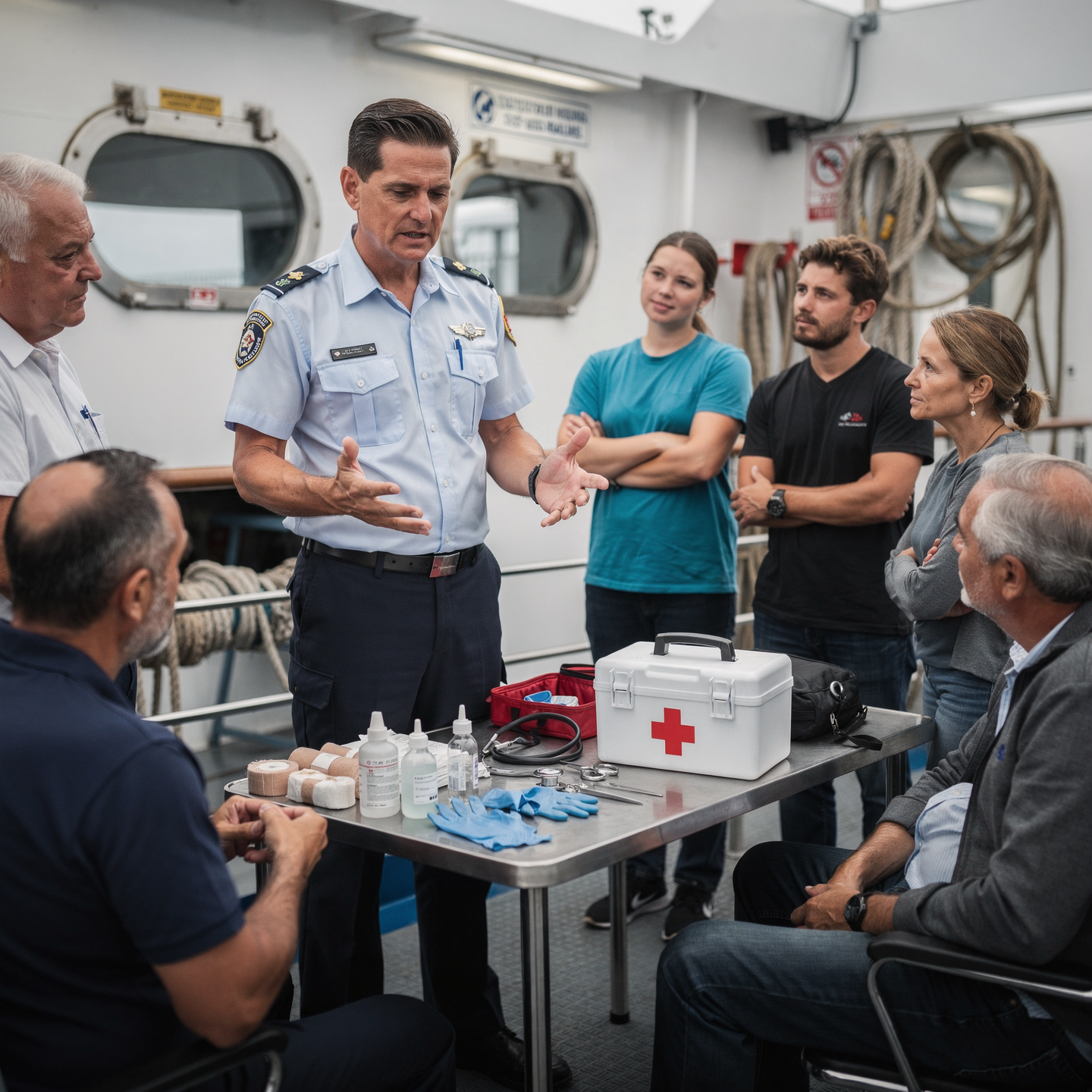
First aid kit and medical equipment on board course
Why this course?
The First Aid Kit and Medical Equipment Onboard Course
This course provides you with the essential skills to respond effectively to medical emergencies at sea. Learn to manage the standard first aid kit, diagnose and treat the most common ailments, and use the basic medical equipment available. This course prepares you to act safely and confidently in critical situations, minimizing risks and safeguarding the health of the crew.
Differential Advantages
- Simulated Hands-on Training: Realistic onboard medical emergency scenarios.
- Essential Medication Management: Administration, dosage, and contraindications.
- Communication Protocols: How to effectively request remote medical assistance.
- Medical Equipment: Use and maintenance of the defibrillator, oxygen, and other devices.
- Recognized Certification: Meets international standards for maritime safety.
- Modality: Online
- Level: Cursos
- Hours: 150 H
- Start date: 26-07-2026
Availability: 1 in stock
Who is it aimed at?
- Captains, officers, and crew responsible for safety and well-being on board, seeking a thorough understanding of regulatory requirements and the practical use of the first aid kit.
- Shore-based personnel in shipping lines and vessel management companies who need to ensure regulatory compliance and optimize the management of onboard medical inventory.
- Marine medical equipment suppliers who wish to deepen their understanding of the specific needs of the sector and offer more effective solutions.
- Doctors and nurses interested in expanding their experience to the maritime environment and learning about the unique aspects of medical treatment at sea.
- Medical, nursing, and nautical students seeking supplementary training in emergency medical management. Isolated environments.
Professional adaptability
Ideal for professionals with demanding schedules: accessible online material 24/7, practical exercises to apply knowledge, and personalized tutoring to answer questions.
Objectives and competencies

Effectively manage available medical resources:
“Optimize the use of medicines, equipment and healthcare personnel, prioritizing according to severity and maximizing efficiency in the administration and distribution of resources.”

Apply first aid and basic life support techniques:
“Prioritize the safety of the rescuer, assess the scene, activate EMS, and perform quality CPR until specialized help arrives.”

Identify and mitigate common medical risks in navigation:
Recognize symptoms of seasickness (dizziness, hypothermia, dehydration), apply basic first aid and effectively communicate the situation to the relevant medical authorities for remote assistance or evacuation.

Maintain and properly organize the first aid kit and medical equipment:
“Following established protocols and ensuring the availability and integrity of resources.”

Communicating medical information effectively in emergency situations:
“To transmit accurate and concise information, prioritizing vital data and using standardized terminology to facilitate the understanding and response of the medical team.”

Assess and respond appropriately to medical emergencies on board:
“Prioritize the safety of the patient and crew, applying first aid protocols and coordinating medical evacuation if necessary.”
Curriculum - Modules
- Comprehensive Maritime Incident Management: protocols, roles, and chain of command for coordinated response
- Operational Planning and Execution: briefing, routes, weather windows, and go/no-go criteria
- Rapid Risk Assessment: criticality matrix, scene control, and decision-making under pressure
- Operational Communication: VHF/GMDSS, standardized reports, and inter-agency liaison
- Tactical Mobility and Safe Boarding: RHIB maneuvers, approach, mooring, and recovery
- Equipment and Technologies: PPE, signaling, satellite tracking, and field data logging
- Immediate Care of the Affected: primary assessment, hypothermia, trauma, and stabilization for evacuation
- Adverse Environmental Conditions: swell, Visibility, flows, and operational mitigation
Simulation and training: critical scenarios, use of VR/AR, and exercises with performance metrics
Documentation and continuous improvement: lessons learned, indicators (MTTA/MTTR), and SOP updates
- Introduction to Maritime Health Management: Legal and Regulatory Framework.
- Human Physiology in the Maritime Environment: Adaptation and Specific Risks.
- Patient Assessment: Triage and Prioritization in Emergency Situations.
- Basic and Advanced Life Support: CPR, Airway Management, and Oxygen Therapy.
- Trauma at Sea: Management of Wounds, Fractures, and Hemorrhages.
- Common Diseases on Board: Diagnosis, Treatment, and Prevention.
- Use of Essential Medications and the First Aid Kit on Board: Administration and Precautions.
- Medical Communications: Telemedicine and Requesting Remote Assistance.
- Medical Evacuation: Preparation, Coordination, and Rescue Procedures.
- Psychological aspects of the emergency: crew support and stress management.
‘
- Introduction to Maritime Health: Legal and Regulatory Framework
- Type C First Aid Kit: Mandatory Equipment, Management, and Maintenance
- Wound Care Supplies: Dressings, Bandages, Disinfectants, Sutures
- Essential Medicines: Analgesics, Antibiotics, Antiemetics, Antihistamines
- Medical Equipment: Blood Pressure Monitor, Stethoscope, Thermometer, Glucometer
- Oxygen Therapy: Administration, Equipment, and Precautions
- Immobilization and Transfer: Splints, Cervical Collars, Stretchers
- Disinfection and Sterilization: Protocols and Products
- Management of Medical Waste on Board
- Health documentation: records, reports, and communication with telemedicine
‘
- Introduction to Maritime Health: Legal Framework and Responsibilities
- Basic Human Physiology: Vital signs, body systems, and their response to stress at sea.
- Patient Assessment: Medical history, physical examination, and triage in maritime environments.
- Onboard Medical Kit: Mandatory Equipment according to regulations, essential medicines, and their use.
- Trauma at Sea: Management of wounds, fractures, burns, and crush injuries.
- Common Diseases on Board: Diagnosis and treatment of infectious, respiratory, and digestive diseases.
- Cardiovascular and Respiratory Emergencies: Cardiopulmonary resuscitation (CPR) and airway management.
- Poisonings and Intoxications: Risk identification, preventive measures, and action protocols.
- Hypothermia and Hyperthermia: Prevention, recognition, and treatment in extreme conditions.
- Medical Communications: Telemedicine, requesting remote assistance, and coordination with coastal medical centers.
‘
- Basic Anatomy and Physiology: Cardiovascular, respiratory, and nervous systems.
- Initial Patient Assessment: Pediatric Assessment Triangle (PAT) adapted to the maritime environment.
- Basic Life Support (BLS): CPR in adults, children, and infants. Modifications in confined and moving environments.
- Use of the Automated External Defibrillator (AED): Maintenance, safety, and application in maritime conditions.
- Airway Management: Opening, suctioning, basic devices (pocket mask, oropharyngeal airways).
- Hemorrhage and Shock: Identification, direct control, compression bandages, improvised tourniquets.
- Common Injuries at Sea: Fractures, sprains, dislocations. Immobilization with available resources.
Burns: Classification, initial treatment, pain management.
Common Medical Emergencies Onboard: Chest pain, respiratory distress, seizures, allergic reactions.
Emergency Communications: Communication protocols with rescue centers, use of radio and other devices.
‘
- System Architecture and Components: Structural design, materials, and subsystems (mechanical, electrical, electronic, and fluid) with selection and assembly criteria for marine environments
- Fundamentals and Principles of Operation: Physical and engineering foundations (thermodynamics, fluid mechanics, electricity, control, and materials) that explain performance and operating limits
- Safety and Environmental (SHE): Risk analysis, PPE, LOTO, hazardous atmospheres, spill and waste management, and emergency response plans
- Applicable Regulations and Standards: IMO/ISO/IEC requirements and local regulations;
- Conformance criteria, certification, and best practices for operation and maintenance
- Inspection, testing, and diagnostics: Visual/dimensional inspection, functional testing, data analysis, and predictive techniques (vibration, thermography, fluid analysis) to identify root causes
- Preventive and predictive maintenance: Hourly/cycle/seasonal plans, lubrication, adjustments, calibrations, consumable replacement, post-service verification, and operational reliability
- Instrumentation, tools, and metrology: Measuring and testing equipment, diagnostic software, calibration and traceability; selection criteria, safe use, and storage
- Onboard integration and interfaces: Mechanical, electrical, fluid, and data compatibility; Sealing and watertightness, EMC/EMI, corrosion protection, and interoperability testing.
Quality, acceptance testing, and commissioning: process and materials control, FAT/SAT, bench and sea trials, go/no-go criteria, and evidence documentation.
Technical documentation and integrated practice: logs, checklists, reports, and a complete case study (safety → diagnosis → intervention → verification → report) applicable to any system.
Plan de estudio - Módulos
- Comprehensive Maritime Incident Management: protocols, roles, and chain of command for coordinated response
- Operational Planning and Execution: briefing, routes, weather windows, and go/no-go criteria
- Rapid Risk Assessment: criticality matrix, scene control, and decision-making under pressure
- Operational Communication: VHF/GMDSS, standardized reports, and inter-agency liaison
- Tactical Mobility and Safe Boarding: RHIB maneuvers, approach, mooring, and recovery
- Equipment and Technologies: PPE, signaling, satellite tracking, and field data logging
- Immediate Care of the Affected: primary assessment, hypothermia, trauma, and stabilization for evacuation
- Adverse Environmental Conditions: swell, Visibility, flows, and operational mitigation
Simulation and training: critical scenarios, use of VR/AR, and exercises with performance metrics
Documentation and continuous improvement: lessons learned, indicators (MTTA/MTTR), and SOP updates
- Introduction to Maritime Health Management: Legal and Regulatory Framework.
- Human Physiology in the Maritime Environment: Adaptation and Specific Risks.
- Patient Assessment: Triage and Prioritization in Emergency Situations.
- Basic and Advanced Life Support: CPR, Airway Management, and Oxygen Therapy.
- Trauma at Sea: Management of Wounds, Fractures, and Hemorrhages.
- Common Diseases on Board: Diagnosis, Treatment, and Prevention.
- Use of Essential Medications and the First Aid Kit on Board: Administration and Precautions.
- Medical Communications: Telemedicine and Requesting Remote Assistance.
- Medical Evacuation: Preparation, Coordination, and Rescue Procedures.
- Psychological aspects of the emergency: crew support and stress management.
‘
- Introduction to Maritime Health: Legal and Regulatory Framework
- Type C First Aid Kit: Mandatory Equipment, Management, and Maintenance
- Wound Care Supplies: Dressings, Bandages, Disinfectants, Sutures
- Essential Medicines: Analgesics, Antibiotics, Antiemetics, Antihistamines
- Medical Equipment: Blood Pressure Monitor, Stethoscope, Thermometer, Glucometer
- Oxygen Therapy: Administration, Equipment, and Precautions
- Immobilization and Transfer: Splints, Cervical Collars, Stretchers
- Disinfection and Sterilization: Protocols and Products
- Management of Medical Waste on Board
- Health documentation: records, reports, and communication with telemedicine
‘
- Introduction to Maritime Health: Legal Framework and Responsibilities
- Basic Human Physiology: Vital signs, body systems, and their response to stress at sea.
- Patient Assessment: Medical history, physical examination, and triage in maritime environments.
- Onboard Medical Kit: Mandatory Equipment according to regulations, essential medicines, and their use.
- Trauma at Sea: Management of wounds, fractures, burns, and crush injuries.
- Common Diseases on Board: Diagnosis and treatment of infectious, respiratory, and digestive diseases.
- Cardiovascular and Respiratory Emergencies: Cardiopulmonary resuscitation (CPR) and airway management.
- Poisonings and Intoxications: Risk identification, preventive measures, and action protocols.
- Hypothermia and Hyperthermia: Prevention, recognition, and treatment in extreme conditions.
- Medical Communications: Telemedicine, requesting remote assistance, and coordination with coastal medical centers.
‘
- Basic Anatomy and Physiology: Cardiovascular, respiratory, and nervous systems.
- Initial Patient Assessment: Pediatric Assessment Triangle (PAT) adapted to the maritime environment.
- Basic Life Support (BLS): CPR in adults, children, and infants. Modifications in confined and moving environments.
- Use of the Automated External Defibrillator (AED): Maintenance, safety, and application in maritime conditions.
- Airway Management: Opening, suctioning, basic devices (pocket mask, oropharyngeal airways).
- Hemorrhage and Shock: Identification, direct control, compression bandages, improvised tourniquets.
- Common Injuries at Sea: Fractures, sprains, dislocations. Immobilization with available resources.
Burns: Classification, initial treatment, pain management.
Common Medical Emergencies Onboard: Chest pain, respiratory distress, seizures, allergic reactions.
Emergency Communications: Communication protocols with rescue centers, use of radio and other devices.
‘
- System Architecture and Components: Structural design, materials, and subsystems (mechanical, electrical, electronic, and fluid) with selection and assembly criteria for marine environments
- Fundamentals and Principles of Operation: Physical and engineering foundations (thermodynamics, fluid mechanics, electricity, control, and materials) that explain performance and operating limits
- Safety and Environmental (SHE): Risk analysis, PPE, LOTO, hazardous atmospheres, spill and waste management, and emergency response plans
- Applicable Regulations and Standards: IMO/ISO/IEC requirements and local regulations;
- Conformance criteria, certification, and best practices for operation and maintenance
- Inspection, testing, and diagnostics: Visual/dimensional inspection, functional testing, data analysis, and predictive techniques (vibration, thermography, fluid analysis) to identify root causes
- Preventive and predictive maintenance: Hourly/cycle/seasonal plans, lubrication, adjustments, calibrations, consumable replacement, post-service verification, and operational reliability
- Instrumentation, tools, and metrology: Measuring and testing equipment, diagnostic software, calibration and traceability; selection criteria, safe use, and storage
- Onboard integration and interfaces: Mechanical, electrical, fluid, and data compatibility; Sealing and watertightness, EMC/EMI, corrosion protection, and interoperability testing.
Quality, acceptance testing, and commissioning: process and materials control, FAT/SAT, bench and sea trials, go/no-go criteria, and evidence documentation.
Technical documentation and integrated practice: logs, checklists, reports, and a complete case study (safety → diagnosis → intervention → verification → report) applicable to any system.
- Basic Anatomy and Physiology Applied to Maritime Emergencies
- Initial Patient Assessment: Triage and Vital Signs
- Basic Life Support (BLS) and Automated External Defibrillation (AED)
- Airway Management: Obstruction, Suctioning, and Ventilation
- Hemorrhage and Shock: Control and Stabilization
- Trauma: Initial Management of Fractures, Sprains, and Dislocations
- Burns: Assessment, Treatment, and Transport
- Drowning and Immersion Syndrome: Rescue and Resuscitation
- Injuries from Marine Wildlife: Identification and First Aid
- Poisonings: Identification, Initial Management, and Evacuation
‘
- Introduction to Basic Life Support (BLS): CPR, Choking
- Advanced Life Support (ALS): Airway Management, Defibrillation
- Onboard First Aid Kit: Essential Medicines, Use and Storage
- Trauma: Wounds, Burns, Fractures, and Dislocations
- Hypothermia and Hyperthermia: Prevention and Treatment in the Maritime Environment
- Common Illnesses at Sea: Seasickness, Dehydration, Infections
- International Maritime Law: Conventions, Codes, and Regulations
- National and International Health Regulations on Board: Inspections, Certifications
- Management of Healthcare Waste and Prevention of Biological Risks
- Communication in Medical Emergencies: Call relief, telemedicine
‘
- Introduction to Maritime Healthcare: Legal Framework and Responsibilities
- Initial Patient Assessment: Triage, Vital Signs, and Medical History
- Onboard First Aid Kit: Contents, Maintenance, and Proper Use
- Medical Communications: Telemedicine, Medical Radio, and Reporting Formats
- Common Onboard Illnesses: Diagnosis and Treatment (Sea Sickness, Dehydration, Infections)
- Trauma: First Aid for Fractures, Burns, Wounds, and Bleeding
- Cardiovascular and Respiratory Emergencies: CPR, Defibrillation, and Airway Management
- Poisoning and Allergies: Identification, Treatment, and Prevention
- Medical Evacuation (MEDEVAC): Procedures, coordination, and safety
Psychosocial aspects of health in the maritime environment: Stress, isolation, and psychological support
‘
- Introduction to Healthcare on Board: First Aid Kit, Regulations, and Responsibilities.
- Basic Anatomy and Physiology: Cardiovascular, Respiratory, Nervous, and Musculoskeletal Systems.
- First Aid: Patient Assessment, CPR, Choking, Bleeding, and Shock.
- Management of Wounds and Burns: Cleaning, Disinfection, Bandaging, and Dressings.
- Common Illnesses on Board: Seasickness, Heatstroke, Dehydration, Respiratory Infections.
- Injuries: Sprains, Fractures, Dislocations, Head Injuries.
- Poisoning and Allergies: Identification, Treatment, and Prevention.
- Emergencies Medical conditions: heart attack, stroke, epileptic seizures, diabetes.
Medical communications: contact with coordination centers and telemedicine.
Navigation safety: preventive measures, safety equipment, and emergency procedures.
‘
Career opportunities
- Onboard Emergency Medical Technician: Initial care, stabilization, and patient transfer.
- Onboard Medical Kit Manager: Inventory management, expiration date control, and maintenance of medical equipment.
- Passenger Ship Nursing Staff: Medical assistance to passengers and crew.
- Onboard Safety Officer: Knowledge of emergency protocols and use of medical equipment.
- Cruise Ship and Ferry Staff: Care for passengers with medical needs and emergency management.
- Oil Platform and Offshore Wind Farm Worker: Healthcare in remote and hazardous environments.
- Volunteer with NGOs and Maritime Rescue Vessels: Medical assistance in crisis situations and aid Humanitarian.
- First aid and medical equipment trainer on board: Instructor in maritime safety courses.
“`
Admission requirements

Academic/professional profile:
Degree/Bachelor's degree in Nautical Science/Maritime Transport, Naval/Marine Engineering, or a related field; or proven professional experience in bridge/operations.

Language proficiency:
Recommended functional maritime English (SMCP) for simulations and technical materials.

5. Induction
Updated resume, copy of degree or seaman's book, ID card/passport, letter of motivation.

Technical requirements (for online):
Equipment with camera/microphone, stable connection, ≥ 24” monitor recommended for ECDIS/Radar-ARPA.
Admission process and dates

1. Online
application
(form + documents).

2. Academic review and interview
(profile/objectives/schedule compatibility).

3. Admission decision
(+ scholarship proposal if applicable).

4. Reservation of place
(deposit) and registration.

5. Induction
(access to campus, calendars, simulator guides).
Scholarships and grants
- Master the management of the onboard first aid kit: from organization and stock control to regulatory compliance.
- Learn to select the essential medical equipment for common emergencies at sea.
- Action protocols: know the guidelines for acting effectively in various medical situations on board.
- Maintenance and inspection: ensure the operability of medical equipment through preventive maintenance practices.
- Maritime legislation: stay up-to-date on international regulations relating to maritime health.
Testimonials
“Thanks to the training in First Aid Kit and Onboard Medical Equipment, I was able to effectively assist a passenger who suffered a severe burn during a voyage. I quickly identified the extent of the burn, applied appropriate first aid using the supplies in the kit, and kept the patient stable until we reached port and they received specialized medical attention. My knowledge gained in the course was crucial in handling the situation calmly and efficiently, minimizing the damage and ensuring the passenger’s well-being.”
I successfully applied the techniques learned in the Marine Health and First Aid course to stabilize a crew member who suffered a severe burn during a voyage, allowing for his safe evacuation and full recovery.
I implemented the protocol I learned during the “First Aid Kit and Medical Equipment on Board” training to assist a passenger who suffered a second-degree burn. Thanks to the correct identification of the burn type and the immediate application of first aid using the kit’s contents, I was able to alleviate the passenger’s pain and prevent further complications until we reached port and received specialized medical attention. The port doctor commended my actions and emphasized the importance of my training for the passenger’s well-being.
I successfully implemented the onboard medical kit following the course guidelines, which allowed me to effectively assist a crew member with a second-degree burn during a voyage. I applied the first aid techniques I had learned, alleviating his pain and preventing complications until we reached port and he could receive professional medical attention. His prompt recovery was largely due to the training I received and the proper stocking of the kit.

Frequently asked questions
Antiseptics, analgesics, antipyretics, antihistamines, gauze, bandages, adhesive tape, scissors, tweezers, thermometer, disposable gloves, first aid manual and specific medications for people on board.
Yes. The itinerary includes ECDIS/Radar-ARPA/BRM with harbor, ocean, fog, storm, and SAR scenarios.
Online with live sessions; hybrid option for simulator/practical placements through agreements.
Bandages, antiseptics, painkillers, motion sickness medication, scissors, tweezers, and gloves.
Recommended functional SMCP. We offer support materials for standard phraseology.
Yes, with a relevant degree or experience in maritime/port operations. The admissions interview will confirm suitability.
Optional (3–6 months) through Companies & Collaborations and the Alumni Network.
Simulator practice (rubrics), defeat plans, SOPs, checklists, micro-tests and applied TFM.
A degree from Navalis Magna University + operational portfolio (tracks, SOPs, reports and KPIs) useful for audits and employment.
- Introduction to Healthcare on Board: First Aid Kit, Regulations, and Responsibilities.
- Basic Anatomy and Physiology: Cardiovascular, Respiratory, Nervous, and Musculoskeletal Systems.
- First Aid: Patient Assessment, CPR, Choking, Bleeding, and Shock.
- Management of Wounds and Burns: Cleaning, Disinfection, Bandaging, and Dressings.
- Common Illnesses on Board: Seasickness, Heatstroke, Dehydration, Respiratory Infections.
- Injuries: Sprains, Fractures, Dislocations, Head Injuries.
- Poisoning and Allergies: Identification, Treatment, and Prevention.
- Emergencies Medical conditions: heart attack, stroke, epileptic seizures, diabetes.
Medical communications: contact with coordination centers and telemedicine.
Navigation safety: preventive measures, safety equipment, and emergency procedures.
‘
Request information
- Complete the Application Form
- Attach your CV/Qualifications (if you have them to hand).
- Indicate your preferred cohort (January/May/September) and whether you want the hybrid option with simulator sessions.
Teachers
Eng. Tomás Riera
Full Professor
Eng. Tomás Riera
Full Professor
Eng. Sofía Marquina
Full Professor
Eng. Sofía Marquina
Full Professor
Eng. Javier Bañuls
Full Professor
Eng. Javier Bañuls
Full Professor
Dr. Nuria Llobregat
Full Professor
Dr. Nuria Llobregat
Full Professor
Dr. Pau Ferrer
Full Professor
Dr. Pau Ferrer
Full Professor
Cap. Javier Abaroa (MCA)
Full Professor
Cap. Javier Abaroa (MCA)
Full Professor

