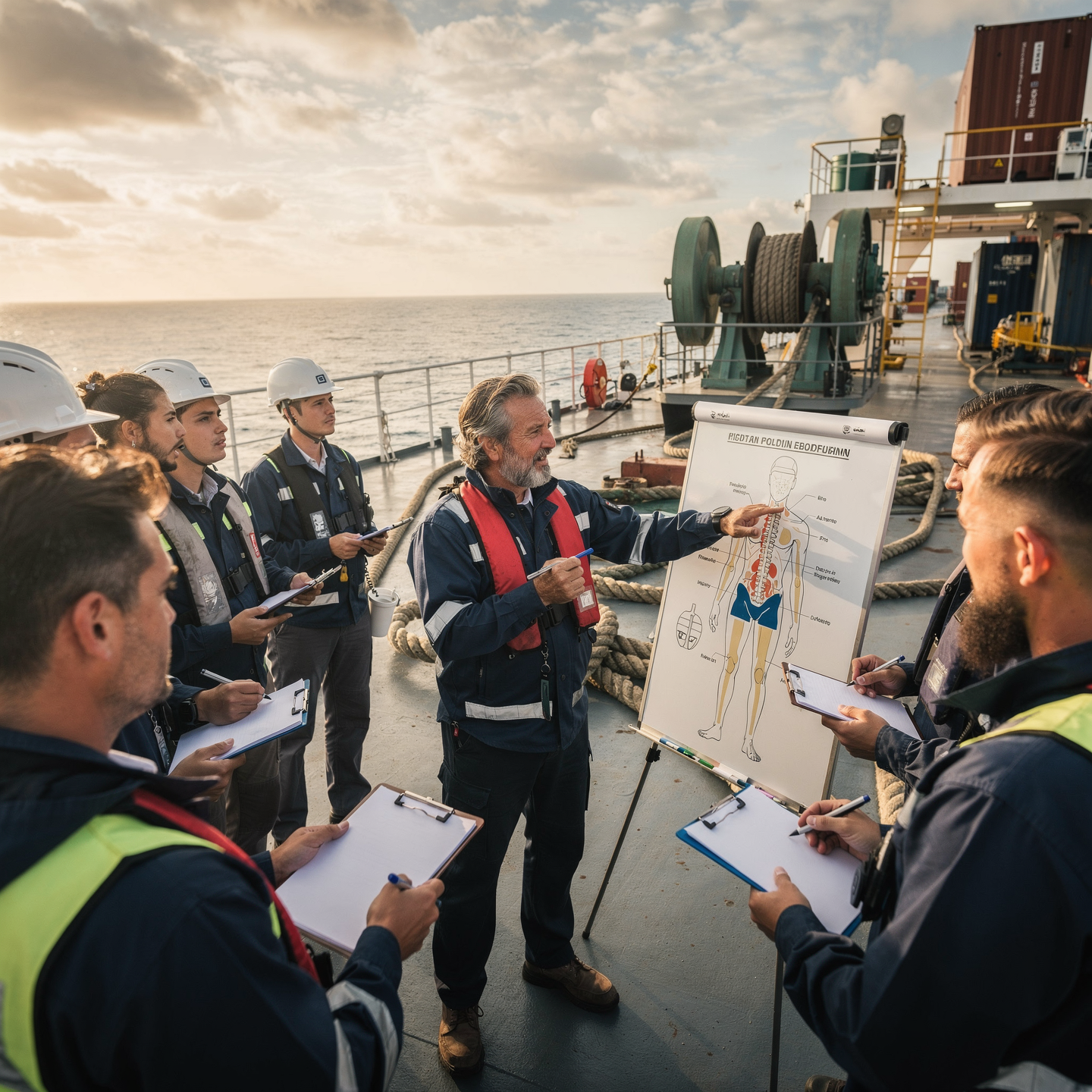
Accident Prevention Course on Deck

Why this course?

The Deck Accident Prevention

course

This course is designed to provide the tools and knowledge necessary to identify, assess, and mitigate the most common workplace hazards in maritime environments. This program will enable you to create a safer and more efficient work environment, significantly reducing the likelihood of incidents and injuries. You will learn to implement robust safety protocols, use personal protective equipment correctly, and respond effectively to emergency situations.

Differential Advantages

  • Hazard Identification: Recognition and assessment of specific risks on the ship’s deck.
  • Risk Control: Implementation of preventive and corrective measures to minimize exposure to hazards.
  • Personal Protective Equipment (PPE): Selection, use, and proper maintenance of PPE.
  • Emergency Procedures: Effective response to critical situations, including fires, spills, and injuries.
  • Legislation and Regulations: Compliance with national and international maritime safety regulations.

Prevención

Accident Prevention Course on Deck

Availability: 1 in stock

Who is it aimed at?

  • Seamen and Boatswains looking to strengthen their practical skills in safety and equipment handling on deck.
  • Deck Supervisors and Safety Officers needing to update their knowledge of regulations, procedures, and risk management.
  • Nautical Studies and related fields requiring supplementary training in accident prevention and maritime occupational safety.
  • Shipping and port service companies interested in reducing incidents, improving safety, and complying with international regulations.
  • Maritime Safety Inspectors and Auditors wishing to deepen their knowledge of best practices and risk assessment techniques on deck.

Flexibility and Applicability
Designed for working professionals: flexible online format, real-world case studies, and tools for implementation in daily work.

Prevención

Objectives and competencies

Identify and mitigate specific roof risks:

“Conduct thorough inspections, implement preventive maintenance, and ensure proper cargo stowage.”

Use personal protective equipment (PPE) correctly:

“Select, inspect, adjust and maintain PPE according to the task, ensuring its effectiveness and continuous use at all times.”

Apply safe procedures in mooring and unmooring tasks:

“Using appropriate equipment, respecting environmental conditions, and communicating effectively with the team.”

Reacting effectively to emergencies on deck:

Assess the situation, communicate clearly, execute emergency procedures, and coordinate with the crew and external resources.

Maintain order and cleanliness on deck:

“Conduct inspection rounds, identify risks and apply cleaning and safe stowage procedures, minimizing hazards to the crew and the environment.”

Inspect and maintain the good condition of deck equipment:

“Identify and correct deficiencies in the sling, lubrication, and general operation of winches, windlasses, and winches.”

Curriculum - Modules

  1. Comprehensive Maritime Incident Management: protocols, roles, and chain of command for coordinated response
  2. Operational Planning and Execution: briefing, routes, weather windows, and go/no-go criteria
  3. Rapid Risk Assessment: criticality matrix, scene control, and decision-making under pressure
  4. Operational Communication: VHF/GMDSS, standardized reports, and inter-agency liaison
  5. Tactical Mobility and Safe Boarding: RHIB maneuvers, approach, mooring, and recovery
  6. Equipment and Technologies: PPE, signaling, satellite tracking, and field data logging
  7. Immediate Care of the Affected: primary assessment, hypothermia, trauma, and stabilization for evacuation
  8. Adverse Environmental Conditions: swell, Visibility, flows, and operational mitigation

    Simulation and training: critical scenarios, use of VR/AR, and exercises with performance metrics

    Documentation and continuous improvement: lessons learned, indicators (MTTA/MTTR), and SOP updates

  1. Deck Safety Regulations: SOLAS, STCW, IMO Conventions and national legislation.
  2. Safety Equipment: EPIRB, SART, AIS, VHF, Personal Protective Equipment (PPE).
  3. Dock Hazards: slips, falls, impacts, working at heights, adverse weather conditions.
  4. Hot Work: work permits, safety procedures, protective equipment.
  5. Confined Spaces: identification, risk assessment, entry and rescue procedures.
  6. Cargo Handling: stowage, lashing, lifting, maximum permissible weights.
  7. Rope and Cable Handling: types, strength, inspection, maintenance, safety.
  8. Man Overboard (MOB) Response: procedures, rescue equipment, search and rescue.
  9. Deck Fires: prevention, detection, extinguishing, firefighting equipment.
  10. Hazardous Material Spills: contingency plans, containment equipment, decontamination.

  1. Introduction to Maritime Safety: Concepts, Regulations, and Standards
  2. Personal Protective Equipment (PPE): Selection, Use, Maintenance, and Inspection
  3. Fire Prevention and Control on Board: Detection, Extinguishing, and Equipment
  4. First Aid and Emergency Medical Response: Basic and Advanced Procedures
  5. Confined Space Safety: Hazard Identification, Ventilation, and Rescue
  6. Safe Cargo Handling: Stowage, Securing, Handling, and Transport
  7. Deck Safety and Mooring Operations: Fall Prevention, Use of Ropes and Equipment
  8. Evacuation and Abandonment Procedures: Roles, Responsibilities, and Equipment Survival
  9. Safety in Operations with Survival and Rescue Craft: Launching, Recovery, and Maintenance
  10. Risk Management and Job Safety Analysis (JSA): Risk Identification, Assessment, and Control

  1. Introduction to Deck Safety: Definitions and Key Concepts
  2. National and International Regulations: SOLAS, MARPOL, IMO Conventions and Applicable Local Legislation
  3. Personal Protective Equipment (PPE): Types, Correct Use, Maintenance, and Inspection
  4. General Deck Hazards: Falls, Impacts, Entrapments, Slips, etc.
  5. Working at Heights: Safe Procedures, Safety Equipment, Work Permits
  6. Confined Spaces: Identification, Risk Assessment, Entry and Rescue Procedures
  7. Cargo Handling: Stowage, Lashing, Lifting, and Unloading of Goods
  8. Hazardous Substances: Identification, Handling, Storage, and Emergency Response
  9. Basic First Aid: Initial care for the injured and management of emergency situations.
  10. Emergency Procedures on Deck: Fires, spills, man overboard, etc.

  1. Introduction to Deck Safety: Regulatory Framework and Responsibilities
  2. Hazard Identification: Falls, Impacts, Entrapments, Slips, and Others
  3. Personal Protective Equipment (PPE): Types, Proper Use, Maintenance, and Inspection
  4. Working at Heights: Safe Procedures, Fall Arrest Systems, and Work Permits
  5. Confined Spaces: Identification, Assessment, Ventilation, Permits, and Rescue
  6. Load Handling: Slings, Wire Ropes, Shackles, Inspection, and Lifting Techniques
  7. Hazardous Substances: Identification, Safety Data Sheets (SDS), Storage, Handling, and Spills
  8. Basic First Aid: Assessment, CPR, Hemorrhage Control, and Burns Fractures

    Fires on board: Types of fire, extinguishers, detection and extinguishing systems

    Maritime emergencies: Man overboard, abandoning ship, collisions, groundings and response

  1. System Architecture and Components: Structural design, materials, and subsystems (mechanical, electrical, electronic, and fluid) with selection and assembly criteria for marine environments
  2. Fundamentals and Principles of Operation: Physical and engineering foundations (thermodynamics, fluid mechanics, electricity, control, and materials) that explain performance and operating limits
  3. Safety and Environmental (SHE): Risk analysis, PPE, LOTO, hazardous atmospheres, spill and waste management, and emergency response plans
  4. Applicable Regulations and Standards: IMO/ISO/IEC requirements and local regulations;
  5. Conformance criteria, certification, and best practices for operation and maintenance
  6. Inspection, testing, and diagnostics: Visual/dimensional inspection, functional testing, data analysis, and predictive techniques (vibration, thermography, fluid analysis) to identify root causes
  7. Preventive and predictive maintenance: Hourly/cycle/seasonal plans, lubrication, adjustments, calibrations, consumable replacement, post-service verification, and operational reliability
  8. Instrumentation, tools, and metrology: Measuring and testing equipment, diagnostic software, calibration and traceability; selection criteria, safe use, and storage
  9. Onboard integration and interfaces: Mechanical, electrical, fluid, and data compatibility; Sealing and watertightness, EMC/EMI, corrosion protection, and interoperability testing.

    Quality, acceptance testing, and commissioning: process and materials control, FAT/SAT, bench and sea trials, go/no-go criteria, and evidence documentation.

    Technical documentation and integrated practice: logs, checklists, reports, and a complete case study (safety → diagnosis → intervention → verification → report) applicable to any system.

Plan de estudio - Módulos

  1. Comprehensive Maritime Incident Management: protocols, roles, and chain of command for coordinated response
  2. Operational Planning and Execution: briefing, routes, weather windows, and go/no-go criteria
  3. Rapid Risk Assessment: criticality matrix, scene control, and decision-making under pressure
  4. Operational Communication: VHF/GMDSS, standardized reports, and inter-agency liaison
  5. Tactical Mobility and Safe Boarding: RHIB maneuvers, approach, mooring, and recovery
  6. Equipment and Technologies: PPE, signaling, satellite tracking, and field data logging
  7. Immediate Care of the Affected: primary assessment, hypothermia, trauma, and stabilization for evacuation
  8. Adverse Environmental Conditions: swell, Visibility, flows, and operational mitigation

    Simulation and training: critical scenarios, use of VR/AR, and exercises with performance metrics

    Documentation and continuous improvement: lessons learned, indicators (MTTA/MTTR), and SOP updates

  1. Deck Safety Regulations: SOLAS, STCW, IMO Conventions and national legislation.
  2. Safety Equipment: EPIRB, SART, AIS, VHF, Personal Protective Equipment (PPE).
  3. Dock Hazards: slips, falls, impacts, working at heights, adverse weather conditions.
  4. Hot Work: work permits, safety procedures, protective equipment.
  5. Confined Spaces: identification, risk assessment, entry and rescue procedures.
  6. Cargo Handling: stowage, lashing, lifting, maximum permissible weights.
  7. Rope and Cable Handling: types, strength, inspection, maintenance, safety.
  8. Man Overboard (MOB) Response: procedures, rescue equipment, search and rescue.
  9. Deck Fires: prevention, detection, extinguishing, firefighting equipment.
  10. Hazardous Material Spills: contingency plans, containment equipment, decontamination.

  1. Introduction to Maritime Safety: Concepts, Regulations, and Standards
  2. Personal Protective Equipment (PPE): Selection, Use, Maintenance, and Inspection
  3. Fire Prevention and Control on Board: Detection, Extinguishing, and Equipment
  4. First Aid and Emergency Medical Response: Basic and Advanced Procedures
  5. Confined Space Safety: Hazard Identification, Ventilation, and Rescue
  6. Safe Cargo Handling: Stowage, Securing, Handling, and Transport
  7. Deck Safety and Mooring Operations: Fall Prevention, Use of Ropes and Equipment
  8. Evacuation and Abandonment Procedures: Roles, Responsibilities, and Equipment Survival
  9. Safety in Operations with Survival and Rescue Craft: Launching, Recovery, and Maintenance
  10. Risk Management and Job Safety Analysis (JSA): Risk Identification, Assessment, and Control

  1. Introduction to Deck Safety: Definitions and Key Concepts
  2. National and International Regulations: SOLAS, MARPOL, IMO Conventions and Applicable Local Legislation
  3. Personal Protective Equipment (PPE): Types, Correct Use, Maintenance, and Inspection
  4. General Deck Hazards: Falls, Impacts, Entrapments, Slips, etc.
  5. Working at Heights: Safe Procedures, Safety Equipment, Work Permits
  6. Confined Spaces: Identification, Risk Assessment, Entry and Rescue Procedures
  7. Cargo Handling: Stowage, Lashing, Lifting, and Unloading of Goods
  8. Hazardous Substances: Identification, Handling, Storage, and Emergency Response
  9. Basic First Aid: Initial care for the injured and management of emergency situations.
  10. Emergency Procedures on Deck: Fires, spills, man overboard, etc.

  1. Introduction to Deck Safety: Regulatory Framework and Responsibilities
  2. Hazard Identification: Falls, Impacts, Entrapments, Slips, and Others
  3. Personal Protective Equipment (PPE): Types, Proper Use, Maintenance, and Inspection
  4. Working at Heights: Safe Procedures, Fall Arrest Systems, and Work Permits
  5. Confined Spaces: Identification, Assessment, Ventilation, Permits, and Rescue
  6. Load Handling: Slings, Wire Ropes, Shackles, Inspection, and Lifting Techniques
  7. Hazardous Substances: Identification, Safety Data Sheets (SDS), Storage, Handling, and Spills
  8. Basic First Aid: Assessment, CPR, Hemorrhage Control, and Burns Fractures

    Fires on board: Types of fire, extinguishers, detection and extinguishing systems

    Maritime emergencies: Man overboard, abandoning ship, collisions, groundings and response

  1. System Architecture and Components: Structural design, materials, and subsystems (mechanical, electrical, electronic, and fluid) with selection and assembly criteria for marine environments
  2. Fundamentals and Principles of Operation: Physical and engineering foundations (thermodynamics, fluid mechanics, electricity, control, and materials) that explain performance and operating limits
  3. Safety and Environmental (SHE): Risk analysis, PPE, LOTO, hazardous atmospheres, spill and waste management, and emergency response plans
  4. Applicable Regulations and Standards: IMO/ISO/IEC requirements and local regulations;
  5. Conformance criteria, certification, and best practices for operation and maintenance
  6. Inspection, testing, and diagnostics: Visual/dimensional inspection, functional testing, data analysis, and predictive techniques (vibration, thermography, fluid analysis) to identify root causes
  7. Preventive and predictive maintenance: Hourly/cycle/seasonal plans, lubrication, adjustments, calibrations, consumable replacement, post-service verification, and operational reliability
  8. Instrumentation, tools, and metrology: Measuring and testing equipment, diagnostic software, calibration and traceability; selection criteria, safe use, and storage
  9. Onboard integration and interfaces: Mechanical, electrical, fluid, and data compatibility; Sealing and watertightness, EMC/EMI, corrosion protection, and interoperability testing.

    Quality, acceptance testing, and commissioning: process and materials control, FAT/SAT, bench and sea trials, go/no-go criteria, and evidence documentation.

    Technical documentation and integrated practice: logs, checklists, reports, and a complete case study (safety → diagnosis → intervention → verification → report) applicable to any system.

  1. Introduction to Maritime Safety: Definitions, Importance, and Legal Framework.
  2. Personal Protective Equipment (PPE): Types, Correct Use, Maintenance, and Storage.
  3. Common Deck Hazards: Slips, Falls, Impacts, Entrapments, and Exposure to Adverse Weather Conditions.
  4. Working at Heights: Safe Procedures, Safety Equipment, and Work Permits.
  5. Safe Handling of Loads: Slings, Shackles, Wire Ropes, Cranes, and Hoists.
  6. Confined Spaces: Identification, Risk Assessment, Entry and Rescue Procedures.
  7. Hazardous Substances: Identification, Handling, Storage, and Spill Response.
  8. Safety in Mooring and Unmooring: Communication, positioning, and use of lines.

    Basic first aid on deck: Assessment, CPR, hemorrhage control, and burn management.

    Fire prevention and suppression on deck: Types of fire, extinguishers, and detection systems.

  1. Introduction to Deck Safety: Definitions and Scope.
  2. Legal and Regulatory Framework: SOLAS, MARPOL, and IMO Conventions, and National Regulations.
  3. Hazard Identification on Deck: Cargo movement, work at height, confined spaces, adverse weather conditions.
  4. Risk Assessment: Methodologies, risk matrices, probability and severity analysis.
  5. Personal Protective Equipment (PPE): Selection, correct use, maintenance, and storage.
  6. Safe Work Procedures (SWPs): Development, implementation, and monitoring.
  7. Management of Hazardous Substances: Identification, handling, storage, and transport.
  8. Work Permit Systems: Types, development, monitoring, and closure.
  9. Emergency Preparedness and Response: Fires, spills, man overboard, first aid.
  10. Safety Inspections: Types, checklists, report writing, and corrective action follow-up.

  1. Introduction to Maritime Safety: Definitions, Scope, and Legal Framework.
  2. Types of Maritime Accidents: Collisions, Groundings, Fires, Sinkings, etc.
  3. Risk Analysis in Navigation: Risk Identification, Assessment, and Control.
  4. Human Factors in Maritime Accidents: Human Error, Fatigue, and Communication.
  5. Adverse Weather Conditions: Prediction, Impact, and Preventive Measures.
  6. Safety Equipment on Board: Lifesaving Appliances, Firefighting, and Spill Containment.
  7. Emergency Procedures: Evacuation, Abandon Ship, Search and Rescue.
  8. Communication in Emergency Situations: GMDSS, VHF, EPIRB and SART.
  9. Maritime accident investigation: Data collection, root cause analysis, and recommendations.

    International regulatory framework: SOLAS, MARPOL, and STCW Conventions and their application.

  1. Introduction to Maritime Safety: Threats and Risks on Board
  2. Legislation and Regulations: SOLAS, ISPS, and MLC Conventions
  3. Safety Equipment: Life Jackets, Life Rafts, Immersion Suits, EPIRBs, and SARTs
  4. Emergency Procedures: Fires, Floods, and Abandon Ship
  5. Access Control and Perimeter Security: Protocols and Measures
  6. First Aid and Medical Care on Board: Protocols and First Aid Kit
  7. Emergency Communication: GMDSS, VHF, and Calling Procedures
  8. Fire Safety: Prevention, Detection, and Extinguishing
  9. Protection of the Marine Environment: Prevention of pollution
  10. Training and drills: Crew preparedness for emergencies

Career opportunities

  • Deckhand: Performing safety tasks, operating emergency equipment, and participating in drills.
  • Boatswain: Supervising deck work, maintaining safety equipment and systems, and managing the deck crew.
  • Safety Officer (SSO): Implementing and monitoring accident prevention measures, investigating incidents, and training the crew.
  • Maritime Safety Inspector: Assessing onboard risks, verifying regulatory compliance, and issuing recommendations.
  • Maritime Safety Consultant: Advising shipping companies on accident prevention, developing emergency plans, and conducting safety audits.
  • Maritime Occupational Risk Prevention Trainer: Providing training courses on onboard safety, using personal protective equipment, and preventing accidents and occupational hazards.
  • accidents.

  • Occupational Risk Prevention Technician (Maritime Sector): Development of prevention plans, risk assessment, and monitoring of corrective measures in shipping and port companies.
  • Maritime Accident Investigator: Analysis of the causes of accidents, preparation of reports, and proposal of preventive measures to avoid their recurrence.

“`

Admission requirements

Academic/professional profile:

Degree/Bachelor's degree in Nautical Science/Maritime Transport, Naval/Marine Engineering, or a related field; or proven professional experience in bridge/operations.

Language proficiency:

Recommended functional maritime English (SMCP) for simulations and technical materials.

5. Induction

Updated resume, copy of degree or seaman's book, ID card/passport, letter of motivation.

Technical requirements (for online):

Equipment with camera/microphone, stable connection, ≄ 24ā€ monitor recommended for ECDIS/Radar-ARPA.

Admission process and dates

1. Online
application

(form + documents).

2. Academic review and interview

(profile/objectives/schedule compatibility).

3. Admission decision

(+ scholarship proposal if applicable).

4. Reservation of place

(deposit) and registration.

5. Induction

(access to campus, calendars, simulator guides).

Scholarships and grants

  • Risk Identification: Learn to recognize common hazards on deck and implement effective preventive measures.
  • Safe Procedures: Master the safety protocols for each task, minimizing the risk of accidents.
  • Protective Equipment: Know the correct use of safety equipment and its maintenance to ensure its effectiveness.
  • Legislation and Regulations: Familiarize yourself with current regulations on maritime safety and accident prevention.
  • Emergency Response: Develop skills to act quickly and effectively in emergency situations, reducing damage and injuries.
Apply best practices and ensure a safe working environment on deck.

Testimonials

Frequently asked questions

Helmet, safety glasses, safety footwear, gloves and life jacket.

Yes. The itinerary includes ECDIS/Radar-ARPA/BRM with harbor, ocean, fog, storm, and SAR scenarios.

Online with live sessions; hybrid option for simulator/practical placements through agreements.

Helmet, safety glasses, non-slip safety footwear, gloves and, depending on the task, safety harness and lifeline.

Recommended functional SMCP. We offer support materials for standard phraseology.

Yes, with a relevant degree or experience in maritime/port operations. The admissions interview will confirm suitability.

Optional (3–6 months) through Companies & Collaborations and the Alumni Network.

Simulator practice (rubrics), defeat plans, SOPs, checklists, micro-tests and applied TFM.

A degree from Navalis Magna University + operational portfolio (tracks, SOPs, reports and KPIs) useful for audits and employment.

  1. Introduction to Maritime Safety: Threats and Risks on Board
  2. Legislation and Regulations: SOLAS, ISPS, and MLC Conventions
  3. Safety Equipment: Life Jackets, Life Rafts, Immersion Suits, EPIRBs, and SARTs
  4. Emergency Procedures: Fires, Floods, and Abandon Ship
  5. Access Control and Perimeter Security: Protocols and Measures
  6. First Aid and Medical Care on Board: Protocols and First Aid Kit
  7. Emergency Communication: GMDSS, VHF, and Calling Procedures
  8. Fire Safety: Prevention, Detection, and Extinguishing
  9. Protection of the Marine Environment: Prevention of pollution
  10. Training and drills: Crew preparedness for emergencies

Request information

  1. Complete the Application Form
  2. Attach your CV/Qualifications (if you have them to hand).
  3. Indicate your preferred cohort (January/May/September) and whether you want the hybrid option with simulator sessions.
An academic advisor will contact you within 24–48 hours to guide you through the admission process, scholarships, and compatibility with your professional schedule. Translated with DeepL.com (free version)
Please enable JavaScript in your browser to complete this form.
Click or drag a file to this area to upload.

Teachers

0
    0
    Tu carrito
    Tu carrito esta vacĆ­oRegresar a la tienda
    Scroll to Top


