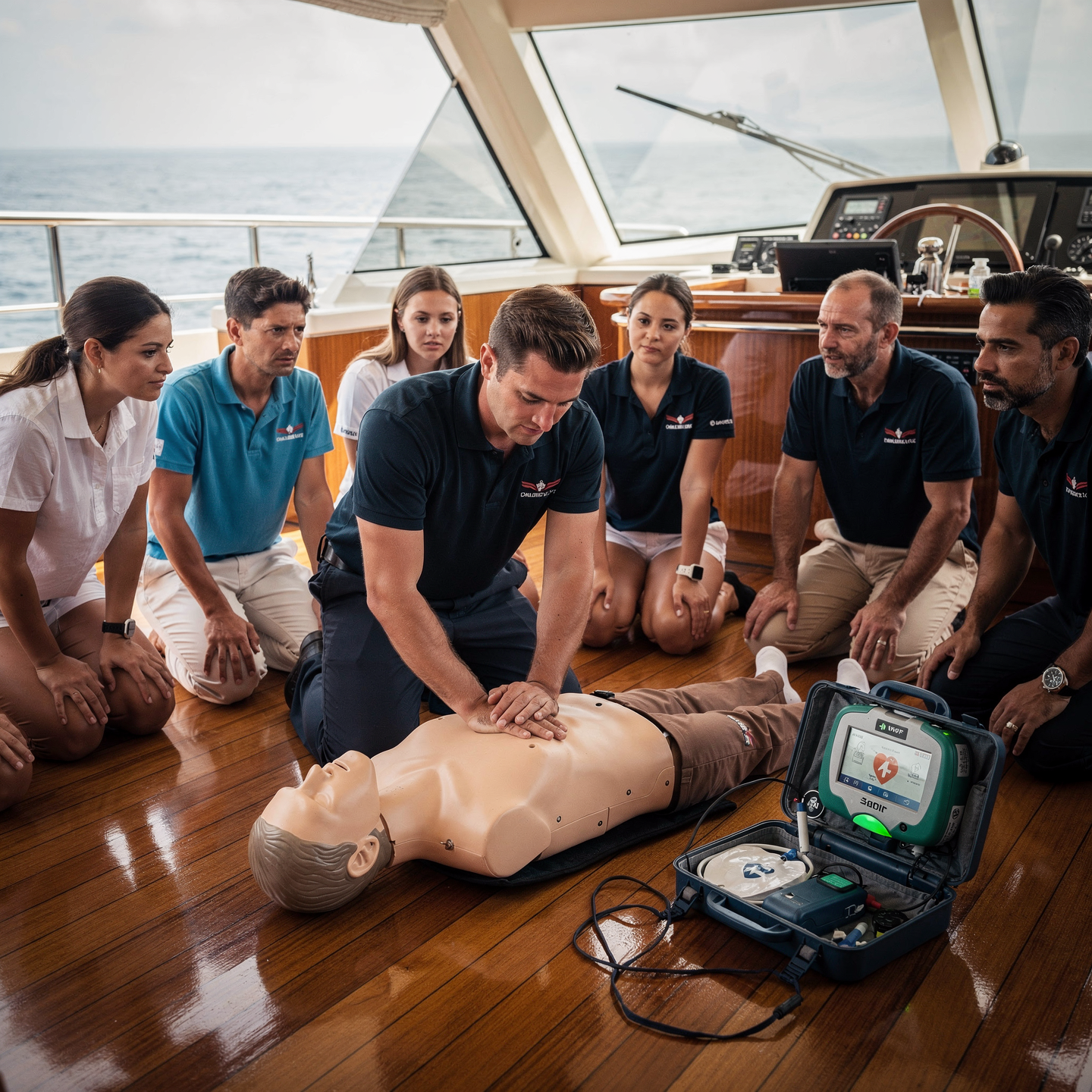
CPR and Defibrillator Use Course
Why this course?
The CPR and Defibrillator Use
This course prepares you to act confidently and effectively in a cardiac emergency, providing vital skills to increase the chances of survival. You will learn cardiopulmonary resuscitation (CPR) techniques for adults, children, and infants, as well as the safe and effective use of an automated external defibrillator (AED). This course empowers you to respond quickly in critical situations, whether at home, at work, or in public spaces.
This course prepares you to act confidently and effectively in a cardiac emergency, providing vital skills to increase the chances of survival.
Differential Advantages
- Practical Simulations: Realistic exercises with mannequins and training AEDs to solidify your skills.
- Recognized Certification: Obtain a valid certification that accredits your competence in CPR and AED use.
- Expert Instructors: Learn from professionals with extensive experience in medical emergencies.
- Up-to-Date Content: Learn the latest recommendations and resuscitation protocols.
- Safe and Participatory Environment: A learning environment where you can practice and get your questions answered with confidence.
- Modality: Online
- Level: Cursos
- Hours: 150 H
- Start date: 24-10-2026
Availability: 1 in stock
Who is it aimed at?
- Healthcare professionals (doctors, nurses, emergency medical technicians) who need updated certification in basic life support and AED use.
- Security professionals (firefighters, police officers, security guards) with first response responsibility for cardiac arrests in public settings.
- Sports instructors and coaches who want to be prepared to act effectively in emergencies at sports facilities.
- Company personnel (first responders, safety committee members) interested in creating a safer and more responsive work environment.
- General public seeking to acquire life skills to save lives in critical situations and feel more confident in intervene.
Hands-on and certified learning
Intensive training with realistic simulations, qualified instructors, and official accreditation recognized nationally.
Objectives and competencies

Apply cardiopulmonary resuscitation (CPR) techniques and use automated external defibrillators (AEDs) effectively and safely.
“Safely and effectively, prioritizing the chain of survival and adapting to different scenarios and victims.”

To quickly recognize a cardiorespiratory emergency and activate the emergency medical response system.
“Assess the patient (ABC), initiate basic CPR, and request specialized help (EMS) with concise information.”

Minimize brain downtime during cardiac arrest.
“Optimize high-quality CPR and ensure early defibrillation, prioritizing continuous cerebral perfusion.”

Coordinate efforts with other rescuers to optimize patient care during a cardiac arrest event:
Clear communication, defined roles, and constant feedback to ensure effective resuscitation and minimize disruptions.

Improving patient survival after cardiac arrest:
Implement the AHA/ERC guidelines by optimizing the chain of survival and post-resuscitation monitoring.

Reduce anxiety and stress in emergency situations to act calmly and accurately:
“Prioritize a rapid assessment of the situation, establish a clear action plan, and effectively communicate decisions to the team.”
Curriculum - Modules
- Comprehensive Maritime Incident Management: protocols, roles, and chain of command for coordinated response
- Operational Planning and Execution: briefing, routes, weather windows, and go/no-go criteria
- Rapid Risk Assessment: criticality matrix, scene control, and decision-making under pressure
- Operational Communication: VHF/GMDSS, standardized reports, and inter-agency liaison
- Tactical Mobility and Safe Boarding: RHIB maneuvers, approach, mooring, and recovery
- Equipment and Technologies: PPE, signaling, satellite tracking, and field data logging
- Immediate Care of the Affected: primary assessment, hypothermia, trauma, and stabilization for evacuation
- Adverse Environmental Conditions: swell, Visibility, flows, and operational mitigation
Simulation and training: critical scenarios, use of VR/AR, and exercises with performance metrics
Documentation and continuous improvement: lessons learned, indicators (MTTA/MTTR), and SOP updates
- Introduction to Basic Life Support (BLS): Key concepts and chain of survival.
- Patient Assessment: Recognizing vital signs and level of consciousness.
- Activating the Emergency System: Calling 112/911 and effective communication.
- Opening and Maintaining the Airway: Maneuvers and devices.
- Ventilation: Mouth-to-mouth, mouth-to-nose, and with barrier devices.
- Chest Compressions: Correct technique, rate, and depth.
- CPR in Adults: Sequence of actions and special considerations.
- CPR in Children and Infants: Adaptations and key differences.
- Automated External Defibrillation (AED): Operation, safety, and maintenance.
- Integrated practice: Simulation of BLS and AED scenarios.
‘
- Introduction to Basic Life Support (BLS): Key concepts, chain of survival, and ethical considerations.
- Patient assessment: Recognition of vital signs, level of consciousness, and activation of the emergency response system.
- CPR in adults: Chest compressions, rescue breathing, and compression-to-ventilation ratio.
- CPR in children and infants: Differences in technique, dosage, and special considerations.
- Foreign body airway obstruction (FBAO): Heimlich maneuver in adults, children, and infants, and modifications for pregnant women.
- Automated External Defibrillation (AED): Principles of defibrillation, safety, equipment maintenance, and shockable rhythms.
- AED Management: pad application, heart rhythm analysis, and shock delivery.
- Special Considerations in BLS and AED: hypothermia, drowning, electrocution, and overdose.
- Teamwork and Communication: the rescuer’s role, coordinator’s role, and emotional support.
- Drills and Integrated BLS and AED Practice: realistic scenarios and performance evaluation.
‘
- Introduction to Basic Life Support (BLS): Definition and objectives.
- Legal and ethical aspects of BLS and early defibrillation.
- Scene and patient assessment: Safety, level of consciousness, and breathing.
- Activating the emergency system: Calling 112/061 and requesting help.
- Opening the airway and managing foreign body obstruction (choking).
- Artificial ventilation: Mouth-to-mouth, mouth-to-nose, and with barrier devices.
- Chest compressions: Correct technique and rate in adults, children, and infants.
- BLS sequence: Combination of chest compressions and ventilations.
- Defibrillation Automated External Defibrillator (AED): Operation, safety, and precautions.
- AED Maintenance: Inspection, cleaning, and replacement of electrodes and batteries.
- Defibrillable and non-defibrillable heart rhythms.
- Integrating the AED into the BLS sequence: Key moments and AED messages.
- Special considerations: Drowning, electrocution, hypothermia.
- Recovery position: Indications and technique.
- Teamwork and effective communication during an emergency.
- Simulation of practical cases: Application of learned skills.
- Knowledge updates and refresher courses: Importance of continuing education.
‘
- Introduction to Life Support: Key Concepts and Chain of Survival
- CPR in Adults: Assessment, Chest Compressions, Ventilations, and AED Use
- CPR in Children and Infants: Technique Adaptations, Anatomical and Physiological Differences
- Airway Obstruction: Heimlich Maneuver in Adults, Children, and Infants
- Use of the Automated External Defibrillator (AED): Operation, Safety, and Maintenance
- First Aid: Scene and Victim Assessment, Priorities of Action
- Bleeding and Shock: Hemorrhage Control, Signs and Symptoms of Shock, Treatment
- Bone, Joint, and Muscle Injuries: Immobilization, bandaging, and transfers
Burns: Classification, initial treatment, and prevention of complications
Common Medical Emergencies: Heart attack, stroke, diabetes, seizures, and allergic reactions‘
- System Architecture and Components: Structural design, materials, and subsystems (mechanical, electrical, electronic, and fluid) with selection and assembly criteria for marine environments
- Fundamentals and Principles of Operation: Physical and engineering foundations (thermodynamics, fluid mechanics, electricity, control, and materials) that explain performance and operating limits
- Safety and Environmental (SHE): Risk analysis, PPE, LOTO, hazardous atmospheres, spill and waste management, and emergency response plans
- Applicable Regulations and Standards: IMO/ISO/IEC requirements and local regulations;
- Conformance criteria, certification, and best practices for operation and maintenance
- Inspection, testing, and diagnostics: Visual/dimensional inspection, functional testing, data analysis, and predictive techniques (vibration, thermography, fluid analysis) to identify root causes
- Preventive and predictive maintenance: Hourly/cycle/seasonal plans, lubrication, adjustments, calibrations, consumable replacement, post-service verification, and operational reliability
- Instrumentation, tools, and metrology: Measuring and testing equipment, diagnostic software, calibration and traceability; selection criteria, safe use, and storage
- Onboard integration and interfaces: Mechanical, electrical, fluid, and data compatibility; Sealing and watertightness, EMC/EMI, corrosion protection, and interoperability testing.
Quality, acceptance testing, and commissioning: process and materials control, FAT/SAT, bench and sea trials, go/no-go criteria, and evidence documentation.
Technical documentation and integrated practice: logs, checklists, reports, and a complete case study (safety → diagnosis → intervention → verification → report) applicable to any system.
Plan de estudio - Módulos
- Comprehensive Maritime Incident Management: protocols, roles, and chain of command for coordinated response
- Operational Planning and Execution: briefing, routes, weather windows, and go/no-go criteria
- Rapid Risk Assessment: criticality matrix, scene control, and decision-making under pressure
- Operational Communication: VHF/GMDSS, standardized reports, and inter-agency liaison
- Tactical Mobility and Safe Boarding: RHIB maneuvers, approach, mooring, and recovery
- Equipment and Technologies: PPE, signaling, satellite tracking, and field data logging
- Immediate Care of the Affected: primary assessment, hypothermia, trauma, and stabilization for evacuation
- Adverse Environmental Conditions: swell, Visibility, flows, and operational mitigation
Simulation and training: critical scenarios, use of VR/AR, and exercises with performance metrics
Documentation and continuous improvement: lessons learned, indicators (MTTA/MTTR), and SOP updates
- Introduction to Basic Life Support (BLS): Key concepts and chain of survival.
- Patient Assessment: Recognizing vital signs and level of consciousness.
- Activating the Emergency System: Calling 112/911 and effective communication.
- Opening and Maintaining the Airway: Maneuvers and devices.
- Ventilation: Mouth-to-mouth, mouth-to-nose, and with barrier devices.
- Chest Compressions: Correct technique, rate, and depth.
- CPR in Adults: Sequence of actions and special considerations.
- CPR in Children and Infants: Adaptations and key differences.
- Automated External Defibrillation (AED): Operation, safety, and maintenance.
- Integrated practice: Simulation of BLS and AED scenarios.
‘
- Introduction to Basic Life Support (BLS): Key concepts, chain of survival, and ethical considerations.
- Patient assessment: Recognition of vital signs, level of consciousness, and activation of the emergency response system.
- CPR in adults: Chest compressions, rescue breathing, and compression-to-ventilation ratio.
- CPR in children and infants: Differences in technique, dosage, and special considerations.
- Foreign body airway obstruction (FBAO): Heimlich maneuver in adults, children, and infants, and modifications for pregnant women.
- Automated External Defibrillation (AED): Principles of defibrillation, safety, equipment maintenance, and shockable rhythms.
- AED Management: pad application, heart rhythm analysis, and shock delivery.
- Special Considerations in BLS and AED: hypothermia, drowning, electrocution, and overdose.
- Teamwork and Communication: the rescuer’s role, coordinator’s role, and emotional support.
- Drills and Integrated BLS and AED Practice: realistic scenarios and performance evaluation.
‘
- Introduction to Basic Life Support (BLS): Definition and objectives.
- Legal and ethical aspects of BLS and early defibrillation.
- Scene and patient assessment: Safety, level of consciousness, and breathing.
- Activating the emergency system: Calling 112/061 and requesting help.
- Opening the airway and managing foreign body obstruction (choking).
- Artificial ventilation: Mouth-to-mouth, mouth-to-nose, and with barrier devices.
- Chest compressions: Correct technique and rate in adults, children, and infants.
- BLS sequence: Combination of chest compressions and ventilations.
- Defibrillation Automated External Defibrillator (AED): Operation, safety, and precautions.
- AED Maintenance: Inspection, cleaning, and replacement of electrodes and batteries.
- Defibrillable and non-defibrillable heart rhythms.
- Integrating the AED into the BLS sequence: Key moments and AED messages.
- Special considerations: Drowning, electrocution, hypothermia.
- Recovery position: Indications and technique.
- Teamwork and effective communication during an emergency.
- Simulation of practical cases: Application of learned skills.
- Knowledge updates and refresher courses: Importance of continuing education.
‘
- Introduction to Life Support: Key Concepts and Chain of Survival
- CPR in Adults: Assessment, Chest Compressions, Ventilations, and AED Use
- CPR in Children and Infants: Technique Adaptations, Anatomical and Physiological Differences
- Airway Obstruction: Heimlich Maneuver in Adults, Children, and Infants
- Use of the Automated External Defibrillator (AED): Operation, Safety, and Maintenance
- First Aid: Scene and Victim Assessment, Priorities of Action
- Bleeding and Shock: Hemorrhage Control, Signs and Symptoms of Shock, Treatment
- Bone, Joint, and Muscle Injuries: Immobilization, bandaging, and transfers
Burns: Classification, initial treatment, and prevention of complications
Common Medical Emergencies: Heart attack, stroke, diabetes, seizures, and allergic reactions‘
- System Architecture and Components: Structural design, materials, and subsystems (mechanical, electrical, electronic, and fluid) with selection and assembly criteria for marine environments
- Fundamentals and Principles of Operation: Physical and engineering foundations (thermodynamics, fluid mechanics, electricity, control, and materials) that explain performance and operating limits
- Safety and Environmental (SHE): Risk analysis, PPE, LOTO, hazardous atmospheres, spill and waste management, and emergency response plans
- Applicable Regulations and Standards: IMO/ISO/IEC requirements and local regulations;
- Conformance criteria, certification, and best practices for operation and maintenance
- Inspection, testing, and diagnostics: Visual/dimensional inspection, functional testing, data analysis, and predictive techniques (vibration, thermography, fluid analysis) to identify root causes
- Preventive and predictive maintenance: Hourly/cycle/seasonal plans, lubrication, adjustments, calibrations, consumable replacement, post-service verification, and operational reliability
- Instrumentation, tools, and metrology: Measuring and testing equipment, diagnostic software, calibration and traceability; selection criteria, safe use, and storage
- Onboard integration and interfaces: Mechanical, electrical, fluid, and data compatibility; Sealing and watertightness, EMC/EMI, corrosion protection, and interoperability testing.
Quality, acceptance testing, and commissioning: process and materials control, FAT/SAT, bench and sea trials, go/no-go criteria, and evidence documentation.
Technical documentation and integrated practice: logs, checklists, reports, and a complete case study (safety → diagnosis → intervention → verification → report) applicable to any system.
- Introduction to Basic Life Support (BLS) and Automated External Defibrillation (AED)
- Ethical and Legal Considerations in the Provision of BLS and Use of the AED
- Basic Anatomy and Physiology of the Cardiovascular and Respiratory Systems
- Scene Assessment and Biosafety: Universal Precautions
- Recognition of Cardiopulmonary Arrest (CPA) in Adults, Children, and Infants
- Activation of the Emergency Medical Services (EMS) System and Request for Help
- Chest Compressions: Correct Technique and Effectiveness
- Rescue Breathing: Mouth-to-Mouth, Mouth-to-Nose, with Barrier Device
- Basic Life Support (BLS) Algorithm for adults, children, and infants
- Use of the Automated External Defibrillator (AED): indications, contraindications, and safety
‘
- Introduction to Basic Life Support (BLS): Key Concepts and Objectives
- Initial Patient Assessment: Consciousness, Breathing, and Circulation (ABCs)
- Activating the Emergency System: Calling 112/Emergency Services
- CPR in Adults: Chest Compressions and Ventilations
- CPR in Children and Infants: Technique Adaptations
- Foreign Body Airway Obstruction (FBAO): Heimlich Maneuver
- Automated External Defibrillation (AED): Operation and Safety
- Cardiac Arrest Response Protocols: Algorithms and Sequences
- Legal and ethical considerations: Consent, responsibility, and confidentiality.
- Integrated practice and scenario simulation: Application of acquired knowledge.
‘
- Introduction to Basic Life Support (BLS) and Automated External Defibrillation (AED)
- Ethical and Legal Considerations in the Application of BLS and AED
- Basic Anatomy and Physiology of the Cardiovascular and Respiratory Systems
- Patient Assessment: Recognition of Vital Signs and Emergency Response
- Activation of the Emergency Response System and Request for Help
- Basic Cardiopulmonary Resuscitation (CPR) in Adults: Chest Compressions and Ventilations
- Basic CPR in Children and Infants: Modifications and Adaptations
- Airway Obstruction Relief in Adults, Children, and Infants (Choking)
- Use of the Automated External Defibrillator (AED): indications, contraindications, and precautions
- Integrated practice of CPR and AED: simulated scenarios and skills assessment
‘
- Introduction to Basic Life Support (BLS): Definition and Objectives.
- Basic Anatomy and Physiology of the Respiratory and Circulatory Systems.
- Patient Assessment: Level of consciousness, respiration, and pulse.
- Airway Opening and Maintenance: Maneuvers and Devices.
- Artificial Ventilation: Mouth-to-mouth, mouth-to-nose, and with barrier devices.
- Chest Compressions: Correct Technique and Appropriate Depth.
- BLS Sequence in Adults, Children, and Infants: Age-Related Adaptations.
- Defibrillation: Operation of the Automated External Defibrillator (AED).
- Protocol for Action: AED use, safety, and maintenance.
Integrated BLS and defibrillation practice: Simulation of real-life cases.
‘
Career opportunities
- Healthcare personnel: nurses, doctors, nursing assistants, and paramedics, trained to respond to in-hospital and out-of-hospital emergencies.
- Emergency Medical Technicians: professionals trained in pre-hospital care and the transport of critically ill patients.
- Firefighters: rescue personnel who require CPR and defibrillation skills to respond to emergencies.
- Police and security forces: first responders in emergency situations, with the need to perform CPR and use defibrillators.
- Sports center and gym staff: instructors, trainers, and reception staff must be trained to respond to cardiac arrest.
- Educational center staff: teachers, administrative, and support staff must have CPR skills to assist students and Colleagues.
- Aquatic Lifeguards: Professionals responsible for safety in swimming pools, beaches, and other aquatic environments, where CPR is essential.
- Civil Protection and Non-Governmental Organization Volunteers: Personnel involved in emergency and natural disaster response.
- Employee and Organization Staff: Implementation of CPR training programs for employees as part of an occupational risk prevention plan.
- Caregivers of Dependent Persons: Family members or professionals who care for people with chronic illnesses or reduced mobility, where the risk of cardiac arrest is higher.
“`
Admission requirements

Academic/professional profile:
Degree/Bachelor's degree in Nautical Science/Maritime Transport, Naval/Marine Engineering, or a related field; or proven professional experience in bridge/operations.

Language proficiency:
Recommended functional maritime English (SMCP) for simulations and technical materials.

5. Induction
Updated resume, copy of degree or seaman's book, ID card/passport, letter of motivation.

Technical requirements (for online):
Equipment with camera/microphone, stable connection, ≥ 24” monitor recommended for ECDIS/Radar-ARPA.
Admission process and dates

1. Online
application
(form + documents).

2. Academic review and interview
(profile/objectives/schedule compatibility).

3. Admission decision
(+ scholarship proposal if applicable).

4. Reservation of place
(deposit) and registration.

5. Induction
(access to campus, calendars, simulator guides).
Scholarships and grants
- Save lives: Learn essential CPR techniques and the safe use of an AED (Automated External Defibrillator).
- Official certification: Obtain a recognized certification that qualifies you to act in cardiac emergencies.
- Intensive practice: Hands-on sessions with realistic simulations and state-of-the-art equipment.
- For everyone: No prior experience required. This course is designed for healthcare professionals and the general public.
- React with confidence: Acquire the skills necessary to respond effectively to cardiac arrest.
Testimonials
Thanks to my CPR and defibrillator training, I was able to assist a coworker who suffered a cardiac arrest. I applied the techniques I had learned while waiting for emergency services to arrive, and the doctor confirmed that my quick intervention was crucial in saving his life.
I successfully applied the techniques learned in the Marine Health and First Aid course to stabilize a crew member who suffered a severe burn during a voyage, allowing for his safe evacuation and full recovery.
I successfully performed CPR and used an AED on a coworker who suddenly collapsed. By remaining calm and following the protocol I had learned, I was able to restore his pulse and breathing before emergency services arrived. I was commended for my quick action and knowledge, which were crucial in saving his life.
I successfully performed CPR and used an AED on a coworker who suddenly collapsed. Remaining calm, I followed protocol, successfully restoring his pulse and breathing before the paramedics arrived. His subsequent full recovery was largely attributed to my quick and effective intervention.

Frequently asked questions
Check for responsiveness, activate emergency medical services (call 911 in the US), start chest compressions, open the airway, and administer rescue breaths.
Yes. The itinerary includes ECDIS/Radar-ARPA/BRM with harbor, ocean, fog, storm, and SAR scenarios.
Online with live sessions; hybrid option for simulator/practical placements through agreements.
100-120 compressions per minute.
Recommended functional SMCP. We offer support materials for standard phraseology.
Yes, with a relevant degree or experience in maritime/port operations. The admissions interview will confirm suitability.
Optional (3–6 months) through Companies & Collaborations and the Alumni Network.
Simulator practice (rubrics), defeat plans, SOPs, checklists, micro-tests and applied TFM.
A degree from Navalis Magna University + operational portfolio (tracks, SOPs, reports and KPIs) useful for audits and employment.
- Introduction to Basic Life Support (BLS): Definition and Objectives.
- Basic Anatomy and Physiology of the Respiratory and Circulatory Systems.
- Patient Assessment: Level of consciousness, respiration, and pulse.
- Airway Opening and Maintenance: Maneuvers and Devices.
- Artificial Ventilation: Mouth-to-mouth, mouth-to-nose, and with barrier devices.
- Chest Compressions: Correct Technique and Appropriate Depth.
- BLS Sequence in Adults, Children, and Infants: Age-Related Adaptations.
- Defibrillation: Operation of the Automated External Defibrillator (AED).
- Protocol for Action: AED use, safety, and maintenance.
Integrated BLS and defibrillation practice: Simulation of real-life cases.
‘
Request information
- Complete the Application Form
- Attach your CV/Qualifications (if you have them to hand).
- Indicate your preferred cohort (January/May/September) and whether you want the hybrid option with simulator sessions.
Teachers
Eng. Tomás Riera
Full Professor
Eng. Tomás Riera
Full Professor
Eng. Sofía Marquina
Full Professor
Eng. Sofía Marquina
Full Professor
Eng. Javier Bañuls
Full Professor
Eng. Javier Bañuls
Full Professor
Dr. Nuria Llobregat
Full Professor
Dr. Nuria Llobregat
Full Professor
Dr. Pau Ferrer
Full Professor
Dr. Pau Ferrer
Full Professor
Cap. Javier Abaroa (MCA)
Full Professor
Cap. Javier Abaroa (MCA)
Full Professor

