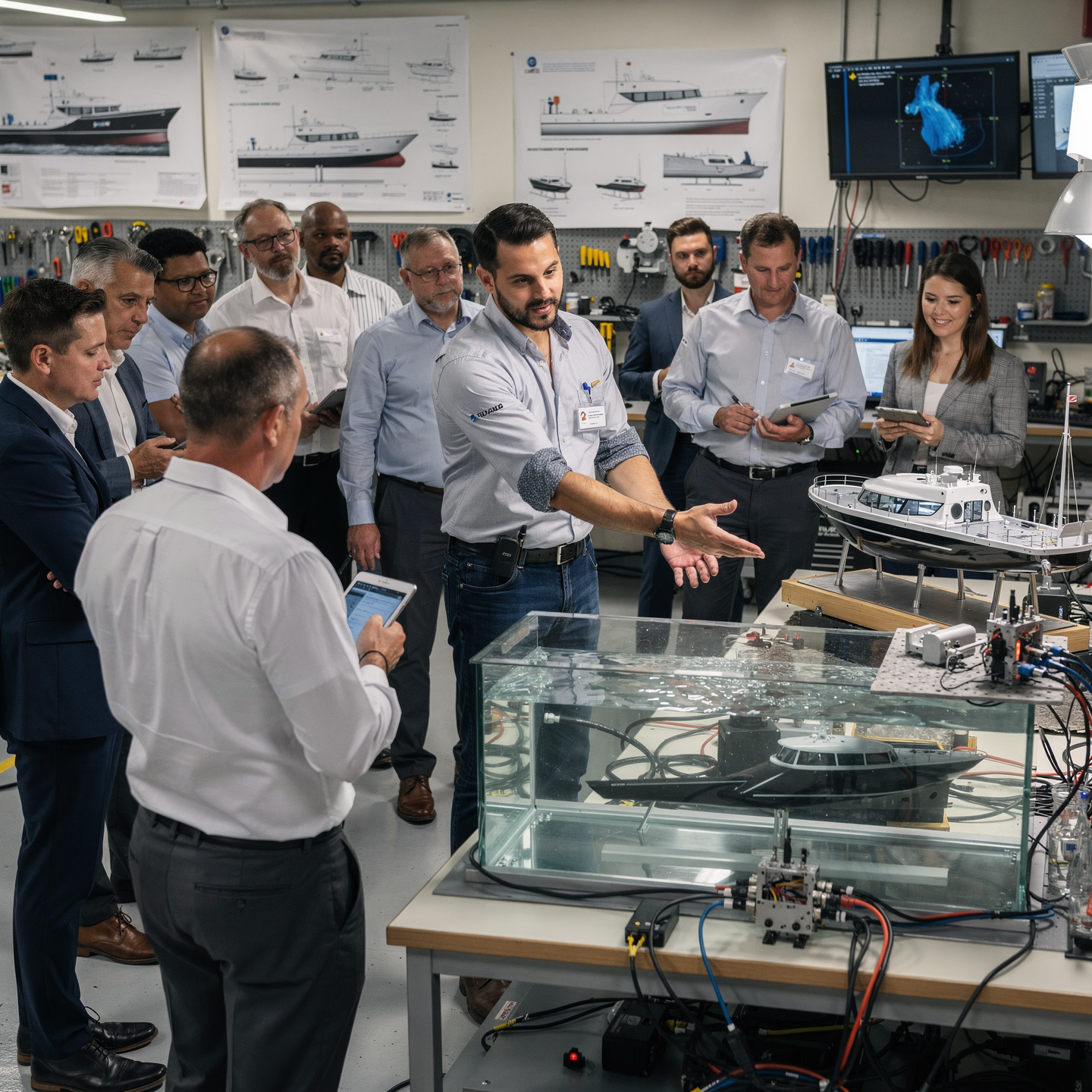
Course on Prototypes and Innovation Testing

Why this course?

The Prototypes and Innovation Testing

course

Will guide you through the process of transforming ideas into tangible solutions. Learn to design rapid and effective prototypes, from initial sketches to functional mock-ups, to validate your hypotheses and reduce the risk of launching failed products or services. Master testing techniques with real users, gathering valuable feedback that will allow you to iterate and optimize your prototypes until you achieve the best possible version. This program equips you with the necessary tools and methodologies to innovate with confidence and create solutions that truly solve problems.

Differential Advantages

  • Practical Approach: Development of real prototypes throughout the course.
  • Agile Methodologies: Application of Lean Startup and Design Thinking.
  • Real Feedback: User testing sessions and results analysis.
  • Digital Tools: Proficiency in prototyping and design software.
  • Adaptability: Techniques applicable to diverse sectors and industries.
Prototipos

Course on Prototypes and Innovation Testing

Availability: 1 in stock

Who is it aimed at?

  • Entrepreneurs and startups looking to quickly validate ideas, minimizing risks and maximizing the potential of their products.
  • Product managers and UX/UI designers who want to optimize the user experience through iterative testing and real-world feedback.
  • Innovation and development teams that need agile methodologies to accelerate the product lifecycle and adapt to market needs.
  • Marketing and sales professionals interested in understanding customer behavior and improving the effectiveness of their strategies.
  • Students and recent graduates looking to acquire practical skills in prototyping and testing to stand out in the job market.

Flexibility and focus Practical

 Course adaptable to your pace: online lessons at your disposal, practical exercises to apply what you’ve learned, and discussion forum to resolve doubts.

Prototipos

Objectives and competencies

Validate critical hypotheses:

“Prioritize navigational safety, considering the environment and weather conditions, and act proactively in the face of potential risks.”

Iterate quickly on solutions:

Prioritize experimentation and continuous learning to optimize the response to changing situations.

Minimize the risk of failure:

Managing fatigue, stress, and workload by optimizing available resources and applying good safety management practices.

Promote continuous learning:

“Research and adapt to new maritime navigation and communication technologies, sharing findings with the crew.”

Evaluate technical feasibility:

Analyze specifications, plans, and simulations to identify risks and propose efficient technical solutions.

Accelerate market entry:

Plan the journey efficiently, optimizing routes and considering environmental and traffic factors.

Curriculum - Modules

  1. Comprehensive Maritime Incident Management: protocols, roles, and chain of command for coordinated response
  2. Operational Planning and Execution: briefing, routes, weather windows, and go/no-go criteria
  3. Rapid Risk Assessment: criticality matrix, scene control, and decision-making under pressure
  4. Operational Communication: VHF/GMDSS, standardized reports, and inter-agency liaison
  5. Tactical Mobility and Safe Boarding: RHIB maneuvers, approach, mooring, and recovery
  6. Equipment and Technologies: PPE, signaling, satellite tracking, and field data logging
  7. Immediate Care of the Affected: primary assessment, hypothermia, trauma, and stabilization for evacuation
  8. Adverse Environmental Conditions: swell, Visibility, flows, and operational mitigation

    Simulation and training: critical scenarios, use of VR/AR, and exercises with performance metrics

    Documentation and continuous improvement: lessons learned, indicators (MTTA/MTTR), and SOP updates

  1. Introduction to Agile Thinking: Principles and Values.
  2. Design Thinking: Phases and Tools for Ideation.
  3. Lean Startup: The Build-Measure-Learn Cycle.
  4. Customer Development: Interviews and Customer Segmentation.
  5. Hypothesis Generation: Formulation and Prioritization.
  6. MVP (Minimum Viable Product): Types and Development Strategies.
  7. Agile Experimentation: Experiment Design and Key Metrics.
  8. Hypothesis Validation: Results Analysis and Decision Making.
  9. Iteration and Pivoting: Adapting to Market Needs.
  10. Presentation of results: storytelling and effective communication.

  1. Fundamentals of Iterative Design: Principles, advantages, and disadvantages.
  2. The Iterative Life Cycle: Planning, design, implementation, testing, and evaluation.
  3. Prototyping Techniques: Sketches, wireframes, low- and high-fidelity prototypes.
  4. Alpha Testing: Planning, tester recruitment, execution, and results analysis.
  5. Feedback Gathering: Interviews, surveys, usability testing, and web/app analytics.
  6. Feedback Analysis and Prioritization: Identifying critical problems, improvements, and new features.
  7. MVP (Minimum Viable Product): Definition, characteristics, and launch strategies.
  8. Metrics of MVP: Acquisition, Activation, Retention, Referral, and Revenue (AARRR).

    Data-Driven Iteration: Using analytics and feedback to guide further development.

    Case Studies: Examples of success and failure in iterative design, alpha testing, and MVPs.

  1. Introduction to Experimental Design: Basic Concepts and Terminology
  2. Experimental Design Methodologies: Factorial Design, Response Surface Methodology (RSM), Taguchi Method
  3. Variable Selection: Identification of Critical Factors, Sensitivity Analysis
  4. Experimental Planning: Sample Size, Randomization, Blocking
  5. Simulation Software: Introduction to Simulation Tools (e.g., ANSYS, COMSOL, Simulink)
  6. Creating Simulation Models: Simplifications, Initial Validation
  7. Analysis of Simulation Results: Interpretation, Identifying Patterns and Trends
  8. Prototype Construction: Material Selection, Manufacturing Techniques
  9. Instrumentation and Measurement: Sensor Selection, Calibration, Data Acquisition
  10. Prototype validation: comparison with simulation results, adjustments, and optimization

  1. Introduction to Rapid Design and Prototyping: Agile Concepts and Methodologies.
  2. Problem Definition and Target User: Needs Research and Analysis.
  3. Ideation and Idea Generation: Brainstorming and Design Thinking Techniques.
  4. Low-Fidelity Prototyping: Sketches, Wireframes, and Storyboards.
  5. Rapid Prototyping Tools: Design Software and Online Platforms.
  6. Creating Interactive Prototypes: Incorporating Basic Functionalities.
  7. Early Prototype Validation: User Testing and Iterative Feedback.
  8. Design and Prototype Refinement: Feedback-Based Iterations.
  9. Scaling the Prototype: Preparing for Production and Launch.
  10. Documentation of the design and prototyping process: Best practices and lessons learned.

  1. System Architecture and Components: Structural design, materials, and subsystems (mechanical, electrical, electronic, and fluid) with selection and assembly criteria for marine environments
  2. Fundamentals and Principles of Operation: Physical and engineering foundations (thermodynamics, fluid mechanics, electricity, control, and materials) that explain performance and operating limits
  3. Safety and Environmental (SHE): Risk analysis, PPE, LOTO, hazardous atmospheres, spill and waste management, and emergency response plans
  4. Applicable Regulations and Standards: IMO/ISO/IEC requirements and local regulations;
  5. Conformance criteria, certification, and best practices for operation and maintenance
  6. Inspection, testing, and diagnostics: Visual/dimensional inspection, functional testing, data analysis, and predictive techniques (vibration, thermography, fluid analysis) to identify root causes
  7. Preventive and predictive maintenance: Hourly/cycle/seasonal plans, lubrication, adjustments, calibrations, consumable replacement, post-service verification, and operational reliability
  8. Instrumentation, tools, and metrology: Measuring and testing equipment, diagnostic software, calibration and traceability; selection criteria, safe use, and storage
  9. Onboard integration and interfaces: Mechanical, electrical, fluid, and data compatibility; Sealing and watertightness, EMC/EMI, corrosion protection, and interoperability testing.

    Quality, acceptance testing, and commissioning: process and materials control, FAT/SAT, bench and sea trials, go/no-go criteria, and evidence documentation.

    Technical documentation and integrated practice: logs, checklists, reports, and a complete case study (safety → diagnosis → intervention → verification → report) applicable to any system.

Plan de estudio - Módulos

  1. Comprehensive Maritime Incident Management: protocols, roles, and chain of command for coordinated response
  2. Operational Planning and Execution: briefing, routes, weather windows, and go/no-go criteria
  3. Rapid Risk Assessment: criticality matrix, scene control, and decision-making under pressure
  4. Operational Communication: VHF/GMDSS, standardized reports, and inter-agency liaison
  5. Tactical Mobility and Safe Boarding: RHIB maneuvers, approach, mooring, and recovery
  6. Equipment and Technologies: PPE, signaling, satellite tracking, and field data logging
  7. Immediate Care of the Affected: primary assessment, hypothermia, trauma, and stabilization for evacuation
  8. Adverse Environmental Conditions: swell, Visibility, flows, and operational mitigation

    Simulation and training: critical scenarios, use of VR/AR, and exercises with performance metrics

    Documentation and continuous improvement: lessons learned, indicators (MTTA/MTTR), and SOP updates

  1. Introduction to Agile Thinking: Principles and Values.
  2. Design Thinking: Phases and Tools for Ideation.
  3. Lean Startup: The Build-Measure-Learn Cycle.
  4. Customer Development: Interviews and Customer Segmentation.
  5. Hypothesis Generation: Formulation and Prioritization.
  6. MVP (Minimum Viable Product): Types and Development Strategies.
  7. Agile Experimentation: Experiment Design and Key Metrics.
  8. Hypothesis Validation: Results Analysis and Decision Making.
  9. Iteration and Pivoting: Adapting to Market Needs.
  10. Presentation of results: storytelling and effective communication.

  1. Fundamentals of Iterative Design: Principles, advantages, and disadvantages.
  2. The Iterative Life Cycle: Planning, design, implementation, testing, and evaluation.
  3. Prototyping Techniques: Sketches, wireframes, low- and high-fidelity prototypes.
  4. Alpha Testing: Planning, tester recruitment, execution, and results analysis.
  5. Feedback Gathering: Interviews, surveys, usability testing, and web/app analytics.
  6. Feedback Analysis and Prioritization: Identifying critical problems, improvements, and new features.
  7. MVP (Minimum Viable Product): Definition, characteristics, and launch strategies.
  8. Metrics of MVP: Acquisition, Activation, Retention, Referral, and Revenue (AARRR).

    Data-Driven Iteration: Using analytics and feedback to guide further development.

    Case Studies: Examples of success and failure in iterative design, alpha testing, and MVPs.

  1. Introduction to Experimental Design: Basic Concepts and Terminology
  2. Experimental Design Methodologies: Factorial Design, Response Surface Methodology (RSM), Taguchi Method
  3. Variable Selection: Identification of Critical Factors, Sensitivity Analysis
  4. Experimental Planning: Sample Size, Randomization, Blocking
  5. Simulation Software: Introduction to Simulation Tools (e.g., ANSYS, COMSOL, Simulink)
  6. Creating Simulation Models: Simplifications, Initial Validation
  7. Analysis of Simulation Results: Interpretation, Identifying Patterns and Trends
  8. Prototype Construction: Material Selection, Manufacturing Techniques
  9. Instrumentation and Measurement: Sensor Selection, Calibration, Data Acquisition
  10. Prototype validation: comparison with simulation results, adjustments, and optimization

  1. Introduction to Rapid Design and Prototyping: Agile Concepts and Methodologies.
  2. Problem Definition and Target User: Needs Research and Analysis.
  3. Ideation and Idea Generation: Brainstorming and Design Thinking Techniques.
  4. Low-Fidelity Prototyping: Sketches, Wireframes, and Storyboards.
  5. Rapid Prototyping Tools: Design Software and Online Platforms.
  6. Creating Interactive Prototypes: Incorporating Basic Functionalities.
  7. Early Prototype Validation: User Testing and Iterative Feedback.
  8. Design and Prototype Refinement: Feedback-Based Iterations.
  9. Scaling the Prototype: Preparing for Production and Launch.
  10. Documentation of the design and prototyping process: Best practices and lessons learned.

  1. System Architecture and Components: Structural design, materials, and subsystems (mechanical, electrical, electronic, and fluid) with selection and assembly criteria for marine environments
  2. Fundamentals and Principles of Operation: Physical and engineering foundations (thermodynamics, fluid mechanics, electricity, control, and materials) that explain performance and operating limits
  3. Safety and Environmental (SHE): Risk analysis, PPE, LOTO, hazardous atmospheres, spill and waste management, and emergency response plans
  4. Applicable Regulations and Standards: IMO/ISO/IEC requirements and local regulations;
  5. Conformance criteria, certification, and best practices for operation and maintenance
  6. Inspection, testing, and diagnostics: Visual/dimensional inspection, functional testing, data analysis, and predictive techniques (vibration, thermography, fluid analysis) to identify root causes
  7. Preventive and predictive maintenance: Hourly/cycle/seasonal plans, lubrication, adjustments, calibrations, consumable replacement, post-service verification, and operational reliability
  8. Instrumentation, tools, and metrology: Measuring and testing equipment, diagnostic software, calibration and traceability; selection criteria, safe use, and storage
  9. Onboard integration and interfaces: Mechanical, electrical, fluid, and data compatibility; Sealing and watertightness, EMC/EMI, corrosion protection, and interoperability testing.

    Quality, acceptance testing, and commissioning: process and materials control, FAT/SAT, bench and sea trials, go/no-go criteria, and evidence documentation.

    Technical documentation and integrated practice: logs, checklists, reports, and a complete case study (safety → diagnosis → intervention → verification → report) applicable to any system.

  1. Introduction to Innovative Design: Definition, typologies, and methodologies.
  2. Needs Research and Analysis: Identifying problems and opportunities.
  3. Idea Generation and Conceptualization: Creativity and brainstorming techniques.
  4. Rapid Prototyping: Materials, tools, and construction techniques.
  5. Prototype Validation: Usability testing, testing, and feedback.
  6. Iteration and Continuous Improvement: Analysis of results and design optimization.
  7. Prototype Scaling: Technical, economic, and market considerations.
  8. Intellectual Property and Patents: Protecting innovation and copyright.
  9. Prototype Presentation and Communication: Marketing and pitching strategies.
  10. Financing and commercializing prototypes: Investment sources and business models.

  1. Introduction to experimental design: basic concepts and types of designs.
  2. Planning the experiment: defining objectives, variables, and factors.
  3. Selection of experimental designs: factorial designs, response surface methodology (RSM) designs, robust designs.
  4. Statistical analysis of experimental data: ANOVA, regression, hypothesis testing.
  5. Validation of experimental results: significance tests, confidence intervals, residual analysis.
  6. Implementation of continuous improvement techniques: PDCA cycle, Six Sigma, Lean Manufacturing.
  7. Optimization methodologies: genetic algorithms, gradient methods, simulation.
  8. Risk analysis and uncertainty management in experimental design.
  9. Software tools for the design and analysis of Experiments: Minitab, R, JMP.

    Case studies and practical applications in different industries.

  1. Introduction to Experimental Design: Principles and Types of Experiments
  2. Defining Hypotheses: Independent and Dependent Variables, Operationalization
  3. Key Metrics: Selection, Definition, and Alignment with Business Objectives
  4. A/B Experiment Design: Sample Size, Statistical Power, Randomization
  5. Qualitative and Quantitative Feedback: Collection and Analysis Methods
  6. Experiment Implementation: Testing Tools, Version Management
  7. Results Analysis: Statistical Significance, Confidence Intervals
  8. Agile Iteration: Continuous Learning, Pivots, Incremental Improvements
  9. Data Visualization: Dashboards, Reports, Communicating Insights
  10. Ethics in Experimentation: privacy, consent, transparency

  1. Agile Design Fundamentals: principles, values, and the Agile Manifesto
  2. Iteration and Incremental Development: short cycles, feedback, and adaptation
  3. Lean Startup: build, measure, learn; The Validation Cycle

    Experimentation and A/B Testing: Experiment Design, Metrics, and Analysis

    Customer Development: Interviews, Surveys, and Behavioral Analysis

    Rapid Prototyping: MVP, Wireframes, Mockups, and Usability Testing

    Key Metrics: Acquisition, Activation, Retention, Referral, Revenue (AARRR)

    Data Analysis: Tools, Visualization, and Interpretation

    Pivoting: Identifying Opportunities and Changing Direction

    Continuous Learning Culture: Retrospectives, Continuous Improvement, and Adapting to Change

Career opportunities

  • Prototype Designer: Creation and development of functional prototypes in various sectors.
  • Innovation Tester: Evaluation and analysis of new products and services, identifying areas for improvement.
  • Innovation Consultant: Advising companies on the implementation of innovation processes and prototype design.
  • Innovation Project Manager: Planning and execution of prototype development and testing projects.
  • Market Researcher: Analysis of market trends and needs for the creation of innovative prototypes.
  • Entrepreneur: Development of personal prototypes for the creation of new products or services.
  • UX/UI Specialist: Design of the user experience and interface of digital prototypes.
  • Prototyping Lab Technician: Operation and maintenance of equipment for prototyping.

“`

Admission requirements

Academic/professional profile:

Degree/Bachelor's degree in Nautical Science/Maritime Transport, Naval/Marine Engineering, or a related field; or proven professional experience in bridge/operations.

Language proficiency:

Recommended functional maritime English (SMCP) for simulations and technical materials.

5. Induction

Updated resume, copy of degree or seaman's book, ID card/passport, letter of motivation.

Technical requirements (for online):

Equipment with camera/microphone, stable connection, ≥ 24” monitor recommended for ECDIS/Radar-ARPA.

Admission process and dates

1. Online
application

(form + documents).

2. Academic review and interview

(profile/objectives/schedule compatibility).

3. Admission decision

(+ scholarship proposal if applicable).

4. Reservation of place

(deposit) and registration.

5. Induction

(access to campus, calendars, simulator guides).

Scholarships and grants

  • Master Prototyping: Create interactive and functional prototypes to validate your ideas quickly and effectively.
  • Effective User Testing: Learn to design and run user tests that provide valuable information to improve your product or service.
  • Iteration and Continuous Improvement: Discover how to use test results to iterate and optimize your prototypes, maximizing the potential of your innovation.
  • Tools and Methodologies: Familiarize yourself with the most widely used tools and methodologies in the field of prototyping and innovation testing.
  • Hypothesis Validation: Learn to validate your innovation hypotheses through experimentation and data analysis.
Boost your projects innovation with a practical and results-oriented approach.

Testimonials

Frequently asked questions

Validate and refine product or service ideas before launching them to market.

Yes. The itinerary includes ECDIS/Radar-ARPA/BRM with harbor, ocean, fog, storm, and SAR scenarios.

Online with live sessions; hybrid option for simulator/practical placements through agreements.

Validate and refine ideas quickly and cost-effectively before large-scale production.

Recommended functional SMCP. We offer support materials for standard phraseology.

Yes, with a relevant degree or experience in maritime/port operations. The admissions interview will confirm suitability.

Optional (3–6 months) through Companies & Collaborations and the Alumni Network.

Simulator practice (rubrics), defeat plans, SOPs, checklists, micro-tests and applied TFM.

A degree from Navalis Magna University + operational portfolio (tracks, SOPs, reports and KPIs) useful for audits and employment.

  1. Agile Design Fundamentals: principles, values, and the Agile Manifesto
  2. Iteration and Incremental Development: short cycles, feedback, and adaptation
  3. Lean Startup: build, measure, learn; The Validation Cycle

    Experimentation and A/B Testing: Experiment Design, Metrics, and Analysis

    Customer Development: Interviews, Surveys, and Behavioral Analysis

    Rapid Prototyping: MVP, Wireframes, Mockups, and Usability Testing

    Key Metrics: Acquisition, Activation, Retention, Referral, Revenue (AARRR)

    Data Analysis: Tools, Visualization, and Interpretation

    Pivoting: Identifying Opportunities and Changing Direction

    Continuous Learning Culture: Retrospectives, Continuous Improvement, and Adapting to Change

Request information

  1. Complete the Application Form
  2. Attach your CV/Qualifications (if you have them to hand).
  3. Indicate your preferred cohort (January/May/September) and whether you want the hybrid option with simulator sessions.
An academic advisor will contact you within 24–48 hours to guide you through the admission process, scholarships, and compatibility with your professional schedule. Translated with DeepL.com (free version)
Please enable JavaScript in your browser to complete this form.
Click or drag a file to this area to upload.

Teachers

0
    0
    Tu carrito
    Tu carrito esta vacíoRegresar a la tienda
    Scroll to Top


