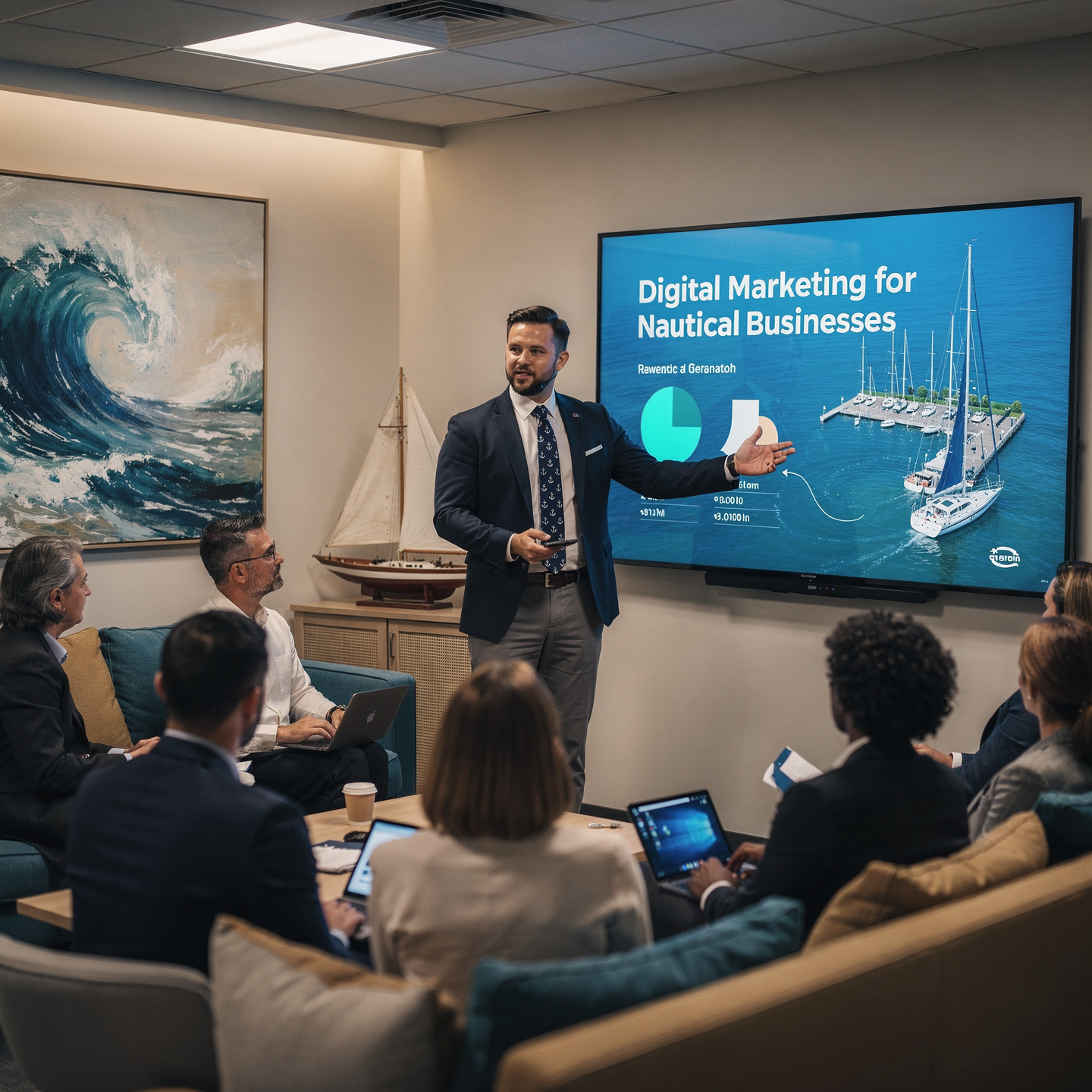
Digital Marketing Course for Nautical Businesses
Why this course?
The Digital Marketing Course for Nautical Businesses
This course provides you with the essential tools to boost your online presence and attract clients in the maritime sector. Learn to optimize your digital strategy, from creating engaging content to effectively using social media and targeted advertising. Master specialized SEO for the nautical niche and measure your results with advanced web analytics.
Differentiating Advantages
- Practical Approach: Implement real strategies and success stories from the nautical sector.
- Nautical SEO: Position your business in the top search results.
- Targeted Advertising: Reach your target audience with effective campaigns.
- Web Analytics: Measure and optimize your results for maximum ROI.
- Online Community: Connect with other professionals in the sector and share experiences.
- Modality: Online
- Level: Cursos
- Hours: 150 H
- Start date: 26-07-2026
Availability: 1 in stock
Who is it aimed at?
- Owners and managers of marinas, shipyards, and nautical shops looking to increase their online visibility and attract more customers.
- Nautical professionals (sales, charters, services) who want to master digital tools to boost their business.
- Nautical entrepreneurs who need to create an effective digital marketing strategy to launch and grow their brand.
- Marketing managers of nautical companies interested in optimizing their campaigns and achieving a higher return on investment.
- Nautical enthusiasts with basic marketing knowledge who aspire to a career in digital marketing specializing in the sector nautical.
Flexibility adapted to the sector
Online course with accessible content 24/7, practical examples from the nautical sector and personalized tutoring to answer your questions.
Objectives and competencies

Riding the digital wave: Attracting and converting customers through online marketing strategies.
“Implement SEO/SEM, Social Media, Email Marketing and Web Analytics strategies to optimize customer acquisition and retention.”

Anchoring your online presence: Building a strong and differentiated digital brand for your nautical business.
Create valuable content (blog, social media) that positions you as a leader in the nautical community, attracting qualified traffic and encouraging interaction.

Set sail for success: Boost the growth and profitability of your nautical business with digital marketing.
“Master digital marketing tools to attract, convert, and retain customers, optimizing online presence and communication to maximize sales and return on investment.”

Mastering the winds of SEO: Optimizing your content to appear in the top search results.
“Implement keyword research, on-page optimization, and link building strategies to climb the SERP rankings.”
Mapping the customer experience: Designing a captivating digital journey from attraction to loyalty.
“Identify key touchpoints, optimize flows, and personalize the interaction to maximize conversion and loyalty.”

Conquer the social seas: Create vibrant online communities and connect with your ideal audience.
“Define brand identity, create engaging content, and foster constant interaction to build lasting relationships.”
Curriculum - Modules
- Comprehensive Maritime Incident Management: protocols, roles, and chain of command for coordinated response
- Operational Planning and Execution: briefing, routes, weather windows, and go/no-go criteria
- Rapid Risk Assessment: criticality matrix, scene control, and decision-making under pressure
- Operational Communication: VHF/GMDSS, standardized reports, and inter-agency liaison
- Tactical Mobility and Safe Boarding: RHIB maneuvers, approach, mooring, and recovery
- Equipment and Technologies: PPE, signaling, satellite tracking, and field data logging
- Immediate Care of the Affected: primary assessment, hypothermia, trauma, and stabilization for evacuation
- Adverse Environmental Conditions: swell, Visibility, flows, and operational mitigation
Simulation and training: critical scenarios, use of VR/AR, and exercises with performance metrics
Documentation and continuous improvement: lessons learned, indicators (MTTA/MTTR), and SOP updates
- Introduction to Digital Marketing in the Nautical Sector: current landscape and trends.
- Nautical SEO: search engine optimization for nautical products and services.
- Online Advertising: Google Ads, Social Ads, and remarketing campaigns for the sector.
- Social Media: content strategies, community management, and advertising on nautical platforms.
- Email Marketing: audience segmentation, newsletter creation, and campaign automation.
- Content Marketing: creation of blogs, guides, videos, and other relevant resources for the target audience.
- Web Analytics: results measurement, KPI tracking, and digital strategy optimization.
- E-commerce Nautical: Online store optimization, payment management, and logistics for nautical products.
Online Reputation: Review management, brand monitoring, and social media comment response.
Digital Legislation: Regulatory compliance in data protection, advertising, and e-commerce.
‘
- Introduction to Digital Marketing in the Nautical Sector: Current Landscape and Trends
- SEO for Nautical Industry: Keyword Research, On-Page and Off-Page Optimization
- Content Marketing: Creating Blogs, Guides, Videos, and Success Stories
- Social Media Marketing: Strategies for Facebook, Instagram, LinkedIn, and YouTube
- Online Advertising: Google Ads, Social Ads, and Remarketing Campaigns
- Email Marketing: List Building, Segmentation, and Newsletter Automation
- Web Analytics: Google Analytics, Key Metrics, and Reporting
- Influencer Marketing: Collaborating with Nautical Influencers and Brand Ambassadors
- Online Reputation: Managing Reviews, comments, and online crises
- Mobile Marketing: optimization for mobile devices and nautical apps
‘
- Fundamentals of Digital Marketing: ecosystem, channels, and strategies.
- Nautical Buyer Persona: identification, segmentation, and behavioral analysis.
- Nautical SEO: content optimization for search engines (Google, etc.).
- Nautical Content Marketing: creating blogs, guides, and videos.
- Nautical Social Media: strategies for Facebook, Instagram, YouTube, and LinkedIn.
- Nautical Email Marketing: segmentation, automation, and effective campaigns.
- Nautical Digital Advertising: Google Ads, Social Ads, and remarketing.
- Nautical Web Analytics: measuring results and optimizing campaigns.
- CRM for the nautical sector: customer management and marketing automation.
- Trends in nautical digital marketing: virtual reality, influencers, and proximity marketing.
‘
- Introduction to Digital Marketing in the Nautical Sector: Current Landscape and Trends
- SEO for Nautical Marketing: Keyword Research, On-Page and Off-Page Optimization
- Online Advertising: Google Ads (SEM) for Nautical Marketing: Search, Display, and Remarketing Campaigns
- Social Media: Social Media Strategies (Facebook, Instagram, LinkedIn) for the Nautical Sector
- Content Marketing: Creating Engaging Content (Blog, Videos, Infographics) for the Nautical Audience
- Email Marketing: Segmentation, Automation, and Effective Campaigns for Lead Generation and Retention
- Web Analytics: Measuring Results and Optimizing Digital Strategies
- Lead Generation Strategies: Landing pages, forms, webinars.
Influencer marketing: collaboration with influencers in the nautical sector.
Online reputation and community management: monitoring, responding, and building lasting relationships.
‘
- System Architecture and Components: Structural design, materials, and subsystems (mechanical, electrical, electronic, and fluid) with selection and assembly criteria for marine environments
- Fundamentals and Principles of Operation: Physical and engineering foundations (thermodynamics, fluid mechanics, electricity, control, and materials) that explain performance and operating limits
- Safety and Environmental (SHE): Risk analysis, PPE, LOTO, hazardous atmospheres, spill and waste management, and emergency response plans
- Applicable Regulations and Standards: IMO/ISO/IEC requirements and local regulations;
- Conformance criteria, certification, and best practices for operation and maintenance
- Inspection, testing, and diagnostics: Visual/dimensional inspection, functional testing, data analysis, and predictive techniques (vibration, thermography, fluid analysis) to identify root causes
- Preventive and predictive maintenance: Hourly/cycle/seasonal plans, lubrication, adjustments, calibrations, consumable replacement, post-service verification, and operational reliability
- Instrumentation, tools, and metrology: Measuring and testing equipment, diagnostic software, calibration and traceability; selection criteria, safe use, and storage
- Onboard integration and interfaces: Mechanical, electrical, fluid, and data compatibility; Sealing and watertightness, EMC/EMI, corrosion protection, and interoperability testing.
Quality, acceptance testing, and commissioning: process and materials control, FAT/SAT, bench and sea trials, go/no-go criteria, and evidence documentation.
Technical documentation and integrated practice: logs, checklists, reports, and a complete case study (safety → diagnosis → intervention → verification → report) applicable to any system.
Plan de estudio - Módulos
- Comprehensive Maritime Incident Management: protocols, roles, and chain of command for coordinated response
- Operational Planning and Execution: briefing, routes, weather windows, and go/no-go criteria
- Rapid Risk Assessment: criticality matrix, scene control, and decision-making under pressure
- Operational Communication: VHF/GMDSS, standardized reports, and inter-agency liaison
- Tactical Mobility and Safe Boarding: RHIB maneuvers, approach, mooring, and recovery
- Equipment and Technologies: PPE, signaling, satellite tracking, and field data logging
- Immediate Care of the Affected: primary assessment, hypothermia, trauma, and stabilization for evacuation
- Adverse Environmental Conditions: swell, Visibility, flows, and operational mitigation
Simulation and training: critical scenarios, use of VR/AR, and exercises with performance metrics
Documentation and continuous improvement: lessons learned, indicators (MTTA/MTTR), and SOP updates
- Introduction to Digital Marketing in the Nautical Sector: current landscape and trends.
- Nautical SEO: search engine optimization for nautical products and services.
- Online Advertising: Google Ads, Social Ads, and remarketing campaigns for the sector.
- Social Media: content strategies, community management, and advertising on nautical platforms.
- Email Marketing: audience segmentation, newsletter creation, and campaign automation.
- Content Marketing: creation of blogs, guides, videos, and other relevant resources for the target audience.
- Web Analytics: results measurement, KPI tracking, and digital strategy optimization.
- E-commerce Nautical: Online store optimization, payment management, and logistics for nautical products.
Online Reputation: Review management, brand monitoring, and social media comment response.
Digital Legislation: Regulatory compliance in data protection, advertising, and e-commerce.
‘
- Introduction to Digital Marketing in the Nautical Sector: Current Landscape and Trends
- SEO for Nautical Industry: Keyword Research, On-Page and Off-Page Optimization
- Content Marketing: Creating Blogs, Guides, Videos, and Success Stories
- Social Media Marketing: Strategies for Facebook, Instagram, LinkedIn, and YouTube
- Online Advertising: Google Ads, Social Ads, and Remarketing Campaigns
- Email Marketing: List Building, Segmentation, and Newsletter Automation
- Web Analytics: Google Analytics, Key Metrics, and Reporting
- Influencer Marketing: Collaborating with Nautical Influencers and Brand Ambassadors
- Online Reputation: Managing Reviews, comments, and online crises
- Mobile Marketing: optimization for mobile devices and nautical apps
‘
- Fundamentals of Digital Marketing: ecosystem, channels, and strategies.
- Nautical Buyer Persona: identification, segmentation, and behavioral analysis.
- Nautical SEO: content optimization for search engines (Google, etc.).
- Nautical Content Marketing: creating blogs, guides, and videos.
- Nautical Social Media: strategies for Facebook, Instagram, YouTube, and LinkedIn.
- Nautical Email Marketing: segmentation, automation, and effective campaigns.
- Nautical Digital Advertising: Google Ads, Social Ads, and remarketing.
- Nautical Web Analytics: measuring results and optimizing campaigns.
- CRM for the nautical sector: customer management and marketing automation.
- Trends in nautical digital marketing: virtual reality, influencers, and proximity marketing.
‘
- Introduction to Digital Marketing in the Nautical Sector: Current Landscape and Trends
- SEO for Nautical Marketing: Keyword Research, On-Page and Off-Page Optimization
- Online Advertising: Google Ads (SEM) for Nautical Marketing: Search, Display, and Remarketing Campaigns
- Social Media: Social Media Strategies (Facebook, Instagram, LinkedIn) for the Nautical Sector
- Content Marketing: Creating Engaging Content (Blog, Videos, Infographics) for the Nautical Audience
- Email Marketing: Segmentation, Automation, and Effective Campaigns for Lead Generation and Retention
- Web Analytics: Measuring Results and Optimizing Digital Strategies
- Lead Generation Strategies: Landing pages, forms, webinars.
Influencer marketing: collaboration with influencers in the nautical sector.
Online reputation and community management: monitoring, responding, and building lasting relationships.
‘
- System Architecture and Components: Structural design, materials, and subsystems (mechanical, electrical, electronic, and fluid) with selection and assembly criteria for marine environments
- Fundamentals and Principles of Operation: Physical and engineering foundations (thermodynamics, fluid mechanics, electricity, control, and materials) that explain performance and operating limits
- Safety and Environmental (SHE): Risk analysis, PPE, LOTO, hazardous atmospheres, spill and waste management, and emergency response plans
- Applicable Regulations and Standards: IMO/ISO/IEC requirements and local regulations;
- Conformance criteria, certification, and best practices for operation and maintenance
- Inspection, testing, and diagnostics: Visual/dimensional inspection, functional testing, data analysis, and predictive techniques (vibration, thermography, fluid analysis) to identify root causes
- Preventive and predictive maintenance: Hourly/cycle/seasonal plans, lubrication, adjustments, calibrations, consumable replacement, post-service verification, and operational reliability
- Instrumentation, tools, and metrology: Measuring and testing equipment, diagnostic software, calibration and traceability; selection criteria, safe use, and storage
- Onboard integration and interfaces: Mechanical, electrical, fluid, and data compatibility; Sealing and watertightness, EMC/EMI, corrosion protection, and interoperability testing.
Quality, acceptance testing, and commissioning: process and materials control, FAT/SAT, bench and sea trials, go/no-go criteria, and evidence documentation.
Technical documentation and integrated practice: logs, checklists, reports, and a complete case study (safety → diagnosis → intervention → verification → report) applicable to any system.
- Introduction to Nautical Digital Marketing: Current Landscape and Trends.
- Nautical SEO: Search Engine Optimization in the Sector.
- SEM and Online Advertising: Effective Campaigns on Google Ads and Social Media.
- Social Media for Nautical Businesses: Strategies and Community Management.
- Nautical Email Marketing: Segmentation, Automation, and Effective Newsletters.
- Nautical E-commerce: Platforms, Product Management, and Logistics.
- User Experience (UX) on Nautical Websites: Design, Usability, and Conversion.
- Web Analytics and Performance Measurement: Google Analytics and Key Tools.
- Nautical Content Marketing: Blogs, Guides, and Valuable Resources.
- Legality and Data Protection in the Nautical Digital Environment: GDPR and LSSI.
‘
- Fundamentals of Digital Marketing: SEO, SEM, Social Media, Email Marketing
- Analysis of the Nautical Audience: Segmentation, Buyer Persona, Online Behavior
- Creation of Relevant Content: Blogs, Videos, Infographics for the Nautical Sector
- SEO Optimization for Nautical Keywords: Research and Strategy
- Online Advertising on Specialized Platforms: Google Ads, Social Media
- Management of Nautical Social Media: Community Building, Engagement
- Email Marketing for the Nautical Industry: Newsletters, Promotions, Segmentation
- Web Analytics for the Nautical Industry: Google Analytics, Key Metrics, Reports
- Strategies for Content marketing: editorial calendar, storytelling
Online reputation: crisis management, reviews, and brand monitoring‘
- Introduction to Digital Marketing and its Relevance in the Nautical Sector
- SEO for the Nautical Sector: Keywords, On-Page and Off-Page Optimization
- Content Marketing: Creating Blogs, Guides, and Nautical Resources
- Social Media for the Nautical Sector: Strategies on Facebook, Instagram, and LinkedIn
- Email Marketing: Segmentation, Newsletters, Automation, and Effective Campaigns
- Digital Advertising: Google Ads, Social Ads, and Remarketing
- Web Analytics: Google Analytics, Key Metrics, and ROI Tracking
- Influencer Marketing: Collaborating with Influencers in the Nautical Sector
- Local Marketing Strategies: Google My Business and Local SEO
- Digital Marketing Trends for the Nautical Sector: Virtual Reality, Artificial Intelligence
‘
- Fundamentals of Digital Marketing: SEO, SEM, Social Media, Email Marketing
- The Nautical Customer: Segmentation, Behavior, Needs, and Desires
- Nautical Content Marketing: Blogs, Videos, Infographics, Podcasts
- SEO Strategies for the Nautical Sector: Keywords, On-Page and Off-Page Optimization
- Nautical Online Advertising: Google Ads, Facebook Ads, Instagram Ads, LinkedIn Ads
- Social Media for the Nautical Sector: Strategies, Community Management, Influencers
- Nautical Email Marketing: List Building, Newsletters, Automations
- Nautical Web Analytics: Google Analytics, Key Metrics, Reports
- Affiliate Marketing and collaborations in the nautical sector
- Nautical digital marketing trends: virtual reality, augmented reality, artificial intelligence
‘
Career opportunities
- Digital Marketing Specialist for Nautical Businesses: Social media management, SEO/SEM, email marketing, web analytics applied to the sector.
- Digital Marketing Consultant for Nautical Businesses: Digital marketing audit, content strategy, online advertising campaign planning.
- Community Manager specializing in the nautical sector: Creation and management of online communities, engagement, lead generation.
- SEO/SEM Specialist for Nautical Businesses: Search engine visibility optimization, online advertising campaign management.
- Content Creator specializing in nautical content: Blog article writing, audiovisual content creation, storytelling.
- Digital Marketing Data Analyst for the Nautical Sector: Measurement and analysis of results, report preparation, optimization of strategies.
- Digital Marketing Manager for Nautical Companies: development and implementation of the digital marketing strategy, budget management, team coordination.
- E-commerce Manager for Online Nautical Stores: management of the online store, optimization of user experience, management of digital marketing campaigns.
“`
Admission requirements

Academic/professional profile:
Degree/Bachelor's degree in Nautical Science/Maritime Transport, Naval/Marine Engineering, or a related field; or proven professional experience in bridge/operations.

Language proficiency:
Recommended functional maritime English (SMCP) for simulations and technical materials.

5. Induction
Updated resume, copy of degree or seaman's book, ID card/passport, letter of motivation.

Technical requirements (for online):
Equipment with camera/microphone, stable connection, ≥ 24” monitor recommended for ECDIS/Radar-ARPA.
Admission process and dates

1. Online
application
(form + documents).

2. Academic review and interview
(profile/objectives/schedule compatibility).

3. Admission decision
(+ scholarship proposal if applicable).

4. Reservation of place
(deposit) and registration.

5. Induction
(access to campus, calendars, simulator guides).
Scholarships and grants
- Master Nautical SEO: Learn how to rank your business on Google and attract potential customers.
- Effective Social Media Advertising: Create impactful and targeted campaigns for the nautical sector.
- Email Marketing for Boats: Build customer loyalty and promote exclusive offers.
- Nautical Data Analysis: Measure and optimize your strategies to maximize your return on investment.
- Engaging Content for the Sector: Develop compelling storytelling that connects with your audience and builds trust.
Testimonials
By implementing the digital marketing strategies learned in the training, we achieved a 40% increase in boat rental bookings during the high season, far exceeding our initial projections and positioning ourselves as leaders in the local market.
The Innovation, Startups, and Entrepreneurship course provided me with the tools and practical knowledge to launch my own startup. I learned to identify market opportunities, develop a solid business model, and implement effective growth strategies. Thanks to the training, I secured funding, and my company is currently in the midst of a rapid expansion.
I implemented the digital marketing strategies I learned in this course for the yacht charter company “Sunset Sails.” In just three months, we achieved a 45% increase in online bookings, a 30% increase in social media followers, and 20% more qualified leads through targeted email marketing campaigns.
I implemented the digital marketing strategies learned in this course for my yacht rental business and in just 3 months, online bookings increased by 45% and we managed to expand our presence into new international markets, far exceeding our annual growth expectations.

Frequently asked questions
Attract and convert potential customers interested in nautical products or services through online strategies.
Yes. The itinerary includes ECDIS/Radar-ARPA/BRM with harbor, ocean, fog, storm, and SAR scenarios.
Online with live sessions; hybrid option for simulator/practical placements through agreements.
Social media, local SEO, and email marketing.
Recommended functional SMCP. We offer support materials for standard phraseology.
Yes, with a relevant degree or experience in maritime/port operations. The admissions interview will confirm suitability.
Optional (3–6 months) through Companies & Collaborations and the Alumni Network.
Simulator practice (rubrics), defeat plans, SOPs, checklists, micro-tests and applied TFM.
A degree from Navalis Magna University + operational portfolio (tracks, SOPs, reports and KPIs) useful for audits and employment.
- Fundamentals of Digital Marketing: SEO, SEM, Social Media, Email Marketing
- The Nautical Customer: Segmentation, Behavior, Needs, and Desires
- Nautical Content Marketing: Blogs, Videos, Infographics, Podcasts
- SEO Strategies for the Nautical Sector: Keywords, On-Page and Off-Page Optimization
- Nautical Online Advertising: Google Ads, Facebook Ads, Instagram Ads, LinkedIn Ads
- Social Media for the Nautical Sector: Strategies, Community Management, Influencers
- Nautical Email Marketing: List Building, Newsletters, Automations
- Nautical Web Analytics: Google Analytics, Key Metrics, Reports
- Affiliate Marketing and collaborations in the nautical sector
- Nautical digital marketing trends: virtual reality, augmented reality, artificial intelligence
‘
Request information
- Complete the Application Form
- Attach your CV/Qualifications (if you have them to hand).
- Indicate your preferred cohort (January/May/September) and whether you want the hybrid option with simulator sessions.
Teachers
Eng. Tomás Riera
Full Professor
Eng. Tomás Riera
Full Professor
Eng. Sofía Marquina
Full Professor
Eng. Sofía Marquina
Full Professor
Eng. Javier Bañuls
Full Professor
Eng. Javier Bañuls
Full Professor
Dr. Nuria Llobregat
Full Professor
Dr. Nuria Llobregat
Full Professor
Dr. Pau Ferrer
Full Professor
Dr. Pau Ferrer
Full Professor
Cap. Javier Abaroa (MCA)
Full Professor
Cap. Javier Abaroa (MCA)
Full Professor