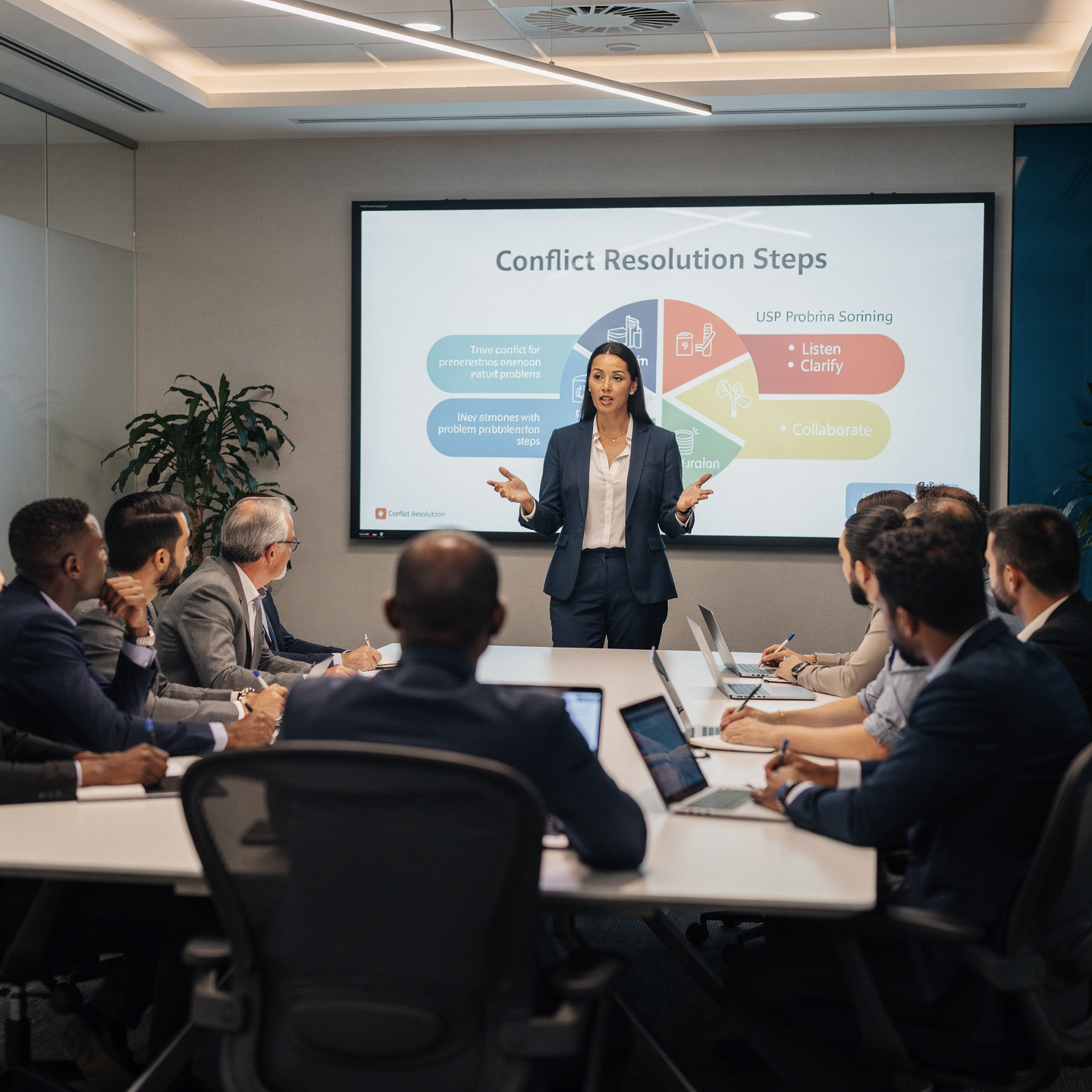
Conflict Resolution in Groups Course
Why this course?
This Conflict Resolution in Groups
This course provides you with the tools and strategies necessary to transform disagreements into opportunities for growth and cohesion. You will learn to identify the sources of conflict, communicate effectively, and facilitate negotiation to reach mutually beneficial solutions. Master mediation, active listening, and emotional intelligence techniques to build more resilient and productive teams.
Key Benefits
- Conflict Diagnosis: Quickly identify underlying causes and triggers.
- Assertive Communication: Learn to express your ideas and needs clearly, respectfully, and persuasively.
- Negotiation Techniques: Master strategies for reaching mutually beneficial agreements, even in complex situations.
- Effective Mediation: Facilitate conflict resolution between third parties, promoting understanding and collaboration.
- Emotional Management: Develop emotional intelligence to manage your own reactions and understand those of others.
- Modality: Online
- Level: Cursos
- Hours: 150 H
- Start date: 25-04-2026
Availability: 1 in stock
Who is it aimed at?
- Team leaders and supervisors looking to effectively manage tensions and foster a collaborative work environment.
- HR professionals and mediators who require tools and techniques to address workplace conflicts constructively.
- Members of multidisciplinary teams interested in improving communication and resolving differences to achieve common goals.
- Students and professionals who want to develop negotiation and problem-solving skills in diverse contexts.
- Anyone looking to understand the dynamics of conflict and learn strategies to transform them into growth opportunities.
Learning flexibility
Ā Tailored to your needs: asynchronous modules with practical cases, discussion forums and online consultation sessions to answer your questions.
Objectives and competencies

Turning frustration into collaboration:
“Implement assertive communication and active listening to understand the needs of each team member, transforming tension into joint solutions.”

Deactivate escalation and activate listening:
Prioritize safety through effective communication, empathy, and conflict resolution.

Transforming confrontation into opportunity:
Prioritize safety through assertive communication, proactive risk analysis, and informed decision-making, escalating if necessary.

Building bridges of mutual understanding:
Encourage assertive communication and active listening among team members, promoting an environment of respect and collaboration.

Navigating tensions towards creative solutions:
Anticipate conflicts, communicate intentions effectively, and negotiate alternatives, prioritizing safety and efficiency.

Cultivating calm in the midst of the storm:
Anticipate risks, prioritize actions, and communicate clearly, while maintaining focus on the main task and adapting to changes in the environment.
Curriculum - Modules
- Comprehensive Maritime Incident Management: protocols, roles, and chain of command for coordinated response
- Operational Planning and Execution: briefing, routes, weather windows, and go/no-go criteria
- Rapid Risk Assessment: criticality matrix, scene control, and decision-making under pressure
- Operational Communication: VHF/GMDSS, standardized reports, and inter-agency liaison
- Tactical Mobility and Safe Boarding: RHIB maneuvers, approach, mooring, and recovery
- Equipment and Technologies: PPE, signaling, satellite tracking, and field data logging
- Immediate Care of the Affected: primary assessment, hypothermia, trauma, and stabilization for evacuation
- Adverse Environmental Conditions: swell, Visibility, flows, and operational mitigation
Simulation and training: critical scenarios, use of VR/AR, and exercises with performance metrics
Documentation and continuous improvement: lessons learned, indicators (MTTA/MTTR), and SOP updates
- Introduction to Collaborative Management: Concepts, Benefits, and Challenges
- Effective Communication: Active Listening, Assertiveness, and Constructive Feedback
- Group Dynamics: Roles, Situational Leadership, and Team Facilitation
- Emotional Intelligence: Self-Awareness, Empathy, and Relationship Management
- Conflict Analysis: Identifying Causes, Types, and Escalation of Conflicts
- Conflict Resolution Strategies: Negotiation, Mediation, and Arbitration
- Negotiation Techniques: Preparation, Concessions, and Finding Mutual Agreements
- Mediation: The Role of the Mediator, Stages of the Process, and Facilitation Techniques
- Culture Organizational impact on collaborative management and conflict resolution.
Creating a collaborative environment: Trust, respect, and shared responsibility.
‘
- Introduction to Collaborative Management and Conflict Resolution: key concepts and their importance in the organizational environment.
- Conflict Theories: nature, causes, types, and levels of conflict in different contexts.
- Effective Communication: active listening, empathy, assertiveness, and nonviolent communication skills.
- Collaborative Negotiation: negotiation strategies based on interests, mutually beneficial options, and lasting agreements.
- Mediation and Facilitation: roles, techniques, and processes for facilitating conflict resolution between parties.
- Emotional Intelligence: self-awareness, self-regulation, motivation, empathy, and social skills in conflict management.
- Conflict Analysis: identifying stakeholders, underlying issues, and dynamics of power.
- Collaborative Process Design: creating safe spaces, establishing clear rules, and fostering participation.
- Conflict Resolution Tools and Techniques: brainstorming, SWOT analysis, cause-and-effect diagrams, etc.
- Evaluation and Monitoring: measuring the impact of conflict resolution strategies and continuous adaptation.
‘
- Introduction to Mediation: Key concepts, principles, and benefits.
- Conflict Theory: Nature, causes, escalation, and de-escalation.
- Effective Communication: Active listening, powerful questions, and nonverbal language.
- Mediator Skills: Empathy, neutrality, impartiality, and confidentiality.
- The Mediation Process: Stages, roles, and responsibilities.
- Collaborative Negotiation Techniques: Identifying interests, options, and criteria.
- Managing Emotions in Mediation: Recognition, management, and channeling.
- Legal and Ethical Frameworks of Mediation: Applicable regulations and codes of conduct behavior.
- Mediation in Different Contexts: Family, work, community, and organizational.
- Development of Sustainable Agreements: Drafting, monitoring, and evaluation.
‘
- Introduction to coexistence: Definitions, importance, and basic principles.
- Effective communication: Active listening, assertiveness, and empathy.
- Emotional intelligence: Recognizing and managing one’s own and others’ emotions.
- Conflict: Nature, types, causes, and stages.
- Conflict prevention strategies: Rules, boundaries, and agreements.
- Mediation: The role of the mediator, techniques, and phases of the process.
- Negotiation: Types of negotiation, strategies, and tactics.
- Conflict resolution techniques: Conciliation, arbitration, and facilitation.
- Managing crisis situations and aggression: Protocols and skills.
- Culture of peace and promotion of positive coexistence: Initiatives and projects.
‘
- System Architecture and Components: Structural design, materials, and subsystems (mechanical, electrical, electronic, and fluid) with selection and assembly criteria for marine environments
- Fundamentals and Principles of Operation: Physical and engineering foundations (thermodynamics, fluid mechanics, electricity, control, and materials) that explain performance and operating limits
- Safety and Environmental (SHE): Risk analysis, PPE, LOTO, hazardous atmospheres, spill and waste management, and emergency response plans
- Applicable Regulations and Standards: IMO/ISO/IEC requirements and local regulations;
- Conformance criteria, certification, and best practices for operation and maintenance
- Inspection, testing, and diagnostics: Visual/dimensional inspection, functional testing, data analysis, and predictive techniques (vibration, thermography, fluid analysis) to identify root causes
- Preventive and predictive maintenance: Hourly/cycle/seasonal plans, lubrication, adjustments, calibrations, consumable replacement, post-service verification, and operational reliability
- Instrumentation, tools, and metrology: Measuring and testing equipment, diagnostic software, calibration and traceability; selection criteria, safe use, and storage
- Onboard integration and interfaces: Mechanical, electrical, fluid, and data compatibility; Sealing and watertightness, EMC/EMI, corrosion protection, and interoperability testing.
Quality, acceptance testing, and commissioning: process and materials control, FAT/SAT, bench and sea trials, go/no-go criteria, and evidence documentation.
Technical documentation and integrated practice: logs, checklists, reports, and a complete case study (safety ā diagnosis ā intervention ā verification ā report) applicable to any system.
Plan de estudio - Módulos
- Comprehensive Maritime Incident Management: protocols, roles, and chain of command for coordinated response
- Operational Planning and Execution: briefing, routes, weather windows, and go/no-go criteria
- Rapid Risk Assessment: criticality matrix, scene control, and decision-making under pressure
- Operational Communication: VHF/GMDSS, standardized reports, and inter-agency liaison
- Tactical Mobility and Safe Boarding: RHIB maneuvers, approach, mooring, and recovery
- Equipment and Technologies: PPE, signaling, satellite tracking, and field data logging
- Immediate Care of the Affected: primary assessment, hypothermia, trauma, and stabilization for evacuation
- Adverse Environmental Conditions: swell, Visibility, flows, and operational mitigation
Simulation and training: critical scenarios, use of VR/AR, and exercises with performance metrics
Documentation and continuous improvement: lessons learned, indicators (MTTA/MTTR), and SOP updates
- Introduction to Collaborative Management: Concepts, Benefits, and Challenges
- Effective Communication: Active Listening, Assertiveness, and Constructive Feedback
- Group Dynamics: Roles, Situational Leadership, and Team Facilitation
- Emotional Intelligence: Self-Awareness, Empathy, and Relationship Management
- Conflict Analysis: Identifying Causes, Types, and Escalation of Conflicts
- Conflict Resolution Strategies: Negotiation, Mediation, and Arbitration
- Negotiation Techniques: Preparation, Concessions, and Finding Mutual Agreements
- Mediation: The Role of the Mediator, Stages of the Process, and Facilitation Techniques
- Culture Organizational impact on collaborative management and conflict resolution.
Creating a collaborative environment: Trust, respect, and shared responsibility.
‘
- Introduction to Collaborative Management and Conflict Resolution: key concepts and their importance in the organizational environment.
- Conflict Theories: nature, causes, types, and levels of conflict in different contexts.
- Effective Communication: active listening, empathy, assertiveness, and nonviolent communication skills.
- Collaborative Negotiation: negotiation strategies based on interests, mutually beneficial options, and lasting agreements.
- Mediation and Facilitation: roles, techniques, and processes for facilitating conflict resolution between parties.
- Emotional Intelligence: self-awareness, self-regulation, motivation, empathy, and social skills in conflict management.
- Conflict Analysis: identifying stakeholders, underlying issues, and dynamics of power.
- Collaborative Process Design: creating safe spaces, establishing clear rules, and fostering participation.
- Conflict Resolution Tools and Techniques: brainstorming, SWOT analysis, cause-and-effect diagrams, etc.
- Evaluation and Monitoring: measuring the impact of conflict resolution strategies and continuous adaptation.
‘
- Introduction to Mediation: Key concepts, principles, and benefits.
- Conflict Theory: Nature, causes, escalation, and de-escalation.
- Effective Communication: Active listening, powerful questions, and nonverbal language.
- Mediator Skills: Empathy, neutrality, impartiality, and confidentiality.
- The Mediation Process: Stages, roles, and responsibilities.
- Collaborative Negotiation Techniques: Identifying interests, options, and criteria.
- Managing Emotions in Mediation: Recognition, management, and channeling.
- Legal and Ethical Frameworks of Mediation: Applicable regulations and codes of conduct behavior.
- Mediation in Different Contexts: Family, work, community, and organizational.
- Development of Sustainable Agreements: Drafting, monitoring, and evaluation.
‘
- Introduction to coexistence: Definitions, importance, and basic principles.
- Effective communication: Active listening, assertiveness, and empathy.
- Emotional intelligence: Recognizing and managing one’s own and others’ emotions.
- Conflict: Nature, types, causes, and stages.
- Conflict prevention strategies: Rules, boundaries, and agreements.
- Mediation: The role of the mediator, techniques, and phases of the process.
- Negotiation: Types of negotiation, strategies, and tactics.
- Conflict resolution techniques: Conciliation, arbitration, and facilitation.
- Managing crisis situations and aggression: Protocols and skills.
- Culture of peace and promotion of positive coexistence: Initiatives and projects.
‘
- System Architecture and Components: Structural design, materials, and subsystems (mechanical, electrical, electronic, and fluid) with selection and assembly criteria for marine environments
- Fundamentals and Principles of Operation: Physical and engineering foundations (thermodynamics, fluid mechanics, electricity, control, and materials) that explain performance and operating limits
- Safety and Environmental (SHE): Risk analysis, PPE, LOTO, hazardous atmospheres, spill and waste management, and emergency response plans
- Applicable Regulations and Standards: IMO/ISO/IEC requirements and local regulations;
- Conformance criteria, certification, and best practices for operation and maintenance
- Inspection, testing, and diagnostics: Visual/dimensional inspection, functional testing, data analysis, and predictive techniques (vibration, thermography, fluid analysis) to identify root causes
- Preventive and predictive maintenance: Hourly/cycle/seasonal plans, lubrication, adjustments, calibrations, consumable replacement, post-service verification, and operational reliability
- Instrumentation, tools, and metrology: Measuring and testing equipment, diagnostic software, calibration and traceability; selection criteria, safe use, and storage
- Onboard integration and interfaces: Mechanical, electrical, fluid, and data compatibility; Sealing and watertightness, EMC/EMI, corrosion protection, and interoperability testing.
Quality, acceptance testing, and commissioning: process and materials control, FAT/SAT, bench and sea trials, go/no-go criteria, and evidence documentation.
Technical documentation and integrated practice: logs, checklists, reports, and a complete case study (safety ā diagnosis ā intervention ā verification ā report) applicable to any system.
- Introduction to coexistence: Definitions, principles, and their importance.
- Conflict theories: Causes, types, and dynamics.
- Effective communication: Active listening, assertiveness, and empathy.
- Emotional intelligence: Recognizing and managing one’s own and others’ emotions.
- Negotiation: Strategies, tactics, and negotiation styles.
- Mediation: The role of the mediator, phases of the process, and techniques.
- Alternative dispute resolution (ADR): Conciliation, arbitration, and other methods.
- Conflict prevention: Identifying risk factors and designing preventive strategies.
- Conflict management in contexts Specific aspects: Family, school, work, and community.
Legal and ethical framework: Human rights, regulations, and codes of conduct.
‘
- Introduction to Mediation: Key Concepts, Principles, and Benefits
- Effective Communication: Active Listening, Empathy, and Nonverbal Language
- Conflict Management: Identifying Causes, Escalation, and De-escalation
- Mediation Techniques: Facilitation, Reframing, and Finding Agreements
- The Mediator’s Role: Neutrality, Impartiality, and Confidentiality
- Constructive Dialogue: Fostering Respect, Tolerance, and Understanding
- Tools for Emotion Management: Self-Control and Emotional Regulation
- Group Dynamics: Cohesion, Leadership, and Group Roles
- Creative Problem Solving: Brainstorming, Negotiation, and Consensus.
- Application of mediation and dialogue in different group contexts.
‘
- Introduction to Conflict: Definitions, typologies, and levels of conflict.
- Conflict Analysis: Identifying causes, actors, interests, and dynamics.
- Effective Communication: Active listening, empathy, and assertiveness in conflict management.
- Dialogue Strategies: Negotiation, mediation, and conciliation as resolution tools.
- Negotiation Techniques: Preparing, developing, and closing agreements.
- Mediation: The role of the mediator, stages of the process, and key skills.
- Emotional Management: Emotional intelligence and impulse control in conflict situations.
- Culture of Peace: Promoting respect, tolerance, and peaceful coexistence.
- Handling Difficult Situations: Addressing aggression, manipulation, and resistance to change.
Consensus and collaborative decision-making: Facilitating agreements and building joint solutions.
‘
- Basic Concepts of Conflict: Definition, Types, Causes, and Levels of Group Conflict
- Group Dynamics and Conflict: Roles, Communication, Power, and Influence in the Generation and Escalation of Conflicts
- Conflict Diagnostic Tools: Situation Analysis, Identification of Actors, Interests, and Needs
- Effective Communication Techniques in Conflict Resolution: Active Listening, Assertiveness, Empathy, and Reframing
- Group Mediation: Principles, Stages, Mediator Skills, and Facilitation Strategies
- Collaborative Negotiation: Identifying Common Interests, Generating Options, and Seeking Mutually Beneficial Agreements
- Managing Emotions in Conflict Situations: Identifying, Regulating, and Appropriately Expressing One’s Own and Others’ Emotions
- Managing Aggression and Hostility: De-escalation Techniques, Setting Boundaries, and Handling Disruptive Behaviors
- Creative Problem Solving: Brainstorming, Lateral Thinking, and Finding Innovative Solutions
- Conflict Prevention: Establishing Clear Rules, Promoting Open Communication, and Fostering Group Cohesion
‘
Career opportunities
- Mediator: Dispute resolution in companies, non-governmental organizations, or public institutions.
- Team Manager: Facilitating communication and resolving internal conflicts in work teams.
- HR Consultant: Implementing strategies for the prevention and management of workplace conflicts.
- Social Skills Trainer: Developing workshops and courses on effective communication and conflict resolution.
- Social Worker: Intervening in situations of family or community conflict.
- School Counselor: Mediating conflicts between students, teachers, or parents.
- Lawyer: Specializing in mediation and conciliation for the out-of-court resolution of conflicts.
- Customer Service Manager to the customer: Handling complaints and claims, seeking satisfactory solutions for both parties.
“`
Admission requirements

Academic/professional profile:
Degree/Bachelor's degree in Nautical Science/Maritime Transport, Naval/Marine Engineering, or a related field; or proven professional experience in bridge/operations.

Language proficiency:
Recommended functional maritime English (SMCP) for simulations and technical materials.

5. Induction
Updated resume, copy of degree or seaman's book, ID card/passport, letter of motivation.

Technical requirements (for online):
Equipment with camera/microphone, stable connection, ā„ 24ā monitor recommended for ECDIS/Radar-ARPA.
Admission process and dates

1. Online
application
(form + documents).

2. Academic review and interview
(profile/objectives/schedule compatibility).

3. Admission decision
(+ scholarship proposal if applicable).

4. Reservation of place
(deposit) and registration.

5. Induction
(access to campus, calendars, simulator guides).
Scholarships and grants
- Master Mediation: Learn proven techniques to manage and resolve conflicts in teams.
- Effective Communication: Develop active listening and assertiveness skills for constructive dialogue.
- Negotiation Strategies: Discover tools to identify interests and reach winnable agreements for all parties.
- Emotional Management: Learn to recognize and manage your own and others’ emotions to prevent escalating tensions.
- Resolution Leadership: Become a key facilitator to build collaborative work environments and productive.
Testimonials
“Thanks to this training, I was able to successfully mediate a conflict between two teams in my department that were competing for resources. By applying the communication and active listening techniques I learned, we facilitated a constructive dialogue that culminated in an agreement that benefited both parties and the company, increasing productivity and improving the work environment.”
This Psychology, Leadership, and Wellbeing course provided me with practical tools to manage teams more effectively. I learned to identify and leverage the individual strengths of each member, improving communication and group cohesion. As a result, team productivity increased by 15%, and the work environment improved significantly.
We facilitated the resolution of a conflict between the marketing and sales departments, who disagreed on the strategy for a new product. Through mediation and the identification of common interests, we enabled both teams to collaborate on a revised plan that met the needs of both and resulted in a successful launch.
I implemented the techniques I learned to mediate a conflict between two teams in my department with opposing goals. We reached an agreement that satisfied both sides’ needs, improving communication and productivity by 20%.

Frequently asked questions
To reach a mutually acceptable solution that addresses the needs of all parties involved and preserves relationships within the group.
Yes. The itinerary includes ECDIS/Radar-ARPA/BRM with harbor, ocean, fog, storm, and SAR scenarios.
Online with live sessions; hybrid option for simulator/practical placements through agreements.
Identify and clearly define the problem or conflict.
Recommended functional SMCP. We offer support materials for standard phraseology.
Yes, with a relevant degree or experience in maritime/port operations. The admissions interview will confirm suitability.
Optional (3ā6 months) through Companies & Collaborations and the Alumni Network.
Simulator practice (rubrics), defeat plans, SOPs, checklists, micro-tests and applied TFM.
A degree from Navalis Magna University + operational portfolio (tracks, SOPs, reports and KPIs) useful for audits and employment.
- Basic Concepts of Conflict: Definition, Types, Causes, and Levels of Group Conflict
- Group Dynamics and Conflict: Roles, Communication, Power, and Influence in the Generation and Escalation of Conflicts
- Conflict Diagnostic Tools: Situation Analysis, Identification of Actors, Interests, and Needs
- Effective Communication Techniques in Conflict Resolution: Active Listening, Assertiveness, Empathy, and Reframing
- Group Mediation: Principles, Stages, Mediator Skills, and Facilitation Strategies
- Collaborative Negotiation: Identifying Common Interests, Generating Options, and Seeking Mutually Beneficial Agreements
- Managing Emotions in Conflict Situations: Identifying, Regulating, and Appropriately Expressing One’s Own and Others’ Emotions
- Managing Aggression and Hostility: De-escalation Techniques, Setting Boundaries, and Handling Disruptive Behaviors
- Creative Problem Solving: Brainstorming, Lateral Thinking, and Finding Innovative Solutions
- Conflict Prevention: Establishing Clear Rules, Promoting Open Communication, and Fostering Group Cohesion
‘
Request information
- Complete the Application Form
- Attach your CV/Qualifications (if you have them to hand).
- Indicate your preferred cohort (January/May/September) and whether you want the hybrid option with simulator sessions.
Teachers
Eng. TomƔs Riera
Full Professor
Eng. TomƔs Riera
Full Professor
Eng. SofĆa Marquina
Full Professor
Eng. SofĆa Marquina
Full Professor
Eng. Javier BaƱuls
Full Professor
Eng. Javier BaƱuls
Full Professor
Dr. Nuria Llobregat
Full Professor
Dr. Nuria Llobregat
Full Professor
Dr. Pau Ferrer
Full Professor
Dr. Pau Ferrer
Full Professor
Cap. Javier Abaroa (MCA)
Full Professor
Cap. Javier Abaroa (MCA)
Full Professor

