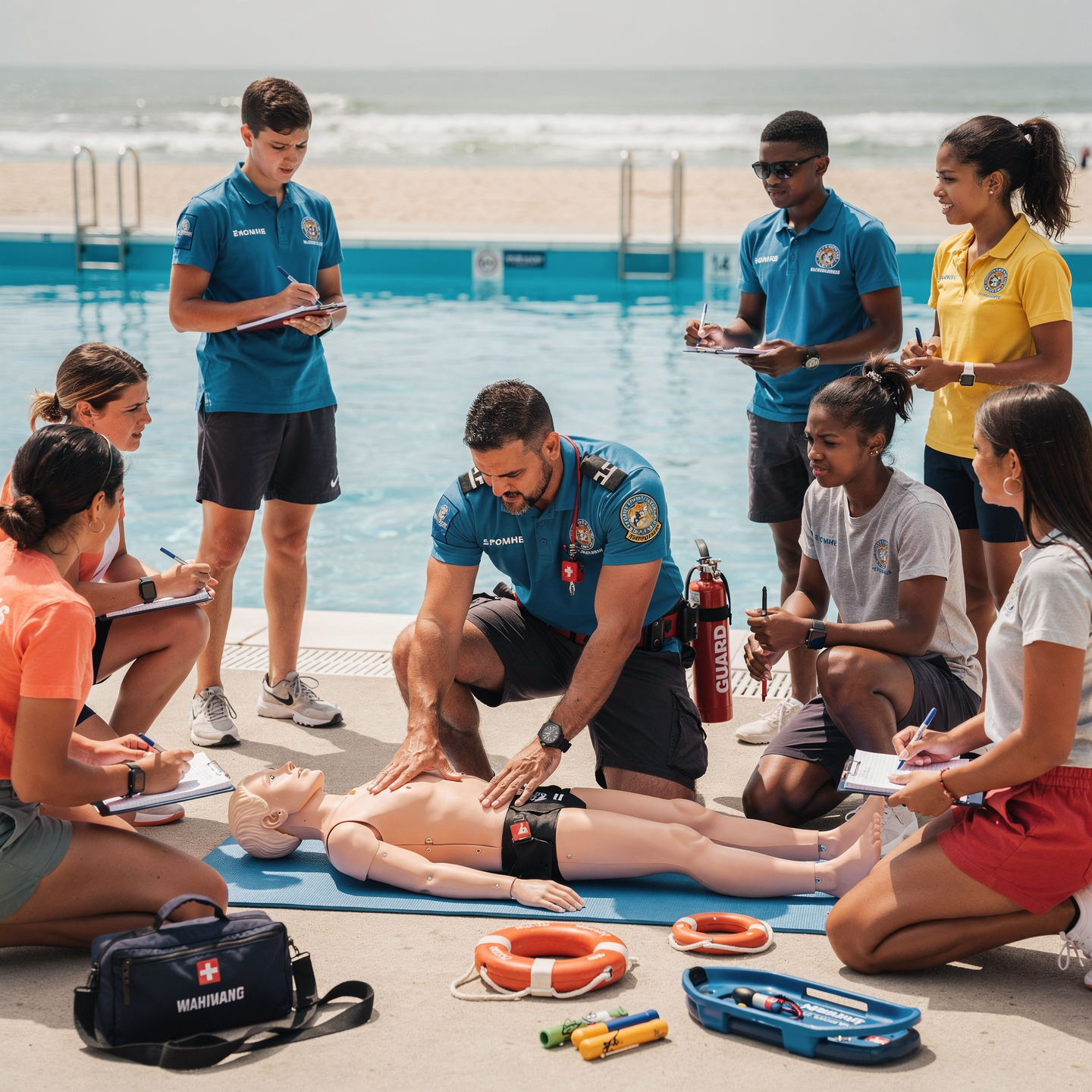
Recreational Rescue Techniques Course
Why this course?
The Recreational Rescue Techniques course
This course provides you with the essential skills to respond effectively in emergency situations during recreational water activities. Learn to identify hazards, perform safe rescues, and apply first aid specific to the aquatic environment. This program equips you with the knowledge and confidence needed to act quickly and effectively, minimizing danger to yourself and others.
Recreational Rescue Techniques
Differential Advantages
- Realistic Simulations: Practice rescues in different aquatic scenarios, including pools, lakes, and beaches.
- Specialized Equipment: Familiarize yourself with the use of rescue equipment such as rescue buoys, ropes, and rescue boards.
- Advanced First Aid: Learn to treat common injuries in aquatic activities, such as drowning, hypothermia, and marine wildlife injuries.
- Communication Protocols: Master effective communication techniques to coordinate rescues and request assistance.
- Certified Instructors: Receive training from experienced instructors with extensive experience in aquatic rescue.
- Modality: Online
- Level: Cursos
- Hours: 150 H
- Start date: 26-07-2026
Availability: 1 in stock
Who is it aimed at?
- Aquatic lifeguards and first responders looking to update their rescue techniques and expand their skill set in recreational environments.
- Water sports instructors (surfing, kayaking, paddle surfing) who need a solid foundation in emergency prevention and response.
- Healthcare professionals (nurses, paramedics) who work at aquatic events or in coastal areas and require specific rescue training.
- Members of volunteer rescue teams who want to improve their efficiency and safety in rescue operations on beaches, rivers, and lakes.
- Experienced water sports enthusiasts looking to learn advanced techniques to assist others in emergency situations Risk.
Flexibility and practice
Combines essential theory with realistic simulations, adapted to different experience levels and with flexible schedules to facilitate participation.
Objectives and competencies

Mastering self-rescue and partner rescue:
“Prioritize safety, assess risks, apply rescue techniques and first aid appropriate to the situation and the victim’s condition.”

Assessing and mitigating risks in recreational aquatic environments:
“Identify hazards (chemical, biological, physical), implement safety protocols, and coordinate emergency response (rescue, first aid).”

Apply towing and transport techniques for injured persons:
“Ensure the stabilization of the injured person and the vessel, using appropriate mooring techniques and respecting the limitations of the towing equipment.”

Use the appropriate rescue equipment and keep it in optimal condition:
“Inspect, maintain and operate rescue equipment (boats, rafts, EPIRBs, SARTs) according to manufacturer’s regulations and procedures.”

Establish effective and coordinated communication during rescue operations:
Use standardized communication protocols (IMO, NATO) and maintain clear and concise language, prioritizing information essential to the safety and efficiency of the rescue, documenting each communication.

Provide basic life support and first aid to victims of aquatic accidents:
“Perform CPR, control bleeding, treat hypothermia, and coordinate the safe evacuation of the victim.”
Curriculum - Modules
- Comprehensive Maritime Incident Management: protocols, roles, and chain of command for coordinated response
- Operational Planning and Execution: briefing, routes, weather windows, and go/no-go criteria
- Rapid Risk Assessment: criticality matrix, scene control, and decision-making under pressure
- Operational Communication: VHF/GMDSS, standardized reports, and inter-agency liaison
- Tactical Mobility and Safe Boarding: RHIB maneuvers, approach, mooring, and recovery
- Equipment and Technologies: PPE, signaling, satellite tracking, and field data logging
- Immediate Care of the Affected: primary assessment, hypothermia, trauma, and stabilization for evacuation
- Adverse Environmental Conditions: swell, Visibility, flows, and operational mitigation
Simulation and training: critical scenarios, use of VR/AR, and exercises with performance metrics
Documentation and continuous improvement: lessons learned, indicators (MTTA/MTTR), and SOP updates
- Introduction to Recreational Water Rescue: Definitions, roles, and responsibilities.
- Physiology of Drowning: Types of drowning, phases, and risk factors.
- Basic Rescue Equipment: Rescue torpedoes, fins, masks, snorkels, and boats.
- Water Entry and Approach Techniques: Controlled, rapid, and underwater entries.
- Water Rescue Techniques: Torpedo tow, armpit tow, rescue board tow.
- Extraction of the Victim from the Water: Extraction techniques on the beach, in swimming pools, and on boats.
- Basic First Aid in Aquatic Environments: CPR, airway management, and hemorrhage control.
- Communication and signaling in aquatic rescue: Signal codes, use of whistles and radios.
- Prevention of aquatic accidents: Risk identification, signaling, and user education.
- Legislation and regulations applicable to recreational aquatic rescue.
‘
- Introduction to recreational water rescue: history, evolution, and legal framework.
- Physiology of drowning: stages, risk factors, and prevention.
- Basic lifeguard equipment: fins, rescue tube, torpedo buoy, radio.
- Water entry techniques: according to height, obstacles, and conditions.
- Approach swimming: efficient styles, victim control, and self-protection.
- Rescue techniques with and without equipment: grabs, tows, and extractions.
- Communication and signaling: codes, flags, and alert systems.
- Basic first aid: CPR, airway obstruction, management of common injuries.
- Risk assessment in environments Recreational water sports: swimming pools, beaches, and water parks.
- Specific legislation and regulations: licenses, insurance, and liabilities.
‘
- Basic principles of first aid: assessment, safety, life support
- Drowning: pathophysiology, types, prevention
- CPR techniques: adults, children, infants; Modifications in the Water
Water Rescue: Entry, Approach, Towing, and Extraction Techniques
Common Injuries in the Water: Cuts, Lacerations, Contusions, Fractures
Spinal Cord Injuries: Prevention, Initial Management, Immobilization
Hypothermia and Hyperthermia: Causes, Symptoms, Treatment
Traumatic Brain Injuries: Assessment, Management, Safe Transport
Use of Rescue Equipment: Rescue Boards, Cervical Collars, Defibrillators
Legal and Ethical Aspects of Water Rescue and First Aid
- Introduction to Recreational Aquatic Rescue: Scope and Responsibilities
- Physiology of Drowning: Mechanisms, Types, and Consequences
- Rescue Equipment: Selection, Maintenance, and Proper Use
- Water Entry and Approach Techniques: Safe and Effective
- Towing and Transfer Techniques: Maintaining the Safety of Both
- Victim Extraction: Techniques on Shore and in Boats
- First Aid and CPR in the Aquatic Environment: Adaptations and Priorities
- Communication and Coordination in Emergency Situations: Protocols and Signals
Prevention of Aquatic Accidents: Risk Identification and Preventive Measures
Legislation and Regulations in Recreational Aquatic Rescue: Rights and Obligations‘
- System Architecture and Components: Structural design, materials, and subsystems (mechanical, electrical, electronic, and fluid) with selection and assembly criteria for marine environments
- Fundamentals and Principles of Operation: Physical and engineering foundations (thermodynamics, fluid mechanics, electricity, control, and materials) that explain performance and operating limits
- Safety and Environmental (SHE): Risk analysis, PPE, LOTO, hazardous atmospheres, spill and waste management, and emergency response plans
- Applicable Regulations and Standards: IMO/ISO/IEC requirements and local regulations;
- Conformance criteria, certification, and best practices for operation and maintenance
- Inspection, testing, and diagnostics: Visual/dimensional inspection, functional testing, data analysis, and predictive techniques (vibration, thermography, fluid analysis) to identify root causes
- Preventive and predictive maintenance: Hourly/cycle/seasonal plans, lubrication, adjustments, calibrations, consumable replacement, post-service verification, and operational reliability
- Instrumentation, tools, and metrology: Measuring and testing equipment, diagnostic software, calibration and traceability; selection criteria, safe use, and storage
- Onboard integration and interfaces: Mechanical, electrical, fluid, and data compatibility; Sealing and watertightness, EMC/EMI, corrosion protection, and interoperability testing.
Quality, acceptance testing, and commissioning: process and materials control, FAT/SAT, bench and sea trials, go/no-go criteria, and evidence documentation.
Technical documentation and integrated practice: logs, checklists, reports, and a complete case study (safety → diagnosis → intervention → verification → report) applicable to any system.
Plan de estudio - Módulos
- Comprehensive Maritime Incident Management: protocols, roles, and chain of command for coordinated response
- Operational Planning and Execution: briefing, routes, weather windows, and go/no-go criteria
- Rapid Risk Assessment: criticality matrix, scene control, and decision-making under pressure
- Operational Communication: VHF/GMDSS, standardized reports, and inter-agency liaison
- Tactical Mobility and Safe Boarding: RHIB maneuvers, approach, mooring, and recovery
- Equipment and Technologies: PPE, signaling, satellite tracking, and field data logging
- Immediate Care of the Affected: primary assessment, hypothermia, trauma, and stabilization for evacuation
- Adverse Environmental Conditions: swell, Visibility, flows, and operational mitigation
Simulation and training: critical scenarios, use of VR/AR, and exercises with performance metrics
Documentation and continuous improvement: lessons learned, indicators (MTTA/MTTR), and SOP updates
- Introduction to Recreational Water Rescue: Definitions, roles, and responsibilities.
- Physiology of Drowning: Types of drowning, phases, and risk factors.
- Basic Rescue Equipment: Rescue torpedoes, fins, masks, snorkels, and boats.
- Water Entry and Approach Techniques: Controlled, rapid, and underwater entries.
- Water Rescue Techniques: Torpedo tow, armpit tow, rescue board tow.
- Extraction of the Victim from the Water: Extraction techniques on the beach, in swimming pools, and on boats.
- Basic First Aid in Aquatic Environments: CPR, airway management, and hemorrhage control.
- Communication and signaling in aquatic rescue: Signal codes, use of whistles and radios.
- Prevention of aquatic accidents: Risk identification, signaling, and user education.
- Legislation and regulations applicable to recreational aquatic rescue.
‘
- Introduction to recreational water rescue: history, evolution, and legal framework.
- Physiology of drowning: stages, risk factors, and prevention.
- Basic lifeguard equipment: fins, rescue tube, torpedo buoy, radio.
- Water entry techniques: according to height, obstacles, and conditions.
- Approach swimming: efficient styles, victim control, and self-protection.
- Rescue techniques with and without equipment: grabs, tows, and extractions.
- Communication and signaling: codes, flags, and alert systems.
- Basic first aid: CPR, airway obstruction, management of common injuries.
- Risk assessment in environments Recreational water sports: swimming pools, beaches, and water parks.
- Specific legislation and regulations: licenses, insurance, and liabilities.
‘
- Basic principles of first aid: assessment, safety, life support
- Drowning: pathophysiology, types, prevention
- CPR techniques: adults, children, infants; Modifications in the Water
Water Rescue: Entry, Approach, Towing, and Extraction Techniques
Common Injuries in the Water: Cuts, Lacerations, Contusions, Fractures
Spinal Cord Injuries: Prevention, Initial Management, Immobilization
Hypothermia and Hyperthermia: Causes, Symptoms, Treatment
Traumatic Brain Injuries: Assessment, Management, Safe Transport
Use of Rescue Equipment: Rescue Boards, Cervical Collars, Defibrillators
Legal and Ethical Aspects of Water Rescue and First Aid
- Introduction to Recreational Aquatic Rescue: Scope and Responsibilities
- Physiology of Drowning: Mechanisms, Types, and Consequences
- Rescue Equipment: Selection, Maintenance, and Proper Use
- Water Entry and Approach Techniques: Safe and Effective
- Towing and Transfer Techniques: Maintaining the Safety of Both
- Victim Extraction: Techniques on Shore and in Boats
- First Aid and CPR in the Aquatic Environment: Adaptations and Priorities
- Communication and Coordination in Emergency Situations: Protocols and Signals
Prevention of Aquatic Accidents: Risk Identification and Preventive Measures
Legislation and Regulations in Recreational Aquatic Rescue: Rights and Obligations‘
- System Architecture and Components: Structural design, materials, and subsystems (mechanical, electrical, electronic, and fluid) with selection and assembly criteria for marine environments
- Fundamentals and Principles of Operation: Physical and engineering foundations (thermodynamics, fluid mechanics, electricity, control, and materials) that explain performance and operating limits
- Safety and Environmental (SHE): Risk analysis, PPE, LOTO, hazardous atmospheres, spill and waste management, and emergency response plans
- Applicable Regulations and Standards: IMO/ISO/IEC requirements and local regulations;
- Conformance criteria, certification, and best practices for operation and maintenance
- Inspection, testing, and diagnostics: Visual/dimensional inspection, functional testing, data analysis, and predictive techniques (vibration, thermography, fluid analysis) to identify root causes
- Preventive and predictive maintenance: Hourly/cycle/seasonal plans, lubrication, adjustments, calibrations, consumable replacement, post-service verification, and operational reliability
- Instrumentation, tools, and metrology: Measuring and testing equipment, diagnostic software, calibration and traceability; selection criteria, safe use, and storage
- Onboard integration and interfaces: Mechanical, electrical, fluid, and data compatibility; Sealing and watertightness, EMC/EMI, corrosion protection, and interoperability testing.
Quality, acceptance testing, and commissioning: process and materials control, FAT/SAT, bench and sea trials, go/no-go criteria, and evidence documentation.
Technical documentation and integrated practice: logs, checklists, reports, and a complete case study (safety → diagnosis → intervention → verification → report) applicable to any system.
- Introduction to Recreational Water Rescue: History, Evolution, and Regulations
- Physiology of Drowning: Types of Drowning, Phases, and the Body’s Response
- Rescue Equipment: Types of Fins, Masks, Snorkels, Wetsuits, and Vests. Maintenance and proper use.
- Water entry techniques: Safety considerations, entry types according to the situation
- Rescue swimming techniques: Approach swimming, towing, and escape
- Rescue techniques with and without equipment: Use of rescue buoys, rescue boards, and other devices.
- Communication in rescue: Hand signals, verbal communication, and use of communication equipment
- Victim extraction: Safe and effective extraction techniques in different scenarios (beach, pool, etc.)
- First aid in the water and on the shore: CPR, wound management, immobilization, and transport.
- Risk assessment and accident prevention: Hazard identification, preventive measures and protocols for action.
‘
- Introduction to First Aid: Basic Principles and Legal Framework
- Victim Assessment: Consciousness, Breathing, Pulse (ABCs)
- Cardiopulmonary Resuscitation (CPR) in Adults, Children, and Infants
- Use of the Automated External Defibrillator (AED): Protocols and Safety
- Choking: Heimlich Maneuver for Different Ages and Situations
- Bleeding: Control and Management of Different Types of Bleeding
- Wounds and Burns: Classification, Treatment, and Infection Prevention
- Musculoskeletal Injuries: Sprains, Fractures, Dislocations, and Immobilization
- Water Emergencies: Types, Risks, and Rescue Techniques safe.
- Handling victims in the water: stabilization, extraction, and life support.
‘
- Introduction to first aid in the water: safety, prevention, and legislation.
- Victim assessment: vital signs, level of consciousness, and injuries.
- Water rescue: water entry techniques, approach, and safe extraction.
- Basic life support (BLS) in the water and on shore: CPR and defibrillation.
- Management of drowning: different types, complications, and treatment.
- Common injuries in aquatic environments: trauma, wounds, burns.
- Immobilization in the water: cervical collar and spinal board.
- Hypothermia and hyperthermia: prevention, recognition, and treatment.
- Communications and activation of emergency services.
Psychological aspects of rescue: stress management and support for the victim and the rescuer.
‘
- Physiology of Drowning: Types, phases, mechanisms, and risk factors.
- Aquatic Rescue Equipment: Wetsuits, life jackets, fins, masks, snorkels, ropes, rescue boards, etc.
- Water Entry Techniques: Controlled entry, jump entry, feet entry.
- Rescue Swimming Techniques: Approach swim, tow swim, escape swim.
- Towing and Extraction Techniques: Axillary tow, cross tow, board extraction, rope extraction.
- Basic Life Support (BLS) in the Aquatic Environment: CPR in the water, airway management, ventilation, hemorrhage control.
- Advanced Life Support (ALS): Use of an automated external defibrillator (AED), oxygen administration, advanced airway management.
Water rescue safety: Risk assessment, rescue planning, communication, personal protective equipment (PPE).
Vessel rescue: Operation of rescue vessels, approach techniques, extraction and transport of victims.
Legislation and regulations: Current regulations regarding water safety, civil and criminal liability.
‘
Career opportunities
- Lifeguard at recreational facilities: swimming pools, water parks, beaches, reservoirs.
- Recreational water activities instructor: swimming lessons, kayaking, paddle surfing, snorkeling, recreational diving.
- Water adventure activity guide: canyoning, rafting, cave diving (with additional training).
- Member of volunteer rescue teams: Civil Protection, Red Cross (requires additional training and certifications).
- Security personnel at water events: swimming competitions, triathlons, beach festivals.
- Summer camp and after-school activity monitor: responsible for safety and supervision in water activities.
- Emergency Medical Technician (EMT): Basic life support in The aquatic environment (requires EMT training).
- Trainer in aquatic risk prevention and first aid: awareness and training in aquatic safety.
“`
Admission requirements

Academic/professional profile:
Degree/Bachelor's degree in Nautical Science/Maritime Transport, Naval/Marine Engineering, or a related field; or proven professional experience in bridge/operations.

Language proficiency:
Recommended functional maritime English (SMCP) for simulations and technical materials.

5. Induction
Updated resume, copy of degree or seaman's book, ID card/passport, letter of motivation.

Technical requirements (for online):
Equipment with camera/microphone, stable connection, ≥ 24” monitor recommended for ECDIS/Radar-ARPA.
Admission process and dates

1. Online
application
(form + documents).

2. Academic review and interview
(profile/objectives/schedule compatibility).

3. Admission decision
(+ scholarship proposal if applicable).

4. Reservation of place
(deposit) and registration.

5. Induction
(access to campus, calendars, simulator guides).
Scholarships and grants
- Rescue Fundamentals: Master the essential techniques for safety in recreational aquatic environments.
- Specialized Equipment: Learn the correct use of rescue equipment, including fins, masks, snorkels, and flotation devices.
- Practical Scenarios: Participate in realistic drills to develop your emergency response skills.
- First Aid: Gain a solid foundation in CPR and first aid tailored to aquatic incidents.
- Hazard Prevention: Identify and mitigate potential hazards to create safer aquatic environments.
Testimonials
During a whitewater rescue drill, I applied the rope throwing and approach swimming techniques learned in training, successfully securing and extracting a “victim” in less than 3 minutes, exceeding the target time set by the instructor and demonstrating effective mastery of rescue skills.
During the Sports, Recreation and Aquatic Activities course, I overcame my fear of water, learned to swim different styles safely, and obtained aquatic lifeguard certification, which allowed me to get a summer job at a water park.
During a kayaking excursion, a companion capsized in rapids. Thanks to rescue techniques I had learned, I was able to safely approach, stabilize his kayak, and help him back on board without incident, preventing a potentially dangerous situation.
During a hike, a companion slipped and became trapped in a rock crevice. Thanks to the recreational rescue techniques I had learned, I was able to secure the area, stabilize the injured person, and coordinate a safe and efficient rescue, minimizing the risk of further injury and facilitating their evacuation.

Frequently asked questions
Preventing and responding to emergencies in recreational environments to ensure the safety of participants.
Yes. The itinerary includes ECDIS/Radar-ARPA/BRM with harbor, ocean, fog, storm, and SAR scenarios.
Online with live sessions; hybrid option for simulator/practical placements through agreements.
Recreational lifeguards focus on safety and incident prevention in recreational settings, while professional lifeguards respond to emergencies in a variety of situations, often of greater complexity and risk.
Recommended functional SMCP. We offer support materials for standard phraseology.
Yes, with a relevant degree or experience in maritime/port operations. The admissions interview will confirm suitability.
Optional (3–6 months) through Companies & Collaborations and the Alumni Network.
Simulator practice (rubrics), defeat plans, SOPs, checklists, micro-tests and applied TFM.
A degree from Navalis Magna University + operational portfolio (tracks, SOPs, reports and KPIs) useful for audits and employment.
- Physiology of Drowning: Types, phases, mechanisms, and risk factors.
- Aquatic Rescue Equipment: Wetsuits, life jackets, fins, masks, snorkels, ropes, rescue boards, etc.
- Water Entry Techniques: Controlled entry, jump entry, feet entry.
- Rescue Swimming Techniques: Approach swim, tow swim, escape swim.
- Towing and Extraction Techniques: Axillary tow, cross tow, board extraction, rope extraction.
- Basic Life Support (BLS) in the Aquatic Environment: CPR in the water, airway management, ventilation, hemorrhage control.
- Advanced Life Support (ALS): Use of an automated external defibrillator (AED), oxygen administration, advanced airway management.
Water rescue safety: Risk assessment, rescue planning, communication, personal protective equipment (PPE).
Vessel rescue: Operation of rescue vessels, approach techniques, extraction and transport of victims.
Legislation and regulations: Current regulations regarding water safety, civil and criminal liability.
‘
Request information
- Complete the Application Form
- Attach your CV/Qualifications (if you have them to hand).
- Indicate your preferred cohort (January/May/September) and whether you want the hybrid option with simulator sessions.
Teachers
Eng. Tomás Riera
Full Professor
Eng. Tomás Riera
Full Professor
Eng. Sofía Marquina
Full Professor
Eng. Sofía Marquina
Full Professor
Eng. Javier Bañuls
Full Professor
Eng. Javier Bañuls
Full Professor
Dr. Nuria Llobregat
Full Professor
Dr. Nuria Llobregat
Full Professor
Dr. Pau Ferrer
Full Professor
Dr. Pau Ferrer
Full Professor
Cap. Javier Abaroa (MCA)
Full Professor
Cap. Javier Abaroa (MCA)
Full Professor

