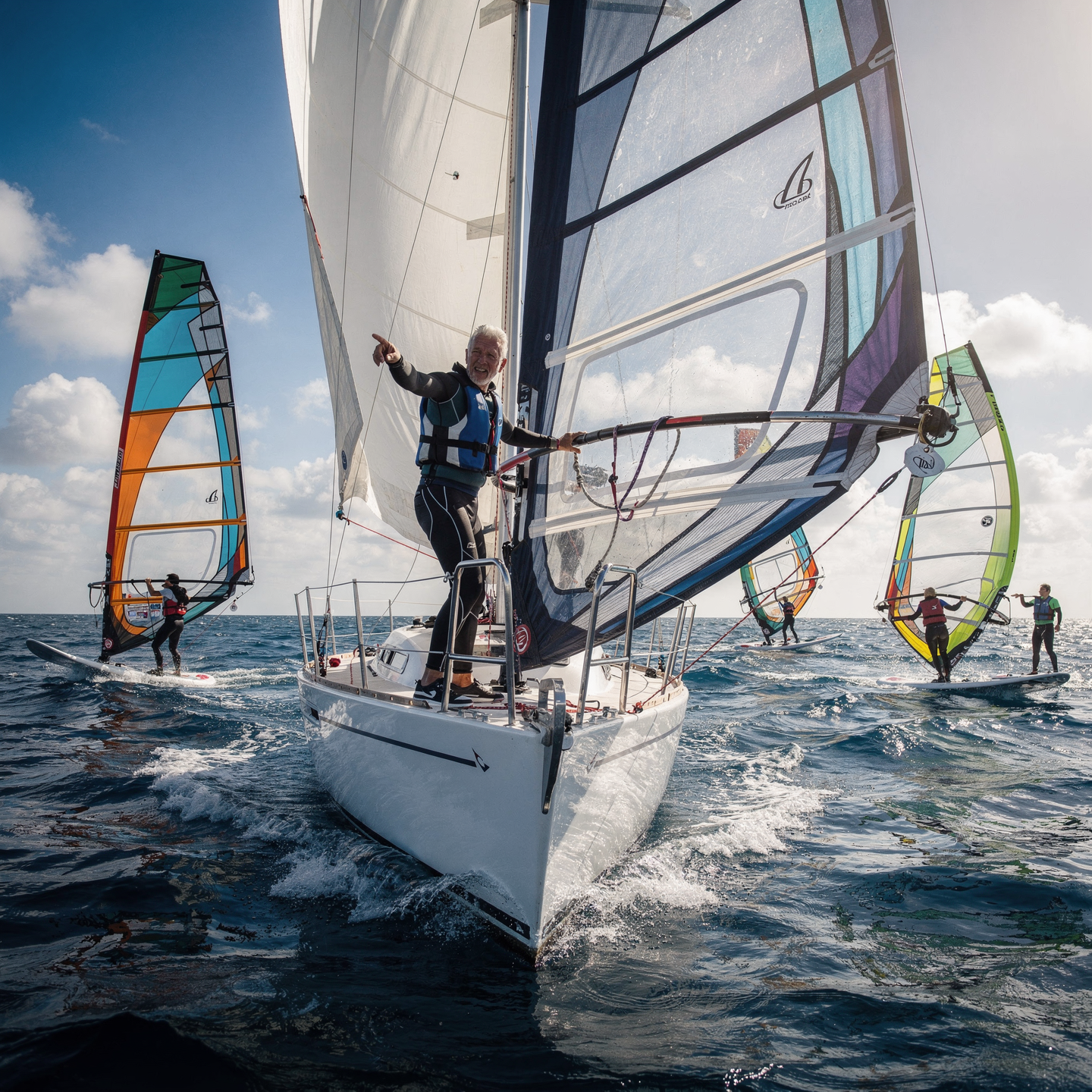
Introduction to Windsurfing Course
Why this course?
Learn to master the wind with our Introduction to Windsurfing course.
Discover the fundamentals of this exciting water sport and experience the freedom of gliding on the waves. This course will provide you with the essential skills and knowledge to windsurf safely and confidently. You will learn about equipment, basic sailing techniques, sail control, and safety measures. Get ready for an unforgettable adventure on the water!
Course Advantages
- Personalized Instruction: Learn with certified instructors who will guide you every step of the way.
- High-Quality Equipment: Use modern equipment suitable for beginners.
- Safety First: Learn safety rules and water rescue techniques.
- Fun Atmosphere: Enjoy a relaxed and motivating environment to learn and socialize.
- Rapid Progression: Advance at your own pace and achieve your windsurfing goals.
- Modality: Online
- Level: Cursos
- Hours: 150 H
- Start date: 25-04-2026
Availability: 1 in stock
Who is it aimed at?
- Beginners looking for a safe and fun introduction to the world of windsurfing, learning the basics and water safety.
- Watersports enthusiasts who want to diversify their skills and experience the thrill of gliding across the water propelled by the wind.
- Adventurous travelers who want to make the most of their vacation by learning a new sport and enjoying nature in a stimulating environment.
- Families looking for an outdoor activity they can enjoy together, creating unforgettable memories and fostering a love for the sea.
- People of all ages and fitness levels looking for a fun and challenging way to stay active and connect with nature.
Flexibility and Adaptability
Designed to adapt to your pace: group and individual lessons available, flexible hours and equipment provided.
Objectives and competencies

Identify and understand basic windsurfing equipment:
“Distinguish between board, sail, boom, and mast, understanding their functions and interdependencies.”

Assemble windsurfing equipment independently and safely:
“Identify components, assemble correctly, verify adjustments, and assess weather conditions for safe navigation.”

Navigate short distances while maintaining the desired course:
“Use navigational aids (GPS, compass, radar) and adjust speed to maintain course, compensating for wind and current.”

Perform basic turns to change direction:
“Controlling speed, rudder angle, and anticipation for smooth and safe execution.”

Interpreting wind conditions to optimize navigation:
“Analyze wind direction and intensity, currents, and sea conditions to adjust sails, course, and speed, maximizing vessel performance and safety.”

Retrieve the sail in the water and return to the sailing position:
Maneuver safely and efficiently, taking into account wind, current, and sea state, to minimize drift and avoid risks to the crew and equipment.
Curriculum - Modules
- Comprehensive Maritime Incident Management: protocols, roles, and chain of command for coordinated response
- Operational Planning and Execution: briefing, routes, weather windows, and go/no-go criteria
- Rapid Risk Assessment: criticality matrix, scene control, and decision-making under pressure
- Operational Communication: VHF/GMDSS, standardized reports, and inter-agency liaison
- Tactical Mobility and Safe Boarding: RHIB maneuvers, approach, mooring, and recovery
- Equipment and Technologies: PPE, signaling, satellite tracking, and field data logging
- Immediate Care of the Affected: primary assessment, hypothermia, trauma, and stabilization for evacuation
- Adverse Environmental Conditions: swell, Visibility, flows, and operational mitigation
Simulation and training: critical scenarios, use of VR/AR, and exercises with performance metrics
Documentation and continuous improvement: lessons learned, indicators (MTTA/MTTR), and SOP updates
- Introduction to Windsurfing: History, evolution, and styles.
- Equipment terminology: Board, sail, boom, mast, fins, and accessories.
- Sailing principles: Wind, direction, headings, upwind, reach, and downwind.
- Equipment assembly and disassembly: Safe and efficient procedures.
- Water safety: Life jacket, leash, signaling, and communication.
- Basic techniques: Board position, sail hoisting, tacking, and jibing.
- Sail control: Power, angle of attack, sheet, and windward tacking.
- Balance and control exercises: Slalom, basic upwind sailing, and maintaining balance Course.
- Weather Conditions: Interpreting wind, waves, and currents.
- Rules of Navigation and Courtesy on the Water: Priorities and Shared Safety.
‘
- Introduction to windsurfing: history, styles, and basic equipment.
- Equipment terminology: board, sail, mast, boom, fin, and their components.
- Equipment assembly and disassembly: step-by-step, safety, and basic maintenance.
- Safety on the water: weather conditions, risks, and distress signals.
- Basic stance: balance, boom grip, and sail control.
- Sail hoisting (optional waterstart): initial techniques and adapting to the wind.
- Steering and control: upwind (going against the wind), reach, and downwind (going with the wind).
- Basic turns: jibe (change of direction with with the wind astern) and tack (change of direction with the wind ahead).
- Simple Navigation: control exercises and technique improvement.
- Navigation Rules: priorities and respect on the water.
‘
- Introduction to Windsurfing: History, evolution, and disciplines.
- Basic Terminology: Parts of the board, sail, and rigging.
- The Wind: Direction, intensity, scales (Beaufort), gusts, and shifts.
- Water Safety: Life jacket, leash, and distress signals.
- Basic First Aid: Hypothermia, sunburn, and cuts.
- Windsurfing Equipment: Types of boards, sails, and rigging for beginners.
- Equipment Setup: Correct assembly of the sail, mast, and boom.
- Basic Balance and Posture: Position on the board, grip on the boom.
- Up-and-down sailing and windward sailing basics: Directions with respect to the wind.
- First steps on the water: Hoisting the sail, basic navigation, and tacking.
‘
- Equipment nomenclature: sail, boom, mast, daggerboard, fins, etc.
- Types of boards: beginner, freeride, slalom, waves, foil. Characteristics and differences.
- Types of sails: construction, materials, optimal wind range.
- Basic rigging: attaching the sail to the boom and mast correctly.
- Sail adjustment: boom and mast tension, setup for different wind conditions.
- Basic ropes and knots: figure eight, clove hitch, bowline, sheet bend.
- Safety equipment: life jacket, leash, helmet.
- Condition assessment: wind (direction, intensity, gusts), currents, obstacles.
- Physical preparation: warm-up, windsurf-specific stretches.
- Risks and prevention: hypothermia, heatstroke, injuries, rescue.
‘
- System Architecture and Components: Structural design, materials, and subsystems (mechanical, electrical, electronic, and fluid) with selection and assembly criteria for marine environments
- Fundamentals and Principles of Operation: Physical and engineering foundations (thermodynamics, fluid mechanics, electricity, control, and materials) that explain performance and operating limits
- Safety and Environmental (SHE): Risk analysis, PPE, LOTO, hazardous atmospheres, spill and waste management, and emergency response plans
- Applicable Regulations and Standards: IMO/ISO/IEC requirements and local regulations;
- Conformance criteria, certification, and best practices for operation and maintenance
- Inspection, testing, and diagnostics: Visual/dimensional inspection, functional testing, data analysis, and predictive techniques (vibration, thermography, fluid analysis) to identify root causes
- Preventive and predictive maintenance: Hourly/cycle/seasonal plans, lubrication, adjustments, calibrations, consumable replacement, post-service verification, and operational reliability
- Instrumentation, tools, and metrology: Measuring and testing equipment, diagnostic software, calibration and traceability; selection criteria, safe use, and storage
- Onboard integration and interfaces: Mechanical, electrical, fluid, and data compatibility; Sealing and watertightness, EMC/EMI, corrosion protection, and interoperability testing.
Quality, acceptance testing, and commissioning: process and materials control, FAT/SAT, bench and sea trials, go/no-go criteria, and evidence documentation.
Technical documentation and integrated practice: logs, checklists, reports, and a complete case study (safety → diagnosis → intervention → verification → report) applicable to any system.
Plan de estudio - Módulos
- Comprehensive Maritime Incident Management: protocols, roles, and chain of command for coordinated response
- Operational Planning and Execution: briefing, routes, weather windows, and go/no-go criteria
- Rapid Risk Assessment: criticality matrix, scene control, and decision-making under pressure
- Operational Communication: VHF/GMDSS, standardized reports, and inter-agency liaison
- Tactical Mobility and Safe Boarding: RHIB maneuvers, approach, mooring, and recovery
- Equipment and Technologies: PPE, signaling, satellite tracking, and field data logging
- Immediate Care of the Affected: primary assessment, hypothermia, trauma, and stabilization for evacuation
- Adverse Environmental Conditions: swell, Visibility, flows, and operational mitigation
Simulation and training: critical scenarios, use of VR/AR, and exercises with performance metrics
Documentation and continuous improvement: lessons learned, indicators (MTTA/MTTR), and SOP updates
- Introduction to Windsurfing: History, evolution, and styles.
- Equipment terminology: Board, sail, boom, mast, fins, and accessories.
- Sailing principles: Wind, direction, headings, upwind, reach, and downwind.
- Equipment assembly and disassembly: Safe and efficient procedures.
- Water safety: Life jacket, leash, signaling, and communication.
- Basic techniques: Board position, sail hoisting, tacking, and jibing.
- Sail control: Power, angle of attack, sheet, and windward tacking.
- Balance and control exercises: Slalom, basic upwind sailing, and maintaining balance Course.
- Weather Conditions: Interpreting wind, waves, and currents.
- Rules of Navigation and Courtesy on the Water: Priorities and Shared Safety.
‘
- Introduction to windsurfing: history, styles, and basic equipment.
- Equipment terminology: board, sail, mast, boom, fin, and their components.
- Equipment assembly and disassembly: step-by-step, safety, and basic maintenance.
- Safety on the water: weather conditions, risks, and distress signals.
- Basic stance: balance, boom grip, and sail control.
- Sail hoisting (optional waterstart): initial techniques and adapting to the wind.
- Steering and control: upwind (going against the wind), reach, and downwind (going with the wind).
- Basic turns: jibe (change of direction with with the wind astern) and tack (change of direction with the wind ahead).
- Simple Navigation: control exercises and technique improvement.
- Navigation Rules: priorities and respect on the water.
‘
- Introduction to Windsurfing: History, evolution, and disciplines.
- Basic Terminology: Parts of the board, sail, and rigging.
- The Wind: Direction, intensity, scales (Beaufort), gusts, and shifts.
- Water Safety: Life jacket, leash, and distress signals.
- Basic First Aid: Hypothermia, sunburn, and cuts.
- Windsurfing Equipment: Types of boards, sails, and rigging for beginners.
- Equipment Setup: Correct assembly of the sail, mast, and boom.
- Basic Balance and Posture: Position on the board, grip on the boom.
- Up-and-down sailing and windward sailing basics: Directions with respect to the wind.
- First steps on the water: Hoisting the sail, basic navigation, and tacking.
‘
- Equipment nomenclature: sail, boom, mast, daggerboard, fins, etc.
- Types of boards: beginner, freeride, slalom, waves, foil. Characteristics and differences.
- Types of sails: construction, materials, optimal wind range.
- Basic rigging: attaching the sail to the boom and mast correctly.
- Sail adjustment: boom and mast tension, setup for different wind conditions.
- Basic ropes and knots: figure eight, clove hitch, bowline, sheet bend.
- Safety equipment: life jacket, leash, helmet.
- Condition assessment: wind (direction, intensity, gusts), currents, obstacles.
- Physical preparation: warm-up, windsurf-specific stretches.
- Risks and prevention: hypothermia, heatstroke, injuries, rescue.
‘
- System Architecture and Components: Structural design, materials, and subsystems (mechanical, electrical, electronic, and fluid) with selection and assembly criteria for marine environments
- Fundamentals and Principles of Operation: Physical and engineering foundations (thermodynamics, fluid mechanics, electricity, control, and materials) that explain performance and operating limits
- Safety and Environmental (SHE): Risk analysis, PPE, LOTO, hazardous atmospheres, spill and waste management, and emergency response plans
- Applicable Regulations and Standards: IMO/ISO/IEC requirements and local regulations;
- Conformance criteria, certification, and best practices for operation and maintenance
- Inspection, testing, and diagnostics: Visual/dimensional inspection, functional testing, data analysis, and predictive techniques (vibration, thermography, fluid analysis) to identify root causes
- Preventive and predictive maintenance: Hourly/cycle/seasonal plans, lubrication, adjustments, calibrations, consumable replacement, post-service verification, and operational reliability
- Instrumentation, tools, and metrology: Measuring and testing equipment, diagnostic software, calibration and traceability; selection criteria, safe use, and storage
- Onboard integration and interfaces: Mechanical, electrical, fluid, and data compatibility; Sealing and watertightness, EMC/EMI, corrosion protection, and interoperability testing.
Quality, acceptance testing, and commissioning: process and materials control, FAT/SAT, bench and sea trials, go/no-go criteria, and evidence documentation.
Technical documentation and integrated practice: logs, checklists, reports, and a complete case study (safety → diagnosis → intervention → verification → report) applicable to any system.
- Introduction to windsurfing: history, evolution, and styles.
- Equipment terminology: board, sail, mast, boom, fins, etc.
- Safety on the water: risk assessment, weather conditions, safety equipment (life jacket, leash).
- Equipment assembly and disassembly: basic steps, adjustments, and maintenance.
- Basic land techniques: movement simulation, balance, sail handling.
- Entering and exiting the water: safe techniques, equipment control.
- Basic position on the board: balance, posture, sail control.
- Basic sailing: heading upwind, upwind, jibing.
- Basic stopping and tacking: Sail control and balance.
Rules of right of way and safety on the water: avoid collisions, respect other sailors.
‘
- Introduction to Windsurfing: History, Evolution, and Disciplines
- Basic Equipment: Board, Sail, Mast, Boom, and Accessories
- Nomenclature and Components: Identification and Function of Each Part
- Assembly and Disassembly: Correct and Safe Procedures
- Safety on the Water: Rules, Signals, and First Aid
- Fundamental Position: Balance, Center of Gravity, and Control
- Wind Direction: Understanding and Effects on Navigation
- Basic Navigation: Course, Jib, and Basic Tack
- Practical Exercises on Land and Water: Simulation and Adaptation
Windsurfing Ethics: Respect for the Environment and Other Sailors
‘
- Introduction to Windsurfing: History, Evolution, and Styles
- Equipment Terminology: board, sail, boom, mast, fins, etc.
- Wind Theory: direction, intensity, scales, and local effects
- Safety on the Water: Navigation Rules, priorities, signals, and rescue
- Equipment Assembly: correct assembly and adjustment of components
- Basic Position: balance, sail control, and direction
- Basic Sailing: courses with respect to the wind (upwind, reach, downwind)
- Tacking and Gybing: fundamental techniques for changing direction
- Upwind Techniques: optimizing angle and speed against the wind wind
- Disassembly, cleaning and basic maintenance of the equipment
‘
- Introduction to Windsurfing: history, evolution, disciplines
- Basic Equipment: board (types and sizes), sail (components and sizes), boom, mast, fins, harness, booties, wetsuit
- Basic Terminology: bow, stern, port, starboard, upwind, reach, downwind, jibe, tack
- Equipment Setup: rigging the sail (correctly), adjusting the boom, securing the mast
- Safety on the Water: weather conditions, currents, hazards, distress signals, using the leash
- Basic Position: on the board, sail handling, balance
- Initial Navigation: Upwind, downwind, downwind, control exercises
Tacking and jibing: basic technique, common mistakes
Environmental considerations: respect for the marine environment, best practices
Basic first aid: hypothermia, heatstroke, cuts, stings
‘
Career opportunities
- Windsurfing Instructor: Teaching basic and advanced techniques in schools and clubs.
- Windsurfing Instructor: Specialized training for different levels, adapting instruction to individual needs.
- Windsurfing Equipment Rental: Equipment management and maintenance, advising clients on its use.
- Summer Camps/Extracurricular Activities: Organizing and supervising windsurfing activities for children and young people.
- Competition (Amateur/Professional Level): Participating in local, national, and international competitions (requires training and dedication).
- Active/Sports Tourism: Guiding windsurfing tours and organizing related events.
- Nautical Industry: Selling and advising on windsurfing equipment in stores specialized.
“`
Admission requirements

Academic/professional profile:
Degree/Bachelor's degree in Nautical Science/Maritime Transport, Naval/Marine Engineering, or a related field; or proven professional experience in bridge/operations.

Language proficiency:
Recommended functional maritime English (SMCP) for simulations and technical materials.

5. Induction
Updated resume, copy of degree or seaman's book, ID card/passport, letter of motivation.

Technical requirements (for online):
Equipment with camera/microphone, stable connection, ≥ 24” monitor recommended for ECDIS/Radar-ARPA.
Admission process and dates

1. Online
application
(form + documents).

2. Academic review and interview
(profile/objectives/schedule compatibility).

3. Admission decision
(+ scholarship proposal if applicable).

4. Reservation of place
(deposit) and registration.

5. Induction
(access to campus, calendars, simulator guides).
Scholarships and grants
- Master the Wind: Learn the fundamentals of windsurfing, from assembling the equipment to your first maneuvers on the water.
- Safety First: Learn the essential safety rules and how to react to different situations at sea.
- Progressive Techniques: Advance at your own pace, with exercises adapted to each level and guidance from expert instructors.
- Equipment Included: All the necessary equipment for the training is available to you at no extra cost.
- Guaranteed Fun: Enjoy an unforgettable experience in a stunning natural setting.
Testimonials
I overcame my initial fear of the water and the equipment. I managed to paddle independently in both directions and change direction with considerable control. I feel confident and eager to continue practicing to perfect my technique.
I mastered water rescue techniques, exceeding my initial expectations and earning my lifeguard certification with honors. My knowledge of first aid and CPR also significantly improved during the course.
I mastered the basic stance and handling of the sail in calm waters much faster than I expected, and even managed to sail a few meters against the wind in my first lesson.
I overcame my initial fear of the water and managed to sail independently on the board, controlling the sail and changing direction with confidence at the end of the introductory windsurfing course.

Frequently asked questions
Sail, mast, boom, board and fin.
Yes. The itinerary includes ECDIS/Radar-ARPA/BRM with harbor, ocean, fog, storm, and SAR scenarios.
Online with live sessions; hybrid option for simulator/practical placements through agreements.
Recommended functional SMCP. We offer support materials for standard phraseology.
Yes, with a relevant degree or experience in maritime/port operations. The admissions interview will confirm suitability.
Optional (3–6 months) through Companies & Collaborations and the Alumni Network.
Simulator practice (rubrics), defeat plans, SOPs, checklists, micro-tests and applied TFM.
A degree from Navalis Magna University + operational portfolio (tracks, SOPs, reports and KPIs) useful for audits and employment.
- Introduction to Windsurfing: history, evolution, disciplines
- Basic Equipment: board (types and sizes), sail (components and sizes), boom, mast, fins, harness, booties, wetsuit
- Basic Terminology: bow, stern, port, starboard, upwind, reach, downwind, jibe, tack
- Equipment Setup: rigging the sail (correctly), adjusting the boom, securing the mast
- Safety on the Water: weather conditions, currents, hazards, distress signals, using the leash
- Basic Position: on the board, sail handling, balance
- Initial Navigation: Upwind, downwind, downwind, control exercises
Tacking and jibing: basic technique, common mistakes
Environmental considerations: respect for the marine environment, best practices
Basic first aid: hypothermia, heatstroke, cuts, stings
‘
Request information
- Complete the Application Form
- Attach your CV/Qualifications (if you have them to hand).
- Indicate your preferred cohort (January/May/September) and whether you want the hybrid option with simulator sessions.
Teachers
Eng. Tomás Riera
Full Professor
Eng. Tomás Riera
Full Professor
Eng. Sofía Marquina
Full Professor
Eng. Sofía Marquina
Full Professor
Eng. Javier Bañuls
Full Professor
Eng. Javier Bañuls
Full Professor
Dr. Nuria Llobregat
Full Professor
Dr. Nuria Llobregat
Full Professor
Dr. Pau Ferrer
Full Professor
Dr. Pau Ferrer
Full Professor
Cap. Javier Abaroa (MCA)
Full Professor
Cap. Javier Abaroa (MCA)
Full Professor

