Ethics and Responsibility Course at Sea

Why this course?

The Ethics and Responsibility at Sea Course

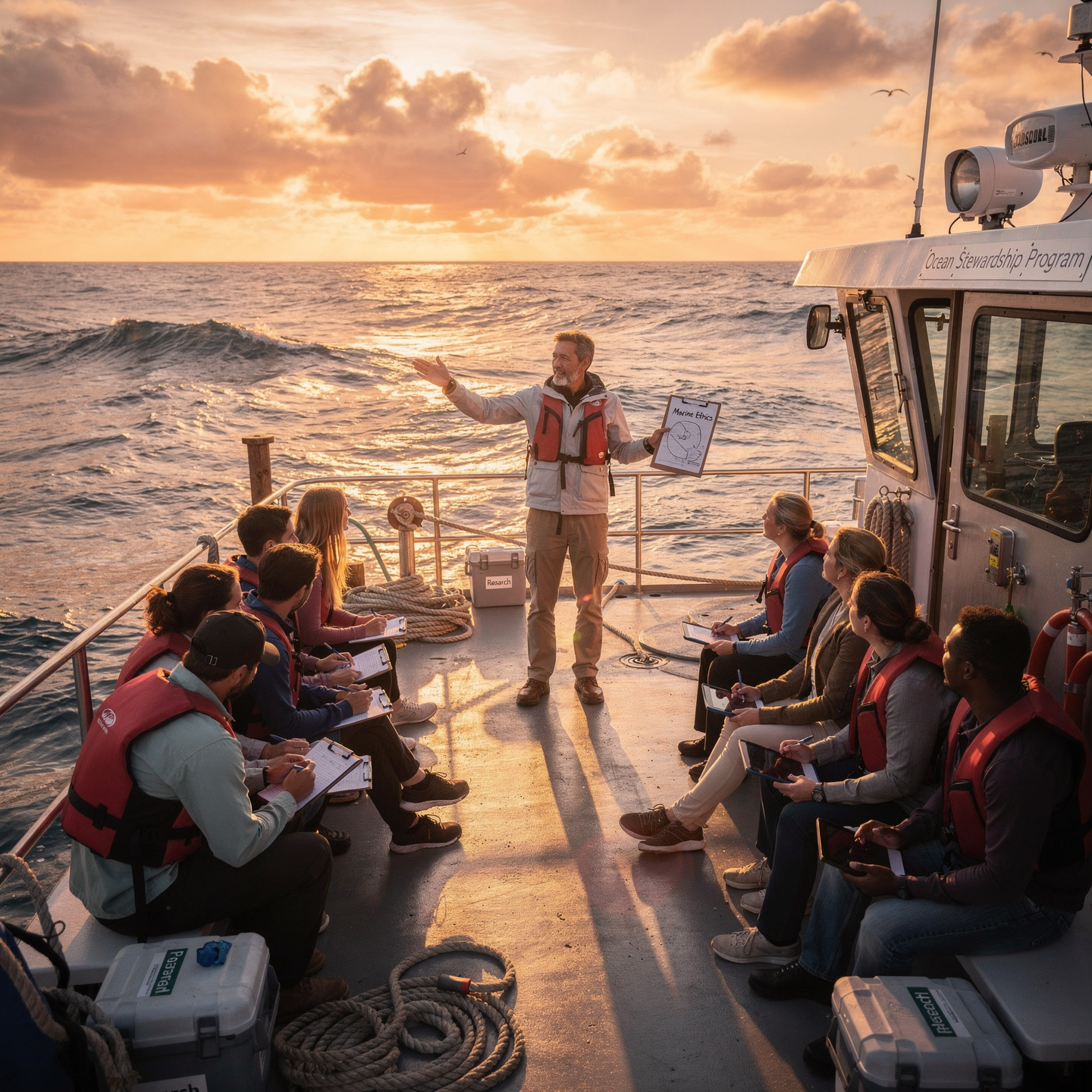
This course prepares you to face the moral and legal challenges of today’s maritime environment. Learn to make informed and fair decisions in critical situations, understanding the implications of your actions on safety, the environment, and human well-being. This program will provide you with the necessary tools to exercise ethical leadership and promote a culture of responsibility and transparency in all your activities.

Ethics and Responsibility at Sea

Differential Advantages

  • Real-life case studies: Examine complex ethical dilemmas and learn from the experience of other professionals.
  • Up-to-date legal framework: Understand the international and national regulations governing conduct at sea.
  • Communication skills development: Improve your ability to express your values ​​and defend your principles.
  • Promotion of responsible decision-making: Acquire tools to evaluate the consequences of your actions and choose the most ethical option.
  • Interactive learning environment: Participate in debates, simulations, and practical exercises to solidify your knowledge.
Ética

Ethics and Responsibility Course at Sea

Availability: 1 in stock

Who is it aimed at?

  • Maritime professionals at all levels seeking to strengthen their understanding and application of ethical principles in the workplace.
  • Officers and crew members aspiring to responsible leadership and integrity-based decision-making.
  • Shipping company managers and administrators interested in promoting an organizational culture of ethics and transparency.
  • Maritime students wishing to acquire a solid foundation in professional ethics for their future careers.
  • Maritime lawyers and consultants needing to delve deeper into the regulations and ethical implications of shipping operations.

Professional Commitment

Tailored to the demands of the sector: practical and relevant content, real-world case studies, and tools for the daily application of ethics in the sea.

Ética

Objectives and competencies

Demonstrate professional and ethical conduct in all maritime interactions:

Comply with the company’s codes of conduct and international regulations, reporting any violations or compromising situations to the appropriate authorities.

Comply with maritime regulations and safety standards:

“Manage emergency situations (fires, floods, man overboard) by applying SOLAS procedures and coordinating with authorities.”

Manage resources responsibly and sustainably:

Optimize fuel consumption through route planning and vessel performance monitoring.

Promote a culture of responsibility and transparency in maritime decision-making:

“Implement standardized communication procedures (IMO) and report incidents/deviations according to internal/external regulations.”
Prioritize the safety of human life at sea in all operations and decisions:

Maintain a vigilant and proactive guard, using all available means (radar, AIS, visual) for the early detection of hazards and react immediately and effectively to emergency situations, communicating the situation according to established protocols (GMDSS, etc.) and leading the response calmly and decisively.

Act with integrity and honesty in all maritime activities:

Strictly comply with maritime safety regulations and professional ethical standards, reporting any irregularities or suspicious behavior.

Curriculum - Modules

  1. Comprehensive Maritime Incident Management: protocols, roles, and chain of command for coordinated response
  2. Operational Planning and Execution: briefing, routes, weather windows, and go/no-go criteria
  3. Rapid Risk Assessment: criticality matrix, scene control, and decision-making under pressure
  4. Operational Communication: VHF/GMDSS, standardized reports, and inter-agency liaison
  5. Tactical Mobility and Safe Boarding: RHIB maneuvers, approach, mooring, and recovery
  6. Equipment and Technologies: PPE, signaling, satellite tracking, and field data logging
  7. Immediate Care of the Affected: primary assessment, hypothermia, trauma, and stabilization for evacuation
  8. Adverse Environmental Conditions: swell, Visibility, flows, and operational mitigation

    Simulation and training: critical scenarios, use of VR/AR, and exercises with performance metrics

    Documentation and continuous improvement: lessons learned, indicators (MTTA/MTTR), and SOP updates

  1. Introduction to Maritime Culture: History, Traditions, and Current Impact
  2. Maritime Legal Framework: International Conventions (SOLAS, MARPOL, etc.) and National Legislation
  3. Situational Awareness: Definition, Components, and Levels of Perception
  4. Human Factors in the Maritime Environment: Communication, Leadership, and Teamwork
  5. Risk Management: Identification, Assessment, and Control in Maritime Operations
  6. Maritime Safety: Prevention of Accidents, Incidents, and Emergencies
  7. Safety Culture: Promotion, Implementation, and Continuous Improvement
  8. Maritime Environmental Awareness: Impact of Maritime Activities and Best Practices
  9. Threats to Maritime Security: Piracy, Terrorism, and Cybersecurity
  10. Corporate Social Responsibility in the Sector maritime

  1. Leadership Fundamentals: Leadership styles, situational leadership, emotional intelligence.
  2. Effective Communication: Verbal and nonverbal communication, active listening, constructive feedback.
  3. Safety Culture: Definition, components, importance in the workplace.
  4. Safety Leadership: The leader’s role in promoting safety, commitment, and responsibility.
  5. Safety Communication: Risk communication, incident reporting, dissemination of relevant information.
  6. Change and Resistance Management: Identifying barriers, adaptation strategies, employee involvement.
  7. Empowerment and Participation: Fostering active participation, recognition, delegation of responsibilities.
  8. Dispute Resolution Conflict and Negotiation: Resolution techniques, mediation, and collaborative solution-finding.

    Motivation and Recognition: Motivation strategies, incentives, and recognition of good performance.

    Measurement and Continuous Improvement: Performance indicators, data analysis, and implementation of corrective actions.

  1. Introduction to Maritime Culture: History, Traditions, and Their Importance
  2. United Nations Convention on the Law of the Sea (UNCLOS): Scope and Application
  3. Rights of Passage and Navigation: Internal Waters, Territorial Sea, Contiguous Zone, EEZ, High Seas
  4. Rights and Obligations of the Flag State: Ship Registration, Safety, Environmental Protection
  5. Rights and Obligations of the Coastal State: Fishing, Exploration, and Exploitation of Resources
  6. Maritime Salvage: Rights and Obligations of the Salvoter and the Owner
  7. Civil Liability for Pollution Damage: Conventions and Liability Regimes
  8. Maritime Labour Rights: Maritime Labour Convention (MLC) and its implementation.
  9. Piracy and armed robbery at sea: prevention and repression.

    Underwater cultural heritage: protection and management.

  1. Human Rights at Sea: International and regional legal framework.
  2. Maritime Security: SOLAS and MARPOL Conventions, and other relevant instruments.
  3. Actors in Maritime Security: States, international organizations, NGOs, and the private sector.
  4. Piracy and Armed Robbery: Causes, consequences, and prevention and response measures.
  5. Human Trafficking and Smuggling of Migrants: Identification, protection of victims, and prosecution of traffickers.
  6. Search and Rescue (SAR): Legal obligations, coordination, and best practices.
  7. Maritime Crisis Management: Planning, response, and recovery.
  8. Crisis Communication: Strategies and protocols for informing the public and stakeholders.

    Psychosocial Aspects in Crisis: Support for victims, families, and response teams.

    Case Studies: Analysis of relevant maritime incidents and lessons learned.

  1. System Architecture and Components: Structural design, materials, and subsystems (mechanical, electrical, electronic, and fluid) with selection and assembly criteria for marine environments
  2. Fundamentals and Principles of Operation: Physical and engineering foundations (thermodynamics, fluid mechanics, electricity, control, and materials) that explain performance and operating limits
  3. Safety and Environmental (SHE): Risk analysis, PPE, LOTO, hazardous atmospheres, spill and waste management, and emergency response plans
  4. Applicable Regulations and Standards: IMO/ISO/IEC requirements and local regulations;
  5. Conformance criteria, certification, and best practices for operation and maintenance
  6. Inspection, testing, and diagnostics: Visual/dimensional inspection, functional testing, data analysis, and predictive techniques (vibration, thermography, fluid analysis) to identify root causes
  7. Preventive and predictive maintenance: Hourly/cycle/seasonal plans, lubrication, adjustments, calibrations, consumable replacement, post-service verification, and operational reliability
  8. Instrumentation, tools, and metrology: Measuring and testing equipment, diagnostic software, calibration and traceability; selection criteria, safe use, and storage
  9. Onboard integration and interfaces: Mechanical, electrical, fluid, and data compatibility; Sealing and watertightness, EMC/EMI, corrosion protection, and interoperability testing.

    Quality, acceptance testing, and commissioning: process and materials control, FAT/SAT, bench and sea trials, go/no-go criteria, and evidence documentation.

    Technical documentation and integrated practice: logs, checklists, reports, and a complete case study (safety → diagnosis → intervention → verification → report) applicable to any system.

Plan de estudio - Módulos

  1. Comprehensive Maritime Incident Management: protocols, roles, and chain of command for coordinated response
  2. Operational Planning and Execution: briefing, routes, weather windows, and go/no-go criteria
  3. Rapid Risk Assessment: criticality matrix, scene control, and decision-making under pressure
  4. Operational Communication: VHF/GMDSS, standardized reports, and inter-agency liaison
  5. Tactical Mobility and Safe Boarding: RHIB maneuvers, approach, mooring, and recovery
  6. Equipment and Technologies: PPE, signaling, satellite tracking, and field data logging
  7. Immediate Care of the Affected: primary assessment, hypothermia, trauma, and stabilization for evacuation
  8. Adverse Environmental Conditions: swell, Visibility, flows, and operational mitigation

    Simulation and training: critical scenarios, use of VR/AR, and exercises with performance metrics

    Documentation and continuous improvement: lessons learned, indicators (MTTA/MTTR), and SOP updates

  1. Introduction to Maritime Culture: History, Traditions, and Current Impact
  2. Maritime Legal Framework: International Conventions (SOLAS, MARPOL, etc.) and National Legislation
  3. Situational Awareness: Definition, Components, and Levels of Perception
  4. Human Factors in the Maritime Environment: Communication, Leadership, and Teamwork
  5. Risk Management: Identification, Assessment, and Control in Maritime Operations
  6. Maritime Safety: Prevention of Accidents, Incidents, and Emergencies
  7. Safety Culture: Promotion, Implementation, and Continuous Improvement
  8. Maritime Environmental Awareness: Impact of Maritime Activities and Best Practices
  9. Threats to Maritime Security: Piracy, Terrorism, and Cybersecurity
  10. Corporate Social Responsibility in the Sector maritime

  1. Leadership Fundamentals: Leadership styles, situational leadership, emotional intelligence.
  2. Effective Communication: Verbal and nonverbal communication, active listening, constructive feedback.
  3. Safety Culture: Definition, components, importance in the workplace.
  4. Safety Leadership: The leader’s role in promoting safety, commitment, and responsibility.
  5. Safety Communication: Risk communication, incident reporting, dissemination of relevant information.
  6. Change and Resistance Management: Identifying barriers, adaptation strategies, employee involvement.
  7. Empowerment and Participation: Fostering active participation, recognition, delegation of responsibilities.
  8. Dispute Resolution Conflict and Negotiation: Resolution techniques, mediation, and collaborative solution-finding.

    Motivation and Recognition: Motivation strategies, incentives, and recognition of good performance.

    Measurement and Continuous Improvement: Performance indicators, data analysis, and implementation of corrective actions.

  1. Introduction to Maritime Culture: History, Traditions, and Their Importance
  2. United Nations Convention on the Law of the Sea (UNCLOS): Scope and Application
  3. Rights of Passage and Navigation: Internal Waters, Territorial Sea, Contiguous Zone, EEZ, High Seas
  4. Rights and Obligations of the Flag State: Ship Registration, Safety, Environmental Protection
  5. Rights and Obligations of the Coastal State: Fishing, Exploration, and Exploitation of Resources
  6. Maritime Salvage: Rights and Obligations of the Salvoter and the Owner
  7. Civil Liability for Pollution Damage: Conventions and Liability Regimes
  8. Maritime Labour Rights: Maritime Labour Convention (MLC) and its implementation.
  9. Piracy and armed robbery at sea: prevention and repression.

    Underwater cultural heritage: protection and management.

  1. Human Rights at Sea: International and regional legal framework.
  2. Maritime Security: SOLAS and MARPOL Conventions, and other relevant instruments.
  3. Actors in Maritime Security: States, international organizations, NGOs, and the private sector.
  4. Piracy and Armed Robbery: Causes, consequences, and prevention and response measures.
  5. Human Trafficking and Smuggling of Migrants: Identification, protection of victims, and prosecution of traffickers.
  6. Search and Rescue (SAR): Legal obligations, coordination, and best practices.
  7. Maritime Crisis Management: Planning, response, and recovery.
  8. Crisis Communication: Strategies and protocols for informing the public and stakeholders.

    Psychosocial Aspects in Crisis: Support for victims, families, and response teams.

    Case Studies: Analysis of relevant maritime incidents and lessons learned.

  1. System Architecture and Components: Structural design, materials, and subsystems (mechanical, electrical, electronic, and fluid) with selection and assembly criteria for marine environments
  2. Fundamentals and Principles of Operation: Physical and engineering foundations (thermodynamics, fluid mechanics, electricity, control, and materials) that explain performance and operating limits
  3. Safety and Environmental (SHE): Risk analysis, PPE, LOTO, hazardous atmospheres, spill and waste management, and emergency response plans
  4. Applicable Regulations and Standards: IMO/ISO/IEC requirements and local regulations;
  5. Conformance criteria, certification, and best practices for operation and maintenance
  6. Inspection, testing, and diagnostics: Visual/dimensional inspection, functional testing, data analysis, and predictive techniques (vibration, thermography, fluid analysis) to identify root causes
  7. Preventive and predictive maintenance: Hourly/cycle/seasonal plans, lubrication, adjustments, calibrations, consumable replacement, post-service verification, and operational reliability
  8. Instrumentation, tools, and metrology: Measuring and testing equipment, diagnostic software, calibration and traceability; selection criteria, safe use, and storage
  9. Onboard integration and interfaces: Mechanical, electrical, fluid, and data compatibility; Sealing and watertightness, EMC/EMI, corrosion protection, and interoperability testing.

    Quality, acceptance testing, and commissioning: process and materials control, FAT/SAT, bench and sea trials, go/no-go criteria, and evidence documentation.

    Technical documentation and integrated practice: logs, checklists, reports, and a complete case study (safety → diagnosis → intervention → verification → report) applicable to any system.

  1. Introduction to situational awareness: definition, levels, and components.
  2. Perception of the environment: selective attention, interpretation, and projection.
  3. Mental models: development, updating, and limitations.
  4. Effective communication: active listening, feedback, and assertiveness.
  5. Situational leadership: adaptability, delegation, and motivation.
  6. Decision-making under pressure: heuristics, biases, and strategies.
  7. Teamwork: roles, responsibilities, and coordination.
  8. Conflict management: negotiation, mediation, and resolution.
  9. Cultural awareness: intercultural communication and sensitivity.
  10. Continuous improvement: self-assessment, feedback, and professional development.

  1. Introduction to Values ​​in Navigation: Safety, Responsibility, and Sustainability
  2. Ethical Decision-Making: Common Dilemmas and Frameworks
  3. Risks and Hazards: Identification, Assessment, and Mitigation
  4. Safety Culture: Communication, Collaboration, and Continuous Improvement
  5. Legislation and Regulations: Compliance and Legal Liability
  6. Consequences of Decisions: Impact on Safety, the Environment, and People
  7. Case Studies: Incident Analysis and Lessons Learned
  8. Leadership and Responsibility: Influence on Decision-Making and Behavior
  9. Resilience and Stress Management: Coping with Difficult Situations and Decision-Making Under Pressure
  10. Promoting a Culture of Values ​​in Navigation: Training and Awareness and good practices

  1. Introduction to maritime culture: history, traditions, and its social impact.
  2. Human rights at sea: international conventions, protection, and guarantees.
  3. The marine environment: ecosystems, biodiversity, and threats.
  4. Marine pollution: sources, effects, and prevention and control measures.
  5. International and national legislation on the protection of the marine environment.
  6. Maritime labor rights: ILO, working conditions, and safety on board.
  7. Indigenous peoples and coastal communities: rights, traditional knowledge, and participation.
  8. Climate change and its effects on the oceans: acidification, sea level rise.
  9. Sustainable management of marine resources: fishing, aquaculture, and tourism.
  10. Ethics and responsibility in the Maritime activity: commitment to sustainability and human rights.

  1. Introduction to Maritime Culture: History, Values, and Traditions
  2. Maritime Legal Framework: International Conventions (SOLAS, MARPOL, etc.), National Legislation
  3. Maritime Organizations: IMO, ILO, Classification Societies, Insurers
  4. Risks in Navigation: Causes, Types (Meteorological, Operational, Human, etc.)
  5. Risk Management: Identification, Analysis, Assessment, and Control
  6. Maritime Safety: Accident Prevention, Protection of Human Life at Sea
  7. Protection of the Marine Environment: Pollution, Invasive Species, Waste Management
  8. Emergency Response: SAR, Pollution Control, Salvage
  9. Cybersecurity in the Maritime Sector Maritime: Threats, Vulnerabilities, and Protective Measures

    Maritime Safety Culture: Promotion, Continuous Improvement, and Incident Reporting

Career opportunities

  • Maritime Ethics Consultant: Advising companies and organizations on responsible and sustainable practices in the sector.
  • Corporate Social Responsibility (CSR) Auditor in the Maritime Sector: Verifying compliance with ethical and social standards in shipping companies, ports, and other related entities.
  • Compliance Officer in Maritime Companies: Developing and implementing regulatory and ethical compliance programs.
  • Trainer in Ethics and Responsibility in Maritime Institutions: Training professionals in the sector on ethics, sustainability, and social responsibility.
  • Researcher in Maritime Research Centers: Analyzing the ethical and social challenges facing the maritime sector and proposing solutions.
  • Sustainability Manager in Shipping and Port Companies: Managing projects and programs to reduce the environmental and social impact of operations maritime.
  • Representative of NGOs and civil society organizations: defense of human rights and environmental protection in the maritime sector.
  • Mediator in maritime conflicts: resolution of disputes between companies, workers, and other stakeholders in the sector, from an ethical perspective.

“`

Admission requirements

Academic/professional profile:

Degree/Bachelor's degree in Nautical Science/Maritime Transport, Naval/Marine Engineering, or a related field; or proven professional experience in bridge/operations.

Language proficiency:

Recommended functional maritime English (SMCP) for simulations and technical materials.

5. Induction

Updated resume, copy of degree or seaman's book, ID card/passport, letter of motivation.

Technical requirements (for online):

Equipment with camera/microphone, stable connection, ≥ 24” monitor recommended for ECDIS/Radar-ARPA.

Admission process and dates

1. Online
application

(form + documents).

2. Academic review and interview

(profile/objectives/schedule compatibility).

3. Admission decision

(+ scholarship proposal if applicable).

4. Reservation of place

(deposit) and registration.

5. Induction

(access to campus, calendars, simulator guides).

Scholarships and grants

  • Ethical Foundations: Explore the key principles that govern professional conduct in the maritime industry.
  • Legal and Moral Responsibility: Understand the legal obligations and ethical imperatives in maritime decision-making.
  • Ethical Risk Management: Learn to identify and mitigate common ethical dilemmas in complex maritime environments.
  • Culture of Integrity: Foster an organizational culture that prioritizes ethics and accountability in all maritime operations.
  • Practical Case Studies: Analyze real-world examples of ethical challenges and learn how to apply responsible solutions. effective.
Develop ethical leadership and contribute to a safer, more transparent, and sustainable maritime industry.

Testimonials

Frequently asked questions

Respect for marine life is crucial to maintaining the health of ocean ecosystems, which are fundamental to the balance of the planet and human well-being.

Yes. The itinerary includes ECDIS/Radar-ARPA/BRM with harbor, ocean, fog, storm, and SAR scenarios.

Online with live sessions; hybrid option for simulator/practical placements through agreements.

Our actions and decisions in the marine ecosystem must be guided by ethical principles that recognize the intrinsic value of marine life and the importance of preserving the health of the oceans for future generations, promoting sustainable and responsible practices in fishing, tourism, waste management and other activities that impact marine environments.

Recommended functional SMCP. We offer support materials for standard phraseology.

Yes, with a relevant degree or experience in maritime/port operations. The admissions interview will confirm suitability.

Optional (3–6 months) through Companies & Collaborations and the Alumni Network.

Simulator practice (rubrics), defeat plans, SOPs, checklists, micro-tests and applied TFM.

A degree from Navalis Magna University + operational portfolio (tracks, SOPs, reports and KPIs) useful for audits and employment.

  1. Introduction to Maritime Culture: History, Values, and Traditions
  2. Maritime Legal Framework: International Conventions (SOLAS, MARPOL, etc.), National Legislation
  3. Maritime Organizations: IMO, ILO, Classification Societies, Insurers
  4. Risks in Navigation: Causes, Types (Meteorological, Operational, Human, etc.)
  5. Risk Management: Identification, Analysis, Assessment, and Control
  6. Maritime Safety: Accident Prevention, Protection of Human Life at Sea
  7. Protection of the Marine Environment: Pollution, Invasive Species, Waste Management
  8. Emergency Response: SAR, Pollution Control, Salvage
  9. Cybersecurity in the Maritime Sector Maritime: Threats, Vulnerabilities, and Protective Measures

    Maritime Safety Culture: Promotion, Continuous Improvement, and Incident Reporting

Request information

  1. Complete the Application Form
  2. Attach your CV/Qualifications (if you have them to hand).
  3. Indicate your preferred cohort (January/May/September) and whether you want the hybrid option with simulator sessions.
An academic advisor will contact you within 24–48 hours to guide you through the admission process, scholarships, and compatibility with your professional schedule. Translated with DeepL.com (free version)
Please enable JavaScript in your browser to complete this form.
Click or drag a file to this area to upload.

Teachers

0
    0
    Tu carrito
    Tu carrito esta vacíoRegresar a la tienda
    Scroll to Top