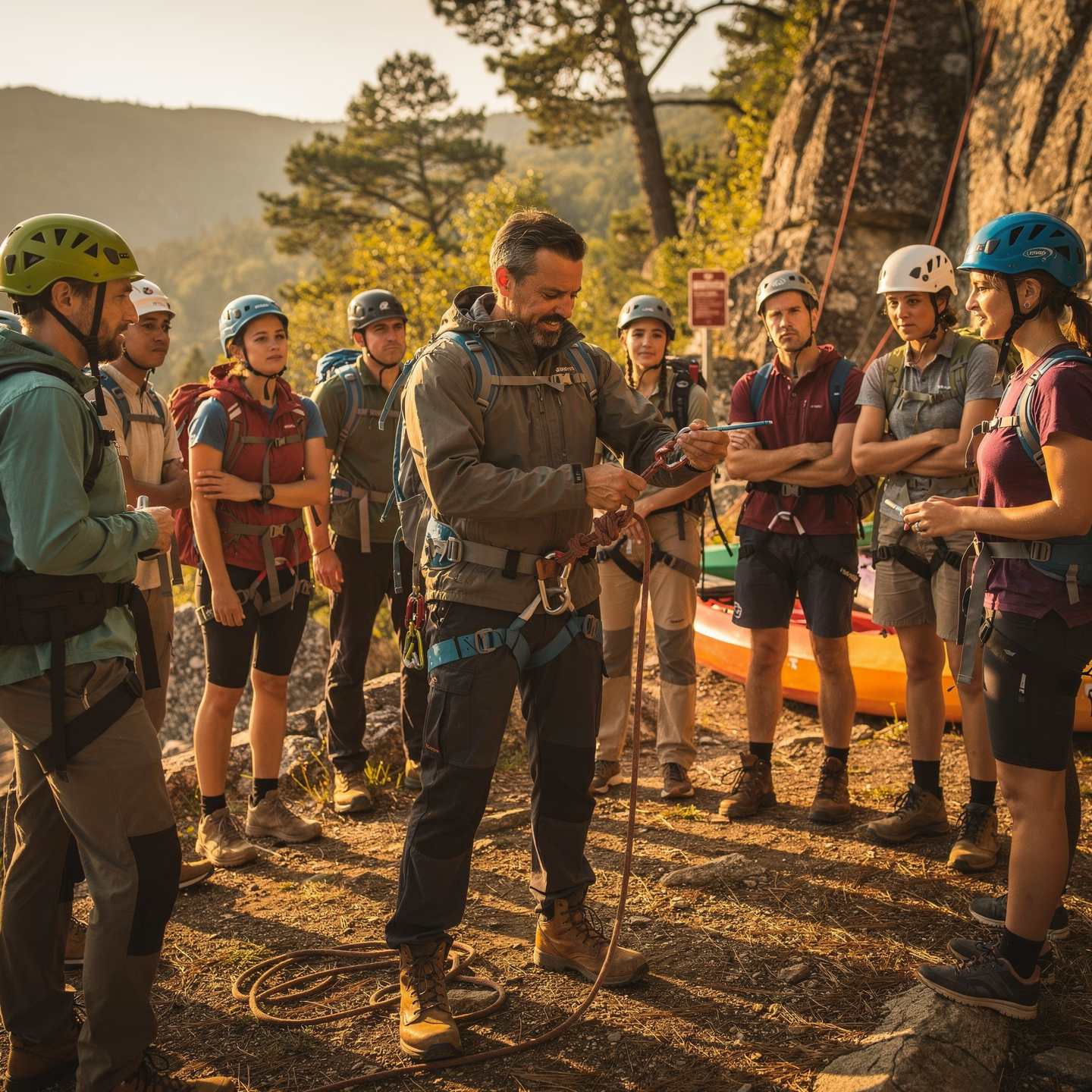
Safety course for recreational excursions
Why this course?
The Recreational Hiking Safety course
This course provides you with the essential tools and knowledge to plan and carry out outdoor activities safely and responsibly. You will learn about risk assessment, wilderness first aid, orienteering and navigation, basic survival, and emergency management in natural environments. Prepare yourself to enjoy nature while minimizing risks and protecting the environment.
Differentiating Advantages
- Practical Approach: simulation exercises and real-life case studies to apply your knowledge.
- Expert Instructors: professionals with extensive experience in safety and outdoor activities.
- Up-to-date Content: latest trends and best practices in nature safety.
- Recognized Certification: validate your skills and knowledge in hiking safety.
- Networking: connect with other nature lovers and industry professionals.
- Modality: Online
- Level: Cursos
- Hours: 150 H
- Start date: 24-07-2026
Availability: 1 in stock
Who is it aimed at?
- Mountain, hiking, and outdoor activity guides seeking to certify their knowledge, update protocols, and minimize risks in natural environments.
- Leisure activity monitors and environmental educators who need practical tools to manage groups, plan safe routes, and interpret the environment.
- Managers of camps, hostels, and active tourism companies who wish to implement safety standards, train their teams, and comply with current regulations.
- Civil protection volunteers and lifeguards interested in rescue techniques, first aid in nature, and communication in emergency situations.
- Hiking and adventure enthusiasts seeking autonomy and confidence to enjoy the mountains safely and Responsibility.
Learning Flexibility
Advance at your own pace: 24/7 accessible online modules, downloadable case studies, and personalized tutoring to answer your questions.
Objectives and competencies

Responding effectively to emergencies:
Assess the situation, communicate clearly (urgency, position, type of emergency), execute response procedures (abandonment, firefighting, damage control) prioritizing the safety of human life and the protection of the environment.

Assessing and mitigating risks in natural environments:
Identify geological, hydrological and meteorological hazards; implement preventive measures and emergency response plans.

Apply land navigation and orientation techniques:
“Using maps, compasses, GPS and other instruments, interpreting the terrain and adapting to changing conditions.”

Implement effective communication protocols:
“Establish clear and concise communication, using standard phraseology and reporting position, intentions and any anomalous conditions to other vessels and coastal stations.”

Managing groups of hikers safely and responsibly:
“Establish clear protocols for communication, risk assessment and emergency response, ensuring the safety and well-being of all participants.”

Adapt the excursion to the abilities of the group:
Adjust the pace, duration, and difficulty of the activities according to the age, physical condition, and prior experience of the participants.
Curriculum - Modules
- Comprehensive Maritime Incident Management: protocols, roles, and chain of command for coordinated response
- Operational Planning and Execution: briefing, routes, weather windows, and go/no-go criteria
- Rapid Risk Assessment: criticality matrix, scene control, and decision-making under pressure
- Operational Communication: VHF/GMDSS, standardized reports, and inter-agency liaison
- Tactical Mobility and Safe Boarding: RHIB maneuvers, approach, mooring, and recovery
- Equipment and Technologies: PPE, signaling, satellite tracking, and field data logging
- Immediate Care of the Affected: primary assessment, hypothermia, trauma, and stabilization for evacuation
- Adverse Environmental Conditions: swell, Visibility, flows, and operational mitigation
Simulation and training: critical scenarios, use of VR/AR, and exercises with performance metrics
Documentation and continuous improvement: lessons learned, indicators (MTTA/MTTR), and SOP updates
- Risk Assessment on Excursions: Hazard identification, vulnerability analysis, and assessment of probability and severity.
- First Aid Kit for Excursions: Essential contents, proper use of medications and supplies, and specific considerations based on the environment.
- Emergency Priorities: Securing the scene, initial patient assessment (ABCDE), and activation of the emergency response system.
- Wound and Bleeding Management: Types of wounds, bleeding control (direct pressure, tourniquets), and bandages and dressings.
- Musculoskeletal Injuries: Sprains, dislocations, fractures, and appropriate immobilization and transport.
- Head and Spinal Cord Injuries: Recognizing signs and symptoms, initial management, and precautions.
- Environmental Conditions
Adverse effects: hypothermia, hyperthermia, frostbite, sunburn, prevention and treatment.
Animal bites and stings: animal identification, wound treatment, allergic reactions and anaphylaxis.
Basic rescue techniques: patient mobilization, improvised transport, use of ropes and pulley systems.
Emergency communication: use of radios, satellite phones, distress signals, essential information to transmit.
‘
- Excursion Planning: Risk assessment, objectives, and itinerary selection.
- Individual and Group Equipment: Review, proper use, and maintenance.
- Meteorology and Orientation: Interpreting forecasts, using a compass, maps, and GPS.
- First Aid in the Wilderness: Treating common injuries and emergencies.
- Communication in Remote Areas: Using radios, satellite phones, and emergency signals.
- Survival Techniques: Building shelters, obtaining water and fire.
- Search and Rescue Protocols: Coordinating with rescue teams, marking the area.
- Incident Management: Situation assessment, decision-making, and leadership.
- Accident Prevention: Identifying hazards Hazards, safety measures, and risk mitigation.
- Applicable legislation and regulations: Responsibilities of the guide and participants.
‘
- Introduction to risk management in hiking activities: key concepts and regulations.
- Hazard identification: analysis of the environment (terrain, climate, flora, fauna), activities, and participants.
- Risk assessment: probability and impact; qualitative and quantitative methodologies.
- Prevention and mitigation measures: equipment, procedures, communication.
- Communication protocols: alert systems, radio, satellite phone; Communication with emergency services.
First aid in remote environments: management of injuries, illnesses, hypothermia, and heatstroke.
Emergency plans: search and rescue, evacuation, and crisis scenarios.
Personal and group safety equipment: selection, use, and maintenance.
Legislation and insurance: civil liability, accident insurance, permits, and authorizations.
Post-incident analysis: lessons learned and continuous improvement of protocols.
‘
- Fundamentals of Hiking Safety: Legislation, Regulations, and Best Practices
- Risk Identification and Assessment: Risk Matrices, Preliminary Hazard Analysis (PHA)
- Personal Protective Equipment (PPE): Selection, Proper Use, and Maintenance
- First Aid in Remote Environments: Emergency Kit, Stabilization and Evacuation Techniques
- Emergency Communication: Communication Protocols, Radio Equipment, Distress Signals
- Emergency Response Planning: Risk Scenarios, Roles, and Responsibilities
- Group Management in Crisis Situations: Leadership, Effective Communication, and Panic Control
- Rescue and Evacuation Techniques: Ropes, Pulley Systems and transport of the wounded
Wildlife survival: shelter, fire, water, and orientation
Post-incident analysis: investigation, reporting, and continuous improvement
‘
- System Architecture and Components: Structural design, materials, and subsystems (mechanical, electrical, electronic, and fluid) with selection and assembly criteria for marine environments
- Fundamentals and Principles of Operation: Physical and engineering foundations (thermodynamics, fluid mechanics, electricity, control, and materials) that explain performance and operating limits
- Safety and Environmental (SHE): Risk analysis, PPE, LOTO, hazardous atmospheres, spill and waste management, and emergency response plans
- Applicable Regulations and Standards: IMO/ISO/IEC requirements and local regulations;
- Conformance criteria, certification, and best practices for operation and maintenance
- Inspection, testing, and diagnostics: Visual/dimensional inspection, functional testing, data analysis, and predictive techniques (vibration, thermography, fluid analysis) to identify root causes
- Preventive and predictive maintenance: Hourly/cycle/seasonal plans, lubrication, adjustments, calibrations, consumable replacement, post-service verification, and operational reliability
- Instrumentation, tools, and metrology: Measuring and testing equipment, diagnostic software, calibration and traceability; selection criteria, safe use, and storage
- Onboard integration and interfaces: Mechanical, electrical, fluid, and data compatibility; Sealing and watertightness, EMC/EMI, corrosion protection, and interoperability testing.
Quality, acceptance testing, and commissioning: process and materials control, FAT/SAT, bench and sea trials, go/no-go criteria, and evidence documentation.
Technical documentation and integrated practice: logs, checklists, reports, and a complete case study (safety → diagnosis → intervention → verification → report) applicable to any system.
Plan de estudio - Módulos
- Comprehensive Maritime Incident Management: protocols, roles, and chain of command for coordinated response
- Operational Planning and Execution: briefing, routes, weather windows, and go/no-go criteria
- Rapid Risk Assessment: criticality matrix, scene control, and decision-making under pressure
- Operational Communication: VHF/GMDSS, standardized reports, and inter-agency liaison
- Tactical Mobility and Safe Boarding: RHIB maneuvers, approach, mooring, and recovery
- Equipment and Technologies: PPE, signaling, satellite tracking, and field data logging
- Immediate Care of the Affected: primary assessment, hypothermia, trauma, and stabilization for evacuation
- Adverse Environmental Conditions: swell, Visibility, flows, and operational mitigation
Simulation and training: critical scenarios, use of VR/AR, and exercises with performance metrics
Documentation and continuous improvement: lessons learned, indicators (MTTA/MTTR), and SOP updates
- Risk Assessment on Excursions: Hazard identification, vulnerability analysis, and assessment of probability and severity.
- First Aid Kit for Excursions: Essential contents, proper use of medications and supplies, and specific considerations based on the environment.
- Emergency Priorities: Securing the scene, initial patient assessment (ABCDE), and activation of the emergency response system.
- Wound and Bleeding Management: Types of wounds, bleeding control (direct pressure, tourniquets), and bandages and dressings.
- Musculoskeletal Injuries: Sprains, dislocations, fractures, and appropriate immobilization and transport.
- Head and Spinal Cord Injuries: Recognizing signs and symptoms, initial management, and precautions.
- Environmental Conditions
Adverse effects: hypothermia, hyperthermia, frostbite, sunburn, prevention and treatment.
Animal bites and stings: animal identification, wound treatment, allergic reactions and anaphylaxis.
Basic rescue techniques: patient mobilization, improvised transport, use of ropes and pulley systems.
Emergency communication: use of radios, satellite phones, distress signals, essential information to transmit.
‘
- Excursion Planning: Risk assessment, objectives, and itinerary selection.
- Individual and Group Equipment: Review, proper use, and maintenance.
- Meteorology and Orientation: Interpreting forecasts, using a compass, maps, and GPS.
- First Aid in the Wilderness: Treating common injuries and emergencies.
- Communication in Remote Areas: Using radios, satellite phones, and emergency signals.
- Survival Techniques: Building shelters, obtaining water and fire.
- Search and Rescue Protocols: Coordinating with rescue teams, marking the area.
- Incident Management: Situation assessment, decision-making, and leadership.
- Accident Prevention: Identifying hazards Hazards, safety measures, and risk mitigation.
- Applicable legislation and regulations: Responsibilities of the guide and participants.
‘
- Introduction to risk management in hiking activities: key concepts and regulations.
- Hazard identification: analysis of the environment (terrain, climate, flora, fauna), activities, and participants.
- Risk assessment: probability and impact; qualitative and quantitative methodologies.
- Prevention and mitigation measures: equipment, procedures, communication.
- Communication protocols: alert systems, radio, satellite phone; Communication with emergency services.
First aid in remote environments: management of injuries, illnesses, hypothermia, and heatstroke.
Emergency plans: search and rescue, evacuation, and crisis scenarios.
Personal and group safety equipment: selection, use, and maintenance.
Legislation and insurance: civil liability, accident insurance, permits, and authorizations.
Post-incident analysis: lessons learned and continuous improvement of protocols.
‘
- Fundamentals of Hiking Safety: Legislation, Regulations, and Best Practices
- Risk Identification and Assessment: Risk Matrices, Preliminary Hazard Analysis (PHA)
- Personal Protective Equipment (PPE): Selection, Proper Use, and Maintenance
- First Aid in Remote Environments: Emergency Kit, Stabilization and Evacuation Techniques
- Emergency Communication: Communication Protocols, Radio Equipment, Distress Signals
- Emergency Response Planning: Risk Scenarios, Roles, and Responsibilities
- Group Management in Crisis Situations: Leadership, Effective Communication, and Panic Control
- Rescue and Evacuation Techniques: Ropes, Pulley Systems and transport of the wounded
Wildlife survival: shelter, fire, water, and orientation
Post-incident analysis: investigation, reporting, and continuous improvement
‘
- System Architecture and Components: Structural design, materials, and subsystems (mechanical, electrical, electronic, and fluid) with selection and assembly criteria for marine environments
- Fundamentals and Principles of Operation: Physical and engineering foundations (thermodynamics, fluid mechanics, electricity, control, and materials) that explain performance and operating limits
- Safety and Environmental (SHE): Risk analysis, PPE, LOTO, hazardous atmospheres, spill and waste management, and emergency response plans
- Applicable Regulations and Standards: IMO/ISO/IEC requirements and local regulations;
- Conformance criteria, certification, and best practices for operation and maintenance
- Inspection, testing, and diagnostics: Visual/dimensional inspection, functional testing, data analysis, and predictive techniques (vibration, thermography, fluid analysis) to identify root causes
- Preventive and predictive maintenance: Hourly/cycle/seasonal plans, lubrication, adjustments, calibrations, consumable replacement, post-service verification, and operational reliability
- Instrumentation, tools, and metrology: Measuring and testing equipment, diagnostic software, calibration and traceability; selection criteria, safe use, and storage
- Onboard integration and interfaces: Mechanical, electrical, fluid, and data compatibility; Sealing and watertightness, EMC/EMI, corrosion protection, and interoperability testing.
Quality, acceptance testing, and commissioning: process and materials control, FAT/SAT, bench and sea trials, go/no-go criteria, and evidence documentation.
Technical documentation and integrated practice: logs, checklists, reports, and a complete case study (safety → diagnosis → intervention → verification → report) applicable to any system.
- Security Fundamentals: Definitions, principles, and objectives.
- Legal and regulatory framework: Applicable laws, standards, and regulations.
- Identification of hazards and risks: Methodologies and tools.
- Vulnerability analysis: Assessing exposure to threats.
- Risk assessment: Probability, impact, and risk levels.
- Design and implementation of security protocols: Operating procedures.
- Emergency response plans: Structure, roles, and responsibilities.
- Emergency drills and exercises: Preparation and evaluation.
- Personal protective equipment (PPE) and its proper use.
- Communication in emergency situations: Protocols and channels.
‘
- Applicable Legislation and Regulations: Local, national, and international laws on water and land safety.
- Risk Assessment in Recreational Environments: Hazard identification, vulnerability analysis, and preventive measures.
- Safety and Rescue Equipment: Life jackets, ropes, first aid kits, communication equipment, etc.
- Water Rescue Techniques: Rescuing people from the water, towing, and safe evacuation.
- First Aid and Basic Life Support: CPR, treatment of wounds, burns, fractures, and other medical emergencies.
- Effective Communication in Emergency Situations: Communication protocols, use of radios, emergency signals, and coordination with external services.
- Crowd Management and Access Control: Strategies for maintaining crowd control Order and safety in crowded areas.
Land search and rescue: orientation, tracking, and evacuation techniques in difficult terrain.
Rescue psychology: managing stress, anxiety, and fear in emergency situations.
Emergency drills and exercises: planning, conducting, and evaluating drills to improve incident response.
‘
- Introduction to Safety: Concepts, Principles, and Legal Framework
- Hazard Identification: Analysis Techniques and Tools
- Risk Assessment: Qualitative and Quantitative Methodologies
- Risk Control Measures: Hierarchy of Controls and Best Practices
- Emergency Plans: Structure, Content, and Responsibilities
- Personal Protective Equipment (PPE): Selection, Use, and Maintenance
- First Aid: Basic Care and Life Support Protocols
- Fire Prevention and Control: Classes of Fire and Extinguishers
- Emergency Drills: Planning, Execution, and Evaluation
- Incident Investigation: Methodology and Report Writing
‘
- Personal Safety Equipment: PPE, emergency backpacks, first aid kit
- Risk Assessment in Nature: Hazard identification, vulnerability analysis, and preventive measures
- Communication Protocols: Use of radios, visual signals, and satellite communication devices
- Basic Rescue Techniques: Evacuation in difficult terrain, stabilization of the injured, and search for missing persons
- Land Navigation and Orientation: Use of maps, compasses, GPS, and non-technological orientation techniques
- Survival in Adverse Conditions: Shelter, fire, water, and food in natural environments
- First Aid in Remote Areas: Treatment of common injuries, illnesses, and medical emergencies
- Management of Incidents and emergencies: activation of protocols, team coordination, and communication with authorities
Rescue psychology: stress management, emotional support for victims, and teamwork
Legislation and regulations: regulations on outdoor activities, civil and criminal liability
‘
Career opportunities
- Recreational Excursion Guide: Leading groups in outdoor activities, ensuring the safety and enjoyment of participants.
- Recreational Activity Monitor: Designing and implementing recreational and educational activities in natural environments, with an emphasis on safety.
- Risk Prevention Technician in Recreational Activities: Assessing and mitigating risks in excursions and outdoor activities.
- Lifeguard in Natural Environments: Responding to emergencies and providing first aid in recreational areas, such as trails, lakes, or parks.
- Safety-Specialized Tourist Entertainer: Integrating safety protocols into tourist entertainment in natural environments.
- Safety Manager in Active Tourism Companies: Planning and supervising safety in companies that offer adventure and recreational activities.
- Safety Consultant for Recreational Activities: Advising companies and organizations on best practices in safety for excursions and outdoor activities.
- Safety Trainer for Recreational Activities: Instructor in courses on safety, first aid, and risk prevention in natural environments.
“`
Admission requirements

Academic/professional profile:
Degree/Bachelor's degree in Nautical Science/Maritime Transport, Naval/Marine Engineering, or a related field; or proven professional experience in bridge/operations.

Language proficiency:
Recommended functional maritime English (SMCP) for simulations and technical materials.

5. Induction
Updated resume, copy of degree or seaman's book, ID card/passport, letter of motivation.

Technical requirements (for online):
Equipment with camera/microphone, stable connection, ≥ 24” monitor recommended for ECDIS/Radar-ARPA.
Admission process and dates

1. Online
application
(form + documents).

2. Academic review and interview
(profile/objectives/schedule compatibility).

3. Admission decision
(+ scholarship proposal if applicable).

4. Reservation of place
(deposit) and registration.

5. Induction
(access to campus, calendars, simulator guides).
Scholarships and grants
- Safety Expert Planning: Master risk assessment techniques and the creation of effective contingency plans.
- First Aid: Learn to respond to medical emergencies in natural environments, including common injuries and evacuation protocols.
- Orientation and Navigation: Hone your map reading, compass, and GPS skills to lead safe and efficient expeditions.
- Basic Survival: Acquire essential knowledge about shelter, fire, water, and Food in nature.
- Group Leadership: Develop your skills to motivate, communicate, and manage groups in challenging environments, promoting the safety and well-being of all participants.
Testimonials
I implemented the safety techniques I learned during training on a hiking trip with a group of young people. I anticipated specific risks along the route, established clear meeting points and communication protocols, and carried a fully stocked first-aid kit. When one of the participants sprained their ankle, I was able to immobilize it correctly and coordinate a safe and efficient evacuation, preventing complications and ensuring the well-being of the group.
I mastered the complex nuances of security legislation, applying it effectively to real-world scenarios and mitigating potential risks. My deep understanding of regulations and best practices allowed me to contribute significantly to improving my organization’s security protocols.
I implemented the safety training techniques I had learned during a hike with a group of young people. I anticipated specific risks along the route, established clear communication protocols, and carried the appropriate equipment. Thanks to this preparation, we effectively managed a minor injury to one participant and avoided a potentially dangerous situation related to a sudden change in the weather. The hike was a success, and the participants highlighted the sense of safety and confidence I instilled in them.
I implemented the techniques I learned in the Recreational Hiking Safety course during a rock climb with my group. I anticipated route-specific hazards, established a clear communication system, thoroughly checked our equipment, and practiced basic rescues. Thanks to my preparation and my calm response to a minor incident with a group member, we were able to resolve it quickly and without further incident, completing the climb safely and enjoyably for everyone.

Frequently asked questions
It depends on the excursion, but one crucial element that is often overlooked is a first aid manual; knowing how to use the supplies is just as important as the supplies themselves.
Yes. The itinerary includes ECDIS/Radar-ARPA/BRM with harbor, ocean, fog, storm, and SAR scenarios.
Online with live sessions; hybrid option for simulator/practical placements through agreements.
Plan the route and communicate it to someone.
Recommended functional SMCP. We offer support materials for standard phraseology.
Yes, with a relevant degree or experience in maritime/port operations. The admissions interview will confirm suitability.
Optional (3–6 months) through Companies & Collaborations and the Alumni Network.
Simulator practice (rubrics), defeat plans, SOPs, checklists, micro-tests and applied TFM.
A degree from Navalis Magna University + operational portfolio (tracks, SOPs, reports and KPIs) useful for audits and employment.
- Personal Safety Equipment: PPE, emergency backpacks, first aid kit
- Risk Assessment in Nature: Hazard identification, vulnerability analysis, and preventive measures
- Communication Protocols: Use of radios, visual signals, and satellite communication devices
- Basic Rescue Techniques: Evacuation in difficult terrain, stabilization of the injured, and search for missing persons
- Land Navigation and Orientation: Use of maps, compasses, GPS, and non-technological orientation techniques
- Survival in Adverse Conditions: Shelter, fire, water, and food in natural environments
- First Aid in Remote Areas: Treatment of common injuries, illnesses, and medical emergencies
- Management of Incidents and emergencies: activation of protocols, team coordination, and communication with authorities
Rescue psychology: stress management, emotional support for victims, and teamwork
Legislation and regulations: regulations on outdoor activities, civil and criminal liability
‘
Request information
- Complete the Application Form
- Attach your CV/Qualifications (if you have them to hand).
- Indicate your preferred cohort (January/May/September) and whether you want the hybrid option with simulator sessions.
Teachers
Eng. Tomás Riera
Full Professor
Eng. Tomás Riera
Full Professor
Eng. Sofía Marquina
Full Professor
Eng. Sofía Marquina
Full Professor
Eng. Javier Bañuls
Full Professor
Eng. Javier Bañuls
Full Professor
Dr. Nuria Llobregat
Full Professor
Dr. Nuria Llobregat
Full Professor
Dr. Pau Ferrer
Full Professor
Dr. Pau Ferrer
Full Professor
Cap. Javier Abaroa (MCA)
Full Professor
Cap. Javier Abaroa (MCA)
Full Professor

