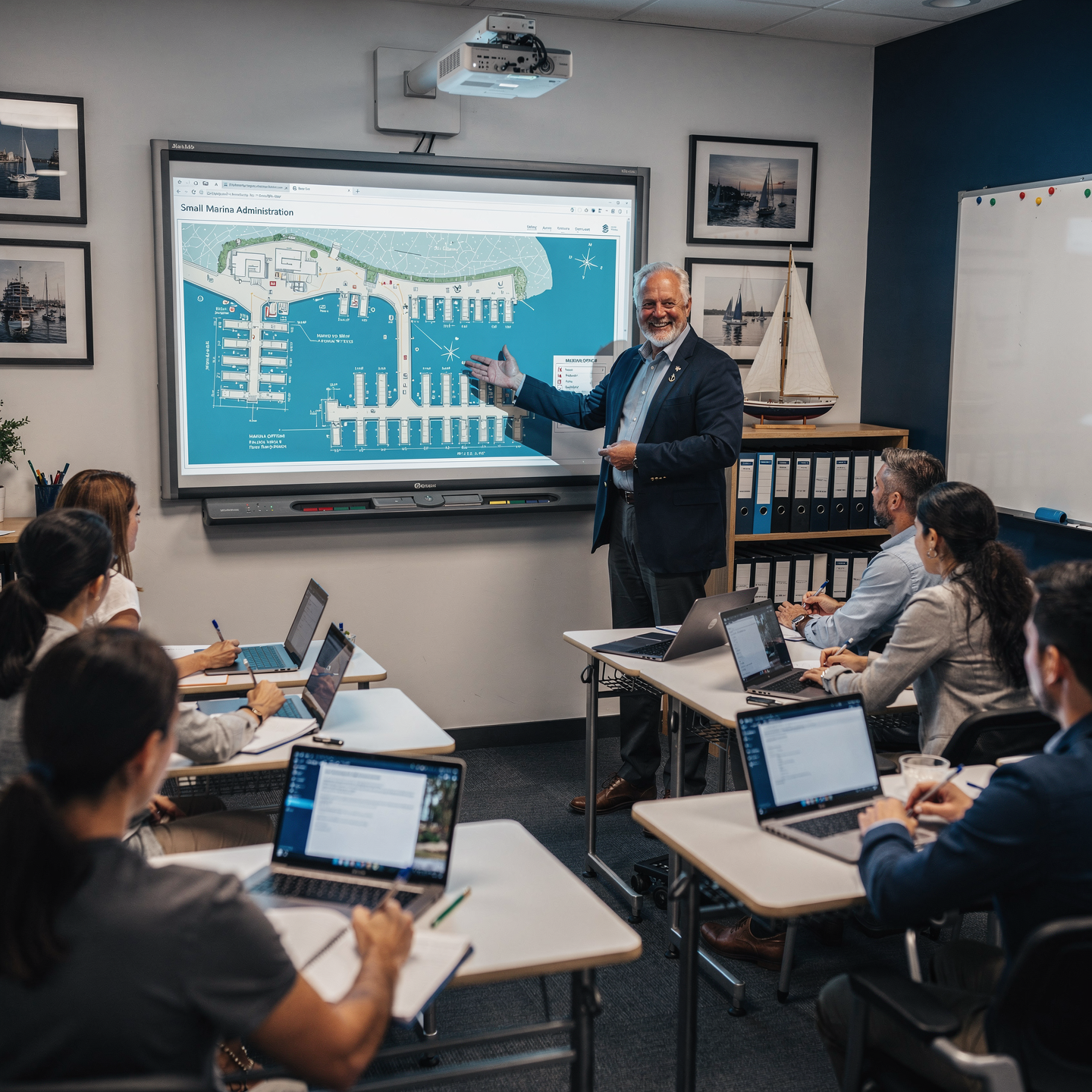
Small Marine Management Course
Why this course?
The Small Marina Management Course
This course provides you with the essential tools to manage and optimize your marina. Learn about financial management, marketing and sales, efficient port operations, and compliance with environmental and safety regulations. Master the key strategies to attract and retain customers, optimize space utilization, and ensure the profitability of your business.
This course provides you with the essential tools to manage and optimize your marina.
Differentiating Advantages
- Comprehensive Management: From invoicing to maintenance, master all aspects of marina administration.
- Digital Marketing: Learn to use social media and other online tools to attract new clients.
- Safety and Environment: Comply with regulations and protect your marina and your clients.
- Case Studies: Analyze real-world situations and learn from the experience of other managers.
- Networking: Connect with other professionals in the sector and expand your network.
- Modality: Online
- Level: Cursos
- Hours: 150 H
- Start date: 24-10-2026
Availability: 1 in stock
Who is it aimed at?
- Small marina owners and managers looking to optimize management, increase profitability, and improve the customer experience.
- Marina and yacht club employees who want to develop their skills in administration, marketing, and customer service.
- Entrepreneurs aspiring to start a business in the marina sector and seeking a solid foundation in management and operations.
- Tourism and nautical management students who want to specialize in marina management and understand the sector’s specific characteristics.
- Nautical service providers seeking to better understand the needs of marinas to offer more efficient and Customized.
Learning Flexibility
Designed for professionals and students: 24/7 online access to content, discussion forums, and downloadable resources to apply directly in your marina.
Objectives and competencies

Efficiently manage naval resources:
Optimize predictive and corrective maintenance of equipment, minimizing downtime and costs, ensuring operational availability.

Optimize customer service and port services:
“Implement clear and efficient communication protocols, prioritizing the rapid resolution of incidents and end-user satisfaction.”

Comply with and enforce maritime and environmental regulations:
“Manage discharges and emissions according to MARPOL, implementing emergency procedures for accidental spills and reporting incidents to port and coastal authorities.”

Develop effective marketing and promotion strategies:
“Analyze the market, define the target audience and select the appropriate communication channels, optimizing the budget and measuring the ROI.”

Supervise and coordinate maintenance and repair operations:
“Ensure compliance with safety procedures, optimizing planning and resource allocation to minimize equipment downtime.”

Implement safety protocols for accident prevention:
Establish physical and logical barriers, verifying their integrity and effectiveness through regular inspections and audits, documenting actions, and training staff.
Curriculum - Modules
- Comprehensive Maritime Incident Management: protocols, roles, and chain of command for coordinated response
- Operational Planning and Execution: briefing, routes, weather windows, and go/no-go criteria
- Rapid Risk Assessment: criticality matrix, scene control, and decision-making under pressure
- Operational Communication: VHF/GMDSS, standardized reports, and inter-agency liaison
- Tactical Mobility and Safe Boarding: RHIB maneuvers, approach, mooring, and recovery
- Equipment and Technologies: PPE, signaling, satellite tracking, and field data logging
- Immediate Care of the Affected: primary assessment, hypothermia, trauma, and stabilization for evacuation
- Adverse Environmental Conditions: swell, Visibility, flows, and operational mitigation
Simulation and training: critical scenarios, use of VR/AR, and exercises with performance metrics
Documentation and continuous improvement: lessons learned, indicators (MTTA/MTTR), and SOP updates
- Introduction to Integrated Marina Management: Key Concepts and Scope.
- Legal and Regulatory Framework: National and International Regulations Applicable to Marinas.
- Marina Planning and Design: Location, Layout, Infrastructure, and Sustainability.
- Marina Safety Management: Risk Prevention, Emergency and Evacuation Plans.
- Port Operations: Berthing, Mooring, Vessel Services, and Waste Management.
- Infrastructure Maintenance: Docks, Piers, Pontoons, and Equipment.
- Environmental Management: Protection of Marine Flora and Fauna, Discharge and Noise Control.
- Customer Services: Customer Service, Reservation and Activity Management Recreational.
- Technologies applied to marina management: Management software, surveillance systems, and access control.
- Case studies and simulations: Analysis of real-life situations and decision-making.
‘
- Introduction to Marina Management: History, Evolution, and Typology
- Legal and Regulatory Framework: Port, Environmental, and Safety Legislation
- Strategic Planning of the Marina: SWOT Analysis, Objectives, and KPIs
- Design and Layout of Spaces: Docks, Berths, Services, and Recreation Areas
- Marina Infrastructure: Electricity, Water, Sanitation, and Communications
- Fuel and Waste Management: Safety and Environmental Protocols
- Mooring and Unmooring Operations: Procedures, Equipment, and Personnel
- Vessel Maintenance: Dry Dock, Workshops, and Technical Services
- Safety and Emergencies: Contingency plans, access control, and CCTV
Customer service and concierge services: Reception, information, and reservations
‘
- Introduction to Marina Management: Types, Roles, and Responsibilities
- Legal and Regulatory Framework: Port, Environmental, and Security Legislation
- Strategic Planning of the Marina: SWOT Analysis, Objectives, and KPIs
- Infrastructure Design and Optimization: Docks, Piers, and Slipways
- Mooring Management: Allocation, Rates, Contracts, and Rotation
- Vessel Services: Water, Electricity, Fuel, etc. Supply
- Preventive and Corrective Maintenance of Facilities and Equipment
- Marina Security: Emergency Plans, Access Control, CCTV
- Environmental Management: Waste Treatment,
- Discharge control, renewable energy
- Customer service and marketing: Loyalty programs, events, and marina promotion
‘
- Legal Framework for Marinas: Applicable national and international legislation.
- Authorizations and Concessions: Procedures, requirements, and management.
- Civil Liability and Insurance: Coverage, risks, and claims management.
- Mooring and Service Contracts: Drafting, compliance, and resolution.
- Environmental Regulations: Waste management, discharges, and environmental protection.
- Maritime and Port Security: ISPS regulations, contingency plans, and security.
- Data Protection: Compliance with the GDPR and LOPDGDD in the management of customer data.
- Occupational Risk Prevention: Assessment Risk assessment, safety and health plans.
- Marine Taxation: Applicable taxes and tax obligations.
- Maritime Law: Salvage, towing, collisions, and other maritime incidents.
‘
- System Architecture and Components: Structural design, materials, and subsystems (mechanical, electrical, electronic, and fluid) with selection and assembly criteria for marine environments
- Fundamentals and Principles of Operation: Physical and engineering foundations (thermodynamics, fluid mechanics, electricity, control, and materials) that explain performance and operating limits
- Safety and Environmental (SHE): Risk analysis, PPE, LOTO, hazardous atmospheres, spill and waste management, and emergency response plans
- Applicable Regulations and Standards: IMO/ISO/IEC requirements and local regulations;
- Conformance criteria, certification, and best practices for operation and maintenance
- Inspection, testing, and diagnostics: Visual/dimensional inspection, functional testing, data analysis, and predictive techniques (vibration, thermography, fluid analysis) to identify root causes
- Preventive and predictive maintenance: Hourly/cycle/seasonal plans, lubrication, adjustments, calibrations, consumable replacement, post-service verification, and operational reliability
- Instrumentation, tools, and metrology: Measuring and testing equipment, diagnostic software, calibration and traceability; selection criteria, safe use, and storage
- Onboard integration and interfaces: Mechanical, electrical, fluid, and data compatibility; Sealing and watertightness, EMC/EMI, corrosion protection, and interoperability testing.
Quality, acceptance testing, and commissioning: process and materials control, FAT/SAT, bench and sea trials, go/no-go criteria, and evidence documentation.
Technical documentation and integrated practice: logs, checklists, reports, and a complete case study (safety → diagnosis → intervention → verification → report) applicable to any system.
Plan de estudio - Módulos
- Comprehensive Maritime Incident Management: protocols, roles, and chain of command for coordinated response
- Operational Planning and Execution: briefing, routes, weather windows, and go/no-go criteria
- Rapid Risk Assessment: criticality matrix, scene control, and decision-making under pressure
- Operational Communication: VHF/GMDSS, standardized reports, and inter-agency liaison
- Tactical Mobility and Safe Boarding: RHIB maneuvers, approach, mooring, and recovery
- Equipment and Technologies: PPE, signaling, satellite tracking, and field data logging
- Immediate Care of the Affected: primary assessment, hypothermia, trauma, and stabilization for evacuation
- Adverse Environmental Conditions: swell, Visibility, flows, and operational mitigation
Simulation and training: critical scenarios, use of VR/AR, and exercises with performance metrics
Documentation and continuous improvement: lessons learned, indicators (MTTA/MTTR), and SOP updates
- Introduction to Integrated Marina Management: Key Concepts and Scope.
- Legal and Regulatory Framework: National and International Regulations Applicable to Marinas.
- Marina Planning and Design: Location, Layout, Infrastructure, and Sustainability.
- Marina Safety Management: Risk Prevention, Emergency and Evacuation Plans.
- Port Operations: Berthing, Mooring, Vessel Services, and Waste Management.
- Infrastructure Maintenance: Docks, Piers, Pontoons, and Equipment.
- Environmental Management: Protection of Marine Flora and Fauna, Discharge and Noise Control.
- Customer Services: Customer Service, Reservation and Activity Management Recreational.
- Technologies applied to marina management: Management software, surveillance systems, and access control.
- Case studies and simulations: Analysis of real-life situations and decision-making.
‘
- Introduction to Marina Management: History, Evolution, and Typology
- Legal and Regulatory Framework: Port, Environmental, and Safety Legislation
- Strategic Planning of the Marina: SWOT Analysis, Objectives, and KPIs
- Design and Layout of Spaces: Docks, Berths, Services, and Recreation Areas
- Marina Infrastructure: Electricity, Water, Sanitation, and Communications
- Fuel and Waste Management: Safety and Environmental Protocols
- Mooring and Unmooring Operations: Procedures, Equipment, and Personnel
- Vessel Maintenance: Dry Dock, Workshops, and Technical Services
- Safety and Emergencies: Contingency plans, access control, and CCTV
Customer service and concierge services: Reception, information, and reservations
‘
- Introduction to Marina Management: Types, Roles, and Responsibilities
- Legal and Regulatory Framework: Port, Environmental, and Security Legislation
- Strategic Planning of the Marina: SWOT Analysis, Objectives, and KPIs
- Infrastructure Design and Optimization: Docks, Piers, and Slipways
- Mooring Management: Allocation, Rates, Contracts, and Rotation
- Vessel Services: Water, Electricity, Fuel, etc. Supply
- Preventive and Corrective Maintenance of Facilities and Equipment
- Marina Security: Emergency Plans, Access Control, CCTV
- Environmental Management: Waste Treatment,
- Discharge control, renewable energy
- Customer service and marketing: Loyalty programs, events, and marina promotion
‘
- Legal Framework for Marinas: Applicable national and international legislation.
- Authorizations and Concessions: Procedures, requirements, and management.
- Civil Liability and Insurance: Coverage, risks, and claims management.
- Mooring and Service Contracts: Drafting, compliance, and resolution.
- Environmental Regulations: Waste management, discharges, and environmental protection.
- Maritime and Port Security: ISPS regulations, contingency plans, and security.
- Data Protection: Compliance with the GDPR and LOPDGDD in the management of customer data.
- Occupational Risk Prevention: Assessment Risk assessment, safety and health plans.
- Marine Taxation: Applicable taxes and tax obligations.
- Maritime Law: Salvage, towing, collisions, and other maritime incidents.
‘
- System Architecture and Components: Structural design, materials, and subsystems (mechanical, electrical, electronic, and fluid) with selection and assembly criteria for marine environments
- Fundamentals and Principles of Operation: Physical and engineering foundations (thermodynamics, fluid mechanics, electricity, control, and materials) that explain performance and operating limits
- Safety and Environmental (SHE): Risk analysis, PPE, LOTO, hazardous atmospheres, spill and waste management, and emergency response plans
- Applicable Regulations and Standards: IMO/ISO/IEC requirements and local regulations;
- Conformance criteria, certification, and best practices for operation and maintenance
- Inspection, testing, and diagnostics: Visual/dimensional inspection, functional testing, data analysis, and predictive techniques (vibration, thermography, fluid analysis) to identify root causes
- Preventive and predictive maintenance: Hourly/cycle/seasonal plans, lubrication, adjustments, calibrations, consumable replacement, post-service verification, and operational reliability
- Instrumentation, tools, and metrology: Measuring and testing equipment, diagnostic software, calibration and traceability; selection criteria, safe use, and storage
- Onboard integration and interfaces: Mechanical, electrical, fluid, and data compatibility; Sealing and watertightness, EMC/EMI, corrosion protection, and interoperability testing.
Quality, acceptance testing, and commissioning: process and materials control, FAT/SAT, bench and sea trials, go/no-go criteria, and evidence documentation.
Technical documentation and integrated practice: logs, checklists, reports, and a complete case study (safety → diagnosis → intervention → verification → report) applicable to any system.
- Legal and regulatory framework for marinas: National and international regulations
- Design and construction of marinas: Types of marinas, materials, and sustainability
- Port infrastructure: Quays, pontoons, breakwaters, ramps, and slipways
- Equipment and services: Water, electricity, and fuel supply, and waste management
- Mooring management: Allocation, rates, contracts, and waiting lists
- Maritime safety: Fire prevention and suppression systems, access control, and surveillance
- Environmental protection: Spill management, invasive species control, and ecosystem conservation
- Waste management: Selective collection, treatment, and disposal
- Emergency plans: Evacuation, Rescue and incident response
Corporate social responsibility: Awareness programs and collaboration with the local community
‘
- Introduction to Integrated Marina Management: Concept, Scope, and Benefits
- Feasibility Analysis: Market Study, Location, Demand, and Competition
- Legal and Regulatory Framework: Port Legislation, Environmental and Safety Regulations
- Marina Design and Planning: Docks, Piers, Channels, Services, and Facilities
- Infrastructure and Equipment: Selection, Maintenance, and Optimization
- Economic and Financial Management: Budgets, Costs, Revenue, and Profitability
- Marina Security: Risk Prevention, Emergency Plans, and Access Control
- Environmental Management: Environmental Impact, Sustainability, and Best Practices
- Marketing and Sales: Customer Acquisition, Loyalty, and Promotion
- Quality of service: customer service, satisfaction, and continuous improvement
‘
- Introduction to Marina Management: History, Types, and Trends
- Legal and Regulatory Framework: Maritime, Port, and Environmental Legislation
- Permits and Licenses: Construction, Operation, and Activities in Marinas
- Safety and Security: Emergency Plans, Occupational Risk Prevention, and Maritime Security
- Port Operations: Berthing, Mooring, Vessel Services, and Waste Management
- Environmental Management: Spill Control, Marine Biodiversity Conservation, and Energy Efficiency
- Marketing and Sales: Customer Acquisition, Loyalty, and Marina Promotion
- Financial Management: Budgets, Accounting, Cost Analysis, and Profitability
- Resources
Human Resources: Selection, training, development, and management of naval personnel
Corporate Social Responsibility: Business ethics, sustainability, and community engagement
‘
- Introduction to Recreational Port Management: Typologies, Evolution, and Trends
- Legal Framework: National and International Regulations Applicable to Recreational Ports
- Port Infrastructure: Design, Construction, and Maintenance of Docks, Piers, and Basins
- Port Services: Mooring, Supply, Repairs, Security, etc.
- Environmental Management: Waste Management Plans, Spill Control, and Marine Environment Protection
- Safety and Security: Emergency Plans, Access Control, and Occupational Risk Prevention
- Economic and Financial Management: Budgeting, Tariffs, and Profitability Analysis
- Marketing and Sales: Strategies for Promoting services and customer acquisition
- Customer service: service protocols, complaint management, and customer loyalty
- New technologies: applications for port management and improving the user experience
‘
Career opportunities
- Marina Manager: General administration, mooring management, customer service, and service coordination.
- Administrative Assistant in Nautical Companies: Document management, invoicing, basic accounting, and administrative support.
- Boatyard/Workshop Manager: Coordination of repairs, vessel maintenance, stock control, and personnel management.
- Nautical Services Salesperson: Sales of moorings, maintenance services, boat rentals, and nautical products.
- Marina Receptionist/Customer Service Representative: Tourist information, reservation management, telephone support, and incident resolution.
- Boat Crane Operator: Operation of cranes and lifts for lifting and moving vessels.
- Marina Maintenance Staff: facility cleaning, gardening, basic repairs, and preventative maintenance.
- Boat Sales Consultant: brokering sales, appraising boats, and managing documentation.
“`
Admission requirements

Academic/professional profile:
Degree/Bachelor's degree in Nautical Science/Maritime Transport, Naval/Marine Engineering, or a related field; or proven professional experience in bridge/operations.

Language proficiency:
Recommended functional maritime English (SMCP) for simulations and technical materials.

5. Induction
Updated resume, copy of degree or seaman's book, ID card/passport, letter of motivation.

Technical requirements (for online):
Equipment with camera/microphone, stable connection, ≥ 24” monitor recommended for ECDIS/Radar-ARPA.
Admission process and dates

1. Online
application
(form + documents).

2. Academic review and interview
(profile/objectives/schedule compatibility).

3. Admission decision
(+ scholarship proposal if applicable).

4. Reservation of place
(deposit) and registration.

5. Induction
(access to campus, calendars, simulator guides).
Scholarships and grants
- Comprehensive Management: Master the daily administration, from mooring management to facility maintenance.
- Financial Optimization: Learn to control costs, maximize revenue, and create effective budgets for your marina.
- Legal Framework: Understand the applicable maritime and port regulations and avoid penalties and legal problems.
- Customer Service: Develop skills to offer exceptional service and build customer loyalty, generating greater profitability.
- Marketing and Promotion: Implement strategies Use digital and traditional marketing to attract new customers and position your marina in the market. Propel your marina to success with efficient and profitable management.
Testimonials
I implemented an online booking management system that increased marina occupancy by 30% in six months and reduced administrative errors by 15%, generating a 20% increase in customer satisfaction, according to surveys conducted.
During the Nautical Management and Administration course, I applied the knowledge I gained to optimize the logistics operations of a small yacht charter company. I implemented a new reservation and inventory control system that resulted in a 20% increase in operational efficiency and a 15% increase in customer satisfaction, as demonstrated by post-service surveys.
I implemented an online booking system that increased marina occupancy by 15% and reduced administrative costs by 10% in the first quarter.
I implemented an online booking and customer management system at the “Sunset Harbor” marina, which increased occupancy by 30% and customer satisfaction by 25% in six months, in addition to reducing administrative costs by 15%.

Frequently asked questions
Maximize profitability and operational efficiency while providing exceptional customer service.
Yes. The itinerary includes ECDIS/Radar-ARPA/BRM with harbor, ocean, fog, storm, and SAR scenarios.
Online with live sessions; hybrid option for simulator/practical placements through agreements.
Reservation management, maintenance of financial records and staff supervision.
Recommended functional SMCP. We offer support materials for standard phraseology.
Yes, with a relevant degree or experience in maritime/port operations. The admissions interview will confirm suitability.
Optional (3–6 months) through Companies & Collaborations and the Alumni Network.
Simulator practice (rubrics), defeat plans, SOPs, checklists, micro-tests and applied TFM.
A degree from Navalis Magna University + operational portfolio (tracks, SOPs, reports and KPIs) useful for audits and employment.
- Introduction to Recreational Port Management: Typologies, Evolution, and Trends
- Legal Framework: National and International Regulations Applicable to Recreational Ports
- Port Infrastructure: Design, Construction, and Maintenance of Docks, Piers, and Basins
- Port Services: Mooring, Supply, Repairs, Security, etc.
- Environmental Management: Waste Management Plans, Spill Control, and Marine Environment Protection
- Safety and Security: Emergency Plans, Access Control, and Occupational Risk Prevention
- Economic and Financial Management: Budgeting, Tariffs, and Profitability Analysis
- Marketing and Sales: Strategies for Promoting services and customer acquisition
- Customer service: service protocols, complaint management, and customer loyalty
- New technologies: applications for port management and improving the user experience
‘
Request information
- Complete the Application Form
- Attach your CV/Qualifications (if you have them to hand).
- Indicate your preferred cohort (January/May/September) and whether you want the hybrid option with simulator sessions.
Teachers
Eng. Tomás Riera
Full Professor
Eng. Tomás Riera
Full Professor
Eng. Sofía Marquina
Full Professor
Eng. Sofía Marquina
Full Professor
Eng. Javier Bañuls
Full Professor
Eng. Javier Bañuls
Full Professor
Dr. Nuria Llobregat
Full Professor
Dr. Nuria Llobregat
Full Professor
Dr. Pau Ferrer
Full Professor
Dr. Pau Ferrer
Full Professor
Cap. Javier Abaroa (MCA)
Full Professor
Cap. Javier Abaroa (MCA)
Full Professor

