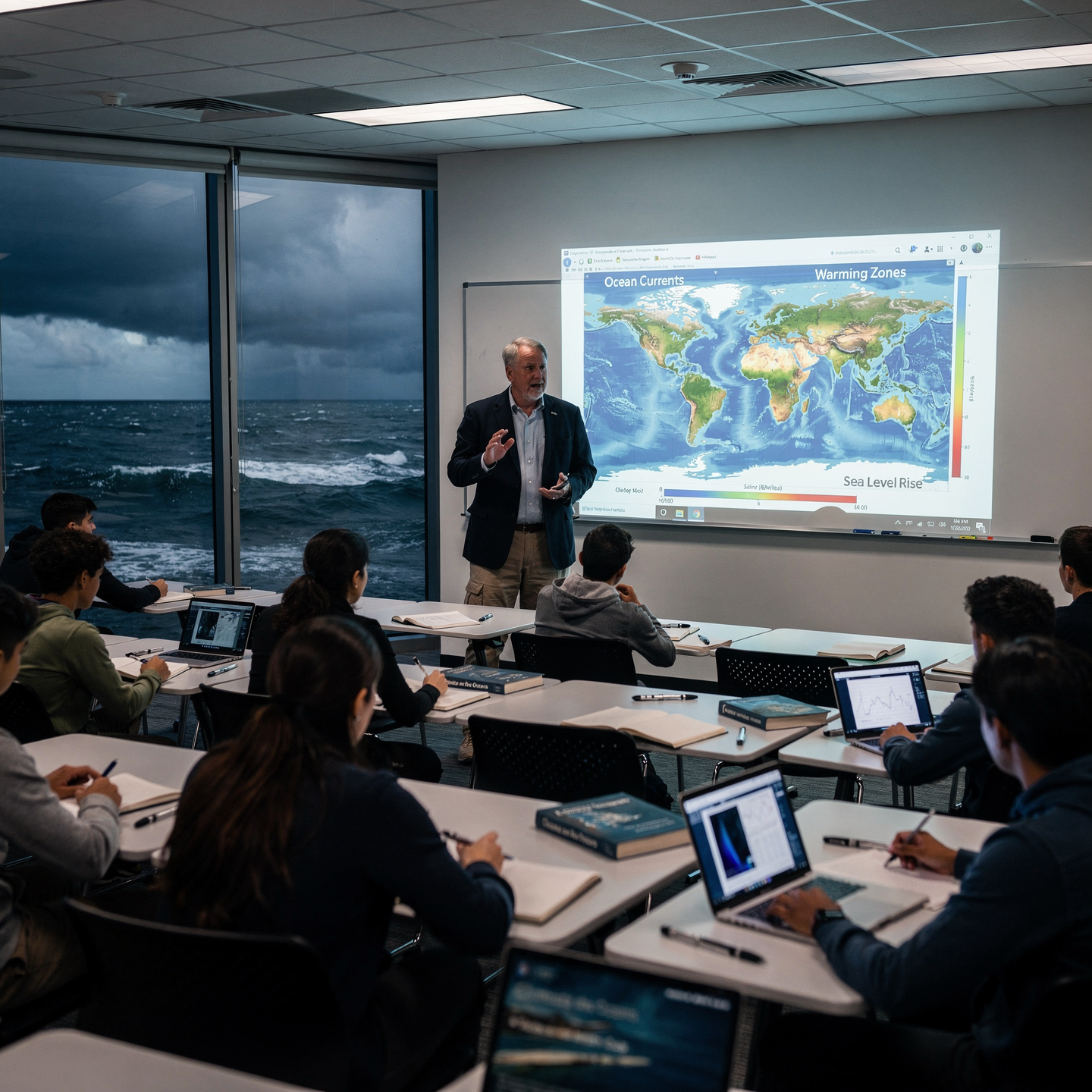
Climate Change and Oceans Course

Why this course?

The Climate Change and Oceans course

Immerses you in understanding the complex interaction between global climate and marine ecosystems. Explore the causes and consequences of climate change in the oceans, from rising temperatures and acidification to the impact on biodiversity and ocean currents. This program provides you with the tools to analyze scientific data and evaluate the mitigation and adaptation strategies needed to protect our oceans.

Differential Advantages

  • In-depth Analysis: Examine the physical, chemical, and biological mechanisms driving ocean change.
  • Global Impact: Understand the implications for fisheries, tourism, food security, and coastal communities.
  • Innovative Solutions: Discover the technologies and policies that can help reverse the effects of climate change on the oceans.
  • Interdisciplinary Perspective: Connect climate science with economics, law, and environmental policy.
  • Hands-on Experience: Participate in case studies and simulations to apply your knowledge to real-world situations.
océanos

Climate Change and Oceans Course

Availability: 1 in stock

Who is it aimed at?

  • Sustainability and environmental management professionals seeking to understand the impact of climate change on marine ecosystems and develop mitigation strategies.
  • Marine scientists and oceanographers wishing to delve deeper into the latest advances on ocean acidification, sea level rise, and changes in ocean currents.
  • Policymakers and legislators needing robust scientific information for decision-making related to ocean protection and climate change adaptation.
  • Science educators and communicators interested in effectively communicating the challenges of climate change in the oceans and promoting public awareness.
  • Companies in the maritime and fishing sectors seeking to adapt their operations to the effects of climate change and comply with emerging environmental regulations.

    Learning flexibility

    Access content at your own pace: asynchronous materials, interactive discussion forums, and practical case studies.

océanos

Objectives and competencies

Promote mitigation and adaptation:

Optimize the use of alternative technologies and fuels, evaluating their environmental and economic impact.

Promote research and innovation:

Develop collaborative R&D&I projects, seeking public and private funding, to generate disruptive solutions in [the area of ​​training].

Raising awareness and mobilizing society:

Promote citizen participation in sustainability and corporate social responsibility initiatives.

Strengthening governance and cooperation:

Implement standardized communication protocols (IMO) with other vessels and port authorities, ensuring transparency and efficiency in joint decision-making.

Promoting sustainable finance and investment:

Promote the disclosure and transparency of ESG criteria in investment decision-making.

Integrating climate change into ocean management:

Develop and implement mitigation and adaptation strategies to protect vulnerable marine ecosystems and ensure the sustainability of ocean economic activities.

Curriculum - Modules

  1. Comprehensive Maritime Incident Management: protocols, roles, and chain of command for coordinated response
  2. Operational Planning and Execution: briefing, routes, weather windows, and go/no-go criteria
  3. Rapid Risk Assessment: criticality matrix, scene control, and decision-making under pressure
  4. Operational Communication: VHF/GMDSS, standardized reports, and inter-agency liaison
  5. Tactical Mobility and Safe Boarding: RHIB maneuvers, approach, mooring, and recovery
  6. Equipment and Technologies: PPE, signaling, satellite tracking, and field data logging
  7. Immediate Care of the Affected: primary assessment, hypothermia, trauma, and stabilization for evacuation
  8. Adverse Environmental Conditions: swell, Visibility, flows, and operational mitigation

    Simulation and training: critical scenarios, use of VR/AR, and exercises with performance metrics

    Documentation and continuous improvement: lessons learned, indicators (MTTA/MTTR), and SOP updates

  1. Introduction to the Ocean Climate Crisis: Causes, Impacts, and Vulnerabilities.
  2. Ocean Acidification: Chemistry, Consequences for Marine Life, and Mitigation.
  3. Sea Level Rise: Causes, Projections, Coastal Impacts, and Adaptation.
  4. Loss of Marine Biodiversity: Threats, Key Species, and Conservation Strategies.
  5. Marine Pollution: Plastics, Chemicals, Eutrophication, and Solutions.
  6. Unsustainable Fishing: Overfishing, Destructive Practices, and Ecosystem-Based Management.
  7. Marine Renewable Energy: Potential, Technologies, and Challenges.
  8. Sustainable Blue Economy: Principles, Key Sectors, and Governance.
  9. Policies Oceanic climate: international agreements, national and local legislation.

    Citizen participation and citizen science: community involvement, monitoring, and solutions.

  1. Introduction to Climate Change and its Impacts on the Oceans
  2. Ocean Acidification: Causes, Consequences, and Mitigation
  3. Sea Level Rise: Impacts on Coasts and Communities
  4. Changes in Ocean Currents and their Influence on Climate
  5. Loss of Marine Biodiversity: Endangered Species and Conservation Strategies
  6. Sustainable Management of Marine Resources: Responsible Fishing and Aquaculture
  7. Marine Renewable Energies: Potential and Challenges
  8. Restoration of Marine Ecosystems: Coral Reefs, Mangroves, and Seagrass Meadows
  9. International Policies and Agreements for Ocean Protection
  10. Adaptation and Resilience: Strategies for coastal communities in the face of climate change

  1. Introduction to Climate Oceanography: Ocean systems and the global climate.
  2. Ocean Acidification: Marine carbon chemistry, impacts on marine life.
  3. Sea Level Rise: Causes, consequences, future projections, and coastal vulnerability.
  4. Changes in Ocean Currents: Alterations in thermohaline circulation and their effects.
  5. Marine Extreme Events: Marine heatwaves, storms, coral bleaching.
  6. Ocean Climate Modeling: Tools and techniques for predicting change.
  7. Mitigation Strategies: Blue carbon capture, marine renewable energies.
  8. Coastal Adaptation: Infrastructure Resilient, relocation, integrated coastal zone management.
  9. Ocean Policies and Governance: International agreements, regulations, and cooperation.
  10. Case Studies: Successful ocean resilience initiatives globally.

  1. Introduction to Oceanography: Currents, Salinity, Temperature, and Stratification
  2. The Global Climate System: Components, Interactions, and Feedback Mechanisms
  3. Greenhouse Gases: Sources, Sinks, and Global Warming Potential
  4. Ocean Acidification: Seawater Chemistry, Causes, and Consequences for Marine Life
  5. Sea Level Rise: Thermal Expansion, Melting of Glaciers and Ice Caps, Coastal Impacts
  6. Extreme Weather Events: Marine Heatwaves, Intense Storms, and Their Relationship to Climate Change
  7. Impact on Marine Ecosystems: Coral Bleaching, Species Migration, and Alteration of Food Chains
  8. Climate Models and Future Projections: Uncertainties and Scenarios
  9. of mitigation and adaptation.

  10. International climate policies: agreements, commitments, and challenges for global action.
  11. Mitigation solutions and strategies: renewable energy, carbon capture, and marine ecosystem restoration.

  1. System Architecture and Components: Structural design, materials, and subsystems (mechanical, electrical, electronic, and fluid) with selection and assembly criteria for marine environments
  2. Fundamentals and Principles of Operation: Physical and engineering foundations (thermodynamics, fluid mechanics, electricity, control, and materials) that explain performance and operating limits
  3. Safety and Environmental (SHE): Risk analysis, PPE, LOTO, hazardous atmospheres, spill and waste management, and emergency response plans
  4. Applicable Regulations and Standards: IMO/ISO/IEC requirements and local regulations;
  5. Conformance criteria, certification, and best practices for operation and maintenance
  6. Inspection, testing, and diagnostics: Visual/dimensional inspection, functional testing, data analysis, and predictive techniques (vibration, thermography, fluid analysis) to identify root causes
  7. Preventive and predictive maintenance: Hourly/cycle/seasonal plans, lubrication, adjustments, calibrations, consumable replacement, post-service verification, and operational reliability
  8. Instrumentation, tools, and metrology: Measuring and testing equipment, diagnostic software, calibration and traceability; selection criteria, safe use, and storage
  9. Onboard integration and interfaces: Mechanical, electrical, fluid, and data compatibility; Sealing and watertightness, EMC/EMI, corrosion protection, and interoperability testing.

    Quality, acceptance testing, and commissioning: process and materials control, FAT/SAT, bench and sea trials, go/no-go criteria, and evidence documentation.

    Technical documentation and integrated practice: logs, checklists, reports, and a complete case study (safety → diagnosis → intervention → verification → report) applicable to any system.

Plan de estudio - MĂłdulos

  1. Comprehensive Maritime Incident Management: protocols, roles, and chain of command for coordinated response
  2. Operational Planning and Execution: briefing, routes, weather windows, and go/no-go criteria
  3. Rapid Risk Assessment: criticality matrix, scene control, and decision-making under pressure
  4. Operational Communication: VHF/GMDSS, standardized reports, and inter-agency liaison
  5. Tactical Mobility and Safe Boarding: RHIB maneuvers, approach, mooring, and recovery
  6. Equipment and Technologies: PPE, signaling, satellite tracking, and field data logging
  7. Immediate Care of the Affected: primary assessment, hypothermia, trauma, and stabilization for evacuation
  8. Adverse Environmental Conditions: swell, Visibility, flows, and operational mitigation

    Simulation and training: critical scenarios, use of VR/AR, and exercises with performance metrics

    Documentation and continuous improvement: lessons learned, indicators (MTTA/MTTR), and SOP updates

  1. Introduction to the Ocean Climate Crisis: Causes, Impacts, and Vulnerabilities.
  2. Ocean Acidification: Chemistry, Consequences for Marine Life, and Mitigation.
  3. Sea Level Rise: Causes, Projections, Coastal Impacts, and Adaptation.
  4. Loss of Marine Biodiversity: Threats, Key Species, and Conservation Strategies.
  5. Marine Pollution: Plastics, Chemicals, Eutrophication, and Solutions.
  6. Unsustainable Fishing: Overfishing, Destructive Practices, and Ecosystem-Based Management.
  7. Marine Renewable Energy: Potential, Technologies, and Challenges.
  8. Sustainable Blue Economy: Principles, Key Sectors, and Governance.
  9. Policies Oceanic climate: international agreements, national and local legislation.

    Citizen participation and citizen science: community involvement, monitoring, and solutions.

  1. Introduction to Climate Change and its Impacts on the Oceans
  2. Ocean Acidification: Causes, Consequences, and Mitigation
  3. Sea Level Rise: Impacts on Coasts and Communities
  4. Changes in Ocean Currents and their Influence on Climate
  5. Loss of Marine Biodiversity: Endangered Species and Conservation Strategies
  6. Sustainable Management of Marine Resources: Responsible Fishing and Aquaculture
  7. Marine Renewable Energies: Potential and Challenges
  8. Restoration of Marine Ecosystems: Coral Reefs, Mangroves, and Seagrass Meadows
  9. International Policies and Agreements for Ocean Protection
  10. Adaptation and Resilience: Strategies for coastal communities in the face of climate change

  1. Introduction to Climate Oceanography: Ocean systems and the global climate.
  2. Ocean Acidification: Marine carbon chemistry, impacts on marine life.
  3. Sea Level Rise: Causes, consequences, future projections, and coastal vulnerability.
  4. Changes in Ocean Currents: Alterations in thermohaline circulation and their effects.
  5. Marine Extreme Events: Marine heatwaves, storms, coral bleaching.
  6. Ocean Climate Modeling: Tools and techniques for predicting change.
  7. Mitigation Strategies: Blue carbon capture, marine renewable energies.
  8. Coastal Adaptation: Infrastructure Resilient, relocation, integrated coastal zone management.
  9. Ocean Policies and Governance: International agreements, regulations, and cooperation.
  10. Case Studies: Successful ocean resilience initiatives globally.

  1. Introduction to Oceanography: Currents, Salinity, Temperature, and Stratification
  2. The Global Climate System: Components, Interactions, and Feedback Mechanisms
  3. Greenhouse Gases: Sources, Sinks, and Global Warming Potential
  4. Ocean Acidification: Seawater Chemistry, Causes, and Consequences for Marine Life
  5. Sea Level Rise: Thermal Expansion, Melting of Glaciers and Ice Caps, Coastal Impacts
  6. Extreme Weather Events: Marine Heatwaves, Intense Storms, and Their Relationship to Climate Change
  7. Impact on Marine Ecosystems: Coral Bleaching, Species Migration, and Alteration of Food Chains
  8. Climate Models and Future Projections: Uncertainties and Scenarios
  9. of mitigation and adaptation.

  10. International climate policies: agreements, commitments, and challenges for global action.
  11. Mitigation solutions and strategies: renewable energy, carbon capture, and marine ecosystem restoration.

  1. System Architecture and Components: Structural design, materials, and subsystems (mechanical, electrical, electronic, and fluid) with selection and assembly criteria for marine environments
  2. Fundamentals and Principles of Operation: Physical and engineering foundations (thermodynamics, fluid mechanics, electricity, control, and materials) that explain performance and operating limits
  3. Safety and Environmental (SHE): Risk analysis, PPE, LOTO, hazardous atmospheres, spill and waste management, and emergency response plans
  4. Applicable Regulations and Standards: IMO/ISO/IEC requirements and local regulations;
  5. Conformance criteria, certification, and best practices for operation and maintenance
  6. Inspection, testing, and diagnostics: Visual/dimensional inspection, functional testing, data analysis, and predictive techniques (vibration, thermography, fluid analysis) to identify root causes
  7. Preventive and predictive maintenance: Hourly/cycle/seasonal plans, lubrication, adjustments, calibrations, consumable replacement, post-service verification, and operational reliability
  8. Instrumentation, tools, and metrology: Measuring and testing equipment, diagnostic software, calibration and traceability; selection criteria, safe use, and storage
  9. Onboard integration and interfaces: Mechanical, electrical, fluid, and data compatibility; Sealing and watertightness, EMC/EMI, corrosion protection, and interoperability testing.

    Quality, acceptance testing, and commissioning: process and materials control, FAT/SAT, bench and sea trials, go/no-go criteria, and evidence documentation.

    Technical documentation and integrated practice: logs, checklists, reports, and a complete case study (safety → diagnosis → intervention → verification → report) applicable to any system.

  1. Introduction to climate change and its impacts on the oceans.
  2. Ocean acidification: causes, consequences, and potential solutions.
  3. Sea level rise: modeling, projections, and coastal adaptation strategies.
  4. Changes in water temperature: effects on the distribution of marine species and ecosystems.
  5. Extreme weather events: hurricanes, storms, storm surges, and their impact on coastal communities.
  6. Effects on marine biodiversity: invasive species, habitat loss, and changes in food webs.
  7. Sustainable fishing: practices to mitigate the impacts of climate change on fish populations.
  8. Restoration of coastal ecosystems: Mangroves, coral reefs, seagrass meadows, and their role in resilience.

    Policies and governance: international agreements, national legislation, and community participation.

    Innovation and technology: nature-based solutions, ecological engineering, and environmental monitoring.

  1. Introduction to the climate system: Components, interactions, and feedback.
  2. Ocean acidification: Carbon chemistry, causes, consequences, and mitigation.
  3. Sea level rise: Thermal expansion, ice melt, coastal impacts, and adaptation.
  4. Marine extreme weather events: Marine heatwaves, storms, coral bleaching.
  5. Impact on marine biodiversity: Species distribution, migrations, vulnerable ecosystems.
  6. Climate models and projections: Scenarios, uncertainties, and prediction tools.
  7. Mitigation strategies: Emission reduction, marine renewable energy, carbon capture.
  8. Adaptation strategies: Restoration of coastal ecosystems, resilient infrastructure, Governance.
  9. Ocean Climate Policy: International Agreements, Legal Frameworks, and Financing.
  10. Case Studies: Ocean Resilience Initiatives in Different Regions of the World.

  1. Introduction to Climate Change and its Impacts on the Oceans
  2. Ocean Acidification: Causes, Consequences, and Mitigation
  3. Sea Level Rise: Projections, Coastal Vulnerabilities, and Adaptation
  4. Changes in Water Temperature: Effects on Marine Life and Ecosystems
  5. Extreme Weather Events: Hurricanes, Marine Heatwaves, and Their Impact
  6. Loss of Marine Biodiversity: Endangered Species and Conservation Strategies
  7. Sustainable Fishing: Responsible Practices and Resource Management
  8. Marine Pollution: Plastics, Spills, and Their Impact on Ocean Health
  9. Marine Renewable Energies: Potential and Sustainable Development
  10. Policies and international agreements for the protection of the oceans

  1. Introduction to Climate Oceanography: Ocean Systems and the Global Climate
  2. Ocean Acidification: Causes, Consequences, and Mitigation
  3. Sea Level Rise: Causes, Projections, and Coastal Adaptation
  4. Changes in Ocean Currents: Impact on Heat Distribution and Marine Life
  5. Extreme Weather Events: Hurricanes, Marine Heatwaves, and Their Intensification
  6. Impact on Marine Biodiversity: Displacements, Extinctions, and Resilience
  7. Sustainable Fisheries in a Changing Climate: Adaptive Management and Aquaculture
  8. Ocean Renewable Energies: Potential, Technologies, and Sustainability
  9. Adaptation and Mitigation: International Agreements and Local Actions

    Innovation and Technology for Ocean Observation and Modeling

Career opportunities

  • Marine Sustainability Consultant: Advising companies and governments on the implementation of climate change mitigation and adaptation strategies in the ocean environment.
  • Research Scientist: Participating in research projects on the effects of climate change on marine ecosystems, ocean acidification, and sea level rise.
  • Marine Protected Area Manager: Designing and managing marine protected areas for biodiversity conservation and the protection of marine resources from the impacts of climate change.
  • Marine Renewable Energy Technician: Developing and managing offshore wind energy, wave energy, and other renewable energy projects in the ocean.
  • Coastal Climate Risk Analyst: Assessing climate change-related risks in coastal areas, including flooding, erosion, and extreme weather events.
  • Marine Environmental Educator: Design and implementation of educational programs to raise awareness about the effects of climate change on the oceans and promote the adoption of sustainable practices.
  • Ocean Policy Officer: Development and implementation of public policies for the sustainable management of the oceans and adaptation to climate change.
  • Sustainable Fisheries Specialist: Implementation of sustainable fishing practices to mitigate the impacts of climate change on fish stocks and other marine resources.

“`

Admission requirements

Academic/professional profile:

Degree/Bachelor's degree in Nautical Science/Maritime Transport, Naval/Marine Engineering, or a related field; or proven professional experience in bridge/operations.

Language proficiency:

Recommended functional maritime English (SMCP) for simulations and technical materials.

5. Induction

Updated resume, copy of degree or seaman's book, ID card/passport, letter of motivation.

Technical requirements (for online):

Equipment with camera/microphone, stable connection, ≥ 24” monitor recommended for ECDIS/Radar-ARPA.

Admission process and dates

1. Online
application

(form + documents).

2. Academic review and interview

(profile/objectives/schedule compatibility).

3. Admission decision

(+ scholarship proposal if applicable).

4. Reservation of place

(deposit) and registration.

5. Induction

(access to campus, calendars, simulator guides).

Scholarships and grants

  • Understand: the scientific basis of climate change and its direct impact on the oceans.
  • Analyze: the consequences of global warming on marine ecosystems, acidification, and sea level rise.
  • Evaluate: mitigation and adaptation strategies to protect the oceans and their resources.
  • Participate: in discussions and case studies to drive innovative and sustainable solutions.
  • Apply: your knowledge to contribute to marine conservation and the fight against climate change.
Join this training and become an agent of change for the health of our oceans.

Testimonials

Frequently asked questions

Yes. The itinerary includes ECDIS/Radar-ARPA/BRM with harbor, ocean, fog, storm, and SAR scenarios.

Online with live sessions; hybrid option for simulator/practical placements through agreements.

The increase in global temperature causes the thermal expansion of seawater and the melting of glaciers and ice sheets, which increases the volume of water in the oceans and raises sea levels.

Recommended functional SMCP. We offer support materials for standard phraseology.

Yes, with a relevant degree or experience in maritime/port operations. The admissions interview will confirm suitability.

Optional (3–6 months) through Companies & Collaborations and the Alumni Network.

Simulator practice (rubrics), defeat plans, SOPs, checklists, micro-tests and applied TFM.

A degree from Navalis Magna University + operational portfolio (tracks, SOPs, reports and KPIs) useful for audits and employment.

  1. Introduction to Climate Oceanography: Ocean Systems and the Global Climate
  2. Ocean Acidification: Causes, Consequences, and Mitigation
  3. Sea Level Rise: Causes, Projections, and Coastal Adaptation
  4. Changes in Ocean Currents: Impact on Heat Distribution and Marine Life
  5. Extreme Weather Events: Hurricanes, Marine Heatwaves, and Their Intensification
  6. Impact on Marine Biodiversity: Displacements, Extinctions, and Resilience
  7. Sustainable Fisheries in a Changing Climate: Adaptive Management and Aquaculture
  8. Ocean Renewable Energies: Potential, Technologies, and Sustainability
  9. Adaptation and Mitigation: International Agreements and Local Actions

    Innovation and Technology for Ocean Observation and Modeling

Request information

  1. Complete the Application Form
  2. Attach your CV/Qualifications (if you have them to hand).
  3. Indicate your preferred cohort (January/May/September) and whether you want the hybrid option with simulator sessions.
An academic advisor will contact you within 24–48 hours to guide you through the admission process, scholarships, and compatibility with your professional schedule. Translated with DeepL.com (free version)
Please enable JavaScript in your browser to complete this form.
Click or drag a file to this area to upload.

Teachers

0
    0
    Tu carrito
    Tu carrito esta vacĂ­oRegresar a la tienda
    Scroll to Top


