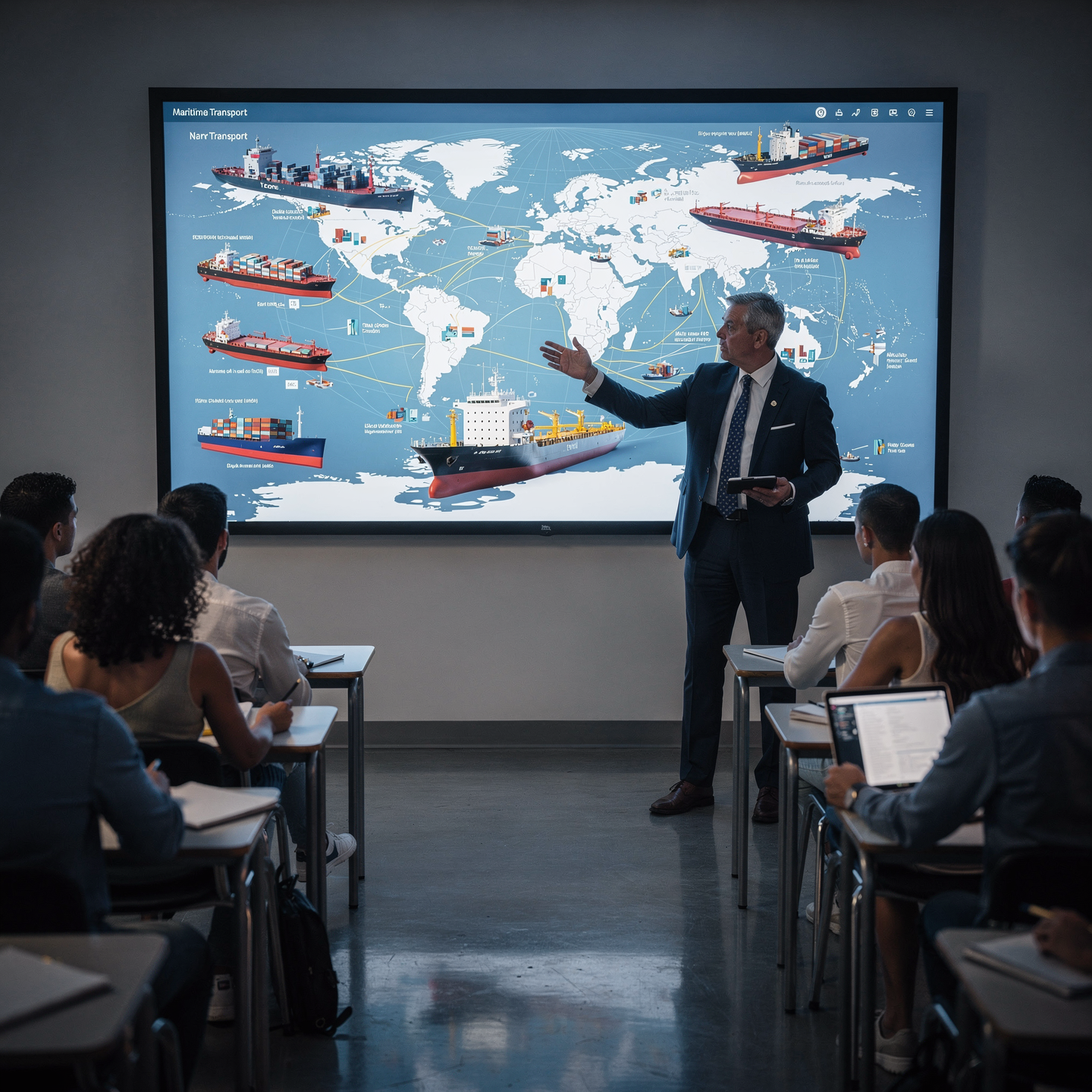
Introduction to Maritime Transport Course

Why this course?

The Introduction to Maritime Transport Course

This course offers you a comprehensive and essential overview of the shipping industry. From the basic concepts of navigation to the complexity of logistics and international trade, this program will provide you with the necessary tools to understand how the sector operates. You will learn about types of vessels, port operations, maritime law, and supply chain management. An essential course for those looking to start a career or expand their knowledge in the world of maritime transport.

This course provides you with a comprehensive and essential overview of the shipping industry.

Differentiating Advantages

  • Solid Foundations: Learn the basic principles of maritime transport clearly and concisely.
  • Comprehensive Overview: Explore the different aspects of the industry, from navigation to logistics.
  • Practical Applications: Understand how the concepts are applied in the real world of maritime transport.
  • Flexibility: Study at your own pace with access to high-quality materials and expert support.
  • Career Opportunities: Open the door to a wide range of careers in the maritime sector.
Introducción

Introduction to Maritime Transport Course

Availability: 1 in stock

Who is it aimed at?

  • Students and recent graduates interested in a global overview of the maritime sector and its opportunities.
  • Logistics, international trade, and finance professionals seeking to understand the strategic role of maritime transport in the supply chain.
  • Insurance, law firm, and consultancy staff who need to understand the legal, economic, and operational aspects of maritime transport.
  • Entrepreneurs and startups wishing to explore innovative business models in the maritime sector.
  • Anyone curious about how global trade works and its impact on the world economy.

Total flexibility:
Learn at your own pace with asynchronous content available 24/7, active discussion forums, and downloadable materials for offline reference.

Introducción

Objectives and competencies

Understanding the terminology and fundamentals of maritime trade:

“Identify the different types of ships, the cargo they carry, and the main shipping routes.”

Identify the different types of ships and their function in the transport of goods:

“Differentiate between general cargo ships, container ships, bulk carriers, oil tankers, chemical tankers, and gas carriers, recognizing their suitability for different types of goods and routes.”

Analyze and apply international regulations governing maritime safety and pollution prevention:

“Implement the SOLAS Convention and the MARPOL Convention, ensuring compliance with safety standards, pollution prevention and emergency management on board, adapting to the particularities of each type of ship and operation.”

Manage the documentation and customs processes associated with maritime transport:

“Prepare and submit the required documentation (DUA, manifests, BL) in compliance with current customs and port regulations, using electronic systems (EDI, telematic platforms) and coordinating with customs agents, freight forwarders and port authorities.”

Evaluate and select the most suitable maritime transport options according to cargo needs and market conditions:

“Analyze rates, routes, transit times and reliability of shipping companies, considering types of vessels, containers and insurance.”

Coordinate and supervise the loading and unloading of goods at the ports:

“Optimize loading and unloading, prioritizing safety and efficiency according to port regulations and type of merchandise.”

Curriculum - Modules

  1. Comprehensive Maritime Incident Management: protocols, roles, and chain of command for coordinated response
  2. Operational Planning and Execution: briefing, routes, weather windows, and go/no-go criteria
  3. Rapid Risk Assessment: criticality matrix, scene control, and decision-making under pressure
  4. Operational Communication: VHF/GMDSS, standardized reports, and inter-agency liaison
  5. Tactical Mobility and Safe Boarding: RHIB maneuvers, approach, mooring, and recovery
  6. Equipment and Technologies: PPE, signaling, satellite tracking, and field data logging
  7. Immediate Care of the Affected: primary assessment, hypothermia, trauma, and stabilization for evacuation
  8. Adverse Environmental Conditions: swell, Visibility, flows, and operational mitigation

    Simulation and training: critical scenarios, use of VR/AR, and exercises with performance metrics

    Documentation and continuous improvement: lessons learned, indicators (MTTA/MTTR), and SOP updates

  1. Introduction to the Maritime Industry: History, Evolution, and Current Landscape.
  2. Types of Ships: Classification, Characteristics, and Applications.
  3. Maritime Nomenclature: Essential Nautical Terms.
  4. Ship Structure and Components: Hull, Superstructure, Main Machinery.
  5. Ship Stability: Basic Principles, Drafts, Freeboard.
  6. Buoyancy and Trim: Calculations and Practical Considerations.
  7. Ship Maneuvering: Acting Forces, Steering, and Control.
  8. Mooring and Unmooring: Procedures, Equipment, and Safety.
  9. International Maritime Regulations: Relevant Conventions and Organizations.
  10. National Legislation: Maritime Authorities and Regulations applicable.

  1. Introduction to Maritime Transport: History, Evolution, and Current Trends
  2. Naval Nomenclature: Parts of a Ship, Main Dimensions, and Characteristics
  3. Stability and Buoyancy: Basic Principles, Drafts, Trim, and Transverse Stability
  4. Types of Ships: General Cargo Ships, Bulk Carriers, Container Ships, Tankers, Gas Carriers, and Passenger Ships
  5. Naval Rigging: Ropes, Hawsers, Cables, Chains, Shackles, and Lashing Devices
  6. Basic Maneuvering: Use of the Rudder, Propellers, and Side Thrusters
  7. Safety on Board: Lifesaving Equipment, Firefighting, and Damage Control
  8. International Maritime Legislation: SOLAS, MARPOL, STCW, and Other Conventions
  9. Organizations Maritime: IMO, classification societies, P&I clubs

    Basic concepts of marine meteorology: Winds, waves, currents, and forecasting systems

  1. Introduction to Naval Logistics: Definition, Scope, and Objectives
  2. Organization and Structure of Naval Logistics: Departments, Roles, and Responsibilities
  3. Maritime Security: Threats and Risks in the Naval Environment
  4. Basic Naval Terminology: Abbreviations, Acronyms, and Glossary of Common Terms
  5. Management of Onboard Inventories and Supplies: Storage, Control, and Distribution
  6. Transport and Handling of Cargo: Types of Cargo, Packaging, and Stowage
  7. Safety Standards and Regulations: International Conventions and National Legislation
  8. Safety and Emergency Equipment: Types, Use, and Maintenance
  9. Communication in the Naval Environment: Procedures, channels, and protocols.
  10. First aid and emergency response: Basic protocols and procedures.

  1. Maritime History: Evolution of navigation and maritime transport.
  2. Nautical Geography: Oceans, seas, channels, and major shipping routes.
  3. Types of Ships: Classification, characteristics, and functions.
  4. Nautical Nomenclature: Basic terminology used on board and in navigation.
  5. Navigation Instruments: Compasses, sextants, radar, and electronic systems.
  6. Propulsion Systems: Engines, propellers, and steering systems.
  7. Ship Stability: Basic principles, factors affecting it, and control measures.
  8. Ship Maneuvering: Use of tugboats, anchors, and berthing and docking techniques Undocking.
  9. Maritime Communications: VHF, MF/HF, satellites, and distress call procedures.
  10. Maritime Meteorology: Weather forecasting, interpretation of weather charts, and effects on navigation.

  1. System Architecture and Components: Structural design, materials, and subsystems (mechanical, electrical, electronic, and fluid) with selection and assembly criteria for marine environments
  2. Fundamentals and Principles of Operation: Physical and engineering foundations (thermodynamics, fluid mechanics, electricity, control, and materials) that explain performance and operating limits
  3. Safety and Environmental (SHE): Risk analysis, PPE, LOTO, hazardous atmospheres, spill and waste management, and emergency response plans
  4. Applicable Regulations and Standards: IMO/ISO/IEC requirements and local regulations;
  5. Conformance criteria, certification, and best practices for operation and maintenance
  6. Inspection, testing, and diagnostics: Visual/dimensional inspection, functional testing, data analysis, and predictive techniques (vibration, thermography, fluid analysis) to identify root causes
  7. Preventive and predictive maintenance: Hourly/cycle/seasonal plans, lubrication, adjustments, calibrations, consumable replacement, post-service verification, and operational reliability
  8. Instrumentation, tools, and metrology: Measuring and testing equipment, diagnostic software, calibration and traceability; selection criteria, safe use, and storage
  9. Onboard integration and interfaces: Mechanical, electrical, fluid, and data compatibility; Sealing and watertightness, EMC/EMI, corrosion protection, and interoperability testing.

    Quality, acceptance testing, and commissioning: process and materials control, FAT/SAT, bench and sea trials, go/no-go criteria, and evidence documentation.

    Technical documentation and integrated practice: logs, checklists, reports, and a complete case study (safety → diagnosis → intervention → verification → report) applicable to any system.

Plan de estudio - Módulos

  1. Comprehensive Maritime Incident Management: protocols, roles, and chain of command for coordinated response
  2. Operational Planning and Execution: briefing, routes, weather windows, and go/no-go criteria
  3. Rapid Risk Assessment: criticality matrix, scene control, and decision-making under pressure
  4. Operational Communication: VHF/GMDSS, standardized reports, and inter-agency liaison
  5. Tactical Mobility and Safe Boarding: RHIB maneuvers, approach, mooring, and recovery
  6. Equipment and Technologies: PPE, signaling, satellite tracking, and field data logging
  7. Immediate Care of the Affected: primary assessment, hypothermia, trauma, and stabilization for evacuation
  8. Adverse Environmental Conditions: swell, Visibility, flows, and operational mitigation

    Simulation and training: critical scenarios, use of VR/AR, and exercises with performance metrics

    Documentation and continuous improvement: lessons learned, indicators (MTTA/MTTR), and SOP updates

  1. Introduction to the Maritime Industry: History, Evolution, and Current Landscape.
  2. Types of Ships: Classification, Characteristics, and Applications.
  3. Maritime Nomenclature: Essential Nautical Terms.
  4. Ship Structure and Components: Hull, Superstructure, Main Machinery.
  5. Ship Stability: Basic Principles, Drafts, Freeboard.
  6. Buoyancy and Trim: Calculations and Practical Considerations.
  7. Ship Maneuvering: Acting Forces, Steering, and Control.
  8. Mooring and Unmooring: Procedures, Equipment, and Safety.
  9. International Maritime Regulations: Relevant Conventions and Organizations.
  10. National Legislation: Maritime Authorities and Regulations applicable.

  1. Introduction to Maritime Transport: History, Evolution, and Current Trends
  2. Naval Nomenclature: Parts of a Ship, Main Dimensions, and Characteristics
  3. Stability and Buoyancy: Basic Principles, Drafts, Trim, and Transverse Stability
  4. Types of Ships: General Cargo Ships, Bulk Carriers, Container Ships, Tankers, Gas Carriers, and Passenger Ships
  5. Naval Rigging: Ropes, Hawsers, Cables, Chains, Shackles, and Lashing Devices
  6. Basic Maneuvering: Use of the Rudder, Propellers, and Side Thrusters
  7. Safety on Board: Lifesaving Equipment, Firefighting, and Damage Control
  8. International Maritime Legislation: SOLAS, MARPOL, STCW, and Other Conventions
  9. Organizations Maritime: IMO, classification societies, P&I clubs

    Basic concepts of marine meteorology: Winds, waves, currents, and forecasting systems

  1. Introduction to Naval Logistics: Definition, Scope, and Objectives
  2. Organization and Structure of Naval Logistics: Departments, Roles, and Responsibilities
  3. Maritime Security: Threats and Risks in the Naval Environment
  4. Basic Naval Terminology: Abbreviations, Acronyms, and Glossary of Common Terms
  5. Management of Onboard Inventories and Supplies: Storage, Control, and Distribution
  6. Transport and Handling of Cargo: Types of Cargo, Packaging, and Stowage
  7. Safety Standards and Regulations: International Conventions and National Legislation
  8. Safety and Emergency Equipment: Types, Use, and Maintenance
  9. Communication in the Naval Environment: Procedures, channels, and protocols.
  10. First aid and emergency response: Basic protocols and procedures.

  1. Maritime History: Evolution of navigation and maritime transport.
  2. Nautical Geography: Oceans, seas, channels, and major shipping routes.
  3. Types of Ships: Classification, characteristics, and functions.
  4. Nautical Nomenclature: Basic terminology used on board and in navigation.
  5. Navigation Instruments: Compasses, sextants, radar, and electronic systems.
  6. Propulsion Systems: Engines, propellers, and steering systems.
  7. Ship Stability: Basic principles, factors affecting it, and control measures.
  8. Ship Maneuvering: Use of tugboats, anchors, and berthing and docking techniques Undocking.
  9. Maritime Communications: VHF, MF/HF, satellites, and distress call procedures.
  10. Maritime Meteorology: Weather forecasting, interpretation of weather charts, and effects on navigation.

  1. System Architecture and Components: Structural design, materials, and subsystems (mechanical, electrical, electronic, and fluid) with selection and assembly criteria for marine environments
  2. Fundamentals and Principles of Operation: Physical and engineering foundations (thermodynamics, fluid mechanics, electricity, control, and materials) that explain performance and operating limits
  3. Safety and Environmental (SHE): Risk analysis, PPE, LOTO, hazardous atmospheres, spill and waste management, and emergency response plans
  4. Applicable Regulations and Standards: IMO/ISO/IEC requirements and local regulations;
  5. Conformance criteria, certification, and best practices for operation and maintenance
  6. Inspection, testing, and diagnostics: Visual/dimensional inspection, functional testing, data analysis, and predictive techniques (vibration, thermography, fluid analysis) to identify root causes
  7. Preventive and predictive maintenance: Hourly/cycle/seasonal plans, lubrication, adjustments, calibrations, consumable replacement, post-service verification, and operational reliability
  8. Instrumentation, tools, and metrology: Measuring and testing equipment, diagnostic software, calibration and traceability; selection criteria, safe use, and storage
  9. Onboard integration and interfaces: Mechanical, electrical, fluid, and data compatibility; Sealing and watertightness, EMC/EMI, corrosion protection, and interoperability testing.

    Quality, acceptance testing, and commissioning: process and materials control, FAT/SAT, bench and sea trials, go/no-go criteria, and evidence documentation.

    Technical documentation and integrated practice: logs, checklists, reports, and a complete case study (safety → diagnosis → intervention → verification → report) applicable to any system.

  1. Introduction to Maritime Transport: History, Evolution, and Current Landscape
  2. Types of Ships: Container Ships, Bulk Carriers, Tankers, Ro-Ro Ships, etc.
  3. Ship Nomenclature and Parts: Hull, Superstructure, Machinery, etc.
  4. Ship Stability: Basic Principles, Trim, Heel, and Draft
  5. Ship Maneuvering: Steering, Inertia, Effects of Wind and Current
  6. Mooring and Anchoring Equipment: Types, Use, Maintenance, and Safety
  7. Cargo Stowage and Securing: Principles, Methods, and Regulations
  8. International Maritime Regulations: SOLAS, MARPOL, STCW, etc.
  9. Safety
  10. On board: equipment, emergency procedures, and firefighting

    Basic first aid and survival at sea

  1. Introduction to Maritime Transport: History, Evolution, and Current Trends
  2. Types of Ships: Container Ships, Bulk Carriers, Tankers, Gas Carriers, Ro-Ro Ships, etc.
  3. Port Operations: Loading/Unloading, Stowage, Cargo Handling, Services
  4. Chartering: Types of Contracts, Main Clauses, Responsibilities
  5. Marine Insurance: P&I, Hull and Machinery, Cargo, Covered Risks
  6. International Conventions: SOLAS, MARPOL, STCW, IMO
  7. National Maritime Legislation: Authorities, Registries, Inspections
  8. Maritime Security: ISM, ISPS, Security Plans, Threats
  9. Management Environmental: pollution prevention, ballast water, emissions

    Future trends: digitalization, automation, sustainability, new fuels

  1. Introduction to Maritime Transport: History, Evolution, and Current Trends
  2. Types of Ships: Classification, Characteristics, and Applications
  3. Port Infrastructure: Terminals, Quays, Docks, and Services
  4. International Maritime Legislation: SOLAS, MARPOL, and STCW Conventions
  5. Maritime Organizations: IMO, OECD, Shipowners’ Associations
  6. Loading and Unloading Operations: Stowage, Lashing, and Cargo Handling
  7. Maritime Safety: Risk Management, Accident Prevention, and Environmental Protection
  8. Maritime Trade: Freight, Insurance, Transport Contracts, and Disputes
  9. Economic Aspects of Maritime Transport: Supply and Demand, Costs, and Profitability
  10. Environmental Impact of Transport Maritime: emissions, discharges and mitigation measures

  1. Introduction to Maritime Law: International Conventions and National Legislation
  2. SOLAS: Structure, Key Chapters, and Relevant Amendments
  3. MARPOL: Annexes, Pollution Prevention, and Waste Management
  4. ISM Code: Safety, Environmental Protection, and Risk Management
  5. ISPS Code: Maritime Safety and Security of Ships and Port Facilities
  6. Load Lines Convention: Stability and Freeboard
  7. General Average Regulations: Principles and Procedures
  8. Marine Insurance: P&I, Hull, and Machinery
  9. Civil Liability and Limits of Liability of the Shipowner
  10. International Maritime Organizations: IMO, ILO and Classification

Career opportunities

  • Port Operations Assistant: Support in loading and unloading management, documentation, and service coordination.
  • Customer Service Representative in Shipping Companies and Maritime Agencies: Information and assistance to passengers and companies.
  • Administrative Assistant in Maritime Transport Companies: Document management, invoicing, and administrative tasks.
  • Logistics and Maritime Transport Technician: Route planning, shipment tracking, and warehouse management.
  • Port Facility Security Personnel: Surveillance and access control to facilities.
  • Customs Agent (Basic Level): Processing customs documentation and tax management.
  • Sales Representative in Maritime Transport Companies: Promotion and sale of maritime transport services.
  • Support staff in stevedoring companies: Assistance in loading and unloading ships.

“`

Admission requirements

Academic/professional profile:

Degree/Bachelor's degree in Nautical Science/Maritime Transport, Naval/Marine Engineering, or a related field; or proven professional experience in bridge/operations.

Language proficiency:

Recommended functional maritime English (SMCP) for simulations and technical materials.

5. Induction

Updated resume, copy of degree or seaman's book, ID card/passport, letter of motivation.

Technical requirements (for online):

Equipment with camera/microphone, stable connection, ≥ 24” monitor recommended for ECDIS/Radar-ARPA.

Admission process and dates

1. Online
application

(form + documents).

2. Academic review and interview

(profile/objectives/schedule compatibility).

3. Admission decision

(+ scholarship proposal if applicable).

4. Reservation of place

(deposit) and registration.

5. Induction

(access to campus, calendars, simulator guides).

Scholarships and grants

  • Industry Fundamentals: Discover the basic principles and structure of maritime transport on a global scale.
  • Types of Vessels and Cargo: Learn to identify different vessels and the types of goods they carry.
  • International Trade Routes and Trade: Analyze the main shipping routes and their impact on the global economy.
  • Legal and Regulatory Framework: Understand the laws and regulations that govern the maritime industry at a national and international level.
  • Career Opportunities: Explore the diverse career options in the dynamic world of maritime transport.
Boost your knowledge and open doors to a key sector of global trade.

Testimonials

Frequently asked questions

Yes. The itinerary includes ECDIS/Radar-ARPA/BRM with harbor, ocean, fog, storm, and SAR scenarios.

Online with live sessions; hybrid option for simulator/practical placements through agreements.

Facilitating international trade and the large-scale transport of goods across the oceans.

Recommended functional SMCP. We offer support materials for standard phraseology.

Yes, with a relevant degree or experience in maritime/port operations. The admissions interview will confirm suitability.

Optional (3–6 months) through Companies & Collaborations and the Alumni Network.

Simulator practice (rubrics), defeat plans, SOPs, checklists, micro-tests and applied TFM.

A degree from Navalis Magna University + operational portfolio (tracks, SOPs, reports and KPIs) useful for audits and employment.

  1. Introduction to Maritime Law: International Conventions and National Legislation
  2. SOLAS: Structure, Key Chapters, and Relevant Amendments
  3. MARPOL: Annexes, Pollution Prevention, and Waste Management
  4. ISM Code: Safety, Environmental Protection, and Risk Management
  5. ISPS Code: Maritime Safety and Security of Ships and Port Facilities
  6. Load Lines Convention: Stability and Freeboard
  7. General Average Regulations: Principles and Procedures
  8. Marine Insurance: P&I, Hull, and Machinery
  9. Civil Liability and Limits of Liability of the Shipowner
  10. International Maritime Organizations: IMO, ILO and Classification

Request information

  1. Complete the Application Form
  2. Attach your CV/Qualifications (if you have them to hand).
  3. Indicate your preferred cohort (January/May/September) and whether you want the hybrid option with simulator sessions.
An academic advisor will contact you within 24–48 hours to guide you through the admission process, scholarships, and compatibility with your professional schedule. Translated with DeepL.com (free version)
Please enable JavaScript in your browser to complete this form.
Click or drag a file to this area to upload.

Teachers

0
    0
    Tu carrito
    Tu carrito esta vacíoRegresar a la tienda
    Scroll to Top


