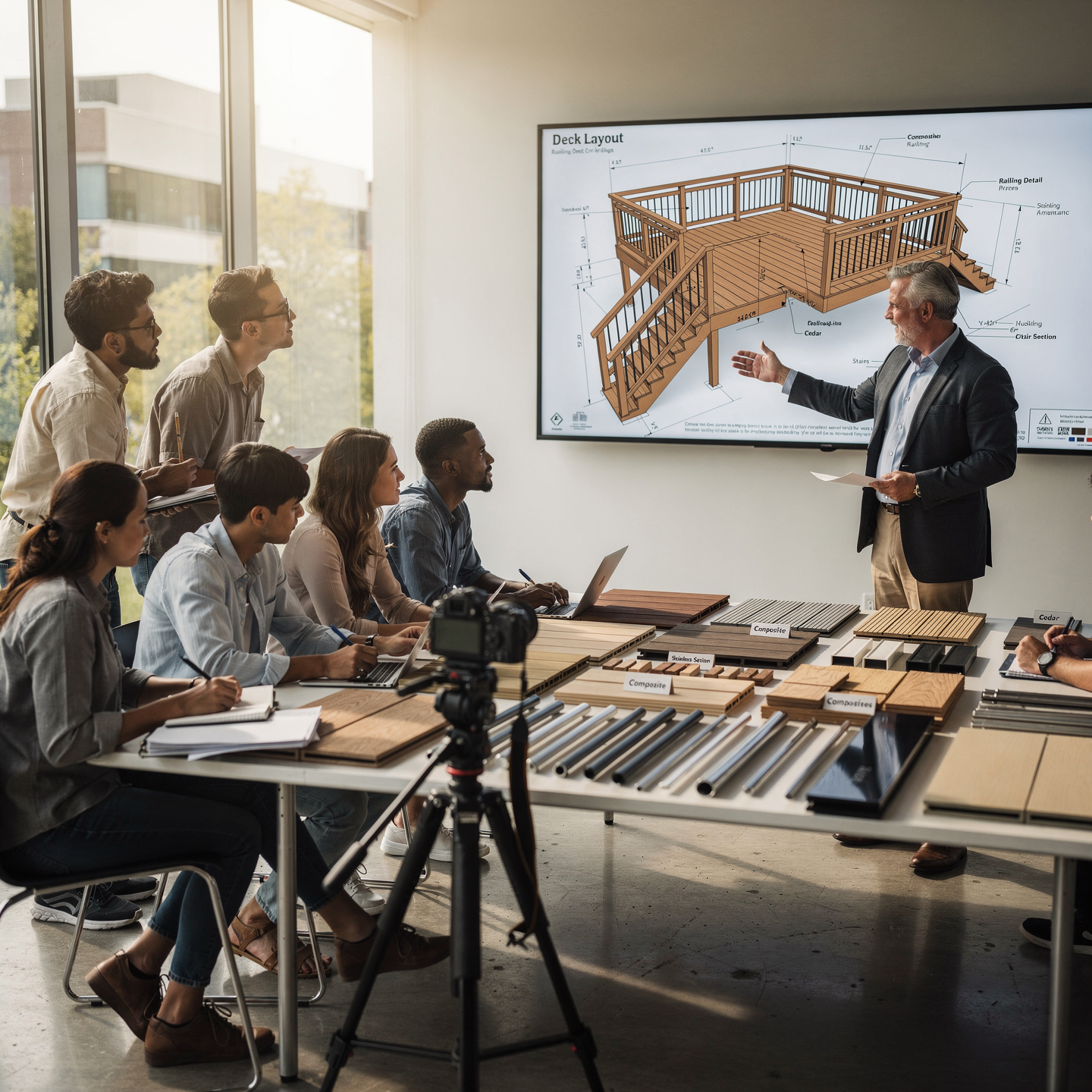
Introduction to Roof Design Course

Why this course?

The Introduction to Roof Design

This course will provide you with the fundamental knowledge to create functional and aesthetically pleasing outdoor spaces tailored to the user’s needs. You will learn about materials, regulations, landscaping, and the distribution of elements, developing the ability to conceptualize and represent your ideas professionally. This course is ideal for those who wish to begin in exterior design or expand their knowledge in this area.

Key Benefits

  • Comprehensive Knowledge: From material selection to irrigation and lighting planning.
  • Design Tools: You will learn to use basic software for representing your projects.
  • Case Studies: You will analyze real-world examples and develop your own project from the initial idea to the final presentation.
  • Personalized Mentoring: You will receive individualized feedback from industry professionals to improve your skills.
  • Networking: You will connect with other design students and professionals, expanding your career opportunities.
diseƱo

Introduction to Roof Design Course

Availability: 1 in stock

Who is it aimed at?

  • Naval architects and designers who want to delve deeper into creating functional, safe, and aesthetically pleasing decks.
  • Naval architecture and marine engineering students seeking practical knowledge of deck design, from conception to implementation.
  • Shipyard engineers and technical staff who need to optimize their deck design and construction processes.
  • Boat owners and hobbyist boatbuilders who want to customize and enhance their boats’ deck designs.
  • Marine industry professionals interested in the latest trends and technologies in deck design.

Learning flexibility:
The course It adapts to your pace: accessible online learning materials, practical exercises and personalized tutoring to answer your questions.

diseƱo

Objectives and competencies

Understanding the fundamental principles of roof design:

“Identify and apply construction regulations, appropriate materials, and waterproofing techniques.”

Select suitable roofing materials based on technical and aesthetic criteria:

“Considering durability, weather resistance, energy efficiency, cost and architectural harmony, consulting regulations and manufacturers’ catalogs.”

Apply graphic representation techniques to communicate cover designs:

“Using CAD/BIM software, isometric projections and exploded views, for a clear and detailed visualization.”

Evaluate and optimize the structural and functional performance of roofs:

Through thorough inspections, data analysis and simulations, identify areas for improvement in strength, durability, insulation and energy efficiency, proposing innovative and cost-effective solutions.

Integrate insulation and waterproofing solutions into roof design:

Select building materials and systems that guarantee energy efficiency, durability and protection against external agents, considering climatic characteristics and regulatory requirements.

Comply with current building and roof safety regulations:

“Interpret and apply the CTE, municipal ordinances and legislation on occupational risk prevention in work at height.”

Curriculum - Modules

  1. Comprehensive Maritime Incident Management: protocols, roles, and chain of command for coordinated response
  2. Operational Planning and Execution: briefing, routes, weather windows, and go/no-go criteria
  3. Rapid Risk Assessment: criticality matrix, scene control, and decision-making under pressure
  4. Operational Communication: VHF/GMDSS, standardized reports, and inter-agency liaison
  5. Tactical Mobility and Safe Boarding: RHIB maneuvers, approach, mooring, and recovery
  6. Equipment and Technologies: PPE, signaling, satellite tracking, and field data logging
  7. Immediate Care of the Affected: primary assessment, hypothermia, trauma, and stabilization for evacuation
  8. Adverse Environmental Conditions: swell, Visibility, flows, and operational mitigation

    Simulation and training: critical scenarios, use of VR/AR, and exercises with performance metrics

    Documentation and continuous improvement: lessons learned, indicators (MTTA/MTTR), and SOP updates

  1. Introduction to Roofs: Types, Functions, and Components.
  2. Roofing Materials: Characteristics, Properties, and Selection.
  3. Building Regulations: CTE, DB-HE, Roofs, and Energy Efficiency.
  4. Flat Roof Design: Waterproofing, Insulation, and Slopes.
  5. Pitched Roof Design: Tiles, Slates, and Fixing Systems.
  6. Green Roofs: Types, Substrates, Drainage, and Environmental Benefits.
  7. Roof Load Calculation: Wind, Snow, and Live Loads.
  8. Energy Efficiency in Roofs: Thermal Insulation, Ventilation, and Cool/Warm Roofs.
  9. Installation of Solar Thermal Systems on Roofs: Architectural Integration and Energy Performance.
  10. Roof maintenance and rehabilitation: Diagnosis, repair, and energy efficiency improvements.

  1. Introduction to Roof Design: History, Evolution, and Current Trends
  2. Roofing Materials: Ceramic tiles, slate, metal, plant-based materials, etc.
  3. Thermal Insulation and Waterproofing: Vapor barriers, asphalt membranes, EPDM
  4. Roof Ventilation: Natural and forced ventilation systems, airflow calculations
  5. Current Regulations: CTE (Spanish Technical Building Code), DB-HS (Basic Document on Health and Safety), DB-SI (Basic Document on Fire Safety), municipal ordinances
  6. Roof Loads: Self-weight, live loads, snow, wind
  7. Roof Slopes: Calculation, types of roofs according to slope
  8. Construction Details: Eaves, hips, valleys, wall junctions
  9. Green roofs: systems, substrates, plant species, drainage
  10. Roof pathologies: dampness, leaks, cracks, repair and maintenance

  1. Introduction to Roofs: Types, Functions, and Components
  2. Roofing Materials: Tiles, Slate, Metals, Membranes, Wood, Glass
  3. Thermal Insulation and Waterproofing: Materials, Techniques, and Regulations
  4. Pitched Roofs: Design, Slope Calculation, Supporting Structures, and Fixing
  5. Flat Roofs: Drainage, Waterproofing, Protection, and Accessibility
  6. Green Roofs: Types, Drainage Systems, Substrates, and Vegetation Selection
  7. Load Calculation: Wind, Snow, Self-Weight, and Live Loads
  8. National and International Regulations: CTE, Eurocodes, Sustainability Standards
  9. Sustainability in Roofs: Energy Efficiency, Recycled Materials, and Solar Thermal Management water
  10. Roof maintenance and rehabilitation: inspection, repair, and structural reinforcement

  1. Introduction to Roof Design: History, Evolution, and Current Trends
  2. Roofing Materials: Ceramic Tiles, Slate, Metal, Wood, Polymers, Glass, and Their Properties
  3. Roof Support Structure: Types of Framing, Load Calculation, and Sizing
  4. Thermal Insulation and Waterproofing: Vapor Barriers, Waterproofing Membranes, and Ecological Insulation
  5. Roof Ventilation: Natural and Forced Ventilation Systems, and Condensation Control
  6. Pitched Roofs: Design, Geometry, Angles, Eaves, Gutters, and Downpipes
  7. Flat Roofs: Types, Minimum Slopes, Drains, and Expansion Joints
  8. Roofs
  9. Ground roofs: extensive and intensive systems, vegetation selection, drainage
  10. Unique roofs: vaults, domes, folded roofs, tensioned membranes
  11. Regulations and legislation applicable to the design and construction of roofs

  1. System Architecture and Components: Structural design, materials, and subsystems (mechanical, electrical, electronic, and fluid) with selection and assembly criteria for marine environments
  2. Fundamentals and Principles of Operation: Physical and engineering foundations (thermodynamics, fluid mechanics, electricity, control, and materials) that explain performance and operating limits
  3. Safety and Environmental (SHE): Risk analysis, PPE, LOTO, hazardous atmospheres, spill and waste management, and emergency response plans
  4. Applicable Regulations and Standards: IMO/ISO/IEC requirements and local regulations;
  5. Conformance criteria, certification, and best practices for operation and maintenance
  6. Inspection, testing, and diagnostics: Visual/dimensional inspection, functional testing, data analysis, and predictive techniques (vibration, thermography, fluid analysis) to identify root causes
  7. Preventive and predictive maintenance: Hourly/cycle/seasonal plans, lubrication, adjustments, calibrations, consumable replacement, post-service verification, and operational reliability
  8. Instrumentation, tools, and metrology: Measuring and testing equipment, diagnostic software, calibration and traceability; selection criteria, safe use, and storage
  9. Onboard integration and interfaces: Mechanical, electrical, fluid, and data compatibility; Sealing and watertightness, EMC/EMI, corrosion protection, and interoperability testing.

    Quality, acceptance testing, and commissioning: process and materials control, FAT/SAT, bench and sea trials, go/no-go criteria, and evidence documentation.

    Technical documentation and integrated practice: logs, checklists, reports, and a complete case study (safety → diagnosis → intervention → verification → report) applicable to any system.

Plan de estudio - Módulos

  1. Comprehensive Maritime Incident Management: protocols, roles, and chain of command for coordinated response
  2. Operational Planning and Execution: briefing, routes, weather windows, and go/no-go criteria
  3. Rapid Risk Assessment: criticality matrix, scene control, and decision-making under pressure
  4. Operational Communication: VHF/GMDSS, standardized reports, and inter-agency liaison
  5. Tactical Mobility and Safe Boarding: RHIB maneuvers, approach, mooring, and recovery
  6. Equipment and Technologies: PPE, signaling, satellite tracking, and field data logging
  7. Immediate Care of the Affected: primary assessment, hypothermia, trauma, and stabilization for evacuation
  8. Adverse Environmental Conditions: swell, Visibility, flows, and operational mitigation

    Simulation and training: critical scenarios, use of VR/AR, and exercises with performance metrics

    Documentation and continuous improvement: lessons learned, indicators (MTTA/MTTR), and SOP updates

  1. Introduction to Roofs: Types, Functions, and Components.
  2. Roofing Materials: Characteristics, Properties, and Selection.
  3. Building Regulations: CTE, DB-HE, Roofs, and Energy Efficiency.
  4. Flat Roof Design: Waterproofing, Insulation, and Slopes.
  5. Pitched Roof Design: Tiles, Slates, and Fixing Systems.
  6. Green Roofs: Types, Substrates, Drainage, and Environmental Benefits.
  7. Roof Load Calculation: Wind, Snow, and Live Loads.
  8. Energy Efficiency in Roofs: Thermal Insulation, Ventilation, and Cool/Warm Roofs.
  9. Installation of Solar Thermal Systems on Roofs: Architectural Integration and Energy Performance.
  10. Roof maintenance and rehabilitation: Diagnosis, repair, and energy efficiency improvements.

  1. Introduction to Roof Design: History, Evolution, and Current Trends
  2. Roofing Materials: Ceramic tiles, slate, metal, plant-based materials, etc.
  3. Thermal Insulation and Waterproofing: Vapor barriers, asphalt membranes, EPDM
  4. Roof Ventilation: Natural and forced ventilation systems, airflow calculations
  5. Current Regulations: CTE (Spanish Technical Building Code), DB-HS (Basic Document on Health and Safety), DB-SI (Basic Document on Fire Safety), municipal ordinances
  6. Roof Loads: Self-weight, live loads, snow, wind
  7. Roof Slopes: Calculation, types of roofs according to slope
  8. Construction Details: Eaves, hips, valleys, wall junctions
  9. Green roofs: systems, substrates, plant species, drainage
  10. Roof pathologies: dampness, leaks, cracks, repair and maintenance

  1. Introduction to Roofs: Types, Functions, and Components
  2. Roofing Materials: Tiles, Slate, Metals, Membranes, Wood, Glass
  3. Thermal Insulation and Waterproofing: Materials, Techniques, and Regulations
  4. Pitched Roofs: Design, Slope Calculation, Supporting Structures, and Fixing
  5. Flat Roofs: Drainage, Waterproofing, Protection, and Accessibility
  6. Green Roofs: Types, Drainage Systems, Substrates, and Vegetation Selection
  7. Load Calculation: Wind, Snow, Self-Weight, and Live Loads
  8. National and International Regulations: CTE, Eurocodes, Sustainability Standards
  9. Sustainability in Roofs: Energy Efficiency, Recycled Materials, and Solar Thermal Management water
  10. Roof maintenance and rehabilitation: inspection, repair, and structural reinforcement

  1. Introduction to Roof Design: History, Evolution, and Current Trends
  2. Roofing Materials: Ceramic Tiles, Slate, Metal, Wood, Polymers, Glass, and Their Properties
  3. Roof Support Structure: Types of Framing, Load Calculation, and Sizing
  4. Thermal Insulation and Waterproofing: Vapor Barriers, Waterproofing Membranes, and Ecological Insulation
  5. Roof Ventilation: Natural and Forced Ventilation Systems, and Condensation Control
  6. Pitched Roofs: Design, Geometry, Angles, Eaves, Gutters, and Downpipes
  7. Flat Roofs: Types, Minimum Slopes, Drains, and Expansion Joints
  8. Roofs
  9. Ground roofs: extensive and intensive systems, vegetation selection, drainage
  10. Unique roofs: vaults, domes, folded roofs, tensioned membranes
  11. Regulations and legislation applicable to the design and construction of roofs

  1. System Architecture and Components: Structural design, materials, and subsystems (mechanical, electrical, electronic, and fluid) with selection and assembly criteria for marine environments
  2. Fundamentals and Principles of Operation: Physical and engineering foundations (thermodynamics, fluid mechanics, electricity, control, and materials) that explain performance and operating limits
  3. Safety and Environmental (SHE): Risk analysis, PPE, LOTO, hazardous atmospheres, spill and waste management, and emergency response plans
  4. Applicable Regulations and Standards: IMO/ISO/IEC requirements and local regulations;
  5. Conformance criteria, certification, and best practices for operation and maintenance
  6. Inspection, testing, and diagnostics: Visual/dimensional inspection, functional testing, data analysis, and predictive techniques (vibration, thermography, fluid analysis) to identify root causes
  7. Preventive and predictive maintenance: Hourly/cycle/seasonal plans, lubrication, adjustments, calibrations, consumable replacement, post-service verification, and operational reliability
  8. Instrumentation, tools, and metrology: Measuring and testing equipment, diagnostic software, calibration and traceability; selection criteria, safe use, and storage
  9. Onboard integration and interfaces: Mechanical, electrical, fluid, and data compatibility; Sealing and watertightness, EMC/EMI, corrosion protection, and interoperability testing.

    Quality, acceptance testing, and commissioning: process and materials control, FAT/SAT, bench and sea trials, go/no-go criteria, and evidence documentation.

    Technical documentation and integrated practice: logs, checklists, reports, and a complete case study (safety → diagnosis → intervention → verification → report) applicable to any system.

  1. Introduction to Roofs: Functions, Types, and Components
  2. Flat Roof Design: Waterproofing, Insulation, Slopes, and Loads
  3. Pitched Roofs: Materials, Fixing Systems, Ventilation, and Water Drainage
  4. Green Roofs: Types, Benefits, Installation, and Maintenance
  5. Metal Roofs: Types of Materials, Joining Systems, Insulation, and Durability
  6. Tile Roofs: Types of Tiles, Installation, Waterproofing, and Durability
  7. Thermal Insulation in Roofs: Materials, Thicknesses, Thermal Conductivity, and Thermal Resistance
  8. Acoustic Insulation in Roofs: Materials, Systems, and Noise Reduction
  9. Ventilation
  10. Energy efficiency in roofs: types of systems, benefits, and design.
  11. Energy efficiency in roofs: design strategies, materials, and systems.

  1. Introduction to Roof Design: Historical Evolution and Typologies
  2. Loads and Stresses: Wind, Snow, Water, Live Loads, and Seismic Loads
  3. Roofing Materials: Tiles (ceramic, concrete, slate), Metal, Wood, Membranes
  4. Thermal and Acoustic Insulation: Materials, Systems, and Calculations
  5. Waterproofing: Vapor Barriers, Asphalt Sheets, Synthetic Membranes
  6. Roof Ventilation: Natural and Forced, Systems, and Components
  7. Green Roofs: Systems, Plant Species, and Maintenance
  8. Current Regulations: CTE (Spanish Technical Building Code), Municipal Ordinances, Quality Standards
  9. Construction Details: Junctions with Walls, Valleys, ridges, and eaves
  10. Roof maintenance and rehabilitation: pathologies, diagnosis, and solutions

  1. Introduction to Roof Design: Types, Functions, and Components
  2. Roofing Materials: Tiles (ceramic, concrete, slate), metal, wood, polymers
  3. Thermal Insulation and Waterproofing: Types, Properties, and Regulations
  4. Slopes and Water Drainage: Calculation, Design of Gutters and Downpipes
  5. Pitched Roofs: Design, Construction, and Construction Details
  6. Flat Roofs: Types, Waterproofing and Drainage Systems
  7. European and National Regulations on Roofs: CTE, Eurocodes
  8. Green Roofs: Types, Benefits, and Construction Systems
  9. Roof Maintenance and Rehabilitation: Inspection, Repair, and Improvement
  10. Safety in working at heights: PPE, preventive measures and legislation

  1. Introduction to Roofs: History, evolution, and typologies
  2. Bioclimatic Roof Design: Orientation, ventilation, and solar exposure
  3. Traditional Materials: Ceramic tiles, slate, and wood
  4. Innovative Materials: Metals, polymers, membranes, and glass
  5. Green Roofs: Types, environmental benefits, and construction considerations
  6. Green Roofs: Design, plant species, irrigation, and maintenance
  7. Thermal and Acoustic Insulation: Materials, systems, and regulations
  8. Waterproofing: Types of membranes, application, and durability
  9. Rainwater Harvesting Systems Rainwater: Design, Filtration, and Storage

    Renewable Energy Integration: Solar Panels, Thermal Collectors, and Wind Turbines

    Sustainability and Life Cycle: Analysis, Evaluation, and Certification of Roofs

    Regulations and Legislation: Building Codes, Sustainability Standards, and Safety

    Construction Details: Connections to Facades, Skylights, and Chimneys

    Maintenance and Rehabilitation: Inspection, Repair, and Renovation of Roofs

    Case Studies: Analysis of Innovative and Sustainable Projects

Career opportunities

  • Cover Designer for Publishers: Creating attractive and functional covers for books, magazines, and other print and digital materials.
  • Cover Illustrator: Developing original and custom images that complement the design and message of the content.
  • Cover Layout Designer: Technically preparing files for printing, ensuring the correct layout of elements and the final quality of the product.
  • Editorial Art Director: Supervising and coordinating cover design within a publishing project, guaranteeing visual consistency and the achievement of objectives.
  • Freelance Cover Designer: Offering design services to publishers, independent authors, and companies that need covers for their publications.
  • Cover Typography Specialist: Selecting and applying typefaces that enhance the style and legibility of the cover. Cover.
  • Cover Design Consultant: Advising authors and publishers on best design practices to maximize the impact and sales of their publications.
  • Cover Designer for Digital Platforms: Adapting designs to the specific formats and requirements of ebook and audiobook sales platforms.

“`

Admission requirements

Academic/professional profile:

Degree/Bachelor's degree in Nautical Science/Maritime Transport, Naval/Marine Engineering, or a related field; or proven professional experience in bridge/operations.

Language proficiency:

Recommended functional maritime English (SMCP) for simulations and technical materials.

5. Induction

Updated resume, copy of degree or seaman's book, ID card/passport, letter of motivation.

Technical requirements (for online):

Equipment with camera/microphone, stable connection, ≄ 24ā€ monitor recommended for ECDIS/Radar-ARPA.

Admission process and dates

1. Online
application

(form + documents).

2. Academic review and interview

(profile/objectives/schedule compatibility).

3. Admission decision

(+ scholarship proposal if applicable).

4. Reservation of place

(deposit) and registration.

5. Induction

(access to campus, calendars, simulator guides).

Scholarships and grants

  • Essential Fundamentals: Learn the basic principles of roof design, from material selection to current regulations.
  • Types of Roofs: Explore in detail the different types of roofs, their advantages and disadvantages, and how to choose the right option for each project.
  • Specialized Software: Familiarize yourself with software tools for roof design and modeling, optimizing workflow and accuracy.
  • Construction Details: Master the creation of precise and functional construction details, ensuring watertightness, insulation, and durability.
  • Energy Efficiency: Incorporate energy efficiency criteria into your roof designs, reducing environmental impact and operating costs.
Boost your career and become an expert in roof design, creating innovative solutions and sustainable.

Testimonials

Frequently asked questions

Protect the interior of the building from weather elements such as rain, wind, snow and sun.

Yes. The itinerary includes ECDIS/Radar-ARPA/BRM with harbor, ocean, fog, storm, and SAR scenarios.

Online with live sessions; hybrid option for simulator/practical placements through agreements.

Protect the interior of the building from weather elements such as rain, wind, snow and sun.

Recommended functional SMCP. We offer support materials for standard phraseology.

Yes, with a relevant degree or experience in maritime/port operations. The admissions interview will confirm suitability.

Optional (3–6 months) through Companies & Collaborations and the Alumni Network.

Simulator practice (rubrics), defeat plans, SOPs, checklists, micro-tests and applied TFM.

A degree from Navalis Magna University + operational portfolio (tracks, SOPs, reports and KPIs) useful for audits and employment.

  1. Introduction to Roofs: History, evolution, and typologies
  2. Bioclimatic Roof Design: Orientation, ventilation, and solar exposure
  3. Traditional Materials: Ceramic tiles, slate, and wood
  4. Innovative Materials: Metals, polymers, membranes, and glass
  5. Green Roofs: Types, environmental benefits, and construction considerations
  6. Green Roofs: Design, plant species, irrigation, and maintenance
  7. Thermal and Acoustic Insulation: Materials, systems, and regulations
  8. Waterproofing: Types of membranes, application, and durability
  9. Rainwater Harvesting Systems Rainwater: Design, Filtration, and Storage

    Renewable Energy Integration: Solar Panels, Thermal Collectors, and Wind Turbines

    Sustainability and Life Cycle: Analysis, Evaluation, and Certification of Roofs

    Regulations and Legislation: Building Codes, Sustainability Standards, and Safety

    Construction Details: Connections to Facades, Skylights, and Chimneys

    Maintenance and Rehabilitation: Inspection, Repair, and Renovation of Roofs

    Case Studies: Analysis of Innovative and Sustainable Projects

Request information

  1. Complete the Application Form
  2. Attach your CV/Qualifications (if you have them to hand).
  3. Indicate your preferred cohort (January/May/September) and whether you want the hybrid option with simulator sessions.
An academic advisor will contact you within 24–48 hours to guide you through the admission process, scholarships, and compatibility with your professional schedule. Translated with DeepL.com (free version)
Please enable JavaScript in your browser to complete this form.
Click or drag a file to this area to upload.

Teachers

0
    0
    Tu carrito
    Tu carrito esta vacĆ­oRegresar a la tienda
    Scroll to Top


