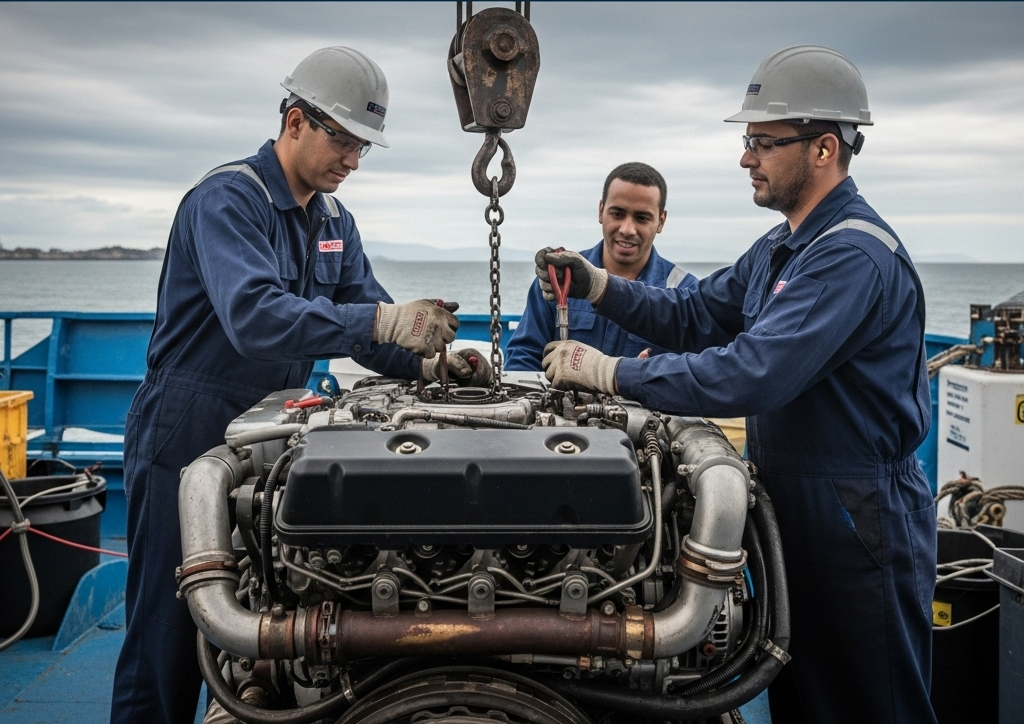
Preventive maintenance course for marine engines

Why this course?

The Marine Engine Preventive Maintenance course

This course provides you with the essential tools to optimize performance and extend the lifespan of your engines. Learn to identify and prevent failures before they occur, reducing costs and minimizing downtime. This program covers everything from regular inspection and lubrication to fluid analysis and component adjustment, ensuring the efficiency and reliability of your equipment. Master predictive maintenance techniques and ensure the continuous operation of your vessel.

Differential Advantages

  • Practical Approach: Real-world examples and case studies for direct field application.
  • Advanced Diagnostics: Techniques for detecting anomalies and predicting potential failures.
  • Resource Optimization: Efficient maintenance planning and inventory management.
  • Regulations and Safety: Compliance with international standards and regulations.
  • Continuous Improvement: Strategies for the constant optimization of engine performance.
Mantenimiento

Preventive maintenance course for marine engines

Availability: 1 in stock

Who is it aimed at?

  • Naval engineers and technicians seeking to optimize the availability and service life of main and auxiliary engines.
  • Chief engineers and engine officers responsible for the planning and execution of onboard maintenance.
  • Shipyard and naval repair shop personnel wishing to update their knowledge of the latest technologies and procedures.
  • Shipowners and fleet managers interested in reducing operating costs and minimizing the risk of engine failures.
  • Naval engineering students and related fields seeking a solid foundation in the preventive maintenance of marine engines.

Flexibility for your career
 Adapted for professionals with demanding schedules: 24/7 accessible online content, discussion forums and practical exercises applicable to various types of engines.

Mantenimiento

Objectives and competencies

Optimize engine availability and reliability:

“Implement a predictive maintenance program based on data analysis and continuous monitoring of the engine’s condition.”

Diagnosing and repairing common engine faults:

“Identify the root cause using diagnostic tools, follow technical procedures, and accurately replace/repair defective components.”

Extending engine life and reducing operating costs:

“Monitor key parameters (temperatures, pressures, vibrations) and act proactively in response to deviations.”

Comply with safety and environmental regulations:

Manage waste and emissions in accordance with current legislation, minimizing environmental impact and reporting incidents.

Mastering engine lubrication and cooling techniques:

“Select the appropriate lubricant and coolant, apply preventive and corrective maintenance procedures, and diagnose common system failures.”

Inspect and adjust the fuel and injection systems:

“Diagnosing faults, calibrating injectors and optimizing combustion to reduce emissions and improve efficiency.”

Curriculum - Modules

  1. Comprehensive Maritime Incident Management: protocols, roles, and chain of command for coordinated response
  2. Operational Planning and Execution: briefing, routes, weather windows, and go/no-go criteria
  3. Rapid Risk Assessment: criticality matrix, scene control, and decision-making under pressure
  4. Operational Communication: VHF/GMDSS, standardized reports, and inter-agency liaison
  5. Tactical Mobility and Safe Boarding: RHIB maneuvers, approach, mooring, and recovery
  6. Equipment and Technologies: PPE, signaling, satellite tracking, and field data logging
  7. Immediate Care of the Affected: primary assessment, hypothermia, trauma, and stabilization for evacuation
  8. Adverse Environmental Conditions: swell, Visibility, flows, and operational mitigation

    Simulation and training: critical scenarios, use of VR/AR, and exercises with performance metrics

    Documentation and continuous improvement: lessons learned, indicators (MTTA/MTTR), and SOP updates

  1. Introduction to Marine Engine Maintenance: Types, Components, and Systems.
  2. Lubrication: Types of lubricants, lubrication systems, oil analysis, common problems.
  3. Cooling: Cooling systems, types of coolants, water treatment, temperature control.
  4. Fuel: Types of marine fuels, fuel systems, injection, cleaning, and treatment.
  5. Intake and Exhaust Systems: Air filters, turbochargers, intercoolers, mufflers, and catalytic converters.
  6. Electrical Systems: Batteries, generators, starter motors, wiring, and electrical protection.
  7. Control and Monitoring Systems: Sensors, actuators, electronic control units (ECUs), alarms, and Protection.
  8. Preventive Maintenance: Scheduling, inspections, adjustments, component replacement, and record keeping.

    Corrective Maintenance: Troubleshooting, repair, component replacement, testing, and commissioning.

    Safety and Environment: Safety standards, waste management, pollution prevention, and emergency response.

  1. Introduction to predictive maintenance: concepts, benefits, and applications in marine engines.
  2. Fundamentals of corrective maintenance: fault identification, diagnosis, and repair.
  3. Regulatory framework for marine engine maintenance: international and local standards.
  4. Lubrication of marine engines: types of lubricants, analysis, and management.
  5. Cooling systems: preventive and corrective maintenance, water treatment.
  6. Combustion in marine engines: exhaust gas analysis, optimization, and control.
  7. Fuel systems: maintenance of injectors, pumps, and filters.
  8. Mechanical components: inspection, adjustment, and replacement of pistons, connecting rods, Crankshafts.
  9. Electrical Systems: Diagnosis and repair of wiring, sensors, and actuators.

    Safety in marine engine maintenance: Procedures, equipment, and risks.

  1. Introduction to Maintenance: Types, Objectives, and Evolution
  2. Reliability Fundamentals: Bathtub Curve, MTBF, MTTR
  3. Diagnostic Techniques: Visual Inspection, Vibration Analysis, Thermography
  4. Preventive Maintenance: Planning and Optimization of Tasks
  5. Predictive Maintenance: Condition Monitoring, Oil Analysis
  6. Corrective Maintenance: Failure Analysis, Repair Actions
  7. Spare Parts Management: Inventory, ABC Classification, Obsolescence
  8. Maintenance Planning: Development of Plans, Resources, Scheduling
  9. Maintenance Management Software (CMMS): Selection and Implementation
  10. Maintenance Costs: Optimization, Cycle Analysis life

  1. Introduction to Lubrication: Types, Properties, and Functions of Lubricants.
  2. Cooling in Machinery: Systems, Coolants, and Their Environmental Impact.
  3. Safety in Handling Lubricants and Coolants: Safety Data Sheets (SDS) and Personal Protective Equipment (PPE).
  4. Lubrication by Machine Type: Motors, Gearboxes, Bearings, and Hydraulic Systems.
  5. Preventive Maintenance: Lubrication Programs, Oil Analysis, and Troubleshooting.
  6. Compatibility of Lubricants and Coolants: Mixtures, Risks, and Best Practices.
  7. Safe Storage and Disposal of Used Lubricants and Coolants: Regulations and Procedures.
  8. Occupational Hazards Associated with Lubrication and Cooling: Fires, spills, and exposure to chemicals.

    First Aid: Response to incidents related to lubricants and coolants.

    Current regulations regarding lubrication, cooling, and safety: National and international regulations.

  1. System Architecture and Components: Structural design, materials, and subsystems (mechanical, electrical, electronic, and fluid) with selection and assembly criteria for marine environments
  2. Fundamentals and Principles of Operation: Physical and engineering foundations (thermodynamics, fluid mechanics, electricity, control, and materials) that explain performance and operating limits
  3. Safety and Environmental (SHE): Risk analysis, PPE, LOTO, hazardous atmospheres, spill and waste management, and emergency response plans
  4. Applicable Regulations and Standards: IMO/ISO/IEC requirements and local regulations;
  5. Conformance criteria, certification, and best practices for operation and maintenance
  6. Inspection, testing, and diagnostics: Visual/dimensional inspection, functional testing, data analysis, and predictive techniques (vibration, thermography, fluid analysis) to identify root causes
  7. Preventive and predictive maintenance: Hourly/cycle/seasonal plans, lubrication, adjustments, calibrations, consumable replacement, post-service verification, and operational reliability
  8. Instrumentation, tools, and metrology: Measuring and testing equipment, diagnostic software, calibration and traceability; selection criteria, safe use, and storage
  9. Onboard integration and interfaces: Mechanical, electrical, fluid, and data compatibility; Sealing and watertightness, EMC/EMI, corrosion protection, and interoperability testing.

    Quality, acceptance testing, and commissioning: process and materials control, FAT/SAT, bench and sea trials, go/no-go criteria, and evidence documentation.

    Technical documentation and integrated practice: logs, checklists, reports, and a complete case study (safety → diagnosis → intervention → verification → report) applicable to any system.

Plan de estudio - Módulos

  1. Comprehensive Maritime Incident Management: protocols, roles, and chain of command for coordinated response
  2. Operational Planning and Execution: briefing, routes, weather windows, and go/no-go criteria
  3. Rapid Risk Assessment: criticality matrix, scene control, and decision-making under pressure
  4. Operational Communication: VHF/GMDSS, standardized reports, and inter-agency liaison
  5. Tactical Mobility and Safe Boarding: RHIB maneuvers, approach, mooring, and recovery
  6. Equipment and Technologies: PPE, signaling, satellite tracking, and field data logging
  7. Immediate Care of the Affected: primary assessment, hypothermia, trauma, and stabilization for evacuation
  8. Adverse Environmental Conditions: swell, Visibility, flows, and operational mitigation

    Simulation and training: critical scenarios, use of VR/AR, and exercises with performance metrics

    Documentation and continuous improvement: lessons learned, indicators (MTTA/MTTR), and SOP updates

  1. Introduction to Marine Engine Maintenance: Types, Components, and Systems.
  2. Lubrication: Types of lubricants, lubrication systems, oil analysis, common problems.
  3. Cooling: Cooling systems, types of coolants, water treatment, temperature control.
  4. Fuel: Types of marine fuels, fuel systems, injection, cleaning, and treatment.
  5. Intake and Exhaust Systems: Air filters, turbochargers, intercoolers, mufflers, and catalytic converters.
  6. Electrical Systems: Batteries, generators, starter motors, wiring, and electrical protection.
  7. Control and Monitoring Systems: Sensors, actuators, electronic control units (ECUs), alarms, and Protection.
  8. Preventive Maintenance: Scheduling, inspections, adjustments, component replacement, and record keeping.

    Corrective Maintenance: Troubleshooting, repair, component replacement, testing, and commissioning.

    Safety and Environment: Safety standards, waste management, pollution prevention, and emergency response.

  1. Introduction to predictive maintenance: concepts, benefits, and applications in marine engines.
  2. Fundamentals of corrective maintenance: fault identification, diagnosis, and repair.
  3. Regulatory framework for marine engine maintenance: international and local standards.
  4. Lubrication of marine engines: types of lubricants, analysis, and management.
  5. Cooling systems: preventive and corrective maintenance, water treatment.
  6. Combustion in marine engines: exhaust gas analysis, optimization, and control.
  7. Fuel systems: maintenance of injectors, pumps, and filters.
  8. Mechanical components: inspection, adjustment, and replacement of pistons, connecting rods, Crankshafts.
  9. Electrical Systems: Diagnosis and repair of wiring, sensors, and actuators.

    Safety in marine engine maintenance: Procedures, equipment, and risks.

  1. Introduction to Maintenance: Types, Objectives, and Evolution
  2. Reliability Fundamentals: Bathtub Curve, MTBF, MTTR
  3. Diagnostic Techniques: Visual Inspection, Vibration Analysis, Thermography
  4. Preventive Maintenance: Planning and Optimization of Tasks
  5. Predictive Maintenance: Condition Monitoring, Oil Analysis
  6. Corrective Maintenance: Failure Analysis, Repair Actions
  7. Spare Parts Management: Inventory, ABC Classification, Obsolescence
  8. Maintenance Planning: Development of Plans, Resources, Scheduling
  9. Maintenance Management Software (CMMS): Selection and Implementation
  10. Maintenance Costs: Optimization, Cycle Analysis life

  1. Introduction to Lubrication: Types, Properties, and Functions of Lubricants.
  2. Cooling in Machinery: Systems, Coolants, and Their Environmental Impact.
  3. Safety in Handling Lubricants and Coolants: Safety Data Sheets (SDS) and Personal Protective Equipment (PPE).
  4. Lubrication by Machine Type: Motors, Gearboxes, Bearings, and Hydraulic Systems.
  5. Preventive Maintenance: Lubrication Programs, Oil Analysis, and Troubleshooting.
  6. Compatibility of Lubricants and Coolants: Mixtures, Risks, and Best Practices.
  7. Safe Storage and Disposal of Used Lubricants and Coolants: Regulations and Procedures.
  8. Occupational Hazards Associated with Lubrication and Cooling: Fires, spills, and exposure to chemicals.

    First Aid: Response to incidents related to lubricants and coolants.

    Current regulations regarding lubrication, cooling, and safety: National and international regulations.

  1. System Architecture and Components: Structural design, materials, and subsystems (mechanical, electrical, electronic, and fluid) with selection and assembly criteria for marine environments
  2. Fundamentals and Principles of Operation: Physical and engineering foundations (thermodynamics, fluid mechanics, electricity, control, and materials) that explain performance and operating limits
  3. Safety and Environmental (SHE): Risk analysis, PPE, LOTO, hazardous atmospheres, spill and waste management, and emergency response plans
  4. Applicable Regulations and Standards: IMO/ISO/IEC requirements and local regulations;
  5. Conformance criteria, certification, and best practices for operation and maintenance
  6. Inspection, testing, and diagnostics: Visual/dimensional inspection, functional testing, data analysis, and predictive techniques (vibration, thermography, fluid analysis) to identify root causes
  7. Preventive and predictive maintenance: Hourly/cycle/seasonal plans, lubrication, adjustments, calibrations, consumable replacement, post-service verification, and operational reliability
  8. Instrumentation, tools, and metrology: Measuring and testing equipment, diagnostic software, calibration and traceability; selection criteria, safe use, and storage
  9. Onboard integration and interfaces: Mechanical, electrical, fluid, and data compatibility; Sealing and watertightness, EMC/EMI, corrosion protection, and interoperability testing.

    Quality, acceptance testing, and commissioning: process and materials control, FAT/SAT, bench and sea trials, go/no-go criteria, and evidence documentation.

    Technical documentation and integrated practice: logs, checklists, reports, and a complete case study (safety → diagnosis → intervention → verification → report) applicable to any system.

  1. Introduction to Marine Engines: Types, Components, and Auxiliary Systems
  2. Basic Thermodynamics applied to Internal Combustion Engines
  3. Fuels and Lubricants: Properties, Selection, and Management
  4. Intake and Exhaust Systems: Design, Operation, and Maintenance
  5. Cooling Systems: Types, Components, Control, and Maintenance
  6. Lubrication Systems: Types, Components, Control, and Maintenance
  7. Fuel Injection Systems: Types, Operation, and Diagnosis
  8. Electronic Engine Control Systems (ECU): Sensors, Actuators, and Programming
  9. Troubleshooting: Techniques, Tools, and Equipment
  10. Environmental Regulations and Safety in Engine Operation and Maintenance marines.

  1. Introduction to Predictive Maintenance in Marine Engines: Concepts and Benefits
  2. Fundamentals of Lubrication: Types of Lubricants, Properties, and Selection
  3. Lubricant Oil Analysis: Sampling Techniques, Testing, and Diagnosis
  4. Infrared Thermography: Application in Marine Engines, Identification of Hot Spots
  5. Vibration Analysis: Sensors, Data Collection, and Analysis Techniques
  6. Ultrasound: Detection of Leaks, Cavitation, and Wear in Components
  7. Particle Wear Analysis: Identification of Failure Modes and Contaminants
  8. Shaft Alignment and Balancing: Techniques and Equipment for Marine Engines

    Visual Inspection and Non-Destructive Testing: Methods and Applications

    Implementation of a Predictive Maintenance Program: Planning, Software, and KPIs

  1. Introduction to Predictive Maintenance: Concepts, Benefits, and Scope
  2. Fundamentals of Lubrication: Types of Lubricants, Properties, and Functions
  3. Oil Analysis: Sampling, Laboratory Testing, and Interpretation of Results
  4. Vibroanalysis Techniques: Data Acquisition, Frequency Spectra, and Fault Diagnosis
  5. Infrared Thermography: Principles and Applications in Electrical and Mechanical Equipment
  6. Visual Inspection and Ultrasound: Detection of Leaks, Wear, and Other Defects
  7. Fault Analysis: RCA Methodologies, Fault Tree Analysis, and 5 Whys
  8. Management Data and Maintenance Software: CMMS, Key Performance Indicators (KPIs)

    Implementation of a Predictive Maintenance Program: Planning, Execution, and Monitoring

    Safety and Environment in Maintenance: Standards, Procedures, and Best Practices

  1. Fundamentals of Marine Propulsion: Engine types, transmission systems, propellers, and nozzles.
  2. Thermodynamics Applied to Marine Engines: Thermodynamic cycles, efficiency, and exhaust gas analysis.
  3. Fuel Systems: Treatment, injection, and combustion optimization.
  4. Lubrication and Cooling Systems: Types of lubricants, coolants, and thermal management.
  5. Vibration Analysis: Diagnosing faults in rotating and reciprocating components.
  6. Predictive Maintenance: Monitoring techniques, trend analysis, and intervention planning.
  7. Control and Automation Systems: Sensors, actuators, PLCs, and energy management systems.
  8. Regulations and Certifications: Standards of emissions, safety, and energy efficiency.
  9. Performance Optimization: Adjustment of operating parameters, efficiency improvement, and emissions reduction.
  10. Case Studies: Analysis of common failures, optimization solutions, and practical examples.

Career opportunities

  • Marine Mechanic / Chief Engineer: Maintenance and repair of marine engines, auxiliary systems, and propulsion equipment.
  • Engine Officer: Supervision and control of the operation of the ship’s propulsion systems and machinery.
  • Shipyard Maintenance Technician: Repair, overhaul, and commissioning of marine engines during the shipbuilding and repair phases.
  • Marine Engine Service Technician: Diagnosis, repair, and maintenance of engines from specific manufacturers.
  • Technical Inspector / Marine Surveyor: Evaluation of the condition and performance of marine engines for insurance companies, shipowners, or maritime authorities.
  • Technical Consultant: Advising on the selection, installation, and maintenance of marine engines for naval projects.
  • Teacher / Technical Instructor: Training future professionals in the area of ​​marine engine maintenance.

    Technical Sales / Marine Engine Representative: Marketing of engines, spare parts, and maintenance services.

    “`

Admission requirements

Academic/professional profile:

Degree/Bachelor's degree in Nautical Science/Maritime Transport, Naval/Marine Engineering, or a related field; or proven professional experience in bridge/operations.

Language proficiency:

Recommended functional maritime English (SMCP) for simulations and technical materials.

5. Induction

Updated resume, copy of degree or seaman's book, ID card/passport, letter of motivation.

Technical requirements (for online):

Equipment with camera/microphone, stable connection, ≥ 24” monitor recommended for ECDIS/Radar-ARPA.

Admission process and dates

1. Online
application

(form + documents).

2. Academic review and interview

(profile/objectives/schedule compatibility).

3. Admission decision

(+ scholarship proposal if applicable).

4. Reservation of place

(deposit) and registration.

5. Induction

(access to campus, calendars, simulator guides).

Scholarships and grants

  • Maintenance Fundamentals: Master the essential techniques for inspection, lubrication, and adjustment of marine engines.
  • Advanced Diagnostics: Learn to identify and troubleshoot common failures, optimizing performance and extending equipment life.
  • Key Components: Delve into the operation of cooling, fuel, and exhaust systems, ensuring comprehensive maintenance.
  • Safety and Regulations: Understand current regulations and best practices for safe and efficient work.
  • Real-World Practice: Apply your knowledge in simulations and case studies, preparing you for real-world challenges in the field.
Boost your career as a naval technician with the most in-demand skills in the sector.

Testimonials

Frequently asked questions

Avoid failures and extend the engine’s lifespan.

Yes. The itinerary includes ECDIS/Radar-ARPA/BRM with harbor, ocean, fog, storm, and SAR scenarios.

Online with live sessions; hybrid option for simulator/practical placements through agreements.

Maximize engine reliability and availability by minimizing failures and downtime.

Recommended functional SMCP. We offer support materials for standard phraseology.

Yes, with a relevant degree or experience in maritime/port operations. The admissions interview will confirm suitability.

Optional (3–6 months) through Companies & Collaborations and the Alumni Network.

Simulator practice (rubrics), defeat plans, SOPs, checklists, micro-tests and applied TFM.

A degree from Navalis Magna University + operational portfolio (tracks, SOPs, reports and KPIs) useful for audits and employment.

  1. Fundamentals of Marine Propulsion: Engine types, transmission systems, propellers, and nozzles.
  2. Thermodynamics Applied to Marine Engines: Thermodynamic cycles, efficiency, and exhaust gas analysis.
  3. Fuel Systems: Treatment, injection, and combustion optimization.
  4. Lubrication and Cooling Systems: Types of lubricants, coolants, and thermal management.
  5. Vibration Analysis: Diagnosing faults in rotating and reciprocating components.
  6. Predictive Maintenance: Monitoring techniques, trend analysis, and intervention planning.
  7. Control and Automation Systems: Sensors, actuators, PLCs, and energy management systems.
  8. Regulations and Certifications: Standards of emissions, safety, and energy efficiency.
  9. Performance Optimization: Adjustment of operating parameters, efficiency improvement, and emissions reduction.
  10. Case Studies: Analysis of common failures, optimization solutions, and practical examples.

Request information

  1. Complete the Application Form
  2. Attach your CV/Qualifications (if you have them to hand).
  3. Indicate your preferred cohort (January/May/September) and whether you want the hybrid option with simulator sessions.
An academic advisor will contact you within 24–48 hours to guide you through the admission process, scholarships, and compatibility with your professional schedule. Translated with DeepL.com (free version)
Please enable JavaScript in your browser to complete this form.
Click or drag a file to this area to upload.

Teachers

0
    0
    Tu carrito
    Tu carrito esta vacíoRegresar a la tienda
    Scroll to Top


