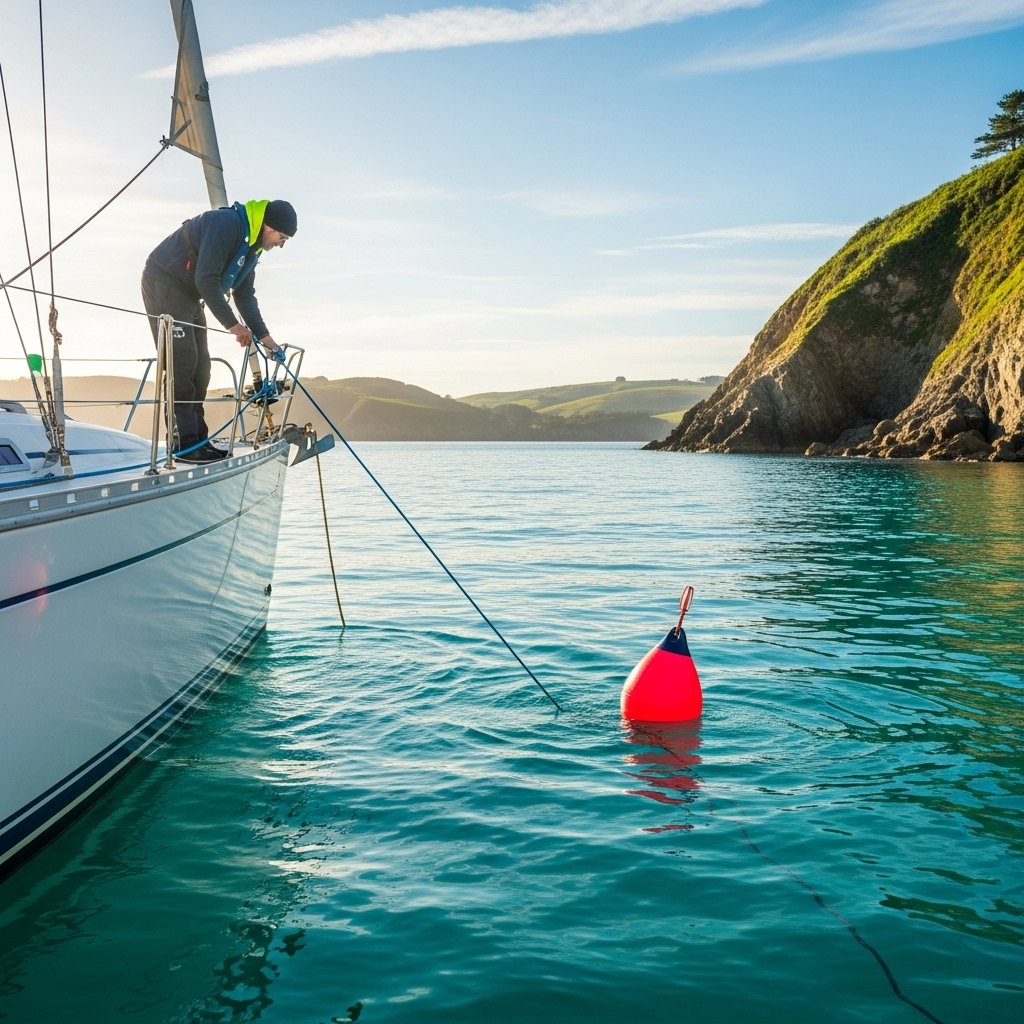
Safe Anchoring Practice Course
Why this course?
The Safe Anchoring Practices
course
This course prepares you to execute efficient and safe anchoring maneuvers in a variety of conditions. Learn to assess risks, select the appropriate anchorage, and use equipment correctly, minimizing incidents and protecting the marine environment. This course is essential for captains, officers, and seamen who wish to refine their skills and ensure safety in their operations.
Safe Anchoring Practices
Differential Advantages
- Risk Assessment: Identification of hazards and preventive measures in the anchoring process.
- Anchorage Site Selection: Analysis of nautical charts, currents, winds, and seabed type.
- Anchoring and Weighing Techniques: Correct use of the anchor, chain, and winch in different scenarios.
- Emergency Procedures: Actions to take in case of equipment failure, anchor dragging, and adverse weather conditions.
- Regulatory Compliance: Knowledge of national and international regulations on safe anchoring.
- Modality: Online
- Level: Cursos
- Hours: 150 H
- Start date: 24-07-2026
Availability: 1 in stock
Who is it aimed at?
- Captains and Bridge Officers seeking to perfect their techniques for planning and executing safe anchorages, minimizing risks and optimizing time.
- Fleet Superintendents and Managers interested in reducing anchorage-related incidents, improving the safety of their vessels, and complying with regulations.
- ISM/ISPS Auditors who need a in-depth understanding of anchorage procedures to conduct effective inspections and ensure regulatory compliance.
- Pilots who wish to update their knowledge of best anchorage practices in different environmental conditions and seabed types.
- Nautical students and early-career professionals seeking to develop skills Practical experience in planning and executing secure anchorages.
Learning flexibility: Adapted to your pace: downloadable materials, practical examples, and unlimited access for the duration of the course.
Objectives and competencies

Select and use the anchoring equipment correctly:
Assess seabed conditions, depth, and potential hazards before anchoring, choosing the appropriate anchoring equipment for the specific circumstances.

Evaluate environmental and seabed conditions for optimal anchoring:
Analyze nautical charts, weather forecasts and currents, considering bathymetry and bottom composition to minimize risks to the environment and the vessel.

Maneuver the vessel precisely for safe anchoring and retrieval:
“Evaluate meteo-oceanographic conditions and seabed characteristics, selecting the best position and length of chain/cable.”

Reacting effectively to emergency situations while anchoring:
“Assess risks (drift, weather conditions, traffic) and execute corrective maneuvers with clear communication.”

Inspect and maintain the anchoring equipment to ensure its proper functioning:
“Check the condition of the anchor, chain/rope, windlass and brakes, lubricate components, and identify and replace worn or damaged items.”

Interpreting current regulations on anchoring and their application in different areas:
“Identify prohibited, restricted and recommended areas according to nautical charts and notices to mariners.”
Curriculum - Modules
- Comprehensive Maritime Incident Management: protocols, roles, and chain of command for coordinated response
- Operational Planning and Execution: briefing, routes, weather windows, and go/no-go criteria
- Rapid Risk Assessment: criticality matrix, scene control, and decision-making under pressure
- Operational Communication: VHF/GMDSS, standardized reports, and inter-agency liaison
- Tactical Mobility and Safe Boarding: RHIB maneuvers, approach, mooring, and recovery
- Equipment and Technologies: PPE, signaling, satellite tracking, and field data logging
- Immediate Care of the Affected: primary assessment, hypothermia, trauma, and stabilization for evacuation
- Adverse Environmental Conditions: swell, Visibility, flows, and operational mitigation
Simulation and training: critical scenarios, use of VR/AR, and exercises with performance metrics
Documentation and continuous improvement: lessons learned, indicators (MTTA/MTTR), and SOP updates
- Introduction to Anchoring: Purpose, Types, and General Considerations
- Anchoring Equipment: Anchors (types, weights), chains (shackles, length), windlasses
- Calculating Chain Length: Influencing Factors, Formulas, and Tables
- Selecting an Anchorage Site: Depth, Bottom Type, Protection from Wind and Current
- Preparing for Anchoring: Checklists, Communication Between the Bridge and Deck
- Approaching the Anchorage: Speed, Heading, and Safety Considerations
- Dropping the Anchorage Technique: Speed Control, Chain Observation, Preventing Anchor Jumping
- Monitoring the Anchoring: Bearings, swing alarms, position check
Weighing anchor: Precautions, windlass use, anchor cleaning
Emergency procedures: Anchor stuck, bad weather, anchor dragging
‘
- Fundamentals of Anchoring: Purpose, advantages, and disadvantages.
- Anchoring Equipment: Types of anchors (Danforth, Bruce, Hall), chains, cables, and windlasses.
- Calculating Chain Length: Factors to consider (depth, wind, current, sea state).
- Selecting an Anchorage Site: Characteristics of the seabed (sand, mud, rock), depth, and protection.
- Planning the Anchorage: Risk assessment, tidal currents, weather conditions, and maritime traffic.
- Anchoring Procedure: Speed, approach angle, and launching technique.
- Monitoring the Anchorage: Use of visual bearings, GPS, and drift alarms.
- Anchoring Maneuvers and anchor hauling: Safe and efficient techniques.
Emergency situations: Dragging anchor, jammed chain, lost anchor.
Maintenance and inspection of anchoring equipment: Inspection, cleaning, and lubrication.
‘
- Introduction to Anchoring: Purpose, Types of Anchoring, and General Considerations
- Anchoring Equipment: Anchors (types, weights), chains, cables, shackles, and windlasses
- Calculating Chain Length: Influencing Factors (depth, wind, current, sea state)
- Selecting an Anchorage Site: Seabed characteristics, nautical charts, and soundings
- Preparing for Anchoring: Equipment check, communication with the crew, and maneuver planning
- Anchoring Maneuvering: Dropping the anchor, speed control, and checking the hold
- Watchkeeping While Anchored: Marking position, swing alarms, and chain tension monitoring
- Weaving Operation: Anchor retrieval, chain cleaning, and safe stowage
- Emergency Situations: Stuck Anchor, Chain Breakage, Bad Weather
- Safety at Anchor: Safety Procedures, Use of Protective Equipment, and Effective Communication
‘
- Introduction to Anchoring: Purpose, types, and system components.
- Anchoring Equipment: Anchors (types, weights, materials), chains, ropes, and windlasses.
- Selecting the Anchorage Site: Analysis of nautical charts, bathymetry, and seabed conditions.
- Calculating Chain/Rope Length: Catenary rule, consideration of depth and weather conditions.
- Anchoring Procedure: Communication, speed, gradual tacking, and checking the hold.
- Monitoring the Anchorage: Position marking, drift alarms, visual and radar/AIS control.
- Maneuvers in Bad Weather: Anchor reinforcement, second anchor, procedures in case of Dragging anchor.
- Anchor raising: Precautions, chain cleaning, safe stowage of equipment.
- Maintenance of anchoring equipment: Inspections, lubrication, replacement of worn parts.
- Environmental and regulatory considerations: Impact on the seabed and local regulations.
‘
- System Architecture and Components: Structural design, materials, and subsystems (mechanical, electrical, electronic, and fluid) with selection and assembly criteria for marine environments
- Fundamentals and Principles of Operation: Physical and engineering foundations (thermodynamics, fluid mechanics, electricity, control, and materials) that explain performance and operating limits
- Safety and Environmental (SHE): Risk analysis, PPE, LOTO, hazardous atmospheres, spill and waste management, and emergency response plans
- Applicable Regulations and Standards: IMO/ISO/IEC requirements and local regulations;
- Conformance criteria, certification, and best practices for operation and maintenance
- Inspection, testing, and diagnostics: Visual/dimensional inspection, functional testing, data analysis, and predictive techniques (vibration, thermography, fluid analysis) to identify root causes
- Preventive and predictive maintenance: Hourly/cycle/seasonal plans, lubrication, adjustments, calibrations, consumable replacement, post-service verification, and operational reliability
- Instrumentation, tools, and metrology: Measuring and testing equipment, diagnostic software, calibration and traceability; selection criteria, safe use, and storage
- Onboard integration and interfaces: Mechanical, electrical, fluid, and data compatibility; Sealing and watertightness, EMC/EMI, corrosion protection, and interoperability testing.
Quality, acceptance testing, and commissioning: process and materials control, FAT/SAT, bench and sea trials, go/no-go criteria, and evidence documentation.
Technical documentation and integrated practice: logs, checklists, reports, and a complete case study (safety → diagnosis → intervention → verification → report) applicable to any system.
Plan de estudio - Módulos
- Comprehensive Maritime Incident Management: protocols, roles, and chain of command for coordinated response
- Operational Planning and Execution: briefing, routes, weather windows, and go/no-go criteria
- Rapid Risk Assessment: criticality matrix, scene control, and decision-making under pressure
- Operational Communication: VHF/GMDSS, standardized reports, and inter-agency liaison
- Tactical Mobility and Safe Boarding: RHIB maneuvers, approach, mooring, and recovery
- Equipment and Technologies: PPE, signaling, satellite tracking, and field data logging
- Immediate Care of the Affected: primary assessment, hypothermia, trauma, and stabilization for evacuation
- Adverse Environmental Conditions: swell, Visibility, flows, and operational mitigation
Simulation and training: critical scenarios, use of VR/AR, and exercises with performance metrics
Documentation and continuous improvement: lessons learned, indicators (MTTA/MTTR), and SOP updates
- Introduction to Anchoring: Purpose, Types, and General Considerations
- Anchoring Equipment: Anchors (types, weights), chains (shackles, length), windlasses
- Calculating Chain Length: Influencing Factors, Formulas, and Tables
- Selecting an Anchorage Site: Depth, Bottom Type, Protection from Wind and Current
- Preparing for Anchoring: Checklists, Communication Between the Bridge and Deck
- Approaching the Anchorage: Speed, Heading, and Safety Considerations
- Dropping the Anchorage Technique: Speed Control, Chain Observation, Preventing Anchor Jumping
- Monitoring the Anchoring: Bearings, swing alarms, position check
Weighing anchor: Precautions, windlass use, anchor cleaning
Emergency procedures: Anchor stuck, bad weather, anchor dragging
‘
- Fundamentals of Anchoring: Purpose, advantages, and disadvantages.
- Anchoring Equipment: Types of anchors (Danforth, Bruce, Hall), chains, cables, and windlasses.
- Calculating Chain Length: Factors to consider (depth, wind, current, sea state).
- Selecting an Anchorage Site: Characteristics of the seabed (sand, mud, rock), depth, and protection.
- Planning the Anchorage: Risk assessment, tidal currents, weather conditions, and maritime traffic.
- Anchoring Procedure: Speed, approach angle, and launching technique.
- Monitoring the Anchorage: Use of visual bearings, GPS, and drift alarms.
- Anchoring Maneuvers and anchor hauling: Safe and efficient techniques.
Emergency situations: Dragging anchor, jammed chain, lost anchor.
Maintenance and inspection of anchoring equipment: Inspection, cleaning, and lubrication.
‘
- Introduction to Anchoring: Purpose, Types of Anchoring, and General Considerations
- Anchoring Equipment: Anchors (types, weights), chains, cables, shackles, and windlasses
- Calculating Chain Length: Influencing Factors (depth, wind, current, sea state)
- Selecting an Anchorage Site: Seabed characteristics, nautical charts, and soundings
- Preparing for Anchoring: Equipment check, communication with the crew, and maneuver planning
- Anchoring Maneuvering: Dropping the anchor, speed control, and checking the hold
- Watchkeeping While Anchored: Marking position, swing alarms, and chain tension monitoring
- Weaving Operation: Anchor retrieval, chain cleaning, and safe stowage
- Emergency Situations: Stuck Anchor, Chain Breakage, Bad Weather
- Safety at Anchor: Safety Procedures, Use of Protective Equipment, and Effective Communication
‘
- Introduction to Anchoring: Purpose, types, and system components.
- Anchoring Equipment: Anchors (types, weights, materials), chains, ropes, and windlasses.
- Selecting the Anchorage Site: Analysis of nautical charts, bathymetry, and seabed conditions.
- Calculating Chain/Rope Length: Catenary rule, consideration of depth and weather conditions.
- Anchoring Procedure: Communication, speed, gradual tacking, and checking the hold.
- Monitoring the Anchorage: Position marking, drift alarms, visual and radar/AIS control.
- Maneuvers in Bad Weather: Anchor reinforcement, second anchor, procedures in case of Dragging anchor.
- Anchor raising: Precautions, chain cleaning, safe stowage of equipment.
- Maintenance of anchoring equipment: Inspections, lubrication, replacement of worn parts.
- Environmental and regulatory considerations: Impact on the seabed and local regulations.
‘
- System Architecture and Components: Structural design, materials, and subsystems (mechanical, electrical, electronic, and fluid) with selection and assembly criteria for marine environments
- Fundamentals and Principles of Operation: Physical and engineering foundations (thermodynamics, fluid mechanics, electricity, control, and materials) that explain performance and operating limits
- Safety and Environmental (SHE): Risk analysis, PPE, LOTO, hazardous atmospheres, spill and waste management, and emergency response plans
- Applicable Regulations and Standards: IMO/ISO/IEC requirements and local regulations;
- Conformance criteria, certification, and best practices for operation and maintenance
- Inspection, testing, and diagnostics: Visual/dimensional inspection, functional testing, data analysis, and predictive techniques (vibration, thermography, fluid analysis) to identify root causes
- Preventive and predictive maintenance: Hourly/cycle/seasonal plans, lubrication, adjustments, calibrations, consumable replacement, post-service verification, and operational reliability
- Instrumentation, tools, and metrology: Measuring and testing equipment, diagnostic software, calibration and traceability; selection criteria, safe use, and storage
- Onboard integration and interfaces: Mechanical, electrical, fluid, and data compatibility; Sealing and watertightness, EMC/EMI, corrosion protection, and interoperability testing.
Quality, acceptance testing, and commissioning: process and materials control, FAT/SAT, bench and sea trials, go/no-go criteria, and evidence documentation.
Technical documentation and integrated practice: logs, checklists, reports, and a complete case study (safety → diagnosis → intervention → verification → report) applicable to any system.
- Introduction to safe maneuvers: fundamental principles and applicable regulations.
- Anchoring: site selection, chain length calculation, anchoring and swinging techniques.
- Anchoring equipment: types of anchors, chains, shackles, and windlasses; Maintenance and inspection.
Winds and currents: influence on anchoring and emergency response.
Emergency communication: distress call procedures (VHF, DSC, EPIRB, SART).
Onboard emergencies: fires, floods, man overboard, collisions, and groundings.
Emergency response: situation assessment, decision-making, and prioritization.
First aid: basic care in onboard emergencies.
Salvage: abandoning ship techniques, use of life rafts, and survival equipment.
Post-emergency analysis: incident investigation, lessons learned, and continuous improvement.
‘
- Fundamentals of Anchoring: Purpose, Advantages, and Disadvantages
- Anchoring Equipment: Types of Anchors, Chains, Stoppers, and Windlasses
- Selecting a Holding Spot: Seabed Characteristics, Depth, and Exposure
- Calculating the Chain Length: Factors to Consider (Wind, Current, Tide)
- Planning the Anchoring: Approach Course, Speed, and Communications
- Executing the anchoring Maneuver: Tacking, Lowering, and Settling the Anchor
- Monitoring the Anchoring: Bearings, Alarms, and Checking Position
- Maneuvers in Adverse Conditions: Strong Winds, Currents, and Visibility reduced
- Weighing Anchor: Precautions, Communications, and Safety
- Emergency Procedures: Dragging Anchor, Broken Chain, and Abandoning Anchorage
‘
- Fundamentals of Anchoring: Purpose, Advantages, and Disadvantages
- Anchoring Equipment: Types of anchors (stock, Danforth, Bruce, etc.), chains, stoppers, and windlasses
- Calculating Chain Length: Influencing Factors, Catenary, Empirical Formula
- Selecting the Anchorage Site: Type of seabed, depth, currents, obstacles
- Anchoring Procedure: Approach, speed, chain tacking, checking the hold
- Anchor Monitoring: Marking the position, swing alarms, visual check
- Maneuvering in Adverse Conditions: Anchoring in strong winds, currents, or reduced visibility
- Raising the Anchor: Procedure, signals
- Alarms and potential problems
- Maintenance of anchoring equipment: Inspection, lubrication, load testing
- Regulations and safety: International regulations, emergency procedures and best practices
‘
- Introduction to Anchoring: Purpose, Types, and Legal Considerations
- Anchoring Equipment: Anchors (types, materials), chains (shackles, length), windlasses
- Selecting a Holding Ground: Bottom characteristics, depth, exposure to wind and currents
- Calculating Chain Length: Factors to consider, general rule, special cases
- Anchoring Maneuvering: Approach, speed, letting out chain, checking the hold
- Weighing in Maneuvering: Safety considerations, raising the anchor, cleaning the chain
- Anchor Watchkeeping: Monitoring position, detecting dragging, communication
- Emergency Situations: Dragging, breaking the Chain, tangles
- Maintenance of anchoring equipment: Inspections, lubrication, parts replacement
- Best practices and lessons learned in anchoring maneuvers
‘
Career opportunities
- Deck/Bridge Seaman: Safe execution of anchoring maneuvers, maintenance of related equipment.
- Boatswain: Supervision and coordination of anchoring tasks, stowage management, and securing of chain/cable.
- Deck Officer: Planning and supervision of anchoring maneuvers, risk assessment, and environmental conditions.
- Captain: Decision-making in complex anchoring maneuvers, emergency management, and regulatory compliance.
- Ship Inspector/Surveyor: Verification of compliance with safe anchoring procedures, damage and risk assessment.
- Port Terminal Personnel: Coordination with vessels during anchoring operations in the vicinity of the terminal.
- Salvage Companies Maritime: Assistance in emergency anchoring operations, recovery of lost anchors.
Maritime Training: Instructor in safe anchoring maneuvers courses, development of practical simulations.
“`
Admission requirements

Academic/professional profile:
Degree/Bachelor's degree in Nautical Science/Maritime Transport, Naval/Marine Engineering, or a related field; or proven professional experience in bridge/operations.

Language proficiency:
Recommended functional maritime English (SMCP) for simulations and technical materials.

5. Induction
Updated resume, copy of degree or seaman's book, ID card/passport, letter of motivation.

Technical requirements (for online):
Equipment with camera/microphone, stable connection, ≥ 24” monitor recommended for ECDIS/Radar-ARPA.
Admission process and dates

1. Online
application
(form + documents).

2. Academic review and interview
(profile/objectives/schedule compatibility).

3. Admission decision
(+ scholarship proposal if applicable).

4. Reservation of place
(deposit) and registration.

5. Induction
(access to campus, calendars, simulator guides).
Scholarships and grants
- Advanced Techniques: Master the safest and most efficient anchoring practices to protect your vessel.
- Equipment Selection: Learn to choose the right anchor, chain, and lines for every condition and type of seabed.
- Risk Assessment: Identify and mitigate potential hazards while anchoring, including tides, currents, and weather conditions.
- Emergency Maneuvers: Be prepared to act in unforeseen situations, such as dragging anchor or breakage of anchoring equipment.
- Legislation and Best Practices: Understand the regulations and recommendations for responsible and environmentally friendly anchoring.
Testimonials
During the safe anchoring drills, I demonstrated a thorough understanding of anchorage selection techniques, including assessing depth, bottom type, and protection from wind and currents. I accurately executed the approach and anchoring maneuvers, utilizing effective communication with the crew and properly employing the anchoring equipment, resulting in a safe and stable anchorage under various conditions. My ability to anticipate and mitigate potential risks, such as anchor swing and dragging, was commended by the instructor.
During the Nautical and Marine Operations course, I applied my knowledge of celestial navigation to correct the course of a navigation simulator in an emergency situation, successfully solving a complex problem and demonstrating a practical mastery of the theoretical concepts.
“I implemented the safe anchoring practices we learned, and we reduced anchoring-related incidents by 60% in the last quarter. The crew now works with greater confidence and efficiency, which has improved safety and productivity.”
“Thanks to safe anchoring techniques, I avoided having my boat dragged during an unexpected storm. Proper site selection, checking the seabed type, and using the anchor and line correctly gave me the confidence to weather the storm without incident. I feel much more confident sailing and anchoring in various conditions.”

Frequently asked questions
Anchoring is the act of securing a vessel to a fixed location in the water, either to the seabed (using an anchor) or to a fixed point such as a mooring buoy.
Yes. The itinerary includes ECDIS/Radar-ARPA/BRM with harbor, ocean, fog, storm, and SAR scenarios.
Online with live sessions; hybrid option for simulator/practical placements through agreements.
Damage to sensitive marine ecosystems, such as coral reefs and seagrass meadows.
Recommended functional SMCP. We offer support materials for standard phraseology.
Yes, with a relevant degree or experience in maritime/port operations. The admissions interview will confirm suitability.
Optional (3–6 months) through Companies & Collaborations and the Alumni Network.
Simulator practice (rubrics), defeat plans, SOPs, checklists, micro-tests and applied TFM.
A degree from Navalis Magna University + operational portfolio (tracks, SOPs, reports and KPIs) useful for audits and employment.
- Introduction to Anchoring: Purpose, Types, and Legal Considerations
- Anchoring Equipment: Anchors (types, materials), chains (shackles, length), windlasses
- Selecting a Holding Ground: Bottom characteristics, depth, exposure to wind and currents
- Calculating Chain Length: Factors to consider, general rule, special cases
- Anchoring Maneuvering: Approach, speed, letting out chain, checking the hold
- Weighing in Maneuvering: Safety considerations, raising the anchor, cleaning the chain
- Anchor Watchkeeping: Monitoring position, detecting dragging, communication
- Emergency Situations: Dragging, breaking the Chain, tangles
- Maintenance of anchoring equipment: Inspections, lubrication, parts replacement
- Best practices and lessons learned in anchoring maneuvers
‘
Request information
- Complete the Application Form
- Attach your CV/Qualifications (if you have them to hand).
- Indicate your preferred cohort (January/May/September) and whether you want the hybrid option with simulator sessions.
Teachers
Eng. Tomás Riera
Full Professor
Eng. Tomás Riera
Full Professor
Eng. Sofía Marquina
Full Professor
Eng. Sofía Marquina
Full Professor
Eng. Javier Bañuls
Full Professor
Eng. Javier Bañuls
Full Professor
Dr. Nuria Llobregat
Full Professor
Dr. Nuria Llobregat
Full Professor
Dr. Pau Ferrer
Full Professor
Dr. Pau Ferrer
Full Professor
Cap. Javier Abaroa (MCA)
Full Professor
Cap. Javier Abaroa (MCA)
Full Professor

