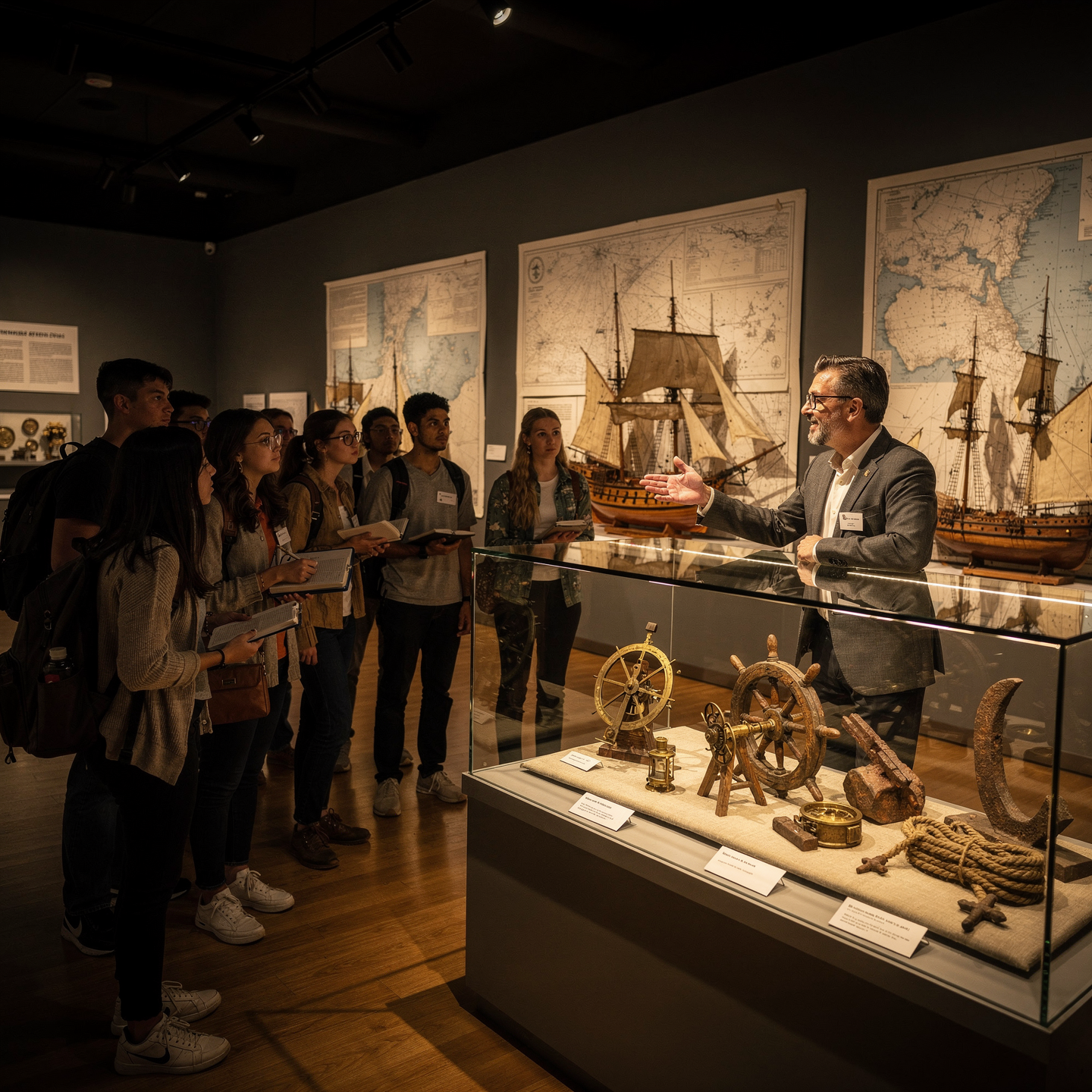
Diploma in Management of Maritime Museums and Exhibitions

Why this certificate program?

The Diploma in Maritime Museum and Exhibition Management

This program will provide you with the key tools to lead and transform museum spaces dedicated to maritime heritage. Learn to design impactful exhibitions, from conception to implementation, integrating the latest technologies and museographic trends. Master collection management, preventive conservation, and cultural marketing strategies to attract and retain your audience.

Differential Advantages

  • Practical Approach: Development of real-world projects and case studies of leading maritime museums.
  • Specialization: In-depth study of naval history, underwater archaeology, and maritime culture.
  • Networking: Direct contact with museum professionals and maritime heritage experts.
  • Digital Tools: Application of collection management software and creation of interactive content.
  • Comprehensive Vision: From strategic planning to evaluating the museum’s social and economic impact.
Gestión

Diploma in Management of Maritime Museums and Exhibitions

Availability: 1 in stock

Who is it aimed at?

  • Museum directors and curators who wish to deepen their knowledge of the management of nautical collections and innovative exhibition strategies.
  • Curators and exhibition designers interested in engaging maritime narratives, immersive space design, and interactive technologies.
  • Cultural heritage professionals seeking to specialize in the preservation and dissemination of maritime heritage.
  • Museum marketing and communications managers who want to increase visibility, attract new audiences, and build visitor loyalty.
  • Students and graduates in History, Art, Museology, and Tourism who aspire to a professional career in the field of maritime museums.

Flexibility Academic

Adapted for professionals and students: flexible online format, interactive discussion forums, and access to cutting-edge digital resources.

Gestión

Objectives and competencies

Directing and optimizing the visitor experience:

“Analyze feedback, adapt processes, and personalize interaction to exceed expectations.”

Cataloging and preserving maritime heritage:

“To thoroughly document artifacts, vessels, and traditions, implementing preventive and corrective conservation protocols.”

Develop and promote impactful exhibitions:

“With creativity and strategy, creating visual narratives that attract the public and generate emotional impact.”

Manage and ensure financial sustainability:

“Optimize budget management, controlling costs and maximizing the return on investment.”

Promote research and dissemination of maritime knowledge:

“Publish scientific articles and participate in international conferences on maritime safety and ocean sustainability.”

Establish collaborative networks and strategic alliances:

“Identify and contact potential partners, negotiate mutually beneficial agreements, and maintain open communication for joint projects.”

Curriculum - Modules

  1. Comprehensive Maritime Incident Management: protocols, roles, and chain of command for coordinated response
  2. Operational Planning and Execution: briefing, routes, weather windows, and go/no-go criteria
  3. Rapid Risk Assessment: criticality matrix, scene control, and decision-making under pressure
  4. Operational Communication: VHF/GMDSS, standardized reports, and inter-agency liaison
  5. Tactical Mobility and Safe Boarding: RHIB maneuvers, approach, mooring, and recovery
  6. Equipment and Technologies: PPE, signaling, satellite tracking, and field data logging
  7. Immediate Care of the Affected: primary assessment, hypothermia, trauma, and stabilization for evacuation
  8. Adverse Environmental Conditions: swell, Visibility, flows, and operational mitigation

    Simulation and training: critical scenarios, use of VR/AR, and exercises with performance metrics

    Documentation and continuous improvement: lessons learned, indicators (MTTA/MTTR), and SOP updates

  1. Introduction to nautical collections: typology and heritage value
  2. Constituent materials of nautical objects: wood, metal, textiles, paper
  3. Agents of deterioration: environmental, biological, chemical, and physical factors
  4. Preventive conservation: environmental control, packaging, handling, and storage
  5. Curative conservation: cleaning, consolidation, and restoration of nautical objects
  6. Documentation of collections: inventory, cataloging, and photographic record
  7. Exhibition planning: concept, script, and museographic design
  8. Exhibition installation: display cases, lighting, supports, and signage
  9. Accessibility: inclusive design adapted to different needs public
  10. Security of the collections on display: prevention of theft and damage

  1. Introduction to nautical collections: typologies and heritage value.
  2. Preventive conservation: environmental control, handling, and packaging.
  3. Nautical materials: wood, metal, textiles, paper, and their degradation.
  4. Museum exhibitions: design, lighting, installation, and accessibility.
  5. Heritage interpretation: narratives, audio guides, and educational resources.
  6. Sustainability in museums: energy efficiency, waste management, and responsible procurement.
  7. Legislation and ethics: intellectual property, looting, and repatriation.
  8. Digitization of collections: photography, cataloging, and online access.
  9. Risk management: emergency plans, security, and protection Fire protection.
  10. Case studies: maritime museums, interpretation centers, and best practices.

  1. Introduction to Maritime Collections: Types, Value, and Importance
  2. Cataloging I: ISAD(G), ISAAR(CPF), and MARC Formats
  3. Cataloging II: Archival Description of Documents, Objects, and Art
  4. Preventive Conservation: Environmental Control, Handling, and Packaging
  5. Curative Conservation: Basic Treatments for Paper, Textiles, and Metals
  6. Digitization: Standards, Metadata, and Digital Preservation
  7. Dissemination I: Exhibitions, Publications, and Educational Activities
  8. Dissemination II: Use of Social Media and Online Platforms
  9. Legislation and Ethics: Intellectual Property, Access, and Responsibility
  10. Risk Management and emergency plans for maritime collections

  1. Introduction to nautical collections: typology and historical value
  2. Constituent materials: wood, metal, textiles, paper, and their alterations
  3. Agents of deterioration: light, humidity, temperature, pollutants, and pests
  4. Preventive conservation: environmental control, packaging, handling, and storage
  5. Curative conservation: cleaning, consolidation, restoration, and reintegration
  6. Documentation: inventory, cataloging, photography, and digitization
  7. Exhibition: design, installation, lighting, and security
  8. Interpretation: scripts, panels, audiovisuals, and educational resources
  9. Dissemination: publications, social media, events, and guided tours
  10. Legislation and ethics professional in the conservation and dissemination of nautical heritage

  1. System Architecture and Components: Structural design, materials, and subsystems (mechanical, electrical, electronic, and fluid) with selection and assembly criteria for marine environments
  2. Fundamentals and Principles of Operation: Physical and engineering foundations (thermodynamics, fluid mechanics, electricity, control, and materials) that explain performance and operating limits
  3. Safety and Environmental (SHE): Risk analysis, PPE, LOTO, hazardous atmospheres, spill and waste management, and emergency response plans
  4. Applicable Regulations and Standards: IMO/ISO/IEC requirements and local regulations;
  5. Conformance criteria, certification, and best practices for operation and maintenance
  6. Inspection, testing, and diagnostics: Visual/dimensional inspection, functional testing, data analysis, and predictive techniques (vibration, thermography, fluid analysis) to identify root causes
  7. Preventive and predictive maintenance: Hourly/cycle/seasonal plans, lubrication, adjustments, calibrations, consumable replacement, post-service verification, and operational reliability
  8. Instrumentation, tools, and metrology: Measuring and testing equipment, diagnostic software, calibration and traceability; selection criteria, safe use, and storage
  9. Onboard integration and interfaces: Mechanical, electrical, fluid, and data compatibility; Sealing and watertightness, EMC/EMI, corrosion protection, and interoperability testing.

    Quality, acceptance testing, and commissioning: process and materials control, FAT/SAT, bench and sea trials, go/no-go criteria, and evidence documentation.

    Technical documentation and integrated practice: logs, checklists, reports, and a complete case study (safety → diagnosis → intervention → verification → report) applicable to any system.

  1. Introduction to Maritime Heritage: Definitions, typologies, and social value.
  2. Maritime History: Navigation, trade, exploration, and naval conflicts.
  3. Maritime Culture: Traditions, folklore, art, and music related to the sea.
  4. Underwater Archaeology: Methodology, excavation, conservation, and legislation.
  5. Historic Vessels: Types, construction, restoration, and maintenance.
  6. Maritime Museums: Types, functions, collection management, and audiences.
  7. Maritime Exhibitions: Design, installation, narrative, and accessibility.
  8. Conservation and Restoration: Materials, techniques, ethics, and documentation.
  9. Legislation and Protection: International conventions, national and regional laws.

    Maritime Heritage Management: Management plans, sustainability, and responsible tourism.

Career opportunities

  • Maritime Collections Manager: Cataloging, conservation, and documentation of objects and archives related to maritime history.
  • Maritime Exhibition Designer: Creating visual narratives and immersive experiences for exhibitions on maritime themes.
  • Maritime Museum Educator/Guide: Developing and facilitating educational programs and guided tours for diverse audiences.
  • Maritime Museum Communications and Marketing Manager: Promoting the museum and its activities through various channels.
  • Maritime Heritage Conservator/Restorer: Preserving and restoring historic vessels, naval artifacts, and other objects related to the sea.
  • Maritime History Researcher: Studying and analyzing documents, objects, and sites related to maritime history to enrich collections and exhibitions.
  • Consultant in Maritime Museum and Exhibition Management: advising public and private institutions on the planning, development, and management of maritime museums and exhibitions.
  • Event and Cultural Activities Manager in Maritime Museums: organizing special events, conferences, workshops, and other activities to attract visitors and promote interest in maritime history.

“`

Admission requirements

Academic/professional profile:

Degree/Bachelor's degree in Nautical Science/Maritime Transport, Naval/Marine Engineering, or a related field; or proven professional experience in bridge/operations.

Language proficiency:

Recommended functional maritime English (SMCP) for simulations and technical materials.

Documentation:

Updated resume, copy of degree or seaman's book, ID card/passport, letter of motivation.

Technical requirements (for online):

Equipment with camera/microphone, stable connection, ≄ 24ā€ monitor recommended for ECDIS/Radar-ARPA.

Admission process and dates

1. Online
application

(form + documents).

2. Academic review and interview

(profile/objectives/schedule compatibility).

3. Admission decision

(+ scholarship proposal if applicable).

4. Reservation of place

(deposit) and registration.

5. Induction

(access to campus, calendars, simulator guides).

Scholarships and grants

  • Master maritime storytelling: Learn to transform objects and stories into captivating exhibitions.
  • Comprehensive collection management: From preventive conservation to digitization and cataloging.
  • Exhibition design and installation: Create immersive experiences that connect with the public.
  • Cultural marketing and communication: Attract visitors and generate community impact.
  • Financing and sustainability: Ensure the economic viability of your museum.
Boost your career and lead the preservation of maritime heritage.

Testimonials

Frequently asked questions

Management of museums and exhibitions with a maritime theme.

Yes. The itinerary includes ECDIS/Radar-ARPA/BRM with harbor, ocean, fog, storm, and SAR scenarios.

Online with live sessions; hybrid option for simulator/practical placements through agreements.

Maritime museum sector, including professionals from museums, interpretation centers, aquariums, and other institutions related to maritime heritage.

Recommended functional SMCP. We offer support materials for standard phraseology.

Yes, with a relevant degree or experience in maritime/port operations. The admissions interview will confirm suitability.

Optional (3–6 months) through Companies & Collaborations and the Alumni Network.

Simulator practice (rubrics), defeat plans, SOPs, checklists, micro-tests and applied TFM.

A degree from Navalis Magna University + operational portfolio (tracks, SOPs, reports and KPIs) useful for audits and employment.

  1. Introduction to Maritime Heritage: Definition, Typologies, and Value
  2. Legislation and Regulations: International Treaties, National and Local Laws
  3. Research Methodologies: Underwater Archaeology, Documentary Sources, Oral History
  4. Curating Maritime Collections: Acquisition, Registration, Documentation, and Cataloging
  5. Preventive Conservation: Environmental Control, Packaging, and Handling of Objects
  6. Curative Conservation: Restoration Treatments, Materials, and Techniques
  7. Exhibitions and Museography: Design, Installation, Interpretation, and Accessibility
  8. Education and Outreach: Educational Programs, Guided Tours, Workshops, and Activities
  9. Risk Management: Emergency, Safety, and Security Plans
  10. Professional Ethics: Deontological Principles, Social Responsibility, and Sustainability

Request information

  1. Complete the Application Form.

  2. Attach your CV/degree certificate (if you have it to hand).

  3. Indicate your preferred cohort (January/May/September) and whether you would like the hybrid option with simulator sessions.

    An academic advisor will contact you within 24–48 hours to guide you through the admission process, scholarships, and compatibility with your professional schedule.

Please enable JavaScript in your browser to complete this form.
Click or drag a file to this area to upload.

Faculty

0
    0
    Tu carrito
    Tu carrito esta vacĆ­oRegresar a la tienda
    Scroll to Top


