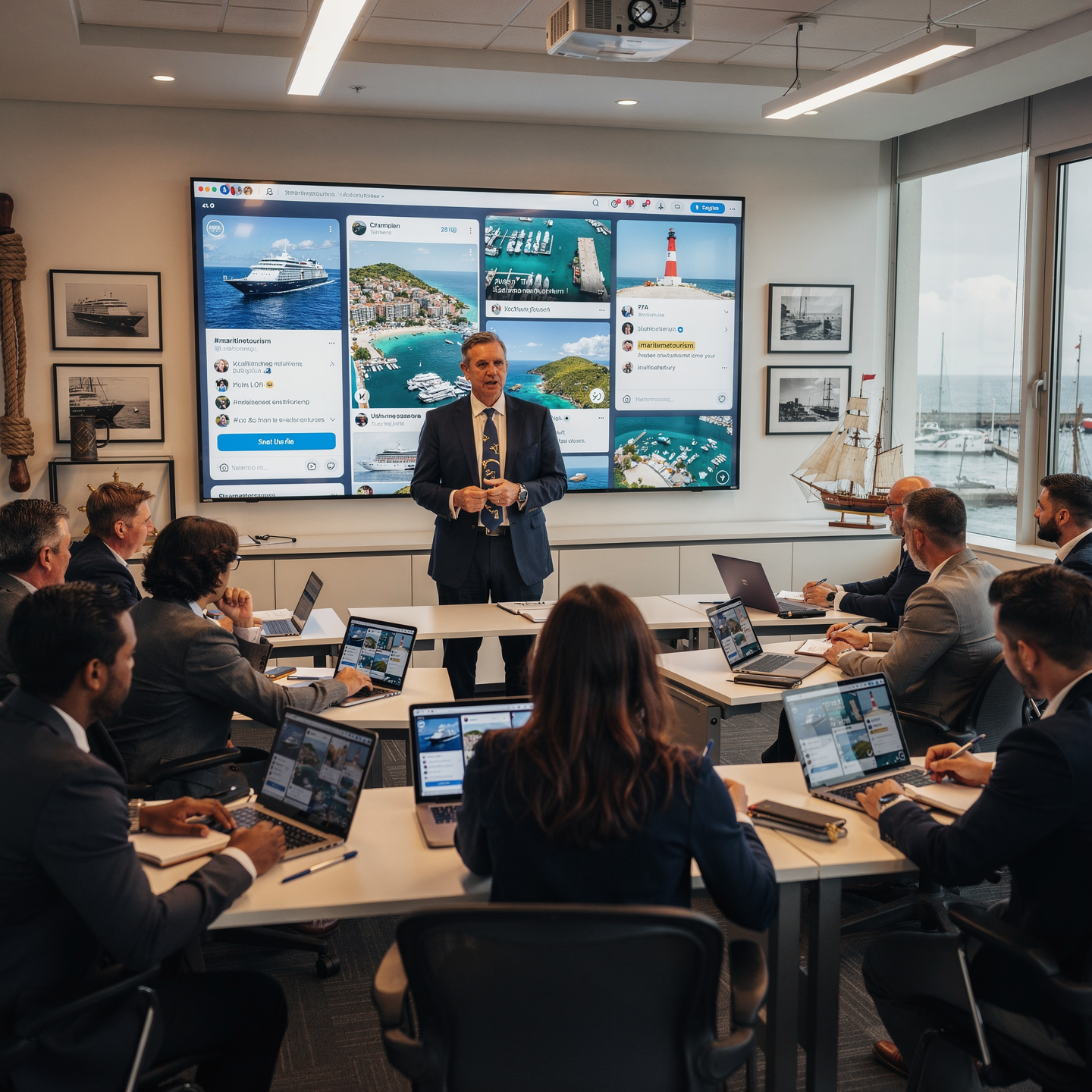
Diploma in Maritime Experience Sales Strategies
Why this certificate program?
The Diploma in Maritime Experience Sales Strategies
This program prepares you to master the art of marketing travel and adventures at sea. Learn to create irresistible proposals that connect with your clients’ emotions, from luxury cruises to diving expeditions and exclusive charters. Become an expert in consultative selling and boost your results in the maritime experiences market.
Key Benefits
- Market Segmentation: Identify and attract your ideal target audience for each type of maritime experience.
- Storytelling and Emotional Marketing: Learn to build compelling narratives that inspire your customers to set sail.
- Consultative Selling Techniques: Master the art of listening, understanding needs, and offering personalized solutions.
- Digital Distribution Channels: Optimize your online presence and use social media to generate leads and close sales.
- Customer Experience Management: Build customer loyalty by offering exceptional service before, during, and after their trip.
- Modality: Online
- Level: Diplomado
- Hours: 800 H
- Start date: 01-10-2026
Availability: 1 in stock
Who is it aimed at?
- Tourism professionals and travel agencies looking to differentiate their offerings with unique and memorable experiences at sea.
- Nautical sector entrepreneurs and tour operators who want to maximize their revenue and create high value-added products.
- Consultants and tourism marketing experts who need innovative tools and strategies for the maritime experiences market.
- Students and graduates in tourism, marketing, and business administration who aspire to specialize in a booming sector with great growth potential.
- Sea and adventure lovers with an entrepreneurial vision who want to turn their passion into a profitable and sustainable business.
Flexibility and Applicability
Adapted to your pace: 24/7 accessible online content, case studies, live sessions, and personalized support to boost your project.
Objectives and competencies

Transforming customers into nautical ambassadors:
Create personalized and memorable experiences that foster loyalty, positive word of mouth, and active brand advocacy within the nautical community.

Mastering the customization of maritime offers:
“Adapt the offer to the specific needs of the client (cargo, time, port) and optimize it based on market fluctuations.”

Maximize profitability on every trip sold:
Optimize pricing dynamically, considering demand, seasonality, variable costs, and competitor strategies.

Leading the innovative marketing of maritime services:
Develop differentiated value propositions, leveraging digitalization and sustainability, for specific market niches.
Efficiently manage after-sales service for maritime experiences:
“Resolve incidents, manage complaints, and propose solutions that maximize customer satisfaction and the company’s reputation.”

Developing persuasive negotiation skills in the nautical sector:
“Identify key interests of the parties, adapt communication strategies, and build mutually beneficial agreements in sales, contracts, and conflict resolution.”
Curriculum - Modules
- Comprehensive Maritime Incident Management: protocols, roles, and chain of command for coordinated response
- Operational Planning and Execution: briefing, routes, weather windows, and go/no-go criteria
- Rapid Risk Assessment: criticality matrix, scene control, and decision-making under pressure
- Operational Communication: VHF/GMDSS, standardized reports, and inter-agency liaison
- Tactical Mobility and Safe Boarding: RHIB maneuvers, approach, mooring, and recovery
- Equipment and Technologies: PPE, signaling, satellite tracking, and field data logging
- Immediate Care of the Affected: primary assessment, hypothermia, trauma, and stabilization for evacuation
- Adverse Environmental Conditions: swell, Visibility, flows, and operational mitigation
Simulation and training: critical scenarios, use of VR/AR, and exercises with performance metrics
Documentation and continuous improvement: lessons learned, indicators (MTTA/MTTR), and SOP updates
- Introduction to Customer Psychology in the Nautical Sector
- Neuroscience of Consumption: Biological Bases of Nautical Purchasing Decisions
- Psychographic Segmentation: Nautical Customer Profiles and Their Motivations
- Emotions and Experiences: The Role of Sensory Neuromarketing in the Nautical Industry
- Mental Triggers: Influence and Persuasion in the Sale of Nautical Products and Services
- Choice Architecture: Designing Effective Shopping Experiences in the Nautical Environment
- Storytelling and Emotional Branding: Creating Lasting Connections with Nautical Customers
- Digital Neuromarketing: Optimizing the Online Customer Experience nautical
Measurement and analysis: Neuromarketing metrics applied to the nautical sector
Ethics and responsibility in nautical neuromarketing
‘
- Introduction to consumer psychology and its relevance in the nautical sector.
- Psychographic profile of the nautical customer: motivations, values, lifestyle.
- Segmentation of the nautical market: demographic, geographic, behavioral, and psychographic criteria.
- Needs and desires of the nautical customer: from acquisition to after-sales experience.
- Decision-making process: influencing factors and stages in the purchase of nautical products/services.
- Nautical customer experience: design, management, and satisfaction measurement.
- Pricing psychology: pricing strategies and value perception in the nautical sector.
- Persuasive Communication: Techniques for Influencing the Decisions of Nautical Customers.
- Complaint Management and Conflict Resolution: Strategies for Maintaining Customer Loyalty.
- Current Trends in Nautical Consumer Psychology: Personalization, Sustainability, and Digitalization.
‘
- Introduction to Customer Psychology in Tourism: Tourist needs, motivations, and expectations.
- Tourism Segmentation: Geographic, demographic, psychographic, and behavioral criteria.
- Tourist Decision-Making Processes: Need recognition, information search, evaluation of alternatives, purchase, and post-purchase behavior.
- Tourist Perceptions and Attitudes: Influence of culture, prior experiences, and communication on attitude formation.
- Tourist Motivation: Motivation theories applied to tourism (Maslow, Herzberg, etc.).
- Tourist Personality and Lifestyles: Impact on tourism preferences and choices.
- Emotions in Tourism: The role of emotions in the tourist experience and customer loyalty.
Neuromarketing in Tourism: Application of neuromarketing techniques to better understand tourist responses.
Online Consumer Psychology in Tourism: Tourist behavior in digital environments and social networks.
Ethics in Customer Psychology and Tourism Segmentation: Ethical considerations in the research and application of psychological techniques.
‘
- Introduction to customer psychology in the nautical context: needs, motivations, and expectations
- Segmentation of nautical customers: demographic, psychographic, and behavioral profiles
- Customer experience (CX) in the nautical industry: definition, importance, and key components
- Customer-centered design of nautical services: methodologies and tools
- Emotions and experiences: the role of psychology in creating memorable moments on board
- Effective communication with nautical customers: active listening, empathy, and personalization
- Complaint management and conflict resolution: addressing difficult situations and exceeding expectations
- Customer loyalty Customers in the nautical sector: strategies and loyalty programs
Measuring and analyzing customer experience: key metrics and evaluation tools
Trends in customer psychology and CX applied to the design of innovative nautical experiences
‘
- System Architecture and Components: Structural design, materials, and subsystems (mechanical, electrical, electronic, and fluid) with selection and assembly criteria for marine environments
- Fundamentals and Principles of Operation: Physical and engineering foundations (thermodynamics, fluid mechanics, electricity, control, and materials) that explain performance and operating limits
- Safety and Environmental (SHE): Risk analysis, PPE, LOTO, hazardous atmospheres, spill and waste management, and emergency response plans
- Applicable Regulations and Standards: IMO/ISO/IEC requirements and local regulations;
- Conformance criteria, certification, and best practices for operation and maintenance
- Inspection, testing, and diagnostics: Visual/dimensional inspection, functional testing, data analysis, and predictive techniques (vibration, thermography, fluid analysis) to identify root causes
- Preventive and predictive maintenance: Hourly/cycle/seasonal plans, lubrication, adjustments, calibrations, consumable replacement, post-service verification, and operational reliability
- Instrumentation, tools, and metrology: Measuring and testing equipment, diagnostic software, calibration and traceability; selection criteria, safe use, and storage
- Onboard integration and interfaces: Mechanical, electrical, fluid, and data compatibility; Sealing and watertightness, EMC/EMI, corrosion protection, and interoperability testing.
Quality, acceptance testing, and commissioning: process and materials control, FAT/SAT, bench and sea trials, go/no-go criteria, and evidence documentation.
Technical documentation and integrated practice: logs, checklists, reports, and a complete case study (safety → diagnosis → intervention → verification → report) applicable to any system.
- Introduction to customer psychology in the nautical sector: needs, desires, and expectations.
- Segmentation of nautical customers: profiles, motivations, and lifestyles.
- Designing memorable nautical experiences: personalization, storytelling, and sensory experiences.
- Emotions and perception in nautical environments: safety, adventure, relaxation, and connection with nature.
- Effective communication with nautical customers: active listening, empathy, and expectation management.
- Psychology of decision-making in the purchase of nautical products and services: influences, biases, and heuristics.
- Creating perceived value in the nautical offering: quality, innovation, sustainability, and social responsibility.
- Managing customer satisfaction and loyalty in the nautical sector: surveys, feedback, and loyalty programs.
- The role of technology in the nautical customer experience: virtual reality, mobile applications, and onboard connectivity.
- Ethics and responsibility in the design of nautical experiences: respect for the environment, local culture, and customer well-being.
‘
Career opportunities
- Specialized Travel Agent: Design and marketing of customized maritime tour packages.
- Maritime Experience Consultant: Advising tourism companies on the creation of innovative products.
- Tourism Marketing Manager: Promoting maritime destinations and activities through various channels.
- Nautical Event Manager: Organizing regattas, festivals, and other maritime-related events.
- Nautical Products and Services Salesperson: Selling boats, equipment, and services to businesses and individuals.
- Sustainable Tourism Specialist: Developing tourism practices that are responsible towards the marine environment.
- Cruise Ship or Resort Entertainment Worker: Creating leisure and entertainment activities for passengers and guests.
- Digital Content Creator: Generating engaging content for blogs, social media, and online platforms about maritime experiences.
“`
Admission requirements

Academic/professional profile:
Degree/Bachelor's degree in Nautical Science/Maritime Transport, Naval/Marine Engineering, or a related field; or proven professional experience in bridge/operations.

Language proficiency:
Recommended functional maritime English (SMCP) for simulations and technical materials.

Documentation:
Updated resume, copy of degree or seaman's book, ID card/passport, letter of motivation.

Technical requirements (for online):
Equipment with camera/microphone, stable connection, ≥ 24” monitor recommended for ECDIS/Radar-ARPA.
Admission process and dates

1. Online
application
(form + documents).

2. Academic review and interview
(profile/objectives/schedule compatibility).

3. Admission decision
(+ scholarship proposal if applicable).

4. Reservation of place
(deposit) and registration.

5. Induction
(access to campus, calendars, simulator guides).
Scholarships and grants
- Master the Experience: Learn to design and market unique maritime experiences that captivate your clients.
- Emotional Connection: Discover how to forge a deep connection with travelers through memorable stories and experiences at sea.
- Strategic Sales: Implement effective sales techniques tailored to the maritime sector to maximize your results.
- Segmentation and Personalization: Identify your target audience and create customized offers that exceed their expectations.
- Digital Maritime Marketing: Use digital tools to promote your experiences and reach new markets.
Testimonials
This diploma program exceeded my expectations. The strategies I learned, especially those focused on selling personalized experiences and digital marketing for the maritime sector, allowed me to increase my company’s sales by 35% in just six months. The combination of theory and practical case studies proved invaluable for immediately applying what I learned and achieving concrete results.
The Diploma in Nautical Marketing & Tourism exceeded my expectations. I gained practical and up-to-date knowledge of digital marketing strategies, nautical business management, and the development of innovative tourism products. The tools and methodologies I learned allowed me to successfully implement a new marketing strategy in my company, achieving a 20% increase in online bookings in just three months. Furthermore, the network of contacts I established during the diploma program has been invaluable to my professional growth.
“This diploma program provided me with the tools and strategic knowledge to significantly boost sales at my maritime tourism company. I learned to design unique and engaging experiences, effectively segment my target market, and communicate the value of our services more precisely, resulting in a 25% increase in bookings in just six months. Furthermore, the network I built during the program has been invaluable to my professional development.”
This diploma program exceeded my expectations. The strategies I learned, especially those focused on digital marketing and creating personalized experience packages, allowed me to increase my charter company’s sales by 35% in just six months. Furthermore, the hands-on methodology and networking with other professionals in the industry were invaluable.

Frequently asked questions
Develop effective strategies for selling maritime experiences.
Yes. The itinerary includes ECDIS/Radar-ARPA/BRM with harbor, ocean, fog, storm, and SAR scenarios.
Online with live sessions; hybrid option for simulator/practical placements through agreements.
Tourism professionals, specifically those focused on selling maritime experiences, such as cruises, nautical activities, boat trips, etc.
Recommended functional SMCP. We offer support materials for standard phraseology.
Yes, with a relevant degree or experience in maritime/port operations. The admissions interview will confirm suitability.
Optional (3–6 months) through Companies & Collaborations and the Alumni Network.
Simulator practice (rubrics), defeat plans, SOPs, checklists, micro-tests and applied TFM.
A degree from Navalis Magna University + operational portfolio (tracks, SOPs, reports and KPIs) useful for audits and employment.
- Introduction to Customer Psychology: Needs, Desires, and Motivations in the Nautical Sector
- Neuroscience and Consumer Behavior: How the Brain Makes Purchasing Decisions
- Emotions and Sales: The Power of Emotional Connection in the Nautical Buying Experience
- Nautical Customer Profile: Segmentation, Lifestyles, and Expectations
- Persuasive Communication: Influence Techniques and Emotional Language in Sales
- Value Creation: How to Present Nautical Products/Services as Emotional Solutions
- Handling Objections: Turning Doubts into Opportunities for Emotional Connection
- Exceptional Customer Service: Generating Loyalty Through Memorable Experiences
- Emotional Closing Techniques: How to close the sale by appealing to the customer’s feelings and aspirations.
- Ethics and Psychology in Sales: The importance of honesty and integrity in building long-term relationships.
‘
Request information
Complete the Application Form.
Attach your CV/degree certificate (if you have it to hand).
Indicate your preferred cohort (January/May/September) and whether you would like the hybrid option with simulator sessions.
An academic advisor will contact you within 24–48 hours to guide you through the admission process, scholarships, and compatibility with your professional schedule.
Faculty
Eng. Tomás Riera
Full Professor
Eng. Tomás Riera
Full Professor
Eng. Sofía Marquina
Full Professor
Eng. Sofía Marquina
Full Professor
Eng. Javier Bañuls
Full Professor
Eng. Javier Bañuls
Full Professor
Dr. Nuria Llobregat
Full Professor
Dr. Nuria Llobregat
Full Professor
Dr. Pau Ferrer
Full Professor
Dr. Pau Ferrer
Full Professor
Cap. Javier Abaroa (MCA)
Full Professor
Cap. Javier Abaroa (MCA)
Full Professor