Diploma in Design of Recreational Activities for Cruise Ships
Why this certificate program?
The Diploma in Design of Recreational Activities for Cruise Ships
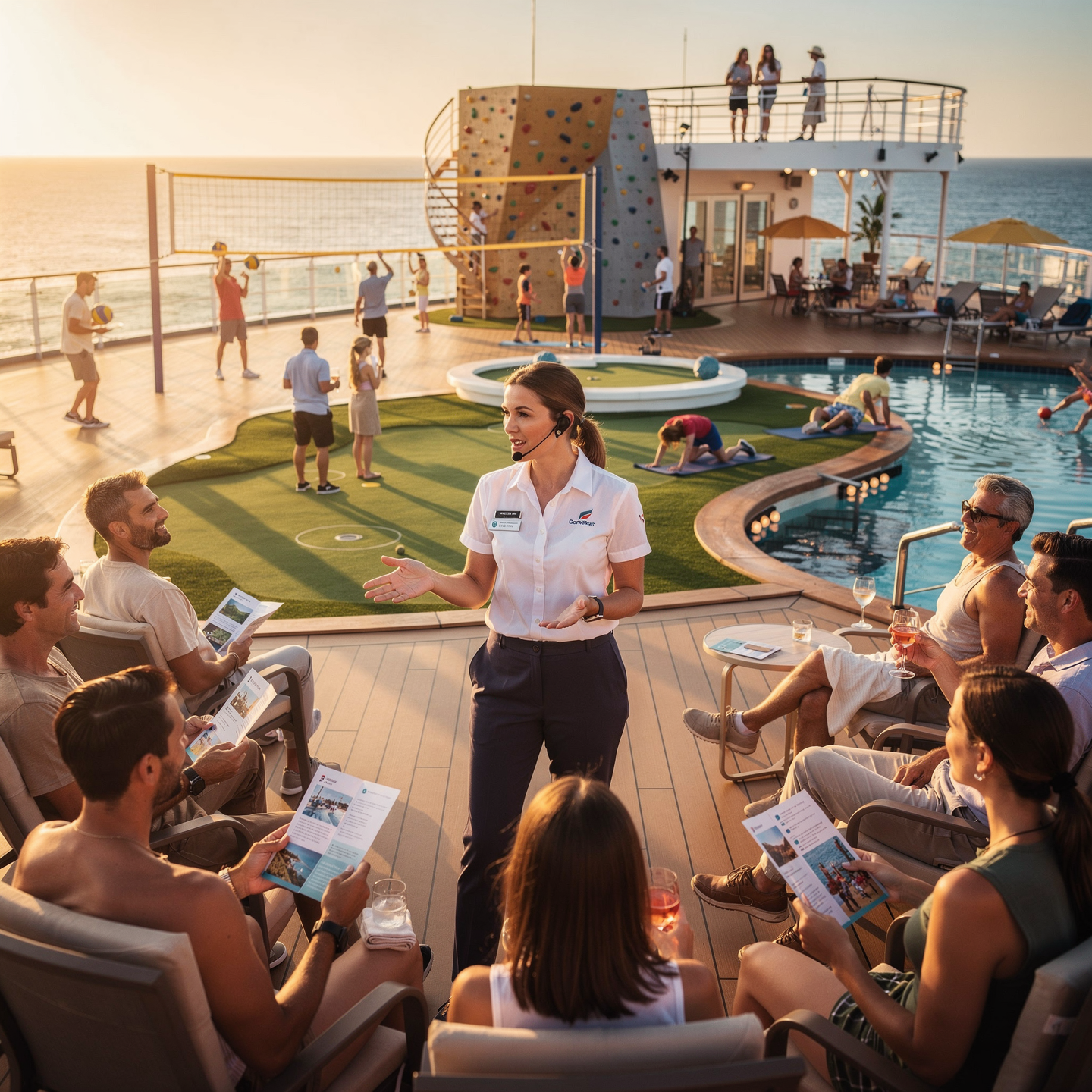
Immerse yourself in the dynamic world of onboard entertainment. Learn to conceptualize, plan, and execute unforgettable experiences for passengers of all ages and preferences. This program provides you with the tools to excel in the cruise industry, creating magical moments and building customer loyalty.
Differentiating Advantages
- Themed Experience Design: Create unique and personalized activities tailored to different cruises and destinations.
- Entertainment Team Management: Lead and motivate teams to deliver exceptional service and create a fun atmosphere.
- Trend Awareness: Stay up-to-date with the latest innovations in entertainment, from shows and games to sports and wellness activities.
- Communication and Marketing Skills: Promote your activities effectively and connect with passengers to ensure their participation.
- Professional Internships: Apply your knowledge to real-world projects and develop your portfolio to stand out in the job market.
- Modality: Online
- Level: Diplomado
- Hours: 800 H
- Start date: 01-10-2026
Availability: 1 in stock
Who is it aimed at?
- Tourism and entertainment professionals looking to specialize in the cruise sector and develop innovative activities.
- Students of tourism, recreation, and related fields who want to acquire practical skills to design memorable onboard experiences.
- Activity coordinators and supervisors who need to update their knowledge of the latest cruise entertainment trends.
- Tourism entrepreneurs and consultants interested in expanding their service portfolio with recreational offerings for the cruise industry.
- Cruise ship personnel with experience in other areas who aspire to advance professionally into roles in the design and management of recreational activities.
Flexibility and Applicability
Modular and practice-focused training: updated content, applicable projects, and networking with cruise industry experts.
Objectives and competencies

Creating memorable recreational experiences on board:
“Design innovative, personalized and safe activities that foster social interaction and exceed passenger expectations.”

Managing and energizing multicultural groups in maritime environments:
Promote effective communication and intercultural understanding by adapting leadership and mediation styles to the diverse nationalities, ranks, and roles present on board.

Adapting and applying innovative tourism animation techniques at sea:
Design and implement themed entertainment programs (cultural, sports, wellness) that integrate the destination experience, leveraging technology and digital platforms for interaction and personalization of the passenger experience.

Ensuring the safety and well-being of passengers during activities:
“To effectively manage emergency situations, applying standardized procedures and coordinating with available resources.”
Evaluate and optimize the quality of the recreational programs offered:
“Analyze user satisfaction through surveys and participation metrics, identifying areas for improvement and proposing adjustments to the design and execution of programs.”
Develop effective communication and leadership skills in nautical entertainment contexts:
“Managing teams, motivating passengers and resolving conflicts, conveying confidence and security in challenging situations.”
Curriculum - Modules
- Comprehensive Maritime Incident Management: protocols, roles, and chain of command for coordinated response
- Operational Planning and Execution: briefing, routes, weather windows, and go/no-go criteria
- Rapid Risk Assessment: criticality matrix, scene control, and decision-making under pressure
- Operational Communication: VHF/GMDSS, standardized reports, and inter-agency liaison
- Tactical Mobility and Safe Boarding: RHIB maneuvers, approach, mooring, and recovery
- Equipment and Technologies: PPE, signaling, satellite tracking, and field data logging
- Immediate Care of the Affected: primary assessment, hypothermia, trauma, and stabilization for evacuation
- Adverse Environmental Conditions: swell, Visibility, flows, and operational mitigation
Simulation and training: critical scenarios, use of VR/AR, and exercises with performance metrics
Documentation and continuous improvement: lessons learned, indicators (MTTA/MTTR), and SOP updates
- Introduction to Tourist Entertainment: Concept, Evolution, and Trends
- The Profile of the Nautical Tourist Entertainer: Skills, Competencies, and Professional Ethics
- Types of Nautical Events: Sports, Recreational, Cultural, and Corporate
- Strategic Planning of Nautical Events: Objectives, Target Audience, and Resources
- Designing Entertainment Programs: Activities, Schedules, and Budgets
- Communication and Group Animation Techniques in Nautical Environments
- Risk and Safety Management in Nautical Events
- Logistics and Coordination of Nautical Events: Suppliers, Permits, and Insurance
- Marketing and Promotion of Nautical Events: Online and Offline Strategies
- Evaluation and Monitoring of Events Nautical: indicators of success and continuous improvement
‘
- Introduction to Cruise Ship Recreation: History and Evolution
- The Cruise Ship as a Tourism Product: Typology, Segments, and Customer Expectations
- Group Facilitation: Basic Principles, Dynamics, and Communication Techniques
- Planning Recreational Activities: Design, Programming, and Evaluation
- Sports and Wellness Activities: Yoga, Fitness, Water Sports
- Cultural and Educational Activities: Workshops, Talks, Themed Excursions
- Shows and Evening Entertainment: Shows, Live Music, Themed Parties
- Resource Management and Logistics: Materials, Spaces, and Personnel
- Customer Service and Conflict Resolution: Communication and Empathy Skills
- Safety and Risk Prevention in Recreational Activities: Protocols and regulations.
‘
- Introduction to Cruise Ship Entertainment: History, Evolution, and Current Trends
- The Role of the Cruise Ship Entertainer: Skills, Competencies, and Professional Ethics
- Cruise Ship Passenger Types: Segmentation, Needs, and Expectations
- Design and Planning of Entertainment Programs: Daytime and Nighttime Activities
- Managing Onboard Events and Shows: Logistics, Resources, and Coordination
- Music and Ambiance: Music Selection, Sound Equipment, and Special Effects
- Water Sports and Activities: Organization, Safety, and Regulations
- Games and Contests: Design, Entertainment, and Prizes
- Excursions and Tours: Information, Promotion, and accompaniment.
- Evaluation of tourist entertainment: customer satisfaction, feedback, and continuous improvement.
‘
- Introduction to the Cruise Industry: History, evolution, and current landscape.
- The Role of the Cruise Ship Entertainment Leader: Functions, responsibilities, and key skills.
- Group Entertainment Techniques: Games, activities, themed activities, and contests.
- Planning Events and Recreational Activities: Program creation, time and resource management.
- Cruise Ship Protocol and Etiquette: Rules of courtesy, dress code, and social behavior.
- Effective Communication with Passengers from Different Cultures: Intercultural sensitivity, languages, and adaptation.
- Organizing and Managing Themed Events: Parties, galas, and special celebrations.
- Safety and Risk Prevention in Recreational Activities: First aid, risk management Emergencies and regulations.
Conflict management and problem resolution with passengers: Mediation techniques, empathy, and professionalism.
Professional development and career opportunities in the cruise industry: Networking, job searching, and personal growth.
‘
- System Architecture and Components: Structural design, materials, and subsystems (mechanical, electrical, electronic, and fluid) with selection and assembly criteria for marine environments
- Fundamentals and Principles of Operation: Physical and engineering foundations (thermodynamics, fluid mechanics, electricity, control, and materials) that explain performance and operating limits
- Safety and Environmental (SHE): Risk analysis, PPE, LOTO, hazardous atmospheres, spill and waste management, and emergency response plans
- Applicable Regulations and Standards: IMO/ISO/IEC requirements and local regulations;
- Conformance criteria, certification, and best practices for operation and maintenance
- Inspection, testing, and diagnostics: Visual/dimensional inspection, functional testing, data analysis, and predictive techniques (vibration, thermography, fluid analysis) to identify root causes
- Preventive and predictive maintenance: Hourly/cycle/seasonal plans, lubrication, adjustments, calibrations, consumable replacement, post-service verification, and operational reliability
- Instrumentation, tools, and metrology: Measuring and testing equipment, diagnostic software, calibration and traceability; selection criteria, safe use, and storage
- Onboard integration and interfaces: Mechanical, electrical, fluid, and data compatibility; Sealing and watertightness, EMC/EMI, corrosion protection, and interoperability testing.
Quality, acceptance testing, and commissioning: process and materials control, FAT/SAT, bench and sea trials, go/no-go criteria, and evidence documentation.
Technical documentation and integrated practice: logs, checklists, reports, and a complete case study (safety ā diagnosis ā intervention ā verification ā report) applicable to any system.
- Introduction to Cruise Ship Entertainment: History and Evolution
- Profile of the Cruise Ship Entertainment Worker: Skills, Competencies, and Qualities
- The Cruise Ship as a Tourism Product: Characteristics, Types, and Markets
- Onboard Protocol and Etiquette: Rules of Courtesy, Dress Code, and Behavior
- Planning Entertainment Activities: Design, Programming, and Execution
- Communication and Entertainment Techniques: Oral, Body Language, and Stage Performance
- Group Management and Conflict Resolution: Leadership, Empathy, and Mediation
- Welcome and Farewell Activities: Organization, Entertainment, and Protocol
- Cultural and Themed Entertainment: Design of Activities Related to Culture and History
- Regulations Safety and hygiene on board: risk prevention and first aid
‘
Career opportunities
- Cruise Ship Entertainer: Design and execution of recreational activities for passengers of all ages.
- Activities Coordinator: Planning, organization, and supervision of the onboard entertainment program.
- Themed Events Specialist: Creation and development of special events and themed parties.
- Children’s Activities Monitor: Care and entertainment of children and teenagers in recreational areas.
- Dance and Fitness Instructor: Teaching dance, yoga, Pilates, and other physical activities.
- Games and Contests Coordinator: Organization of games, contests, and tournaments for passengers.
- Shore Excursions Organizer: Assistance in the planning and execution of excursions and tourist activities.
- Support staff for recreational activities: General assistance in the preparation and execution of events and activities.
“`
Admission requirements

Academic/professional profile:
Degree/Bachelor's degree in Nautical Science/Maritime Transport, Naval/Marine Engineering, or a related field; or proven professional experience in bridge/operations.

Language proficiency:
Recommended functional maritime English (SMCP) for simulations and technical materials.

Documentation:
Updated resume, copy of degree or seaman's book, ID card/passport, letter of motivation.

Technical requirements (for online):
Equipment with camera/microphone, stable connection, ā„ 24ā monitor recommended for ECDIS/Radar-ARPA.
Admission process and dates

1. Online
application
(form + documents).

2. Academic review and interview
(profile/objectives/schedule compatibility).

3. Admission decision
(+ scholarship proposal if applicable).

4. Reservation of place
(deposit) and registration.

5. Induction
(access to campus, calendars, simulator guides).
Scholarships and grants
- Master the creation of unforgettable experiences: Learn to design innovative and engaging recreational activities for cruise passengers.
- Discover the latest trends in onboard entertainment: Explore the most successful dynamics and creative tools to surprise your customers.
- Develop team management and logistics skills: Acquire the necessary competencies to coordinate and execute high-impact recreational programs.
- Boost your career in the cruise industry: Earn a recognized diploma that will open doors to new professional opportunities in a constantly growing sector.
- Learn from industry experts and professionals: Interact with industry leaders and expand your network to enhance your professional development.
Testimonials
This diploma program exceeded my expectations. I acquired the skills and knowledge necessary to design innovative and engaging recreational experiences, specifically for the unique environment of a cruise ship. I was able to immediately apply what I learned to my work, increasing passenger satisfaction and receiving recognition for the quality and originality of the activities I implemented.
This diploma program provided me with the tools and knowledge necessary to design innovative and sustainable maritime experiences. I applied what I learned to the development of a new whale watching excursion, which increased customer satisfaction by 20% and reduced environmental impact by 15% in its first year of operation.
This diploma program exceeded my expectations. I acquired the skills and knowledge necessary to design innovative and engaging recreational experiences, specifically for the unique environment of a cruise ship. I was able to apply the methodology I learned to create my own activity program, which was praised by the instructors for its originality and feasibility. I feel fully prepared to embark on a career in the cruise industry.
This diploma program exceeded my expectations. I acquired the skills and knowledge necessary to design innovative and engaging recreational experiences, specifically for the unique environment of a cruise ship. I was able to immediately apply what I learned, securing a position as onboard entertainment coordinator, where I have successfully implemented several of the activities I designed during the course, receiving excellent feedback from both passengers and the company.
Frequently asked questions
Yes. The itinerary includes ECDIS/Radar-ARPA/BRM with harbor, ocean, fog, storm, and SAR scenarios.
Online with live sessions; hybrid option for simulator/practical placements through agreements.
For people interested in designing, planning and executing recreational activities on cruise ships, including entertainers, recreation specialists, cruise ship staff and entrepreneurs in the tourism sector.
Recommended functional SMCP. We offer support materials for standard phraseology.
Yes, with a relevant degree or experience in maritime/port operations. The admissions interview will confirm suitability.
Optional (3ā6 months) through Companies & Collaborations and the Alumni Network.
Simulator practice (rubrics), defeat plans, SOPs, checklists, micro-tests and applied TFM.
A degree from Navalis Magna University + operational portfolio (tracks, SOPs, reports and KPIs) useful for audits and employment.
- Fundamentals of Tourist Entertainment: History, Evolution, and Types.
- The Tourist Entertainer: Profile, Communication Skills, and Teamwork.
- Planning Entertainment Activities: Design, Programming, and Evaluation.
- Group Management: Facilitation Techniques, Conflict Resolution, and Leadership.
- Nautical Events: Types, Characteristics, and Particularities.
- Organizing Nautical Events: Stages, Resources, and Logistics.
- Safety at Nautical Events: Regulations, Risk Prevention, and First Aid.
- Marketing and Promotion of Nautical Events: Strategies, Channels, and Communication.
- Tourist Entertainment in the Environment Nautical: Water activities, sports, and games.
Tourism and nautical legislation: Rights and obligations, insurance, and licenses.
‘
Request information
Complete the Application Form.
Attach your CV/degree certificate (if you have it to hand).
Indicate your preferred cohort (January/May/September) and whether you would like the hybrid option with simulator sessions.
An academic advisor will contact you within 24ā48 hours to guide you through the admission process, scholarships, and compatibility with your professional schedule.
Faculty
Eng. TomƔs Riera
Full Professor
Eng. TomƔs Riera
Full Professor
Eng. SofĆa Marquina
Full Professor
Eng. SofĆa Marquina
Full Professor
Eng. Javier BaƱuls
Full Professor
Eng. Javier BaƱuls
Full Professor
Dr. Nuria Llobregat
Full Professor
Dr. Nuria Llobregat
Full Professor
Dr. Pau Ferrer
Full Professor
Dr. Pau Ferrer
Full Professor
Cap. Javier Abaroa (MCA)
Full Professor
Cap. Javier Abaroa (MCA)
Full Professor