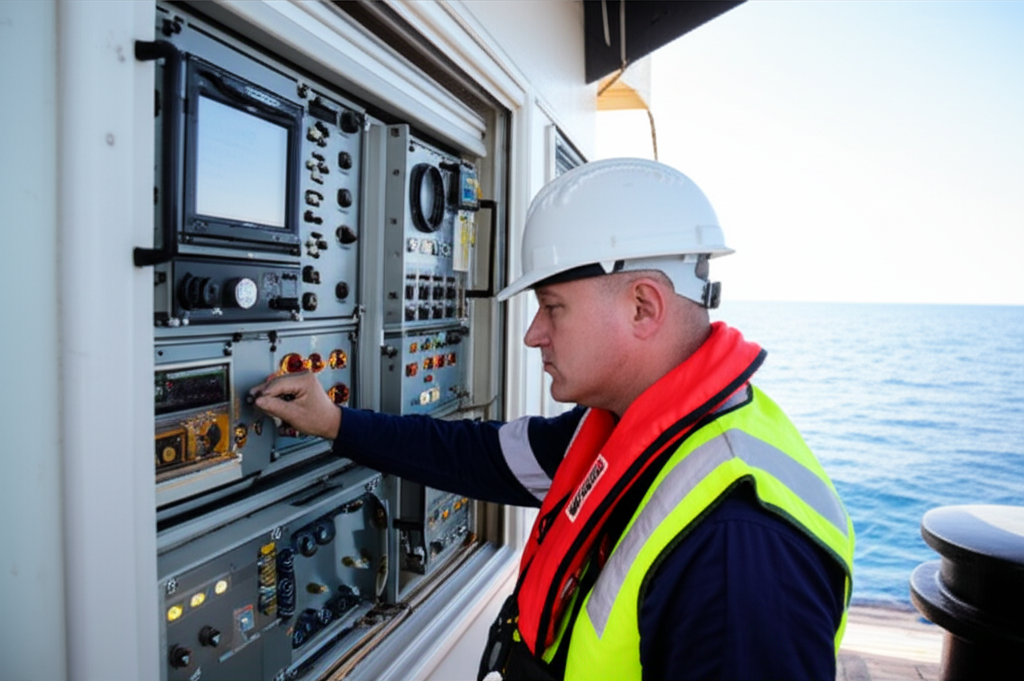
Diploma in Navigation and Control Electronics

Why this certificate program?

The Diploma in Navigation and Control Electronics

This program provides you with the essential skills for the installation, configuration, and maintenance of modern onboard electronic systems. Master the principles of maritime electronics, from navigation sensors and communication systems to the automatic control of engines and propellers. Gain in-depth knowledge of international regulations and best practices to ensure safety and efficiency at sea. This program prepares you to meet the challenges of current and future naval technology.

Differential Advantages

  • Practical Approach: Learning based on real-world cases and simulations of common failures.
  • Diagnostic Tools: Use of testing equipment and analysis software for troubleshooting.
  • Connectivity and Networks: Understanding communication protocols and systems integration.
  • Sustainability: Study of emerging technologies in electronics for more efficient and environmentally friendly navigation.
  • Certification: Obtain a recognized diploma that boosts your career in the maritime sector.
Electrónica

Diploma in Navigation and Control Electronics

Availability: 1 in stock

Who is it aimed at?

  • Technicians and Engineers seeking to specialize in the installation, configuration, and maintenance of electronic navigation equipment.
  • Merchant Marine Officers interested in deepening their knowledge of ECDIS, radar, AIS, and communications systems, optimizing safety and efficiency in navigation.
  • Electronic and Naval Engineering Students wishing to complement their academic training with a practical approach to cutting-edge technologies for the maritime sector.
  • Technical support staff from shipping companies requiring updates and certification in the latest navigation regulations and technologies.
  • Professionals from maritime service companies seeking to expand their offerings to include the installation and maintenance of electronic navigation equipment and control.

Flexibility
 Designed for professionals: asynchronous online modality, 24/7 access to materials and personalized tutoring.

Electrónica

Objectives and competencies

Diagnose and resolve faults in electronic navigation systems.

“Identify the root cause using diagrams, manuals, and diagnostic software.”

Integrate and calibrate electronic maritime navigation equipment:

Interpret technical manuals, perform functional tests and adjust parameters to optimize equipment performance according to manufacturer specifications and current regulations.

Manage the operation and maintenance of naval electronic control systems:

“Supervise the proper functioning of the equipment, interpreting manuals and detecting anomalies to guarantee the operability of the vessel.”

Apply current regulations on maritime safety and communications:

“Use the GMDSS to ensure the safety of human life at sea, including sending distress alerts and coordinating search and rescue operations.”

Optimize the energy efficiency of on-board electronic systems:

Implement energy management strategies, monitoring consumption in real time and adjusting demand according to operational needs and security priorities.

Develop and implement automation solutions for onboard processes:

Integrate optimized control systems, considering cybersecurity and redundancy to ensure operational continuity.

Curriculum - Modules

  1. Comprehensive Maritime Incident Management: protocols, roles, and chain of command for coordinated response
  2. Operational Planning and Execution: briefing, routes, weather windows, and go/no-go criteria
  3. Rapid Risk Assessment: criticality matrix, scene control, and decision-making under pressure
  4. Operational Communication: VHF/GMDSS, standardized reports, and inter-agency liaison
  5. Tactical Mobility and Safe Boarding: RHIB maneuvers, approach, mooring, and recovery
  6. Equipment and Technologies: PPE, signaling, satellite tracking, and field data logging
  7. Immediate Care of the Affected: primary assessment, hypothermia, trauma, and stabilization for evacuation
  8. Adverse Environmental Conditions: swell, Visibility, flows, and operational mitigation

    Simulation and training: critical scenarios, use of VR/AR, and exercises with performance metrics

    Documentation and continuous improvement: lessons learned, indicators (MTTA/MTTR), and SOP updates

  1. Fundamentals of radar systems: principles, components, types
  2. Radar antennas: characteristics, radiation patterns, polarization
  3. Radar signal processing: detection, filtering, clutter suppression
  4. Radar indicators: PPI, A-Scope, B-Scope, information interpretation
  5. Radar performance: range, resolution, accuracy, factors affecting it
  6. Identification of Target (IFF) systems: principles, operation, applications
  7. Navigation aids: radio beacons, radio beacons, positioning systems
  8. Instrument landing systems (ILS): principles, components, procedures
  9. Air navigation systems: VOR, DME, TACAN, operation, limitations
  10. Maintenance and calibration of radar systems and navigation aids

  1. Introduction to Advanced Electronic Navigation Systems: Evolution and Trends
  2. Advanced Sensors: IMU, DVL, Doppler Radar, Laser Scanners
  3. Multisensor Data Integration: Kalman Filtering, Sensor Fusion
  4. Inertial Navigation: Principles, Errors, and Compensation
  5. Underwater Positioning Systems (USBL, LBL, SBL): Principles and Applications
  6. 3D Mapping and Environmental Models: Generation and Use in Navigation
  7. Autonomous Route Planning: Algorithms and Optimization
  8. Control and Tracking of Autonomous Vehicles: Architectures and Protocols
  9. Navigation in Complex Environments: Obstacles, Currents, Restricted Areas
  10. Advanced cybersecurity in electronic navigation systems

  1. Radar Fundamentals: Principles of operation, types of radar (primary, secondary), frequency, and bandwidth.
  2. Radar System Components: Transmitter, receiver, antenna, display, signal processor.
  3. Radar Tuning and Optimization: Gain, clutter suppression (rain, sea), tuning, and range.
  4. Radar Image Interpretation: Target identification, false echoes, atmospheric and geographic effects.
  5. Introduction to ARPA: Principles of operation, automatic and manual target acquisition.
  6. TARGET TRACKING with ARPA: Velocity vectors, CPA (Closest Point of Approach), TCPA (Time to Closest Point of Approach).
  7. Risk Analysis
  8. and Avoidance Maneuvers: Situation assessment, calculation of headings and speeds to avoid collisions.

    Using ARPA in Different Conditions: Reduced visibility, heavy traffic, coastal navigation.

    Integrating Radar/ARPA with Other Navigation Systems: ECDIS, AIS, GNSS.

    Limitations of Radar and ARPA: Errors, sources of interference, dependence on configuration and calibration.

  1. Introduction to Marine Electronic Systems: Evolution and Importance
  2. Fundamentals of Electricity and Electronics: Circuits, Components, and Measurements
  3. Marine Sensors: Types, Operating Principles, and Applications (Position, Speed, Depth, etc.)
  4. Marine Communication Systems: VHF, MF/HF, Satellite (Inmarsat, Iridium)
  5. Electronic Navigation Systems: GNSS, ECDIS, Radar, AIS
  6. Onboard Network Architecture: Data Buses (NMEA 0183/2000), Ethernet
  7. Automation and Control: Monitoring Systems, Alarms, and Machinery Control
  8. Electric Propulsion Systems: Concepts, Advantages, and Disadvantages.
  9. Integration of marine electronic systems and their impact on safety.
  10. Maintenance and troubleshooting of marine electronic systems.

  1. System Architecture and Components: Structural design, materials, and subsystems (mechanical, electrical, electronic, and fluid) with selection and assembly criteria for marine environments
  2. Fundamentals and Principles of Operation: Physical and engineering foundations (thermodynamics, fluid mechanics, electricity, control, and materials) that explain performance and operating limits
  3. Safety and Environmental (SHE): Risk analysis, PPE, LOTO, hazardous atmospheres, spill and waste management, and emergency response plans
  4. Applicable Regulations and Standards: IMO/ISO/IEC requirements and local regulations;
  5. Conformance criteria, certification, and best practices for operation and maintenance
  6. Inspection, testing, and diagnostics: Visual/dimensional inspection, functional testing, data analysis, and predictive techniques (vibration, thermography, fluid analysis) to identify root causes
  7. Preventive and predictive maintenance: Hourly/cycle/seasonal plans, lubrication, adjustments, calibrations, consumable replacement, post-service verification, and operational reliability
  8. Instrumentation, tools, and metrology: Measuring and testing equipment, diagnostic software, calibration and traceability; selection criteria, safe use, and storage
  9. Onboard integration and interfaces: Mechanical, electrical, fluid, and data compatibility; Sealing and watertightness, EMC/EMI, corrosion protection, and interoperability testing.

    Quality, acceptance testing, and commissioning: process and materials control, FAT/SAT, bench and sea trials, go/no-go criteria, and evidence documentation.

    Technical documentation and integrated practice: logs, checklists, reports, and a complete case study (safety → diagnosis → intervention → verification → report) applicable to any system.

  1. Fundamentals of radar systems: principles, components, types.
  2. Radio wave propagation theory: factors affecting range and accuracy.
  3. Radar antennas: design, directivity, polarization, and scanning techniques.
  4. Radar signal processing: detection, filtering, and clutter suppression.
  5. Radar indicators: display types and information interpretation.
  6. Navigation aid systems: NDB, VOR, DME, ILS.
  7. Global positioning systems (GNSS): GPS, GLONASS, Galileo, BeiDou, and their applications in air and maritime navigation.
  8. Operation and maintenance of radar equipment and navigation aids.
  9. Applicable regulations and standards to radar systems and navigation aids.
  10. Calibration and adjustment techniques for radar systems and navigation aids.

Career opportunities

  • Electronic Navigation Systems Maintenance Technician: Diagnosis and repair of equipment such as radars, GPS, ECDIS, and communication systems.
  • Electronic Navigation Equipment Installer: Assembly and configuration of electronic systems on new and existing vessels.
  • Navigation Systems Software Programmer/Developer: Creation and improvement of applications for navigation control and monitoring.
  • Marine Electronics Technical Consultant: Advising companies and individuals on the selection, use, and maintenance of electronic navigation equipment.
  • Electronic Navigation Equipment Technical Inspector: Verification of compliance with regulations and standards for onboard electronics.
  • Marine Electronics Companies Support Technician: Customer service, troubleshooting, and training on equipment use.
  • Salesperson/Retailer of Electronic Navigation Equipment: Promotion and sale of electronic navigation products to businesses and individuals.
  • Instructor/Trainer in Electronic Navigation Equipment: Delivery of courses and workshops on the use and maintenance of electronic equipment.

“`

Admission requirements

Academic/professional profile:

Degree/Bachelor's degree in Nautical Science/Maritime Transport, Naval/Marine Engineering, or a related field; or proven professional experience in bridge/operations.

Language proficiency:

Recommended functional maritime English (SMCP) for simulations and technical materials.

Documentation:

Updated resume, copy of degree or seaman's book, ID card/passport, letter of motivation.

Technical requirements (for online):

Equipment with camera/microphone, stable connection, ≥ 24” monitor recommended for ECDIS/Radar-ARPA.

Admission process and dates

1. Online
application

(form + documents).

2. Academic review and interview

(profile/objectives/schedule compatibility).

3. Admission decision

(+ scholarship proposal if applicable).

4. Reservation of place

(deposit) and registration.

5. Induction

(access to campus, calendars, simulator guides).

Scholarships and grants

  • Advanced Electronics: Master the latest generation of maritime navigation, communication, and control systems.
  • Naval Instrumentation: Delve into the operation and maintenance of radars, GPS, depth sounders, and automation equipment.
  • Simulation and Practice: Apply your knowledge in realistic simulated environments, optimizing decision-making on board.
  • Regulations and Safety: Understand current legislation and protocols for safe and efficient navigation.
  • Professional Certification: Obtain a recognized diploma that will boost your career in the maritime sector.
Prepare for the challenges of the Modern navigation with comprehensive and cutting-edge training.

Testimonials

Frequently asked questions

Yes. The itinerary includes ECDIS/Radar-ARPA/BRM with harbor, ocean, fog, storm, and SAR scenarios.

Online with live sessions; hybrid option for simulator/practical placements through agreements.

Recommended functional SMCP. We offer support materials for standard phraseology.

Yes, with a relevant degree or experience in maritime/port operations. The admissions interview will confirm suitability.

Optional (3–6 months) through Companies & Collaborations and the Alumni Network.

Simulator practice (rubrics), defeat plans, SOPs, checklists, micro-tests and applied TFM.

A degree from Navalis Magna University + operational portfolio (tracks, SOPs, reports and KPIs) useful for audits and employment.

1. System Definition and Operational Requirements

2. Electronic Architecture and Onboard Network Topology

3. Selection and Integration of Navigation and Attitude Sensors

4. Control Integration: Autopilot, Steering, and Actuators

5. Power Supply, Protections, and Electromagnetic Compatibility

6. Software Configuration, Parameters, and Calibrations

7. Test Plan (FAT/SAT) and Commissioning procedures

8. Troubleshooting and fault resolution

9. Cybersecurity, hardening, and change management

10. Final delivery: technical documentation and sea trial

Request information

  1. Complete the Application Form.

  2. Attach your CV/degree certificate (if you have it to hand).

  3. Indicate your preferred cohort (January/May/September) and whether you would like the hybrid option with simulator sessions.

    An academic advisor will contact you within 24–48 hours to guide you through the admission process, scholarships, and compatibility with your professional schedule.

Please enable JavaScript in your browser to complete this form.
Click or drag a file to this area to upload.

Faculty

0
    0
    Tu carrito
    Tu carrito esta vacíoRegresar a la tienda
    Scroll to Top


