Diploma in Restoration of Historic Vessels
Why this certificate program?
The Diploma in Historic Vessel Restoration
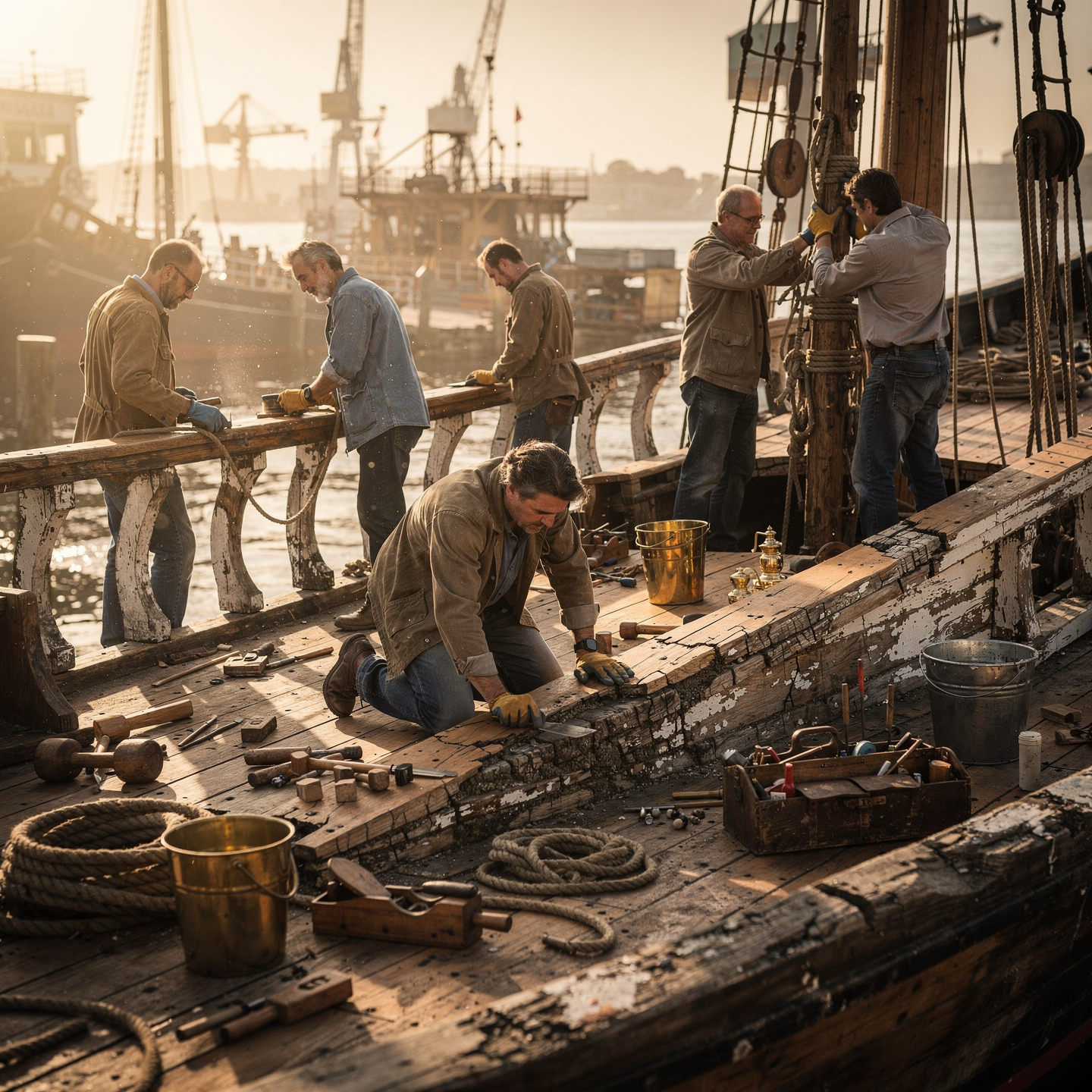
Immerse yourself in the fascinating world of maritime heritage preservation. Learn ancestral techniques and modern methodologies to revitalize vessels of historical value, combining a passion for traditional boatbuilding with the rigor of conservation. This program provides you with the skills necessary to diagnose, plan, and execute restoration projects, from identifying original materials to applying innovative protective treatments.
Differential Advantages
- Mastery of Traditional Techniques: boatbuilding, caulking, rigging, and sailmaking.
- Conservation of Original Materials: identification, treatment, and respectful replacement.
- Use of Modern Technology: 3D scanning, computer-aided design, and innovative materials.
- Intensive Practice: real-world restoration projects under expert supervision.
- Connection with the Community: visits to historic shipyards, maritime museums, and networking with industry professionals.
- Modality: Online
- Level: Diplomado
- Hours: 800 H
- Start date: 30-09-2026
Availability: 1 in stock
Who is it aimed at?
- Shipwrights and master craftsmen who wish to specialize in traditional techniques for repairing and conserving wooden boats.
- Professionals in the nautical sector (shipyards, slipways) who seek to expand their services by offering restoration of classic and heritage vessels.
- Owners of historic boats who yearn to restore the original splendor of their vessels using appropriate methods and materials.
- Students of Fine Arts, Art History, and Conservation-Restoration interested in maritime heritage and the particularities of naval timbers.
- Enthusiasts of classic sailing and shipbuilding who aspire to master the skills necessary to Restore your own boats.
Learning flexibility
Adapted to your schedule: online format with live classes, 24/7 access to multimedia materials, and personalized tutoring to answer your questions.
Objectives and competencies

Mastering traditional boatbuilding techniques:
“Perform complex hand joinery (mortise and tenon, dovetail joints) and select the appropriate wood according to its grain and resistance to moisture.”

Diagnosing and solving structural problems in wooden boats:
“Assess damage, select appropriate repair techniques (replacement, grafts, reinforcements) and ensure structural integrity with materials and methods that conform to standards.”

Apply conservation and restoration criteria that respect naval heritage:
“Using compatible materials and techniques, documenting each intervention, and prioritizing reversibility.”

Managing naval restoration projects:
“Define the scope of the project, prioritizing the preservation of historical value and technical/economic feasibility.”
Adapting historic vessels to new uses without compromising their authenticity:
Employ reversible and documented restoration materials and techniques, prioritizing the comprehensive conservation of the original vessel.
Selecting and using appropriate materials for the restoration of historic vessels:
“Considering authenticity, compatibility with original materials, and long-term durability.”
Curriculum - Modules
- Comprehensive Maritime Incident Management: protocols, roles, and chain of command for coordinated response
- Operational Planning and Execution: briefing, routes, weather windows, and go/no-go criteria
- Rapid Risk Assessment: criticality matrix, scene control, and decision-making under pressure
- Operational Communication: VHF/GMDSS, standardized reports, and inter-agency liaison
- Tactical Mobility and Safe Boarding: RHIB maneuvers, approach, mooring, and recovery
- Equipment and Technologies: PPE, signaling, satellite tracking, and field data logging
- Immediate Care of the Affected: primary assessment, hypothermia, trauma, and stabilization for evacuation
- Adverse Environmental Conditions: swell, Visibility, flows, and operational mitigation
Simulation and training: critical scenarios, use of VR/AR, and exercises with performance metrics
Documentation and continuous improvement: lessons learned, indicators (MTTA/MTTR), and SOP updates
- Introduction to Classical Shipbuilding: History, Evolution, and Current Relevance
- Traditional Materials: Selection, Properties, and Preparation of Hardwoods (teak, mahogany, cedar).
- Hand Tools: Use, Maintenance, and Sharpening of Planes, Gouges, Chisels, Saws, and Rasps.
- Classic Joints: mortise and tenon joints, half-lap joints, dovetail joints, and biscuit joints.
- Frame Construction: Layout, cutting, assembly, and placement in the ship’s structure.
- Hulal Planking: Cleatsling, plain planking, and double planking techniques.
- Traditional Caulking: Tow preparation, application, and sealing with pitch or putty.
- Deck Construction: planking, caulking, and joint sealing.
- Finishes and Varnishes: surface preparation, application of traditional and modern marine varnishes.
- Repair and Restoration of Classic Vessels: diagnosis, replacement techniques, and conservation.
‘
- Introduction to Shipbuilding: History, Evolution, and Traditional Materials
- Hardwoods: Identification, Properties, Selection, and Treatment for Naval Use
- Hand Tools: Use, Maintenance, and Sharpening of Traditional Shipbuilding Tools
- Construction of Frames and Floors: Assembly and Fitting Techniques
- Hulus Planking: Clintle, Planking, and Lashing Methods
- Caulking: Materials, Techniques, and Tools for Sealing Joints
- Joints and Assembly: Dovetails, Biscuits, and Other Types of Joints Used in Shipbuilding
- Surface Finishes: Sanding, Polishing, Varnishing, and Painting of wooden surfaces.
- Introduction to the restoration of wooden boats: damage diagnosis, repair, and conservation.
- Safety and hygiene regulations in the traditional boatbuilding workshop.
‘
- Introduction to Shipbuilding: History, Materials, and Tools
- Identification and Selection of Naval Timbers: Types, Properties, and Treatments
- Design and Planning of Naval Elements: Blueprint Interpretation, Layout, and Parts Breakdown
- Traditional Assembly Techniques: Half-Lap Joints, Tongue and Groove, and Dowel Joints
- Construction of Basic Naval Structures: Frames, Keel, Stem, and Sternpost
- Hulal Planking: Guttering, Cleats, and Plain Planking Techniques
- Caulking and Battening: Sealing and Waterproofing of Joints
- Introduction to Finishes
Marine: Surface preparation, sanding, and polishing.
Application of Marine Primers and Paints: Types, techniques, and protection systems.
Maintenance and Repair of Wooden Elements on Vessels: Diagnosis, repair, and replacement.
‘
- Introduction to traditional boatbuilding: history, materials, and tools.
- Identification and selection of woods: characteristics, durability, and specific uses.
- Traditional hand tools: handling, sharpening, and maintenance.
- Layout and templates: creating patterns for curved and complex pieces.
- Traditional joints: tenon, mortise, half-lap, and others.
- Bending wood: steam and fire techniques.
- Caulking: materials and techniques for sealing joints.
- Traditional finishes: oils, natural varnishes, and hand-painted finishes.
- Repair and restoration of wooden boats.
- Safety and hygiene in the traditional boatbuilding workshop.
‘
- System Architecture and Components: Structural design, materials, and subsystems (mechanical, electrical, electronic, and fluid) with selection and assembly criteria for marine environments
- Fundamentals and Principles of Operation: Physical and engineering foundations (thermodynamics, fluid mechanics, electricity, control, and materials) that explain performance and operating limits
- Safety and Environmental (SHE): Risk analysis, PPE, LOTO, hazardous atmospheres, spill and waste management, and emergency response plans
- Applicable Regulations and Standards: IMO/ISO/IEC requirements and local regulations;
- Conformance criteria, certification, and best practices for operation and maintenance
- Inspection, testing, and diagnostics: Visual/dimensional inspection, functional testing, data analysis, and predictive techniques (vibration, thermography, fluid analysis) to identify root causes
- Preventive and predictive maintenance: Hourly/cycle/seasonal plans, lubrication, adjustments, calibrations, consumable replacement, post-service verification, and operational reliability
- Instrumentation, tools, and metrology: Measuring and testing equipment, diagnostic software, calibration and traceability; selection criteria, safe use, and storage
- Onboard integration and interfaces: Mechanical, electrical, fluid, and data compatibility; Sealing and watertightness, EMC/EMI, corrosion protection, and interoperability testing.
Quality, acceptance testing, and commissioning: process and materials control, FAT/SAT, bench and sea trials, go/no-go criteria, and evidence documentation.
Technical documentation and integrated practice: logs, checklists, reports, and a complete case study (safety ā diagnosis ā intervention ā verification ā report) applicable to any system.
- Introduction to traditional boatbuilding: history, evolution, and traditional materials.
- Identification and selection of woods: characteristics, properties, and uses in shipbuilding.
- Tools and equipment: handling, maintenance, and sharpening of hand and power tools.
- Traditional joinery techniques: butt joints, tongue and groove, half-lap, and tenon joints.
- Bending wood: steam, heat, and rolling methods for structural and ornamental elements.
- Caulking: materials, techniques, and tools to ensure watertightness of the hull.
- Structural construction: frames, floor timbers, beams, and hull planking.
- Fitting and finishing of parts: sanding, brushing, polishing, and application of protective coatings and varnishes.
Repair and restoration: damage assessment, replacement of components, and conservation of naval heritage.
Workshop safety: regulations, protective equipment, and prevention of occupational hazards.
‘
Career opportunities
- Restorer of Historic Vessels: diagnosis, planning, and execution of restoration, conservation, and maintenance projects.
- Specialized Shipwright: construction and repair of wooden structures on traditional vessels.
- Naval Cabinetmaker: design and manufacture of furniture and decorative elements for the interiors of classic vessels.
- Specialized Naval Painter: surface preparation and application of traditional paints and varnishes.
- Naval Rigger: design, manufacture, and maintenance of rigging and rigging for classic sailing ships.
- Mast Builder: construction and repair of wooden masts for historic vessels.
- Researcher and Documentalist: collection and analysis of information on historic vessels, construction techniques, and materials.
- Naval Heritage Consultant: Advising museums, institutions, and private owners on the conservation and restoration of historic vessels.
- Restoration Project Manager: Planning, coordinating, and supervising restoration projects for historic vessels.
- Naval Craftsman: Manufacturing scale or full-size replicas of historic vessels.
“`
Admission requirements

Academic/professional profile:
Degree/Bachelor's degree in Nautical Science/Maritime Transport, Naval/Marine Engineering, or a related field; or proven professional experience in bridge/operations.

Language proficiency:
Recommended functional maritime English (SMCP) for simulations and technical materials.

Documentation:
Updated resume, copy of degree or seaman's book, ID card/passport, letter of motivation.

Technical requirements (for online):
Equipment with camera/microphone, stable connection, ā„ 24ā monitor recommended for ECDIS/Radar-ARPA.
Admission process and dates

1. Online
application
(form + documents).

2. Academic review and interview
(profile/objectives/schedule compatibility).

3. Admission decision
(+ scholarship proposal if applicable).

4. Reservation of place
(deposit) and registration.

5. Induction
(access to campus, calendars, simulator guides).
Scholarships and grants
- Advanced Techniques: Master traditional boatbuilding, caulking, and period nautical finishes.
- Materials and Conservation: Learn about the selection and treatment of woods, metals, and textiles for lasting restoration.
- Legislation and Heritage: Understand the legal framework for the protection of maritime heritage and best practices in documentation.
- Case Studies: Apply your knowledge to real-world projects, from initial assessment to final vessel delivery.
- Networking: Connect with experts, shipyards, and owners, expanding your opportunities in the industry.
Testimonials
This diploma program exceeded my expectations. I gained in-depth theoretical and practical knowledge, from historical research and documentation to traditional boatbuilding techniques and materials conservation. The hands-on experience on real vessels was invaluable, solidifying my skills and preparing me to confidently tackle challenging restoration projects. Thanks to this training, I secured a position as a conservator at a leading maritime museum.
This diploma program exceeded my expectations. I gained practical skills in painting, finishing, and boat conservation that allowed me to completely restore a classic vessel. The combination of theory and practice, along with the guidance of expert instructors, gave me the confidence to tackle complex projects and achieve professional results. I now feel ready to start my own boat restoration business.
This diploma program exceeded my expectations. I applied the techniques I learned to the restoration of a 19th-century sailing ship, recovering its original splendor and ensuring its seaworthiness. The combination of theory and practice was fundamental to my success.
I applied the techniques I learned in the diploma program to completely restore a 19th-century sailing ship, returning it to its original splendor and ensuring its seaworthiness for many more years. The project was praised by international experts and published in specialized journals, becoming a benchmark for naval restoration in my region.

Frequently asked questions
The restoration of historic vessels.
Yes. The itinerary includes ECDIS/Radar-ARPA/BRM with harbor, ocean, fog, storm, and SAR scenarios.
Online with live sessions; hybrid option for simulator/practical placements through agreements.
It focuses on practical restoration, although it includes the theory necessary to support the interventions.
Recommended functional SMCP. We offer support materials for standard phraseology.
Yes, with a relevant degree or experience in maritime/port operations. The admissions interview will confirm suitability.
Optional (3ā6 months) through Companies & Collaborations and the Alumni Network.
Simulator practice (rubrics), defeat plans, SOPs, checklists, micro-tests and applied TFM.
A degree from Navalis Magna University + operational portfolio (tracks, SOPs, reports and KPIs) useful for audits and employment.
- Introduction to Shipbuilding: History, tradition, and evolution.
- Materials Used: Hardwoods, characteristics, selection, and treatment.
- Traditional and Modern Tools: Use, maintenance, and sharpening.
- Wood Joining Techniques: Joints, butt joints, half-lap joints, tenons, and mortises.
- Wood Bending: Steam bending, rolling, and cutting methods.
- Design and Planning: Interpretation of naval plans, calculations, and layout.
- Hulal Construction: Frame, strut, and planking system.
- Ship Planking: Planking techniques Timber framing, butt joint, and diagonal joint.
- Caulking and Sealing: Materials and techniques for watertightness.
- Finishing and Wood Protection: Impregnation, varnishing, painting, and maintenance.
‘
Request information
Complete the Application Form.
Attach your CV/degree certificate (if you have it to hand).
Indicate your preferred cohort (January/May/September) and whether you would like the hybrid option with simulator sessions.
An academic advisor will contact you within 24ā48 hours to guide you through the admission process, scholarships, and compatibility with your professional schedule.
Faculty
Eng. TomƔs Riera
Full Professor
Eng. TomƔs Riera
Full Professor
Eng. SofĆa Marquina
Full Professor
Eng. SofĆa Marquina
Full Professor
Eng. Javier BaƱuls
Full Professor
Eng. Javier BaƱuls
Full Professor
Dr. Nuria Llobregat
Full Professor
Dr. Nuria Llobregat
Full Professor
Dr. Pau Ferrer
Full Professor
Dr. Pau Ferrer
Full Professor
Cap. Javier Abaroa (MCA)
Full Professor
Cap. Javier Abaroa (MCA)
Full Professor