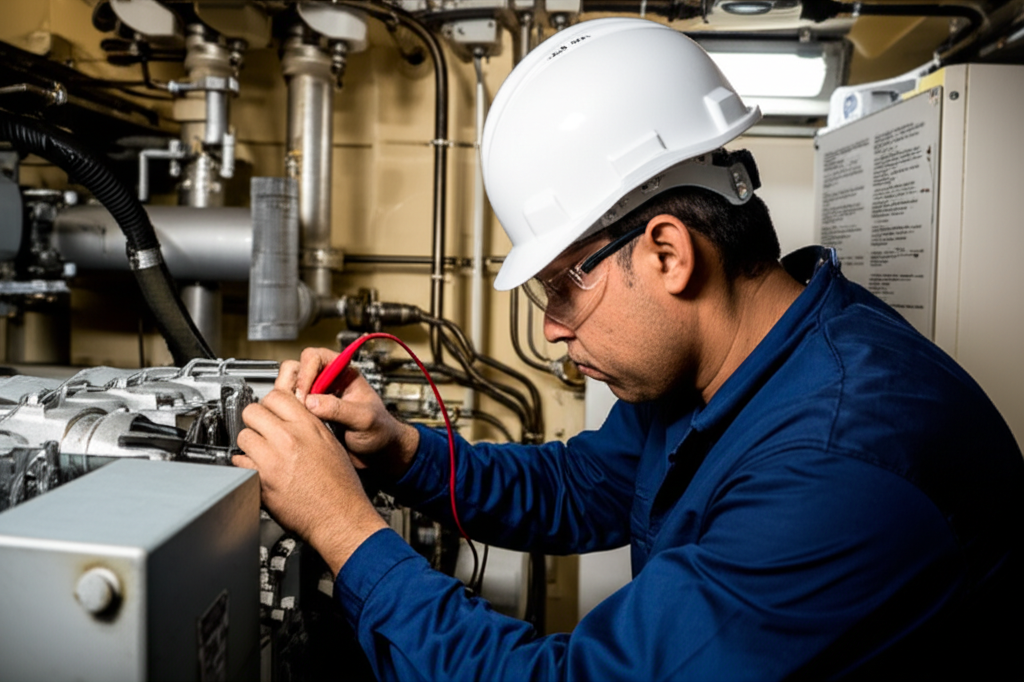
Diploma in Mechanical Failure Diagnosis

Why this certificate program?

The Diploma in Mechanical Failure Diagnosis

This program provides you with the specialized tools and knowledge to efficiently identify and solve problems in industrial machinery. You will learn everything from the theoretical foundations to the most advanced diagnostic techniques, allowing you to optimize maintenance and reduce operating costs. This program prepares you to face the challenges of predictive and proactive maintenance in a demanding industrial environment.

Differential Advantages

  • Advanced Methodologies: Vibration analysis, infrared thermography, oil analysis, and ultrasound.
  • Diagnostic Equipment: Use of specialized tools and software for fault detection.
  • Real-World Case Studies: Study and resolution of common problems in different types of machinery.
  • Predictive Maintenance: Implementation of strategies to anticipate and prevent failures.
  • Professional Certification: Recognition of your skills and knowledge in the field.
Diagnóstico

Diploma in Mechanical Failure Diagnosis

Availability: 1 in stock

Who is it aimed at?

  • Maintenance technicians and industrial mechanics looking to master predictive diagnostics, reduce downtime, and optimize equipment lifespan.
  • Plant engineers and production supervisors requiring advanced tools for maintenance management, strategic planning, and continuous improvement.
  • Mechanical engineering students and related fields seeking practical specialization in failure analysis, data interpretation, and inspection techniques.
  • Health and safety managers interested in identifying risks associated with mechanical failures, implementing preventive measures, and ensuring workplace safety.
  • Maintenance service providers and technical consultants looking to expand their portfolio Offer innovative solutions and differentiate yourself in the market.

    Flexibility and Applicability

    Adapted to your pace: online format with live and recorded classes, real-world case studies, and personalized guidance to apply the knowledge to your work environment.

Diagnóstico

Objectives and competencies

Locating and correcting complex faults:

“Identify the root cause through systematic analysis and advanced diagnostic tools, minimizing downtime and optimizing repair.”

Interpreting and analyzing diagnostic data:

Identify trends, anomalies, and outliers, and effectively communicate the findings to stakeholders for informed decision-making.

Optimizing efficiency in vehicle repair:

“To diagnose faults accurately, minimizing downtime and maximizing the resolution rate on the first intervention.”

Apply advanced inspection and evaluation techniques:

“Identify and analyze anomaly patterns using predictive analytics and risk modeling tools, proposing corrective actions based on criticality and probability of occurrence.”

Implement effective predictive maintenance strategies:

“Using data analysis and machine learning techniques to predict failures, optimize maintenance plans, and reduce unexpected downtime.”

Managing and optimizing resources in the mechanical workshop:

“Implement an efficient inventory system, control operating costs, and schedule preventive equipment maintenance.”

Curriculum - Modules

  1. Comprehensive Maritime Incident Management: protocols, roles, and chain of command for coordinated response
  2. Operational Planning and Execution: briefing, routes, weather windows, and go/no-go criteria
  3. Rapid Risk Assessment: criticality matrix, scene control, and decision-making under pressure
  4. Operational Communication: VHF/GMDSS, standardized reports, and inter-agency liaison
  5. Tactical Mobility and Safe Boarding: RHIB maneuvers, approach, mooring, and recovery
  6. Equipment and Technologies: PPE, signaling, satellite tracking, and field data logging
  7. Immediate Care of the Affected: primary assessment, hypothermia, trauma, and stabilization for evacuation
  8. Adverse Environmental Conditions: swell, Visibility, flows, and operational mitigation

    Simulation and training: critical scenarios, use of VR/AR, and exercises with performance metrics

    Documentation and continuous improvement: lessons learned, indicators (MTTA/MTTR), and SOP updates

  1. Introduction to Predictive Maintenance: Concepts, Benefits, and Limitations.
  2. Mechanical Vibrations: Fundamentals, Analysis, and Failure Diagnosis.
  3. Infrared Thermography: Principles, Applications in Mechanics, and Detection of Thermal Anomalies.
  4. Oil Analysis: Lubrication, Wear, and Contamination.
  5. Interpretation of Results.

  6. Ultrasound: Applications in Leak Detection, Bearing Inspection, and Hydraulic Systems.
  7. Motor Current Signature Analysis (MCSA): Identification of Electrical and Mechanical Faults.
  8. Alignment and Balancing: Techniques, Instrumentation, and Reliability Improvement.
  9. Online Condition Monitoring: Sensors, Data Acquisition Systems, and Software Platforms.
  10. Data Integration and Multivariate Analysis: Fusion of Data from Different Monitoring Techniques.
  11. Case Studies: Application of Predictive Analysis Techniques to Different Mechanical Equipment.

  1. Introduction to Predictive, Corrective, and RCM Analysis: Key Concepts and Benefits.
  2. Fundamentals of Reliability-Centered Maintenance (RCM): Methodology and Basic Principles.
  3. Failure Mode and Effects Analysis (FMEA): Identifying Potential Failures and Their Consequences.
  4. Collecting and analyzing Maintenance Data: Data Sources, Key Metrics, and Analysis Tools.
  5. Predictive Analysis Techniques: Thermography, Vibration Analysis, Ultrasound, Oil Analysis.
  6. Implementing Corrective Maintenance Strategies: Diagnosing Failures, Repairing, and Continuously Improving.
  7. Modeling Reliability and Availability: Calculating MTBF, MTTR, and Analyzing Weibull.
  8. Optimization of maintenance plans: Selection of tasks, frequencies, and resources.
  9. Integration of CMMS systems (Computerized Maintenance Management System): Management of work orders, inventory, and costs.
  10. Case studies and practical applications: Examples of successful implementation of RCM and predictive/corrective analysis.

  1. Introduction to Predictive Maintenance: Concepts, Benefits, and Limitations
  2. Fundamentals of Predictive Analysis: Techniques, Tools, and Applications
  3. Tribology and Lubrication: Types of Lubricants, Properties, and Selection
  4. Oil Analysis: Sampling, Laboratory Analysis, Interpretation of Results, and Corrective Actions
  5. Vibration Analysis: Data Acquisition, Spectrum Analysis, and Fault Identification
  6. Infrared Thermography: Principles, Equipment, and Applications in Electrical and Mechanical Equipment
  7. Non-Destructive Testing (NDT): Introduction, Types (UT, MT, PT, VT), and Applications
  8. Ultrasound: Fundamentals, Leak Detection, Bearing Inspection, and Applications
  9. Implementation of a Predictive Maintenance Program Predictive Maintenance: Planning, Organization, and Management

    Case Studies: Examples of predictive maintenance applications in different industries

  1. Introduction to Predictive Analysis in Industrial Maintenance
  2. Fundamentals of Mechanics: Kinematics, Dynamics, and Statics
  3. Types of Wear: Adhesive, Abrasive, Corrosive, Erosive, and Fatigue
  4. Visual Inspection Techniques: Endoscopy, Boroscopy, and Thermography
  5. Vibration Analysis: Frequency Spectrum, Amplitude, and Phase
  6. Oil Analysis: Viscosity, Contamination, and Metal Wear
  7. Ultrasound: Principles and Applications in Leak and Wear Detection
  8. Infrared Thermography: Hot Spot Detection and Distribution Temperature
  9. Data Correlation: Information Integration for Accurate Diagnosis
  10. Report Generation and Recommendations for Proactive Maintenance

  1. System Architecture and Components: Structural design, materials, and subsystems (mechanical, electrical, electronic, and fluid) with selection and assembly criteria for marine environments
  2. Fundamentals and Principles of Operation: Physical and engineering foundations (thermodynamics, fluid mechanics, electricity, control, and materials) that explain performance and operating limits
  3. Safety and Environmental (SHE): Risk analysis, PPE, LOTO, hazardous atmospheres, spill and waste management, and emergency response plans
  4. Applicable Regulations and Standards: IMO/ISO/IEC requirements and local regulations;
  5. Conformance criteria, certification, and best practices for operation and maintenance
  6. Inspection, testing, and diagnostics: Visual/dimensional inspection, functional testing, data analysis, and predictive techniques (vibration, thermography, fluid analysis) to identify root causes
  7. Preventive and predictive maintenance: Hourly/cycle/seasonal plans, lubrication, adjustments, calibrations, consumable replacement, post-service verification, and operational reliability
  8. Instrumentation, tools, and metrology: Measuring and testing equipment, diagnostic software, calibration and traceability; selection criteria, safe use, and storage
  9. Onboard integration and interfaces: Mechanical, electrical, fluid, and data compatibility; Sealing and watertightness, EMC/EMI, corrosion protection, and interoperability testing.

    Quality, acceptance testing, and commissioning: process and materials control, FAT/SAT, bench and sea trials, go/no-go criteria, and evidence documentation.

    Technical documentation and integrated practice: logs, checklists, reports, and a complete case study (safety → diagnosis → intervention → verification → report) applicable to any system.

  1. Introduction to Predictive Analytics: Concepts, Benefits, and Applications in the Mechanical Industry
  2. Fundamentals of Machine Mechanics: Vibrations, Fatigue, Wear, and Corrosion
  3. Sensors and Data Acquisition: Accelerometers, Microphones, Thermography, Oil Analysis
  4. Signal Processing: Fourier Analysis, Spectrograms, Autocorrelation Functions
  5. Fault Diagnosis: Identifying Failures in Bearings, Gears, Shafts, and Motors
  6. Predictive Analytics Techniques: Statistical Models, Machine Learning, Neural Networks
  7. Maintenance Optimization: RCM Strategies, TPM, Condition-Based Planning
  8. Predictive Analytics Software: Tools and Platforms for Diagnosis and Optimization

    Case studies: practical applications in different industries (automotive, energy, manufacturing)
    Reporting and decision-making: presentation of results, recommendations, and action plans

Career opportunities

  • Mechanical Maintenance Technician: Diagnosis and repair of industrial, automotive, or marine machinery.
  • Vehicle Technical Inspector: Evaluation of mechanical faults at vehicle inspection stations and certification workshops.
  • Mechanical Expert: Investigation of breakdowns and preparation of technical reports for insurance companies and courts.
  • Spare Parts Sales Technical Advisor: Identification of parts and solutions for specific breakdowns.
  • Mechanical Workshop Manager: Supervision of diagnostic equipment and coordination of repairs.
  • Diagnostic Technician at Dealerships: Detection and resolution of complex faults in modern vehicles.
  • Predictive Maintenance: Vibration analysis, thermography, and other techniques to anticipate failures.
  • Technical Consultant: Optimization of maintenance processes and reduced repair costs.

“`

Admission requirements

Academic/professional profile:

Degree/Bachelor's degree in Nautical Science/Maritime Transport, Naval/Marine Engineering, or a related field; or proven professional experience in bridge/operations.

Language proficiency:

Recommended functional maritime English (SMCP) for simulations and technical materials.

Documentation:

Updated resume, copy of degree or seaman's book, ID card/passport, letter of motivation.

Technical requirements (for online):

Equipment with camera/microphone, stable connection, ≥ 24” monitor recommended for ECDIS/Radar-ARPA.

Admission process and dates

1. Online
application

(form + documents).

2. Academic review and interview

(profile/objectives/schedule compatibility).

3. Admission decision

(+ scholarship proposal if applicable).

4. Reservation of place

(deposit) and registration.

5. Induction

(access to campus, calendars, simulator guides).

Scholarships and grants

  • Diagnostic Mastery: Learn to identify and troubleshoot mechanical failures with advanced techniques and cutting-edge tools.
  • In-Depth Analysis: Develop skills to interpret data and perform accurate diagnoses on complex mechanical systems.
  • Efficiency and Productivity: Optimize repair time and reduce costs by applying effective fault detection methodologies.
  • Practical Cases: Apply your knowledge in real-world simulations and case studies, preparing you for challenges in the workplace.
  • Professional Certification: Earn a diploma that validates your expertise and opens doors to better opportunities in the sector.
Boost your career in industrial maintenance with a practical and specialized approach.

Testimonials

Frequently asked questions

To train professionals to diagnose and solve mechanical failures in industrial machinery.

Yes. The itinerary includes ECDIS/Radar-ARPA/BRM with harbor, ocean, fog, storm, and SAR scenarios.

Online with live sessions; hybrid option for simulator/practical placements through agreements.

Skills to diagnose and troubleshoot mechanical problems in machinery and equipment.

Recommended functional SMCP. We offer support materials for standard phraseology.

Yes, with a relevant degree or experience in maritime/port operations. The admissions interview will confirm suitability.

Optional (3–6 months) through Companies & Collaborations and the Alumni Network.

Simulator practice (rubrics), defeat plans, SOPs, checklists, micro-tests and applied TFM.

A degree from Navalis Magna University + operational portfolio (tracks, SOPs, reports and KPIs) useful for audits and employment.

  1. Introduction to Predictive Analysis and Condition-Based Maintenance
  2. Wear Fundamentals: Mechanisms, Types, and Influencing Factors
  3. Condition Monitoring Techniques: Vibration, Oil, Thermography, Ultrasound
  4. Vibration Analysis: Diagnosing Bearing and Gear Failures
  5. Oil Analysis: Detecting Contaminants and Component Wear
  6. Infrared Thermography: Identifying Hot Spots and Thermal Defects
  7. Ultrasound: Detecting Leaks, Cavitation, and Partial Discharges
  8. Life Modeling Useful: Survival Curves, Weibull and Degradation Models
  9. Data Analysis: Extraction, Cleaning, Transformation and Visualization

    Implementation of a Predictive Analytics and Continuous Improvement Program

Request information

  1. Complete the Application Form.

  2. Attach your CV/degree certificate (if you have it to hand).

  3. Indicate your preferred cohort (January/May/September) and whether you would like the hybrid option with simulator sessions.

    An academic advisor will contact you within 24–48 hours to guide you through the admission process, scholarships, and compatibility with your professional schedule.

Please enable JavaScript in your browser to complete this form.
Click or drag a file to this area to upload.

Faculty

0
    0
    Tu carrito
    Tu carrito esta vacíoRegresar a la tienda
    Scroll to Top


